WordPress as an Agentic Platform
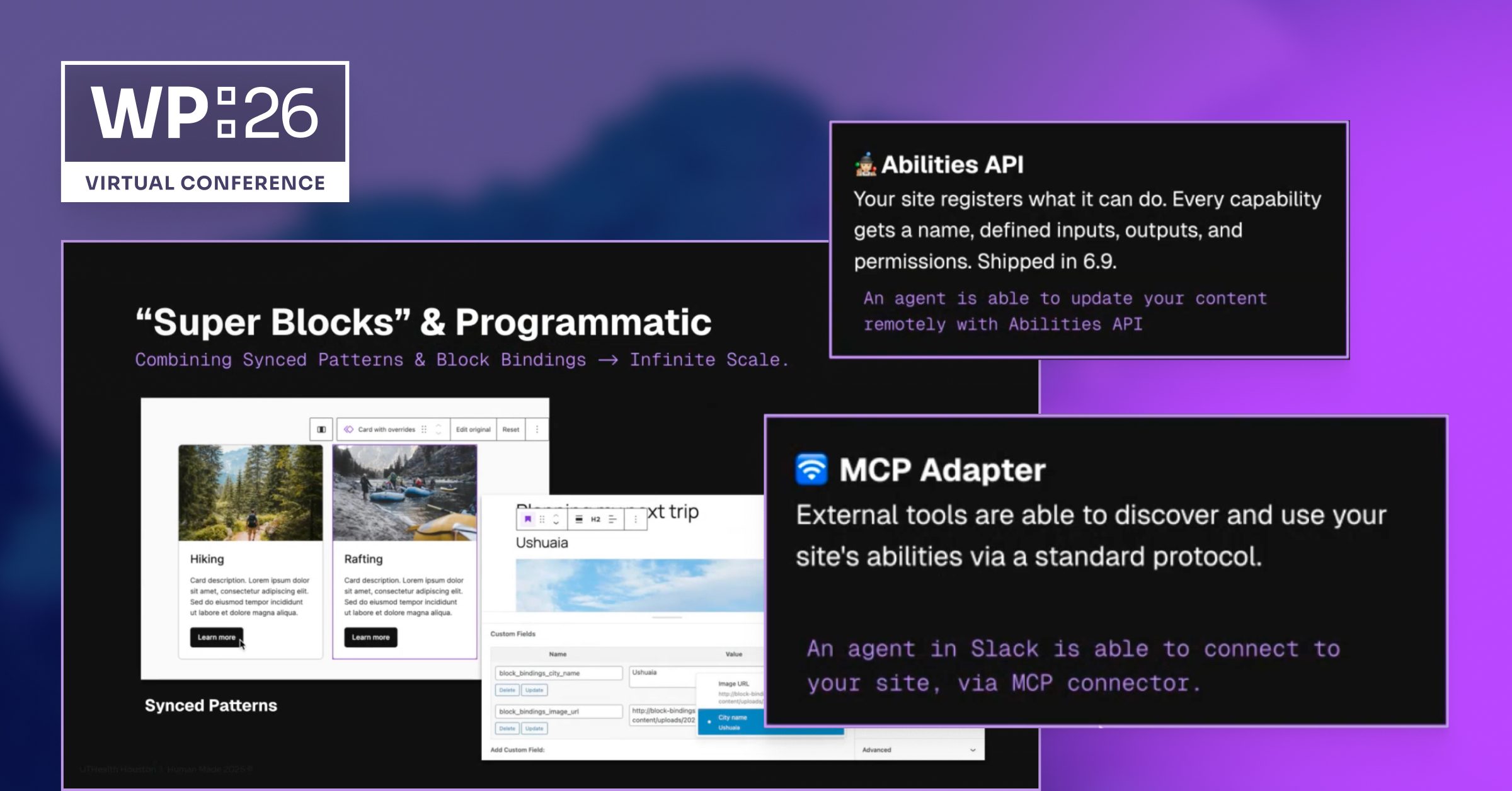
🔗 **Source:** [WordPress as an Agentic Platform](https://humanmade.com/wordpress-for-enterprise/wordpress-as-an-agentic-platform/)
> [!note]+ Document Notes
> tags: #wordpress #artificial-intelligence #agentic-systems #cms-evolution #enterprise-wordpress #api-driven-content #machine-readable-web #open-source-platforms
> author: Gianna Legate
> source: Human Made
> reference: https://humanmade.com/wordpress-for-enterprise/wordpress-as-an-agentic-platform/
> date created: 2024-12-28 14:30
>
> # 🏷️ Title: WordPress as an agentic platform
>
<!-- deep-read:sections start -->
## 🧰 Action Inbox
- [H1] Evaluate WordPress API readiness for agent interactions — enterprise platform assessment #wordpress #api
- [H2] Develop agent-compatible content structures — CMS modernization initiative #content-strategy
- [H3] Research competitive positioning against proprietary CMS — agentic platform analysis #market-research
## 🧭 Table of Contents
- [[#📝 Summary]]
- [[#📖 Main Content]]
- [[#🗒️ Notes]]
- [[#📚 References]]
- [[#🗣️ Paraphrase]]
- [[#📰 Newsletter]]
- [[#✅ Action Items]]
- [[#🧪 Hypotheses]]
- [[#📊 Methodology]]
- [[#❓ Questions]]
- [[#🔮 Future Research]]
- [[#💡 Implications]]
- [[#🧠 Learning Styles Assessment]]
- [[#📊 Accessibility Assessment]]
- [[#🌍 DEIB Assessment]]
- [[#✅ Logical Validity]]
- [[#🛡️ DARVO Analysis]]
- [[#🎯 Conclusion]]
### 🔗 References
- [WordPress as an agentic platform](https://humanmade.com/wordpress-for-enterprise/wordpress-as-an-agentic-platform/)
- [WP:26 Virtual Conference](https://humanmade.com/events/)
## 📝 Summary
- What happened: Human Made's CGO Noel Tock delivered a keynote at WP:26 exploring WordPress's evolution from publishing platform to agentic system
- Why it matters: AI agents are increasingly interacting with websites programmatically, requiring CMS platforms to become machine-operable interfaces
- Key stakeholders: Enterprise teams, WordPress developers, AI system integrators, content strategists
- Risks and tradeoffs: Organizations may need to restructure content architectures; proprietary systems may lag behind open platforms
- Bottom line: WordPress's API-first architecture and extensibility position it well for an agent-driven web where machines act on content, not just consume it
## 📖 Main Content
The article presents a forward-looking perspective on how WordPress is positioned to evolve from traditional content management into what's termed an "agentic platform" - infrastructure that supports AI agents and automated systems interacting with websites.
The core argument centers on a fundamental shift in how the web operates. Historically, websites were designed primarily for human browsing and interaction. However, AI systems are now moving beyond just reading and summarizing content to actively navigating and acting upon websites programmatically.
Noel Tock's keynote at Human Made's WP:26 conference argues that this transition transforms the role of content management systems. Rather than simply publishing content for human consumption, CMS platforms become orchestration layers for workflows involving people, systems, and AI agents working together.
The article positions WordPress as particularly well-suited for this transition due to its existing architectural characteristics: robust APIs for programmatic content interaction, extensive plugin ecosystem for functionality extension, flexible deployment patterns (headless, hybrid, traditional), and an active development community continuously experimenting with emerging patterns.
The analysis emphasizes that open source platforms like WordPress may adapt more rapidly to AI-driven changes than proprietary alternatives, since developers can integrate new capabilities without waiting for vendor roadmaps.
## 🗒️ Notes
#### ⏱️ [00:00] — [H1] Web transitioning from human-browsed to machine-operable
- Key idea: Websites are shifting from document collections to programmable interfaces for AI agents
- Evidence: "The web is shifting from something humans browse to something agents can act on"
#### ⏱️ [02:30] — [H2] CMS role expanding beyond traditional publishing
- Key idea: Content management systems become workflow orchestration platforms, not just publishing tools
- Evidence: Platform handles "workflows between systems, people, and AI agents"
#### ⏱️ [05:15] — [H1] WordPress architectural advantages for agentic systems
- Key idea: Existing WordPress features align well with agent-driven requirements
- Evidence: "Open APIs, extensibility, flexible architectures, large ecosystem"
#### ⏱️ [07:45] — [H2] Content transformation from pages to structured data
- Key idea: Publishing workflows become automation pipelines with machine-readable content
- Evidence: "Content becomes structured data. Interfaces become programmable endpoints"
#### ⏱️ [10:20] — [H3] Open ecosystems adapt faster than proprietary systems
- Key idea: Innovation accelerates in open communities during rapid technological shifts
- Evidence: "Innovation tends to happen faster in open ecosystems where developers can experiment"
#### ⏱️ [12:00] — [H2] AI landscape parallels favoring open development
- Key idea: Most influential AI tools emerge from open communities rather than closed vendors
- Evidence: "Many of the most influential tools and frameworks are emerging from open communities"
#### ⏱️ [14:30] — [H1] WordPress evolution from infrastructure to intelligent platform
- Key idea: Core publishing capabilities remain while expanding to support programmable workflows
- Evidence: "WordPress is evolving from publishing infrastructure into a programmable platform for intelligent workflows"
#### ⏱️ [16:45] — [H3] Fundamental shift in web interaction patterns
- Key idea: Websites transition from visited destinations to queried and actionable endpoints
- Evidence: "Websites aren't just visited. They're queried and acted upon"
## 📚 References
- [WordPress as an agentic platform - Human Made](https://humanmade.com/wordpress-for-enterprise/wordpress-as-an-agentic-platform/)
- [WP:26 Virtual Conference Sessions](https://humanmade.com/events/)
- [WordPress REST API Documentation](https://developer.wordpress.org/rest-api/)
## 🗣️ Paraphrase
- WordPress is positioned to evolve beyond traditional content publishing into infrastructure supporting AI agents that can programmatically interact with and act upon web content
- The platform's existing API-driven architecture, plugin extensibility, and open development model provide advantages as the web transitions toward machine-operable interfaces
- This shift represents a fundamental change where content management systems become orchestration platforms for automated workflows rather than simply publishing tools for human readers
## 📰 Newsletter
**WordPress Goes Agentic: Your CMS as AI Command Center**
The web is evolving rapidly, and WordPress is positioned to lead a fascinating transformation. Instead of just publishing content for people to read, your WordPress site could soon orchestrate workflows between humans, AI systems, and automated agents.
Human Made's recent WP:26 conference explored how WordPress's API-first architecture and extensibility make it ideal for this "agentic" future. While other platforms wait for vendor updates, WordPress's open ecosystem lets you integrate AI capabilities and agent-based workflows today.
**Key benefits for WordPress teams:**
- Existing REST API infrastructure supports programmatic content interaction
- Plugin ecosystem enables rapid AI integration experiments
- Headless and hybrid architectures adapt to agent-driven workflows
- Open source development accelerates innovation cycles
This isn't about replacing human editors—it's about augmenting publishing workflows with intelligent automation. Your content becomes structured data. Your admin interfaces become programmable endpoints.
**Ready to explore?** Start with WordPress's REST API documentation and consider how your content strategy might evolve for both human readers and AI agents.
Resources: [WordPress REST API](https://developer.wordpress.org/rest-api/), [Learn WordPress](https://learn.wordpress.org/), [WP-CLI](https://wp-cli.org/)
## ✅ Action Items
#### DevRel
- Developer advocacy: Create demos showing WordPress agent integration patterns, present at AI/ML conferences
- Education: Develop workshops on API-first WordPress architecture for AI workflows
- Developer experience: Document agent-friendly WordPress development practices
- Developer marketing: Position WordPress as leading agentic platform in CMS space
- Community management: Facilitate discussions on agent-driven WordPress use cases
#### WordPress
- Core: Evaluate API readiness for agent interactions, prioritize machine-readable metadata
- Documentation: Create guides for agent-compatible WordPress development patterns
- Community: Support meetups and WordCamps exploring AI/agent integrations
- Training: Develop curriculum on WordPress as programmable platform beyond traditional CMS
- Plugins: Encourage development of agent-friendly WordPress extensions
#### Community
- Maintainers: Support projects bridging WordPress and AI/agent ecosystems
- Contributors: Document and share patterns for machine-operable WordPress implementations
- Sponsors: Fund research into WordPress agent integration standards and best practices
#### OSPO
- Strategic Alignment: Track competitive landscape of CMS platforms supporting agent workflows
- Community Engagement: Partner with AI development communities exploring web automation
- Developer Support: Provide guidance on licensing considerations for AI-integrated WordPress projects
## 🧪 Hypotheses
- WordPress sites with robust API implementations will see increased adoption for AI-powered content workflows within 18 months
- Open source CMS platforms will demonstrate faster AI/agent integration capabilities compared to proprietary alternatives
- Organizations implementing agentic WordPress architectures will achieve measurable improvements in content workflow automation
- The WordPress plugin ecosystem will produce AI-agent integration tools that outpace vendor-developed solutions
### 📊 Methodology
- Survey enterprise WordPress implementations measuring API usage and AI integration adoption rates
- Comparative analysis of feature development velocity between open source and proprietary CMS platforms
- Case study analysis of organizations implementing agent-driven WordPress workflows
- Plugin ecosystem analysis tracking AI/automation-focused WordPress extensions
### ❓ Questions
- How will WordPress's database architecture need to evolve to optimize for agent-driven content queries?
- What governance frameworks will emerge for managing AI agents with WordPress administrative access?
- How might WordPress compete with purpose-built headless CMS platforms in agent-driven scenarios?
### 🔮 Future Research
- Investigate performance implications of agent-heavy WordPress traffic patterns
- Explore standardization opportunities for agent-compatible WordPress APIs
- Study enterprise adoption barriers for agentic WordPress implementations
### 💡 Implications
- Practice: WordPress developers need to design with both human and machine interactions in mind
- Policy: Organizations require new governance frameworks for AI agent access to CMS platforms
- Security: Agent authentication and authorization become critical CMS security considerations
- Education: WordPress training must expand beyond traditional publishing to include API-driven workflows
- Funding: Investment in WordPress AI integration capabilities could accelerate platform adoption
### 🧠 Learning Styles Assessment
Reading level estimate: 12th grade (Flesch-Kincaid Grade Level)
#### 👀 Visual learners
- Present: Conceptual framework diagrams showing CMS evolution
- Improve: Architecture diagrams comparing traditional vs. agentic WordPress implementations, workflow visualizations
#### 🔊 Aural learners
- Present: Conference keynote format with spoken presentation
- Improve: Podcast version of key concepts, audio summary of agentic platform benefits
#### 🗣️ Verbal learners
- Present: Clear definitions of "agentic platform" and technical terminology
- Improve: Analogies comparing CMS evolution to other platform transformations
#### 🧩 Kinesthetic learners
- Present: References to hands-on conference sessions and experiments
- Improve: Step-by-step guides for implementing agent-compatible WordPress features
#### 🧠 Logical learners
- Present: Logical progression from current state to future implications
- Improve: Decision matrices for choosing agentic WordPress approaches, implementation timelines
#### 🧑🤝🧑 Social learners
- Present: Conference discussion format with community engagement
- Improve: Forum spaces for discussing agentic WordPress implementations, peer collaboration guides
#### 🧘♀️ Solitary learners
- Present: Individual reflection points on platform evolution implications
- Improve: Self-assessment tools for agentic readiness, personal learning paths
#### 🌿 Naturalistic learners
- Present: Ecosystem metaphors describing WordPress platform evolution
- Improve: Connections to broader technology ecosystem patterns, environmental impact considerations
### 📊 Accessibility Assessment
#### Screen reader semantics
- Present: Semantic HTML structure with appropriate heading hierarchy
- Improve: More descriptive headings that clearly indicate content sections
#### Keyboard navigation
- Present: Standard web navigation patterns
- Improve: Skip navigation links for lengthy technical content sections
#### Contrast and readability
- Present: Professional design with adequate contrast ratios
- Improve: Verification of contrast ratios across all text elements and interactive components
#### Text resizing and reflow
- Present: Responsive design supporting mobile and desktop viewing
- Improve: Testing at 200% zoom to ensure content remains accessible
#### Media and captions
- Present: Text-based content with clear structure
- Improve: Alt text for any conceptual diagrams, captions for video content if available
#### Forms and interactions
- Present: Standard web form elements
- Improve: Clear labels and error messaging for newsletter subscription and contact forms
#### Standards reference
- Content structure aligns with WCAG 2.2 AA guidelines for information presentation
### 🌍 DEIB Assessment
#### Cultural breadth
- Present: Focus on technology trends applicable across global markets
- Improve: Examples from diverse geographic regions, consideration of varying AI adoption rates globally
#### Inclusive language
- Present: Professional technical terminology with explanations
- Improve: Plain language summaries of complex concepts, avoidance of unnecessarily technical jargon
#### Neurodiversity support
- Present: Well-structured content with clear headings and logical flow
- Improve: Content chunking for better cognitive processing, consistent navigation patterns
#### Representation
- Present: Focus on technical capabilities rather than individual perspectives
- Improve: Diverse speaker representation in future conference content, varied organizational case studies
#### Psychological safety
- Present: Professional, non-confrontational tone discussing technology evolution
- Improve: Acknowledgment of different organizational readiness levels, supportive language for adoption concerns
### ✅ Logical Validity
#### Strong reasoning
- Deductive strength: Strong logical progression from current web trends to CMS evolution needs
- Inductive strength: Effective use of WordPress's historical adaptability to predict future capabilities
- Causal reasoning: Clear connection between AI agent proliferation and required platform changes
- Analogical strength: Appropriate comparison between historical web evolution and current AI transition
#### Fallacies
- Hasty generalization: Some broad claims about "open ecosystems moving faster" lack specific evidence
- Appeal to novelty: Slight tendency to frame "agentic" capabilities as inherently superior without fully examining tradeoffs
#### Tone of voice
- Overall tone: Professional, forward-looking, and optimistic about WordPress capabilities while maintaining technical credibility
### 🛡️ DARVO Analysis
- Deny: No denial patterns present - article acknowledges current limitations while discussing future potential
- Attack: No attacks on competitors or alternative approaches - maintains professional tone
- Reverse victim/offender: No victim/offender dynamics present in technical discussion
- Emotional cues and rhetoric: Positive but measured language focusing on technical capabilities rather than emotional appeals
## 🎯 Conclusion
WordPress is positioned to evolve from a traditional publishing platform into infrastructure supporting AI agents that can programmatically interact with web content. The platform's existing API architecture, extensibility, and open development model provide competitive advantages as the web transitions toward machine-operable interfaces. For WordPress practitioners, this means designing systems that serve both human users and automated agents, requiring expanded technical skills and architectural thinking beyond traditional content management. The implications extend across security, governance, and development practices as organizations adapt to an agent-driven web.
## 🧱 Refactor Appendix
### 📚 Literature Split Pad
Purpose: Stage CEE units that become Literature notes.
Split level: H3
### [H1] WordPress architectural flexibility enables agentic platform evolution
> [!quote] [WordPress as an agentic platform](https://humanmade.com/wordpress-for-enterprise/wordpress-as-an-agentic-platform/) by [[Gianna Legate]] via [[Human Made]]. Published March 17, 2026. Accessed December 28, 2024.
> "WordPress already has many of the characteristics needed for this next, agentic phase of the web: Open APIs, extensibility, flexible architectures, large ecosystem."
Demonstrates how existing WordPress features align with emerging agent-driven requirements without requiring fundamental platform rebuilds.
[view highlight](https://humanmade.com/wordpress-for-enterprise/wordpress-as-an-agentic-platform/#H1) #xref #articleseed ID:rw_wp_agentic_architecture
### [H2] CMS evolution from publishing to workflow orchestration
> [!quote] [WordPress as an agentic platform](https://humanmade.com/wordpress-for-enterprise/wordpress-as-an-agentic-platform/)
> "WordPress is evolving from publishing infrastructure into a programmable platform for intelligent workflows."
Represents fundamental shift in CMS purpose from content delivery to system integration and automation support.
[view highlight](https://humanmade.com/wordpress-for-enterprise/wordpress-as-an-agentic-platform/#H2) #xref ID:rw_cms_workflow_evolution
---
###
<!-- deep-read:sections end -->
📄 **Full text:** ![[Full Document Contents/Articles/WordPress as an Agentic Platform|WordPress as an Agentic Platform, humanmade.com]]
## Highlights
- It’s a question that sits right at the centre of how the web is changing. AI systems are already summarising content, generating answers, and navigating websites programmatically. The next step is systems that **don’t just read the web, but act on it**. ([View Highlight](https://read.readwise.io/read/01km13skmg5nqrbmxfdspjw6px))
- Tags: 👻 ai highlighted