Would You Deport Jesus?
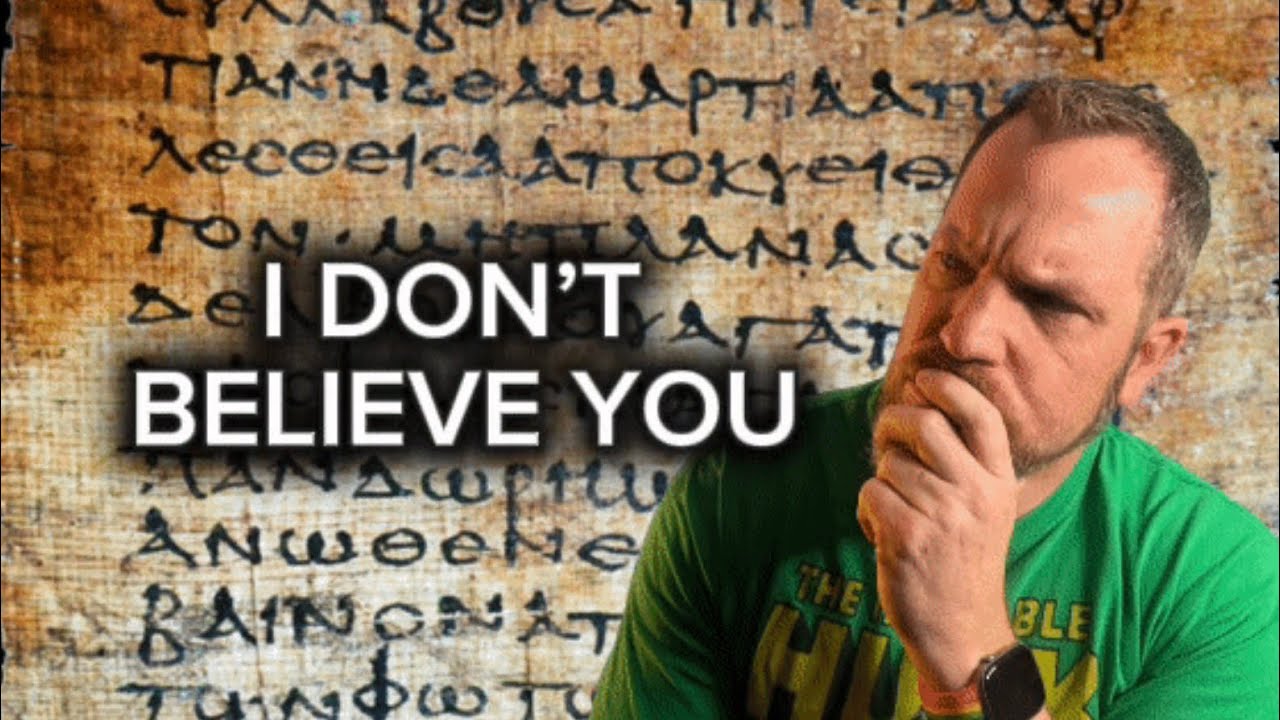
🔗 **Source:** [Would You Deport Jesus?](https://www.youtube.com/watch?v=ZFqoYTFqe4I)
> [!note]+ Document Notes
> tags: [biblical-studies, christian-nationalism, rhetoric-analysis, immigration, apologetics, media-literacy]
> author: Dan McClellan
> source: Dan McClellan (YouTube)
> reference: https://www.youtube.com/watch?v=ZFqoYTFqe4I
> date created: 2026-09-20 19:55
>
> > [!info] Generated analysis — not the author's words. Sections below are machine-written
> > from the captured source. Only text inside `> [!quote]` blocks is verbatim from the author.
> > Do not quote or attribute any other line to the named author.
>
> # 🏷️ Title: Would you deport Jesus?
>
<!-- deep-read:sections start -->
## 🧭 Table of Contents
- [📝 Summary](#-summary)
- [📖 Main Content](#-main-content)
- [🗒️ Notes](#️-notes)
- [📚 References](#-references)
- [🗣️ Paraphrase](#️-paraphrase)
- [📰 Newsletter](#-newsletter)
- [✅ Action Items](#-action-items)
- [🧪 Hypotheses](#-hypotheses)
- [📊 Methodology](#-methodology)
- [❓ Questions](#-questions)
- [🔮 Future Research](#-future-research)
- [💡 Implications](#-implications)
- [🧠 Learning Styles Assessment](#-learning-styles-assessment)
- [📊 Accessibility Assessment](#-accessibility-assessment)
- [🌍 DEIB Assessment](#-deib-assessment)
- [✅ Logical Validity](#-logical-validity)
- [🛡️ DARVO Analysis](#️-darvo-analysis)
- [🎯 Conclusion](#-conclusion)
- [🧱 Refactor Appendix](#-refactor-appendix)
- [🧰 Template Library](#-template-library)
## 🔗 References (in-page)
- Source video: https://www.youtube.com/watch?v=ZFqoYTFqe4I
- Channel: Dan McClellan — https://www.youtube.com/channel/UCAAJCQ0FCqRmAEv95SyTfNg
- Duration: 11m27s. Upload date: 2026-09-20.
- Format: stitched response. Clips of an unnamed interlocutor are interleaved with McClellan's commentary.
## 📝 Summary
**What happened.** Dan McClellan, a biblical scholar who publishes short critical-analysis videos,
responds to footage of an unnamed person being asked a gotcha question at what he identifies as a
TPUSA-adjacent event: if Jesus crossed the border illegally today, would you deport him? The
respondent declines to answer, arguing Jesus would not have done that — the flight to Egypt, he
says, went from one Roman territory to another and was therefore legal passage. McClellan takes
the non-answer apart in three moves: the dodge is rhetorical, the history is wrong, and the
respondent eventually answers anyway without meaning to.
**The rhetorical analysis.** McClellan reads the question as a deliberate trap that forces a
choice between two identity markers — nationalist commitment and Christian commitment — and
argues the respondent avoids it because either answer alienates part of his in-group. He draws a
structural parallel to the pericope of the woman taken in adultery, where Jesus is asked to choose
between Mosaic law and Roman authority and sidesteps the penalty while tacitly affirming the law.
**The historical corrections.** Three specific claims are challenged. The flight was from
Bethlehem, not Nazareth. It ran from a client kingdom into Roman territory, not between two Roman
territories. And the category of illegal or undocumented immigration did not exist in the ancient
world, so no ancient crossing can be parallel to a modern one — McClellan adds that the earliest
US immigration prohibitions targeted specific ethnic groups rather than documentation status. He
further argues the premise that Jesus would not break laws is falsified by the New Testament
itself, citing the temple cleansing and the swords passage in which Jesus is counted among
lawbreakers.
**The concession that decides it.** The respondent offers a joke — if Jesus ran his grandmother
over with a car, yes, he would send him to jail. McClellan treats this as the honest answer
arriving by accident: it concedes that there are circumstances in which the respondent would
punish Jesus under law, which means no identity exempts anyone from enforcement, which answers the
original question in the affirmative.
**Why it matters.** The clip is a compact worked example of analyzing an evasion — separating the
factual errors from the rhetorical maneuver from the unintended admission. It is also openly
polemical. McClellan characterizes the position as "the worship of power" and uses "fascist" and
"draconian" as descriptors, and he attributes motives to a person he cannot interview. Readers
should take the historical corrections, which are checkable, at a different confidence level than
the motive attributions, which are not.
**Stakeholders.** Students of biblical studies and rhetoric; people in arguments about Christian
nationalism; anyone teaching source criticism or fallacy identification; the unnamed interlocutor,
who is analyzed at length without opportunity to reply.
**Bottom line.** The historical claims are specific and verifiable; the rhetorical reading is
sharp and mostly fair; the political characterization is argument, not analysis, and should be
labeled as such when cited.
## 📖 Main Content
The clip opens with the question put to the interlocutor: if Jesus came over the border illegally
right now, would you deport him? The response is a denial of the premise. Jesus would not have
crossed illegally — the flight from Nazareth to Egypt, the respondent says, moved from one Roman
territory to another, making it legal passage. Jesus was escaping a ruler, but doing so lawfully,
and so violated no orders.
McClellan structures his reply around three problems.
**The dodge.** He reads the opening move — *I don't think Jesus would do that, therefore I need
not answer* — as an admission of fear about the honest answer. His account of the question's
purpose is precise: it is designed to pit identity markers against each other, holding up two
commitments and asking which takes priority. In this case, a contemporary position that anyone
crossing the border illegally must be deported regardless of circumstance or identity, set
against the position that Jesus's teaching and the gospel take priority. Whichever the respondent
picks, he alienates the portion of his in-group that ranks the other first. McClellan's claim is
that the refusal is not confusion but avoidance.
He supports the structural reading with a scriptural parallel. In the story of the woman taken in
adultery, the question — do we impose the law of Moses or exempt her — has the same shape: satisfy
those who prioritize Mosaic law and you provoke Roman authority; defer to Rome on the death
penalty and you provoke the other faction. McClellan's reading is that Jesus tacitly endorses the
law of Moses while making its execution impossible by assigning the first stone to the sinless,
sidestepping the penalty without repudiating the statute. The point he draws is that even a dodge
can carry a tacit endorsement — which sets up his treatment of the respondent's eventual answer.
**The history.** Three corrections, stated flatly. First, the flight was from Bethlehem to Egypt,
not from Nazareth. Second, it did not run between two Roman territories; it ran from a client
kingdom into Roman territory, which McClellan concedes is arguable as semantics but insists is an
escape from a ruler's sovereignty. Third, and most consequential, the reason people raise the
flight at all is to establish Jesus's refugee status, not his documentation status — because
illegal and undocumented immigration did not exist as categories in that period. He extends the
point to early American history, noting that the United States lacked that category at its
founding, and that the first laws prohibiting immigration targeted specific ethnic groups rather
than the absence of documents. The conclusion is that no ancient crossing can be parallel to a
modern illegal entry, so the respondent's premise cannot do the work asked of it.
He then attacks the underlying assumption that Jesus would not break laws, citing the New
Testament against it: the cleansing of the temple, and the passage about acquiring swords so that
the text about being counted among lawbreakers would be fulfilled. He offers this as an example of
Jesus breaking law in order to fulfill prophecy. Turning to the modern hypothetical, he argues one
can easily conceive of Jesus crossing a border today without documentation, and adds an empirical
claim: the majority of people crossing the southern US border without documentation are themselves
Christians fleeing persecution and danger — circumstances he suggests Jesus would support fleeing.
The respondent's move is labeled a straw man and a red herring.
**The accidental answer.** The exchange sharpens. The respondent says one must be honest about the
question being asked; McClellan replies that it is more important to be honest with the answer,
which he says the respondent is not being. The respondent retreats further — Jesus did not do that
— and McClellan notes that the absence of a narrated event does not bar a hypothetical.
Then the joke. The respondent compares it to asking whether you would send Jesus to jail for
running someone over with a car, and says yes, he would, if Jesus ran his grandmother over,
concluding that a funny question deserves a funny answer. McClellan rejects the premise that the
question is funny and takes the joke seriously as data: the respondent has just conceded that
there are circumstances in which he would punish Jesus legally for breaking a law. That concession
generalizes. If Jesus crossed the border illegally, he would be deported — and the position being
defended is that no circumstance and no identity exempts anyone from that rule.
The closing section moves from analysis to argument. McClellan characterizes the respondent as
leaning into the nationalism rather than the Christianity in Christian nationalism, preferring
strict enforcement of what he calls draconian fascist laws over empathy, compassion, or mercy. He
describes the struggle as one for power rather than for improving the world or prioritizing the
weightier matters of the law, and notes that the underlying offense amounts, in most cases, to
something comparable to a speeding ticket. He ends by generalizing to TPUSA and Christian
nationalism as "the worship of power," organized to serve right-wing authoritarian and social
dominance orientation, "irrespective of what the letters in red suggest."
### 🗒️ Notes
#### ⏱️ [00:00:00](https://www.youtube.com/watch?v=ZFqoYTFqe4I&t=0) The question and the non-answer
- Question posed: "If Jesus came over the border illegally right now, would you deport him?"
- Respondent: "I don't think that Jesus would would would go illegally."
- Claim offered: the flight "from Nazareth to Egypt" went "from one Roman territory to another Roman territory," so it was "a legal passage."
- Adds that Jesus was escaping a ruler "but he was doing so legally," violating no orders.
- McClellan announces three responses to what he calls a non-answer.
#### ⏱️ [00:00:48](https://www.youtube.com/watch?v=ZFqoYTFqe4I&t=48) The rhetorical trap identified
- Reads the opening as "transparently dodging" — denying the premise to avoid answering.
- Diagnosis: the respondent is "scared of the outcome of an honest answer."
- Function of the question stated precisely: it pits "one's identity politics against themselves," holding up two identity markers and forcing a priority ranking.
- Predicted cost of answering: alienating the in-group members who rank the other marker first.
#### ⏱️ [00:01:38](https://www.youtube.com/watch?v=ZFqoYTFqe4I&t=98) The two commitments named
- First: the position that anyone crossing illegally must be deported "irrespective of circumstances, irrespective of identity" — which McClellan labels "the contemporary fascist notion."
- Second: that "Jesus's teachings and the gospel should take priority."
- Structural parallel introduced: the woman taken in adultery — impose the law of Moses, or exempt her?
- Same bind: satisfying the Mosaic-law faction provokes Rome; deferring to Rome on the death penalty provokes the other faction.
#### ⏱️ [00:02:26](https://www.youtube.com/watch?v=ZFqoYTFqe4I&t=146) How Jesus dodges — and still endorses
- Reading offered: Jesus "basically tacitly endorses the law of Moses" while saying the sinless should cast the first stone.
- Effect: sidesteps "the imposition of the penalty" without repudiating the statute.
- Key move for the argument: the narrative has Jesus dodge the implications, "but Jesus does tacitly endorse one of those positions."
- Foreshadows the conclusion: the respondent will likewise tacitly endorse a position, and "there is an answer."
#### ⏱️ [00:03:16](https://www.youtube.com/watch?v=ZFqoYTFqe4I&t=196) Historical correction one and two
- Correction: it was not the flight from Nazareth to Egypt but "the flight from Bethlehem to Egypt."
- Correction: not from one Roman territory to another but "from a client kingdom into a Roman territory."
- Concedes the second is arguable — "you can argue the semantics of that" — while maintaining it was an escape from a ruler's sovereignty.
- Notes this is not the argument people actually make about the flight.
#### ⏱️ [00:04:03](https://www.youtube.com/watch?v=ZFqoYTFqe4I&t=243) Why the flight is normally cited: refugee status
- The flight is raised "to highlight Jesus's refugee status."
- Central historical claim: "they did not have any illegal immigration. They did not have undocumented immigration in this time period."
- Extension to US history: the category did not exist "when it was first founded."
- Claim about earliest US immigration law: it "prohibited specific ethnic groups," based on "whether or not you were a desired ethnic group," not on documentation.
#### ⏱️ [00:04:53](https://www.youtube.com/watch?v=ZFqoYTFqe4I&t=293) Jesus and lawbreaking
- Summary of the three errors: not Nazareth; not Roman-to-Roman; therefore not "not illegal."
- Counter-evidence that Jesus broke laws: "his cleansing of the temple."
- Second example: the saying about needing swords "so that the passage can be fulfilled which says he was counted among the" lawbreakers.
- Conclusion: "the notion that Jesus wouldn't break laws is kind of falsified by the New Testament itself."
#### ⏱️ [00:05:41](https://www.youtube.com/watch?v=ZFqoYTFqe4I&t=341) The modern hypothetical, and an empirical claim
- Concedes there were no immigration laws then "for them to break."
- Asserts one can readily conceive of Jesus crossing an international border today without documentation.
- Empirical claim: "the majority of the people who are crossing the southern border of the United States of America without documentation are Christians themselves."
- Stated motives: "fleeing persecution, fleeing dangerous circumstances" — circumstances Jesus "would probably support" fleeing.
- Labels the respondent's move "a straw man and a red herring"; says it is "about to go entirely off the rails."
#### ⏱️ [00:07:16](https://www.youtube.com/watch?v=ZFqoYTFqe4I&t=436) Honest question versus honest answer
- Respondent: "you have to be honest about the question that you're asking."
- McClellan: "It's more important that you be honest with the answer, which you're not."
- Respondent retreats to "he didn't do that."
- Reply: the absence of a narrated event "doesn't mean that you can't ask hypothetically."
- Characterizes the move as "a rather silly and juvenile rhetorical dodge" motivated by not wanting "the smoke" from one's own group.
#### ⏱️ [00:08:03](https://www.youtube.com/watch?v=ZFqoYTFqe4I&t=483) The car joke
- Respondent's analogy: "if Jesus ran somebody over with a car, would you send him to jail?"
- Answer given: "yes, I'd send Jesus to jail if he ran my grandmother over with a car."
- Justification: "a funny question deserves a funny answer."
- McClellan: "It's not a funny question. It's a serious question."
- Reads the joke as revealing incapacity to answer honestly because "the implications are something you want to avoid."
#### ⏱️ [00:08:51](https://www.youtube.com/watch?v=ZFqoYTFqe4I&t=531) The accidental concession
- The joke concedes "there are circumstances I can imagine where I would punish Jesus legally."
- Generalization: therefore "if Jesus crossed the border illegally, you would be willing to deport him."
- Verdict: "It seems that the honest answer is yes."
- Implication drawn: the respondent endorses that "there are no circumstances, there are no identities that exempt an individual from this rule."
#### ⏱️ [00:09:39](https://www.youtube.com/watch?v=ZFqoYTFqe4I&t=579) From analysis to polemic
- Characterization: leaning "more into the nationalism side of Christian nationalism than into the Christian side."
- Preference attributed: strict enforcement of "these draconian fascist laws" over "any kind of empathy, any kind of compassion, any kind of Christian mercy."
- Claim about the movement's aim: "our struggle is for power. It is not for making the world a better place."
- Scale of the underlying offense: "what amounts to a speeding ticket in most cases."
#### ⏱️ [00:10:28](https://www.youtube.com/watch?v=ZFqoYTFqe4I&t=628) Closing generalization
- Restates that the respondent is "not being honest" and knows the honest answer's implications are undesirable.
- Concludes the respondent "would deport Jesus... because their nationalism is more important to them than their Christianity."
- Generalizes to organizations: "that's always been the case with TPUSA and with Christian nationalism, it has always been the worship of power."
- Final characterization: structuring "power and values and boundaries in ways that serve right-wing authoritarian and social dominance orientation, identity, politics, irrespective of what the letters in red suggest."
## 📚 References
Primary sources preferred. The clip cites scripture by allusion and displays no on-screen citations.
- **Primary — the clip:** *Would you deport Jesus?*, Dan McClellan, 2026-09-20. https://www.youtube.com/watch?v=ZFqoYTFqe4I
- **Primary — channel:** Dan McClellan. https://www.youtube.com/channel/UCAAJCQ0FCqRmAEv95SyTfNg
- **Scripture alluded to, not cited on screen** (verify before quoting):
- Flight into Egypt — Matthew 2:13–15. Note that the Bethlehem setting is Matthew's; the Nazareth association comes from Luke's distinct infancy narrative, which is the likely source of the respondent's confusion.
- Woman taken in adultery — John 7:53–8:11. Widely regarded as a later insertion absent from the earliest manuscripts, a text-critical point McClellan does not raise here and which bears on using it as evidence of what "the narrative has Jesus do."
- Cleansing of the temple — Matthew 21:12–13, Mark 11:15–17, Luke 19:45–46, John 2:13–16.
- "Counted among the lawless" — Luke 22:35–38, quoting Isaiah 53:12.
- **Named, uncited:** TPUSA (Turning Point USA). The interlocutor is not named in the clip and is not identified here.
- **Empirical claim requiring independent sourcing:** that a majority of undocumented southern-border crossers are Christian. Plausible given the religious demography of the sending countries, but no source is given in the clip; check Pew Research Center or DHS data before repeating.
- **Historical claim requiring independent sourcing:** that the earliest US immigration prohibitions were ethnically targeted. The Page Act (1875) and Chinese Exclusion Act (1882) support the substance; the Naturalization Act of 1790's "free white person" limit concerns naturalization rather than entry. Verify the precise framing before citing.
## 🗣️ Paraphrase
*Paragraph by paragraph, in plain terms.*
1. Someone is asked whether they'd deport Jesus for crossing illegally. They answer that Jesus wouldn't have done it, because the flight to Egypt was legal travel within Roman territory.
2. That's a dodge, and a transparent one. Denying the premise is how you avoid answering a question whose honest answer you're afraid of.
3. The question is built to force a choice between two things you claim to believe — enforce the border no matter what, or put the gospel first. Pick either and you lose part of your audience.
4. It's the same shape as the woman taken in adultery: choose Mosaic law and anger Rome, or choose Rome and anger the Mosaic-law crowd.
5. Jesus dodges that one too — but note that he still tacitly backs the law while making it impossible to carry out. A dodge can contain an answer.
6. Now the facts. It wasn't Nazareth, it was Bethlehem. It wasn't Roman territory to Roman territory, it was a client kingdom into Roman territory.
7. More importantly, that's not why anyone brings up the flight. They bring it up because Jesus was a refugee — and there was no such thing as illegal immigration then to violate.
8. The United States didn't have that category at its founding either. The first immigration bans were about excluding particular ethnic groups, not about paperwork.
9. And the idea that Jesus wouldn't break a law is contradicted by the New Testament — the temple cleansing, and the swords passage that has him counted among lawbreakers.
10. Could Jesus cross a border today without documents? Easily. Most people crossing the southern border undocumented are Christians running from persecution and danger — exactly what he'd tell you to run from.
11. So this is a straw man and a red herring, and it gets worse.
12. They say be honest about the question. I say be honest with the answer, which you aren't. "He didn't do it" doesn't block a hypothetical.
13. Then comes the joke: would you jail Jesus for running your grandmother over? Yes, they say — a funny question deserves a funny answer.
14. It isn't funny. And they just admitted there are conditions under which they'd punish Jesus under law. That's the answer they refused to give.
15. Which means: no circumstance, no identity gets you out of enforcement. Including his.
16. They've chosen the nationalism over the Christianity — enforcement over mercy, for an offense about as serious as speeding.
17. That's what this movement is. It's about power, whatever the words printed in red say.
## 📰 Newsletter
**Subject: The answer arrived by accident**
If you have ever watched a bug report get answered by someone who refuses to reproduce it, you already know the shape of this eleven minutes.
Someone at a Turning Point event gets asked: if Jesus crossed the border illegally today, would you deport him? The answer comes back that Jesus wouldn't have — the flight into Egypt was legal travel, one Roman territory to another. [Dan McClellan](https://www.youtube.com/watch?v=ZFqoYTFqe4I) does what a good reviewer does with a non-answer: separates the factual errors from the rhetorical maneuver, then finds the admission buried in the joke at the end.
The factual pass is the cleanest part, and it's checkable, which is why it's the part worth keeping. It was Bethlehem, not Nazareth — the Nazareth detail belongs to a different gospel's infancy story. It was a client kingdom into Roman territory, not Rome to Rome. And the whole frame is an anachronism: there was no undocumented immigration to commit. The category didn't exist. He adds that the earliest US immigration bans targeted ethnic groups, not paperwork — go read the Page Act if you want the receipts.
Then the good structural point. The question is a trap by design: it forces a ranking between two commitments the respondent holds simultaneously, and any ranking costs him part of his audience. McClellan compares it to the woman taken in adultery, where Jesus faces the same bind and sidesteps the penalty while tacitly keeping the law — a dodge that still contains a position. (Text-critical footnote he skips: that passage isn't in the earliest manuscripts. Worth knowing before you cite it.)
And then the respondent makes a joke — sure, he'd jail Jesus for running his grandmother over — and hands over the answer he spent ten minutes refusing to give. There are conditions under which he'd punish Jesus under law. Generalize it and you have a yes.
Where I'd caution you: the last two minutes stop being analysis and start being argument. "Fascist," "draconian," "the worship of power," plus a confident account of what a man he has never spoken to is privately afraid of. Some of that may be right. None of it is the same kind of claim as "it was Bethlehem." Cite the history at one confidence level and the motive-reading at another, and you'll be on solid ground.
The transferable skill is the one I'd want on any review: when someone won't answer, don't just note the refusal. Check the facts they used to refuse, and read the rest of the transcript for the place they answered without noticing.
## ✅ Action Items
**DevRel**
- Use the three-layer teardown — factual errors, rhetorical maneuver, unintended concession — as a structure for handling evasive technical answers in reviews and vendor calls.
- Note the confidence-labeling lesson: when a source mixes verifiable claims with contested characterization, cite them separately. Applies directly to how we quote analyst reports.
**OSPO**
- Relevant to policy-argument hygiene: distinguish claims about what a license or policy *says* from claims about what its advocates *want*. The first is checkable; the second is attribution of motive.
**Community**
- Community moderation parallel: the "identity-marker trap" describes a common bad-faith question shape in community spaces. Worth naming in moderation guidance so moderators can identify it without adjudicating the underlying politics.
**WordPress subteams**
- *Core* — no action; source is non-technical.
- *Core Performance* — no action.
- *Core AI* — relevant as a worked example of analyzing a confident, fluent, factually wrong answer — the same failure mode as a plausible hallucination.
- *Core Program Team* — no action.
- *Mobile* — no action.
- *Playground* — no action.
- *Community* — see Community above.
- *Training* — strong candidate for a critical-thinking or source-evaluation module: named fallacies (straw man, red herring), anachronism, and burden-shifting in one short artifact.
- *Marketing* — cautionary note on mixing verifiable claims with loaded characterization in the same piece; it lowers the credibility of the verifiable part.
- *Support* — the "answer the question actually asked" discipline maps directly to support practice.
- *Design* — no action.
- *Documentation* — no action.
- *Photos* — no action.
- *TV* — no action.
- *Polyglots* — note: the clip's argument depends on precise historical terminology ("client kingdom") that translates poorly; flag for any translation work.
- *Accessibility* — note only: auto-captions garble speaker turns in a stitched-response format (see Accessibility Assessment).
- *Meta* — no action.
- *CLI* — no action.
- *Hosting* — no action.
- *Tide* — no action.
- *Openverse* — no action.
- *Themes* — no action.
- *Plugins* — no action.
**The WPOCC**
- Governance-relevant: the clip models separating a factual dispute from a values dispute. Useful when a governance disagreement is presented as a factual one.
**FAIR**
- Reinforces provenance and citation practice — the clip's weakest moments are precisely where it asserts without sourcing, and its strongest are where the claim can be checked against a primary text.
### → Things 3
- [ ] Verify the majority-Christian border-crossing claim against Pew or DHS data before reuse
- [ ] Check the earliest-US-immigration-law framing (Page Act 1875, Chinese Exclusion 1882) against the clip's wording
- [ ] Note the John 7:53–8:11 text-critical issue alongside any use of the adultery-pericope parallel
- [ ] Extract the three-layer teardown structure as a reusable review pattern
## 🧪 Hypotheses
1. **Identity-marker traps reliably produce premise denial.** Questions forcing a ranking between two in-group commitments will elicit premise-denial rather than direct answers at higher rates than matched questions without the conflict. Testable via structured interview experiments.
2. **Humor functions as a disclosure channel under social pressure.** Respondents avoiding a costly answer will concede the substance in joke form more often than in earnest form. Testable by coding political interview corpora for joke-adjacent concessions.
3. **Mixed-confidence sourcing degrades transmission.** Audiences exposed to a piece mixing verifiable corrections with loaded characterization will recall and repeat the characterization more than the corrections. Directly testable in a message-retention study.
4. **Anachronism is the most common error in scripture-to-policy arguments.** A coded sample of such arguments will show anachronistic category transfer as the single most frequent flaw, ahead of mistranslation or selective citation.
5. **Religious demography of border crossers matches sending-country demography.** McClellan's majority-Christian claim should hold if crossers are demographically representative of their countries of origin. Testable against existing survey data.
6. **Tacit endorsement is detectable by third parties.** Independent coders shown only a dodge, without the analyst's commentary, will identify the same implied position at above-chance rates. This tests whether McClellan's central inferential move is reproducible or interpretive.
## 📊 Methodology
**What the source is.** A stitched-response commentary video, roughly eleven and a half minutes, in which clips of an interlocutor are interleaved with the author's analysis. No research design; this is scholarly commentary delivered in a social-media format.
**Evidence types present.**
- *Textual and historical correction* — the strongest material. Claims about Bethlehem versus Nazareth, client kingdom versus Roman province, and the absence of ancient immigration categories are specific, falsifiable, and checkable against primary texts and standard historical scholarship. They are delivered without citation, which is a presentation flaw rather than an evidentiary one.
- *Structural-literary argument* — the adultery-pericope parallel. Interpretive but disciplined, and the analogy is doing real analytical work rather than decoration. Weakened by an unmentioned text-critical problem: the passage is absent from the earliest manuscripts, which complicates any appeal to what "the narrative has Jesus do."
- *Inference from utterance to belief* — the central move, reading the car joke as a concession. The inference is reasonable and clearly reasoned, but it is interpretation of a person who is not present and cannot clarify.
- *Attribution of motive* — claims about fear, in-group management, and what the respondent "doesn't want." Unfalsifiable as stated. No interview, no self-report, no corroboration.
- *Uncited empirical claim* — the majority-Christian crossing statistic. Presented as established; no source given.
- *Political characterization* — "fascist," "draconian," "worship of power," social dominance orientation. Argument rather than finding; the SDO reference invokes a real psychological construct without measurement.
**Selection concerns.** The interlocutor is edited into the piece by the author, who controls which segments appear and in what order. This is standard for the format and the clip's argument depends on a short exchange, but a viewer cannot assess whether omitted material would change the reading.
**Appropriate weight.** Treat the historical corrections as reliable pending routine verification; treat the rhetorical analysis as a strong, reproducible reading; treat the motive attributions and political characterizations as the author's argument, to be attributed to him rather than cited as fact.
## ❓ Questions
- Does the respondent's joke actually carry the weight placed on it? A joke deflecting an absurd hypothetical is not obviously the same act as endorsing a deportation policy — what would distinguish the two?
- If ancient categories cannot map onto modern immigration law, does that not also weaken arguments *for* Jesus as a refugee-rights precedent, which rely on the same transfer?
- Why does the analysis omit the text-critical status of John 7:53–8:11, given that the author's own field treats it as a later addition?
- What is gained, and what is lost, by closing a factually strong segment with "fascist" and "worship of power"? Does the characterization persuade anyone not already persuaded?
- Is analyzing an unnamed private individual's psychology at length a fair use of a short clip, even where the position criticized is public?
- What is the actual documented religious composition of undocumented southern-border crossers, and does it support the claim as stated?
- Would McClellan's tacit-endorsement method, applied to his own rhetoric, yield commitments he would accept?
## 🔮 Future Research
- **Code the tacit-endorsement inference.** Test whether independent analysts, given only the exchange, reach the same conclusion about what the respondent conceded. This would move the clip's central move from interpretation toward method.
- **Anachronism taxonomy.** Systematically catalogue category-transfer errors in scripture-to-policy argumentation across the political spectrum, which would test whether the pattern is symmetric or concentrated.
- **Verify the demographic claim.** Establish the religious composition of recent undocumented crossers from survey and administrative data, and determine whether "majority Christian" is supportable as stated.
- **Humor-as-concession corpus study.** Examine whether joke responses in political interviews systematically encode positions the speaker declines to state earnestly.
- **Effect of loaded framing on persuasion.** Test the same historical corrections with and without the closing characterization to measure what the polemic costs or gains in audience uptake.
- **Reception study on stitched-response formats.** Assess whether audiences retain the corrections or the characterizations, and whether the format's editorial control affects perceived fairness.
## 💡 Implications
**Practice.** For anyone arguing publicly, the clip demonstrates a durable technique: when an answer is refused, audit the refusal's factual content and then read on for the accidental admission. It also demonstrates a cost — the closing polemic gives anyone inclined to dismiss the piece an easy exit that the factual section would not have offered.
**Policy.** The substantive policy content is narrow but real: the argument that ancient and modern migration categories are not commensurable undercuts scriptural arguments on both sides of immigration debates, not only the one being criticized. Anyone building policy argument on biblical precedent should treat that as a constraint.
**Security.** Not applicable to this source in any direct sense. The nearest analogue is epistemic rather than technical — evaluating fluent, confident claims that are factually wrong, which is the same skill required for reviewing machine-generated output. Noted rather than omitted per template rule.
**Education.** The clip is genuinely well suited to teaching. It contains named fallacies in the wild, a clean anachronism, a burden-shifting move, and an inference from utterance to belief — all in eleven minutes, all discussable. Its mixing of verifiable and contested claims is itself the best teaching feature, since students can be asked to sort them.
**Funding.** Points at a gap in public-facing scholarship: short-form, well-sourced historical correction has an audience, but the format pressures toward polemic because polemic travels. Funding that rewards sourcing over reach would change the incentive.
## 🧠 Learning Styles Assessment
- **Visual** — Weak. Talking-head commentary intercut with clip footage; nothing visual carries argument. The historical material is inherently geographic — Bethlehem, Egypt, a client kingdom, a Roman province — and a single map would do more than the whole visual track currently does.
- **Aural** — Strong. Clear, rapid, well-organized speech with explicit enumeration ("three things to say"). Works fully as audio, with the caveat that the clip/commentary alternation is harder to follow without picture.
- **Verbal** — Strongest channel. The entire contribution is linguistic analysis: parsing an utterance, naming its moves, correcting its terms. Precision of vocabulary is the substance.
- **Kinesthetic** — Minimal. Nothing enactable.
- **Logical** — Strong. Explicitly structured: three numbered problems, a parallel case, then an inference chain from joke to concession to policy commitment. The reasoning is visible and checkable, which is unusual for the genre.
- **Social** — Moderate. Framed as a dialogue but is not one; the interlocutor cannot respond. Learners who process through debate will want the other side, which the format structurally withholds.
- **Solitary** — Strong. Dense enough to reward pausing, and the historical claims invite independent checking, which is the best kind of solitary follow-up.
- **Naturalistic** — Not applicable to this source. No natural-world classification content. Noted rather than omitted per template rule.
**Reading level estimate.** Roughly grade 12 to early undergraduate — the highest of the three clips in this batch. Vocabulary is technical across two domains at once ("client kingdom," "pericope"-adjacent reasoning, "social dominance orientation," "anachronistic"), sentences are long and subordinated, and the argument assumes familiarity with the gospel narratives, US immigration history, and the term Christian nationalism. A general audience will follow the conclusions while missing the warrants.
## 📊 Accessibility Assessment
Mapped to WCAG 2.2 AA, evaluated as published on YouTube.
1. **Perceivable — captions (1.2.2 Captions, Prerecorded).** *Fails.* Auto-generated only. The track is unpunctuated, marks speaker changes as raw `>>` entities, and transcribes the disfluent original ("would would would go illegally") verbatim. In a stitched-response format the speaker-attribution failure is severe: a deaf viewer may read the interlocutor's claims as McClellan's own, which inverts the argument entirely. It also garbles at least one substantive term ("acquies" for acquiesce, "lawb breakakers").
2. **Perceivable — audio description (1.2.3 / 1.2.5).** *Passes in substance.* No essential visual-only content; the argument is fully carried in speech.
3. **Perceivable — contrast and text alternatives (1.4.3, 1.1.1).** *Not assessable from transcript alone.* Requires inspection of the frame and any on-screen text or burned-in clip labels.
4. **Operable — keyboard and controls (2.1.1, 2.4.x).** *Passes by platform.* Inherited from the YouTube player.
5. **Operable — seizure safety (2.3.1).** *Not assessable from transcript.* Cut-heavy editing between sources is possible; unverified.
6. **Understandable — language and readability (3.1.x).** *Partial, and the weakest of the three clips.* Specialist vocabulary from two domains, no glossary, no on-screen definitions. "Client kingdom" is load-bearing and undefined.
7. **Robust — structure and navigation (4.1.x, 2.4.10).** *Fails.* No chapters despite an explicitly enumerated three-part structure that would map to chapter markers almost automatically — the author says "three things to say" and then never marks where each begins.
**Highest-value remediation, in order:** human-corrected captions with speaker labels distinguishing clip from commentary, since this one changes meaning; chapter markers on the author's own stated three-part structure; a description with the scripture references, which would also fix the sourcing gap.
## 🌍 DEIB Assessment
**Cultural breadth.** Deliberately cross-cultural in its historical work — the argument's core is that first-century Judean and Roman categories cannot be mapped onto modern American legal ones, which is an argument *for* cultural specificity and against flattening. It also centers the experience of present-day migrants from Latin America, though they are described rather than heard. The frame remains American-political throughout; the treatment of Christian nationalism is US-specific and not presented as otherwise.
**Inclusive language.** Mixed, and this is the clip's most contested dimension. Language about migrants is humanizing and specific — people fleeing persecution and danger, whose offense compares to a speeding ticket. Language about ideological opponents is severe: "fascist," "draconian," "juvenile," "silly," and characterizations of a movement as "the worship of power." The severity is directed at positions and at a named organization rather than at any protected class, which is the defensible target, but "juvenile" and "silly" are aimed at a person rather than an argument and add nothing the substantive critique does not already carry. The unnamed interlocutor is subjected to extended psychological characterization without the ability to respond.
**Neurodiversity support.** Moderate, and the best of the three clips in this batch. The argument is explicitly enumerated and signposted ("three things to say," "two other parts"), which supports listeners who rely on structure. Working against that: rapid delivery, long subordinated sentences, frequent parenthetical qualification, and source-switching between clip and commentary with no auditory marker. Chapters would close most of the gap.
**Representation.** The visible participants are two men, and the analysis is conducted entirely by one. The people whose lives the policy question concerns — migrants, and specifically the Christian migrants central to the argument — are spoken about and never heard. The woman in the adultery pericope functions as an illustration of a rhetorical structure rather than as a subject. This is a limitation of the format rather than an error, but it means every claim about migrant motive in the clip is secondhand.
**Psychological safety.** Moderate. The content is politically charged and will be activating for viewers on both sides; the closing characterization is likely to feel hostile to anyone who identifies with the position criticized, which limits the clip's persuasive reach to the already-convinced. There is no content warning. Against that, the treatment of migrants is consistently dignifying, and the historical section is delivered without contempt — the register only sharpens in the final two minutes. Viewers seeking the scholarship can take the first nine minutes and stop.
## ✅ Logical Validity
### Strong reasoning
- **The historical corrections are specific and falsifiable.** Bethlehem rather than Nazareth, client kingdom rather than Roman province, and the absence of ancient illegal-immigration categories are all checkable claims stated precisely enough to be wrong. That is the mark of real analysis.
- **The anachronism argument is the clip's strongest move.** Pointing out that a legal category did not exist defeats the premise without requiring any political commitment, and it cuts against sloppy arguments on both sides.
- **Internal falsification is well chosen.** Answering "Jesus wouldn't break laws" with the temple cleansing and the swords passage uses the respondent's own authoritative text, which is the most efficient available refutation.
- **The dodge/endorsement structure is genuinely insightful.** Establishing via the adultery pericope that a dodge can still encode a position, then applying that frame to the respondent's joke, is a disciplined two-step that earns its conclusion.
- **Self-aware concession.** "You can argue the semantics of that" acknowledges the weakest of his three corrections rather than overselling it.
### Fallacies
1. **Mind-reading / unfalsifiable motive attribution.** *Located* at [00:48], [07:16], [10:28]. Repeated claims about what the respondent is "scared of," what he "doesn't want," and what he "knows." *Why it fails:* no access to the respondent's mental states; the claims cannot be tested and are compatible with alternative explanations such as genuine belief, unpreparedness, or reluctance to engage a hostile format. *Proposed fix:* describe the rhetorical function of the move and let the audience infer motive — the argument loses nothing.
2. **Loaded language substituting for argument.** *Located* at [01:38], [09:39], [10:28]. "Fascist," "draconian," "worship of power" are applied as descriptors rather than defended as characterizations. *Why it fails:* a contested term used as a premise assumes what it should establish. *Proposed fix:* state the specific features that warrant the label, or use a descriptive term and let the reader judge.
3. **Overreading the joke.** *Located* at [08:51]. A deflecting joke about a deliberately absurd hypothetical (vehicular homicide) is treated as a considered concession that generalizes to immigration enforcement. *Why it fails:* a joke conceding that Jesus could be punished for killing someone does not straightforwardly entail a view about a regulatory offense the speaker himself compares to a speeding ticket — the two cases differ in gravity by exactly the amount the argument needs them not to. *Proposed fix:* present as a plausible reading rather than as "the honest answer."
4. **Hasty generalization to organizations.** *Located* at [10:28]. From one person's evasion to "that's always been the case with TPUSA and with Christian nationalism." *Why it fails:* n=1, and the individual's relationship to the organization is never established in the clip. *Proposed fix:* separate the individual analysis from the organizational claim and source the latter independently.
5. **Ad hominem, minor.** *Located* at [07:16]. "Silly and juvenile" characterizes the person rather than the reasoning, alongside an otherwise adequate substantive critique. *Proposed fix:* delete; the substantive point stands alone.
6. **Uncited empirical assertion.** *Located* at [05:41]. The majority-Christian crossing claim is delivered with the cadence of established fact and no source. *Proposed fix:* cite, or mark as an estimate.
7. **Selective omission bearing on his own evidence.** *Located* at [01:38]–[02:26]. The adultery pericope is used as evidence of what "the narrative has Jesus do" without noting that it is absent from the earliest manuscripts — a fact squarely within the author's expertise. *Why it matters:* it does not break the structural analogy, which works as literature regardless, but omitting it while correcting someone else's textual error is an inconsistent standard.
### Tone of voice
Two distinct registers, and the seam is visible. Through roughly nine minutes the tone is instructional and confident — a specialist correcting errors, fast, precise, occasionally sharp but proportionate. The final two minutes shift to polemic: the vocabulary escalates, the claims broaden from the individual to a movement, and the evidentiary standard drops while the certainty rises. The shift is the clip's central weakness, because the earlier section's credibility is what gives the later section its force, and the later section is what an unsympathetic viewer will quote. The persistent second-person address to an absent interlocutor also lends a prosecutorial cast that the historical material does not need.
## 🛡️ DARVO Analysis
DARVO — Deny, Attack, Reverse Victim and Offender — is a pattern in which an accused party denies wrongdoing, attacks the credibility of the accuser, and recasts themselves as the true victim.
**Is the source performing DARVO?** No. McClellan is the accusing party throughout and makes no victimhood claim of any kind. His rhetoric is aggressive, but aggression is not DARVO; the pattern requires the reversal, which is entirely absent. The nearest criticism available is ad hominem ("silly," "juvenile"), which is a distinct failure.
**Is DARVO described or displayed within the source?** Partially, in the interlocutor's conduct as presented — with the caveat that we see only the segments the author selected.
- **Deny** — Clearly present. The respondent's entire strategy is denial of the premise: Jesus would not have crossed illegally, therefore the question does not arise. McClellan names this directly as refusing to answer. This is the best-evidenced rung, visible in the primary footage rather than inferred.
- **Attack** — Weakly present. "You have to be honest about the question that you're asking" shifts the charge of bad faith onto the questioner, which is a genuine Attack move — it recasts a challenge as itself dishonest. It is mild and isolated, and McClellan's reply inverts it cleanly.
- **Reverse Victim and Offender** — Not demonstrated. Nothing in the clip shows the respondent claiming injury or presenting himself as the wronged party. The broader Christian-nationalist framing McClellan invokes at the close — enforcement as defense of a besieged order — would supply this rung, but it is asserted about the movement rather than shown in the footage.
**A note on the inverse pattern.** The clip's substantive argument is that a mercy-centered reading is being subordinated to enforcement, with migrants cast as offenders for conduct McClellan compares to a speeding ticket. That is an allegation of offender/victim inversion at the level of policy rather than of interpersonal conduct — adjacent to DARVO's third rung but not an instance of it, and it should not be cited as one.
**Assessment.** Low to moderate DARVO content, concentrated almost entirely in the Deny rung, which is well evidenced. Attack is thin and Reverse is absent from the footage. Anyone citing this clip for DARVO should limit the claim to the denial behavior and should note the editorial selection constraint.
## 🎯 Conclusion
**Bottom line.** The clip does two things at different levels of quality. The historical and rhetorical analysis is strong: the corrections are specific and checkable, the anachronism argument defeats the premise without requiring any political commitment, the internal falsification from the temple cleansing and the swords passage is efficiently chosen, and the dodge-can-still-endorse structure is a genuinely useful analytical tool. The closing two minutes are a different kind of speech — motive attribution about a person never interviewed, contested political labels used as premises, and a leap from one man's evasion to a claim about an entire movement. Both are in the same video, and they should not be cited at the same confidence. The single overreach inside the analytical section is the car joke, which is asked to carry more than a deflection about vehicular homicide can bear when the argument elsewhere insists the underlying offense is trivial.
**Next steps.**
1. Verify the two uncited empirical claims — the religious composition of undocumented crossers, and the ethnic-targeting characterization of earliest US immigration law — before repeating either.
2. When citing the adultery-pericope parallel, note the text-critical status of John 7:53–8:11; the structural point survives, but the omission is worth flagging.
3. Extract the three-layer teardown (factual errors → rhetorical maneuver → unintended concession) as a reusable review pattern; it is the most portable thing here.
4. Cite the historical corrections and the political characterization separately, and attribute the latter to McClellan as argument rather than as finding.
## 🧱 Refactor Appendix
### Literature Split Pad
**L1 — The identity-marker trap**
Source: Dan McClellan, ZFqoYTFqe4I, [00:48]–[01:38]. The question is constructed to force a ranking between two commitments the respondent holds simultaneously — unconditional border enforcement and gospel priority — so that any direct answer alienates part of his in-group. Premise denial is the predicted escape.
**L2 — A dodge can encode an endorsement**
Source: same, [02:26]. Reading of the woman taken in adultery: Jesus sidesteps the penalty by assigning the first stone to the sinless while tacitly affirming the law of Moses. Establishes the interpretive tool later applied to the respondent's joke.
**L3 — The anachronism argument**
Source: same, [03:16]–[04:53]. Corrections: Bethlehem not Nazareth; client kingdom into Roman territory, not province to province. Core claim: illegal and undocumented immigration did not exist as categories in the period, so no ancient crossing is commensurable with a modern one. Extended to early US history, where the earliest prohibitions are characterized as ethnically targeted.
**L4 — Internal falsification of "Jesus wouldn't break laws"**
Source: same, [04:53]. The temple cleansing, and the swords saying in which Jesus is counted among lawbreakers, are cited from the respondent's own authoritative text against the respondent's premise.
**L5 — The accidental concession**
Source: same, [08:03]–[09:39]. A joke about jailing Jesus for vehicular homicide is read as conceding that circumstances exist in which the respondent would punish Jesus under law, generalized to the conclusion that no identity exempts anyone from enforcement.
**L6 — The closing characterization**
Source: same, [09:39]–[10:28]. Movement-level claims: nationalism prioritized over Christianity, "draconian fascist laws," "the worship of power," social dominance orientation. Asserted without in-clip evidence; argument rather than finding.
#### Atomic Split Pad
**A1 — A refused answer still contains evidence.**
When someone declines to answer, audit the factual content of the refusal and read on for the place they answer inadvertently. The dodge is data. Links: [[Evasion analysis]], [[Reading the whole transcript]].
**A2 — Categories that did not exist cannot be violated.**
Transferring a modern legal category onto a period that lacked it produces an argument that cannot be true or false, only anachronistic. Check that the category existed before assessing compliance with it. Links: [[Anachronism in argument]], [[Historical category transfer]].
**A3 — Refute from the opponent's own authority.**
The most efficient refutation uses a source the opponent already accepts. It removes the dispute about evidentiary standing before it starts. Links: [[Internal critique]], [[Argument economy]].
**A4 — Mixing confidence levels degrades the whole.**
Verifiable corrections placed beside unfalsifiable motive claims invite the audience to discount both. Separate them, or label them. Links: [[Confidence labeling]], [[Why polemic costs credibility]].
**A5 — A contested label is not a premise.**
Using a term whose applicability is exactly what is in dispute assumes the conclusion. Name the features instead and let the label be the reader's inference. Links: [[Loaded language]], [[Begging the question]].
**A6 — Humor is a low-cost channel for costly admissions.**
People concede in jokes what they will not state plainly, because the joke frame supplies deniability. Treat it as a signal — but not as a considered position. Links: [[Deniability and disclosure]], [[Overreading a deflection]].
**A7 — Asymmetric standards discredit a correction.**
Correcting another's textual error while omitting a known problem with your own supporting text applies two standards, and an informed reader will notice. Links: [[Consistent evidentiary standards]], [[Self-application of method]].
#### Fleeting Queue
- Identify the interlocutor and the original footage — is the full exchange available, and does the surrounding context change the reading?
- Pew / DHS data on religious composition of undocumented crossers: verify or retire the majority-Christian claim.
- Page Act 1875 and Chinese Exclusion 1882 versus Naturalization Act 1790 — which actually supports "earliest prohibitions were ethnically targeted"? Entry versus naturalization distinction matters.
- Does McClellan address the John 7:53–8:11 text-critical issue elsewhere on the channel? If so, the omission here is a format constraint rather than inconsistency.
- "Client kingdom" — confirm Herodian Judea's precise status at the traditional date of the flight, and whether Egypt's status as a Roman province makes the crossing a provincial entry.
- Compare with the two *Leaving the Message* clips in this batch: all three are about distinguishing a claim's source from its warrant. Consider one merged permanent note on that theme.
- Test the tacit-endorsement method on McClellan's own closing claims as an exercise.
<!-- deep-read:sections end -->
📄 **Full text:** [[Full Document Contents/Articles/Would You Deport Jesus.md|Would You Deport Jesus? by Dan McClellan]]
## Highlights
- this is not an argument that people bring up about illegally entering some other territory. People bring this up to highlight Jesus's refugee status because they did not have any illegal immigration. They did not have undocumented immigration in this time period. We didn't even have that kind of undocumented immigration in the United States of America when it was first founded. And the first laws against or ([View Highlight](https://read.readwise.io/read/01m30kgy447n7c14wnk0b165n8))
- Note: Atom A2 — categories that did not exist cannot be violated. The clip's strongest move: it defeats the premise without requiring any political commitment, and it cuts against scripture-to-policy arguments on both sides. Verify the early-US-immigration-law framing (Page Act 1875 / Chinese Exclusion 1882 concern entry; the 1790 Act concerns naturalization) before reuse.
- Tags: atom/atomic/h1, biblical-studies, anachronism, rhetoric-analysis
- can imagine where I would punish Jesus legally for doing something that was against the law. And that's somewhat of a signal that yes, if Jesus broke the law, you would be willing to punish him. If Jesus crossed the border illegally, you would be willing to deport him. is kind of the tacit signal that is being given off here. Even as this individual is trying to dodge the question precisely because they don't want to be honest about it. It seems that the honest answer is yes. This individual ([View Highlight](https://read.readwise.io/read/01m30kh9fp4n3dd7yezbjwphym))
- Note: FALLACY — overreading the joke. A deflection about vehicular homicide is treated as a considered concession generalizing to immigration enforcement. The two cases differ in gravity by exactly the amount the argument needs them not to, since McClellan elsewhere calls the crossing offense comparable to a speeding ticket. Fix: present as a plausible reading, not as "the honest answer." Also the clip's Atom A6 — humor as a low-cost channel for costly admissions.
- Tags: fallacy/overreading-inference, media-literacy, rhetoric-analysis, atom/atomic/h2