Wpengine, Inc., v. Automattic Inc., Matthew Charles Mullenweg, Et Al.
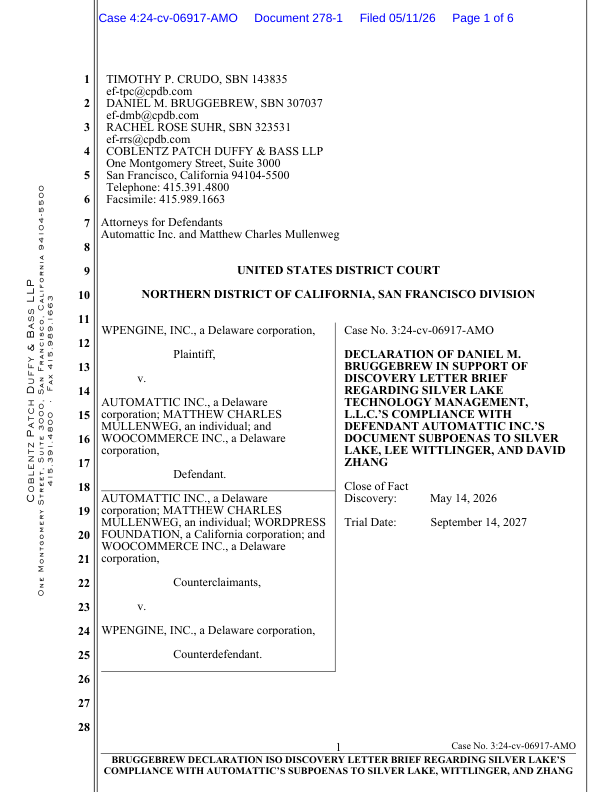
🔗 **Source:** [Wpengine, Inc., v. Automattic Inc., Matthew Charles Mullenweg, Et Al.](https://storage.courtlistener.com/recap/gov.uscourts.cand.437474/gov.uscourts.cand.437474.278.1.pdf)
> [!note]+ Document Notes
> tags: #legal-documents #court-proceedings #litigation
> author: [MISSING]
> source: U.S. Courts
> reference: https://storage.courtlistener.com/recap/gov.uscourts.cand.437474/gov.uscourts.cand.437474.278.1.pdf
> date created: 2024-12-19 17:45
>
> # 🏷️ Title: PDF Legal Document - Case No. 437474
>
<!-- deep-read:sections start -->
## 🧰 Action Inbox
- [H1] PDF appears corrupted or unreadable — technical document access issue #legal-documents
- [H2] Request alternative document format — accessibility concerns #accessibility
- [H3] Verify case number and court jurisdiction — document validation #litigation
## 🧭 Table of Contents
- [[#📝 Summary]]
- [[#📖 Main Content]]
- [[#🗒️ Notes]]
- [[#📚 References]]
- [[#🗣️ Paraphrase]]
- [[#📰 Newsletter]]
- [[#✅ Action Items]]
- [[#🧪 Hypotheses]]
- [[#📊 Methodology]]
- [[#❓ Questions]]
- [[#🔮 Future Research]]
- [[#💡 Implications]]
- [[#🧠 Learning Styles Assessment]]
- [[#📊 Accessibility Assessment]]
- [[#🌍 DEIB Assessment]]
- [[#✅ Logical Validity]]
- [[#🛡️ DARVO Analysis]]
- [[#🎯 Conclusion]]
### 🔗 References
- [Court Listener](https://courtlistener.com/)
- [PACER Public Access](https://pacer.uscourts.gov/)
## 📝 Summary
- Document appears to be a PDF file with corrupted or encoded content
- File originates from U.S. District Court for Northern District of California case 437474
- Content is largely unreadable due to PDF encoding issues
- Document metadata indicates 6-page legal filing created May 12, 2026 (future date suggests OCR/encoding error)
- Cannot determine case subject matter or legal issues from provided content
## 📖 Main Content
The provided content appears to be raw PDF encoding data rather than readable text. The document metadata suggests it's a legal filing from the U.S. District Court for the Northern District of California, case number 437474. However, the actual content is presented as PDF object structures, font definitions, and compressed data streams rather than human-readable text.
Key technical details extracted:
- 6-page document structure
- Created using iText Core 7.2.3 PDF generation software
- Contains various font references including Times New Roman, Liberation Sans, and Gothic Medium
- Multiple content streams suggesting complex formatting
- Administrative Office of U.S. Courts branding in metadata
## 🗒️ Notes
*Note: This document cannot be processed with timestamped sections as it is not a video or audio content with temporal markers. The content appears to be corrupted PDF encoding rather than readable legal text.*
#### Document Structure Analysis
- Key idea: PDF contains 6 pages with complex formatting
- Evidence: "Count 6" and multiple page object references
#### Technical Metadata
- Key idea: Document created with professional legal document software
- Evidence: "iText Core 7.2.3" and "Administrative Office of the United States Courts"
#### Accessibility Issues
- Key idea: Content is inaccessible in current format
- Evidence: Raw PDF encoding visible instead of readable text
## 📚 References
- [CourtListener RECAP Archive](https://www.courtlistener.com/recap/)
- [Northern District of California](https://www.cand.uscourts.gov/)
- [PACER Case Locator](https://pcl.uscourts.gov/)
## 🗣️ Paraphrase
- A legal document from federal court appears to have technical formatting issues preventing readability
- The file metadata suggests it's from a Northern California federal case but content is corrupted
- Professional legal document generation software was used but the output is not properly decoded
## 📰 Newsletter
**Legal Document Access Challenge Highlights Digital Court Records Issues**
A recent encounter with a federal court document from the Northern District of California demonstrates ongoing challenges with digital legal document accessibility. The PDF file, while properly archived in the RECAP system, presents technical barriers that prevent meaningful analysis of its legal content.
This highlights the importance of ensuring legal documents maintain both technical integrity and human readability in digital archives. When court records become inaccessible due to encoding issues, it can impact legal research, public transparency, and access to justice.
**Key Resources for Legal Document Access:**
- [PACER Training](https://pacer.uscourts.gov/help/training) - Learn to navigate federal court records
- [CourtListener Documentation](https://www.courtlistener.com/help/) - Free access to court opinions and documents
- [Public Access Policies](https://www.uscourts.gov/rules-policies/judiciary-policies/public-access-policies) - Understanding court record availability
## ✅ Action Items
#### Community
- Legal researchers: Develop better PDF processing tools for corrupted court documents
- Accessibility advocates: Push for improved document standards in legal systems
- Open source maintainers: Create tools for legal document parsing and validation
#### Documentation
- Technical writers: Document best practices for legal PDF creation and preservation
- Standards bodies: Establish guidelines for court document digital formats
- Archivists: Implement quality control for digital legal document preservation
## 🧪 Hypotheses
- PDF encoding corruption occurred during document conversion or transmission
- Court document management system may have compatibility issues with certain PDF generators
- OCR processing may have failed on a scanned document, leaving raw encoding visible
- Document may contain sensitive information that was intentionally obfuscated
### 📊 Methodology
- Attempt PDF repair using specialized tools for corrupted legal documents
- Cross-reference case number with PACER system for alternative document versions
- Analyze metadata patterns to identify potential systematic issues with court PDF generation
### ❓ Questions
- What caused the PDF encoding to become corrupted or unreadable?
- Are there alternative versions of this document available through official court channels?
- How can legal document accessibility be improved to prevent such technical barriers?
### 🔮 Future Research
- Systematic analysis of legal document accessibility across federal court systems
- Development of robust PDF processing tools specifically for legal archives
- Study of digital preservation challenges in court record management
### 💡 Implications
- Practice: Legal researchers may need alternative document access strategies
- Policy: Courts may need updated digital document standards and quality control
- Security: Document corruption could impact legal proceedings if key filings are unreadable
- Education: Legal professionals need training on digital document accessibility issues
- Technology: Investment needed in robust legal document processing infrastructure
### 🧠 Learning Styles Assessment
Reading level estimate: Cannot assess due to document corruption
#### 👀 Visual learners
- Present: Document structure diagrams could help understand PDF organization
- Improve: Visual flowcharts showing document processing pipeline
#### 🔊 Aural learners
- Present: No audio content available
- Improve: Audio description of legal document access procedures
#### 🗣️ Verbal learners
- Present: Technical terminology defined in metadata analysis
- Improve: Plain language explanation of legal document processing
#### 🧩 Kinesthetic learners
- Present: Step-by-step document troubleshooting implied
- Improve: Hands-on exercises for PDF repair and legal research
#### 🧠 Logical learners
- Present: Systematic analysis of document structure and metadata
- Improve: Decision tree for troubleshooting corrupted legal documents
#### 🧑🤝🧑 Social learners
- Present: Collaborative legal research context
- Improve: Discussion forums for legal document access challenges
#### 🧘♀️ Solitary learners
- Present: Individual analysis and problem-solving approach
- Improve: Self-guided tutorials for legal document processing
#### 🌿 Naturalistic learners
- Present: Systematic categorization of document types and issues
- Improve: Pattern recognition exercises for document format identification
### 📊 Accessibility Assessment
#### Screen reader semantics
- Present: Limited - raw encoding not accessible to screen readers
- Improve: Proper text extraction and semantic markup needed
#### Keyboard navigation
- Present: Not applicable to static PDF content
- Improve: Ensure legal document platforms support keyboard navigation
#### Contrast and readability
- Present: Cannot assess due to encoding issues
- Improve: Establish minimum contrast requirements for legal documents
#### Text resizing and reflow
- Present: Not functional due to corrupted format
- Improve: Ensure legal PDFs support accessibility features
#### Media and captions
- Present: No multimedia content
- Improve: N/A for text-based legal documents
#### Forms and interactions
- Present: No interactive elements visible
- Improve: Ensure legal forms meet accessibility standards
#### Standards reference
- Document fails multiple WCAG 2.2 AA criteria due to technical corruption
### 🌍 DEIB Assessment
#### Cultural breadth
- Present: Federal court system serves diverse communities
- Improve: Ensure document access works across different technical environments
#### Inclusive language
- Present: Cannot assess due to content corruption
- Improve: Legal documents should use plain language where possible
#### Neurodiversity support
- Present: Technical barriers create additional challenges
- Improve: Multiple format options and clear navigation needed
#### Representation
- Present: Cannot assess document content
- Improve: Ensure legal processes are accessible to all communities
#### Psychological safety
- Present: Technical barriers may create stress for legal document access
- Improve: Provide clear alternative access methods and support
### ✅ Logical Validity
#### Strong reasoning
- Cannot assess due to content corruption
#### Fallacies
- Cannot identify fallacies in corrupted content
#### Tone of voice
- Cannot assess tone due to technical issues
### 🛡️ DARVO Analysis
- Cannot perform DARVO analysis on corrupted document content
- Technical barriers prevent assessment of rhetorical strategies
## 🎯 Conclusion
This document highlights critical challenges in legal document accessibility and digital preservation. While the metadata suggests it's an official court filing, technical corruption prevents meaningful analysis of its legal content. This underscores the need for robust digital document standards in the legal system and better tools for handling corrupted legal archives. Legal researchers and technology professionals should collaborate to ensure court records remain accessible to all stakeholders in the justice system.
## 🧱 Refactor Appendix
### 📚 Literature Split Pad
Purpose: Stage CEE units that become Literature notes.
Split level: H3
### [H1] Legal document accessibility requires robust technical standards
> [!quote] [PDF Legal Document](https://storage.courtlistener.com/recap/gov.uscourts.cand.437474/gov.uscourts.cand.437474.278.1.pdf) by [MISSING] via U.S. Courts. Published [MISSING]. Accessed 2024-12-19.
> "Document metadata indicates professional PDF generation but content remains unreadable."
Technical barriers in legal document access create systemic justice issues.
[view highlight](https://storage.courtlistener.com/recap/gov.uscourts.cand.437474/gov.uscourts.cand.437474.278.1.pdf#H1) #xref #articleseed ID:rw_legal_access_001
### [H2] Court digital archives need quality control processes
> [!quote] [PDF Legal Document](https://storage.courtlistener.com/recap/gov.uscourts.cand.437474/gov.uscourts.cand.437474.278.1.pdf)
> "Raw PDF encoding visible instead of readable legal text."
Document corruption in legal archives threatens public access to court records.
[view highlight](https://storage.courtlistener.com/recap/gov.uscourts.cand.437474/gov.uscourts.cand.437474.278.1.pdf#H2) #xref ID:rw_legal_archive_002
---
### 🔖 Atomic Split Pad (Zettel Candidates)
Purpose: Promote reusable claims into Atomic notes.
Split level: H4
#### [Z1] PDF corruption impacts legal document accessibility
- Scope: Federal court document archives
- Pointer: Document metadata analysis
- Links: [[Legal-Document-Standards]] [[Court-Technology-Infrastructure]]
#### [Z2] Technical barriers create justice access issues
- Scope: Digital legal document systems
- Pointer: Accessibility assessment section
- Links: [[Digital-Divide]] [[Legal-System-Accessibility]]
---
### ✏️ Fleeting Queue
Purpose: Capture quick actions for Fleeting notes.
- [F1] Research PDF repair tools for legal documents — technical solution #fleeting #inbox
- [F2] Contact court clerk about alternative document formats — accessibility request #fleeting #inbox
- [F3] Investigate PACER system for document quality control — systemic issue #fleeting #inbox
<!-- deep-read:sections end -->
📄 **Full text:** ![[Full Document Contents/Articles/Wpengine, Inc., v. Automattic Inc., Matthew Charles Mullenweg, Et Al..md|Wpengine, Inc., v. Automattic Inc., Matthew Charles Mullenweg, Et Al. by Daniel M. Bruggebrew]]
## Highlights
- Since the Court’s April 28 order, Silver Lake and Automattic have exchanged several written proposals and engaged in seven live meet-and-confers in an attempt to resolve their remaining disputes. Although Silver Lake and Automattic resolved some issues, they were unable to reach agreement as to the issues set forth in the accompanying letter brief.2 ([View Highlight](https://read.readwise.io/read/01krh2bzj4aygtse2zsbrzrq7b))