You're Scoring Leads Like It's 2015
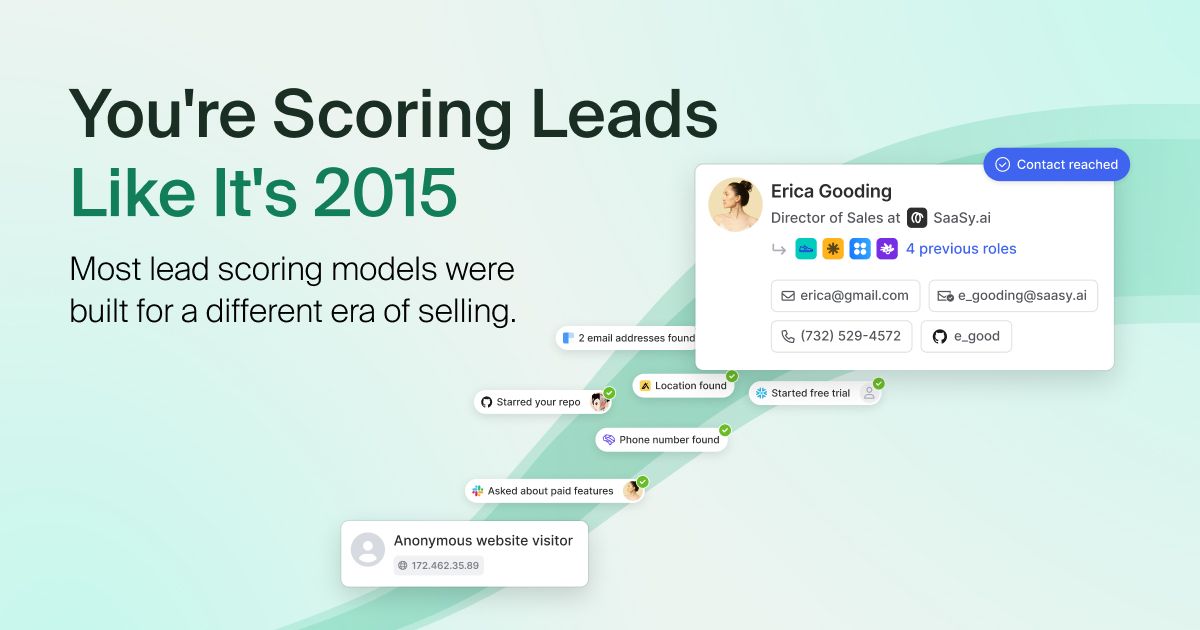
🔗 **Source:** [You're Scoring Leads Like It's 2015](https://www.commonroom.io/blog/behavioral-lead-scoring/)
> [!note]+ Document Notes
> tags: [lead-scoring, behavioral-signals, product-led-growth, devrel-analytics, community-intelligence, go-to-market]
> author: Common Room
> source: Common Room
> reference: https://www.commonroom.io/blog/behavioral-lead-scoring/
> date created: 2026-06-20 12:00
>
> # 🏷️ Title: You're Scoring Leads Like It's 2015
>
<!-- deep-read:sections start -->
## 🧭 Table of Contents
- [📝 Summary](#-summary)
- [📖 Main Content](#-main-content)
- [🗒️ Notes](#️-notes)
- [📚 References](#-references)
- [🗣️ Paraphrase](#️-paraphrase)
- [📰 Newsletter](#-newsletter)
- [✅ Action Items](#-action-items)
- [🧪 Hypotheses](#-hypotheses)
- [📊 Methodology](#-methodology)
- [❓ Questions](#-questions)
- [🔮 Future Research](#-future-research)
- [💡 Implications](#-implications)
- [🧠 Learning Styles Assessment](#-learning-styles-assessment)
- [📊 Accessibility Assessment](#-accessibility-assessment)
- [🌍 DEIB Assessment](#-deib-assessment)
- [✅ Logical Validity](#-logical-validity)
- [🛡️ DARVO Analysis](#-darvo-analysis)
- [🎯 Conclusion](#-conclusion)
### 🔗 References
- [Common Room — behavioral lead scoring](https://www.commonroom.io/blog/behavioral-lead-scoring/)
- [Common Room — Account Prioritization: signal-based targeting](https://www.commonroom.io)
- [Common Room — BuyerCaddy technographics](https://www.commonroom.io)
- [Otter.ai](https://otter.ai) (cited example of a 70/30 behavioral-firmographic rebuild)
## 📝 Summary
- **What happened.** Common Room argues that most lead scoring models — built on firmographics (company size, industry, job title, revenue band, geography) — are obsolete for product-led-growth (PLG) companies, which can now see *inside* the account: how many people use the product, which features they've adopted, how deeply it's embedded, and whether usage is growing or stalling. The fix is to rebuild scoring around behavioral signals, citing Otter.ai's flip to a 70% behavioral / 30% firmographic ratio.
- **Why it matters.** Firmographics tell you who *could* buy (fit); they say almost nothing about who is *ready* to buy (intent and timing). That gap is where pipeline gets wasted — reps chase high-fit accounts with no buying motion while real signals (three execs signing up in a week, a usage threshold being hit, eight teams using the product independently) go unsurfaced because firmographic data never changes.
- **Key stakeholders.** PLG/SaaS revenue teams (sales, marketing, RevOps), reps prioritizing accounts on Monday morning, and — by analogy — DevRel and community teams who measure engagement signals rather than form-fills. Vendor: Common Room (a community-intelligence platform that sells exactly this signal capture).
- **Risks and tradeoffs.** Behavioral models require clean product-usage instrumentation and historical closed-won/closed-lost data; the method is "not perfect" (the article admits) and signals vary by product. Vendor incentive is strong: the article's conclusion points readers to Common Room's own product. Fit data still matters — the argument is rebalancing, not abandoning firmographics.
- **Bottom line.** Stop scoring from the outside in. Derive a behavioral "signature of a ready account" from your own recent closed-won and closed-lost deals, then prioritize accounts that are *doing the things your best customers did right before they bought.*
## 📖 Main Content
- **The era mismatch.** Legacy scoring used firmographics because, before PLG telemetry, that was the best visible data: "If you couldn't see inside an account, you scored what you could see from the outside and hoped the pattern held." PLG flips this — product usage is now observable, yet "most companies are still scoring leads like it isn't."
- **Fit ≠ intent ≠ timing.** A central distinction. Firmographic fit (a 5,000-person financial-services firm vs. a 12-person startup) is real and the model "should know that." But a perfect-fit company can have "no buying motion happening right now" — happily on the free tier, two years from a conversation. "Firmographic scoring tells you who *could* buy. It tells you almost nothing about who is *ready* to buy."
- **Why the waste compounds.** Static firmographic data "never changes," so the model "keeps surfacing the same names" whether an account is "actively evaluating or completely dormant." Reps burn cycles on names that look great on paper. Meanwhile dynamic signals — three execs signing up in one week, a usage threshold that historically preceded enterprise deals, eight teams using the product independently with no consolidation conversation — "change every day" and a firmographic model "will never surface them."
- **The 70/30 reframe (Otter.ai).** When Otter.ai rebuilt its model it inverted the usual ratio to 70% behavioral, 30% firmographic. The shift is conceptual, not cosmetic: the primary question changes from "does this company look like our customer?" to "is this account doing the things that our best customers did right before they bought?" — "very different questions" that "produce very different lists."
- **Three behavioral signal categories.** (1) *Depth of usage* — not just whether the product is used but how deeply embedded; advanced features, workflows built around it, "something they'd notice if it disappeared tomorrow." (2) *Breadth of adoption* — how many people use it and how that number moves ("A single power user is interesting. Three teams using it independently is a buying signal. Ten people added in the last two weeks is a trigger"). (3) *Expansion patterns* — unprompted usage growth signals intent "through behavior rather than words." The throughline: "Words lie. Usage data doesn't."
- **How to build the model.** It's not bolting product data onto an old model — it's rebuilding around a different question. Start with closed-won deals from the last 12–18 months (recent deals give the clearest conversion signal). Map the behavioral patterns in those accounts at 30/60/90 days before close. Then examine closed-lost deals from the same period and find where the pattern diverged. The result is "the behavioral signature of a ready account — not a theoretical one, but one derived from your actual revenue data." Honest caveat: "It's not perfect. But it's significantly more honest than a model built on demographic proxies."
- **The Monday-morning payoff.** Instead of a ranked list of demographic look-alikes, a rep sees accounts where "something changed in the last week." Each is a "triggered play, not a cold outreach" — the signal tells the rep "why this account, why now." Behavioral scoring unlocks "a fundamentally different kind of outreach, one that starts from something real rather than something assumed."
- **Uncertainties / contested claims.** The 70/30 ratio is presented as Otter.ai's choice, not a validated universal optimum. "Words lie. Usage data doesn't." is rhetorically strong but overstated — usage data carries its own noise (trials, evaluations, churned pilots). The piece is vendor content; the prescription maps neatly onto Common Room's product, which colors the framing.
### 🗒️ Notes
- **Thesis in one line:** rebuild lead scoring around what accounts *do* inside the product (behavioral) rather than what they *are* on paper (firmographic).
- **Three-part decomposition:** fit (firmographic, static), intent (behavioral, dynamic), timing (signal-triggered, daily-changing). Firmographics answer only fit.
- **Cost of the gap:** wasted pipeline — reps work high-fit, zero-motion accounts; high-fit names sit in sequences for months; the model re-surfaces the same dormant names because the inputs never move.
- **Otter.ai anchor:** flipped to 70% behavioral / 30% firmographic; reframes the primary question from "looks like our customer?" to "doing what our best customers did pre-purchase?"
- **Signal taxonomy:** depth (embeddedness, advanced features, workflows) · breadth (seat/team count and its velocity) · expansion (unprompted usage growth).
- **Trigger examples (verbatim flavor):** "three executives sign up in the same week"; "Ten people added in the last two weeks is a trigger"; "eight different teams using the product independently" → consolidation play.
- **Build recipe:** closed-won (12–18 mo) → map 30/60/90-day pre-close behavior → contrast against closed-lost → derive "behavioral signature of a ready account" from real revenue data.
- **Epistemic stance:** explicitly modest — "It's not perfect," only "significantly more honest" than stale demographic proxies.
- **Outreach shift:** triggered play vs. cold outreach; "why this account, why now" is supplied by the signal, not guessed.
- **DevRel/community cross-ref:** the fit→intent→timing distinction maps directly to community-analytics work — engagement depth/breadth/momentum are the DevRel analogue of usage signals; contrast with vanity form-fill/MQL counting. See [[A Guide to Community Analytics]] and [[Measuring DevRel Success - Thinking Outside the Funnel]].
- **Vendor flag:** Common Room sells signal capture/scoring; the closing "Next in the series" and product links (Account Prioritization, BuyerCaddy technographics) reveal the marketing-funnel intent.
## 📚 References
- [Common Room — "You're Scoring Leads Like It's 2015"](https://www.commonroom.io/blog/behavioral-lead-scoring/) — the source article.
- [Common Room — Account Prioritization: a practical guide to signal-based targeting](https://www.commonroom.io) — linked companion resource.
- [Common Room — Introducing BuyerCaddy technographics](https://www.commonroom.io) — linked product/feature announcement.
- [Otter.ai](https://otter.ai) — cited case for the 70/30 behavioral-firmographic rebuild.
- [Common Room — "You bought a Ferrari, but your reps are using it to fetch groceries"](https://www.commonroom.io) — linked related post.
## 🗣️ Paraphrase
- Lead scoring models were designed for an era when only external, firmographic attributes were visible; that made sense before product telemetry but is now outdated for PLG companies that can observe usage directly.
- Firmographic fit is real and worth keeping, but fit is not intent and intent is not timing — a perfect-fit account may have no current buying motion, so firmographics surface who could buy, not who is ready.
- Because firmographic inputs never change, scoring keeps re-surfacing the same dormant names while live behavioral triggers (executive signups, usage thresholds, multi-team adoption) go unseen.
- Otter.ai's rebuild to 70% behavioral / 30% firmographic changes the core question from "does this look like a customer?" to "is this account behaving like our best customers did right before buying?"
- Predictive behavioral signals cluster into depth of usage, breadth of adoption, and unprompted expansion; what people do in the product is a more honest predictor than any demographic proxy.
- Build the model from your own recent closed-won deals (mapping 30/60/90-day pre-close behavior) contrasted against closed-lost deals, yielding a data-derived signature of a ready account rather than a theoretical one.
- The payoff is a Monday-morning list of accounts where something just changed, turning cold outreach into triggered plays that start from a real signal.
## 📰 Newsletter
**Stop scoring leads like it's 2015 — score what they *do***
If your team still ranks prospects by company size, industry, and job title, this Common Room piece is a useful gut-check (vendor angle noted — Common Room sells exactly this). The argument is clean: firmographics tell you *fit*, but fit isn't *intent* and intent isn't *timing*. A 5,000-person firm that's a perfect ICP match can be two years and zero buying motion away from a conversation, while your static model keeps surfacing the same dormant names. Meanwhile the real signals — three execs signing up in one week, a usage threshold your best deals always crossed, eight teams quietly using the product independently — change every day and never show up. The fix Otter.ai used: flip to 70% behavioral / 30% firmographic, and reframe the question from "does this look like our customer?" to "is this account doing what our best customers did right before they bought?" The build recipe is refreshingly concrete: take your closed-won deals from the last 12–18 months, map what usage did in the 30/60/90 days before close, contrast against closed-lost, and derive a *behavioral signature of a ready account* from your real revenue data. For the WordPress and DevRel crowd, the translation writes itself: engagement depth, breadth, and momentum are the community analogue of product-usage signals — far better than counting form-fills. "Words lie. Usage data doesn't" is a bit strong (trials and churned pilots are noisy too), but the core move — measure behavior, not biography — is sound.
## ✅ Action Items
#### DevRel
- Developer advocacy: turn "fit ≠ intent ≠ timing" into a talk/demo reframing community engagement scoring around behavioral signals, not form-fills.
- Education: workshop on building a "behavioral signature of an engaged developer" from real activation/conversion data (issues, PRs, repeat attendance).
- Developer experience: instrument and document which product/community actions are observable as signals (depth/breadth/expansion).
- Developer marketing: replace MQL-style demographic targeting in campaigns with triggered plays off engagement signals; track attribution.
- Community management: design a Monday-morning "what changed this week" signal digest for community managers.
- Internal/external/cross-project: align RevOps, DevRel, and community on a shared signal taxonomy (depth, breadth, expansion).
#### OSPO
- Policy & Governance: norms for using contributor/community behavioral data for outreach (consent, transparency).
- License Compliance: Not applicable to this source — no licensing dimension in behavioral scoring.
- Security Management: data-governance review of product-usage and community-activity data piped into scoring (PII exposure).
- Software Inventory: catalog the telemetry/signal sources feeding any scoring model.
- Developer Support: consultation on instrumenting usage signals ethically.
- Community Engagement: fund a study on engagement-signal predictiveness across open-source projects.
- Strategic Alignment: track "intent-signal coverage" as an ecosystem health KPI.
#### Community
- Maintainers: define which maintainer-visible signals (recurring contributors, multi-repo activity) indicate deepening investment.
- Contributors: "first signal → triggered welcome" onboarding play instead of generic outreach.
- Sponsors: report behavioral engagement momentum (depth/breadth/expansion) rather than headcount-style vanity metrics.
- Ecosystem: coordinate a shared definition of "ready-to-deepen" community accounts across projects.
#### WordPress
- Core: Not applicable to this source — no core-development angle.
- Core Performance: Not applicable to this source.
- Core AI: consider behavioral-signal scoring as a pattern for AI-assisted contributor/triage prioritization.
- **Core Program Team:** consider signal-based prioritization for contributor outreach across teams.
- Mobile: Not applicable to this source.
- Playground: Not applicable to this source.
- Community: WordCamp session on "measure behavior, not biography" for sponsor/agency engagement.
- Training: learning path on community/product analytics and signal taxonomy.
- Marketing: pilot triggered-play outreach off real engagement signals; retire demographic-only segmentation.
- Support: Not applicable to this source.
- Design: design a "what changed this week" signal dashboard pattern.
- Documentation: examples-first guide to defining and capturing engagement signals.
- Photos / TV / Openverse: Not applicable to this source.
- Polyglots: glossary for "behavioral scoring," "firmographic," "triggered play," "fit/intent/timing."
- Accessibility: ensure any scoring dashboards meet WCAG (see Accessibility Assessment).
- Meta: Not applicable to this source.
- CLI: Not applicable to this source.
- Hosting: Not applicable to this source.
- Tide / Themes / Plugins: Not applicable to this source.
#### The WPCC
- Programs: fellowship on community-analytics and behavioral-signal measurement for small projects.
- Projects: documentation sprint translating PLG signal taxonomy into community-engagement terms.
- Funding experiments: microgrants for projects instrumenting engagement signals.
### FAIR
- Technical independence: prefer first-party, self-hosted signal/telemetry stores over vendor lock-in to a single scoring SaaS.
- Policies and covenants: transparency on how behavioral/community data is collected and used for scoring/outreach.
- Productized governance artifacts: a "behavioral-signal data-governance" scorecard and consent charter.
## 🧪 Hypotheses
- H1: Scoring models weighted ~70% behavioral / 30% firmographic produce higher pipeline-to-close conversion than firmographic-majority models for PLG companies.
- H2: Behavioral signatures derived from a company's own closed-won/closed-lost deals predict conversion better than vendor-supplied generic scoring templates.
- H3: Breadth-of-adoption velocity (e.g., seats added in a trailing two-week window) is a stronger near-term purchase predictor than absolute usage depth.
- H4: Triggered, signal-based outreach yields higher reply/meeting rates than firmographic cold outreach to equally high-fit accounts.
- H5: In DevRel/community contexts, engagement-signal scoring (depth/breadth/momentum) predicts adoption or sponsorship better than form-fill/MQL counts.
- H6: The marginal value of firmographic data falls as product-usage observability rises, so optimal behavioral weight increases with telemetry maturity.
### 📊 Methodology
- H1/H2/H4: controlled A/B or holdout study within one PLG company — score the same account pool with firmographic-majority vs. behavioral-majority models (and triggered vs. cold outreach), compare conversion/reply/meeting rates.
- H3: feature-importance / survival analysis on closed-won deals regressing time-to-close against depth vs. breadth-velocity signals.
- H5: cohort study mapping community engagement signals (issues, PRs, event attendance, multi-channel activity) at 30/60/90 days against later adoption/sponsorship outcomes.
- H6: cross-company comparison correlating telemetry maturity with realized lift from increasing behavioral weight.
### ❓ Questions
- What is the right behavioral/firmographic ratio for *your* product, and is 70/30 anything more than Otter.ai's anecdote?
- How do you separate true buying-intent usage from noise (trials, evaluations, soon-to-churn pilots) so "usage data doesn't lie" actually holds?
- How transferable is the closed-won/closed-lost recipe to companies with thin deal history or long sales cycles?
- Where are the consent and privacy limits on scoring individuals by their in-product behavior?
- Does the behavioral edge erode once every competitor instruments the same signals?
### 🔮 Future Research
- Empirical validation of the 70/30 ratio across multiple PLG companies and stages.
- A reusable method for denoising usage signals (distinguishing intent from evaluation/churn).
- Translation of the PLG signal taxonomy into open-source/community-engagement scoring with measured predictiveness.
- Privacy-preserving behavioral scoring (aggregate/consented signals) and its accuracy cost.
- Decay study: how quickly a signal advantage commoditizes once widely adopted.
### 💡 Implications
- **Practice:** Rebuild scoring around a behavioral question and derive the signature from your own revenue data; don't bolt usage data onto a stale firmographic model.
- **Policy:** Scoring people by in-product behavior raises consent/transparency obligations that need explicit norms.
- **Security:** Piping usage and community-activity data into scoring concentrates PII and behavioral profiles — a governance and breach-surface concern.
- **Education:** Analytics curricula (incl. DevRel/community) should teach fit/intent/timing and depth/breadth/expansion taxonomies, not just MQL mechanics.
- **Funding models:** Signal-based prioritization can reallocate sales/community effort (and budget) toward accounts with real motion, changing how pipeline and ROI are forecast.
### 🧠 Learning Styles Assessment
- Reading level estimate: business-prose article, short punchy sentences and fragments for rhythm; ~Flesch–Kincaid Grade 9–11. Flesch Reading Ease ~50–60. Jargon is mostly explained ("firmographic," "PLG," "ICP," "triggered play") but assumes B2B SaaS familiarity.
#### 👀 Visual learners
- Present: none — prose only, no diagrams, charts, or screenshots.
- Improve: a fit/intent/timing Venn or funnel; a depth/breadth/expansion signal matrix; a before/after "Monday list" comparison graphic; a 70/30 ratio bar.
#### 🔊 Aural learners
- Present: none — text article, no audio version.
- Improve: a 3-minute audio summary or podcast read; the article reads aloud well due to its cadence.
#### 🗣️ Verbal learners
- Present: strong — vivid analogies ("Ferrari to fetch groceries," "Words lie. Usage data doesn't.") and crisp definitions of fit vs. intent vs. timing.
- Improve: an inline glossary (firmographic, PLG, ICP, behavioral signature, triggered play).
#### 🧩 Kinesthetic learners
- Present: a usable build recipe (closed-won → 30/60/90 mapping → closed-lost contrast).
- Improve: a worksheet/template to derive your own behavioral signature; a checklist of candidate signals to instrument.
#### 🧠 Logical learners
- Present: clear cause→effect (static firmographics → stale lists → wasted pipeline) and a structured taxonomy.
- Improve: a decision tree for signal selection; the elastic logic of weighting shown as a simple model with KPIs.
#### 🧑🤝🧑 Social learners
- Present: none — single-author monologue, no dialogue.
- Improve: discussion prompts for RevOps/DevRel peer groups; a shared signal-definition workshop format.
#### 🧘♀️ Solitary learners
- Present: reflective "is your model asking the wrong question?" framing.
- Improve: self-audit prompts ("which of my best deals' pre-purchase signals do I currently capture?").
#### 🌿 Naturalistic learners
- Present: faint — "signals are already firing" / organic-spread ("adoption is spreading on its own") framing.
- Improve: tie to data-minimization and lifecycle thinking on what signals are worth retaining.
### 📊 Accessibility Assessment
#### Screen reader semantics
- Present: standard blog article; headings likely present in the published page.
- Improve: ensure section subheads ("The problem with scoring from the outside," "What 70/30 actually means") are real heading elements, not styled bold text.
#### Keyboard navigation
- Present: standard web article; links keyboard-reachable.
- Improve: verify visible focus on links and any in-page CTAs/forms.
#### Contrast and readability
- Present: assumed adequate on a modern marketing site.
- Improve: verify 4.5:1 on body text, link colors, and CTA buttons; short fragments aid readability.
#### Text resizing and reflow
- Present: responsive marketing-site layout expected.
- Improve: confirm no clipping at 200% zoom, especially around pull-quote styling.
#### Media and captions
- Present: text-only article — no media to caption (low risk).
- Improve: if illustrative graphics are added later, provide descriptive alt text and a transcript for any audio version.
#### Forms and interactions
- Present: likely newsletter/CTA forms on the page.
- Improve: ensure form fields have labels, accessible error handling, and adequate target size.
#### Standards reference
- Maps to WCAG 2.2 AA: 1.3.1 Info & Relationships (real headings), 1.4.3 Contrast, 2.1.1 Keyboard, 2.4.7 Focus Visible, 1.4.10 Reflow, 3.3.2 Labels/Instructions, 2.5.8 Target Size (Minimum).
### 🌍 DEIB Assessment
#### Cultural breadth
- Present: minimal — examples are generic B2B SaaS (no regional or cultural specificity); financial-services and startup sizing are the only concrete contexts.
- Improve: include non-US/non-enterprise examples; acknowledge markets where product telemetry is sparse or privacy-restricted (e.g., GDPR contexts).
#### Inclusive language
- Present: generally neutral and plain; "reps" and "power user" are role terms, not identity terms.
- Improve: define jargon (firmographic, PLG, ICP) inline for non-specialist readers; avoid assuming a US-sales worldview as universal.
#### Neurodiversity support
- Present: strong — short paragraphs, fragments, repeated signposting, concrete examples aid comprehension.
- Improve: add a TL;DR and a labeled summary box for readers who want structure before the narrative.
#### Representation
- Present: single authorial voice (corporate "Common Room"); one named external example (Otter.ai).
- Improve: include multiple company perspectives and counter-examples where behavioral scoring underperformed.
#### Psychological safety
- Present: low-stakes business topic; the "you're doing it wrong" hook is mildly accusatory but not hostile.
- Improve: soften the implied blame ("scoring like it isn't") and acknowledge teams constrained by limited telemetry rather than negligence.
### ✅ Logical Validity
#### Strong reasoning
- Conceptual distinction (fit vs. intent vs. timing): well-drawn and load-bearing — cleanly explains why static firmographics waste pipeline. Located in "The problem with scoring from the outside."
- Causal chain: static firmographic inputs → model re-surfaces the same names → reps chase dormant accounts → wasted pipeline. Mechanized and plausible.
- Inductive method (build from closed-won/closed-lost): sound in principle — deriving the signature from real outcomes is more defensible than theoretical proxies, and the article concedes it's "not perfect."
- Analogical clarity: "Ferrari to fetch groceries" and the Monday-morning vignette make the abstraction concrete.
#### Fallacies
- **Vendor bias / appeal to (self-)interest** — *Quote:* "Turning tech stack insights into action: Introducing BuyerCaddy technographics to Common Room" (closing links), plus the whole prescription mapping to Common Room's product. *Location:* final lines / overall framing. *Weakness:* the source sells behavioral-signal scoring, so the recommendation is not disinterested. *Fix:* disclose the commercial interest and cite independent, multi-vendor evidence for the lift claim.
- **Hasty generalization (single example)** — *Quote:* "When Otter AI rebuilt their scoring model, they flipped the ratio... Seventy percent behavioral. Thirty percent firmographic." *Location:* "What 70/30 actually means." *Weakness:* one company's choice is presented as the right ratio; n=1. *Fix:* present 70/30 as illustrative, not optimal, and show outcome data across companies.
- **Overstatement / false dichotomy** — *Quote:* "Words lie. Usage data doesn't." *Location:* "Behavioral signals that actually predict conversion." *Weakness:* usage data is also noisy (trials, evaluations, churn); the binary overclaims. *Fix:* qualify to "usage is a more honest signal, but still needs denoising."
- **Survivorship framing** — *Quote:* "Map the behavioral patterns that appeared in those accounts in the 30, 60, and 90 days before the deal closed." *Location:* "The scoring model most companies actually need." *Weakness:* mapping only winners risks confirmation bias; the article partly mitigates by adding closed-lost contrast. *Fix:* weight both classes and validate on held-out data to avoid overfitting the won set.
#### Tone of voice
- Confident, punchy, lightly provocative ("scoring like it's 2015," "you're still asking the wrong question"); short fragments for rhythm; pragmatic and example-driven. Persuasive marketing register with genuine analytical substance, tilted toward the vendor's solution.
### 🛡️ DARVO Analysis
- Deny: Not applicable — no accusation is being deflected; the piece is a persuasive argument, not a defense.
- Attack: Mild rhetorical jab at the reader's status quo ("you're still scoring leads like it isn't," "asking the wrong question"), but it critiques a *practice*, not a person or accuser — not DARVO-style attack.
- Reverse victim/offender: None — no party is recast as victim.
- Overall: DARVO is largely not applicable to this source. The only adjacent tension is the vendor's self-interested framing (see Fallacies), which is a bias concern, not a deny-attack-reverse pattern.
## 🎯 Conclusion
- **Bottom line.** Firmographic scoring tells you who *could* buy; behavioral scoring tells you who is *ready*. For PLG companies that can see inside the account, the winning move is to rebuild the model around what accounts *do* — depth of usage, breadth of adoption, unprompted expansion — and to derive the "behavioral signature of a ready account" from your own recent closed-won and closed-lost deals. Otter.ai's 70/30 flip is the illustration, not a law. Keep firmographic fit as a minority weight; let behavior drive intent and timing.
- **Next steps for readers.** (1) Audit which pre-purchase signals your best recent deals exhibited at 30/60/90 days — and which you currently capture. (2) Instrument depth/breadth/expansion signals you're missing. (3) Pilot a behavioral-majority score against your firmographic one on the same account pool and measure conversion. (4) Convert top signals into triggered plays ("why this account, why now") for reps' Monday lists. (5) DevRel/community: translate the same taxonomy to engagement signals and retire form-fill counting — but note the vendor incentive and validate the lift independently.
## 🔄 Refactor Appendix — You're Scoring Leads Like It's 2015
> Density: 2–5 Literature atoms (H3), 0–3 Permanent candidates (H4).
> Defaults applied. Resonance filter on.
>
> Tag pool: #bmf · #addendum · #xref · #articleseed · #storystem · #share · #aphorisms
### 📚 Literature Atoms (H3)
#### [H1] Firmographics show fit, not readiness to buy
> [!quote] ID:rw_pending
> "Firmographic scoring tells you who could buy. It tells you almost nothing about who is ready to buy. That gap is where pipeline gets wasted."
**Context & use**:
- Core distinction of the piece: fit ≠ intent ≠ timing.
- Explains why static firmographic models re-surface dormant accounts and waste reps' time.
**Tags**: #xref #aphorisms
**Highlight**: [view highlight](readwise://pending)
<!-- atomicity: 1 idea ✓ -->
#### [H2] Score accounts by what your best customers did pre-purchase
> [!quote] ID:rw_pending
> "It's \"is this account doing the things that our best customers did right before they bought?\" Those are very different questions. And they produce very different lists."
**Context & use**:
- The 70/30 reframe (Otter.ai): primary question shifts from look-alike to behavior-alike.
- Reorients scoring around dynamic, daily-changing signals.
**Tags**: #xref #share
**Highlight**: [view highlight](readwise://pending)
<!-- atomicity: 1 idea ✓ -->
#### [H3] Behavioral signals cluster as depth, breadth, expansion
> [!quote] ID:rw_pending
> "A single power user is interesting. Three teams using it independently is a buying signal. Ten people added in the last two weeks is a trigger."
**Context & use**:
- The signal taxonomy: depth of usage, breadth of adoption, unprompted expansion.
- Directly portable to DevRel/community engagement scoring.
**Tags**: #xref #articleseed
**Highlight**: [view highlight](readwise://pending)
<!-- atomicity: 1 idea ✓ -->
#### [H4] Derive the ready-account signature from your own deals
> [!quote] ID:rw_pending
> "That analysis gives you the behavioral signature of a ready account - not a theoretical one, but one derived from your actual revenue data."
**Context & use**:
- Build recipe: closed-won (12–18 mo) mapped at 30/60/90 days, contrasted against closed-lost.
- Honest caveat in source: "It's not perfect" — only "significantly more honest" than demographic proxies.
**Tags**: #xref #addendum
**Highlight**: [view highlight](readwise://pending)
<!-- atomicity: 1 idea ✓ -->
### 🧠 Permanent Candidates (H4)
#### [P1] Intent lives in behavior, not in biography
**Claim** (one sentence, Courtney's voice): A prospect's or community member's readiness to act is best predicted by what they actually do over time, not by the static demographic or firmographic attributes that describe who they are.
**Evidence pointer**: [[#H1]]
**Scope & conditions**: Holds where behavior is observable and historically tied to outcomes (PLG products, instrumented communities). Breaks when telemetry is absent or noisy, when consent/privacy forbids individual behavioral profiling, or when sample deal history is too thin to derive a reliable signature.
**Links**:
- [[A Guide to Community Analytics]] — because applies-in DevRel/community engagement scoring
- [[Measuring DevRel Success - Thinking Outside the Funnel]] — because extends beyond form-fill/MQL counting
- [[Vanity metrics vs leading indicators]] — because contrasts on static vs. dynamic signals
<!-- atomicity: 1 idea ✓ -->
### ✏️ Fleeting Queue
- [F1] Map which pre-purchase/engagement signals my best recent outcomes showed at 30/60/90 days — and which I currently capture — https://www.commonroom.io/blog/behavioral-lead-scoring/ #fleeting #inbox
- [F2] Open question: how do you denoise usage/engagement signals (trials, evaluations, churn) so "usage data doesn't lie" holds? #fleeting #inbox
### → Things 3 (max 2 actions)
- [ ] Draft a "score behavior, not biography" note translating fit/intent/timing to community analytics — #things
- [ ] Cross-link the depth/breadth/expansion taxonomy into the DevRel MOC and community-analytics notes — #things
<!-- deep-read:sections end -->
📄 **Full text:** ![[Full Document Contents/Articles/You're Scoring Leads Like It's 2015.md|You're Scoring Leads Like It's 2015 by commonroom.io]]
## Highlights
- Firmographic scoring tells you who could buy. It tells you almost nothing about who is ready to buy. ([View Highlight](https://read.readwise.io/read/01kvkrpk9mccr7rrz97m1yrq8w))
- Note: H1 — the fit-vs-readiness thesis: firmographics tell you who *could* buy, not who's *ready* — that gap is where pipeline is wasted.
- Tags: atom/literature/h1, lead-scoring
- It means the primary question is no longer "does this company look like our customer?" It's "is this account doing the things that our best customers did right before they bought?" ([View Highlight](https://read.readwise.io/read/01kvkrpnjyhgh6cjqhghwsetnz))
- Note: H2 + Permanent: readiness is best predicted by behavior over time, not static demographics — behavior-alike replaces look-alike.
- Tags: atom/zettel/z1, lead-scoring, atom/literature/h2
- - **Breadth of adoption** - how many people inside the account are using it, and how is that number moving? A single power user is interesting. Three teams using it independently is a buying signal. Ten people added in the last two weeks is a trigger. ([View Highlight](https://read.readwise.io/read/01kvkrpqywy18h11h3yv5y6j6a))
- Note: H3 — the signal taxonomy (depth/breadth/expansion), portable to DevRel/community: a single power user vs. three independent teams vs. ten new users in two weeks.
- Tags: atom/literature/h3, devrel