Your CRM Knows the Deal. It Doesn't Know the Buyer.
🔗 **Source:** [Your CRM Knows the Deal. It Doesn't Know the Buyer.](https://www.commonroom.io/blog/know-the-buyer/)
> [!note]+ Document Notes
> tags:
> - buyer-intelligence
> - revops
> - community-signals
> - data-privacy
> - devrel-measurement
> author: Tasha Reasor
> source: https://www.commonroom.io/blog/know-the-buyer/
> reference: https://www.commonroom.io/blog/know-the-buyer/
> date created: 2026-09-17
>
> > [!info] Generated analysis — not the author's words. Sections below are machine-written
> > from the captured source. Only text inside `> [!quote]` blocks is verbatim from the author.
> > Do not quote or attribute any other line to the named author.
>
<!-- deep-read:sections start -->
## 🏷️ Title
**Your CRM Knows the Deal. It Doesn't Know the Buyer.** — Tasha Reasor, Common Room, article one of a three-part "Know, Act, Learn" series co-produced with Zoom. Roughly 1,215 words. Category: vendor content marketing for a community-intelligence and GTM signal platform.
## 🧭 Table of Contents
1. Opening: more tools were never the fix
2. The System of Record Was Never the System of Decision (layer table: CRM / BI / RevOps tooling / revenue OS)
3. Why Teams Are Searching for This Now (tool sprawl, CRM trust, AI readiness gap)
4. Know Comes First: Complete Buyer Intelligence (Person360, Context360, Buying Committee, AI Scoring)
5. What Comes Next: Act and Learn (Dial, Engage, Ads, Coach, Forecast)
6. How You'll Know It's Working (leading, pipeline, organizational indicators)
7. What's Next (Weaviate proof point, demo CTA)
## 🔗 References (in-page)
Links actually present in the captured body:
- Validity, *The State of CRM Data Management in 2025* — https://www.validity.com/resource-center/the-state-of-crm-data-management-in-2025/
- LeanData, *2026 State of Martech and Revenue Operations* — https://www.leandata.com/state-of-martech-revops-report-2026/
- Salesforce, CRM integration / data silos — https://www.salesforce.com/crm/crm-integration/
- LeanData, AI GTM guide for B2B revenue leaders ("signal-to-action gap") — https://www.leandata.com/blog/ai-gtm-guide-b2b-revenue-leaders/
- Common Room, ROI of the dark funnel — https://www.commonroom.io/blog/roi-of-the-dark-funnel/
- Common Room, Person360 — https://www.commonroom.io/product/person-360/
- Common Room, data enrichment / waterfall enrichment — https://www.commonroom.io/blog/data-enrichment/
- Common Room, Buying Committee — https://www.commonroom.io/product/buying-committee/
- Common Room, AI lead scoring — https://www.commonroom.io/product/lead-scoring/
- Common Room, RevOps as orchestration layer — https://www.commonroom.io/blog/revops-orchestration-layer/
- Common Room, Weaviate customer story ("triple pipeline") — https://www.commonroom.io/customers/weaviate-gtm-command-center-triple-pipeline/
- Common Room, request a demo — https://www.commonroom.io/demo/?website_attribution=blog%252Fknow-the-buyer
Ratio: 3 third-party links, 8 first-party Common Room links, 1 CTA. Two of the three third-party links are to gated vendor research; the third is a Salesforce marketing page.
## 📝 Summary
**What it argues.** The B2B go-to-market stack has plenty of systems of record (CRM), explanation (BI), and execution (automation/routing), but no system of *decision*. The missing layer is "Know": continuous, person-level identity resolution that merges CRM, product usage, web activity, community participation, social engagement, and job-change signals into one profile per human and per account, plus shared definitions of "ready" that marketing and sales both accept. Without that layer, the piece argues, AI only multiplies volume — more content, more signals, more dashboards — without improving prioritization or conversion.
**Why it matters.** For community and DevRel practitioners, this is the clearest articulation yet of how community activity is being repositioned inside the revenue stack. The argument's center of gravity — "accounts don't buy, people do" — is the same insight DevRel has used for a decade to argue that developer relationships precede purchase. The difference is direction of travel: here the insight is instrumentation for sales prioritization, not for developer experience.
**Stakeholders.** RevOps (named as the owning function), marketing and sales leadership (the intended buyers), DevRel and community teams (the signal producers, largely unaddressed), community members and open-source contributors (the signal subjects, entirely unaddressed), and Zoom (co-marketing partner whose "reach into where sales conversations already happen" is the distribution half of the pitch).
**Risks.** Three. (1) Measurement capture: once community activity becomes a scored input to pipeline, community programs get funded by pipeline attribution rather than by community health, and the incentive to optimize for high-signal accounts over the long tail is immediate. (2) Consent asymmetry: the person whose GitHub issue, Discord question, or conference talk becomes a scoring input did not participate in that decision and usually cannot see the resulting profile. (3) Vendor lock on the identity graph — "the identity layer Common Room owns outright" is a candid statement that the resolved profile is a product asset, not a portable one.
**Bottom line.** The diagnosis (tool sprawl, no shared decision layer, AI outrunning data readiness) is sound and matches what DevRel teams experience. The prescription is a product page in essay clothing, and it is silent on the ethics of the very aggregation it sells.
## 📖 Main Content
The piece opens with a concession framed as sympathy: you bought enrichment, intent, orchestration, and content AI, and pipeline still feels hard. It then reframes that as a category error — the stack was never the problem, the missing decision layer was.
The layer table is the structural argument and is genuinely useful independent of the product: CRM optimizes for storing accounts, contacts, deals, and activity; analytics for reporting what happened; RevOps tooling for running workflows and routing; and the proposed revenue operating system for "what matters now, who owns it, and the next best step." The author explicitly declines to claim the CRM is obsolete, and separately disambiguates "revenue operating system" from the billing/monetization category that uses the same phrase. Both are honest moves that raise the piece above average vendor content.
The evidence section leans on two vendor research reports: Validity's 2025 CRM data research (76% say less than half of CRM data is accurate and complete; 37% say poor data quality costs revenue; 45% say CRM data isn't AI-ready) and LeanData's 2026 martech/RevOps report (82% of leaders agree clean data must precede AI scaling; about one in three have systems that can do it; 11% have built AI for lead routing versus roughly 46% for content creation). The 11%-versus-46% contrast is the strongest single data point in the piece: it supports the claim that AI adoption has gone to generation rather than decision.
The "Know" section is where the product enters. Person360 and Context360 are named as the identity layer, built on waterfall enrichment and identity merging that "reduces duplicate records by up to 79% in product use." Buying Committee mapping supplies coverage gaps; AI Scoring supplies an explicitly "transparent, explainable priority instead of a black box." The signal list is the part DevRel should read twice: job changes, pricing-page depth, product surges, **community questions**, and dark-funnel research, combined into one readiness judgment.
The closing metrics section is the most operationally transferable material. Leading indicators: percent of priority records with trusted identity and current enrichment, duplicate rate trending down, signal-to-first-touch SLA on high-intent events. Pipeline indicators: conversion by play versus baseline sequences, meetings and opportunities sourced from signal-driven outreach, cycle time on prioritized accounts. Organizational indicators: fewer tools in the critical path, marketing influence sales recognizes, rep adoption "without enablement theater." The single proof point is Weaviate's RevOps team consolidating open-source, product, social, and CRM signals into one command center with HubSpot sync, reported as threefold pipeline generation.
### 🗒️ Notes
- "Accounts don't buy. People do." is DevRel's oldest argument, arriving from the revenue side. Courtney can use the sentence in internal advocacy while declining the tooling.
- The author's framing of vanity metrics ("agent prompts run and content drafts generated") is a transferable critique: the DevRel equivalent is talks delivered and Discord message counts.
- "Enablement theater" is a usable phrase for any program adopted on paper and ignored in practice.
- The word *consent* does not appear anywhere in the piece. Neither does *privacy*, *GDPR*, *opt-out*, or *disclosure*. The signal inventory includes community participation without a sentence on what the community was told.
- "The identity layer Common Room owns outright" — ownership language applied to a graph assembled from other people's public activity is worth sitting with.
- Note the co-marketing structure: a three-part series built with Zoom. The series format is itself a lead-nurture sequence; parts two and three exist to keep the reader in the funnel.
## 📚 References (primary sources preferred)
Primary sources the piece cites (all vendor-published; none peer-reviewed or governmental):
- Validity, *The State of CRM Data Management in 2025* — the source of the 76%, 37%, and 45% figures. Sample size, sampling frame, and question wording are not stated in this article.
- LeanData, *2026 State of Martech and Revenue Operations* — the source of the 82%, one-in-three, 11%, and ~46% figures. Same gap.
- Salesforce, CRM integration page — cited for "data silos still block digital transformation for most IT leaders," but the link goes to a product/marketing page rather than to the underlying research.
- Common Room, Weaviate case study — the source of "threefold pipeline generation."
For a reader who wants non-vendor grounding on the privacy question, the relevant primary sources are outside this piece entirely: GDPR Article 6(1)(f) legitimate-interest balancing, the EDPB guidance on legitimate interest, and CCPA/CPRA provisions on the sale and sharing of personal information. The article does not engage any of them.
## 🗣️ Paraphrase (paragraph by paragraph)
1. Buying more tools never solved the pipeline problem, though everyone tried.
2. Persistent difficulty despite a large stack is evidence that the stack was never the bottleneck.
3. Vendor survey data indicates most CRM users distrust the accuracy and completeness of their own data, and a substantial minority attribute lost revenue to it.
4. A second vendor survey finds leaders agree data hygiene must precede AI, few have the systems for it, and almost none have applied AI to routing.
5. The deficit is not effort but the absence of a system that converts buyer truth into a shared decision and then into action.
6. That system is called a revenue operating system; it complements rather than replaces the CRM and answers who matters, why, and what happens next.
7. This article is part one of three — Know, Act, Learn — produced with Zoom.
8. Four stack layers are distinguished: record, explanation, execution, and decision. Only the last is missing from most stacks.
9. The decision layer requires person-level identity, multi-source signals, shared readiness definitions, and plays delivered where reps already work.
10. The term "revenue operating system" is disambiguated from the billing/monetization category.
11. Teams run eight to ten or more overlapping tools that disagree on buyer identity and on what "ready" means.
12. Data silos persist, which is why integration work never ends, and CRM data is widely judged unready for AI.
13. AI adoption skews heavily to content generation over routing and decision-making, so output rises while clarity does not.
14. Symptoms: broad campaigns, unused marketing signals, more leads without better pipeline, and product and dark-funnel engagement that never converts to motion.
15. This is a structural signal-to-action gap, not a feature gap.
16. Knowing the buyer means resolving every first- and third-party signal, including community and social activity, to one continuously updated person and account profile.
17. The vendor's identity products are named as that layer, with a claimed reduction in duplicate records of up to 79% in product use.
18. Identity alone is insufficient; buying-committee coverage and explainable scoring translate identity into shared priority, and marketing and sales must agree on "ready."
19. Act (right person, right channel, agentic outreach) and Learn (outcome feedback into future decisions) follow, but both depend on Know.
20. RevOps is the function that builds this; the revenue OS is what it runs.
21. Success should be measured by leading, pipeline, and organizational indicators rather than by AI activity counts.
22. One customer consolidated open-source, product, social, and CRM signals and reports tripled pipeline generation.
23. Closing: the Know layer makes the present legible; the vendor claims it must prove this before asking for trust, then asks for a demo.
## 📰 Newsletter (WordPress-focused, witty, with links)
**Your CRM knows the deal. Does your community know it's a signal?**
Common Room's Tasha Reasor has written the clearest sales-side argument for something DevRel folks have been saying since before "dark funnel" was a phrase: [accounts don't buy, people do](https://www.commonroom.io/blog/know-the-buyer/). The stack has a system of record (CRM), a system of explanation (BI), and a system of execution (automation) — and no system of *decision*. Fair enough. The bit that should make WordPress people sit up straight is the signal inventory: job changes, pricing-page depth, product surges, and *community questions*.
Community questions. That Trac ticket. That #core-editor thread. That Slack answer you gave at 11pm to someone in Polyglots.
In a WordPress context this lands oddly, because our "community platform" is Make blogs, Trac, GitHub, and a public Slack where the archive is the point. Every one of those is scrapeable, and nobody who joined #meta to fix a sidebar bug consented to being resolved into a buying-committee map. The article never mentions consent. Not once. It does mention that the identity layer is [owned outright](https://www.commonroom.io/product/person-360/) by the vendor, which is at least refreshingly direct about who holds the graph assembled from your contributors' public work.
Take the good parts and leave the rest. The measurement framework is genuinely portable: leading indicators (identity coverage, duplicate rate, time-to-first-touch), outcome indicators, and organizational indicators like "rep adoption without enablement theater" — which is the best phrase in the piece and applies equally to every contributor handbook page nobody reads. Steal it. Then go write the disclosure paragraph the article forgot.
Worth reading alongside [the dark-funnel ROI piece](https://www.commonroom.io/blog/roi-of-the-dark-funnel/) if you want the full argument, and [LeanData's AI GTM guide](https://www.leandata.com/blog/ai-gtm-guide-b2b-revenue-leaders/) for the signal-to-action framing the article borrows.
## ✅ Action Items
### DevRel
- Write a one-page "what we do and don't do with your public activity" disclosure and publish it where community members actually are, before any signal tooling is adopted.
- Adopt the leading/pipeline/organizational indicator split for the DevRel scorecard, substituting developer outcomes for pipeline outcomes in the middle tier.
- Audit any existing community-intelligence tooling for what it ingests, how long it retains, and whether a member can request deletion.
### OSPO
- Decide policy on whether contributor activity in org-run repos may be exported to sales systems, and document the answer in the contributing guide.
- Require a data-processing review before any GTM tool is pointed at community infrastructure.
### Community
- Distinguish community health metrics from pipeline metrics in reporting, so the program is not refunded on the wrong axis.
- Add a plain-language note to onboarding: this space is public, it is archived, and here is who can see it.
### WordPress subteams
- **Meta**: inventory which public endpoints (profiles.wordpress.org, Trac, Slack archives) are already machine-harvestable and what the project's stance is.
- **Community**: consider whether event and meetup attendee data should ever flow to third-party enrichment, and state it in the code of conduct orbit.
- **Polyglots** and **Support**: highest-volume, lowest-visibility contributor activity; most likely to be scored without anyone noticing.
- **Documentation** and **Training**: the disclosure page itself is a documentation deliverable, not a legal one.
- **Marketing**: the measurement framework is directly usable for campaign reporting; the identity graph is not appropriate for a volunteer project.
- **Core**, **Core Performance**, **Core AI**, **Core Program Team**, **Mobile**, **Playground**, **CLI**, **Hosting**, **Tide**, **Openverse**, **Themes**, **Plugins**, **Design**, **Photos**, **TV**, **Accessibility**: no direct action; contributors in these teams are the population whose activity would be aggregated, so any project-level policy should be circulated to all of them rather than negotiated per team.
### The WPOCC (The WP Open Community Collective)
- A contributor-data ethics statement is squarely in scope for a body that exists to steward community interests; draft it as a reusable template other projects can adopt.
### FAIR
- Federated infrastructure changes the threat model: if package and update traffic decentralizes, the telemetry that would feed "product surge" signals also decentralizes. Document what FAIR nodes may and may not log about individuals.
## 🧪 Hypotheses
1. Community teams that adopt person-level signal scoring will show measurable near-term pipeline attribution and a decline in long-tail contributor engagement within four quarters, because attention follows the scored accounts.
2. Publishing an explicit disclosure about community-activity aggregation will not reduce participation in a developer community, and may increase trust scores in a community survey.
3. The "up to 79% duplicate reduction" figure is a best-case internal measurement; a controlled comparison across three customer datasets would produce a materially lower median.
4. Teams whose marketing and sales share a written definition of "ready" outperform teams with equal tooling and no shared definition — testable by comparing conversion by play against baseline sequences, exactly as the article proposes.
5. In volunteer open-source projects, signal-based prioritization will correlate with employer size rather than with contribution value, making it a poor proxy for community health.
6. Vanity-metric substitution is real and detectable: teams reporting AI activity counts will show weaker cycle-time improvement than teams reporting conversion by play.
## 📊 Methodology
**Evidenced claims (third-party sourced, though vendor-published):**
- 76% say less than half of CRM data is accurate and complete — Validity 2025, linked. No sample size, sampling frame, or question wording given in this article.
- 37% say poor data quality costs revenue — Validity 2025, linked. Same gaps.
- 45% say CRM data isn't AI-ready — Validity 2025, linked. Same gaps.
- 82% agree clean data and reliable routing must precede AI scaling; ~1 in 3 have systems that can do it; 11% have built AI for lead routing; ~46% for content creation — LeanData 2026, linked. No n, no method.
**Claims presented as fact without a linked source:**
- "GTM teams stitch together eight to 10 or more tools" — no citation.
- "Data silos still block digital transformation for most IT leaders" — links to a Salesforce product page, not to research.
**Vendor-internal claims (no external verification possible):**
- "reduces duplicate records by up to 79% in product use" — first-party, hedged with "up to," no baseline, no sample, no method. This is a marketing figure, not a measurement.
- Weaviate "threefold pipeline generation" — single customer, self-reported via the vendor's own case study, no control period stated, no isolation of the tool's contribution from concurrent changes.
**Pure assertion:**
- The four-layer stack model, the claim that the decision layer is what most stacks lack, and the claim that none of Act or Learn works without Know. These are framings, not findings, and should be evaluated as such.
**Net:** no statistic in this piece carries a stated sample, method, or confidence interval. Two carry a link to a vendor report that may contain them; two carry no source at all; two are first-party and unfalsifiable as presented.
## ❓ Questions
- What is the lawful basis for aggregating an individual's public activity across platforms into a commercial profile, and does it differ by jurisdiction of the subject rather than of the buyer?
- Can a community member see, correct, or delete the profile assembled about them? The article does not say, and that is the question a DevRel team will be asked first.
- Does "transparent, explainable priority" mean explainable to the rep, to the buyer, or to both?
- What happens to community health metrics when the same team is measured on signal-sourced pipeline?
- Is the identity graph portable if the customer churns, given it is described as owned by the vendor?
- Where does the Zoom partnership put meeting-derived signal in this model — is conversation content an input to Know, or only to Learn?
## 🔮 Future Research
- Longitudinal study of developer communities before and after adoption of signal-scoring tools, measuring contributor retention and newcomer conversion alongside pipeline.
- Comparative legal analysis of public-activity aggregation under GDPR legitimate interest versus CPRA sharing provisions, specifically for open-source contribution data.
- Replication of the duplicate-reduction claim with a published method and multiple datasets.
- Survey of community members on perceived acceptability of their public activity being used for sales prioritization, segmented by whether disclosure was given.
- Investigation of whether shared "ready" definitions, independent of tooling, account for most of the reported conversion lift.
## 💡 Implications
**Practice.** The measurement framework transfers cleanly to DevRel: identity coverage and duplicate rate become "do we know who our contributors are," signal-to-first-touch becomes response latency on community questions, and organizational indicators become adoption of the workflows you built. The identity graph itself should be treated as a separate decision from the measurement discipline; you can adopt the second without the first.
**Policy and the privacy question.** This is where the article is silent and where a DevRel team cannot be. When a person answers a question in a public Discord, files an issue, or gives a meetup talk, they are participating in a technical community. When that activity is resolved into a person-level profile, scored for purchase readiness, and routed to a sales rep, it has been repurposed into a commercial signal about them without their participation. "Public" is not "consented": contextual integrity means information flows carry norms from the context they occurred in, and the norms of a support forum are not the norms of a lead-scoring queue. Practically, a DevRel team owes community members at least four things: (1) a plain-language disclosure of what is collected, from which platforms, and for what purpose, published where members will see it rather than buried in a corporate privacy policy; (2) a way to ask what is held about them and to have it removed; (3) a commitment that community support quality does not vary by account score — the person with no pipeline value gets the same answer; and (4) an internal line that community-run spaces are not sales instrumentation by default, with any exception decided openly. Absent those, the community learns what happened the hard way, and the trust that made the signals valuable is what gets spent.
**Security.** A resolved cross-platform identity graph is a high-value target: it links pseudonymous handles to employers, personal emails, and behavioral history. Breach impact is de-anonymization of contributors who deliberately separated identities, which for some contributors is a safety issue rather than an inconvenience.
**Education.** Community programs should teach members what is observable about public participation, as a literacy matter, not as a scare tactic. Contributor onboarding is the right place.
**Funding.** The strongest pressure here is budgetary. Community work funded on attributable pipeline will optimize for the accounts that attribute, which is precisely the population that needs community least. Any team adopting this model should fix a floor of unattributed community investment before the first dashboard exists.
## 🧠 Learning Styles Assessment
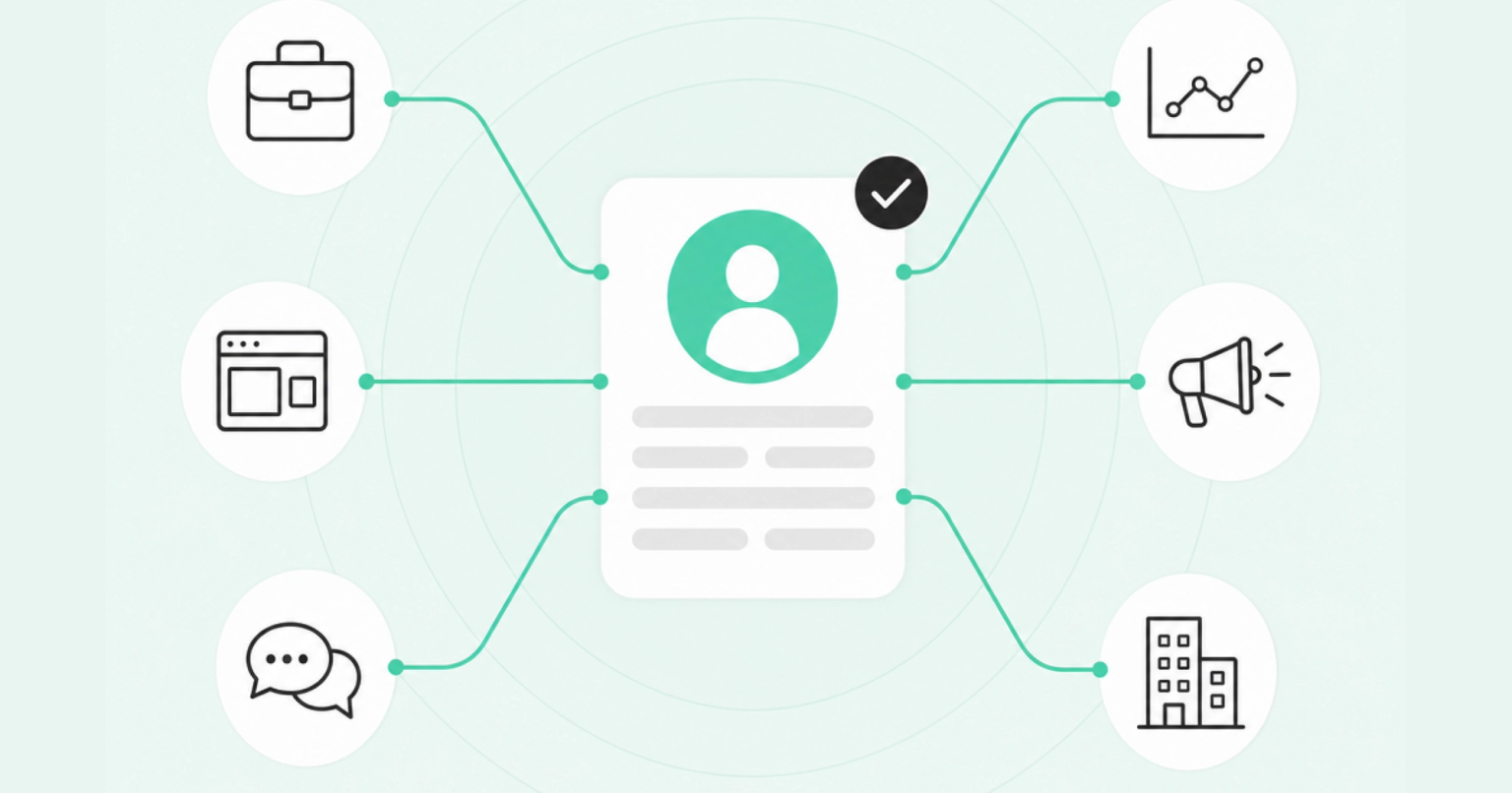
- **Visual**: Strong. One comparison table (four stack layers) plus a hero diagram of signals converging into a resolved profile. The table is the load-bearing visual.
- **Aural**: Weak. No audio, no embedded talk. The prose has a declarative cadence that reads aloud well.
- **Verbal**: Strong. Short sentences, aphoristic turns ("Accounts don't buy. People do."), and named concepts that are easy to repeat.
- **Kinesthetic**: Moderate. The indicator lists are directly actionable; nothing else invites doing.
- **Logical**: Moderate. The four-layer taxonomy is clean and the 11%-versus-46% contrast is a real inference. Weakened by unsourced premises and a single-case proof.
- **Social**: Moderate. Framed around cross-functional agreement between marketing, sales, and RevOps; no discussion prompt or community element.
- **Solitary**: Strong. A short, self-contained read.
- **Naturalistic**: Weak. No ecological, seasonal, or environmental framing; the closest analogue is the "silent tax" metaphor.
- **Reading level**: Roughly grade 10–12 / early undergraduate. Sentences are short but the vocabulary is heavily jargoned (dark funnel, waterfall enrichment, MQL, SLA, buying committee, signal-to-action gap), so a reader outside B2B GTM will find it harder than the sentence length suggests.
## 📊 Accessibility Assessment
Mapped to WCAG 2.2 AA, based on the captured content and its markup.
1. **Text alternatives (1.1.1)**: Pass. The hero image carries a descriptive alt text — "Multi-source signals converging into one resolved person profile" — which conveys the concept rather than the decoration.
2. **Adaptable structure (1.3.1)**: Pass. Headings are properly nested, the layer comparison uses a real data table with a header row, and the indicator groups use genuine lists.
3. **Contrast and visual presentation (1.4.3, 1.4.11)**: Not assessable from the capture; the rendered site styling was not retained. Flag for check on the live page.
4. **Reflow and text spacing (1.4.10, 1.4.12)**: Not assessable from the capture. The four-column table is the likely narrow-viewport risk and should be verified for horizontal scroll at 320px.
5. **Link purpose in context (2.4.4)**: Mostly pass. Anchor text such as "Validity's 2025 CRM research," "Person360," and "request a demo" is self-describing. "Data silos" and "RevOps" are thinner but remain interpretable in sentence context.
6. **Headings and labels, focus appearance (2.4.6, 2.4.11, 2.4.13)**: Headings are descriptive and accurate. Focus indicators and focus-not-obscured cannot be judged from the capture — verify on the live site.
7. **Readable language (3.1.1, 3.1.3)**: Partial. Language is presumably declared by the CMS, but unexpanded jargon (dark funnel, waterfall enrichment, MQL, SLA) is a comprehension barrier for non-specialists and none is defined inline. Cognitive-accessibility improvement: define each on first use.
## 🌍 DEIB Assessment
- **Cultural breadth**: Narrow. The frame is US/Western B2B SaaS throughout. No consideration of jurisdictions where cross-platform profiling is restricted, and no acknowledgment that GDPR-region buyers and community members face a materially different regime.
- **Inclusive language**: Adequate. No gendered defaults, no ableist idiom of note. "Enablement theater" is pointed but aimed at process, not people.
- **Neurodiversity support**: Reasonable. Short paragraphs, frequent headings, bulleted indicator lists, and a summary table all support scanning and reduce working-memory load. Jargon density works against this.
- **Representation**: Limited. Practitioners appear as roles (reps, RevOps, leaders) rather than people; one named customer, Weaviate, and one named partner, Zoom, both firmly in the enterprise-tech mainstream. Community members appear only as signal sources, never as participants with interests.
- **Psychological safety**: Mixed. The opening deliberately absolves the reader ("the problem isn't effort"), which is disarming and generous. But the underlying move — rendering individuals legible and scoreable without their knowledge — creates the opposite condition for the people being scored, and the piece never registers the tension.
## ✅ Logical Validity
**Strong reasoning.** The four-layer taxonomy does real work: distinguishing record, explanation, execution, and decision is a genuine analytical contribution, and the author strengthens it by refusing the easy "CRM is dead" claim. The 11%-routing versus 46%-content-creation contrast is a legitimate inference from cited data to the conclusion that AI adoption has favored generation over decision-making. Disambiguating "revenue operating system" from the billing category is an honest move most vendor content skips. And the vanity-versus-pipeline-metrics distinction is sound and self-applying.
**Fallacies identified.**
1. **False dilemma** — located at "You don't close it by adding a widget. You close it by building a system that knows the buyer first." The options are framed as widget-adding versus buying the described system, which excludes the most common real remedies: writing a shared definition of "ready," consolidating existing tools, or fixing CRM hygiene without a new identity layer. *Fix*: state the alternatives and argue why they fall short, rather than eliminating them by construction.
2. **Hasty generalization** — located at "The result was threefold pipeline generation, not more dashboards." A single self-reported customer outcome, published by the vendor, is offered as "the bar." No control period, no isolation from concurrent changes, n=1. *Fix*: report median results across a customer cohort with the time window and the confounders named, or present Weaviate explicitly as an illustration rather than as evidence.
3. **Appeal to unfalsifiable quantification** (a form of vague-quantifier equivocation) — located at "reduces duplicate records by up to 79% in product use." "Up to" makes the claim true if one customer once hit 79%, while the sentence reads as a typical result. *Fix*: publish median and range with the measurement method, or drop the number.
**Minor issues.** The opening "more tools were never the fix / but you added them anyway" sets up a straw reader who bought tools thoughtlessly. And there is a mild circularity in defining the revenue OS as the thing that answers who matters, then concluding that what stacks lack is something that answers who matters.
**Tone of voice.** Confident, clipped, second-person, deliberately unhyped. Sentence fragments used for emphasis. The rhetorical strategy is concession-then-redirect: agree with the reader's frustration, absolve them of blame, then locate the cause in a gap only the sponsor's product fills. "We have to prove this works before we ask you to trust it" is a genuinely effective humility move, though it precedes a demo CTA in the same paragraph. Where it is selling: every "Know" paragraph, the named-product cluster (Person360, Context360, Buying Committee, AI Scoring, Dial, Engage, Ads, Coach, Forecast), the Weaviate proof, and the close. Where it is not: the layer taxonomy, the category disambiguation, and the indicator lists — those survive removal of the product.
## 🛡️ DARVO Analysis
**Deny.** No denial of wrongdoing, because no wrongdoing is alleged or acknowledged. There is, however, a notable omission that functions adjacent to denial: the piece enumerates community, social, and dark-funnel activity as inputs and never raises privacy, consent, or disclosure. Silence is not DARVO, but it is the precondition for never having to deny anything.
**Attack.** No attacks on people. Criticism is aimed at categories — "another dashboard that promised clarity," "a marketing automation system of guesses," "enablement theater," "black box they learn to ignore." Competitors are characterized generically rather than named, which is mild and within normal comparative-marketing bounds.
**Reverse victim and offender.** Not present in the classic sense. There is a softer structural analogue worth naming: the reader who has spent heavily on tooling is positioned as the wronged party ("the problem isn't effort"), which is sympathetic and true as far as it goes — but it also relocates accountability away from purchasing decisions and toward an abstract category gap, and the remedy for that gap is another purchase. The people with the strongest claim to being affected, the community members whose activity becomes signal, never appear as stakeholders at all.
**Verdict**: No DARVO pattern. Standard sympathetic-vendor framing with a consequential omission.
## 🎯 Conclusion
**Bottom line.** A well-constructed vendor essay with a real idea inside it. The four-layer stack model and the leading/pipeline/organizational indicator framework are worth keeping and are usable without buying anything. The evidence is entirely vendor-published, the one proof point is n=1, and the headline product statistic is hedged into unfalsifiability. Most importantly for a DevRel reader: the piece proposes routing community participation into sales scoring and never once mentions what the community was told.
**Next steps.**
1. Lift the three-tier indicator framework into the DevRel scorecard, substituting developer outcomes for the pipeline tier.
2. Draft the disclosure the article omits — one page, plain language, published where community members are.
3. Before any signal tool is adopted, get a written answer on retention, subject access, and deletion, and on whether support quality can vary by account score.
4. Read parts two and three (Act, Learn) with the same question: who is being measured, and were they told?
## 🧱 Refactor Appendix
### Literature Split Pad
### L1 — Person-level signal inventory
> [!quote] Know means person-level intelligence across CRM, product usage, website activity, community, social engagement, job changes, and every other first- and third-party signal you have, resolved to one profile per person and account.
The operative definition of the whole piece, and the sentence that puts community participation inside the sales stack.
`#atom/literature/h1`
### L2 — Duplicate identity as the hidden cost
> [!quote] Duplicate identity is the silent tax on every play you run. Without this layer, you're not operating a revenue system. You're operating a marketing automation system of guesses.
The product's core value claim, stated as a diagnosis of everyone else's stack.
`#atom/literature/h2`
### L3 — Vanity metrics versus pipeline metrics
> [!quote] Vanity metrics, like agent prompts run and content drafts generated, will flatter you. Pipeline metrics will tell the truth.
The most portable line in the article; transfers directly to DevRel measurement debates.
`#atom/literature/h3`
### Atomic Split Pad
#### Z1 — Public is not consented
When public community activity is resolved into a scored commercial profile, the information has crossed contexts without the subject's participation. Contextual integrity, not publicness, is the right test. A DevRel team adopting signal tooling inherits a disclosure obligation the tooling vendor does not mention.
`#atom/zettel/z1`
### Fleeting Queue
#### F1 — AI raised volume, not clarity
The 11%-routing versus 46%-content-generation split is the cleanest available evidence that AI adoption has gone to producing more rather than deciding better. Reusable in any DevRel talk about AI and developer experience. Check the LeanData report for n and method before citing.
`#atom/fleeting/f1`
<!-- deep-read:sections end -->
📄 **Full text:** [[Full Document Contents/Articles/Your CRM Knows the Deal. It Doesn't Know the Buyer..md|Your CRM Knows the Deal. It Doesn't Know the Buyer. by Tasha Reasor]]
## Highlights
- AI increased the volume of data, signals, activity, and content. It didn't increase clarity, prioritization, or conversion. ([View Highlight](https://read.readwise.io/read/01m2pfg0fjwf920fg7hdkv60km))
- Note: The article's sharpest general claim, supported by the 11%-routing vs 46%-content-generation split.
- Tags: atom/fleeting/f1
- You don't close it by adding a widget. You close it by building a system that knows the buyer first. ([View Highlight](https://read.readwise.io/read/01m2pfg28jnmbcf2p04w4c88zr))
- Note: False dilemma: excludes the real alternatives (shared definition of ready, tool consolidation, CRM hygiene) by construction.
- Tags: fallacy/false-dilemma
- Know means person-level intelligence across CRM, product usage, website activity, community, social engagement, job changes, and every other first- and third-party signal you have, resolved to one profile per person and account. ([View Highlight](https://read.readwise.io/read/01m2pffre90scdmq6sqf4dnz8n))
- Note: The operative definition of the piece, and the line that places community participation inside the sales stack without mentioning consent.
- Tags: atom/zettel/z1, atom/literature/h1
- Know means person-level intelligence across CRM, product usage, website activity, community, social engagement, job changes, and every other first- and third-party signal you have, resolved to one profile per person and account. ([View Highlight](https://read.readwise.io/read/01m2zdwbf159nrz8gt8det2wcw))
- This is the identity layer Common Room owns outright: Person360 and Context360, built on waterfall enrichment and identity merging that reduces duplicate records by up to 79% in product use. ([View Highlight](https://read.readwise.io/read/01m2pfgb7pvtw7x0x3bx9wn0cd))
- Note: "Up to 79%" is true if one customer once hit it, but reads as typical; no baseline, sample, or method.
- Tags: fallacy/unfalsifiable-quantification
- Duplicate identity is the silent tax on every play you run. Without this layer, you're not operating a revenue system. You're operating a marketing automation system of guesses. ([View Highlight](https://read.readwise.io/read/01m2pffwnxzs0fzac7x20kb0n6))
- Note: The product's core value claim, stated as a diagnosis of everyone else's stack.
- Tags: atom/literature/h2
- Vanity metrics, like agent prompts run and content drafts generated, will flatter you. Pipeline metrics will tell the truth. ([View Highlight](https://read.readwise.io/read/01m2pffygvtwk9gdp2aqt8avsg))
- Note: Most portable line in the article; transfers straight to DevRel measurement debates.
- Tags: atom/literature/h3, action/h3
- The result was threefold pipeline generation, not more dashboards. ([View Highlight](https://read.readwise.io/read/01m2pfg41tcx4bzfpbgz97fjys))
- Note: Hasty generalization: one self-reported customer, published by the vendor, offered as "the bar."
- Tags: fallacy/hasty-generalization