Your Champion Isn't Enough
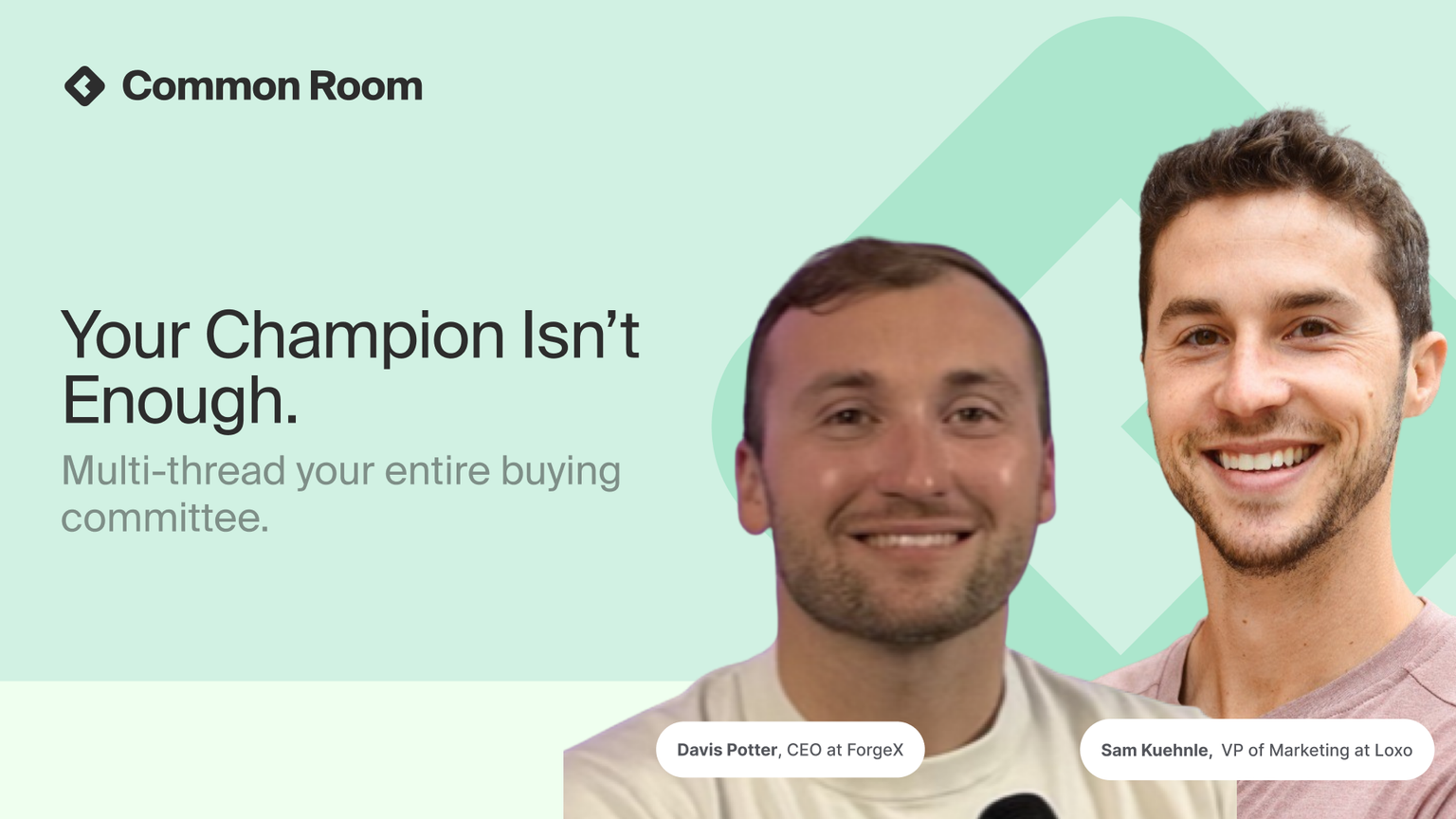
🔗 **Source:** [Your Champion Isn't Enough](https://www.commonroom.io/blog/your-champion-isnt-enough/)
> [!note]+ Document Notes
> tags: [account-based-marketing, buying-committee, multi-threading, community-signals, revenue-operations]
> author: [MISSING]
> source: Common Room
> reference: https://www.commonroom.io/blog/your-champion-isnt-enough/
> date created: 2026-07-28 12:45
>
> > [!info] Generated analysis — not the author's words. Sections below are machine-written
> > from the captured source. Only text inside `> [!quote]` blocks is verbatim from the author.
> > Do not quote or attribute any other line to the named author.
>
> # 🏷️ Title: Your Champion Isn't Enough
>
<!-- deep-read:sections start -->
## 🧭 Table of Contents
- [📝 Summary](#-summary)
- [📖 Main Content](#-main-content)
- [🗒️ Notes](#️-notes)
- [📚 References](#-references)
- [🗣️ Paraphrase](#️-paraphrase)
- [📰 Newsletter](#-newsletter)
- [✅ Action Items](#-action-items)
- [🧪 Hypotheses](#-hypotheses)
- [📊 Methodology](#-methodology)
- [❓ Questions](#-questions)
- [🔮 Future Research](#-future-research)
- [💡 Implications](#-implications)
- [🧠 Learning Styles Assessment](#-learning-styles-assessment)
- [📊 Accessibility Assessment](#-accessibility-assessment)
- [🌍 DEIB Assessment](#-deib-assessment)
- [✅ Logical Validity](#-logical-validity)
- [🛡️ DARVO Analysis](#-darvo-analysis)
- [🎯 Conclusion](#-conclusion)
### 🔗 References
- [Original post — Common Room](https://www.commonroom.io/blog/your-champion-isnt-enough/)
- [Gartner via IntentAmplify — B2B buying group of 6 to 10 stakeholders](https://intentamplify.com/blog/b2b-buying-decision-process/)
- [Gong — analysis of 1.8 million opportunities on multi-threading to executives](https://www.gong.io/blog/when-and-how-to-multi-thread-when-selling-to-executives)
- [SalesMotion — multi-threading sales strategy](https://salesmotion.io/blog/multi-threading-sales-strategy)
- [Landbase — over 40% of B2B deals stall on internal misalignment](https://www.landbase.com/blog/multi-threading-enterprise-deals-win-rate-2026)
- [Video — Sam Kuehnle @ Loxo on the multi-threading campaign](https://www.youtube.com/watch?v=Ab9xEG0ErwI)
- [Video — Davis Potter @ ForgeX on the 90-day rule](https://www.youtube.com/watch?v=3P8t0pG919s)
## 📝 Summary
- **What happened.** Common Room published an operator-interview post arguing that account-based marketing programs systematically under-cover buying groups: they engage one champion per account while the actual decision involves six to ten people. It presents two named practitioner plays — Sam Kuehnle (VP of Marketing, Loxo) on proactive versus reactive ABM, and Davis Potter (CEO, ForgeX) on a 90-day engagement review rule — and closes with a product pitch for Common Room's buying-committee visibility features.
- **Why it matters.** The failure mode described is specific and diagnosable: the deal dies in a meeting the seller was not in, because everyone else in the room encountered the vendor for the first time when the champion presented. The post reframes this from a champion-quality problem to a coverage problem, which changes what you measure and what you do about it.
- **Key stakeholders.** ABM and demand-generation marketers; sales leadership and individual reps; revenue operations owning the data model; the buying-side stakeholders themselves (CFO, IT, procurement, skeptical VPs) who are researching independently; Common Room as the vendor whose product the analysis is designed to justify.
- **Risks and tradeoffs.** The post is vendor content and its conclusion is that you need the vendor's tooling — the analysis is real but the framing is not disinterested. The cited statistics come mostly from secondary aggregator blogs rather than primary sources. The 90-day rule risks becoming activity theater if re-engagement is measured by touches rather than genuine engagement. Expanding outreach across a buying group without genuine role-relevant context produces spam at scale, which the post acknowledges but cannot fully guard against.
- **Bottom line.** The durable insight is structural rather than tactical: multi-threading fails as a task on a checklist and works only as a continuously answered set of questions about who is in the group, who is engaged, who has gone dark, and who is missing entirely. Whether that requires this particular vendor is the question the post is designed not to ask.
## 📖 Main Content
- **The autopsy framing.** The post opens with a diagnostic image rather than a statistic: one great champion, five strangers in the decision meeting. The champion loved the demo and built the business case, then presented to a room of people who had never heard the vendor's name. The deal died somewhere the seller had no presence. This is offered as the common cause behind stalled pipeline.
- **The coverage argument.** Four supporting data points are marshalled: Gartner places the typical B2B buying group at six to ten stakeholders, each researching independently and forming independent opinions; Gong's analysis of 1.8 million opportunities found closed-won deals have roughly twice as many buyer contacts as lost ones; deals with five or more engaged stakeholders close at higher rates; and over 40% of B2B deals stall on internal misalignment rather than competitive loss. The post's synthesis is that "no decision" kills more pipeline than any competitor — a reframe that redirects attention from competitive differentiation toward internal-consensus enablement.
- **Play one — proactive versus reactive ABM (Sam Kuehnle, Loxo).** The distinction drawn is that reactive ABM operates on the buyer's timeline, answering questions as they arrive; proactive ABM anticipates what the buying group will need and shapes the narrative before the buyer knows what to ask. The operational move is counterintuitive: rather than removing converted accounts from targeting once a champion raises their hand — the standard efficiency play — Kuehnle's team expanded reach *within* those accounts, targeting CXOs, finance directors, and IT leaders who would later weigh in. The content changed accordingly: not awareness material, because those people are not at the awareness stage of their colleague's project, but ROI calculators, implementation timelines, and change management guides. Reported results are higher win rates, shorter cycles, and less end-stage friction convincing finance.
- **Play two — the 90-day rule (Davis Potter, ForgeX).** Derived from a closed-won analysis finding that 90 to 95% of the buying group was actively engaged at close in their best deals. The mechanism: monthly review of every contact in the buying group against a single rule — no engagement in 90 days means treated as lost. This converts coverage from an aspiration into a reviewable question with a named person attached ("Lisa is the CMO and critical to this deal, but she hasn't engaged in 75 days"). Two design details carry the weight: re-engagement was role-specific rather than generic content sends, and marketing and sales ran the review jointly with no lead handoff. Reported result: engagement rose as deals progressed rather than decaying onto a single overloaded champion.
- **The systems argument.** The post's strongest section argues both plays fail as to-do items and work only as systems, because both depend on continuously answering five questions: who is in the buying group including hidden influencers; who is engaged now and through which channel; who has gone dark and for how long; which role has no contact at all; and what each person cares about. A one-time account map is stale by week three, at which point multi-threading collapses into "we should really loop in the CFO at some point."
- **The pitch.** The final third maps those five questions onto Common Room features — person-level signals, Person360 identity unification, automatic gap surfacing, and plays triggering re-engagement before the 90-day line — and closes with a demo request.
- **Uncertainties and contested claims.** The numbers are reported through secondary blogs, not primary research documents, and the Gartner figure in particular is widely repeated without consistent sourcing. The Gong correlation (winning deals have twice the contacts) is presented in a context implying causation — that adding contacts causes wins — when deals that are going well naturally attract more participants. Both practitioner results are self-reported with no counterfactual. The 90 to 95% engagement figure comes from analyzing *best deals*, which is selection on the dependent variable.
### 🗒️ Notes
- **"That's not a champion problem. It's a coverage problem."** The pivot the whole post rests on. Reframing a quality problem as a coverage problem changes the intervention from "find better champions" to "reach more of the room," which is operationally tractable in a way the former is not.
- **The counterintuitive targeting move.** Standard practice removes an account from targeting once it converts a champion — it looks like waste to keep spending there. Kuehnle's inversion treats champion conversion as the *start* of the committee campaign, not the end of the account campaign. This is the most transferable idea in the post because it costs nothing but a change in suppression rules.
- **Content stage mismatch.** "These people weren't at the awareness stage of their colleague's project." Sharp observation: the committee is at a *decision* stage on a project they just learned about, so awareness content is stage-appropriate for the person and stage-inappropriate for the deal. ROI calculators, implementation timelines, and change management guides are the material a leadership team needs to say yes.
- **"The internal sell happens before the meeting, not during it."** The thesis compressed. Everything else is machinery for making that true.
- **The 90-day rule as a forcing function.** Its value is less the specific threshold than that it converts a vague aspiration into a binary, reviewable state with a named human attached. Any threshold would work; having one is the intervention.
- **Joint review, no handoff.** "No lead handoffs, no 'marketing's job is done here': one shared view of the group, worked jointly." Easy to skim past, but this is the organizational precondition — the rest is unenforceable across a marketing-to-sales handoff boundary.
- **Selection on the dependent variable.** The 90–95% engagement figure comes from examining best deals. Deals that go well generate engagement; engagement in deals that were going to fail is much harder to manufacture. The causal arrow is not established and the post does not raise the question.
- **Community relevance beyond sales.** The five questions generalize cleanly to any multi-stakeholder consensus process — open source governance proposals, standards adoption, RFC approval, foundation funding decisions. The mechanics of getting a room to say yes are not sales-specific.
## 📚 References
- [Common Room — Your Champion Isn't Enough](https://www.commonroom.io/blog/your-champion-isnt-enough/)
- [Gong — When and how to multi-thread when selling to executives](https://www.gong.io/blog/when-and-how-to-multi-thread-when-selling-to-executives)
- [IntentAmplify — B2B buying decision process (citing Gartner)](https://intentamplify.com/blog/b2b-buying-decision-process/)
- [SalesMotion — Multi-threading sales strategy](https://salesmotion.io/blog/multi-threading-sales-strategy)
- [Landbase — Multi-threading enterprise deals and win rate](https://www.landbase.com/blog/multi-threading-enterprise-deals-win-rate-2026)
- [Common Room — Accounts Don't Buy. People Do.](https://www.commonroom.io/blog/accounts-dont-buy-people-do/)
- [Common Room — Your Buyers Talk To Each Other. Just Not To You.](https://www.commonroom.io/blog/buying-committee-visibility/)
## 🗣️ Paraphrase
- **Opening.** Stalled deals share an autopsy: one strong champion and five people in the decision meeting who had never heard of you. The champion did everything right and the deal still died somewhere you were not present.
- **The reframe.** This is not a failure of champion quality. It is a failure of coverage — you engaged one person in a decision that involves six to ten.
- **The evidence.** Buying groups typically run six to ten people who each research independently. Won deals carry roughly twice the buyer contacts of lost ones. Deals with five or more engaged stakeholders close at higher rates, and more than 40% of B2B deals die from internal misalignment rather than losing to a competitor.
- **The gap.** Most ABM programs know all of this and still engage exactly one person per account.
- **Kuehnle's distinction.** ABM is either reactive — answering the buyer's questions on the buyer's timeline — or proactive, anticipating what the group will need and shaping the story before they know what to ask. Most teams choose reactive without noticing they chose.
- **Kuehnle's play.** Rather than suppressing accounts once a champion converts, expand within them: target the executives, finance, and IT people who will weigh in later, and serve decision-stage material rather than awareness material.
- **Kuehnle's result.** When the champion walks into the leadership meeting, the room already knows the story and has seen what success looks like. The internal sell has already happened.
- **Potter's finding.** In his team's best closed-won deals, 90 to 95% of the buying group was actively engaged at close, and that was deliberate rather than accidental.
- **Potter's rule.** Review every buying-group contact monthly; anyone who has not engaged in 90 days is treated as lost. That makes coverage a concrete question with a name attached rather than a vague aspiration.
- **Potter's execution details.** Re-engagement was tailored to each person's role and interests rather than generic content, and marketing and sales ran the review together as one shared view rather than handing leads across a boundary.
- **The systems argument.** Neither play survives as a line on a rep's task list, because both require continuously knowing who is in the group, who is engaged, who has gone dark, who is missing entirely, and what each person cares about. Answer those from a stale one-time account map and multi-threading collapses back into good intentions.
- **The pitch.** Common Room positions its person-level signals, identity unification, gap detection, and triggered plays as the continuous answer to those five questions.
## 📰 Newsletter
**"Your champion isn't enough" — and the same is true of your RFC sponsor.** Common Room's latest operator post is nominally about B2B sales, but strip the CRM vocabulary and it describes something painfully familiar to anyone who has pushed a proposal through an open source project: one enthusiastic advocate walks into a room of people who have never heard the argument, and the thing dies there.
Two plays worth stealing. **Sam Kuehnle (Loxo)** inverts a standard efficiency rule — instead of *reducing* outreach to an account once someone raises their hand, expand it, and switch from awareness material to the decision-stage material the rest of the room actually needs. His line is the whole post: *"When your champion walks into that leadership meeting, the people in the room already know your story."* **Davis Potter (ForgeX)** runs a monthly review where any stakeholder who hasn't engaged in 90 days is treated as lost — not because 90 days is magic, but because a binary threshold turns "we should loop in the CFO sometime" into a reviewable question with a name on it.
The WordPress translation is direct. Make proposals, a governance change, a new focus for a release cycle — the pattern is identical: identify who will actually weigh in, notice who has gone quiet, and notice which role has *no* representation at all. That last one is the hidden killer, and it is the one nobody tracks.
Fair warning: this is vendor content and the conclusion is that you need the vendor's product. The stats are also all cited through secondary blogs rather than primary sources, and the "best deals had 95% engagement" finding is selection on the dependent variable — winning deals generate engagement as much as engagement generates wins. Read it for the mechanics, not the arithmetic. [The post is here.](https://www.commonroom.io/blog/your-champion-isnt-enough/)
## ✅ Action Items
#### DevRel
- Developer advocacy: map the "buying committee" equivalent for developer tooling adoption — the platform team, the security reviewer, the budget holder, the ICs who will actually use it — and check which of those roles your advocacy currently reaches.
- Education: build enablement material for the roles that block adoption rather than the roles that champion it; the security review guide is worth more than another tutorial.
- Developer experience: create the decision-stage artifacts a champion needs to sell internally — migration cost estimate, rollback plan, support commitment — and ship them as first-class docs rather than sales collateral.
- Developer marketing: audit your suppression rules for the Kuehnle inversion; if you stop targeting an account after a signup, you are removing air cover exactly when the internal sell begins.
- Community management: track which community members have gone quiet on an ongoing initiative and re-engage with role-relevant context, not a generic newsletter.
- Internal/external/cross-project: apply the joint-review model to cross-team initiatives — one shared view of stakeholders worked together, no handoffs.
#### OSPO
- Policy & Governance: adopt the five coverage questions as a checklist for any policy change requiring org-wide buy-in; "which role has no contact at all" is the one that predicts failure.
- License Compliance: identify the full stakeholder set for a policy rollout — legal, engineering leadership, procurement, individual maintainers — and cover each with role-appropriate material rather than one all-hands deck.
- Security Management: the multi-threading logic applies to embargo coordination; a single contact at a downstream consumer is a single point of failure during disclosure.
- Software Inventory: not applicable to this source; no inventory or SBOM dimension appears.
- Developer Support: run a monthly staleness review on relationships with key internal consumers using an explicit threshold, borrowing Potter's rule directly.
- Community Engagement: apply the 90-day rule to upstream relationships and sponsor contacts; quiet relationships decay silently and are noticed only when something is needed.
- Strategic Alignment: report stakeholder coverage as an OKR input for major initiatives, not just delivery milestones.
#### Community
- Maintainers: before proposing a significant governance change, list every party who will weigh in and note who has never heard the argument — the post's core diagnostic, applied upstream.
- Contributors: recognize that a proposal's fate is usually decided in conversations you are not in, and that the remedy is written, discoverable, role-relevant material rather than more advocacy in the thread.
- Sponsors: sponsor relationships have buying committees too — the champion who advocates internally, the finance approver, the marketing lead measuring return. Cover all three or renewal becomes a surprise.
- Ecosystem: coordinate stakeholder mapping across projects for shared initiatives so the same executives are not approached five times with five framings.
#### WordPress
- Core: for any significant proposal, identify committers, component maintainers, and hosting stakeholders who will weigh in, and check for roles with zero engagement before the discussion opens.
- Core Performance: performance budget adoption needs hosting partners and plugin authors, not just Core contributors; map both.
- Core AI: AI feature adoption faces a genuine buying committee — security reviewers, privacy-conscious users, hosts absorbing the cost. Address each with material aimed at their objection.
- **Core Program Team:** add stakeholder coverage to cross-team coordination rituals; note which teams have gone silent on a shared dependency and treat 90 days of silence as a status, not a lull.
- Mobile: identify which stakeholders decide mobile priorities and whether any are currently unrepresented.
- Playground: Playground's adoption depends on educators, contributors, and hosts — three distinct audiences needing three distinct arguments.
- Community: apply the 90-day rule to meetup and WordCamp organizers; organizer attrition is silent and visible only at renewal time.
- Training: build the decision-stage material an internal champion needs to justify WordPress training spend to their leadership — this is the missing artifact.
- Marketing: the "no decision kills more pipeline than any competitor" reframe applies directly to platform selection; address internal-consensus barriers rather than competitor comparisons.
- Support: identify the stakeholders behind recurring escalations rather than treating each ticket as isolated.
- Design: research the full stakeholder set for design system adoption, including the plugin authors who must implement it.
- Documentation: docs are the decision-stage artifact for the non-champion stakeholders — the security reviewer and the platform lead read docs, not blog posts.
- Photos: not applicable to this source.
- TV: not applicable to this source beyond general content distribution.
- Polyglots: locale communities have their own stakeholder structures; a single contact per locale is the single-champion failure mode at scale.
- Accessibility: the accessibility-ready theme requirements need theme authors, hosts, and directory reviewers aligned — a textbook multi-stakeholder consensus problem where one silent group stalls everything.
- Meta: instrument who is engaged on a given make.wordpress.org initiative so silence is visible rather than inferred.
- CLI: identify who decides CLI adoption in agency and hosting contexts.
- Hosting: hosts are the classic hidden influencer in WordPress decisions — often unrepresented in project discussions until they are the blocker.
- Tide: not applicable to this source.
- Openverse: not applicable to this source.
- Themes: theme directory policy changes need author, reviewer, and user stakeholders covered; the current accessibility deadline is a live test of exactly this.
- Plugins: same structure as Themes — policy changes stall when one stakeholder group was never engaged.
#### The WPOCC
- Programs: apply buying-committee logic to fellowship and microgrant fundraising — the champion at a sponsor company is not the person who approves the budget.
- Projects: use the five coverage questions as a standard section in project charters, making "which role has no contact" an explicit field.
- Funding experiments: track funder-side stakeholder engagement with an explicit staleness threshold; publish coverage alongside financials in the transparent ledger.
### FAIR
- Technical independence: adoption of independent infrastructure requires hosts, plugin authors, and end users to align — the classic multi-stakeholder consensus problem the post describes, with the same failure mode.
- Policies and covenants: covenant adoption needs the legal reviewer and the executive sponsor covered separately, with different material for each.
- Productized governance artifacts: package a "stakeholder coverage map" as a reusable governance artifact with the five questions as its fields.
## 🧪 Hypotheses
- **H1.** Accounts that continue receiving targeted outreach after champion conversion show higher close rates than accounts suppressed at conversion, controlling for account size and segment.
- **H2.** A monthly staleness review with an explicit engagement threshold increases buying-group coverage at close more than an equivalent volume of untargeted outreach.
- **H3.** The relationship between contact count and win rate is substantially confounded by deal health — that is, deals going well attract contacts, rather than contacts causing deals to go well.
- **H4.** Role-specific re-engagement content produces higher response rates from previously dormant stakeholders than generic content of equivalent quality.
- **H5.** Joint marketing-and-sales stakeholder review produces higher coverage than either function reviewing independently, with the effect concentrated in identifying *missing* roles rather than re-engaging dormant ones.
- **H6.** The five coverage questions predict outcome in non-sales consensus processes — open source RFC adoption, standards ratification, foundation funding — as well as they do in B2B deals.
### 📊 Methodology
- **For H1 (the highest-value test).** Randomize accounts at champion conversion into continued-targeting and suppressed arms. Measure close rate, cycle length, and stakeholder count at close. Randomization matters here more than anywhere else in this list, because the observational version is hopelessly confounded — teams choose to keep spending on accounts that look promising.
- **For H2 (quasi-experimental).** Stagger introduction of the staleness review across sales pods, using a stepped-wedge design. Outcome is the proportion of the identified buying group engaged at close. Pair with a process measure distinguishing genuine re-engagement from touch-logging, or the intervention will appear to work while producing only activity.
- **For H3 (reanalysis).** Model win rate as a function of contact count with deal-stage progression, deal size, and elapsed time as covariates; ideally use contact count measured at a fixed early stage rather than at close, which removes the reverse-causal path. This is the single most important methodological correction to the post's evidence base.
- **For H4 (A/B test).** Randomize dormant contacts to role-specific versus generic re-engagement content matched for production quality. Response rate and meeting acceptance as outcomes. Controlling for quality is essential — role-specific content is usually also better content.
- **For H5 (comparative).** Compare pods running joint reviews against pods running separate function reviews, decomposing the coverage outcome into re-engaged-dormant and newly-identified-missing components. The post's implicit claim is that joint review helps mainly with the second.
- **For H6 (cross-domain observational).** Code a corpus of open source proposals — WordPress make posts, Rust RFCs, W3C standards tracks — for stakeholder coverage at proposal time, then model adoption outcome. Coding scheme reliability is the main threat; two independent coders with a reported agreement statistic.
- **General caution.** Every effect size in the source post is self-reported by an interested practitioner with no counterfactual, and the 90–95% figure is drawn from best deals only. Treat all reported magnitudes as directional at most.
### ❓ Questions
- Does continued targeting after champion conversion actually improve outcomes, or does it mostly increase spend on accounts that were already going to close?
- Is 90 days the right threshold, or is any explicit threshold sufficient because the mechanism is the forcing function rather than the interval?
- What distinguishes genuine re-engagement from logged activity, and can the difference be measured without self-report?
- How much of the contact-count-to-win-rate correlation survives controlling for deal health measured at a fixed early stage?
- At what point does buying-group outreach cross from helpful air cover into spam that damages the champion's internal credibility?
- Do the five coverage questions generalize to consensus processes with no commercial transaction, where there is no CRM and no owner of the stakeholder map?
- Who owns the buying-group map when marketing and sales share it — and what happens to the joint review model when that ownership is contested?
### 🔮 Future Research
- **Causal identification of the multi-threading effect.** The entire practitioner literature rests on correlations between contact count and outcome. A randomized study at the account level would settle a question the industry has been asserting for a decade.
- **The saturation curve.** Nobody has published where added stakeholder outreach stops helping and starts harming. Practitioners assume monotonic benefit; the existence of a peak is far more likely and would change targeting strategy materially.
- **Cross-domain transfer.** Whether buying-committee mechanics predict outcomes in open source governance, standards bodies, and grantmaking is genuinely open and would be valuable well beyond sales. This is the most interesting research direction in the post for a non-commercial audience.
- **Hidden influencer detection.** The post asserts hidden influencers exist and matter but offers no method for identifying them beyond buying the product. Methodological work on inferring influence from observable signal — and validating it against post-hoc interviews — would be a real contribution.
- **Distinguishing engagement from activity.** No validated construct separates meaningful stakeholder engagement from logged touches. Building one would improve every study in this area, including the ones the post cites.
- **The champion-credibility cost.** No literature examines whether committee-wide outreach undermines the champion's standing internally. Practitioners assume it helps; the opposite is plausible and untested.
### 💡 Implications
- **Practice.** The single cheapest change available is auditing suppression rules: if your automation stops targeting an account when someone converts, you are withdrawing exactly when the internal sell begins. This requires no new tooling and no new budget.
- **Policy.** The joint marketing-and-sales review with no handoff is an organizational design decision, not a process tweak. It cannot be adopted piecemeal, and attempting the 90-day rule without it produces a review nobody owns.
- **Security.** Not directly applicable, though the multi-threading logic transfers cleanly to disclosure coordination, where a single point of contact at a downstream consumer is a genuine operational risk during an embargo.
- **Education.** The framing is a useful teaching device well outside sales: any proposal requiring multi-party consensus faces the same structure, and the failure is usually the unrepresented role rather than the unpersuasive argument.
- **Funding models.** For open source foundations and grant programs, the buying-committee model explains why sponsor relationships fail at renewal despite an enthusiastic internal champion — the champion changed roles, and nobody else in that organization knew the story.
- **Community equity consideration.** Engaging the "whole room" advantages parties who already have visibility into who is in the room. In open source governance, the analogous move can concentrate influence with those who already know the informal decision map, which argues for making stakeholder maps public rather than proprietary — the opposite of the post's vendor conclusion.
### 🧠 Learning Styles Assessment
- **Reading level estimate:** Flesch-Kincaid Grade Level approximately 10–11; Flesch Reading Ease approximately 52. Sentence structure is deliberately punchy with frequent fragments used rhetorically. Vocabulary assumes fluency with ABM, multi-threading, buying group, and pipeline terminology but explains the underlying concepts adequately for a general business reader. Stated read time is five minutes, which matches.
#### 👀 Visual learners
- Present: two embedded videos with thumbnails; pull-quote blocks styled distinctly from body text; a bulleted feature list at the close.
- Improve: the five coverage questions want a diagram — a buying-group map with engagement state color-coded per role would communicate the entire argument at a glance. A before/after of single-threaded versus multi-threaded coverage would do the same for the thesis.
#### 🔊 Aural learners
- Present: strong. Two embedded YouTube interviews with the featured operators mean the source material exists in audio form, not just as pull quotes.
- Improve: no audio version of the post itself, and no indication whether the embedded videos are captioned. A short audio summary would suit the conversational register.
#### 🗣️ Verbal learners
- Present: excellent. This is the post's strongest dimension — memorable aphoristic quotes ("ABM is either reactive or proactive"), a vivid opening analogy (the autopsy, the five strangers), and clear terminology.
- Improve: define "multi-threading" explicitly on first use rather than relying on audience familiarity; the term is jargon outside revenue teams and the post is otherwise accessible to a wider audience.
#### 🧩 Kinesthetic learners
- Present: the 90-day rule is genuinely actionable — a reader can run the monthly review described without any additional tooling.
- Improve: a worksheet version of the five coverage questions, and a template for the monthly review meeting, would convert the post from reading into doing. The gap here is deliberate: the product is positioned as the tool.
#### 🧠 Logical learners
- Present: a clear structure moving from problem to evidence to two plays to a systems argument. Statistics are cited with links.
- Improve: the causal reasoning needs work — the Gong correlation is presented in a causal context, and the 90–95% figure selects on the dependent variable. Acknowledging both would strengthen credibility with exactly the analytical reader most likely to notice.
#### 🧑🤝🧑 Social learners
- Present: the content is built from operator interviews, and the joint marketing-and-sales review is inherently collaborative.
- Improve: no discussion prompts or community forum links. A peer-comparison element — how does your coverage compare to similar teams — would suit the audience.
#### 🧘♀️ Solitary learners
- Present: short, self-contained, skimmable at five minutes.
- Improve: self-assessment questions — "how many stakeholders are engaged in your three largest open deals right now?" — would give a solitary reader an immediate personal application.
#### 🌿 Naturalistic learners
- Present: none.
- Improve: the decay framing is available and unused. Relationships decaying without tending is an ecological metaphor that would make the 90-day rule intuitive rather than arbitrary, and would connect to lifecycle thinking about account health.
### 📊 Accessibility Assessment
#### Screen reader semantics
- Present: a heading hierarchy with H1 title and H2 section headings; images carry alt attributes including a descriptive one on the author photo.
- Improve: the embedded YouTube players inject substantial unlabeled text into the reading order ("Tap to unmute", thumbnail-image, subscriber counts), which is disruptive to linear screen reader navigation. Pull quotes use bold-plus-blockquote rather than semantic citation markup, so attribution relationships are not programmatically conveyed. Maps to WCAG 2.2 AA 1.3.1 Info and Relationships.
#### Keyboard navigation
- Present: standard link and button navigation.
- Improve: the cookie consent banner ("Preferences / OK") appears at the document end in source order but is likely visually overlaid, which is a common focus-order defect; embedded video players need verified keyboard operability and escape behavior. Maps to WCAG 2.2 AA 2.4.3 Focus Order and 2.1.1 Keyboard.
#### Contrast and readability
- Present: the Common Room template uses generally high-contrast body text.
- Improve: verify the metadata line ("5 min read", date) and the cookie notice text, which render smaller and lighter and are the likely failures. Maps to WCAG 2.2 AA 1.4.3 Contrast (Minimum).
#### Text resizing and reflow
- Present: responsive layout.
- Improve: verify the embedded video containers do not clip or force horizontal scroll at 200% zoom — fixed-aspect iframes are a frequent reflow failure. Maps to WCAG 2.2 AA 1.4.10 Reflow.
#### Media and captions
- Present: two embedded videos are provided, extending the content into another modality.
- Improve: no transcripts are provided for either video, and caption availability is not indicated. Since the videos carry the primary practitioner evidence, this is a substantive content gap rather than a cosmetic one — a deaf reader gets only the pull quotes. Maps to WCAG 2.2 AA 1.2.2 Captions (Prerecorded) and 1.2.3 Audio Description or Media Alternative.
#### Forms and interactions
- Present: the cookie preferences control is reachable.
- Improve: the demo request flow is off-page and unassessed; the consent banner needs an accessible name and a documented dismissal path. Maps to WCAG 2.2 AA 3.3.2 Labels or Instructions and 2.5.8 Target Size (Minimum).
#### Standards reference
- Principal gaps map to WCAG 2.2 AA 1.2.2, 1.2.3, 1.3.1, and 2.4.3. The missing video transcripts are the most consequential because the videos carry unique content not fully duplicated in text.
### 🌍 DEIB Assessment
#### Cultural breadth
- Present: minimal. Both featured operators appear to be US-based, and all cited research is US and UK B2B SaaS.
- Improve: buying-group dynamics vary substantially across markets — consensus-oriented decision cultures, regions where procurement holds different authority, and non-English-language sales contexts all change the model materially. No acknowledgment appears that the six-to-ten-stakeholder figure is culturally situated.
#### Inclusive language
- Present: gender-neutral throughout; the single named hypothetical ("Lisa is the CMO") assigns a woman to the senior executive role, which is a small positive default.
- Improve: heavy unexplained jargon — ABM, multi-threading, air cover, pipeline, closed-won, Person360. A plain-language framing would widen reach considerably, and the underlying insight deserves a wider audience than revenue operations.
#### Neurodiversity support
- Present: strong. Short sections, frequent headings, bulleted lists, distinct pull quotes, and a stated read time all support predictable navigation and self-pacing.
- Improve: the embedded video blocks interrupt the reading rhythm with a large block of unrelated interface text, which is disorienting for readers relying on consistent structure.
#### Representation
- Present: two named practitioners with photos and role attribution, quoted substantively.
- Improve: both featured operators appear to be white men in similar senior roles at similar-stage companies — no diversity of role seniority, company size, industry, or background. The perspective of the *buyer* side, and of junior practitioners who execute these plays, is entirely absent. Alt text on the header photo names the individuals, which is good practice.
#### Psychological safety
- Present: the framing is notably non-blaming toward the reader — the failure is attributed to a systemic coverage gap rather than to poor selling, and "most ABM programs know all of this and still engage exactly one person" normalizes the gap rather than shaming it.
- Improve: the 90-day rule creates a surveillance dynamic that the post does not examine — it is a monitoring system applied to relationships, and the buying-side stakeholders being tracked have not consented to and are not aware of it. A post about person-level signal tracking that never raises privacy is a meaningful omission, and it is the ethical question the product itself raises most sharply. No content warning is needed for the material.
### ✅ Logical Validity
#### Strong reasoning
- **Convergent evidence across independent sources.** Four separate data points — group size, contact count differential, stakeholder threshold effects, and stall causes — all point the same direction. Convergence from independent measurements is genuinely stronger than any single statistic, and the post assembles them well.
- **Analogical reasoning from the reframe.** Recasting a champion problem as a coverage problem is a well-formed analogy: it maps a quality dimension onto a quantity dimension where the quantity is measurable and actionable. The reframe earns its conclusion because the proposed interventions follow directly from it.
- **Strong practical inference in the systems argument.** "Neither survives as a line on a rep's task list, because both depend on answering questions most GTM stacks can't answer on demand" is the post's best reasoning. It identifies a genuine dependency — the plays require continuously fresh state — and correctly infers that intermittent manual effort cannot supply it. The inference holds independently of whether the vendor's product is the answer.
- **Explicit specification of the failure mode.** "Answer them from a one-time account map that's stale by week three, and multi-threading collapses back into 'we should really loop in the CFO at some point'" states the defeating condition concretely rather than gesturing at it, which makes the claim checkable.
- **To clarify further:** stating the causal limits of the cited correlations would cost the argument nothing, since the systems argument does not depend on them.
#### Fallacies
- **Questionable cause / reversed causation.** Location: "Gong's analysis of 1.8 million opportunities found that deals that close successfully have roughly twice as many buyer contacts as deals that don't," deployed in support of adding contacts. The correlation is at least as consistent with the reverse arrow — deals progressing well naturally accumulate participants, because interested organizations assign more people to things they intend to buy. **Fix:** report contact count measured at a fixed early stage rather than at close, or state plainly that the direction is unestablished.
- **Selection on the dependent variable.** Location: "in their best deals, 90 to 95% of the buying group was actively engaged at close." Examining only best deals cannot establish that engagement produces good deals; the comparison group of engaged-but-lost deals is exactly what is missing. **Fix:** report the same engagement figure for closed-lost deals. If it is materially lower, the claim strengthens considerably; the fact that it is not reported is itself informative.
- **False dilemma.** Location: "ABM is either reactive or proactive. Most teams choose reactive without realizing it." Real programs are mixed rather than binary, and the framing exists to make the reader's current practice sound like an unexamined default. **Fix:** present it as a spectrum and ask where a given program sits.
- **Appeal to consequences / fear.** Location: the opening autopsy — "the deal died in a meeting you weren't in." Vivid and effective, but it motivates through loss aversion rather than evidence, and it does the persuasive work before any data is presented. **Fix:** this is legitimate rhetorical framing rather than a hard fallacy, but the emotional setup preceding the evidence inverts the normal burden.
- **Circular support via secondary sourcing.** Location: the four statistics link to aggregator blogs (IntentAmplify, SalesMotion, Landbase) rather than to the primary research. The Gartner six-to-ten figure in particular circulates widely with inconsistent attribution. **Fix:** cite the primary Gartner and Gong publications directly.
- **Suppressed evidence.** Location: throughout the systems argument, which enumerates five questions and then presents one vendor's product as the answer, without acknowledging that a CRM field, a spreadsheet, or a recurring calendar invite answers several of them. **Fix:** acknowledge the low-tech implementations, then argue why they degrade at scale — which is a defensible argument the post declines to make.
- **Solution-shaped problem framing (implicit).** The five questions are constructed such that only continuous, person-level, cross-channel signal data can answer them. That framing is not neutral; it is the product's feature list stated as a set of requirements. **Fix:** derive the requirements from practitioner interviews rather than from the product, or disclose the direction of derivation.
#### Tone of voice
- Confident, compressed, operator-to-operator. Heavy use of sentence fragments for emphasis ("That didn't happen by accident."), second person throughout, and a deliberately unsentimental register — "autopsy," "the deal died," "treated as lost." The stance is knowing rather than instructional: it positions the reader as a competent practitioner with a blind spot rather than a novice needing education, which is flattering and effective. The vendor pivot in the final third is executed smoothly but is unmistakable — the tone shifts from diagnostic to promotional at "That's what buyer-committee visibility looks like in Common Room." Content marketing of a high craft standard, and transparent about being marketing.
### 🛡️ DARVO Analysis
- **Deny:** Not present in the interpersonal sense. There is a mild commercial version — the post never denies but consistently declines to acknowledge that low-tech implementations of its recommendations exist, and that the featured results are unverified self-reports.
- **Attack:** Not present. No party's credibility is undermined. The closest move is characterizing standard practice ("most teams choose reactive without realizing it") as unreflective, which is a gentle criticism of an unnamed general audience rather than an attack on an identified accuser.
- **Reverse victim/offender:** Not present. No accusation exists to defend against, and no party is recast as a victim. If anything the reader is positioned as the sympathetic party losing deals to a structural problem.
- **Emotional cues and rhetoric:** The opening autopsy is the strongest emotional device — loss framing, the deal dying somewhere you had no presence, the champion who did everything right. This creates urgency ahead of evidence. Related fallacies are the appeal-to-consequences framing and the false dilemma noted above, both of which are ordinary persuasion techniques in marketing content rather than defensive maneuvers.
- **Assessment:** DARVO analysis is largely not applicable here. This is vendor thought-leadership content with no accusation in play, so the pattern has no target. The relevant critical lens for this source is commercial-interest disclosure — which the post handles honestly, since it is plainly branded and ends with an explicit demo request — rather than DARVO. Noted rather than omitted, per template requirements.
## 🎯 Conclusion
- **Bottom line.** The diagnosis is sound and the reframe is genuinely useful: deals stall because the decision room contains people who have never encountered you, and that is a coverage problem with measurable dimensions rather than a champion-quality problem. The two plays — expanding rather than suppressing targeting after champion conversion, and a monthly staleness review with an explicit threshold — are concrete, cheap to try, and do not require the vendor's product. The evidence marshalled for them is weaker than presented: the central correlation has an unaddressed reverse-causal reading, and the headline engagement figure selects on winning deals only.
- **The systems argument is the durable part.** That multi-threading fails as a checklist item and works only as continuously maintained state is correct and generalizes well beyond sales. That the only way to maintain that state is this vendor's product does not follow, and the post does not argue it — it asserts it by construction.
- **Next steps for readers.**
1. Audit suppression rules: if outreach stops when a champion converts, you are withdrawing air cover precisely when the internal sell begins. This is the highest-value, lowest-cost change in the post.
2. Run one monthly staleness review against an explicit threshold on your top open opportunities, using whatever tooling you already have. The forcing function is the intervention; the threshold value is arbitrary.
3. For each major open deal or proposal, answer the "which role has no contact at all" question. Missing roles predict failure better than dormant ones and are the question nobody tracks.
4. Before citing the statistics, retrieve the primary Gong and Gartner sources — the aggregator chain is not solid enough to build an internal argument on.
5. If applying this outside sales, make the stakeholder map public rather than proprietary; in open source governance the informal decision map is already an equity problem, and privatizing it makes that worse.
## 🔄 Refactor Appendix — Your Champion Isn't Enough
> Density: 2–5 Literature atoms (H3), 0–3 Permanent candidates (H4).
> Defaults: 3 Literature, 1 Permanent. Resonance filter: if you can't
> articulate in one line why a claim matters, drop it.
>
> Konik claim-header rules: present tense, declarative, ≤10 words when
> possible, searchable, unique, mirrors annotation focus if present.
>
> Atomicity: one declarative sentence per atom. "and"/"also" → split.
>
> Tag pool: #bmf · #addendum · #xref · #articleseed · #storystem · #share · #aphorisms
### 📚 Literature Atoms (H3)
### [H1] Stalled deals reveal coverage gaps, not weak champions
> [!quote]
> That's not a champion problem. It's a coverage problem
**Context & use**:
- Body, fourth paragraph, immediately after the opening autopsy scenario.
- The reframe the entire post rests on. Converts an unactionable quality judgment into a measurable quantity, which changes both the metric and the intervention. Transfers directly to any multi-party consensus process.
**Tags**: #xref #aphorisms
<!-- atomicity: 1 idea ✓ -->
### [H2] Proactive ABM shapes the narrative before buyers ask
> [!quote]
> ABM is either reactive or proactive. Most teams choose reactive without realizing it.
**Context & use**:
- Quoted from Sam Kuehnle, VP of Marketing at Loxo, opening the first play section.
- Names a default nobody chose deliberately. The false-dilemma framing is a rhetorical simplification, but the underlying distinction — operating on the buyer's timeline versus ahead of it — is real and diagnostic.
**Tags**: #xref
<!-- atomicity: 1 idea ✓ -->
### [H3] Warm the committee so the internal sell precedes the meeting
> [!quote]
> When your champion walks into that leadership meeting, the people in the room already know your story.
**Context & use**:
- Quoted from Sam Kuehnle, closing the first play section.
- The post's thesis in one sentence, and the criterion by which every tactic in the piece should be judged. The corresponding operational move is inverting the standard rule that suppresses targeting once an account converts.
**Tags**: #xref #share
<!-- atomicity: 1 idea ✓ -->
### [H4] A dormancy threshold turns coverage into a reviewable question
> [!quote]
> Lisa is the CMO and critical to this deal, but she hasn't engaged in 75 days. What can we do?
**Context & use**:
- Quoted from Davis Potter, CEO of ForgeX, in "The 90-day rule" section.
- Shows the mechanism rather than the rule: a binary threshold with a named human attached converts a vague aspiration into something a monthly meeting can actually act on. The specific interval matters far less than having one.
**Tags**: #xref #aphorisms
<!-- atomicity: 1 idea ✓ -->
### [H5] Multi-threading needs continuous state, not a checklist item
> [!quote]
> Both plays sound simple. Neither survives as a line on a rep's task list
**Context & use**:
- Body, opening the "Why multi-threading fails as a to-do item" section — the post's strongest reasoning.
- Identifies the real dependency: the plays require continuously fresh knowledge of who is engaged and who is missing, which intermittent manual effort cannot supply. The inference holds regardless of whether the vendor's product is the right answer.
**Tags**: #xref #articleseed
<!-- atomicity: 1 idea ✓ -->
### 🧠 Permanent Candidates (H4)
#### [P1] The unrepresented role predicts failure better than the dormant one
**Claim** (one sentence, Courtney's voice): In any multi-party decision, the stakeholder role with zero contact is a stronger predictor of failure than the stakeholder who has merely gone quiet, because dormancy is visible and absence is not.
**Evidence pointer**: [[#H5]] — the five coverage questions, of which "which role has no contact at all" is the only one that cannot be answered by looking at existing activity data.
**Scope & conditions**:
- Holds when: the decision requires assent from a defined set of roles, and any single role can block — true of enterprise purchases, open source governance changes, standards ratification, and grant approvals alike.
- Breaks when: the decision is genuinely made by one authority, or when the blocking role is unknowable in advance because the decision structure is informal and shifting.
**Links**:
- [[Stakeholder-mapping]] — because extends
- [[Single-point-of-contact-risk]] — because contrasts on visibility of the failure mode
- [[WordPress-governance-proposals]] — because applies-in open source consensus, where the unrepresented group is usually hosts or plugin authors
- [[Survivorship-bias]] — because evidence-for why post-hoc deal analysis misses this
**Optional**: `proof_state: working`
## Tests / falsifiers
- If proposals with full role coverage but several dormant stakeholders fail at the same rate as proposals missing a role entirely, the claim is refuted.
- If the blocking role is reliably unpredictable before the decision, the claim is true but operationally useless.
<!-- atomicity: 1 idea ✓ -->
#### [P2] Withdrawing support at conversion is when advocacy is most needed
**Claim** (one sentence, Courtney's voice): The moment a champion commits is the moment external support should increase rather than stop, because that is when the argument moves into rooms the advocate cannot enter.
**Evidence pointer**: [[#H3]] — Kuehnle's inversion of the standard suppression rule, and the shift from awareness content to decision-stage material.
**Scope & conditions**:
- Holds when: the champion must re-argue the case to parties who were not part of the original persuasion, which is the normal condition for anything requiring budget or organizational assent.
- Breaks when: the champion holds unilateral decision authority, or when additional outreach undermines the champion's standing by appearing to route around them — a risk the source never examines.
**Links**:
- [[Champion-enablement]] — because extends
- [[Air-cover]] — because applies-in advocacy contexts generally
- [[Suppression-rules]] — because contrasts on efficiency-versus-coverage tradeoff
<!-- atomicity: 1 idea ✓ -->
### ✏️ Fleeting Queue
- [F1] Retrieve the primary Gong and Gartner sources rather than the aggregator blogs the post cites — the six-to-ten figure circulates with inconsistent attribution and should not be quoted secondhand. https://www.gong.io/blog/when-and-how-to-multi-thread-when-selling-to-executives #fleeting #inbox
- [F2] Open question: the 90-day rule is a surveillance system applied to people who have not consented to being tracked. The post never raises privacy. Worth a separate note on the ethics of person-level signal tracking in community tooling. #fleeting #inbox
- [F3] Article seed — "the buying committee model applied to open source governance": the five coverage questions map cleanly onto make-proposal adoption, and the unrepresented-role failure is recognizable to anyone who has watched a proposal stall. #articleseed #fleeting #inbox
- [F4] Watch both embedded operator videos (Kuehnle, Potter) — the pull quotes are thin and the actual mechanics are likely in the interviews. No transcripts provided. #fleeting #inbox
### → Things 3 (max 2 actions)
- [ ] Draft the "stakeholder coverage map" governance artifact with the five questions as fields, reusable for WPOCC project charters — 1 page #things
- [ ] Run the five coverage questions against one live WordPress proposal to test cross-domain transfer #things
<!-- deep-read:sections end -->
📄 **Full text:** [[Full Document Contents/Articles/Your Champion Isn't Enough.md|Your Champion Isn't Enough by commonroom.io]]
## Highlights
- That's not a champion problem. It's a coverage problem, and the data on it is blunt: ([View Highlight](https://read.readwise.io/read/01kymv3m2qb21tbaqp1qvtk1h0))
- Note: H1 — The reframe the whole post rests on. Converts an unactionable quality judgment into a measurable quantity, changing both the metric and the intervention. Transfers to any multi-party consensus process.
- Tags: atom/literature/h1
- > **"ABM is either reactive or proactive. Most teams choose reactive without realizing it."
>
> -- Sam Kuehnle, VP of Marketing at Loxo** ([View Highlight](https://read.readwise.io/read/01kymv3yz2j76c7m9rhfh7x7va))
- Note: H2 — Names a default nobody chose deliberately. Flagged: the either/or is a false dilemma (real programs are mixed), but the underlying distinction — operating on the buyer's timeline vs ahead of it — is real and diagnostic.
- Tags: atom/literature/h2, fallacy/false-dilemma
- > **"When your champion walks into that leadership meeting, the people in the room already know your story."
>
> -- Sam Kuehnle, VP of Marketing at Loxo** ([View Highlight](https://read.readwise.io/read/01kymv45y59qa5qegwhy7rt8ey))
- Note: H3 / P2 — The post's thesis in one sentence, and the criterion by which every tactic should be judged. The operational move is inverting the standard rule that suppresses targeting once an account converts.
- Tags: atom/literature/h1, atom/zettel/z1
- > **"Lisa is the CMO and critical to this deal, but she hasn't engaged in 75 days. What can we do?"
>
> -- Davis Potter, CEO of ForgeX** ([View Highlight](https://read.readwise.io/read/01kymv4e9yt7n6w988ptdven8w))
- Note: H4 — Shows the mechanism, not the rule: a binary threshold with a named human attached turns a vague aspiration into something a monthly meeting can act on. The specific interval matters far less than having one.
- Tags: atom/literature/h2
- Both plays sound simple. Neither survives as a line on a rep's task list, because both depend on answering questions most GTM stacks can't answer on demand: ([View Highlight](https://read.readwise.io/read/01kymv4nh0f9en1y8rfvezqv6x))
- Note: H5 / P1 — The post's strongest reasoning. Identifies the real dependency: these plays need continuously fresh state, which intermittent manual effort can't supply. Holds regardless of whether the vendor's product is the right answer.
- Tags: atom/literature/h1, atom/zettel/z1