Your RAG Pipeline Dies on Real Documents: Here's Why
🔗 **Source:** [Your RAG Pipeline Dies on Real Documents: Here's Why](https://hackernoon.com/your-rag-pipeline-dies-on-real-documents-heres-why)
> [!note]+ Document Notes
> ---
> tags: [retrieval-augmented-generation, document-parsing, pdf-structure, table-extraction, llm-benchmarks]
> author: Paolo Perrone
> source: HackerNoon
> reference: https://hackernoon.com/your-rag-pipeline-dies-on-real-documents-heres-why
> date created: 2026-10-04 16:15
> ---
> > [!info] Generated analysis — not the author's words. Sections below are machine-written
> > from the captured source. Only text inside `> [!quote]` blocks is verbatim from the author.
> > Do not quote or attribute any other line to the named author.
> > [!warning] Source note. Reader stored the author as "hackernoon.com" and the article text has no byline. The name Paolo Perrone comes from the stored HTML: four inline images carry alt text "Paolo Perrone's image-…", and the closing line links the author's newsletter, The AI Engineer (theaiengineer.substack.com). Treat the attribution as inferred, not confirmed against the live page. The piece is vendor-adjacent: it names LlamaIndex's LlamaParse as the fix, repeats LlamaIndex's own benchmark and adoption figures, and closes with a dated promotion ($250 in free credits, 50% off Pro within 30 days, campaign ends 30 October). Reader shows no "sponsored" label, but the offer section reads as campaign copy. The "Signing up" link points to a Medium editor URL (medium.com/p/d5e9f5c32dc2/edit), not a LlamaIndex page, which looks like a copy error. No benchmark or study cited in the article was fetched or verified for this analysis.
> # 🏷️ Title: Your RAG Pipeline Dies on Real Documents: Here's Why
> ## 🧭 Table of contents
> - [📝 Summary](#-summary)
> - [📖 Main content](#-main-content)
> - [🗒️ Notes](#️-notes)
> - [📚 References](#-references)
> - [🗣️ Paraphrase](#️-paraphrase)
> - [📰 Newsletter](#-newsletter)
> - [✅ Action items](#-action-items)
> - [🧪 Hypotheses](#-hypotheses)
> - [📊 Methodology](#-methodology)
> - [❓ Questions](#-questions)
> - [🔮 Future research](#-future-research)
> - [💡 Implications](#-implications)
> - [🧠 Learning styles assessment](#-learning-styles-assessment)
> - [📊 Accessibility assessment](#-accessibility-assessment)
> - [🌍 DEIB assessment](#-deib-assessment)
> - [✅ Logical validity](#-logical-validity)
> - [🛡️ DARVO analysis](#️-darvo-analysis)
> - [🎯 Conclusion](#-conclusion)
> ## 📝 Summary
> - **What happened.** HackerNoon published "Your RAG Pipeline Dies on Real Documents: Here's Why" on 2026-10-03, 1,926 words per Reader (8-minute read). The author, inferred as Paolo Perrone of The AI Engineer newsletter, argues that retrieval-augmented generation (RAG) fails on production documents because the parser, not the retriever, throws away structure.
> - **The claim.** A PDF stores glyph positions, not tables or reading order. Plain text extraction flattens tables, interleaves columns, returns nothing for scans, and drops charts, and none of these raise an error. Sending page images to a frontier vision model works per page but costs more at agentic accuracy, varies run to run, and can't see across page breaks. Layout-aware "document-understanding" parsers (layout detection, reading order, table structure, OCR plus a language model) close more of the gap. LlamaParse is the named example.
> - **Why it matters.** The failure is silent. Evals written against a clean corpus pass, and the defect appears only "when someone checks a number by hand." A team can ship a RAG system that answers confidently from scrambled input.
> - **Key stakeholders.** Engineers building RAG over contracts, financial reports and scanned forms; teams choosing between a parsing API and direct vision-model calls; anyone writing evals for document QA; and LlamaIndex, whose product and promotion the piece features.
> - **Risks and tradeoffs.** A parsing API adds a service, a bill and a vendor on the ingest path, as the author concedes. Better parsing moves failure to chunking and retrieval, it doesn't remove it. Several key figures are LlamaIndex's own (ExtractBench costs, "several times cheaper" and "several times more accurate"), and others are unlinked (the 20,000-PDF tagging study, the temperature-zero variance result, the PDF spec quote).
> - **Bottom line.** The diagnosis (structure loss at parse time, silent failure) is sound and matches how PDF works. The prescription is one vendor's category pitch with mixed evidence: the OmniDocBench table numbers are a third-party benchmark, the cost and accuracy multiples are vendor claims. The author's own advice is the part to keep: read the raw extracted string of your worst document before you tune anything else.
> ## 📖 Main content
> - **Opening.** Demos use clean Markdown, blog posts or CSVs. Production uses supplier contracts in PDF, quarterly reports with tables split across two pages, and scanned signed forms. The pipeline "does not error. That is the problem." It answers from text in the wrong order and tables flattened into "a single line of digits with no column headers." Evals pass because they were written against the clean corpus. The parser is the component "nobody puts on the architecture diagram," and the author introduces LlamaParse in the first section as the kind of tool that rebuilds structure.
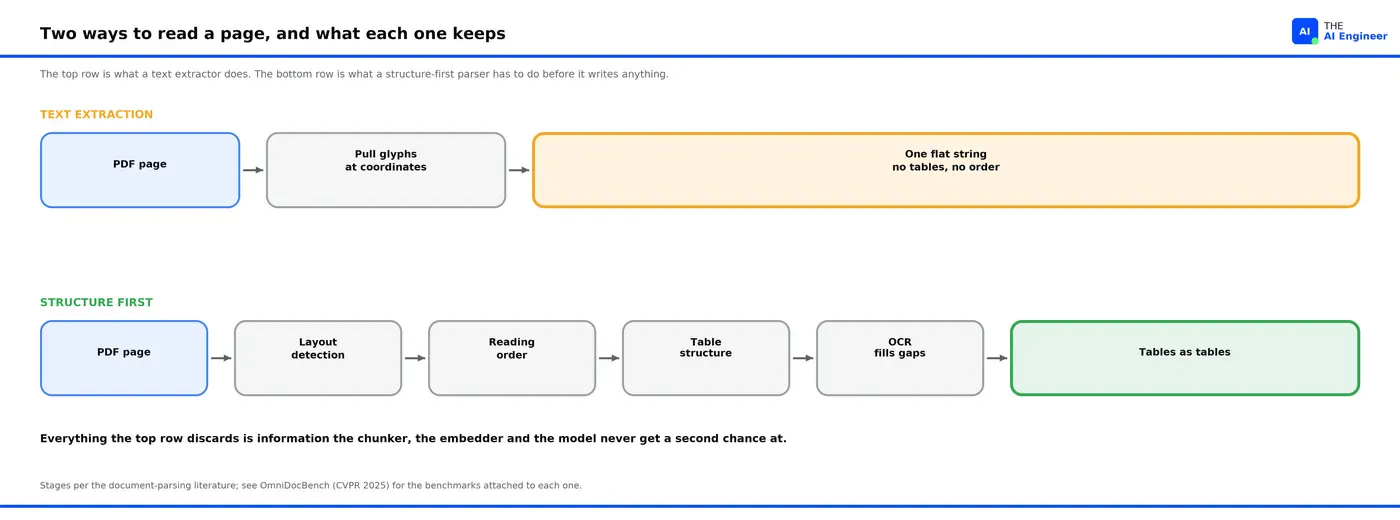
> - **A PDF does not contain a document.** PDF is "a set of drawing instructions": glyph, coordinates, font, size. It was built to print identically everywhere. There's no table object; a table is text runs at aligned coordinates plus some lines. PDF can carry structure in optional accessibility tags, but a cited study of 20,000 scholarly PDFs found 74.9% had none, and the spec is quoted saying header matching without tags "may fail for complex tables." Reading order follows emission order, which for two columns can read across instead of down. Chunking and embedding can't recover what extraction dropped "because the information is no longer in the input." The author links their own "What is RAG?" post for downstream mechanics.
> - **Four silent failure modes.** (1) Tables become sentences: a query like "what was Q3 revenue in the EMEA segment" retrieves the right chunk, but the model gets digits with no headers. (2) Reading order scrambles on two-column papers, invoices with sidebars, header blocks, producing "fluent nonsense." (3) Scans have no text layer, so a plain extractor returns an empty string and the document contributes nothing. (4) Charts, handwritten margin notes and stamps are visual and vanish. None throws an exception.
> - **Why a frontier model doesn't close the gap.** The 2026 shortcut is page images to a vision model with structured output. It works on good pages, and three problems show up at scale. Cost: one cheap call per page is competitive, but driving a frontier model agentically to parser-grade accuracy cost 27.8 cents per page against 8.1 cents for LlamaIndex's extraction tier on LlamaIndex's ExtractBench, with the cheaper one scoring higher. The author flags it as "Their benchmark, so weigh it accordingly," and supports it with a mechanism: output tokens cost several times input tokens, and agentic runs write a lot. Consistency: format holds, contents drift; identical prompts at temperature zero showed accuracy swings "of up to 15 points" (unlinked). Page context: a table continued across a break needs the previous page's headers, which a single-page call lacks. Conclusion: use the model on the hard page and a pipeline on the corpus.
> - **What document-understanding agents do.** LlamaIndex's term is "layout-aware parsing": a vision layer finds regions and table boundaries, OCR recovers text without a text layer, a language model interprets regions. Any system in the category does four jobs in order: layout detection on a rasterized page; reading-order resolution as a separate decision; table structure recognition, scored with TEDS (tree edit distance similarity) against a true table tree; then OCR and assembly. On OmniDocBench, described as a 1,355-page benchmark from CVPR 2025, GPT-4o scores 67.1 table TEDS, a dedicated pipeline 81.7, and "a current fast model" 88.0. The author attributes the "several times cheaper" and "several times more accurate" claims to LlamaIndex, calls adoption the more checkable signal (tens of millions of monthly downloads, tens of thousands of GitHub stars, KPMG and Pepsi as listed c
📄 **Full text:** [[Full Document Contents/Articles/Your RAG Pipeline Dies on Real Documents Here's Why.md|Your RAG Pipeline Dies on Real Documents: Here's Why by Paolo Perrone]]
## Highlights
- A PDF is a set of drawing instructions. Put this glyph at these coordinates, in this font, at this size. That is close to the whole format. It was designed so a page would print identically everywhere, and it succeeded completely at that job. Describing what the page means was never part of the brief. ([View Highlight](https://read.readwise.io/read/01m44949yfjdfj09fdb70f674w))
- Note: [H1] PDF stores drawing instructions, not document structure
- Tags: atom/literature/h1
- Your chunker then splits that string. Your embedder turns the pieces into vectors. I took the whole pipeline apart in What is RAG? If you want the mechanics of what happens after the parse. None of those later stages can recover what the parser dropped, because the information is no longer in the input. ([View Highlight](https://read.readwise.io/read/01m4494cn1h53jg12p9f21gjke))
- Note: [H2] Downstream stages can't restore what the parser dropped
- Tags: atom/literature/h2
- On a dense table that shows up as a cell dropped here, a digit misread there. Your code gets a table that validates, with a wrong number in it, and nothing raises an error. ([View Highlight](https://read.readwise.io/read/01m4494f0vqk5tsm3jtnrngg4j))
- Note: [H3] Schema-valid output can still carry wrong values silently
- Tags: atom/literature/h3
- Reach for it on the hard page. Reach for a pipeline on the corpus. ([View Highlight](https://read.readwise.io/read/01m4494hkm0kra0tjf2vsfy408))
- Note: [H4] Use models for hard pages, pipelines for corpora
- Tags: atom/literature/h3
- Run it through whatever you use now and read the raw output, ahead of any answers. Most teams discover the problem right there, in the extracted string, before any model is involved. ([View Highlight](https://read.readwise.io/read/01m4494mjgytbsks8s72xe4t72))
- Note: [H5] Read the raw extraction before involving any model
- Tags: atom/literature/h3