Your Side Gig Can Make or Break You
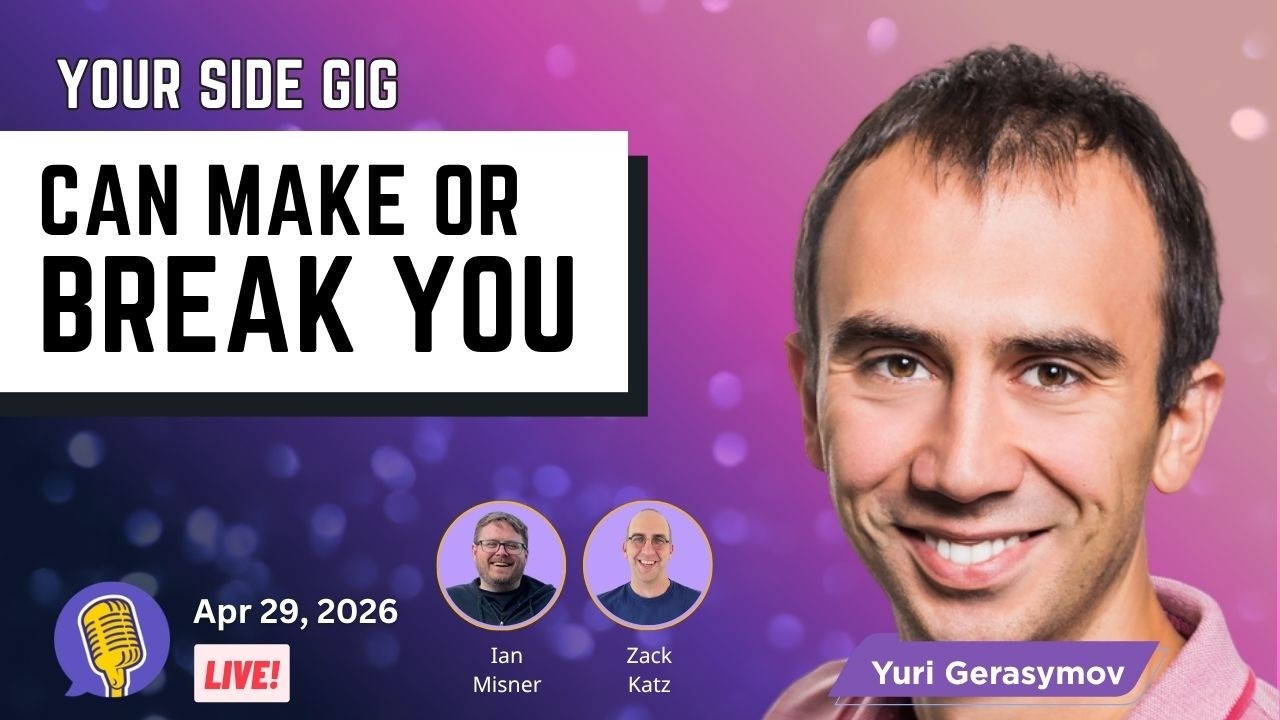
🔗 **Source:** [Your Side Gig Can Make or Break You](https://www.youtube.com/watch?v=OBeETQDzSsI)
> [!note]+ Document Notes
> tags: #side-gigs #visual-regression-testing #saas #team-management #entrepreneurship #product-development
> author: WP Product Talk
> source: YouTube
> reference: https://www.youtube.com/watch?v=OBeETQDzSsI
> date created: 2024-12-27 10:30
>
> # 🏷️ Title: Your side gig can make or break you
>
<!-- deep-read:sections start -->
## 🧰 Action Inbox
- [H1] Hire team members as soon as $500-1000 MRR achieved — enables founder focus on business vs development #team-management
- [H2] Build separate legal entity with dedicated Stripe account — keeps finances clean for potential exit #business-structure
- [H3] Focus on getting first paying customer over everything else — validates business idea better than any other metric #validation
## 🧭 Table of Contents
- [[#📝 Summary]]
- [[#📖 Main Content]]
- [[#🗒️ Notes]]
- [[#📚 References]]
- [[#🗣️ Paraphrase]]
- [[#📰 Newsletter]]
- [[#✅ Action Items]]
- [[#🧪 Hypotheses]]
- [[#📊 Methodology]]
- [[#❓ Questions]]
- [[#🔮 Future Research]]
- [[#💡 Implications]]
- [[#🧠 Learning Styles Assessment]]
- [[#📊 Accessibility Assessment]]
- [[#🌍 DEIB Assessment]]
- [[#✅ Logical Validity]]
- [[#🛡️ DARVO Analysis]]
- [[#🎯 Conclusion]]
### 🔗 References
- [Diffy](https://diffy.website)
- [Freemius](https://freemius.com)
- [Trusted Login](https://www.trustedlogin.com)
## 📝 Summary
- Yuri Gerasymov shares how he built and maintained Diffy, a visual regression testing SaaS, as a side gig for 8+ years
- Key to success: hired team early (at $500-1000 MRR) to avoid burnout and enable focus on business vs development
- Diffy serves ~120 clients with 1.5 developers plus Yuri's part-time involvement in mornings/weekends
- Growth is organic and slow - no "hockey stick" acceleration found yet despite trying various marketing approaches
- Bottom line: Get paying customers first, separate finances early, and build sustainable team structure for long-term success
## 📖 Main Content
Yuri Gerasymov built Diffy, a visual regression testing tool, while working full-time as an engineer. Visual regression testing takes screenshots of web pages and compares them to detect changes - crucial for agencies managing complex sites where small CSS changes can break layouts.
The project originated from necessity at an agency working with a legal network client who demanded pixel-perfect accuracy across 500+ pages. Breaking attorney profiles meant getting fired, so Yuri's team developed an automated screenshot comparison system.
Key success factors include hiring team members early (at just $500-1000 monthly revenue), maintaining separate business entities and accounts, and focusing relentlessly on customer acquisition over feature development. Yuri emphasizes that no validation beats paying customers.
The business serves approximately 120 clients with a lean team structure: one full-time developer, one part-time developer, plus Yuri's morning hours before his day job. Growth remains organic without dramatic acceleration, though the business is profitable and sustainable.
## 🗒️ Notes
#### ⏱️ [00:00](https://youtu.be/OBeETQDzSsI?t=0) — [H1] Introduction and guest background
- Key idea: Visual regression testing automates screenshot comparison for web deployments
- Evidence: "Takes screenshots of your web pages and compare them... let automation do that for you"
#### ⏱️ [03:45](https://youtu.be/OBeETQDzSsI?t=225) — [H2] Origin story from agency work
- Key idea: Diffy was born from high-stakes client requirements at legal network
- Evidence: "If something is displayed incorrectly on their profiles... terrible mistake. You get fired"
#### ⏱️ [06:30](https://youtu.be/OBeETQDzSsI?t=390) — [H3] Transition from internal tool to commercial product
- Key idea: Early customer interest validated the business potential
- Evidence: "People started showing up the interest and some of them started paying"
#### ⏱️ [09:15](https://youtu.be/OBeETQDzSsI?t=555) — [H1] Defining a side gig vs side business
- Key idea: Side gig requires dedicated schedule but minority of total working time
- Evidence: "I do specifically on a schedule... early morning thing that I do before I start my job"
#### ⏱️ [12:00](https://youtu.be/OBeETQDzSsI?t=720) — [H2] Team structure enables sustainability
- Key idea: Founder handles business decisions while team executes development
- Evidence: "My time involvement is the smallest across the whole team"
#### ⏱️ [15:30](https://youtu.be/OBeETQDzSsI?t=930) — [H1] Early hiring strategy prevents burnout
- Key idea: Hire help as soon as any revenue is generated
- Evidence: "As soon as you can... $500 MRR, a thousand dollars MRI started getting some help external"
#### ⏱️ [18:45](https://youtu.be/OBeETQDzSsI?t=1125) — [H3] AI tools enhance but don't replace team structure
- Key idea: Senior developers using AI tools improve quality without changing team needs
- Evidence: "Quality of the work that we shipping is higher because we like writing automated test is so much cheaper with Claude"
#### ⏱️ [22:10](https://youtu.be/OBeETQDzSsI?t=1330) — [H2] Risk management through team redundancy
- Key idea: Never rely on single person for critical business functions
- Evidence: "You never want to have just a single person working on your code base... they should be able to go on a trip for a month"
#### ⏱️ [26:40](https://youtu.be/OBeETQDzSsI?t=1600) — [H1] Growth challenges in developer market
- Key idea: Organic growth is slow without clear acceleration mechanisms
- Evidence: "I still haven't figured out the way to... accelerate the growth... my market is like developers"
#### ⏱️ [32:15](https://youtu.be/OBeETQDzSsI?t=1935) — [H2] Marketing approaches and limitations
- Key idea: Traditional marketing tactics don't scale for solo founder with limited time
- Evidence: "Cold outreach is amazing... but it should be personalized... I can talk to maybe three, four different people a day"
#### ⏱️ [36:50](https://youtu.be/OBeETQDzSsI?t=2210) — [H3] Business structure and potential exit considerations
- Key idea: Separate legal entity essential for clean business operations
- Evidence: "It's a separate entity, separate accounts, everything is just dedicated to that business"
#### ⏱️ [41:20](https://youtu.be/OBeETQDzSsI?t=2480) — [H1] Maintaining motivation through difficult periods
- Key idea: Customer testimonials provide emotional fuel during challenging times
- Evidence: "I have this document. It's called testimonials... I read it and it feels better"
#### ⏱️ [44:30](https://youtu.be/OBeETQDzSsI?t=2670) — [H1] Key advice for aspiring side gig founders
- Key idea: Getting paying customers is the only validation that matters
- Evidence: "There is no better validation of your business idea than somebody paying you"
## 📚 References
- [Diffy Visual Regression Testing](https://diffy.website)
- [Freemius Growth Platform](https://freemius.com)
- [Gravity Kit](https://gravitykit.com)
- [Trusted Login](https://www.trustedlogin.com)
- [BackstopJS Open Source Tool](https://github.com/garris/BackstopJS)
## 🗣️ Paraphrase
- Build a sustainable side business by hiring team members early rather than trying to do everything yourself
- Focus on customer acquisition over feature development - paying customers validate your idea better than anything else
- Structure your business properly from the start with separate accounts and legal entities to enable future growth or exit
- Accept that some markets grow organically and slowly rather than expecting hockey stick growth from every venture
## 📰 Newsletter
Running a successful side gig while maintaining a full-time job requires strategic thinking about team building and customer focus. Yuri Gerasymov's 8-year journey with Diffy shows how visual regression testing can solve real problems for agencies and developers managing complex websites.
The key insight? Hire help as early as possible - even at just $500 monthly revenue - to prevent burnout and enable focus on business growth rather than execution. This approach has allowed Yuri to maintain work-life balance while building a profitable SaaS serving 120+ clients.
For WordPress professionals considering side projects, remember that customer validation trumps everything else. Get that first paying customer, separate your finances properly, and build sustainable systems from day one.
Resources: [Diffy](https://diffy.website), [Freemius](https://freemius.com), [WP Product Talk](https://wpproducttalk.com)
## ✅ Action Items
#### WordPress
- Plugins: Consider visual regression testing for plugin updates and theme compatibility checks
- Themes: Implement automated screenshot testing for responsive design validation
- Core: Evaluate visual regression tools for WordPress core development workflows
- Community: Share case studies of automated testing tools that benefit WordPress agencies
#### DevRel
- Developer advocacy: Create content about visual regression testing best practices for WordPress developers
- Education: Develop workshops on automated testing workflows for agencies and freelancers
- Community management: Facilitate discussions around quality assurance tools and processes
#### OSPO
- Software Inventory: Evaluate visual regression testing tools for open source project maintenance
- Developer Support: Provide guidance on testing automation for contributor onboarding
#### Community
- Maintainers: Consider automated visual testing for WordPress plugin and theme repositories
- Contributors: Integrate visual regression checks into development workflows
- Ecosystem: Promote testing tools that improve overall WordPress site quality
## 🧪 Hypotheses
- Side businesses with early team hiring achieve better long-term sustainability than solo founder approaches
- Visual regression testing adoption correlates with agency size and client complexity requirements
- Developer-focused SaaS products grow more slowly but with higher retention than consumer products
- AI tools enhance developer productivity without reducing need for human oversight and business judgment
### 📊 Methodology
- Survey WordPress agencies about their testing workflows and pain points with visual regressions
- Track correlation between team hiring timing and side business longevity across multiple founders
- Analyze growth patterns in developer tooling SaaS versus other market segments
- Measure productivity gains from AI-assisted development in small teams
### ❓ Questions
- How do different WordPress hosting environments affect visual regression testing accuracy?
- What percentage of WordPress agencies currently use automated visual testing tools?
- How might visual regression testing integrate with WordPress core development and release cycles?
### 🔮 Future Research
- Impact of AI-generated code on visual regression testing requirements
- WordPress-specific visual regression testing tools and market opportunities
- Side gig success patterns in the WordPress ecosystem versus broader tech industry
### 💡 Implications
- Practice: Agencies need systematic approaches to visual quality assurance beyond manual testing
- Policy: WordPress plugin directory could benefit from automated visual regression requirements
- Security: Visual changes might indicate compromised websites or malicious code injection
- Education: WordPress developers need training on automated testing tools and workflows
- Funding: Visual regression testing tools represent underserved market opportunity in WordPress space
### 🧠 Learning Styles Assessment
Reading level estimate: 10th-11th grade (moderate technical vocabulary with clear explanations)
#### 👀 Visual learners
- Present: Screenshots of Diffy interface, team structure diagrams implied
- Improve: Workflow diagrams showing visual regression testing process, before/after comparison examples
#### 🔊 Aural learners
- Present: Full podcast format with natural conversation flow
- Improve: 2-minute audio summary highlighting key takeaways for side gig founders
#### 🗣️ Verbal learners
- Present: Clear definitions of visual regression testing, testimonials document concept
- Improve: Glossary of SaaS business terms, analogies comparing automated testing to manual processes
#### 🧩 Kinesthetic learners
- Present: Free tier signup mentioned for hands-on trial
- Improve: Step-by-step setup guide for visual regression testing, interactive demo environment
#### 🧠 Logical learners
- Present: Revenue numbers, team structure rationale, hiring timeline decisions
- Improve: ROI calculations for visual regression testing, decision tree for team hiring timing
#### 🧑🤝🧑 Social learners
- Present: Conference networking mentions, team communication practices
- Improve: Community forum for side gig founders, peer mentorship program recommendations
#### 🧘♀️ Solitary learners
- Present: Morning routine schedule, independent business management
- Improve: Self-assessment checklist for side gig readiness, personal reflection prompts
#### 🌿 Naturalistic learners
- Present: Organic growth patterns mentioned
- Improve: Business ecosystem analogies, natural progression from idea to sustainable business
### 📊 Accessibility Assessment
#### Screen reader semantics
- Present: Clear chapter markers in video, structured conversation flow
- Improve: Transcript with speaker identification, heading structure for key topics
#### Keyboard navigation
- Present: Standard YouTube controls accessible via keyboard
- Improve: Skip links for major discussion topics, keyboard shortcuts for chapter navigation
#### Contrast and readability
- Present: Standard video player meets basic contrast requirements
- Improve: High contrast mode option, adjustable font size for transcript display
#### Text resizing and reflow
- Present: YouTube responsive design supports zoom
- Improve: Dedicated transcript page with responsive text layout
#### Media and captions
- Present: Full transcript provided, clear audio quality
- Improve: Time-synced captions, downloadable transcript file
#### Forms and interactions
- Present: Standard YouTube interaction elements
- Improve: Accessible comment submission, keyboard-navigable chapter selection
### 🌍 DEIB Assessment
#### Cultural breadth
- Present: Focus on global developer tools market, international agency examples
- Improve: Case studies from diverse geographic regions, multilingual testing considerations
#### Inclusive language
- Present: Gender-neutral business terminology, accessible technical explanations
- Improve: Avoid assumptions about traditional work arrangements, acknowledge diverse business models
#### Neurodiversity support
- Present: Clear structure with timestamped sections, logical progression
- Improve: Visual topic indicators, consistent formatting for key concepts
#### Representation
- Present: Male-dominated tech industry representation typical of current demographics
- Improve: Highlight diverse founders in similar spaces, inclusive imagery in related content
#### Psychological safety
- Present: Respectful discussion of business challenges, non-judgmental advice sharing
- Improve: Acknowledge different risk tolerances, validate various approaches to entrepreneurship
### ✅ Logical Validity
#### Strong reasoning
- Deductive strength: Team hiring prevents burnout → sustainable business (solid with evidence)
- Inductive strength: Customer payment validates business model (strong pattern recognition)
- Causal reasoning: Early team hiring → better long-term outcomes (supported by personal experience)
- Analogical strength: Side gig as "passion project" comparison (helpful framing)
#### Fallacies
- Survivorship bias: Success story may not represent typical side gig outcomes, limited sample size
- Hasty generalization: Developer market challenges may not apply to all niches
#### Tone of voice
- Overall tone: Practical and encouraging, honest about challenges while remaining optimistic about possibilities
### 🛡️ DARVO Analysis
- Deny: No denial patterns present - honest about business challenges and limitations
- Attack: No attacks on competitors or critics - collaborative and supportive approach
- Reverse victim/offender: Not applicable - straightforward business advice sharing
- Emotional cues: Positive testimonial strategy for motivation rather than manipulation
## 🎯 Conclusion
Yuri's 8-year journey with Diffy demonstrates that successful side gigs require strategic thinking about team building, customer focus, and sustainable growth. The key insight is hiring help early - even at minimal revenue levels - to prevent burnout and enable focus on business development rather than execution. For WordPress professionals considering side projects, the priority should be validating ideas through paying customers while building proper business structure from the start.
## 🧱 Refactor Appendix
### 📚 Literature Split Pad
### [H1] Early team hiring prevents side gig burnout
> [!quote] Your side gig can make or break you by WP Product Talk via YouTube.
---
## Full Transcript
[00:02] Yeah.<br>[00:04] Uh, welcome to a WordPress product talk
where we cover everything you need for<br>[00:10] starting your WordPress product business.<br>[00:13] Today we're gonna have Yuri Gerasymov
speaking about how your sidekick.<br>[00:17] Your side gig can make or break you.<br>[00:19] I'm just gonna jump in here.<br>[00:23] This is WP Product Tech, a place where
every week we bring you insights,<br>[00:29] product marketing, business management,
and growth, customer experience,<br>[00:34] product development, and more.<br>[00:36] It's your go-to podcast for WordPress
product owners by WordPress product<br>[00:41] owners, and now enjoy the show.<br>[00:51] Hi, I am Ian Misner.<br>[00:52] I'm with Kestrel.<br>[00:54] And I'm Zack Katz, founder of Gravity Kit.<br>[00:57] I did completely blank as we went live.<br>[01:00] So, you know, that's super
way, great way to start things.<br>[01:03] But uh, before we get started, you know,
despite all that, if you do benefit from<br>[01:07] WP Product Talk, we do love your support.<br>[01:10] Easiest way to help us out is just
hitting the subscribe button right now.<br>[01:13] So.<br>[01:14] There's buttons somewhere.<br>[01:15] Makes a huge difference.<br>[01:16] We really appreciate it.<br>[01:18] Yeah.<br>[01:18] And huge thanks to Freemius for
being our exclusive growth partner.<br>[01:22] And if you don't know about
Freemius, they help software<br>[01:25] makers grow, monetize, and succeed.<br>[01:27] Uh, they're a merchant of record platform,
which means they handle everything<br>[01:30] around selling software, which like
checkouts payments, subscriptions,<br>[01:34] licensing updates, global tax compliance,
y'all, uh, so that you can focus<br>[01:39] on building your amazing products.<br>[01:42] Yeah.<br>[01:42] And, uh, we can jump into today's topic.<br>[01:44] Uh, so, you know, running a side gig,
how your side gig can make or break<br>[01:47] you, you know, it sounds amazing, you
know, make a whole bunch of money on<br>[01:51] the side and do the big whole thing.<br>[01:53] But then you're eight months in day job's
leaking into your nights and nobody in<br>[01:58] your family's seen you since spring.<br>[02:00] So our guest today is someone who's been
doing that for, uh, eight years, I think,<br>[02:04] while holding down a full-time job.<br>[02:06] And we're gonna ask him how to do it.<br>[02:08] All right, so.<br>[02:10] Welcome, Yuri, please.<br>[02:12] Uh, you know, thanks so much
for being here, of course.<br>[02:15] But please tell everyone a little
bit about yourself and, uh, maybe<br>[02:18] actually a little bit about the,
the side gig as well, right.<br>[02:22] Sure, sure.<br>[02:22] Uh, so my background
is in web development.<br>[02:26] Um, and I started my project
roughly eight, nine years ago.<br>[02:33] And that's a visual
regression testing tool.<br>[02:35] So it's related to web development.<br>[02:38] Uh, it's a tool, it's a fancy name
for a tool that takes screenshots<br>[02:43] of your web pages and compare them.<br>[02:45] So if you are checking your
deployment or some changes, you can.<br>[02:50] Instead of going through all the
pages of your site and making sure<br>[02:53] that they're all right, you can let
automation do that for you and just<br>[02:57] let you know what pages changed.<br>[02:59] Um, and, uh, the way some
history about the project.<br>[03:04] The way it was born actually was
in, while I was working, one of the<br>[03:09] agencies in the past, and, uh, we had
a very interesting client that was, uh.<br>[03:16] Network of legal attorneys in
United States, and they were<br>[03:20] very, very particular about
how their profiles look like.<br>[03:24] And the problem was is that we were
agency probably number five, six, and the<br>[03:30] website was really old and at that time
it was seven 10,000 lines in CSS files.<br>[03:39] So it was extremely easy to change one
little thing and break something else.<br>[03:44] The tricky part with them is that if,
uh, something is displayed incorrectly<br>[03:50] on their profiles, like one of their
publications, uh, title is cut off or<br>[03:56] some like that was a huge deal for them.<br>[03:58] Like, terrible mistake.<br>[04:00] You get fired.<br>[04:01] Like, like lawyers are tough on it.<br>[04:03] All cons, right?<br>[04:04] And, uh, first couple of
deployments didn't get that well.<br>[04:09] And uh, we started thinking about how we
can improve and we needed to check like.<br>[04:13] 500 pages, and we came up with the idea
of taking screenshots and comparing them.<br>[04:19] And then, and then we evolved
that idea more and more and more.<br>[04:24] At that time, there were not that many
open source projects around this topic.<br>[04:29] And the ones that we checked that
they didn't work well, and, and<br>[04:34] then it kind of like spun up in a
dedicated product that, um, I started<br>[04:39] to maintain and keep running with.<br>[04:43] Yeah.<br>[04:43] Awesome.<br>[04:43] Thank you for sharing and
thank you for coming on.<br>[04:45] And, uh, for anyone watching on YouTube
right now, we do encourage you to<br>[04:49] leave comments, questions, or feedback.<br>[04:51] Um, you know, we'll highlight comments to
discuss live on the show and, you know,<br>[04:55] ask questions,Yuridirectly go for it.<br>[04:57] Of course.<br>[04:58] Um, so, uh, based on your
interaction, the first thing I<br>[05:01] was wanna lead with is like, what?<br>[05:03] Took you from, you know, building
this thing for, you know, one or two<br>[05:06] sites to deciding it would be like
a side gig, something you were gonna<br>[05:10] keep building on nights and weekends.<br>[05:13] Um.<br>[05:15] I think the best feedback was
that we didn't get fired as an<br>[05:18] agency, so we, we kept the client,
so it started being useful.<br>[05:23] We started using it, uh, across multiple
teams, uh, and we had a great feedback.<br>[05:30] Um, and it was very scrappy at the time.<br>[05:32] It was like terrible design.<br>[05:35] Uh, working half of the times
and we started improving things.<br>[05:39] Um, and then I started talking to my
friends in other agencies and people<br>[05:44] started showing up the interest
and some of them started paying and<br>[05:49] that was probably the moment that
like, okay, uh, we can actually<br>[05:52] build something up with to it.<br>[05:55] Yeah.<br>[05:55] That's awesome.<br>[05:56] So you, um, made something.<br>[06:00] People wanted, like they came to you to
ask you to buy it, is what it sounds like.<br>[06:04] Is that<br>[06:05] Yes, yes.<br>[06:06] And it was very interesting moment.<br>[06:09] Um, so we were probably, I don't
know, year, two years, uh, in it.<br>[06:16] And, uh, all of a sudden, so my
background is in Drupal development.<br>[06:21] And we'll talk about like different
CMSs and stuff, but, uh, at that time<br>[06:27] it was getting popular to start using
visual regression testing and then<br>[06:32] open source project, backstop GS came
out and it were, there were a lot of<br>[06:38] presentations on the conferences, so
people were looking for this type of.<br>[06:43] Tools and our tool was a SaaS
platform at the time already.<br>[06:48] Um, and you know, sometimes you
struggle with open source solutions,<br>[06:52] so you try to find alternatives where
you can hand over all the support and<br>[06:57] maintenance of the tool to someone else.<br>[06:59] And we were that someone else project
and uh, that's how things started to<br>[07:04] grow and we started seeing some traction.<br>[07:08] Um, so that's where.<br>[07:10] Decision was made like, okay,
we need to run it further and.<br>[07:14] It might grow into something bigger.<br>[07:17] And what is a side gig?<br>[07:20] And I'll, I'll open this question up
to all of us because, uh, and when do<br>[07:25] you, when do you consider it a gig?<br>[07:26] Ver versus like its own actual
thing before, uh, like when<br>[07:30] do you register the domain?<br>[07:32] How do you know it's a thing?<br>[07:33] Like what are we even talking about here?<br>[07:35] Because, uh, I have plenty of ideas.<br>[07:39] I've got plenty of, uh, repos that may
or may not have associated websites.<br>[07:43] And then I have my main
Business Gravity kit.<br>[07:46] I have a, I have a side gig called
Trusted Login, but it's its own<br>[07:51] thing, but it also doesn't make
nearly as much money as Gravity Kit.<br>[07:55] What is a side gig to you, Yuri?<br>[07:58] I think you touched on
the definition very well.<br>[08:01] Okay, so it's on the side.<br>[08:03] So I do have full-time engineering
job that I run, and, uh, this project<br>[08:08] is kind like in the mornings, on
the weekends, whenever I have some<br>[08:15] downtime, that's kind of thing.<br>[08:17] So it's not, it's not dedicate,<br>[08:18] you don't set aside time in your week.<br>[08:21] Uh,<br>[08:21] I do<br>[08:21] specifically on a schedule.<br>[08:24] I do, I do.<br>[08:25] You do.<br>[08:25] There is no way you can run something for
this long without having some routines.<br>[08:30] Um, so for me that is more
like a early morning thing that<br>[08:35] I do before I start my job.<br>[08:38] And, um, sometimes I check, I mean,
you check emails, communicate on Slack<br>[08:43] with the team, but still it's uh.<br>[08:48] I put minority of my working time into
this project, so that's how I would<br>[08:53] define a side gig, so it's not nearly
as close as your full-time occupation.<br>[09:01] I do wanna stay on the questions, Zack,
because I have some thoughts there too.<br>[09:04] But really quick, uh, you,
you did mention the team.<br>[09:07] Is that the day job or the side job?<br>[09:11] Is there, which team are we?<br>[09:13] We.<br>[09:13] Oh,<br>[09:13] okay.<br>[09:14] So I'm not running this
project on my own, actually.<br>[09:18] I'm all for, uh, not running side
gigs on your own because it'll be<br>[09:23] very, like, you'll, you will burn
out like very fast, uh, because there<br>[09:28] are so many ideas and so less time.<br>[09:31] Um, so I have a team who
actually does development and<br>[09:35] help me with marketing and with.<br>[09:37] Other things whenever I need them.<br>[09:39] And communication with the team,
meaning communication with the team<br>[09:42] who is actually doing all the work?<br>[09:45] Yeah, that's something.<br>[09:45] Side business, not a side gig though.<br>[09:49] Uh.<br>[09:50] Uh, yes,<br>[09:52] I trusted login.<br>[09:53] I have some people I work with when I
need additional help for development<br>[09:56] and like I have a certain, like a
infrastructure person that I contract<br>[09:59] with specifically, but like for the, for
the most of the development that's on me.<br>[10:03] And now it's, you know,
also Claude as well.<br>[10:06] But like, uh, you have a
dedicated team it sounds like.<br>[10:10] I do.<br>[10:11] I do.<br>[10:11] That's correct.<br>[10:12] That's,<br>[10:12] that's cool.<br>[10:13] Yeah.<br>[10:14] If you would call side gig is
something that starts and ends<br>[10:17] like, I don't know, a help on the
concert or something like coaching a<br>[10:22] team, then no, it's not this thing.<br>[10:25] It's more like a side business that I run
with a team, um, that probably I am the.<br>[10:32] I'm the founder, uh, but
my time involvement is the<br>[10:37] smallest across the whole team.<br>[10:39] Hmm.<br>[10:39] Yeah.<br>[10:40] No, and I, I, I actually think that's
really helpful because, uh, when you<br>[10:43] know, to your question originally,
Zack, like, what is a side gig?<br>[10:46] Like, I mean, I've done
side stuff the entire time.<br>[10:50] I've worked for, you know, like
20 years now or whatever, but I've<br>[10:53] never like, done anything that, like
I grew meaningfully on the side.<br>[10:57] I'm sort of very much
like I'm all or nothing.<br>[10:59] You know, we got 40 something.<br>[11:01] Products in the main gig
instead, basically, right.<br>[11:04] We lean in all the way or not, but
that like that, what you just said,<br>[11:09] you about the team, I think that maybe,
like I never took that step, right?<br>[11:12] I never did bring other people
in to help push it forward.<br>[11:15] And I'd love to hear a little bit more
of like, how early did you do that?<br>[11:19] Like when did, like how, why did you
make that choice early on to, to bring in<br>[11:24] people to help push it forward for you?<br>[11:28] So, and you can think about this in, I
don't know if this will sound pragmatic<br>[11:35] to you, but idea is that, uh, if you
yourself can do certain job that is paid<br>[11:43] way more than you would hire someone to do
it on your own project, you just do that.<br>[11:51] And that is what is happening to me.<br>[11:53] So I have a team.<br>[11:55] Uh, they're great developers.<br>[11:57] They work on dfi.<br>[11:59] I am very happy to work on dfi,
like, like it's my little baby<br>[12:03] that I'm very happy to work on.<br>[12:05] But the thing is that, uh, I do that
very, very rarely, just when it's<br>[12:11] kind of like r and d type of work.<br>[12:14] If I can formulate what is need to be,
what, what is needed to be done, I just<br>[12:19] do it and I'll let the team handle it.<br>[12:23] Uh, and my general, I, I got
very lucky that I had funds to<br>[12:29] actually sponsor this development.<br>[12:31] And with the current iteration of dfi,
um, I didn't write much code at all.<br>[12:38] Like I hired a person to work on it right
away, and it was funded by the client.<br>[12:44] Um, so if you have something that
you can offload from yourself.<br>[12:51] You do that right away and focus on
the things that nobody else can do.<br>[12:55] And that is like marketing and sales
and, and support and other things.<br>[13:01] At some point, of course, idea is
that if the tool will grow, then<br>[13:05] you can afford those as well.<br>[13:07] But me as developer, um, development
tasks are the easiest one to let go.<br>[13:15] And, uh, now that AI is so effective
in doing so much, how might you think<br>[13:23] about diffy today if you were starting
it, um, and like how would that<br>[13:29] change how you structure your team?<br>[13:32] Um, truly to say, I don't
think that would change much.<br>[13:37] Uh, the thing is that I, my team members
are like more on a senior level developers<br>[13:43] and they use Claude all the time.<br>[13:45] Uh, I, I do see the quality of
the work that we, uh, shipping is<br>[13:50] higher because we like writing,
automated test is so much cheaper<br>[13:55] with Claude and other tools and, uh.<br>[13:57] You have a lot of tool to help you.<br>[14:01] Um, but we still have a lean team.<br>[14:04] It's like one and a half developer, like
one full-time, one part-time, and me, and,<br>[14:11] uh, I would keep it this way and it's.<br>[14:14] It's actually like another recommendation
that I usually give to people when<br>[14:18] they ask about development is that
you never want to have just a single<br>[14:22] person working on your code base.<br>[14:23] You want to have a few, uh, they
need to be able to go on vacation.<br>[14:28] They, uh, they should be able to
go on a trip for a month and things<br>[14:34] should not stop because of that.<br>[14:36] Um, so.<br>[14:38] It's, um, like in terms of the
team structure, I'm very happy<br>[14:41] where I am and I wouldn't change
anything because of AI tools.<br>[14:47] It's just efficiency thing.<br>[14:49] Mm-hmm.<br>[14:49] Yeah, I, I'd love to like.<br>[14:51] So this is really interesting to me
specifically because, you know, the,<br>[14:54] the way I often think of a side gig
is just like, you know, you're playing<br>[14:58] around on the side and, you know,
doing an extra thing and building<br>[15:00] something, and hopefully it works.<br>[15:02] Hopefully it doesn't.<br>[15:03] But again, that's why yours
worked and mine didn't, basically.<br>[15:06] Right.<br>[15:06] So, um, I wanna hear, love to
hear more about that time though.<br>[15:09] Like when you brought in that
first developer, somebody to keep<br>[15:12] it going, was that like day one?<br>[15:14] Was that.<br>[15:16] Was it, was it profitable enough to pay
for the developer when you chose to do<br>[15:21] that, or is that something you chose?<br>[15:23] Like, I'm thinking a lot about,
you know, someone's considering<br>[15:26] going down the path you're on now.<br>[15:28] What advice would you give for them
to get started down that path of<br>[15:32] bringing people to help with that?<br>[15:34] Right.<br>[15:35] So in the very beginning, because
you're starting on your own, if<br>[15:38] you don't have, if you don't want
to put your own money into it, of<br>[15:41] course you do development yourself.<br>[15:43] And that was a short period of
time when we were doing this.<br>[15:47] But truly to say the moment
I started having any funds.<br>[15:52] Like $500, MR, a thousand dollars MRI
started getting some help external<br>[15:58] and then more and more and more.<br>[15:59] And then at certain point I was able
to hire a person, not a full-time,<br>[16:04] but kind of like 20 hours a week.<br>[16:07] Uh, and then I hired another one, and
then one of them grew to the full-time.<br>[16:12] Um, so as soon as you can.<br>[16:17] Try to do that if you are planning
to run this project for a long time.<br>[16:20] 'cause they, like, different people
might have different ideas, right?<br>[16:25] Uh, some people would say like, yes, but
I am putting all my energy and I'm putting<br>[16:30] all my money and I don't get anything
out of it, uh, for a couple of years.<br>[16:35] That's too much.<br>[16:36] It's like, I get it.<br>[16:37] Uh, but my feeling at the time was that
it can grow and it'll be beneficial<br>[16:43] to keep it running for longer term.<br>[16:45] So that's why.<br>[16:46] Try to offload my time as much as
I could, so I don't get burnout.<br>[16:53] Yeah, no, it's super helpful.<br>[16:54] I really appreciate that.<br>[16:55] Uh, we do have a question from,
uh, Ben Green here in the chat's.<br>[16:59] Gonna pull this up here.<br>[17:00] Um, so Ben asks, do you want to keep
a side gig on the side intentionally,<br>[17:05] or would you be open to making
it the main gig at some point?<br>[17:09] Um, this is the question of the growth.<br>[17:13] So if the project takes off and
uh, it grows and will be able to<br>[17:19] sustain me financially full time,
of course it will be amazing.<br>[17:24] Uh, on the other hand, it is like
if it grows, I can build more team<br>[17:30] and make it even more autonomous.<br>[17:32] Um, so you can get to the point when
business runs and doesn't need you.<br>[17:38] I mean, it's kind of like an idea very
far on horizon, but you see what I mean?<br>[17:44] Like, if you can build something
in the way that doesn't need<br>[17:47] you, like it's very sellable.<br>[17:48] It's, uh, amazing business model for
you so you can do your own things.<br>[17:53] And uh, actually I do enjoy my
engineering job very much so.<br>[17:59] We'll see how it goes.<br>[18:01] Right now.<br>[18:01] I just enjoy the journey, um,
and, uh, that keeps me motivated.<br>[18:10] Yeah, one of the, so trusted login
I started in 20, well, 2019, uh, was<br>[18:16] the main idea and, uh, the point of
trusted login is to, uh, came from.<br>[18:23] Gravity kit support.<br>[18:24] We were always asking people for, uh,
a, a way to log into their websites,<br>[18:29] uh, and WordPress plugins, you
know, like, this is what people did.<br>[18:33] They'd ask for username and password,
uh, create an account for us, send<br>[18:37] it plain text and email in the
support or the support desk form.<br>[18:41] It was no good.<br>[18:42] Uh, it's, everybody said, don't do this.<br>[18:44] Any other is no way to
do it, uh, to get access.<br>[18:47] That was better.<br>[18:47] So I created Trusted Login, which is
the secure easy way for, um, plugin<br>[18:52] developers to integrate support
grant functionality, uh, into their<br>[18:57] plugin that allows for secure easy
access for the support providers.<br>[19:02] Um, so that was the idea and I said
to myself, I'm not going to take my<br>[19:07] way myself away from Gravity Kit.<br>[19:09] 'cause Gravity Kit is the money maker.<br>[19:11] I love trusted logins idea.<br>[19:12] I want it to be built out.<br>[19:14] So I hired some people to build
it out and I hired more people to<br>[19:18] build it out and I kept on paying
people to build it out and I kept<br>[19:22] on not getting over the finish line.<br>[19:24] So I realized I had to get more involved.<br>[19:27] I got more involved.<br>[19:28] It finally got launched and then I was
kind of out of like money to outsource for<br>[19:35] other people to keep on building this out.<br>[19:36] 'cause we were using it
internally at Gravity Kit.<br>[19:39] And we finally now are like years
later, are starting to get people<br>[19:43] on board with, with trusted login.<br>[19:45] Um, but the amount of money and time
it took to to get off the ground really<br>[19:50] took it out of me from, uh, my ability
to, to keep trusted login growing.<br>[19:56] But now with ai, uh, it's so much
easier to be able to do more.<br>[20:01] The backlog of things that I've wanted
to do is finally coming to fruition<br>[20:05] because I am able to multitask more
with Gravity Kit and Trusted login.<br>[20:09] Finally, the features are coming out
that I've wanted to build for so long.<br>[20:14] Um, so the question of like when to
build, when to bring on a developer, when<br>[20:17] to bring on other people, like ideally.<br>[20:20] I would have a team of people that would
have like outreach for other plugin<br>[20:25] developers, outreach for agencies, uh,
people working on the marketing website.<br>[20:30] But honestly, all this stuff, now I'm
thinking of it, uh, as a skill in Claude.<br>[20:35] Like I need to have this automated so
that when, uh, so that for example, I can.<br>[20:41] Fork, somebody's plugin, uh, on GitHub
automatically in integrate trusted login.<br>[20:47] Do a pull request, schedule the
call with 'em and say, Hey, I've<br>[20:50] already integrated trusted login.<br>[20:52] Uh, this is what it brings to you.<br>[20:53] You're gonna, your support time is
gonna go down by, you know, 60%.<br>[20:57] Uh, so that type of automation, I'm
not thinking about a team anymore.<br>[21:01] I'm thinking about how can I do this
myself because it is a side gig to<br>[21:05] prove it out, uh, to make more money
so that I can actually hire somebody<br>[21:10] who's now like a product owner.<br>[21:12] Rather than necessarily a developer or
a marketer or somebody else, it would<br>[21:16] be somebody who has great AI skills.<br>[21:19] I, as a developer would
then review all the code.<br>[21:22] Um, but I'm, I, it has really flipped
a switch in my head in terms of<br>[21:26] how I think about what I can do on
the side and what a side gig means.<br>[21:31] And I think a lot of people
are going to be doing well.<br>[21:34] We're already seeing
this a lot more projects.<br>[21:37] Uh, and side gigs because
they, AI has unlocked so much<br>[21:41] of their ability to do more.<br>[21:43] What, what are your thoughts, Ian?<br>[21:46] I mean, I'm very stressed out
about everything you just said.<br>[21:49] That's what I'm still figuring out.<br>[21:50] Enough of the main gig, frankly.<br>[21:52] Right.<br>[21:52] The, how much of, um, so as a quick
background with Kes, like we have<br>[21:57] hired basically only engineers and
everything else was just figuring it out.<br>[22:01] Finding time, squeezing it in,
getting everything else done.<br>[22:04] And as you can, like if you look around
what we've done, we probably should<br>[22:08] do marketing a hundred times more.<br>[22:10] You know what I mean?<br>[22:10] Like everyone knows that.<br>[22:12] But ultimately making the
thing was the main thing.<br>[22:14] So we really, you know, invested deeply
there and made sure the tools were<br>[22:18] the best and, you know, product led
growth and all that kind of stuff.<br>[22:22] Uh, nowadays though, it's, it is like.<br>[22:26] A lot.<br>[22:27] So I actually, I don't know if I've
shared this on the show yet, but I've<br>[22:29] been doing a lot of these like meetups,
uh, you know, e-commerce things,<br>[22:33] and there's all these like recent CS
grads that are, that are showing up to<br>[22:36] these things and you know, they built
four products last weekend and like,<br>[22:41] they're actually pretty great, right?<br>[22:42] Like they're not bad.<br>[22:43] And like, it makes me really
nervous if these guys figure<br>[22:46] out how to sell these things.<br>[22:47] Like we're all in trouble.<br>[22:49] Uh, sorry, I may, I went on a slight
tangent maybe, but that's the way this<br>[22:52] topic.<br>[22:53] Well, and here's the thing.<br>[22:54] We, I, as an old person, have so much
ha so many hangups over what marketing<br>[23:00] should be and how intentional we should
be when we communicate with our customers.<br>[23:04] And, and the product pages should, should
be, you know, curated and really good.<br>[23:08] Um, with I, I'm working on another side
project that I, I, I'm not ready to<br>[23:14] talk about yet, but, uh, I am having
the code developed at the same time<br>[23:19] as the support docs, as the, at the
same time as the marketing website.<br>[23:23] All three are developed in sync so
that when something changes in the<br>[23:28] code base, the marketing website and
the docs update at the same time.<br>[23:32] And this is like.<br>[23:34] Okay, so I, I can just imagine,
and I'm not having to imagine<br>[23:38] 'cause I want this to be the case.<br>[23:39] The emails that are generated, uh, after
in the post sale, like onboarding flows<br>[23:45] should also be updated and reflected
when you change something in the code.<br>[23:48] Like, this is what people
are thinking about now.<br>[23:51] I think when coming up with a
side gig, they're thinking, I<br>[23:55] don't want to be involved anymore.<br>[23:57] I want it to be automated.<br>[24:02] You, you still really need the
somebody to push things forward though.<br>[24:05] And actually, I'd throw this as a
question to you, Yuri, like, so as you<br>[24:08] have, you know, your team, your like
engineers that are working on it, for<br>[24:12] you it's like, how are you thinking
about, you know, getting that push<br>[24:16] to this like new way of doing things?<br>[24:18] How are you, like, do you have to handle
that or is your team able to kind of<br>[24:22] push that forward for you, you know.<br>[24:26] Well, I, I'm very open to any new
ideas the team comes up with and I<br>[24:32] encourage them and, uh, they do, and
they come up with different approaches.<br>[24:41] Like, uh, the last one that I really liked
as an example, um, we introduced Datadog<br>[24:49] to monitoring all of our infrastructure.<br>[24:52] And previously when something
got stuck, for example.<br>[24:56] Q was, the jobs got stuck.<br>[24:58] We, I heard it from customers.<br>[25:00] I went in and I started
investigating and or someone from<br>[25:04] the team did the investigation.<br>[25:06] Now it's just notification now
Slack channel from Datadog.<br>[25:09] And that's the idea that one
of developers came up with.<br>[25:12] And I said like, sure, let's do it.<br>[25:14] And same things happens with all the
AI stuff they do the development, they<br>[25:20] try to improve the processes and, uh.<br>[25:24] I try to help as much as I can.<br>[25:26] Um, there are of course things
where I need to be involved, uh,<br>[25:33] because, um, some solutions the team
can come up with, it can be coming<br>[25:39] from purely engineering standpoint.<br>[25:41] So they want to make everything
perfect, everything covered with tests.<br>[25:45] And I'm more concerned with will
somebody buy this and if nobody<br>[25:51] buys it or I don't have clients,
or clients are not committed.<br>[25:55] We are not building it like at all.<br>[25:57] Um, so there should be some influence
from business perspective, but<br>[26:01] in general I'm very welcoming.<br>[26:03] Any improvements the team coming up with?<br>[26:06] Yeah, and I, that's the part that,
like, that hearing everything you're<br>[26:10] doing as a society, again, I, forgive
me for not realizing that you had<br>[26:13] folks involved in helping you when
we first started this conversation.<br>[26:16] 'cause uh, that actually does
make a lot of sense to me.<br>[26:19] It's just the.<br>[26:20] Uh, for me personally, the pressure
of only, you know, let, let's say<br>[26:24] you're doing like 10, 15 hours a
week on the side thing and like<br>[26:28] keeping an eye on all of that.<br>[26:29] You know, making sure the things
being built and done are what you<br>[26:32] want it to be, and what you genuinely
believe will help grow the product.<br>[26:35] Like the, the mental load of
actually being aware of all that is<br>[26:40] almost more than the work itself.<br>[26:42] How, how do you do that?<br>[26:44] For an entire business
and also your whole job.<br>[26:47] Like genuinely, like how I would
like to learn from you, how I could<br>[26:51] do that better, frankly, you know,<br>[26:54] but I, I try to limit my exposure
to what is happening in d in<br>[26:58] terms of what I'm focusing on.<br>[27:01] So I'm focusing on keeping clients happy.<br>[27:03] So when somebody emails me, I
try to bring it up with the team.<br>[27:07] I connect them.<br>[27:08] They always, they, they often just
communicate directly and then I check in.<br>[27:13] Week later, uh, or I am very excited
about building new features that I talk<br>[27:18] to someone at the conference, let's say,
and then I, then I get myself involved.<br>[27:24] Um, and the size of the
business is not that massive.<br>[27:28] It's not like we have
thousands of clients.<br>[27:30] Uh, we, we are talking about
like a hundred, 20, a hundred<br>[27:35] maybe somewhere around that.<br>[27:37] Uh, it's all manageable.<br>[27:39] Uh, you do get support
requests, but it's maybe.<br>[27:42] I dunno, 3, 5, 10 a week.<br>[27:46] Uh, so you're still capable
of handling all of this.<br>[27:50] Um, if it will grow, hopefully, and I
will need a dedicated support person.<br>[27:55] I mean, I know how to hire people.<br>[27:59] We'll deal with that somehow.<br>[28:01] Yeah.<br>[28:01] And, uh, I'd love to hear actually a
little bit about how you did choose<br>[28:05] to hire the people you chose, because
there's a lot of trust in that, right?<br>[28:08] Uh, you know, the, they're running it
forward for you and it sounds like you<br>[28:11] have people that allow you to kinda.<br>[28:14] Step away and not look at all the
details all the time and that's amazing.<br>[28:18] How did you go about doing that,
especially the first time, right?<br>[28:21] Like the bringing in the
first person to help you?<br>[28:24] I mean, in the beginning
it's very paranoid.<br>[28:28] Of course.<br>[28:28] You try to read all the pull requests, you
do the reviews, but then you understand<br>[28:33] that okay, you get things better, but
not as much as you spend the time.<br>[28:41] So you kind of like let it go.<br>[28:43] And then, uh, you have automated tests
for everything and, uh, you just ensure<br>[28:48] that they don't break them, you know?<br>[28:50] So it's like the, the like
engineering practices.<br>[28:54] You just implement them and then you
see that things are starting to break<br>[29:00] less often and clients are happier.<br>[29:03] And uh, another thing was
hiring that I learned.<br>[29:08] Is that you just need to work
with the person to understand<br>[29:12] how they will work with you.<br>[29:13] There is no way, there's no like trial
tasks or discussions on topics or<br>[29:20] anything that will actually reveal the
style, uh, of the work of the person.<br>[29:26] So if you made a mistake and
this doesn't work, like you<br>[29:29] bring it up and say like, well.<br>[29:31] It's not something that you are
bad at or I'm bad at, it's just<br>[29:35] like, you know, it doesn't click.<br>[29:36] Sorry, we move on.<br>[29:38] And, uh, I did it multiple
times and, um, now I am much<br>[29:43] easier to get started to work.<br>[29:47] Uh, but then I bring, like, I
just give all the feedback that<br>[29:52] I have and, uh, if it there's no
fit, then we try another person.<br>[29:58] One question I've had a lot over the years
is, uh, when to decide to go all in on<br>[30:05] a side project because I think, um, you
know, gravity Kit, for example, uh, it's<br>[30:12] the app builder suite for Gravity Forms.<br>[30:15] It does all the, all the stuff with your
form data that you need to have done.<br>[30:19] That's for gravity forms inside WordPress.<br>[30:22] That's, you know, those are,
that's a funnel and we have a very<br>[30:25] niche product that does a lot.<br>[30:27] And it's a great product and it's a
great like, ecosystem to be part of.<br>[30:31] And it's a smaller ecosystem
than the greater web space, uh,<br>[30:36] that, that is addressable market.<br>[30:39] So I've wondered, you know, okay, so
what other opportunities are there<br>[30:43] in the larger addressable market
that I should really dive into?<br>[30:48] So like, when is, when do you say, you
know what, I'm gonna put the agency<br>[30:52] work aside and I'm gonna really try
to grow diffy and I'm gonna really<br>[30:57] try to make diffy a bigger thing.<br>[30:59] Like, is, is it just pushing
it up a hill and then like, it<br>[31:03] turn, it needs escape velocity?<br>[31:05] Or like, is, is you not being more
involved with diffy, the reason<br>[31:09] it hasn't been more successful?<br>[31:11] Like how do you make that judgment call?<br>[31:15] Um, first of all, probably I'm not the
best person to ask because I didn't<br>[31:20] do this jump I planning to do it.<br>[31:23] Yeah.<br>[31:23] But why, why haven't you, like,
what haven't, I know you said that<br>[31:25] you like doing your, your work and
your development work, but like,<br>[31:29] uh, is that the only reason because
you like what you do day to day?<br>[31:35] Uh, I do like that part.<br>[31:38] That is one thing.<br>[31:39] Uh, but then another thing is that, um.<br>[31:43] DFI was growing organically.<br>[31:45] It, I can't, I, I still haven't
figured out the way to, um,<br>[31:52] to like accelerate the growth.<br>[31:55] It's not like, you know, campfire,
you pour the gasoline and it's<br>[31:59] just like, you know, burns and, no,
there's no such thing, unfortunately.<br>[32:03] So I, I'm trying different
marketing things.<br>[32:06] And none of them yet did
like hockey stick growth.<br>[32:10] Mm-hmm.<br>[32:11] So that's why I see that it's
going to grow, but like slowly.<br>[32:16] And it's not like if I'm doing this two
hours, it's one degree and then if I<br>[32:21] do it eight hours, it's like different.<br>[32:23] No, it's not going to be like this.<br>[32:26] Uh, the thing is that my
market is like developers.<br>[32:30] Um, like I tried, called outreach,
called tried ads, tried different things.<br>[32:36] It doesn't quite work that well.<br>[32:39] Uh, they need to be motivated enough
to come and try a tool and, uh,<br>[32:46] that's, that's the main reason why
I didn't do the jump, because I<br>[32:51] like if, for example, starting from
tomorrow, I'm doing it full time.<br>[32:55] Um, I still don't have a way
to accelerate the growth.<br>[32:59] It's, it's still growing like very slowly.<br>[33:03] And we can talk about
marketing on the project.<br>[33:06] Uh, but again, it's not something
like that I can, that I understand<br>[33:11] like, oh, I wish I had more hours,
then I would do this and this and<br>[33:14] this, and that will bring the results.<br>[33:17] There's no such thing in my world.<br>[33:19] Yeah.<br>[33:19] I find it really interesting.<br>[33:21] And Zack, I had a very similar
question kind of bubbling up,<br>[33:23] so thanks for asking that.<br>[33:24] It's the, it is a little bit of like
a chicken and an egg thing maybe.<br>[33:28] Right.<br>[33:28] And as a quick example, actually, like
Zack, when you launched Trusted Login,<br>[33:32] like with 2019, like I've known about it.<br>[33:34] The whole time, but as you just talked
about it here, now I literally have<br>[33:39] the website open on another screen.<br>[33:41] I'm browsing around because the pitch just
now is like the best one I've heard yet.<br>[33:45] You know what I mean?<br>[33:46] It's kinda<br>[33:46] right,<br>[33:47] but it, it's like that time
of like exposure just showing<br>[33:50] up and just like it, it is.<br>[33:52] I mean, again, I'm not the best at
marketing myself, but I will say there<br>[33:56] is very much this like showing up,
you know, a hundred times a thousand<br>[33:59] times where, you know, it, it, it's not
like pouring gasoline on the fire, but<br>[34:04] it's like, you know, you're throwing
matches at a fire that has gasoline in<br>[34:08] it and eventually one of those might
blow the thing up into flames, right?<br>[34:12] And, uh, that is a little bit
what marketing feels like to me.<br>[34:16] And so.<br>[34:17] I, I guess other than like, maybe
Yuri, maybe to help me kinda tie<br>[34:21] that back to what your original
answer was, there is the, like, how<br>[34:26] do you think about marketing today?<br>[34:27] Like what is the step by step that you,
you take to keep the thing growing in<br>[34:33] the, the time that you invest in it?<br>[34:34] Right,<br>[34:36] right.<br>[34:36] So I try to again, build things
around my availability if I can.<br>[34:44] Try to do something with
the help of other person.<br>[34:48] I can do this if everything is on me.<br>[34:51] Like there is no way I can do this.<br>[34:53] So, for example, if um, I'm, I will talk
to some consultant and they will tell<br>[34:59] me, oh, you need to do call outreach.<br>[35:01] Oh, for example.<br>[35:02] Yes.<br>[35:03] That's a great one.<br>[35:03] Cold outreach is amazing.<br>[35:05] 'cause people say like, oh.<br>[35:07] Cold outreach is very effective,
but it should be personalized and it<br>[35:11] shouldn't be AI based because of course
developers will see it like from miles.<br>[35:17] So you need to talk to them about
different topics, uh, give them<br>[35:21] value and then in the meantime,
pitch them idea of your tool and<br>[35:26] then you can get to certain results.<br>[35:28] And that was extremely effective with
this team, with 20 salespeople who<br>[35:32] were doing this $1 million contract.<br>[35:35] And it's like, it's not about me.<br>[35:38] I have no team and I have no time.<br>[35:41] And yes, I can do personalized outreach.<br>[35:44] Uh, I can talk to maybe three, four
different people a day, and then<br>[35:49] I will just stop all my product
development, all my, everything else.<br>[35:54] It's not going to work.<br>[35:55] So when I approach any problem in the
business, I try to think it's like,<br>[35:59] can I. Find a way to do it without
my big involvement in terms of the<br>[36:05] time and, uh, I just pick in these
directions, otherwise I will burn out<br>[36:12] and that will not be good for anything.<br>[36:17] I think it's fascinating.<br>[36:19] Uh,Yuriso often I've read.<br>[36:21] What you're saying in books, uh,
you know, if, if you find yourself,<br>[36:26] if, if something's not multiplied
by your participation, don't<br>[36:30] try to make it grow necessarily.<br>[36:33] Um, and.<br>[36:35] And yet you're actually doing it.<br>[36:36] So I find that very inspirational.<br>[36:38] Uh, like you say, I'm, you know, me
getting more involved isn't going<br>[36:42] to make it more exponential growth.<br>[36:44] So like, congratulations on like
actually following some best practices.<br>[36:50] But then the flip side of that
for me is like, okay, um, Diffy<br>[36:54] sounds like it's making money.<br>[36:55] It sounds like it's a solid business that
doesn't take much investment of your time.<br>[36:59] Uh, from, for a side gig, a lot of
people choose to build a side gig so they<br>[37:04] can eventually have an exit and sell.<br>[37:06] Uh, what are your thoughts around that?<br>[37:08] What has that ever been a, a,
a consideration for you or a<br>[37:12] reason that you built Diffy?<br>[37:15] Uh, idea of the sale is amazing and I hope
I will get to that point, but I understand<br>[37:25] how much work needs to be involved.<br>[37:29] Yeah, selling a business takes a lot
of due diligence, a lot of paperwork,<br>[37:33] like a lot of back and forth,<br>[37:35] uh, a lot of paperwork.<br>[37:36] And then the company that will buy the
business from you, they will probably<br>[37:41] ask you to work on it, uh, for a few more
years, and they will not buy something<br>[37:47] that is dependent on you so much.<br>[37:51] And.<br>[37:53] There are a lot of just consequences
that I don't see feasible in my case.<br>[37:58] So yes, if there will be a company
who will come to me and say like, oh,<br>[38:02] we are buying this for this amount
of money and you can stay with us<br>[38:06] for a couple of months, and then
we take it over, I can consider it.<br>[38:11] But the thing is that I really enjoy
another aspect of the business that is<br>[38:16] talking to developers, talking to my.<br>[38:19] Friends to the agencies, I
start going to the conferences.<br>[38:24] So that's the part that I enjoy the most,
like actually human interaction because<br>[38:28] you get a lot of interesting ideas,
a lot of insights, a lot of things.<br>[38:32] I don't want to let that part go.<br>[38:35] So, um, in terms of the selling the
business, I mean everything has the price.<br>[38:42] I don't have any,<br>[38:45] anything against that.<br>[38:48] But it's not on horizon for me right now.<br>[38:50] Did you structure, 'cause one of
the things that I did, I tried to<br>[38:53] do intentionally for Trusted Login
differently than I had done for some<br>[38:56] other side projects was to register, uh,
like a trademark to separate the Stripe<br>[39:02] accounts, to, to, to have different
accounting practices, to make sure that<br>[39:06] trusted login is separate so that if
I did ever wanna sell Trusted login,<br>[39:11] that it would be a clean handoff.<br>[39:13] Is, is that how you structured Diffy?<br>[39:15] Is that like, how did you think about it?<br>[39:17] From an organizational standpoint?<br>[39:20] Yes.<br>[39:20] Uh, exactly Like you mentioned,
it's a separate entity, separate<br>[39:25] accounts, everything is just
dedicated to that business.<br>[39:29] I don't mix it with anything else.<br>[39:32] Um.<br>[39:33] So, and, and I don't run any other
projects as well, so I don't, I don't<br>[39:38] need to worry about mixing anything.<br>[39:40] Um, so, but definitely, uh, I agree
with you if the project is growing<br>[39:44] and, uh, at certain point it makes.<br>[39:48] Like this kind of changes because
maintaining legal entity and taxation<br>[39:53] and accounting, it costs money.<br>[39:55] Mm-hmm.<br>[39:56] And you don't want to do that right
away from the very beginning before<br>[40:00] you prove that somebody is going
actually to buy the service from you.<br>[40:03] But at certain point, once you have, uh.<br>[40:06] Enough validation and you
have enough income coming in.<br>[40:09] That's an important thing to do,
to have a clean state of things.<br>[40:12] And I would recommend for anybody
listening, uh, if you have any money<br>[40:16] coming in, stop what you're doing
and get another stripe account.<br>[40:20] Like they, they have
different stripe teams.<br>[40:21] At least have a different stripe team and
then you can switch between them easily.<br>[40:25] It's no big deal, but have different
stripe keys have, like, have, keep it<br>[40:28] all separate so that it is much clearer
where the money's coming from and<br>[40:32] it's easier to separate going forward.<br>[40:34] Instead of trying to do
it all in one account.<br>[40:38] Yeah, for sure.<br>[40:38] And I do wanna double down on the
whole, like, I am asking a lot of these<br>[40:41] questions sort of like to, to get to
the, the root of the doing it on the side<br>[40:45] thing because, uh, mostly a curiosity.<br>[40:49] And we do have a comment here
from Matt Schwartz at Inri.<br>[40:52] You know, totally agree, smart take.<br>[40:55] This is Matt too here actually.<br>[40:57] But wishing need thought
that way from the beginning.<br>[41:00] And I just wanna like highlight
like the questions coming on my<br>[41:03] end aren't like, it's not meant to
be like interrogation or whatever.<br>[41:07] It's more like, I'm just very curious
because you know, you've done something<br>[41:11] really well that'll think a lot of
people that see this, you know, aspire<br>[41:15] to get to the point where they have
this like healthy side business.<br>[41:19] That's<br>[41:20] right with, with with a team
that you can just, uh, you<br>[41:23] know, check in on occasionally.<br>[41:24] It's kind of a dream situation.<br>[41:25] Right?<br>[41:27] Yeah.<br>[41:28] And I, I, I mean, I, I think that
I've been thinking a lot about how<br>[41:31] AI influences the way we do things
going forward, and I think these<br>[41:34] smaller teams that, you know, are very
self-sufficient and the person's job<br>[41:38] is to care about the thing more than.<br>[41:40] Execution on the tasks.<br>[41:42] I think what you're doing, like you may be
ahead of the game in a lot of ways, Yuri,<br>[41:45] you know, really leaning down that path.<br>[41:47] So thank<br>[41:48] you.<br>[41:50] I do have a, so I do have a sort of like,
I guess in contrast to what I just said<br>[41:54] though, um, you know, with all the time
investment carrying two jobs, et cetera,<br>[41:58] did you ever have a, like a moment or
an experience where, you know, you just<br>[42:03] thought maybe it's just not worth it.<br>[42:04] Like if you had an opportunity to.<br>[42:06] Was there ever a time where you
were just like, you know what?<br>[42:08] Forget it.<br>[42:09] I'm just not gonna do it anymore.<br>[42:10] Has that happened at any point?<br>[42:12] Uh, that happens, of course.<br>[42:15] Um, that's why I have this, uh, document.<br>[42:20] It's called testimonials.<br>[42:23] I look at those comments from people
who really appreciate my work and<br>[42:28] they praise the product and uh,
I read it and it feels better.<br>[42:33] And then I take a post for a
couple of days and then I'm<br>[42:37] fresh and recovered, you know?<br>[42:40] So that is very,<br>[42:41] somehow you're doing like
all the best practice stuff.<br>[42:43] I don't understand it.<br>[42:45] No, but it's.<br>[42:47] It's a very important part because you
always have some client who will just<br>[42:51] like keep nudging you that there was
some bug and it's like, yes, I know.<br>[42:56] And they are paying you like $20
a month and they keep reaching<br>[43:00] out to you like every single
day and nothing worse for them.<br>[43:04] And then in the end you say
like, well, we are very sorry.<br>[43:08] It's terrible.<br>[43:09] We understand that your website is so
unique and it doesn't work for you.<br>[43:12] Well.<br>[43:13] So here I am.<br>[43:15] Our competitors, like try with them
and then they say like, oh no, but<br>[43:18] they will charge me $500 a month.<br>[43:20] It's like, yes, we know.<br>[43:22] So it's just, you know,
behave, this type of things.<br>[43:28] So there are a lot of, a lot of this, like
funny jokes, stories, but idea is that<br>[43:35] if it's too much, you just take a pause.<br>[43:36] And I'm very lucky and happy that I can
do that for this site project because.<br>[43:42] And not fully depend on it.<br>[43:44] Like if I would be like
all in and my family.<br>[43:49] Happiness would depend on that income.<br>[43:51] That would be a different story.<br>[43:53] Then I would take way
more stress, of course.<br>[43:55] Uh, but at this time and the
setup that I organized, it's<br>[44:00] kinda like things go great.<br>[44:02] Amazing things go, not that great.<br>[44:04] I mean bad, but it's like it
will come back at some point.<br>[44:08] Yeah.<br>[44:09] The thing with Trusted login is,
uh, even for the years where I was<br>[44:13] deciding to focus on Gravity cut, um.<br>[44:16] I, we were using trusted
login every single day.<br>[44:19] So even as a side gig, we were getting
benefit from it inside the organization.<br>[44:24] And, and I, every time I used it,
I'm like, oh, this is so nice.<br>[44:27] I really should promote it more,
but at least we are using it.<br>[44:31] Uh, so that's anything to consider
about side gigs is like, it's always<br>[44:34] nice if it's also something that
you use on the regular because<br>[44:37] then you benefit from it at least.<br>[44:40] Are you guys, uh, using it in your day
job at all?Yuriis, is it still with an<br>[44:44] agency that you're spending your time?<br>[44:46] Like does it come up there?<br>[44:48] Diffy.<br>[44:49] That is<br>[44:49] Diffy.<br>[44:50] Yeah, Diffy, sorry.<br>[44:53] Um, so<br>[44:54] like, like, so you originally
built DFY when you were working<br>[44:56] at an agency, you said, right?<br>[44:58] So are, are you using
diffy in your day job?<br>[45:01] Like does it benefit you?<br>[45:02] No.<br>[45:02] No,<br>[45:02] no.<br>[45:03] Just doesn't come up.<br>[45:03] That's, that's great.<br>[45:05] Okay.<br>[45:05] And, uh, to your point of a
testimonials, I would also<br>[45:08] highlight, for anyone listening,
you have a great case studies page.<br>[45:10] Again, all the best practices,
Zack, they're all there.<br>[45:13] And check out the website.<br>[45:14] He's got a pretty good
list of happy people.<br>[45:17] Looks like YouTube videos even.<br>[45:19] It's great.<br>[45:20] It's fantastic.<br>[45:21] Finding a time to get it all
done is amazing actually.<br>[45:25] So I think, uh, typically we wrap
up every show then with, you know,<br>[45:30] a quick round table question.<br>[45:32] Um, and you know, at this point
I think you're what I would<br>[45:35] ask and Zack too, of course.<br>[45:37] Um, you know, what would you guys
give as advice for someone who, like<br>[45:40] right now they're watching this.<br>[45:41] They've always wanted
to start a side project.<br>[45:44] You know, they, they wanna build
something they think would be useful.<br>[45:47] They wanna put it out there.<br>[45:48] What's the best piece of advice, like
one thing you would tell that person<br>[45:51] that, you know, what should they do next?<br>[45:53] What should they think about you first?<br>[45:56] Yuri,<br>[45:58] uh, I met a lot of people who had great
ideas, uh, and they were starting.<br>[46:07] Building things, but they never got to the
point when they started charging clients.<br>[46:14] So there is no better validation of your
business idea than somebody paying you.<br>[46:22] Like that's it.<br>[46:23] Like there's, there's nothing else.<br>[46:26] No press card, anything else matters or
your competitor, nothing like, you don't<br>[46:31] need to focus on like some competitors.<br>[46:34] Like you just need to find the niche.<br>[46:36] You need to find 10 clients who will
pay you, and that will get you started.<br>[46:40] Everything else is just
like too much noise.<br>[46:44] So if somebody's starting, get to
that point as fast as you can and<br>[46:50] then start building on top of it.<br>[46:53] Yeah, that's awesome.<br>[46:54] Zack, how about yourself?<br>[46:56] That was gonna be my answer.<br>[46:57] Uh, you know, with ai, it's,
it's so easy to build things now.<br>[47:01] Uh, you know, register a domain,
put it up there, uh, but none of it<br>[47:05] matters until you close that first
customer and you start charging for it.<br>[47:09] So, Yuri said 10 customers.<br>[47:11] I say close one sale.<br>[47:14] And here's the thing, you don't
have to commit to this for life.<br>[47:17] Businesses shut down.<br>[47:18] It's fine if it fails, if it's fine,
if you have a monthly, uh, you know,<br>[47:22] SaaS fee that, that you just like
shut down the business and you say,<br>[47:25] sorry, we're no longer a business.<br>[47:26] Here are the competitors.<br>[47:27] You can, you can possibly
do close that first sale.<br>[47:30] Focus really carefully on closing
that first one, and then everything<br>[47:35] else will be become easier.<br>[47:38] Yeah.<br>[47:38] Awesome.<br>[47:38] Thank you.<br>[47:39] And, uh, for myself, uh, again,
I've shared a few times of having<br>[47:43] been the best side projects here,
but I will take a lot of advice<br>[47:46] from whatYurihas said in the whole.<br>[47:48] My thought coming off of that is the
external accountability is probably super<br>[47:52] valuable having those couple of customers,
but more importantly from my end is.<br>[47:57] Don't start a side business
because you want a side business.<br>[48:01] Come up with an idea first.<br>[48:03] You know, have something really cool
you want to exist, something you're<br>[48:06] excited about, and go build that.<br>[48:09] You know, don't start immediately.<br>[48:10] Start the next time you have a great
idea for something you wish existed.<br>[48:15] It's side gigs.<br>[48:16] Another name that people call
them as passion projects.<br>[48:19] Like passion being involved is
certainly helpful for getting<br>[48:22] something off the ground.<br>[48:23] Even still put the pricing page up first.<br>[48:26] Yeah, it's<br>[48:26] fine.<br>[48:26] Close the deal.<br>[48:27] Use Stripe as another.<br>[48:28] Best advice, just use
Stripe for everything.<br>[48:31] Like, you know, focus on that.<br>[48:34] The, the accounts are much easier
to transfer than everything else,<br>[48:37] so that is definitely, uh, correct<br>[48:39] or, or actually, you know,
what's also easy to transfer?<br>[48:43] FIUs, who's our global sponsor.<br>[48:45] Uh, I wish I had gone off with
MIUs from the very beginning.<br>[48:48] I'm on EDD still with Gravity Kit.<br>[48:50] Uh, MIUs would've made
my life so much easier.<br>[48:52] So, uh, even something like MIUs
or, you know, if it must be Stripe.<br>[48:58] Uh,<br>[48:59] yeah, even with the, the tax
compliance, which every time I see<br>[49:03] that I'm a little surprised, but yeah.<br>[49:05] Mm-hmm.<br>[49:06] All right.<br>[49:06] Well, uh, so that's a wrap then.<br>[49:07] Yuri.<br>[49:08] Thank you so much for joining us.<br>[49:09] Uh, where do people go to find you?<br>[49:12] Oh my, um,<br>[49:12] the best way, just on the DFI
website, so it's DFI website<br>[49:17] and uh, you can reach out to me.<br>[49:19] There is a contact form.<br>[49:21] Um, but the best way, of course, if you
try my product, we have a free tier.<br>[49:26] Um, and you can start doing a
lot of things with your website<br>[49:30] and there will be an intercom.<br>[49:33] Messenger in the bottom right corner
and then you type some words and<br>[49:37] that will be responding to you.<br>[49:38] So that will be,<br>[49:39] yeah,<br>[49:39] the best compliment I can get,
uh, from way to contact me.<br>[49:45] Yeah, it's perfect.<br>[49:46] So sign up for the free tier is
a get started button at Diffy<br>[49:49] with two Fs website and just use
Intercom to get in touch with Yuri,<br>[49:52] ask him about running a side gig<br>[49:55] and I love that.<br>[49:55] Get started with free to your button.<br>[49:57] It's nice big call to action.<br>[49:59] Love it.<br>[50:01] Thank you.<br>[50:02] Yeah.<br>[50:03] That's awesome.<br>[50:04] Uh, so if you're enjoying these
shows, please do us a favor, uh, and<br>[50:08] hit that subscribe button because
this is the end of the episode.<br>[50:11] So, uh, hit that subscribe
button on YouTube.<br>[50:14] It's free, easy and helps
support us work our work Special.<br>[50:17] Thanks again to free me,
us for sponsoring the show.<br>[50:20] Yeah.<br>[50:20] And we'll see you back here next week.<br>[50:21] Uh, when, uh, it looks like you
again, Zack and Katie will be here<br>[50:25] for, get Outta the Weeds with Chris.<br>[50:29] Can you say his name?<br>[50:29] What's his last name?<br>[50:30] Chris Kille<br>[50:31] C I'm Kill, afraid I haven't asked
Chris how to pronounce his last name.<br>[50:35] Chris Kille.<br>[50:35] Yeah.<br>[50:36] Uh, and<br>[50:37] yeah.<br>[50:37] Yeah.<br>[50:37] It's gonna be a good one.<br>[50:39] Yeah.<br>[50:40] And if you've ever felt like you're
stuck doing the work instead of<br>[50:42] running the business, you can,
well watch this episode again.<br>[50:45] Talk to Yuri, uh, sign up for
his free tier and talk to 'em via<br>[50:48] Intercom, or come back next week and
follow us on YouTube and et cetera.<br>[50:53] All right.<br>[50:53] Thanks everybody.<br>[50:56] Bye.<br>[50:56] Thanks, URI.
<!-- deep-read:sections end -->
📄 **Full text:** ![[Full Document Contents/Articles/Your Side Gig Can Make or Break You.md|Your Side Gig Can Make or Break You by YouTube]]
## Highlights
- Yeah. Uh, welcome to a WordPress product talk where we cover everything you need for starting your WordPress product business. Today we're gonna have Yuri Gerasymov speaking about how your sidekick. Your side gig can make or break you. I'm just gonna jump in here. This is WP Product Tech, a place where every week we bring you insights, product marketing, business management, and growth, customer experience, ([View Highlight](https://read.readwise.io/read/01krgpfk6pzjf1yq894q7cmvf2))
- Tags: 👻 ai highlighted
- around selling software, which like checkouts payments, subscriptions, licensing updates, global tax compliance, y'all, uh, so that you can focus on building your amazing products. Yeah. And, uh, we can jump into today's topic. Uh, so, you know, running a side gig, how your side gig can make or break you, you know, it sounds amazing, you know, make a whole bunch of money on the side and do the big whole thing. But then you're eight months in day job's leaking into your nights and nobody in your family's seen you since spring. ([View Highlight](https://read.readwise.io/read/01krgpfk6wzjrt7aaz5prwdpy7))
- Tags: 👻 ai highlighted
- I do wanna stay on the questions, Zack, because I have some thoughts there too. But really quick, uh, you, you did mention the team. Is that the day job or the side job? Is there, which team are we? We. Oh, okay. So I'm not running this project on my own, actually. I'm all for, uh, not running side gigs on your own because it'll be very, like, you'll, you will burn out like very fast, uh, because there are so many ideas and so less time. ([View Highlight](https://read.readwise.io/read/01krgpfk87zez3xxgdq9e7mbnp))
- Tags: 👻 ai highlighted
- to you, but idea is that, uh, if you yourself can do certain job that is paid way more than you would hire someone to do it on your own project, you just do that. And that is what is happening to me. So I have a team. Uh, they're great developers. They work on dfi. I am very happy to work on dfi, like, like it's my little baby ([View Highlight](https://read.readwise.io/read/01krgpfkaga8ejpasm7ky92ahm))
- Tags: 👻 ai highlighted
- that I'm very happy to work on. But the thing is that, uh, I do that very, very rarely, just when it's kind of like r and d type of work. If I can formulate what is need to be, what, what is needed to be done, I just do it and I'll let the team handle it. Uh, and my general, I, I got very lucky that I had funds to actually sponsor this development. ([View Highlight](https://read.readwise.io/read/01krgpfkccdyv2dn7c4kf71tg6))
- Tags: 👻 ai highlighted
- I'm thinking about how can I do this myself because it is a side gig to prove it out, uh, to make more money so that I can actually hire somebody who's now like a product owner. Rather than necessarily a developer or a marketer or somebody else, it would be somebody who has great AI skills. I, as a developer would then review all the code. Um, but I'm, I, it has really flipped a switch in my head in terms of how I think about what I can do on the side and what a side gig means. ([View Highlight](https://read.readwise.io/read/01krgpfkdzzcte3jyk6gq73ja8))
- Tags: 👻 ai highlighted
- Finding time, squeezing it in, getting everything else done. And as you can, like if you look around what we've done, we probably should do marketing a hundred times more. You know what I mean? Like everyone knows that. But ultimately making the thing was the main thing. So we really, you know, invested deeply there and made sure the tools were the best and, you know, product led growth and all that kind of stuff. Uh, nowadays though, it's, it is like. A lot. So I actually, I don't know if I've shared this on the show yet, but I've been doing a lot of these like meetups, uh, you know, e-commerce things, ([View Highlight](https://read.readwise.io/read/01krgpfkfcdmbytscm89f5haz1))
- Tags: 👻 ai highlighted
- want it to be, and what you genuinely believe will help grow the product. Like the, the mental load of actually being aware of all that is almost more than the work itself. How, how do you do that? For an entire business and also your whole job. Like genuinely, like how I would like to learn from you, how I could do that better, frankly, you know, but I, I try to limit my exposure to what is happening in d in terms of what I'm focusing on. ([View Highlight](https://read.readwise.io/read/01krgpfkjdkqjpmttc8pgwmv00))
- Tags: 👻 ai highlighted
- And we can talk about marketing on the project. Uh, but again, it's not something like that I can, that I understand like, oh, I wish I had more hours, then I would do this and this and this, and that will bring the results. There's no such thing in my world. Yeah. I find it really interesting. And Zack, I had a very similar question kind of bubbling up, so thanks for asking that. It's the, it is a little bit of like a chicken and an egg thing maybe. Right. And as a quick example, actually, like Zack, when you launched Trusted Login, ([View Highlight](https://read.readwise.io/read/01krgpfkmwqtk28364ktw3ak6h))
- Tags: 👻 ai highlighted
- try to make it grow necessarily. Um, and. And yet you're actually doing it. So I find that very inspirational. Uh, like you say, I'm, you know, me getting more involved isn't going to make it more exponential growth. So like, congratulations on like actually following some best practices. But then the flip side of that for me is like, okay, um, Diffy sounds like it's making money. It sounds like it's a solid business that doesn't take much investment of your time. Uh, from, for a side gig, a lot of people choose to build a side gig so they ([View Highlight](https://read.readwise.io/read/01krgpfky6vx6abrmp3nm32zp5))
- Tags: 👻 ai highlighted