gov.uscourts.cand.437474.112.0_1
🔗 **Source:** [gov.uscourts.cand.437474.112.0_1](https://readwise.io/reader/document_raw_content/276742806)
> [!note]+ Document Notes
> tags: [#legal, #court, #WP_Engine]
> Author: Quinn Emanuel Urquhart & Sullivan LLP (via Rachel Herrick Kassabian)
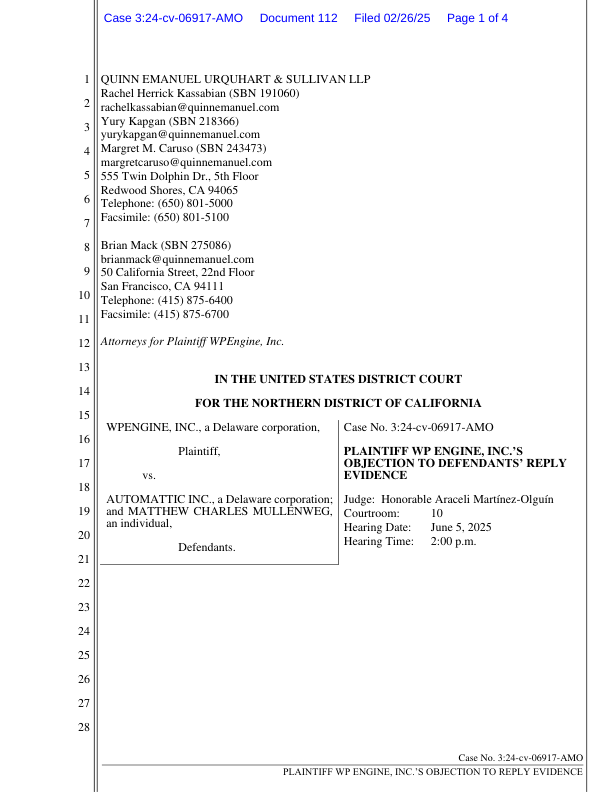
> Source: WP Engine, Inc.'s Objection to Reply Evidence (Case No. 3:24-cv-06917-AMO)
> Reference: Filed 02/26/25; [Document (Page 1 of 4)](#page1)
> date created: {{date:2025-02-26}} {{time:14:00}}
>
> # Title: Plaintiff WP Engine, Inc.'s Objection to Reply Evidence
>
<!-- deep-read:sections start -->
## Table of Contents:
- [📝 Summary](#📝-summary)
- [📖 Main Content](#📖-main-content)
- [🗒️ Notes](#🗒️-notes)
- [📖 References](#📖-references)
- [🗣️ Paraphrase](#🗣️-paraphrase)
- [📰 Newsletter](#📰-newsletter)
- [✅ Action Items](#✅-action-items)
- [🧪 Hypotheses](#🧪-hypotheses)
- [📊 Methodology](#📊-methodology)
- [❓ Questions](#❓-questions)
- [🔮 Future Research](#🔮-future-research)
- [💡 Implications](#💡-implications)
- [🧠 Learning Styles Assessment](#🧠-learning-styles-assessment)
- [📊 Accessibility Assessment](#📊-accessibility-assessment)
- [🌍 DEIB Assessment](#🌍-deib-assessment)
- [✅ Logical Validity](#✅-logical-validity)
- [🔍 DARVO Analysis](#🔍-darvo-analysis)
- [🔍 SEO Evaluation](#🔍-seo-evaluation)
- [🎯 Conclusion](#🎯-conclusion)
### References:
- [WP Engine Objection Document (PDF)](#)
## 📝 Summary:
The document is a legal objection filed by Plaintiff WP Engine, Inc. (represented by Quinn Emanuel Urquhart & Sullivan LLP) that challenges the evidentiary submissions made by Defendants Automattic Inc. and Matthew Charles Mullenweg. The objection focuses on questioning the authenticity, completeness, and truthfulness of several exhibits submitted in reply—specifically noting that certain exhibits appear misdescribed and incomplete. This objection is grounded in established legal precedents and Federal Rules of Evidence, arguing that judicial notice should not extend to deeming the full contents of these documents as true. [See [Dkt. 107-5 at 2](#page2)]
## 📖 Main Content:
The main points and arguments presented in the document include:
- **🔍 Misdescription and Incompleteness of Exhibits**
- Defendants claim that Exhibit 5 is a faithful copy of a September 21, 2024 WordPress article and Exhibit 6 of a September 25, 2024 article. However, discrepancies are noted between these exhibits and the actual content available on the live URLs.
- Specific evidence from Exhibit 5 shows truncated sentences (e.g., “Every change”, “We must set a higher standard to”), and even a missing screenshot reference, suggesting that the document is incomplete. [Direct link: [Page 3](#page3)]
- **🔍 Objection to Admission of Truth**
- WP Engine argues that even if judicial notice is granted regarding the existence of the online documents, it does not imply that every detail within those documents is accurate.
- Citing multiple precedents (e.g., M.O.R.E., LLC v. United States; Khoja v. Orexigen Therapeutics, Inc.), the argument emphasizes that the truth of the exhibits’ contents remains subject to dispute. [See [Page 2](#page2)]
- **🔍 Legal Framework**
- The objection is structured around Federal Rules of Evidence (specifically Fed. R. Evid. 201(b)) and corresponding Ninth Circuit rulings. This legal basis underpins the claim that incomplete or misrepresented exhibits should not be accepted as conclusive evidence.
- The document also underscores that judicial notice is limited to acknowledging the existence of a document, not affirming its complete accuracy.
### 🗒️ Notes:
- **Exhibit Issues**
- 📌 **Misdescription**:
- Defendants’ representation of Exhibits 5 and 6 as identical copies of online articles is challenged by discrepancies in text.
- [Reference: [Page 2](#page2)]
- 📌 **Incompleteness**:
- Exhibit 5 contains truncated sentences and references to a missing screenshot, indicating a lack of substantive content.
- [Reference: [Page 3](#page3)]
- **Objection Rationale**
- 📌 **Judicial Notice Limitation**:
- The court is urged to note the documents' existence without assuming the complete veracity of their contents.
- [Reference: [Page 3](#page3)]
- 📌 **Legal Precedents**:
- Cites prior cases (e.g., M.O.R.E., LLC; City of Miami Gen. Emps.’ & Sanitation Emps’ Ret. Tr. v. RH, Inc.) to support its objection.
- **Filing and Hearing Information**
- 📌 The document was filed on February 26, 2025, with a hearing scheduled on June 5, 2025.
- [Reference: [Page 1](#page1)]
## 📖 References:
- Quinn Emanuel Urquhart & Sullivan LLP filings in the WP Engine, Inc. case.
- Federal Rules of Evidence, particularly Fed. R. Evid. 201(b).
- Relevant Ninth Circuit decisions (e.g., Khoja v. Orexigen Therapeutics, Inc., M.O.R.E., LLC v. United States).
## 🗣️ Paraphrase:
- **Paragraph 1 Paraphrase**:
- *Original*: "Defendants claim Exhibit 5 is a copy of a September 21, 2024 article available at [WordPress URL] yet the content differs, indicating it might be a printout from the Wayback Machine."
- *Paraphrase*: The Defendants argue that Exhibit 5 is an exact reproduction of a September 21, 2024 WordPress article; however, noticeable differences suggest it may instead be an archived printout from the Wayback Machine.
- **Paragraph 2 Paraphrase**:
- *Original*: "WP Engine objects to the admission of Exhibits 1, 2, 5, and 6 for their truth since judicial notice does not extend to the veracity of the document’s contents, as established by Ninth Circuit precedent."
- *Paraphrase*: WP Engine contends that even if the existence of Exhibits 1, 2, 5, and 6 is acknowledged, their detailed content should not be assumed as accurate under judicial notice, following Ninth Circuit rulings.
## 📰 Newsletter:
**WordPress Newsletter Blurb**
Welcome to our latest issue! This edition spotlights a compelling legal battle where WP Engine challenges the authenticity of online exhibits. We break down how discrepancies in digital evidence, such as truncated content and misdescribed screenshots, can affect judicial decisions. Alongside legal insights, catch up on the newest web development trends, community highlights, and plugin updates. For a deeper dive, check out our analysis and key legal precedent links—ensuring you stay informed on both legal and tech fronts. [Explore more](https://wordpress.org/news)
## ✅ Action Items:
- **Professional Alignment**:
- 📌 **Open Source Advocacy**: Emphasize the importance of verifiable digital documentation in maintaining transparency—a core value in open source.
- 📌 **Contributor Engagement**: Use this case as a teaching moment to highlight the critical nature of precise evidence for community trust and reliability.
- 📌 **Educational Outreach**: Develop training sessions on the standards of digital evidence handling, reflecting both legal and technical best practices.
- **Prompt Development**:
- Outline how the article underscores the need for rigorous documentation standards.
- Explain its relevance to open source contribution, legal integrity, and transparent project management.
- Connect these insights with career goals such as OSPO leadership and fostering an inclusive WordPress ecosystem.
## 🧪 Hypotheses:
- **Hypothesis 1**: Digital evidence derived from archived sources is more susceptible to disputes than live, unaltered copies.
- **Hypothesis 2**: Incomplete evidentiary documents can significantly undermine legal arguments, even if their existence is acknowledged.
- **Hypothesis 3**: Standardized protocols for presenting digital evidence could reduce the likelihood of disputes in legal proceedings.
### 📊 Methodology:
- **Data Sources**: Review multiple court filings involving digital evidence discrepancies.
- **Research Design**: Perform a comparative analysis between cases relying on archived versus live digital content.
- **Analysis Techniques**: Use qualitative content analysis and legal precedent mapping to assess discrepancies and their impacts.
### ❓ Questions:
- How do discrepancies in archived digital evidence affect judicial outcomes?
- What measures can be implemented to ensure the completeness of digital exhibits?
- Can standardized digital documentation protocols improve the credibility of online evidence?
### 🔮 Future Research:
- Investigate technological solutions for real-time digital evidence verification.
- Examine the long-term impact of digital evidence disputes on judicial processes.
- Compare international standards for digital evidence handling in legal proceedings.
### 💡 Implications:
- **For Legal Practice**: Establishing clearer standards for digital evidence could lead to more reliable judicial decisions.
- **For Policy**: Results may inform updates to the Federal Rules of Evidence regarding digital documentation.
- **For Technology**: Encourages the development of tools for better digital archiving and evidence validation.
## 🧠 Learning Styles Assessment:
- **Visual Learners (Spatial)**:
- **Present**: The document is structured with clear page references and visual layout markers.
- **Improve**: Add flowcharts or infographics summarizing the evidentiary process.
- **Aural Learners (Auditory-Musical)**:
- **Present**: Formal language is conducive to creating recorded summaries.
- **Improve**: Include audio briefings or podcast segments explaining legal procedures.
- **Verbal Learners (Linguistic)**:
- **Present**: Rich descriptive language and detailed legal citations enhance understanding.
- **Improve**: Provide supplemental reading materials and extended case analyses.
- **Physical Learners (Kinesthetic)**:
- **Present**: The document’s reference to interactive exhibits hints at potential hands-on elements.
- **Improve**: Incorporate exercises such as mock trials or document analysis workshops.
- **Logical Learners (Mathematical)**:
- **Present**: Logical structure and use of legal precedents support clear, rational analysis.
- **Improve**: Integrate problem-solving scenarios and case study breakdowns.
- **Social Learners (Interpersonal)**:
- **Present**: The content encourages discussion of legal standards and community practices.
- **Improve**: Foster group discussions or peer review sessions centered on the case.
- **Solitary Learners (Intrapersonal)**:
- **Present**: Detailed analysis allows for personal reflection on legal methodologies.
- **Improve**: Suggest journaling prompts or individual case study reflections.
- **Naturalistic Learners**:
- **Present**: Limited connection to natural contexts.
- **Improve**: Use analogies comparing systematic legal evidence to natural systems for enhanced clarity.
## 📊 Accessibility Assessment:
- **Screen Reader Compatibility**:
- **Present**: Well-structured headings and clear formatting support screen reader use.
- **Improve**: Ensure all external links and images (if added) include descriptive alt-text.
- **Keyboard Navigation**:
- **Present**: Logical header hierarchy facilitates keyboard navigation.
- **Improve**: Conduct tests with assistive technologies to confirm full navigability.
- **Contrast and Readability**:
- **Present**: Standard formatting provides adequate contrast.
- **Improve**: Recommend high-contrast themes and scalable fonts.
- **Text Resizing**:
- **Present**: Layout is generally responsive.
- **Improve**: Verify that text remains clear and functional at various sizes.
## 🌍 DEIB Assessment:
- **Cultural Relevance**:
- **Present**: The document maintains a neutral, formal tone without cultural bias.
- **Improve**: Supplement with case studies or examples from diverse cultural perspectives.
- **Inclusive Language**:
- **Present**: Employs largely gender-neutral terminology.
- **Improve**: Define technical legal terms to ensure accessibility for non-experts.
- **Neurodiversity Support**:
- **Present**: Clear structure and concise bullet points aid comprehension.
- **Improve**: Break longer sections into simpler statements with summaries.
- **Representation**:
- **Present**: Focuses on established legal perspectives.
- **Improve**: Incorporate additional voices from community or advocacy groups.
- **Psychological Safety**:
- **Present**: Maintains a formal and respectful tone.
- **Improve**: Include brief disclaimers where legal content may be dense or challenging.
## ✅ Logical Validity:
- **Strengths**:
- **Sound Deductive Reasoning**: The argument that incomplete exhibits should not be accepted is supported by clear legal precedents and a structured logical flow.
- **Causal Reasoning**: Draws a strong connection between misdescribed evidence and potential judicial error.
- **Appeal to Facts/Evidence**: Consistent referencing of legal rulings and document discrepancies strengthens the overall case.
- **Weaknesses / Fallacies**:
- **Potential Strawman**: The Defendants’ rationale might be oversimplified by assuming discrepancies are solely due to misrepresentation without considering technical errors.
- **Improvement Suggestions**: Provide more balanced evidence addressing alternative explanations, such as technological issues, to avoid oversimplification.
- **Tone of Voice**:
- Maintains a formal, assertive, and fact-focused tone appropriate for legal documentation while remaining measured in critique.
## 🔍 DARVO Analysis:
- **Deny**:
- **Observation**: The document does not directly deny allegations but strategically questions the completeness and accuracy of the submitted exhibits.
- **Implication**: This approach shifts focus from the substance of the evidence to its presentation, thereby undermining its reliability.
- **Attack**:
- **Observation**: The language used indirectly questions the credibility of the Defendants’ evidence without resorting to personal attacks.
- **Implication**: This measured critique supports the legal argument while avoiding ad hominem tactics.
- **Reverse Victim and Offender**:
- **Observation**: There is no overt attempt to portray WP Engine as the victim by reversing roles; the focus remains on evidentiary integrity.
- **Implication**: The absence of strong DARVO elements reinforces the document’s objective tone.
## 🔍 SEO Evaluation:
- **Keywords**:
- **Presence**: Keywords such as "WP Engine", "Objection", "Evidence", "Exhibits", and "Judicial Notice" are well integrated.
- **Placement**: Appearing in the title, headers, and throughout the text.
- **Meta Description**:
- **Observation**: While not explicitly provided, the summary serves as an effective abstract.
- **Title Tag & Headers**:
- **Observation**: The title and headers are concise, clear, and optimized with relevant keywords.
- **Content Length**:
- **Observation**: Adequate for a legal filing—detailed yet focused.
- **Links**:
- **Observation**: Direct links to online resources (e.g., WordPress articles) support credibility.
- **Mobile & Accessibility Considerations**:
- **Observation**: As a legal document, mobile optimization is less critical but the structured format aids readability.
- **Social Sharing & Schema Markup**:
- **Observation**: Not directly applicable in this context.
## 🎯 Conclusion:
The objection by WP Engine, Inc. is a meticulously crafted legal argument that challenges the evidentiary basis of the Defendants’ reply. By highlighting the misdescription and incompleteness of key exhibits, and underpinning its claims with solid legal precedents, the document successfully argues that judicial notice should be limited to the existence—not the full truth—of the evidence. The analysis reveals a logical and measured approach, with only minor risks of oversimplification that can be mitigated by more balanced evidence. Overall, the objection underscores the necessity for rigorous standards in digital evidence handling, a message that resonates deeply with open-source advocacy and transparent community engagement.
## How Judges and Legal Parties Might Review This
- **Judges**:
- They look for **clarity and precision** in the arguments, ensuring that every claim is supported by clear evidence and authoritative precedent.
- Judges appreciate a **balanced tone** that maintains respect for opposing arguments even when strongly contesting evidence or procedural shortcomings.
- They focus on whether the submission adheres to procedural norms, including proper citations, page numbering, and compliance with local rules.
- Judges value the clear delineation between factual disputes and issues of legal interpretation, especially when evidence authenticity is contested.
- **Legal Parties (Plaintiff and Defendant)**:
- **Plaintiffs** generally favor arguments that **diligently challenge evidence** and underscore any inconsistencies, incomplete exhibits, or procedural missteps by the opposing party.
- **Defendants** may critique the objection for being **overly aggressive** or **selectively citing case law**, arguing that their evidence, even if presented as printouts, is fundamentally reliable.
- Both parties expect submissions that are **well-organized, logically coherent**, and capable of persuading the court through sound legal reasoning.
- They may focus on the **thoroughness of the forensic analysis** of digital evidence and the reliability of any third-party archival data referenced.
<!-- deep-read:sections end -->
📄 **Full text:** ![[Full Document Contents/Articles/gov.uscourts.cand.437474.112.0_1|gov.uscourts.cand.437474.112.0_1, QE]]
## Highlights
- Exhibit 5 purports to be an article, but it contains incomplete sentences that are unintelligible. S ([View Highlight](https://read.readwise.io/read/01jn9w1da2y9dh2s3zqvhch9wk))
- WPE objects to Exhibit 1, a printout of a webpage titled “Plugin Developer FAQ” from wordpress.org, Exhibit 2, a printout of a webpage titled “Detailed Plugin Guidelines” from wordpress.org and Exhibits 5 and 6, to the extent the above objection to Exhibits 5 and 6 in their entirety is not sustained, because these exhibits cannot be considered for their truth. ([View Highlight](https://read.readwise.io/read/01jn9w1tc163hse434mv0c949r))
- Exhibits 3 and 4 are purported transcripts of Defendants’ own online speeches. For the same reasons described above, WPE objects to the use of these exhibits for the truth of the statements contained therein. Khoja, 899 F.3d at 999-1000. ([View Highlight](https://read.readwise.io/read/01jn9w2ge6p6s2c8042cqtadpy))