5 Benefits of Training Needs Analysis[Infographic]

## Metadata
- Author: [[Akarsh Jain]]
- Full Title: 5 Benefits of Training Needs Analysis[Infographic]
- Category: #articles
- Document Note: ---
tags:
- #TrainingNeedsAnalysis
- #LXD
- #WorkplaceLearning
Author: Akarsh Jain
Source: CommLab India Blog
Reference: https://blog.commlabindia.com/elearning-design/training-need-analysis-benefits-infographic
date created: 2025-08-23 00:00
---
# Title: 5 Benefits of Training Needs Analysis [Infographic] — Comprehensive Notes
## Table of Contents:
- 🔎 Introduction to TNA (#-introduction-to-tna)
- 🎯 Benefits of TNA (#-benefits-of-tna)
- 🧭 Steps to Conduct a TNA (#-steps-to-conduct-a-tna)
- 🧩 Additional Insights (#-additional-insights)
- 🏁 Conclusion (#-conclusion)
- 📚 References (#-references)
### References:
- CommLab India Blog
- AIHR Guide
- MTD Training
- GoSkills Guide
- EdApp Guide
## 📝 Summary:
Training Needs Analysis (TNA) is a structured approach to pinpointing the knowledge, skills, and competencies employees need to perform effectively. The article emphasizes five benefits and provides a sequenced method: define purpose/scope, collect/analyze data, prioritize needs, develop/implement training, evaluate, and continuously improve. It highlights aligning training with organizational goals, selecting appropriate modalities (workshops, eLearning, on-the-job, mentoring), and documenting to enable iteration and impact measurement.
## 📖 Main Content:
The piece frames TNA as a compass for organizational performance, ensuring training is relevant, targeted, and outcome-driven. It recommends stakeholder involvement early (managers, HR, employees), multi-source evidence gathering (surveys, interviews, performance data, job descriptions), and a prioritization lens centered on strategic impact and urgency. The implementation guidance stresses clear learning objectives and blended modalities, while evaluation and continuous documentation enable adaptation to evolving business needs.
Quoted:
- “Training Needs Analysis (TNA) is a systematic process for identifying the knowledge, skills, and competencies…” (about 0–14%)
- “Select the appropriate training methods, which could include workshops, online eLearning courses, on-the-job training, mentoring, or a combination of these.” (about 57%)
### 🗒️ Notes
- Definition and purpose
- TNA = systematic identification of knowledge/skill/competency gaps for role effectiveness (≈0%)
- Aligns L&D with organizational priorities; prevents misaligned or wasteful training
- Stakeholder engagement
- Include managers, HR, employees to capture accurate needs (≈14%)
- Use cross-functional perspectives to avoid siloed assumptions
- Data collection and analysis
- Sources: surveys, interviews, performance evaluations, job descriptions; add focus groups for depth (≈29%)
- Analyze for performance gaps, root causes, and training-suitable issues
- Prioritization
- Rank by impact on goals, strategic importance, urgency (≈43%)
- Translate to clear learning objectives per need; define success criteria
- Design and implementation
- Choose methods: workshops, eLearning, OJT, mentoring; blend as needed (≈57%)
- Monitor effectiveness during rollout; ensure manager enablement
- Evaluation and continuous improvement
- Assess impact; capture feedback; iterate content/process (≈86%)
- Maintain thorough documentation: findings, recommendations, actions, outcomes
- Wrap-up insight
- TNA guides high performance and empowers employees; keep adapting as needs change (≈86–100%)
## 📖 References:
- CommLab India Blog: 5 Benefits of Training Needs Analysis [Infographic] — https://blog.commlabindia.com/elearning-design/training-need-analysis-benefits-infographic
- The State of Learning: 2023 and Beyond (editor’s note references an eBook)
## 🗣️ Paraphrase:
1) Original idea: TNA is a systematic process to identify needed knowledge/skills so employees can perform effectively.
Paraphrase: A Training Needs Analysis is a structured method to determine which capabilities employees must build or refine so they can meet role expectations and deliver on organizational outcomes.
2) Original idea: Select appropriate training methods—workshops, eLearning, on-the-job, mentoring—or combine them.
Paraphrase: Choose delivery formats that fit the goals, such as instructor-led sessions, digital courses, experiential practice at work, or guided mentoring, and consider blending them to optimize results.
## 📰 Newsletter:
This week in WordPress and Open Source: Level up your learning and your stack. We’re spotlighting practical paths to becoming a full-stack web dev: start with HTML/CSS foundations, add JavaScript and modern tooling, sprinkle in PHP for WordPress extensibility, and version it all with Git/GitHub. Recent core updates bring performance boosts and improved block editor stability—perfect timing to ship those theme tweaks. Community shout-outs to contributor onboarding sprints happening across Meetup groups; if you’re new, jump into good-first-issues and pair with a mentor. Plugin watch: a lightweight image optimizer landed a major update with smarter lazy-loading, and a CI-friendly testing plugin now supports Playwright for end-to-end coverage. Pro tip: map your learning with a mini “needs analysis”—define your goal (e.g., build a Gutenberg block), identify gaps (React hooks, WP data stores), pick targeted resources, then iterate. Useful links: WordPress Developer Resources, Gutenberg handbook, and GitHub Learning Lab for branching mastery. As always—commit early, commit often, and don’t forget to hydrate your README.
## ✅ Action Items:
Prompt you can reuse for alignment with your Developer Advocate/OSPO goals:
“Analyze how this article advances open-source advocacy, contributor engagement, and education within the WordPress ecosystem. Specifically:
- Map key points to: a) sustainable community health (funding, governance, OSPO practices), b) contributor onboarding/retention, and c) instructional design excellence (clear objectives, inclusive pedagogy).
- Propose outreach activities (talks, workshops, docs) that translate the article’s ideas into contributor-friendly pathways.
- Identify metrics (contributor growth, PR cycle time, learning outcomes) and transparent reporting tactics aligned with OSPO maturity.
- Recommend DEIB-centered strategies to widen participation and ensure psychological safety.
- Outline how this supports my trajectory toward OSPO leadership, demonstrating policy alignment, cross-functional collaboration, and measurable impact.”
## 🧪 Hypotheses:
- H1: Teams using formal TNA prioritize training with higher business impact than teams with ad hoc training.
- H2: Blended methods (eLearning + OJT + mentoring) yield superior skill transfer versus single-modality training.
- H3: Involving line managers during scope definition increases post-training application rates.
- H4: Thorough documentation correlates with faster iteration cycles and improved training ROI.
### 📊 Methodology:
- Mixed-methods evaluation with pre/post performance metrics and learner surveys.
- Quasi-experimental design comparing departments adopting TNA vs. control.
- Data sources: LMS analytics, HRIS performance data, manager observations, Git/GitHub activity where applicable (for dev teams).
- Analysis: difference-in-differences for ROI; thematic coding on qualitative feedback; regression controlling for role tenure and workload.
### ❓ Questions:
- Which prioritization criteria most strongly predict training impact: strategic alignment, urgency, or skill scarcity?
- How does manager involvement influence reinforcement behaviors post-training?
- What documentation practices best support institutional learning across cycles?
- When does mentoring outperform workshops for complex skill acquisition?
### 🔮 Future Research:
- TNA frameworks tailored to open-source contributor programs.
- Cost-benefit analysis of blended learning vs. microlearning for fast-moving teams.
- Standardized TNA documentation templates that integrate with popular LMS/LRS tools.
### 💡 Implications:
- Stronger alignment of L&D to strategic goals can reduce wasted spend.
- Clear documentation standards could become part of L&D governance models.
- In open-source contexts, TNA-informed onboarding may increase contributor retention and code quality.
#
- Document Tags: [[needs analysis]]
- Summary: Training Needs Analysis (TNA) is a systematic process that helps organizations identify the knowledge, skills, and competencies that employees need to perform their jobs effectively. The infographic highlights five benefits of TNA: targeted training and development efforts, improved performance and productivity, better alignment with organizational goals, reduced training costs, and increased employee engagement and satisfaction. The step-by-step guide provides instructions on how to carry out a TNA, including purpose and scope identification, data collection and analysis, prioritization of training needs, development and implementation of training programs, evaluation and feedback, and continuous improvement and documentation. Conducting a TNA can help organizations enhance performance, empower employees, and align training efforts with organizational goals.
- URL: https://blog.commlabindia.com/elearning-design/training-need-analysis-benefits-infographic

Training Needs Analysis (TNA) is a systematic process for identifying the knowledge, skills, and competencies that employees or a group of individuals within an organization must acquire or improve to perform their jobs effectively. TNA helps organizations ensure that their training and development efforts are targeted and aligned with the specific needs of their workforce. The infographic below mentions 5 notable benefits of TNA followed by a step guide on how to carry out a seamless TNA.
#### 5 Benefits of Training Needs Analysis
[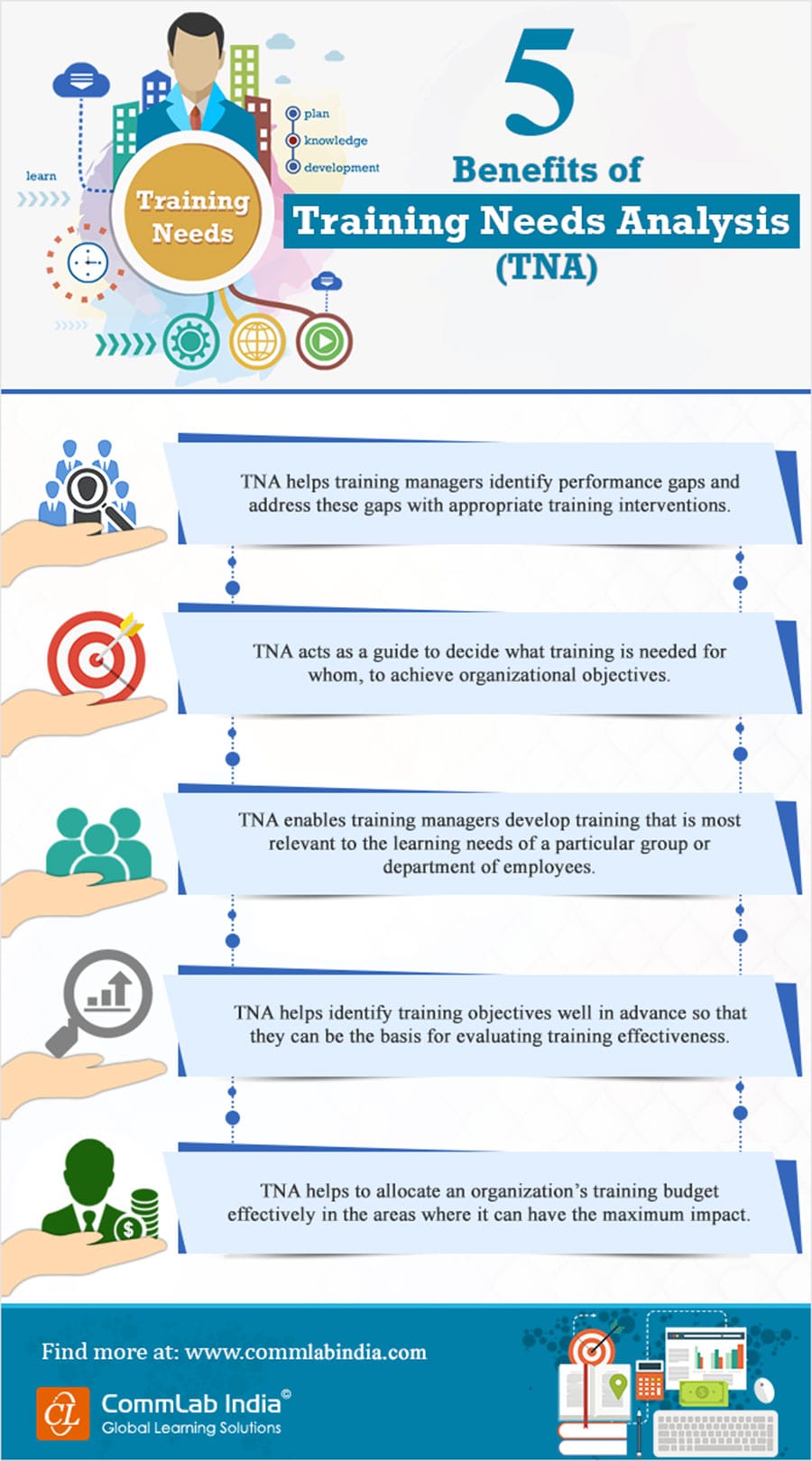](https://www.commlabindia.com/hubfs/blogs/training-need-analysis-benefits-infographic-info.jpg)[Training Needs Analysis: 5 Noteworthy Benefits](https://www.commlabindia.com/hubfs/blogs/training-need-analysis-benefits-infographic-info.jpg)
#### A Step-By-Step guide on How to Carry Out a Training Needs Analysis
##### 1. Purpose and Scope Identification
Clearly define the objectives of the [Training Needs Analysis (TNA)](https://blog.commlabindia.com/elearning-design/training-needs-analysis-learning-objectives), specifying the desired outcomes and the areas to be assessed. Decide the scope of the analysis, including which departments, roles, or individuals will be included. Involve key stakeholders, such as managers, employees, and HR personnel, to gather insights and perspectives on training requirements.
##### 2. Data Collection and Analysis
Gather data from a variety of sources, such as employee surveys, interviews, performance evaluations, and job descriptions. Consider conducting focus groups or one-on-one interviews with employees to gain a deeper understanding of their needs. Analyze this data to identify performance gaps, knowledge or skill deficiencies, and specific areas requiring improvement.
##### [→ Download eBook Now: The State of Learning - 2023 and Beyond](https://resources.commlabindia.com/ebook/state-of-learning)
##### 3. Prioritization of Training Needs
Not all training needs are of equal importance, so focus on those that will yield the most significant benefits. Prioritize identified needs based on their impact on organizational goals, strategic importance, and urgency. Clearly define the [learning objectives](https://blog.commlabindia.com/elearning-design/learning-objectives-elearning-importance) for each training need. What specific skills or knowledge should the training address?
##### 4. Development and Implementation of Training Programs
Based on the prioritized needs, design and develop training programs with clear learning objectives and [instructional design strategies](https://resources.commlabindia.com/ebook/instructional-design-101). Select the appropriate training methods, which could include workshops, online eLearning courses, on-the-job training, mentoring, or a combination of these. Implement the training programs and closely monitor their effectiveness.
##### 5. Evaluation and Feedback
After training, assess the impact of the training on employee performance and skill development. Collect feedback from participants and their supervisors to assess the impact on performance. Adjust the training as necessary to address any shortcomings.
##### 6. Continuous Improvement and Documentation
Continuously review and refine the TNA process and training programs to adapt to changing organizational needs and employee development requirements. Maintain thorough documentation of the entire process, including findings, recommendations, actions taken, and the impact on the organization.
#### Wrapping Up!
Conducting a Training Needs Analysis (TNA) serves as the compass guiding your organization toward higher performance levels. By systematically identifying and addressing knowledge and skill gaps, TNA ensures that training efforts are targeted and relevant. This process empowers employees to excel in their roles, ultimately benefiting the entire organization. Apart from TNA, there are other crucial aspects to follow and to have more insights about the same, you can check out this comprehensive eBook that will eventually help you understand the state of learning.
*Editor’s note: This post was originally published in June 2018 and has been updated for comprehensiveness.*
[](https://blog.commlabindia.com/cs/c/?cta_guid=8b1480aa-1254-46fc-9a9f-2c3754633396&signature=AAH58kGGHvRz4hZ5eYL1fWowtlTgwWWKVQ&pageId=123326930221&placement_guid=af1c88db-f5b7-46da-8a31-25a7fb7d2361&click=e9ae1964-fc73-4f12-97d4-9acef4148d43&hsutk=&canon=https%3A%2F%2Fblog.commlabindia.com%2Felearning-design%2Ftraining-need-analysis-benefits-infographic&portal_id=59327&redirect_url=APefjpF3Bqfbatp6sSJYd0gN5mdr7X1uW5aRSt60AqpmlRihqlWTUrrWceNthnn-WTQo2dlxzy43uPpFmoGVaE4A1JYnU19PQz3twx2d2PRcttuboEwCcW_XuBTw1jeLLksy7t3jkNLxHe7iZG8UoUaoH6luTiER-w)[The State of Learning: 2023 and Beyond](https://blog.commlabindia.com/cs/c/?cta_guid=8b1480aa-1254-46fc-9a9f-2c3754633396&signature=AAH58kGGHvRz4hZ5eYL1fWowtlTgwWWKVQ&pageId=123326930221&placement_guid=af1c88db-f5b7-46da-8a31-25a7fb7d2361&click=e9ae1964-fc73-4f12-97d4-9acef4148d43&hsutk=&canon=https%3A%2F%2Fblog.commlabindia.com%2Felearning-design%2Ftraining-need-analysis-benefits-infographic&portal_id=59327&redirect_url=APefjpF3Bqfbatp6sSJYd0gN5mdr7X1uW5aRSt60AqpmlRihqlWTUrrWceNthnn-WTQo2dlxzy43uPpFmoGVaE4A1JYnU19PQz3twx2d2PRcttuboEwCcW_XuBTw1jeLLksy7t3jkNLxHe7iZG8UoUaoH6luTiER-w), 5 Benefits of Training Needs Analysis[Infographic], Akarsh Jain, 01hdrm88c8zjg12tv0xx0qs7x5.