A Newcomer’s Guide to WordCamps
## Metadata
- Author: [[Jonathan]]
- Full Title: A Newcomer’s Guide to WordCamps
- Category: #articles
- Document Note: ---
tags:
- #wordpress
- #wordcamps
- #community
Author: Jonathan
Source: Blog
Reference: https://jonathanwold.com/blog/a-newcomers-guide-to-wordcamps/
date created: {{date:YYYY-MM-DD}} {{time:HH:mm}}
---
# Title: A Newcomer’s Guide to WordCamps
## Table of Contents:
- [📌 Overview](#-overview)
- [🤝 Volunteer Teams](#-volunteer-teams)
- [🌐 Local Autonomy](#-local-autonomy)
- [💼 Commercial Tension](#-commercial-tension)
- [🏢 WordCamps for Business](#-wordcamps-for-business)
- [🧭 Guidance for Newcomers](#-guidance-for-newcomers)
- [✅ Conclusions](#-conclusions)
- [📚 References](#-references-1)
- [📝 Notes](#-notes)
- [🗣️ Paraphrase](#-paraphrase)
- [📰 Newsletter](#-newsletter)
- [✅ Action Items](#-action-items)
- [🧪 Hypotheses](#-hypotheses)
- [📊 Methodology](#-methodology)
- [❓ Questions](#-questions)
- [🔮 Future Research](#-future-research)
- [💡 Implications](#-implications)
- [🧠 Learning Styles Assessment](#-learning-styles-assessment)
- [📊 Accessibility Assessment](#-accessibility-assessment)
- [🌍 DEIB Assessment](#-deib-deib-assessment)
- [✅ Logical validity](#-logical-validity)
- [🔍 DARVO Analysis](#-darvo-analysis-prompt)
- [🔍 SEO Evaluation](#-seo-evaluation)
- [🎯 Conclusion](#-conclusion)
### References:
- What to expect at WordCamps – A visitor’s guide (WordCamp Central)
- Will What Got Us Here, Get Us There? WordPress Community at Scale – talk by Andrea Middleton
- My First WordCamp & Why It’s Different Than Other Trade Shows – by Tom Fanelli
- “Want more? Check out this thread on Twitter I started while writing this piece.”
Note: The article does not include timestamps, but key sections are linked here directly.
## 📝 Summary:
The article welcomes newcomers to WordCamps and explains why they’re uniquely valuable to the WordPress ecosystem: they connect people, inspire participation, and encourage contribution. It outlines what makes WordCamps different from traditional business events—volunteer-led organization, local autonomy that creates variation across events, and a thoughtful balance between community values and commercial activity. It then offers specific guidance for businesses and first-time attendees: attend, volunteer, sponsor, plan, connect, and repeat. The conclusion reaffirms that embracing WordCamp values benefits both individual businesses and the broader ecosystem.
## 📖 Main Content:
The author situates WordCamps as the “essential magic” of WordPress—community-building events that can feel “delightfully and occasionally disorienting” to those used to conventional trade shows. Three structural characteristics differentiate WordCamps:
- They’re run by volunteers whose passion drives exceptional results but whose limited time can create unevenness.
- Organizers enjoy high local autonomy, so experiences vary widely between local and regional events.
- There’s a healthy but sometimes confusing tension around commerce: sponsors are welcome, but promotional excess is curbed to preserve community ethos.
For businesses entering WordPress, WordCamps accelerate learning, relationship-building, and awareness—provided companies respect community values. The author’s concrete steps for newcomers—Attend, Volunteer, Sponsor, Plan, Connect, Repeat—form a practical pathway for sustainable engagement.
Personal insight: This piece models a community-first playbook that aligns well with open-source norms. The “commercial tension” section is especially helpful for vendor teams calibrating tone, swag, and side events. The guidance scales for both solo freelancers and enterprise teams, but teams new to OSS culture should pair it with value-orientation training (e.g., contributor etiquette, Codes of Conduct).
### 🗒️ Notes
- 📌 Overview
- WordCamps reconnect the community post-hiatus; many new faces.
- For business-event veterans, WordCamps can feel different and values-driven.
- Origins: Began in 2006; ongoing except for the COVID pause.
- 🤝 Volunteer Teams
- Run by volunteers; some employer-sponsored.
- Strength: outsized passion and care.
- Tradeoff: uneven resources and response times across teams.
- 🌐 Local Autonomy
- Common frameworks (handbook, Codes of Conduct, WordCamp Central).
- High autonomy yields variety; local vs. regional experiences differ.
- Newcomer risk: overgeneralizing from a single event.
- 💼 Commercial Tension
- Sponsors welcomed; guardrails against superlatives and aggressive pitches.
- Side events must not conflict with official schedule.
- Low-cost tickets; mixed presence from global enterprises to passion projects.
- 🏢 WordCamps for Business
- Increase understanding: shortcut to ecosystem knowledge.
- Build relationships: in-person time deepens trust.
- Create awareness: decentralized ecosystem makes visibility hard; WordCamps help if values are respected.
- 🧭 Guidance for Newcomers
- Attend: local and regional.
- Volunteer: Contributor Day and event roles.
- Sponsor: treat as community contribution.
- Plan: objectives for before/during/after; get community feedback.
- Connect: expect inclusion and welcome; note exceptions.
- Repeat: growth compounds across events.
- ✅ Conclusions
- WordCamps are foundational; values should endure as events evolve.
- Embrace the model for mutual ecosystem benefit.
## 📖 References:
- What to expect at WordCamps – A visitor’s guide (WordCamp Central)
- Will What Got Us Here, Get Us There? WordPress Community at Scale – Andrea Middleton
- My First WordCamp & Why It’s Different Than Other Trade Shows – Tom Fanelli
## 🗣️ Paraphrase:
1) Original idea: WordCamps can feel delightful yet disorienting to newcomers, especially those used to typical business events, because they’re community-centric and contribution-oriented.
Paraphrase: If your background is conventional trade shows, a WordCamp may surprise you—in a good way. The focus on community connection and contribution creates a vibe that’s both welcoming and a little unfamiliar at first.
2) Original idea: Sponsors are invited, but overt commercial superlatives and schedule conflicts are discouraged to protect community values.
Paraphrase: Sponsorship is part of the fabric at WordCamps, but hard-sell tactics and flashy claims are tempered. Side events are fine too—just not at the expense of the official program.
## 📰 Newsletter:
WordPress World Tour: Learning, Launches, and the Love of Community
This week we’re diving into how to level up your web development journey the WordPress way—by showing up where the magic happens: WordCamps. If you’re new, think “open-source festival meets friendly hallway track.” Attend sessions to sharpen your HTML/CSS/JS/PHP chops, drop into Contributor Day to ship your first patch, and meet the folks behind your favorite plugins.
Recent updates: Keep an eye on ongoing Gutenberg iterations and performance improvements across core. For a refresher on community culture, Andrea Middleton’s talk on the community’s scaling values is a must-watch.
Community highlights: WordCamps are volunteer-powered and locally unique—what you see at a regional (WCUS, WCEU, WCAsia) will differ from a local meetup. Sponsors are welcome, but the tone stays community-first. If you’re a vendor, calibrate your presence to teach, not pitch.
New plugins and tools: Explore block patterns libraries, monitoring/perf tools, and accessibility checkers that make shipping sites faster and fairer for everyone.
Further reading: “A Newcomer’s Guide to WordCamps” lays out a simple plan—Attend, Volunteer, Sponsor, Plan, Connect, Repeat. It’s the open-source flywheel in six steps.
- A Newcomer’s Guide to WordCamps: https://jonathanwold.com/blog/a-newcomers-guide-to-wordcamps/
- WordCamp Central visitor’s guide: https://central.wordcamp.org/
- Andrea Middleton on community values: Search “Will What Got Us Here, Get Us There? WordPress Community at Scale”
See you in the hallway track—bring questions, comfortable shoes, and your contributor hat.
## ✅ Action Items:
Prompt for aligning articles with your Developer Advocate/OSPO trajectory
Use this prompt with each article you review:
“Analyze how this article advances open-source advocacy, contributor engagement, and education within
- Summary: WordCamps are part of the essential magic of WordPress. They connect community (including newcomers!) to each other, inspire attendees with what's possible in WordPress, and encourage (and empower) people to contribute, which makes WordPress (and the ecosystem) better for us all.
- URL: https://jonathanwold.com/blog/a-newcomers-guide-to-wordcamps/

WordCamps are back! While one of the highlights for me personally is certainly seeing old friends what I’ve *especially* enjoyed are all the new faces!
I’ve had the privilege of talking with quite a folks new to the ecosystem both before, during, and after their WordCamp experience and I’ve noticed a recurring theme.
For folks who’ve never been to a WordCamp, *especially* those from the world of business used to “normal” events, a WordCamp can be a delightfully and occasionally disorienting experience.
WordCamps are part of the essential magic of WordPress. They connect community (including newcomers!) to each other, inspire attendees with what’s possible in WordPress, and encourage (and empower) people to contribute, which makes WordPress (and the ecosystem) better for us all.
WordCamps started off with a bang in 2006, just a few years after WordPress’ own origin. The [first WordCamp was held in San Francisco](https://milestonesbook.wordpress.com/2015/11/22/wordcamp-2006/) and, with the exception of our pause during COVID, WordCamps have become a consistent part of the WordPress ecosystem.
When comparing WordCamps against more traditional business events, though, a few key characteristics stand out.
##### Volunteer Teams
WordCamps are run by volunteers. While some of the organizers might be in full-time volunteer positions (“sponsored” by their respective employers), many contribute because they love to and take their involvement seriously. There are benefits and tradeoffs to working with volunteers. On the positive, you get *incredible* efforts that far surpass what you’d expect at a typical business event. On the negative, volunteers often have limited time and resources, resulting in frustrating gaps compared to what you’d expect at a typical business event. One team may be responsive and on schedule while another is severely under resourced and doing their best to get by.
##### **Local Autonomy**
WordCamps have consistent threads (e.g. an [organizer handbook](https://make.wordpress.org/community/handbook/wordcamp-organizer/) with [codes of conduct templates](https://make.wordpress.org/community/handbook/wordcamp-organizer/planning-details/code-of-conduct/) and [WordCamp Central](https://central.wordcamp.org)) that provide layers continuity from one to the other. That said, individual organizers have high autonomy (which we love) and, as a result, your experience at one WordCamp can and often does vary widely from one to the next, especially when comparing local WordCamps to regional (e.g. W[ordCamp Europe](https://europe.wordcamp.org/), [WordCamp Asia](https://asia.wordcamp.org/), and [WordCamp US](https://us.wordcamp.org/)). While there are strong positives to this from an ecosystem perspective (see [the benefits and tradeoffs of decentralization](https://blog.jonathanwold.com/the-benefits-and-tradeoffs-of-decentralization/)), it can be disconcerting for someone new to the ecosystem who forms an impression (positive or negative) based on one WordCamp without realizing that the next experience might be quite different.
##### **Commercial Tension**
We have a curious relationship with business at WordCamps. Sponsors are welcome and at the same time, superlatives on sponsor swag and in booths are not (see [sponsorship rules for details and examples](https://make.wordpress.org/community/handbook/wordcamp-organizer/planning-details/fundraising/local-wordcamp-sponsorship/)). Supporting events are welcome, as long as they don’t interfere with the official schedule. Tickets are typically $50 or less and, these days, often sell out within a day. Some of the world’s largest companies manage booths only a few feet away from passion projects run by volunteers. It’s fantastic and can also be daunting to navigate if you’re used to explicitly commercial events.
Want to dig a bit deeper? Here are a few additional resources on WordCamps:
* [What to expect at WordCamps](https://central.wordcamp.org/what-to-expect/) – A visitor’s guide published on WordCamp Central.
* [Will What Got Us Here, Get Us There? WordPress Community at Scale](https://wordpress.tv/2019/10/31/andrea-middleton-will-what-got-us-here-get-us-there-wordpress-community-at-scale/) – A talk given by Andrea Middleton unpacking the values of the WordPress community and sharing the history of WordCamps.
* [My First WordCamp & Why It’s Different Than Other Trade Shows](https://convesio.com/blog/wordpress-ecosystem/wordcamp-us-2019/) – A reflection written by Tom Fanelli after attending WordCamp US in 2019.
##### WordCamps for Business
As I see it, getting involved in WordCamps offer several unique benefits for businesses entering the WordPress ecosystem.
* **Increasing Understanding** – If you want to grow your business in the WordPress ecosystem there’s a lot to learn. WordCamps can be a great shortcut to learning the nuances of WordPress and the ecosystem we’ve built around it.
* **Building Relationships** – While I will always be a fan of building relationships over distance, there is something special about time in person. WordCamps are a great way to anchor the relationships you’ve been building and to give you an opportunity to meet new folks you weren’t expecting.
* **Creating Awareness** – Because of WordPress’ decentralized nature, introducing your business to the ecosystem can be quite difficult. WordCamps can be a great place to create awareness and begin bridging the gap between you and your potential customers, as long as you learn and respect the values of the WordPress community. ([Watch Andrea’s talk](https://wordpress.tv/2019/10/31/andrea-middleton-will-what-got-us-here-get-us-there-wordpress-community-at-scale/) for an explanation of the values)
##### Guidance for Newcomers
So if you want to increase your understanding of WordPress, if you want to build relationships within the community, and if you want to create awareness and grow your business within the WordPress ecosystem, here’s what I recommend you do:
1. **Attend** – See what WordCamps are about for yourself. Attend local WordCamps and attend the regional ones.
2. **Volunteer** – Attend Contributor Day and look for opportunities to volunteer before or during the event.
3. **Sponsor** – Sponsor a WordCamp and embrace their non-commercial nature, thinking of your investment as a contribution to the community.
4. **Plan** – Think about what you want to do before, during, and after the event to increase your understanding, build relationships, and promote positive awareness of your business. Ask for feedback on your plans from folks who know the community.
5. **Connect** – We attend WordCamps because we love WordPress and the community we’ve built around it. As a newcomer, enjoy that. While there are always going to be negative exceptions, as a whole you can expect to feel an inclusivity and welcomeness that will be easy for you to connect to.
6. **Repeat** – After you’ve experienced your first, do it again. For businesses serious about growing in the WordPress ecosystem, each WordCamp will give you more to work with.
Want more? Check out [this thread on Twitter](https://twitter.com/sirjonathan/status/1556806190243332096) I started while writing this piece.
##### Conclusions
WordCamps are amazing and a foundational part of the WordPress ecosystem. While they will continue to grow and evolve, there are values and characteristics that we expect (and want) to remain. Embrace them and enjoy. Your business will benefit and our ecosystem (which you’re a part of) will too.
Got questions? I love talking about WordCamps. [Contact me](https://jonathanwold.com/contact). Coming to WordCamp US? Be sure to find me and say hi!
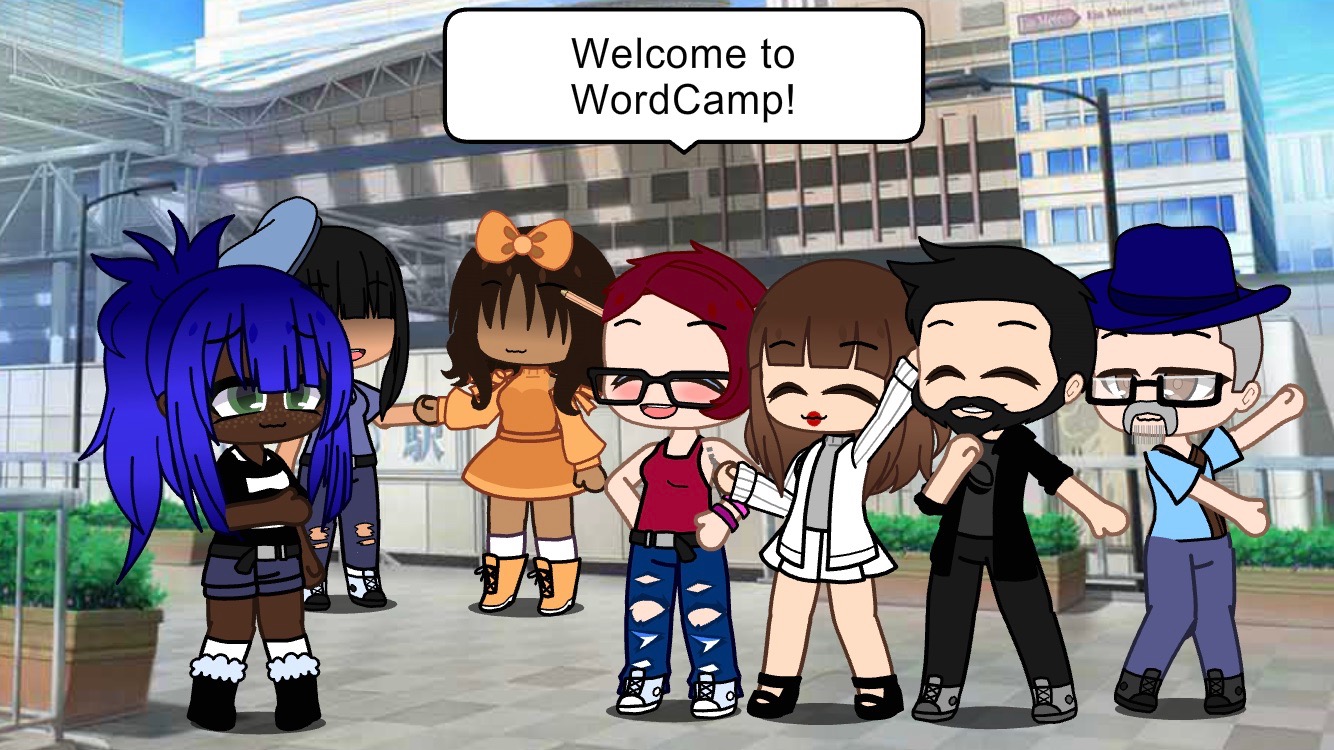
Special thanks to my daughter Jensyn (9) for her illustration of me and a few friends at WordCamp!
Thanks to Adam Weeks, Ali Darwich, Angela Jin, Anna Maria Radu, Bob Dunn, David Mainayar, Kelley Muro, Sé Reed, Tammie Lister, and Tom Fanelli for their early feedback!, A Newcomer’s Guide to WordCamps, Jonathan, 01k37bwphpkdgs1a9z6a3v747f.