Accounts Don't Buy. People Do.
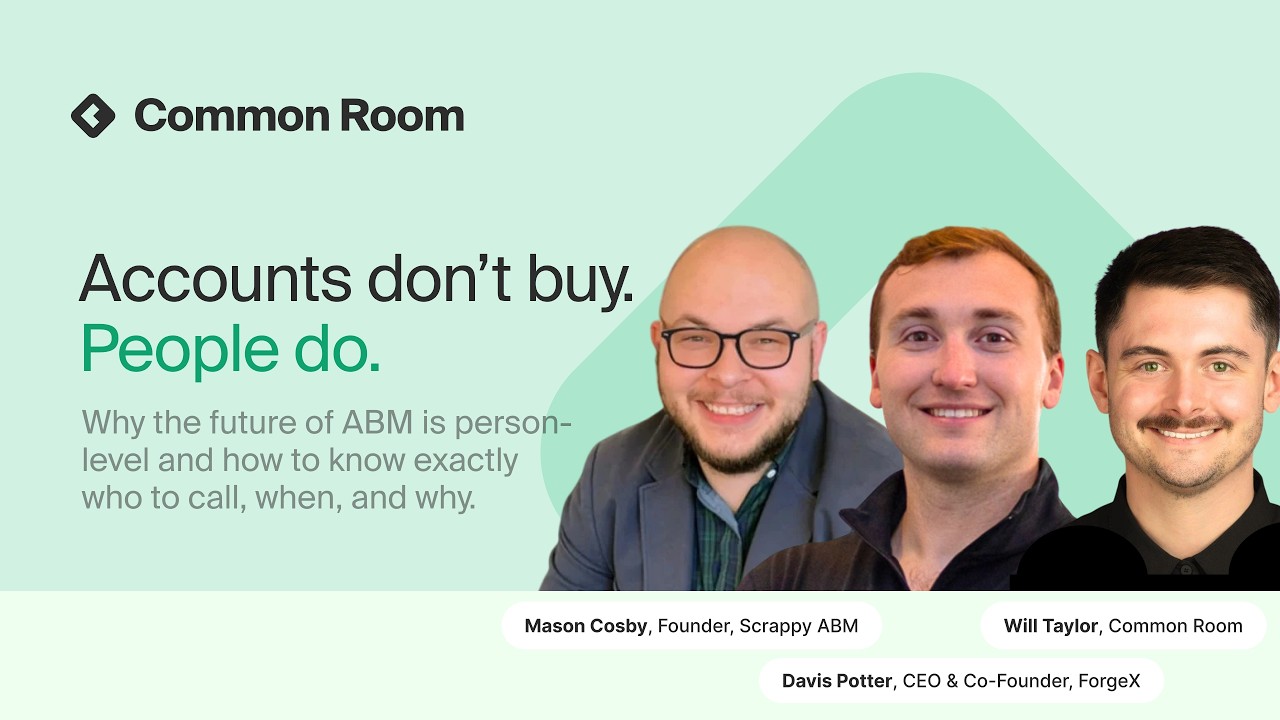
🔗 **Source:** [Accounts Don't Buy. People Do.](https://www.youtube.com/watch?v=cKDamhLwow8)
> [!note]+ Document Notes
> ---
> tags: [abm, buying-committee, b2b-sales, go-to-market, sales-marketing-alignment, devrel-measurement]
> author: [Common Room webinar — Will Taylor with Mason Cosby (Scrappy ABM) and Davis Potter (ForgeX)]
> source: [YouTube — Common Room]
> reference: [https://www.youtube.com/watch?v=cKDamhLwow8]
> date created: 2026-08-07 00:00
> ---
> > [!info] Generated analysis — not the author's words. Sections below are machine-written
> > from the captured source. Only text inside `> [!quote]` blocks is verbatim from the author.
> > Do not quote or attribute any other line to the named author.
> # 🏷️ Title: Accounts Don't Buy. People Do. (Common Room webinar, full session)
> ## 🧭 Table of Contents
> - [🔗 References](#-references)
> - [📝 Summary](#-summary)
> - [📖 Main Content](#-main-content)
> - [📚 References](#-references-primary)
> - [🗣️ Paraphrase](#️-paraphrase)
> - [📰 Newsletter](#-newsletter)
> - [✅ Action Items](#-action-items)
> - [🧪 Hypotheses](#-hypotheses)
> - [📊 Methodology](#-methodology)
> - [❓ Questions](#-questions)
> - [🔮 Future Research](#-future-research)
> - [💡 Implications](#-implications)
> - [🧠 Learning Styles Assessment](#-learning-styles-assessment)
> - [📊 Accessibility Assessment](#-accessibility-assessment)
> - [🌍 DEIB Assessment](#-deib-assessment)
> - [✅ Logical Validity](#-logical-validity)
> - [🛡️ DARVO Analysis](#️-darvo-analysis)
> - [🎯 Conclusion](#-conclusion)
> - [🧱 Refactor Appendix](#-refactor-appendix)
> ### 🔗 References
> - Video: https://www.youtube.com/watch?v=cKDamhLwow8 (published 2026-08-06, ~5,869 transcript words)
> - **Companion document in this library:** the Common Room blog recap of this same session — `01kze5620hqprv2zdxwcycsev0`, https://www.commonroom.io/blog/abm-webinar-recap/
> - Scrappy ABM (Mason Cosby) · ForgeX (Davis Potter) · Common Room (host and publisher)
> - SiriusDecisions Demand Waterfall — referenced in-transcript as "serious decisions as demand waterfall" (ASR)
> > [!important] **This is the primary source; the blog post is its recap.** Read them as a pair.
> > The webinar contains **material evidence the recap omits** — most importantly, a confound that
> > undercuts the recap's headline statistic. See Logical Validity → fallacy 1. Where the two
> > disagree, this transcript is the original.
> ## 📝 Summary
> - **What happened.** The full ~45-minute webinar behind the Common Room recap. Cosby and Potter argue that account-level ABM scoring cannot tell sales who to contact, and that the unit of action must be the individual buyer inside an eight-role buying committee.
> - **Why it matters.** Beyond the framework, the session supplies three things the recap dropped: the **confound** explaining why fast deals are fast, a concrete story about buying insurance to remove a blocker, and a striking base rate — roughly **5% of the 338 organizations Cosby spoke with were running any marketing into pipeline at all**.
> - **Key stakeholders.** B2B marketing/sales leaders; RevOps; DevRel and community teams under pressure to attribute pipeline; anyone whose signal data resolves to accounts rather than people.
> - **Risks and tradeoffs.** The evidence is one practitioner's self-reported book, the arithmetic does not reconcile (see below), and the headline cycle-time comparison compares two structurally different kinds of deal. The framework is sound; the proof is not.
> - **Bottom line.** Better than its recap. The confound Cosby volunteers in passing is the most intellectually honest moment in either document, and it happens to demolish the causal reading the recap promotes.
> ## 📖 Main Content
> - **The trust-collapse mechanic (verbatim origin).** The line the recap quotes originates here: an account is hot, sales asks why, > [!quote] marketing gets to respond back with, "Well, it's 80 points." And at that point, um sales immediately loses trust, doesn't actually know who to reach out to, and everything kind of falls apart in that exact moment. Cosby attributes the failure specifically to "the broken promise of ABM" from "our big three tech vendors from 2020."
> - **Potter's historical arc.** MQL hamster wheel (SiriusDecisions demand waterfall era) → ABM unifies teams behind a target account list → new failure mode, the MQA thrown over the wall → current push toward buying groups. His framing throughout: identify, **validate**, and continuously **re-engage** the group in partnership with sales.
> - **Explicitly not either/or.** Potter is emphatic: > [!quote] what I don't want people to walk away with today is thinking let's completely throw out the account-based approach and just go to buying groups. It's not a it's not a eitheror. The recommendation is a blend, with the blend ratio left undefined.
> - **The dataset, with its own arithmetic problem.** Cosby states 338 sales cycles over three years, 118 closed won, and the remainder as "20 whatever the remainder 211" closed lost. **118 + 211 = 329, not 338.** He later refers to "339 whatever sales cycles." The numbers are spoken approximations, not a reconciled dataset — worth knowing before anyone cites them.
> - **The eight roles, with sharper definitions than the recap gives.** Decision maker (says yes); economic buyer (finance — not the go/no-go, but the terms negotiation); champion (drives internally); key influencers (manager level); technical/implementation ("we get most often blocked by IT"); blockers (> [!quote] they aren't vocal on the call. They just sew seeds of doubt behind the scenes that you never get to actually directly address unless your champion's amazing and brings them to you); end users (matter at retention, not first sale — "if nobody uses the product then you're going to not get the second, third, fourth, seventh sale"); gatekeepers, which he distinguishes from blockers precisely — **gatekeepers protect time but hold no opinion**, executive assistants being the archetype.
> - **The insurance story — the best concrete artifact in the session.** Cosby's agency kept losing deals at the IT-review stage. Someone eventually told them they could not sign because the agency had no cyber insurance. He bought a policy (he corrects himself mid-sentence: $4,000, then "actually, sorry, it's $14,000 a year") and the blocking stopped. His framing: > [!quote] you lose so many deals, you do so much work to then lose over a freaking $14,000 a year insurance policy. Just buy it regardless. This is the clearest illustration in either document that blockers are often *procedural*, not persuasive — and that the fix is operational rather than rhetorical.
> - **The 5% base rate.** Of the ~338 organizations he ran deep-dive discussions with, > [!quote] Roughly 5% of them were running any kind of marketing in pipeline. His inference: sales is limited to whoever the champion grants access to, whereas marketing can reach the economic buyer and decision maker directly with ads. This is the actual argument for marketing's role in the committee, and the recap omits it.
> - **The cycle-time claim — and its confound.** Deals with more committee engagement earlier average 60 days; those engaged through marketing before booking the meeting run 30 days. Then Cosby adds the line the recap leaves out: > [!quote] They're also not exploring other vendors or competitors. He goes on to contrast it explicitly with "here's the RFP and you're going to be one of five vendors" — calling them "totally different" sales. He is describing two different deal types, not one deal type accelerated.
> - **Forecasting benefit.** He claims the mapped committees let him forecast the next quarter more confidently, and stresses the timeline honestly: "it takes 12 months. Like it's not going to happen overnight."
> - **Enterprise complexity (Potter).** Buying groups vary by industry, product line, org maturity, and business unit. Title aggregation misleads inside large banks whose siloed units hold competing vendor contracts. A concrete audience example: "civil engineer" denotes entirely different roles across organizations, so title-based enrichment breaks.
> - **Discovery stack when sales knows little.** (1) Instrument cheaply — call recorder ~$20/month plus HubSpot Starter ~$20/month, sales extension BCCs every email to the contact/account record, revealing who sales en
Welcome everyone to another webinar. Uh we're titling this one accounts don't buy people do for pretty obvious reasons, but we're going to get into the nitty-gritty and we are having a lot of fun in the backstage. Uh we're probably going to have some healthy discourse between our two guests today, but I'm excited to dig into the content. Uh I would love to hear where you're tuning in from. And as with all of these that
I've run, this is not for me to hear my own voice. I obviously want to put our guests on stage and make them feel awesome. But this is ultimately for you in the chat. So if you have questions, pop them in the chat. We're going to try and answer them live. We will save some time at the end. But if you have a question pop up, put it in. We want to make this more conversational with you. And heck, if you want to even come on stage, then uh we'll put you on stage as well. Uh today we're talking about accounts don't buy, people do. Most ABM
programs only really look at the account level information. And honestly, that's not good enough. That's not how buyers want to engage. And that's not how buyers buy. Buying groups are only getting larger. And I actually wrote a piece recently around the trust between buyers in a buying group is actually eroding just like buyers trust in most companies is as well. So, you have a lot to do in the way of leg work of reaching those buyers and convincing them. But
there is a way and we're going to be talking about those tactics today. Um, before we dig into everything, I'd like to introduce our two speakers on stage, Mason and Davis. And, uh, they're going to introduce themselves, talk more about what they're doing and, uh, what they're working on, and of course those tactics that I mentioned today. Um, I don't know who to choose first because you both have great energy. I'll go with Davis. Uh, Davis, tell us more about working on.
>> You see that, Mason? >> Thanks, Will. >> Like already deviating from the dock where I was, [laughter] but whatever. Who cares? >> What's up? What's up, everybody? Thank you so much for joining. Thanks for having us on too, Will and and Conorman room. My name is Davis. I'm the CEO and co-founder of Forjax. Forjax is think Forester, think Gartner in terms of we conduct a lot of primary research and translate that into best practices, frameworks, models and advisory for
other organizations. Um, and we deeply specialize in accountbased and AI. Mason, throw it your way. >> Hi, I'm founder of Scrap ABM. We actually build programs for people. So, we've built about a hundred in the past three years. So I also unintentionally do research because I see what makes our clients money and then the things that don't and we then turn those into standardized approaches that uh I feel and our clients often feel are the most proven approaches to actually building
an ABM program that works today. Strategies fairly self-explanatory at this point. Target good people that look like your best customers. Engage them in a way that you know they want to be engaged with where it typically falls down to the actual execution and the speed at which people can make decisions. So, uh, we're going to talk through today is more that perspective of how do you then know what to go do next week versus, uh, you know, thinking and pontificating for the next 6 months and not doing anything. >> Nice. And we're going to prove it as much as we can today with the proof both
of you have and of course the strategies and tactics that work. So, uh, Mason, set the stage for us. We had uh an event last year actually where we talked about the broken promises of ABM and I feel like this is a really good time to uh call back to that. What is the problem that most teams are facing given the current state of buying in this B2B world? Uh what is the core problem and the core challenge to be solved that you effectively help your clients solve?
Yeah, the the core challenge that was the broken promise of ABM and primarily our big three tech vendors from 2020 is uh they'll tell you exactly who to go after at an account level. So you get an account that's hot and then sales says, "Well, why is this account hot?" And marketing gets to respond back with, "Well, it's 80 points." And at that point, um sales immediately loses trust, doesn't actually know who to reach out to, and everything kind of falls apart in that exact moment. So
again, that's where it comes back to even if you've nailed down the right accounts to go after, they're showing engagement, you want to reach out to them. Uh the running joke that I have seen from many of my other friends in the ABM space is like an account showing high degrees of intent because somebody went and viewed 80 different blogs on your website. Um that person might have been the janitor, could have been the CEO, standard tech vendors from, you know, the big three wouldn't tell you. So that's the core problem that we're trying to actually solve is not only do we have good accounts, are those
accounts engaged, but who do we speak to at those accounts? >> Yeah, cuz ultimately you're not reaching out to the account holistically. It's that person and not one person makes a decision. Uh which is great to set the stage for us today. So, uh, Davis, you are looking at this, um, from a different angle and you've spent a lot of time looking at actual closed one deals in your research. Um, why is it that the account is the wrong unit of measurement? What's your take?
So I think it even goes back to how we measure the success of our programs where you know there's been this massive shift or at least there was over to what Mason alluded to as in just merely look at looking at accounts or following some sort of account progression scoring taking a account that hits a threshold of MQA and then just throwing it over to the sales team and saying okay we did our job now you all go close them. But
before that uh even then so you think about the MQL and the MQL hamster wheel that so many organizations were leveraging and they were probably on some version of serious decisions as demand waterfall and so they were thinking in this capacity of okay you know now we are at this contact level but we're just trying to run this massive top offunnel uh essentially gathering this these form fills or
contact information for these people and then we throw them at sales as in you know ABM really helped to usher in this whole focus around okay now we're actually unifying our marketing sales sometimes customer success resources behind a unified target account list or portfolio but then it shifted to that MQA or the account progression model and now what you're starting to see uh you're in on
LinkedIn or through some of these conferences and research is this whole push towards buying groups as in inside of those actual accounts instead of just taking that MQA or that you know XQA whatever qualified account cuz it hit this scoring threshold actually zeroing in and looking in at okay who are those people so going back to the contact level but MQLs are one individual person which we all know you know especially in
enterprise sales one person isn't freaking making the actual purchase decision. So it's how do we look at for example some research from LinkedIn the 12 to 14 people who are part of that buying group and have different roles responsibilities throughout the the buying process. How do we identify them? How do we validate them? And then how do we partner with sales to one pass the buying groups towards them and then also continuously re-engage them throughout
the buying process. And what I think is interesting about what you just said there is um like sales there there's of course all the tension between marketing and sales and the MQL and all that kind of stuff but ultimately sales speaks to people and maybe they're speaking to a group a group of people but each individual has their own motivations their own engagement and behaviors and their role and they care about different things and so the misalignment there is we're getting further towards it with modern technology and of course AI but uh the
it it's always perplexed me that it's marketing goes to the accounts. Uh they're obviously doing the best they can and then sales goes well I'm trying to talk to the right person and get through to the right buying group. But it was always that challenge and you you brought the stat of 12 to 14 in the buying group. My stat that I had was 6 to 10 and then I was going to say and it's only increasing. So you validated that and why is it the case that that account score doesn't see the no
decision and obviously a lot of the vendors in the space have been able to make that account score more robust with more information. We talk about intent data and what have you, but why is that the specific missing piece? And what's the better way? And if you want to just jump to the better way, then we could dig into that. But what's your take on the missing data points? Because it's not useless information, but it's not there enough for the sales team to actually convert. What's your take on
that? How does the account score not actually point to a decision being made? >> Davis, that's all you first. Oh, sweet. I thought I thought that was pass it to you, Mason. Well, I think that the biggest thing is, you know, again, you have merely that just account level insight, which is great. It's cool. It's it's interesting to look at, but it doesn't actually go down to the specific people. And that is what sales is looking for. They want to know, okay,
who can I conduct outreach to? Who are the people that are actually engaged? And often if you just merely look at an account, a rolledup account score, you know, it's probably some version of uh first party signals as in they had a direct interaction with you in some type of capacity, maybe anonymously through your website or they attended a webinar like people did today or they registered for a webinar. But how do you aggregate and look at these specific people who
are most likely to be part of the buying group? How do you roll that up and pass that over to sales? That's the missing link. And I also from a measurement and reporting standpoint and also from an ABM perspective, the it what I don't want people to walk away with today is thinking let's completely throw out the account-based approach and just go to buying groups. It's not a it's not a eitheror or we have to just do MQLs or
we have to do some account scoring and progression modeling or we have to merely just do buying groups but how do you pick the right blend of both? >> And Mason, walk us through how that is being practiced in actuality. So you've done like you said over a 100 programs and you've been producing results for clients. What are you looking for? uh you shared with me the play of going to the recently closed loss deals. Why is
that a good place to start from an AVM standpoint and what data points actually matter and why is it that play that those data points matter and you focus there first? Talk to me more about running that. >> So again, what we're all trying to do with a marketing program is get our right fit customers to want to book a meeting with us and then inevitably close. So, we like to start with the closed, lost, and closed one data to actually look at who is involved in those um direct interactions in those direct groups. When I'll just I actually was doing the math earlier. Um we've had
338 sales cycles in the past 3 years. 118 of those were closed one. 20 whatever the remainder 211 um were closed lost. And we looked at the core differences. More often than not, in the closed lost, we were singlethreaded, which functionally means we had one person that was like, I kind of want to learn more. And then they got pricing and they're like took it back and their boss was like no just go do it like go do your job and it was like okay so those we lost whereas those that we won unsurprisingly more often than not we had more people involved and
engaged. What is then the miss there for so many people is they focus exclusively on the champion. We have found that there are eight standardized roles in any decision group. So that's going to be the decision maker the economic buyer. So decision maker is like who actually you know decides and says that we're going to do this. Economic buyer is typically your finance buyer. So they're not going to be the determining factor of if we do the program or not. They're going to be more the negotiation around terms. So you're going to figure out how much am I willing to bend on my terms to make sure that this set of deliverables actually happens. Then you
got the champion that's actually like driving the deal internally. You've got key influencers. So this is typically going to be those manager folks. Uh you've also got the technical implementation team. So like we get most often blocked by it. Fun fact, when you then buy a $3 million cyber security policy, you get a lot less blocked by it. So, like, we wouldn't have bought that unless we'd actually looked at our sales cycles and said, "We keep losing because it doesn't trust us with their data. Let's go get some insurance for $4,000 a year or actually, sorry, it's $14,000 a year." And unsurprisingly, we
now get better deals. Crazy. But like, what marketing agency makes that purchase unless they it's a it's a real objection. Um, so someone finally told us, "We can't sign because you don't have insurance." Great. Let me go buy it. helpful. Sorry, I get really passionate about this because it's just you lose so many deals, you do so much work to then lose over a freaking $14,000 a year insurance policy. Just buy it regardless. Then you get blockers who are just like, I actually think this is the wrong thing for us to do. And they aren't vocal on the call. They just sew seeds of doubt behind the scenes that
you never get to actually directly address unless your champion's amazing and brings them to you. Then you have the actual end user who's going to do the thing. And that doesn't come up as much on the upfront sale. It comes in retention because if nobody uses the product then you're going to not get the second, third, fourth, seventh sale. And the last you have gatekeepers. Gatekeepers are different from blockers in my mind because they're people that are intended to protect time but they don't have an opinion. So like EAS are typically good gatekeepers. So you don't make friends with your EAS. So when you actually map out those people, good
sellers are already doing this. That data just never gets back to marketing. And again in the I've now I've had 339 whatever sales cycles which means I've had deep dive discussions with that many people about their specific programs. Roughly 5% of them were running any kind of marketing in pipeline which functionally means that sales is only getting access to who their champions enable them to get access to. Whereas marketing can actually just run ads. So like we can run ads that are case study
and ROI focused ads towards our procurement buyer or our economic buyer or our decision maker to then showcase proof points that we are the right solution for them uniquely. But that's why we start here because then once you've actually mapped out that decision committee, you see who's involved, you accelerate sales cycles and you use that as a testing ground. Then guess what? You freaking do that earlier and you get more of them involved earlier from a marketing perspective. you intentionally create some content for that buyer so that when they book the meeting, they fly through the pipeline. In our own
data, those that have actually where we've gotten more folks engaged in the buying committee earlier, our average sales cycle is 60 days. Those that have shown engagement earlier in marketing before they book the meeting have a 30day sales cycle. They're also not exploring other vendors or competitors. It's I just need to figure out if we can actually make this happen or I'm going to have to figure out how to use all your content for free to do this internally. Totally different sale than the well here's the RFP and you're going to be one of five vendors that we're
going to explore. Like totally different because we found the buying committee through doing a close lost and close one analysis validated that we can get those people engaged through cycle that they will move faster and then market it to them earlier before they ever booked a meeting with us. And we take it takes 12 months. Like it's not going to happen overnight. But again, I now fun fact can better forecast my Q2 today based on the decision committees that are engaged in our current marketing programs. That makes me able to much more
confidently and effectively scale my own business. So anyway, that's why I get so passionate about like just doing this on the front end so you actually know who you're trying to sell to. Davis, do you have any quick thoughts before I ask the next question on what Mason just broke down? Sorry, pretty [laughter] >> so many. No, that was a really great explanation because it's like, okay, you know, these are the pieces that make up the buying groups and if you're thinking on the close lost, right? That that's a great breakdown there. And then conversely, if you're trying to break
into uh Greenfield accounts, it's like, you know, we get this qu question day in and day out as in how do I even understand or uncover who's part of the buying group? And buying groups, especially when you're in enterprise sales, they can be really complex. the bigger the companies that you're pursuing, especially even the company that you're in. If you have multiple different product lines, uh just think about, you know, all of the each
industry can have different makeups of buying groups. The maturity of the organizations that you're pursuing can influence the way in which the buying groups are made up. Even in some of these large organizations, takes take a bank for example, there are so many different business units that can fall inside of those banks. So if you're just looking at your data and you're seeing this mass aggregation of let's say titles, for example, you know, that's going to be misleading because you still
don't have it mapped back to the specific business units. And those business units can be as siloed to the point where they have competing contracts for tech vendors. So the big question here is I is, you know, how do I actually take all of this data? How do I understand who makes up the buying groups? How do I predict that to the best of my capabilities? I'll give you another example here too. We had someone come up at one of our events and she asked the question, you know, how title
alone I'm really struggling when I'm doing data enrichment and when I'm going through these buy group exercises because civil engineer can mean something completely different inside of different organizations. Um, and so the roles and responsibilities. So buying groups, they're they're very complex. It's not something that is incredibly simple where you can just, you know, go out and say, "Oh, here are the titles. Let me just pull them back and boom, I have I have the buying group." There are
a lot of different dimensions to consider. >> I was just uh seeing the question from Carlo. Can you give a couple examples? Uh couple of what? Pop it in the chat. We'll dig into it. Uh Davis, I liked what you said there, and I want to distill both of your answers into something that I think uh and you can tell me if I'm on the the right track here, uh that can be actionable for the audience here. So, it sounds like there's buying motions. That's kind of
the highest level, whether it's they already know about us and that's going to impact how they buy with us. And then there's we're going out to them, maybe it's an RFP, maybe it's cold. Great. There are two buying motions. And then from there, there are of course the different parts of the buying committee. there's maybe it, there's finance, there's your champion, there's probably the champion's boss. And so that's starting to make up what that buying group is. So you have the motions, you have the buying groups in those motions, and then you have the actual specific individuals and the data that they're
giving you in terms of their engagement or what you can glean from any kind of like intent data or of course if you have any owns data, uh, if it's a PLG motion or what have you. All of that is going to culminate into how do we reach these specific individuals based on their role in the buying group based on the buying motion. Is that a good way to think about how we can simplify the different data points or the different let's say motions if we're trying to build this into our systems? Um what's
your take on how I've simplified it? Uh we'll go with Mason first. >> I was hoping you go with Davis first because I was reading Carlo's question thinking about my answer for Carlo. [laughter] >> Okay. Davis, do you have an answer to like how I've simplified it? >> Yeah, I think it was great. It's almost like how do we think about pipeline generation, deal acceleration after you have an open opportunity and then you have uh how do we deliver on our product and then how do we retain and then also how do we expand and thinking about each of those different buying processes and
how you're identifying the buying group, validating the buying group, they can change uh even as different people come in and out. So to Mason's point earlier, it's like what is the perception and what is the role as maybe organizational shifts happen or people come in and out of the org. So continuously refreshing that um is also important but 100% in terms of where the account is in its buying journey and then also uh making sure that you keep tabs on who that
buying group is and making sure that you partner with sales around this is so important. It's a great segue to to Carlos's question. So, um, recent examples or a couple examples of recent tactics used to locate who is on the buying committee when sales has minimal knowledge. So, this is partly assuming that we can define a lot of that information. And I always say that well make your best guess knowing that there are some basic
uh parts of the buying group that you already have exposure to and you can extrapolate to a degree. But um Mason, how do you find it when you're working with clients? What do you do? Who are you asking? Um what are what's the structure that you're you're running to capture that information to then effectively build those buying groups? So thing one is even if your sales has minimal knowledge, I want to go ahead and just make this super practical. Um
you can get a call recorder for like 20 bucks a month and then HubSpot starter is also 20 bucks a month. So if you have zero tracking currently just get literally anything. And the reason I call it HubSpot starter is 20 bucks a month is you can set up the sales extension and then it will BCC every email and then tag that to a contact or an account record. And then what you can actually do is then get data on who sales is emailing with. The reason that's important is sales is not only going to email with the champion, but they're also inevitably if they get late enough in the cycle, they're actually
going to inevitably rub shoulders with people that are blockers. They're going to rub shoulders with people that are the actual decision makers and economic buyers and some gatekeepers. So you can actually start to see who is sales engaging with in our sales cycle because just as important as those that they're engaging with are those that they're not. You're going to do more guessing on those that they're not, but like you may have again as a starting point good titles that you can see within your actual organization both through emails and through call transcripts. So that's step one. It's just like get data and
it's like it's not expensive to start to get this data. Now, that said, you then have to then wait a year um to then get all the sales cycles because you can't you can't go back if you you can't re you can't record a call that wasn't recorded. Tough. But that's step one. Step two is then if you need data today, I would just do essentially a round of internal interviews with as many folks as you can
that are customerf facing in any capacity that so that would be some capacity of sales, that would be some capacity of customer success and then there are customers that are really like really like you. Um what would be interesting is to hear the stories of those where like the champion did some internal heroics to like get the deal across the line and talk through who were the blockers in our deal together. Who did you have to convince and get some anecdotal evidence to get you started? From there you can then take all of that information and then say is this an anomaly or is this a standard?
Um and that will help you. Again, this is some judgment call, so forgive me. There's not a perfect science if you have zero data, but you can start to gather anecdot. So, anecdotal information that helps you get started. And the last thing is there's this lovely tool called AI. So, like I would use this tool called CR. It's a framework called crit. So, it's context roll um interview task. So, context is I'm trying to figure out our decision committee um but I don't have enough sales data to actually have an objective
view. Can you help me identify based on publicly available information on who is standardly involved? Your role is you have 15 years experience doing close, lost and close one analysis, building decision groups um for highly complex B2B organizations like mine and then you have your industries. Interview is literally say please interview me on any questions to fill in any gaps you possibly can. And then task is an objective view that I could upload into a tool like LinkedIn or to use for data enrichment purposes to identify the
buying comm within my account. So that's what I would do if I'm in your shoes going from most data to least data to then using tools to actually help you fill in the gaps. >> Nice. That will help to distill it into those specific data points uh that you can track for those specific people, for those specific buying groups, and for those specific buying motions. Uh I love it. Okay, so I want to do some rapidfire questions. Uh the first one and try and keep it one to two sentences or so. Uh the first one is why are you right? What
data do you have that flexes? I'm I know that this works andor uh I know because of XYZ data points that um this is you know call it the future of ABM or why you should be continuing to to listen to us. Davis uh why are you right? What is the the flex that you can you can make? We have some data in our ABM maturity report. I'm blanking on it off the top of my head, but organizations who are implementing a buying group centric
approach are seeing x multiple stronger results than others. >> Nice. Mason, why are you right? >> 100 programs, 350 million in pipeline, 130 million in revenue for our customers. >> Nice. uh for both of you, what's your favorite, if you were to only choose one program that you can run in ABM, what is the campaign or strategy that you would run or you would recommend clients run?
And I know there's a lot of nuance, but what is that favorite one? Uh Mason, I'll go. >> There's not there is a correct answer. Um close lost. This is the bucket where you have the most data that is first party. You know exactly why they didn't buy and it's a perfect sample group of a representative larger market where you can test conversion offers to accelerate pipeline. So close lost is objectively best data. No one's loyal to it. Um you
know why they didn't buy and you can again representative markets of sample sizes that you can then scale once you've proven a conversion mechanism. So close lost is the answer. Davis, what's your favorite campaign or play >> that works super well for us as well from a tactical perspective? Uh really hi highly curated virtual roundts or smaller events. >> Nice. Uh what's a big red flag uh that you see in either the research or in
working with clients? Um is it a champion who won't introduce you or an exec that you've never met? What's the bigger red flag if you're trying to, you know, run marketing to those those people? Davis, I'll go with you first. What's worse? The champion who won't intro intro you or the exec that you've never met? >> Depends on where they are and depends on your strategy, but I would go with uh champion who won't make an intro for you >> because they're not really a champion.
Mason, what's your answer? >> I mean, if I'm a salesperson, it's the champion I've never met. If or sorry, the champion that won't make the intro. Um, the real red flag is like a sales team that doesn't know who's in their buying committee. So like, sorry, but I'm thinking about it from a marketing lens. I can't market to people that you don't know need access. >> Nice. And then uh the last one, most ABM programs would fix themselves overnight if they just blank. Uh, Davis, what's
your answer? >> This is the answer that's been there for 20 plus years. Built a stronger relationship with the sales team. Nice Mason. >> My perspective on this has changed a lot. Um started with one product, one market for one year. >> Very good. >> Just give it a year. >> Everyone, thank you for your attention. We're coming up on time and we blazed through that. It felt like it was 15
minutes. U but we are at the 30 minute mark. Um there was a question in the chat. Is this what common room can do? The answer is yes. I implore you to fa go and speak with the team and get a demo and learn more about what we've been building. Um buying groups are very important to the buying decision obviously. So that is being baked into the common platform and even more ABM functionality uh to be announced soon. Please check out what both Davis and Mason are building. They're both very
great experts that share a lot of information and you should absolutely follow them. Join their communities. Spend money with them. Uh they clearly know what they're doing. So, [laughter] thank you again for your attention. Any parting words? Pretty sure we're still live. Uh Mason Davis that you wanted to share before we end it here. >> Davis, you go first. >> This was awesome. No, thanks so much, Will. Mason, we need to run this back again. We'll have to do another podcast or something. Maybe we need a round two.
We'll we can uh get more into debate, too, which would be really fun. >> Um, but Peter, I also saw your question in there. Uh, hit me or Mason up on LinkedIn and we'll make sure to get that answered. >> Uh, thank you all for being here. If you want more stuff like this, as Dave referenced, there is a podcast. You can go check out the Scrappy ABM podcast. Uh, and if you want to hang out with me for eight hours, we have a thing called the ABM a day workshop. So, go to scrappyabm.com/workshop. use the code 75 off and it'll give you 75% off. It's on August 25th, so I hope
to see some of you there. >> And we'll follow up with all that information in the emails as well. This was also recorded and we'll be clipping it up for everyone because uh some really good takes that uh are very tactical as well. So, thanks again everyone for your time and attention. >> See you everybody. Bye. >> Hit that big red button. Red button at the bottom there., Accounts Don't Buy. People Do., YouTube, 01kze5641dzp34bewdtm00pwc4.