Advancing Accessibility Through Community and Open Source
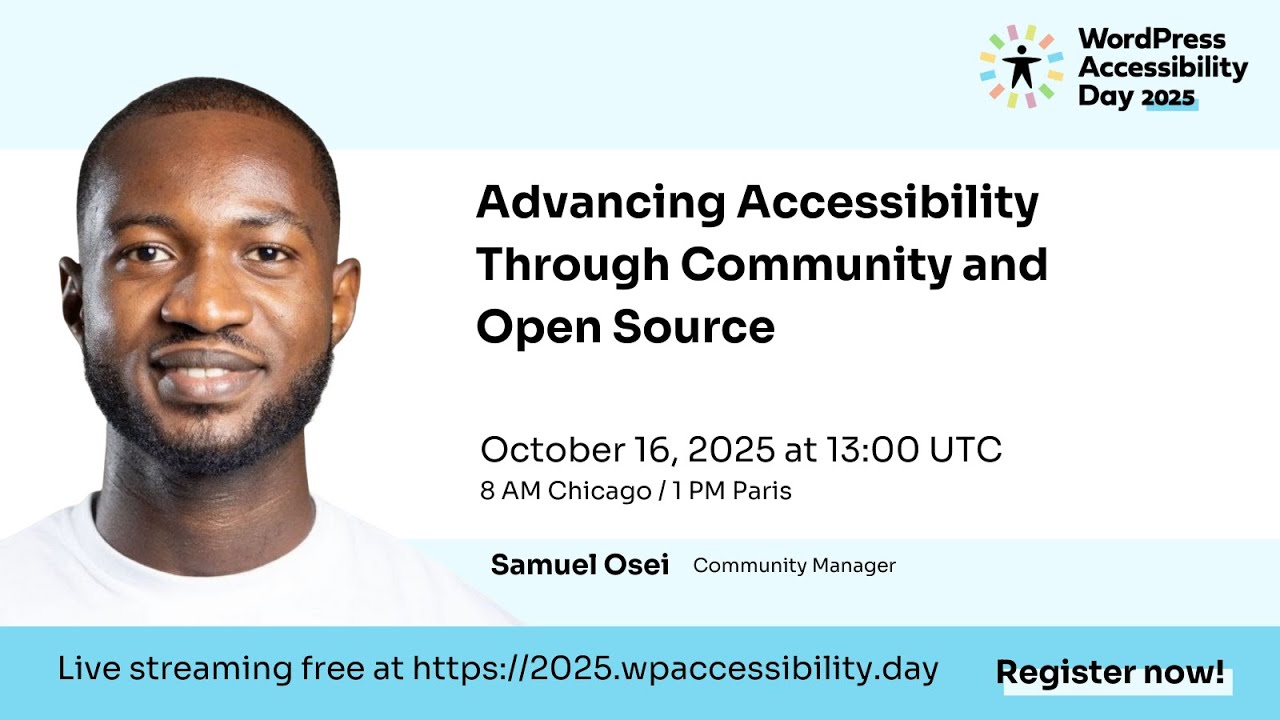
🔗 **Source:** [Advancing Accessibility Through Community and Open Source](https://www.youtube.com/watch?v=g0NY4T6AQcA)
> [!note]+ Document Notes
> ---
> tags: [accessibility, digital-inclusion, wordpress-community, devrel, disability-employment, ghana]
> author: Samuel Osei
> source: WordPress Accessibility Day 2025
> reference: https://www.youtube.com/watch?v=g0NY4T6AQcA
> date created: 2026-09-08
> ---
> > [!info] Generated analysis — not the author's words. Sections below are machine-written
> > from the captured source. Only text inside `> [!quote]` blocks is verbatim from the author.
> > Do not quote or attribute any other line to the named author.
> # 🏷️ Title: Advancing Accessibility Through Community and Open Source
> ## 🧭 Table of Contents
> - [📝 Summary](#-summary)
> - [📖 Main Content](#-main-content)
> - [🗒️ Notes](#️-notes)
> - [📚 References](#-references)
> - [🗣️ Paraphrase](#️-paraphrase)
> - [📰 Newsletter](#-newsletter)
> - [✅ Action Items](#-action-items)
> - [🧪 Hypotheses](#-hypotheses)
> - [📊 Methodology](#-methodology)
> - [❓ Questions](#-questions)
> - [🔮 Future Research](#-future-research)
> - [💡 Implications](#-implications)
> - [🧠 Learning Styles Assessment](#-learning-styles-assessment)
> - [📊 Accessibility Assessment](#-accessibility-assessment)
> - [🌍 DEIB Assessment](#-deib-assessment)
> - [✅ Logical Validity](#-logical-validity)
> - [🛡️ DARVO Analysis](#-darvo-analysis)
> - [🎯 Conclusion](#-conclusion)
> - [🔄 Refactor Appendix](#-refactor-appendix--advancing-accessibility-through-community-and-open-source)
> ### 🔗 References
> - [TechAble contact —
[email protected]](mailto:
[email protected]) (funding and partnership inquiries, mentioned t=2320)
> - [KNUST — Kwame Nkrumah University of Science and Technology](https://www.knust.edu.gh/) (program partner, t=2261)
> - [IEEE Computer Society](https://www.computer.org/) (initial TechAble funder, t=2251)
> - [WordPress Accessibility Day feedback form](https://2025.wpaccessibility.day/feedback) (t=2870)
> - Event hashtags: #WPA11yDay, #WPAD2025 (t=2856)
> ## 📝 Summary
> - **What happened.** Samuel Osei, a Ghanaian software engineer and WordPress Meetup organizer in Kumasi, presented at WordPress Accessibility Day 2025 (hosted by Chris Hinds, COO of Equalize Digital) on TechAble, a WordPress-based digital-skills training initiative for people with disabilities in Ghana.
> - **Why it matters.** Osei ties a global accessibility statistic — the WHO's estimate that 16% of the world's population, or 1.3 billion people, experiences significant disability (t=499) — to a concrete, running program that trains people with disabilities in WordPress development, digital marketing, and graphic design (t=2524), funded initially by the IEEE Computer Society and run in partnership with KNUST's Student with Disability Association (t=2251–2269).
> - **Key stakeholders.** TechAble participants (56% women, t=1631), IEEE Computer Society (funder), KNUST and its Student with Disability Association (partner/volunteers), industry mentors, WordPress's accessibility team, and WordPress Accessibility Day sponsors who were asked live to donate commercial plugin licenses.
> - **Risks and tradeoffs.** The program is still pre-launch on infrastructure: no public website yet (t=2394), funding requests route through a personal email address rather than a formal channel (t=2320–2333), and the biggest cost driver is hardware/connectivity, not curriculum (t=2341–2383) — a scaling risk if device costs aren't solved before enrollment grows.
> - **Bottom line.** Osei's central claim is that open source removes the financial barrier to entry that proprietary tools create (t=1483–1489), and that community — mentorship, peer buddies, industry connections — is what converts technical training into sustained employment and belonging (t=1990–2010).
> ## 📖 Main Content
> Osei frames accessibility as a legal and ethical mandate, not a feature (t=414–426), then names four concrete barriers people with disabilities face when trying to gain digital skills: inaccessible platforms and tools (unlabeled form fields, image buttons with no alt text, t=610–708), training content without captions (t=708–807), lack of assistive-technology support baked into how software is coded (t=807–904), and limited community support that leads to isolation and attrition (t=911–1024).
> He pairs each barrier with an opportunity: inclusive training opens remote jobs and entrepreneurship because digital skills are "location-independent" (t=1077–1093), builds independence and dignity through economic self-sufficiency (t=1179–1258), improves representation because people with disabilities catch accessibility issues able-bodied teams miss (t=1274–1372), and creates empowered communities where "learners become teachers" (t=1381–1452) — a grassroots-over-top-down argument for how the movement scales.
> WordPress is positioned as the delivery mechanism specifically because it's free to use, modify, and distribute, removing the cost barrier proprietary software creates, and because it already has "a very active accessibility team" (t=1477–1500). That belief led to TechAble: three tracks (WordPress web development, digital marketing, graphic design, t=2522–2534), a mentorship structure pairing each participant with an industry mentor (t=1712–1719), and a deliberate 56%-women cohort achieved through "peer buddy" accountability pairing and extra facilitation attention rather than by accident (t=1639–1649, t=2417–2455).
> The closing third covers five operating lessons (accessibility as ongoing work, not a checklist item; disabilities and learning styles vary; soft skills matter as much as technical skills; psychological and emotional barriers — internalized ableism, family discouragement — require direct intervention; and collaboration beats competition in social-impact work, t=1842–1985), followed by role-specific calls to action for developers, employers, educators, funders, advocates, and people with disabilities themselves (t=2009–2136), and a Q&A that surfaces the program's real operational constraints: no government support, funding routed through IEEE, and device/internet cost as the binding scale constraint in Ghana (t=2240–2383).
> ### 🗒️ Notes
> #### ⏱️ [00:01:32](https://www.youtube.com/watch?v=g0NY4T6AQcA&t=92s) Introduction and speaker bio
> - Chris Hinds (COO, Equalize Digital) introduces WordPress Accessibility Day 2025 and Samuel Osei as the Kumasi, Ghana WordPress Meetup organizer and WordPress.org support-forum volunteer.
> - Q&A will run through Zoom's Q&A panel; chat is for attendee-to-attendee connection.
> #### ⏱️ [00:03:46](https://www.youtube.com/watch?v=g0NY4T6AQcA&t=226s) Osei's background
> - Osei is a software engineer and community manager, goes by OseiAGM online, and frames his work as sitting at the intersection of community involvement and technical expertise (t=234–284).
> - Names Ghana's "global South" constraints directly: infrastructure challenges, economic barriers, and "significant accessibility gaps" (t=318–333).
> #### ⏱️ [00:06:50](https://www.youtube.com/watch?v=g0NY4T6AQcA&t=410s) "Accessibility is not optional"
> - States accessibility is an ethical and often legal mandate (t=420–426), then pivots to education: universities, certifications, job applications, and freelance marketplaces have moved online, so inaccessible pathways structurally exclude people from skills and the economy (t=463–486).
> #### ⏱️ [00:08:12](https://www.youtube.com/watch?v=g0NY4T6AQcA&t=492s) WHO statistics
> - Cites the World Health Organization figure: ~16% of the global population, 1.3 billion people, experience significant disability (t=499–505); people with disabilities face unemployment rates 2–3x higher than people without disabilities (t=517–525).
> - Universal-design argument: captions help noisy-environment and second-language viewers too; keyboard navigation helps power users; simple language helps everyone parsing complex information (t=542–576).
> #### ⏱️ [00:10:10](https://www.youtube.com/watch?v=g0NY4T6AQcA&t=610s) Barrier 1 — inaccessible platforms and tools
> - Walks through a concrete scenario: a blind student using a screen reader hits a course registration form with unlabeled fields (reader announces "edit boxes") and a submit button that's an unlabeled image, so the form is unusable even though the course itself might be a good fit (t=642–693).
> #### ⏱️ [00:11:48](https
(Announcer) Thank you to our sponsors. Platinum Sponsor: Gravity Forms. Build accessible, powerful WordPress forms
with Gravity Forms' flexible tools for creators, developers,
and teams of all sizes. Platinum Sponsor: WP Engine. WP Engine provides the most relied-upon
and trusted WordPress products for businesses, brands,
and agencies of all sizes. Platinum Sponsor: Woo. WooCommerce is
the open source e-commerce platform built
on WordPress, helping merchants worldwide sell, manage,
and grow their businesses. Gold Sponsors: Ally Web Accessibility. Equalize Digital – websites for everyone. GoDaddy, GreenGeeks Web Hosting, Yoast. Silver Sponsors: AAArdvark, CodeGeek, Your Vision. Our Talent. One Team, Kinetic Iris, Kinsta, Pressable,
Second Melody. Bronze Sponsors, Nine Planets Hosting, Engage, Draw Attention, Multidots,
NerdPress, Osom Studio, OZeWAI –
Australian Web Accessibility Initiative, Progress Planner, QualityLogic, Sharp, Simply Schedule Appointments, SiteGround, StellarWP, Termageddon, WebYes.
(Chris Hinds) Welcome
to WordPress Accessibility Day 2025. My name is Chris Hinds and I'm
the COO at Equalize Digital. Thank you for joining us for Advancing
Accessibility Through Community and Open Source with Samuel Osei. Samuel is a community leader
who fosters local engagement as the WordPress Meetup organizer
in Kumasi, Ghana, while also supporting users
worldwide in the WordPress support forums. He's a passionate advocate
for the power of local tech communities,
drawing from his extensive experience
serving in multiple community focused roles. Please feel free to add
your questions in the Zoom Q&A section and we'll answer them
at the end of the session. Use the chat to connect
with other attendees. (Samuel Osei) Good morning, good afternoon, or good evening wherever
you are joining from. Thank you for being part
of this important conversation today. My name is Samuel Osei and I am honored
to discuss a topic that is truly vital
for the future of the digital world,
Advancing Accessibility Through Community and Open Source. Before we begin, I want you to take
a moment and consider this. How many times today
have you already interacted with a website, an app, or a digital tool? Perhaps you checked
your email this morning,
scrolled through social media, or even registered
for this very event online. For many of us, these interactions are seamless, almost invisible, but for millions of people
around the world, specifically over 1 billion people
with disabilities, these same interactions
can be filled with frustration, confusion, or worse,
complete impossibility.
Today, we are going
to explore not just why this matters, but more importantly, what we can do about it
and what we are already doing about it through practical community-driven action. Before we delve into the core material,
let me briefly introduce myself and share why this work
is so personal and important to me. As I mentioned earlier,
my name is Samuel Osei
and you can find me online as OseiAGM. O-S-E-I A-G-M. I work as a software engineer building
digital solutions that I hope make people's life easier and more connected. I also serve as a community manager,
which means I spend a lot of my time connecting with people, creating networks of support,
and enabling collaboration,
and proudly, I am a Ghanaian. This blend of community involvement
and technical expertise drives my commitment to making technology
truly open and accessible to all. Throughout my career,
I've witnessed firsthand how the right training,
the right community, and the right tools
can completely transform someone's trajectory.
I've seen individuals go
from feeling excluded by technology to becoming confident digital creators. That transformation is what fuels
my work every single day. Ghana, like many countries
in the global South, faces unique challenges
when it comes to digital inclusion. We have brilliant minds,
incredible creativity, and strong community bonds,
but we also have
infrastructure challenges,
economic barriers, and yes, significant accessibility gaps. This contest makes our work
even more urgent and, I believe, even more impactful. Over the next 30 minutes
or so, we will navigate through several key areas
that structure our discussion today. We will start by establishing
the foundational importance
of accessibility in our introduction before moving
to define the challenge faced by people with disabilities globally. Then, we will explore the opportunity
that inclusive training offers and discuss WordPress
as a catalyst for change. The heart of this presentation
lies in the TechAble Initiative, detailing our approach,
including mentorship for participants, and our specific focus
on gender inclusion.
Following that, we will review
the tangible impact our work is having and discuss the lessons
we've learned along the way. Finally, we will close
with a call to action for how you can be part of this movement. Let's start
with a non-negotiable principle. Accessibility is not optional. This is more than a slogan.
It is an ethical and often legal mandate
that defines how we should build the digital world. Why must we start here? Because, despite the digital evolution, despite the fact that we can video call
someone on the other side of the planet, access the world's information instantly,
and work from virtually anywhere, people with disabilities or PWDs continue to face
significant barriers
in accessing education globally. Think about the sheer amount of knowledge, training, and opportunities
that are delivered exclusively online. Universities have moved courses online. Professional certifications are digital. Job applications happen
through web portals. Freelance marketplaces
operate entirely in the digital space. If those pathways
are structurally inaccessible,
we are systematically excluding
millions of people from obtaining the necessary skills to participate fully
in modern society and the economy. Let me put this in perspective
with some statistics. According
to the World Health Organization, approximately 16%
of the global population, that's 1.3 billion people, experience significant disability. In the context of education
and employment,
studies show that people with disabilities
are significantly less likely to complete secondary education and face
unemployment rates that are two to three times higher
than those without disabilities. Addressing this gap,
this systemic exclusion from education, is the first critical step
in ensuring genuine inclusion for persons with disabilities, but here's the crucial point. When we build accessible systems,
everyone benefits.
Captions help not just deaf users,
but also people watching videos in noisy environments, or those learning in a second language. Keyboard navigation helps not just users
with motor disabilities, but also power users who want
to work more efficiently. Clear, simple language
helps not just users with cognitive disabilities,
but everyone trying to understand
complex information. Accessibility is good design,
it's universal design, and it's simply the right thing to do. The digital divide for persons
with disabilities is created by a combination of technical failure
and social exclusion. The challenges we currently face can be distilled
into four critical barriers, but I want to spend time really unpacking
each one so you can understand
the lived reality
behind these technical descriptions. Firstly, we contend
with inaccessible platforms and tools. Many mainstream learning
management systems, collaboration tools, and general software are designed
without disabled users in mind. This means navigation
is impossible for some,
or essential functions are unusable,
locking out individuals before they even begin to learn. Let me give you a concrete example. Imagine you're a blind student
trying to enroll in an online course. You navigate to the website
using your screen reader, software that reads the test
on screen aloud to you, but the course registration form
wasn't coded with accessibility in mind.
The form fields don't have proper labels,
so your screen reader just says, edit books, without telling you
what information to put there. The submit button is actually
an image without an alternative text, so you don't even know
where to click to submit your form. The course you want
to take might be perfect for you, but you can't even register
because the gateway is locked.
This isn't a hypothetical scenario,
this happens every single day to millions of people
trying to access education, employment, and essential services online. Secondly, there is
the pervasive issue of training content without captions. While captions
might seem like a small detail to those who don't rely on them,
the lack of them instantly renders
educational videos, lectures,
and virtual training inaccessible to individuals who are deaf
or hard of hearing. This exclusion narrows
the available educational contents dramatically. Consider the explosion
of video-based learning. Platforms like YouTube, Coursera, and Udemy have democratized
education in many ways.
You can learn almost anything
from world-class instructors, but if you are deaf or hard of hearing
and the video doesn't have captions, that entire course is closed to you. You might be the most motivated learner
in the world, but motivation can't overcome
a fundamental technical barrier. Here's what frustrates me most
about this particular barrier.
Adding captions is entirely achievable. The technology exists. Automatic captioning
has improved dramatically. Manual captioning services are affordable. The barrier here
isn't technical impossibility, it's lack of awareness, lack of priority,
and sometimes lack of care. Thirdly, we often see a fundamental lack
of assistive technology support.
Assistive technologies
such as screen readers for blind users, voice recognition software
for those with motor disabilities, or switch control for users
with limited mobility are essential tools. When platforms are poorly coded,
they conflict with these tools, rendering technology useless. If a screen reader
cannot correctly interpret
a website structure, that website remains closed off. This barrier is particularly insidious
because it's often invisible to developers who don't use
assistive technology themselves. A website might look perfectly functional
in a standard browser, but be completely unusable
with a screen reader. Developers might use
the latest JavaScript framework and create beautiful animations,
but if they don't consider
semantic HTML or keyboard navigations,
they've built a beautiful building with no doors. I want to emphasize
something important here. Assistive technology users are incredibly resourceful and determined. They will try workarounds,
they will spend extra hours trying to make something work,
they will seek help from their networks, but the burden should not be on them
to constantly adapt to our failures.
The burden should be on us as creators
to build right from the start. Finally and critically,
there's limited community support. Technical barriers are often compounded
by social isolation. When persons with disabilities
pursue technical training, they need not only technical resources,
but a strong supportive peer network
where they can share
challenges, find mentorship, and feel represented. A lack of this community support can lead
to attrition and limit long-term success. Think about your own learning journey,
whether you learned to code, learned a new language,
or developed a new skill. Who helped you? Maybe it was a friend
who recommended a good resource.
Maybe it was a study group
that kept you motivated. Maybe it was a mentor who believed in you
when you doubted yourself. Maybe it was just seeing someone
who looked like you succeeding in that field and thinking
if they can do it too, so can I. Now imagine trying to break
into the tech industry, an industry already known for
being exclusive and sometimes unwelcoming, without any of those support structures.
Imagine being one of the only people
with a disability in your course, in your boot camp, in a workplace. Imagine not having anyone who understands
the specific challenges you face or who can give you advice
that actually applies to your situation. This isolation doesn't just make
the journey harder, it makes people give up entirely,
and when that happens, we all lose.
We lose their perspective,
their creativity, their contributions,
and their potential leadership. While the challenges are formidable,
the opportunity to transform lives through inclusive training
is even greater. By intentionally designing
training programs for accessibility, we unlock profound benefits, not just for the participants, but for society as a whole.
I want to shift our mindset here
from seeing accessibility as a problem to solve, to seeing it
as an opportunity to seize. Because when we get this right,
the benefits ripple out in ways you might not even anticipate. Firstly, inclusive training provides crucial access
to jobs and entrepreneurship. Digital skills are highly valuable
and often location-independent,
making them ideal for persons
with disabilities who may face mobility challenges or discrimination
in traditional workplaces. These skills directly translate
into economic opportunities. The digital economy
has fundamentally changed what's possible for employment. A talented web developer in Accra
can work for a client in London,
New York, or Tokyo. A skilled digital marketer
can run campaigns from anywhere with an internet connection. A graphic designer can build
a thriving freelance business without ever commuting to an office. For people with disabilities
who might face physical barriers
in traditional office environments, who might experience
discrimination in hiring, or who might need
flexible work arrangements, the digital economy
represents unprecedented opportunity,
but only if they have the skills to access it. Here's the economic reality. The tech sector is growing faster
than almost any other industry. There's a global shortage
of qualified tech workers. Companies are desperate to find talent. If we can successfully train
people with disabilities in these in-demand skills,
we are not doing charity.
We are meeting market demand
while simultaneously advancing inclusion. Secondly, this access
fosters greater independence. Economic empowerment
through employment leads directly to financial and social independence, allowing individuals
to control their own futures and participate more actively
in the economy. Independence is dignity,
is the ability to make your own choices,
support yourself and potentially your family, and live life
on your own terms. When people with disabilities
are systematically excluded from economic opportunities,
they often become dependent on family members,
social services, or charity. While support systems
are important, the ability to be economically self-sufficient
is transformative.
I've witnessed this transformation
personally through our program. Participants who entered uncertain about their prospects,
who had been told explicitly or implicitly that certain careers weren't for them, who had internalized
society's low expectations, these same participants now run
their own freelance businesses, earn competitive salaries,
and more importantly, see themselves as valuable contributors
to the digital economy.
That shift in self-perception from,
I need help, to, I have valuable skills to offer,
that's the shift that changes everything. Thirdly, we achieve
digital participation and representation. When people with disabilities are skilled
and employed in the digital economy, they cease being mere consumers
of technology and become creators and shapers of it.
Their perspectives are essential
for building truly inclusive products, thereby increasing representation
across the tech landscape. Here's a hard truth
about the tech industry, we have a diversity problem. The people building our digital future
don't represent the diversity of people who use it, and when the builders aren't diverse, the products reflect the lack
of diversity through oversight,
through bias,
and through outright exclusion. Here's the opportunity, when we bring people with disability
into tech as designers, developers, product managers,
and leaders, they bring invaluable perspective. They understand accessibility not
as a compliance checkbox, but as a fundamental design principle. They catch issues that others miss. They advocate for inclusive features
from the beginning
of the development process, not as an afterthought. Beyond the practical benefits,
representation matters for its own sake. When a young person with a disability
sees someone like them succeeding in tech, it expands their sense of what's possible. It challenges stereotypes,
it changes narratives, it inspires the next generation. Finally, we build empowered communities.
When individuals gain
skills and confidence, they often turn around and lift up those
in their networks, creating a powerful ripple effect
that strengthens social cohesion and spreads a culture of inclusion. One of the most beautiful things
I've observed in our program is how quickly participants
go from being learners to teachers. Someone who struggled
with their concept three weeks
ago is now helping
a newer participant understand it. Someone who landed
their first freelance client is now sharing advice with others
on how to find opportunities. Someone who built
their first accessible website is now advocating for accessibility
in their community. This is how movements grow,
not through top-down mandates, but through grassroots empowerment
where each person actually succeeds,
reaches back to help
the next person climb up. This creates sustainable change
that doesn't depend on any single organization or initiative, but becomes woven
into the fabric of the community itself. So, the problem is clear
and the potential is huge, but how do we bridge that gap? This is where open source comes in. I firmly believe that open source
democratizes access to technology
and learning opportunities. Tools like WordPress are perfect examples. WordPress is open source,
meaning it's free to use, modify and distribute. This removes the financial barrier
to entry that proprietary software often creates. It has a massive global community
dedicated to its development and support, including a very active accessibility team
committing to making the platform usable
for everyone. This belief in the power of open source
and community led to the creation of TechAble. TechAble is an initiative that aims
to bridge the technological gap for people with disabilities. Our mission is to enhance employability,
promote inclusivity in the digital economy by providing
accessible digital skills training in web development using WordPress. We set out to create a program
that didn't just teach technical skills,
but also address
the other barriers we identified. We wanted to build a supportive,
inclusive environment where people could not only learn, but also thrive and feel
a true sense of belonging. A crucial component
of the TechAble mission is a specific focus on gender inclusion. Statistics often show that women,
and particularly women with disabilities,
face a double barrier
to entry in the tech sector. We are actively working
to change that narrative. Let me provide some context
for why this focus is so important. Women are already underrepresented
in tech globally, typically comprising only about 25%
to 30% of the tech workforce. Women with disabilities
face even steeper odds, dealing with both gender discrimination
and disability discrimination,
what researchers
call intersectional disadvantage. Studies have shown that women
with disabilities experience lower employment rates than both men
with disabilities and women without disabilities,
higher rates of poverty, less access to education,
more significant wage gaps, greater barriers to career advancement. We decided that addressing
this intersectional challenge would be
a core focus of TechAble,
not an afterthought. I am proud to share
that 56% of our participants are women. This demonstrates
our commitment to providing an equitable environment
where everyone has a chance to thrive. We didn't achieve
this percentage by accident. It required intentional outreach,
creating a supportive environment, addressing specific barriers
and being thoughtful about the program design.
Our program's overarching goal is
that it empowers women to shape accessible digital futures. When we invest in them, we not only change
individual lives but also ensure that the future generation
of digital products and services is designed
with a wider, more inclusive lens. The women in our program
are not just learning to code, they are learning to lead.
They are becoming
the next generation of tech entrepreneurs, accessibility advocates
and community builders, and that's going to change
the face of tech in Ghana and beyond. A core component of TechAble's success
is our approach to mentorship. We knew that just providing
lessons wouldn't be enough. We needed to address the issue
of limited community support head-on. Our mentorship program
provides personalized guidance.
Each participant is paired
with experienced mentors from the tech industry
who can provide one-on-one support, answer technical questions
and offer career advice. It fosters peer support. We built a community where participants
can learn from and support each other. They work on projects together, share their challenges and successes
and build lasting friendships. This peer network is often just
as valuable as the formal training itself,
and crucially, it helps participants build
valuable industry networks. Our mentors open doors
for our participants, connecting them to people
and opportunities they might not otherwise have access to. This helps to break down
the professional barriers that can be just as challenging as the technical ones. What has the impact been?
It has been profound, both for the individuals
and for the community as a whole. First and foremost, participants built
their first accessible websites. They went from having little
or no web development experience to creating fully functional,
professional, and most importantly, accessible websites. This is a huge technical achievement. Perhaps even more important
is the human impact. We saw participants gain the confidence
to pursue freelance and digital jobs.
They started to see
themselves as professionals, as people with valuable skills to offer. That shift in mindset is life-changing. Finally, we fostered
a stronger sense of community and inclusion. Participants told us they finally felt
they belong in the tech world. They found a network of peers and mentors
who understood them and supported them. This sense of belonging is
the foundation upon which long-term success is built.
No initiative succeeds without challenges
and no team grows without learning from mistakes. One first major lesson
was that accessibility is not something you achieve once
and check off your list. It's an ongoing commitment
that requires constant attention, learning, and improvement. Our second major lesson was
about the diversity of disabilities
and learning styles. Different disabilities require
different accommodations. What works for deaf participants
doesn't necessarily work for a blind participant. Beyond disability categories,
people are individuals with different learning paces,
different prior knowledge and different goals.
Lesson three: soft skills
matter as much as technical ones. Technical skills are necessary
but not sufficient. Many of our graduates struggled not
because they couldn't build good websites but because they didn't know
how to find clients, communicate professionally, price their services, manage
projects or market themselves. Lesson four:
perhaps our most important lesson, has been about the psychological
and emotional dimensions of this work.
Many of our participants entered
the program carrying years of rejection, low expectations from others
and internalized ableism. They've been told explicitly or implicitly
that they can't succeed in tech. Some have been discouraged
by family members out of misguided protectiveness try
to steer them toward more realistic goals. Technical training alone doesn't overcome
years of being told you're not capable.
We learned that we needed
to intentionally address the psychological barriers alongside
the technical ones. Lesson five: partnership and collaboration amplify impact. We've learned that collaboration,
not competition, is how social impact works best.
When organizations working
towards similar goals support each other, everyone wins, especially
the people we are all trying to serve. We've covered a lot of ground
in this presentation. Now I want to talk
about the most important part, what you can do
to help advance this mission. There are actions you can take right now regardless of your role or resources. Let me suggest several ways you can. For developers and designers,
learn accessibility standards.
There are
excellent free resources available online. If you have
accessibility expertise, share it. Mentor someone who is learning. For employers and business leaders,
don't just say you value diversity. Demonstrate it through action. Actively recruit people with disabilities. For educators and trainers,
make your content accessible.
Use accessible documents formats. Test your learning platforms
with assistive technology. For funders and philanthropists, support programs that are doing
the hard work of creating opportunity. Accessible training programs
need financial support to scale. For advocates and allies, learn
about accessibility and disability rights. Read blogs by people with disabilities. Speak up when you encounter
inaccessible products
or discriminatory practices. Support disability-led organizations. For people with disabilities, know your worth. You have valuable skills,
perspectives and contributions to offer. The barriers you face are not your fault
and they do not reflect your abilities. Connect with other people
with disabilities. Share resources, challenges and successes. There is power in community.
Advocate for yourself. Learn to articulate your needs
and advocate for accommodations. Consider mentoring. Once you have the skills and experience,
consider paying it forward. I'll leave you
with one specific challenge. In the next week, take one concrete action
to advance digital accessibility. It could be adding proper access
to images on your website, learning one new thing
about web accessibility,
making a donation
to an accessibility-focused organization, committing to making accessibility
a priority in your next project. Just one action, small steps, taken by many people,
creates movement. Thank you for your time and attention. Thank you for caring about this issue. Thank you for whatever action
you choose to take, whether large or small,
to advance accessibility.
I hope this discussion
has not only informed you, but also inspired you to think
about how you too can contribute to a more accessible digital future. The work continues,
the community grows, the impact expands and we invite you to be
a part of it. I am happy to take
any questions you may have. Thank you once again. Let's build
an accessible digital future together.
(Chris Hinds) Thank you very much, Samuel,
for that wonderful presentation. Just a reminder to our audience, you can enter questions
in the Q&A section anytime, and we would love to take
any additional questions you have. Samuel was kind enough to share
some answers in writing, but I do want to run
through a couple of these questions, Samuel, that you've already answered
and just give people the opportunity to hear you speak to them a little bit.
First and foremost, one question that I would love
to hear you expand on and just share is, could you just share more about overcoming
challenges and surpassing barriers like a lack of government support
at TechAble as you were working on that program? (Samuel Osei) As you mentioned, there were several challenges
that we had to face. When there was no government support,
we had to rely on funding
from IEEE Computer Society. That was like the initial funds we had
to get started with TechAble. We also partnered with KNUST, which is the Kwame Nkrumah University
of Science and Technology. There's a Student
with Disability Association there. We partnered with their patron. Also, one part of it was getting
their volunteers. It was really hard trying
to convince everyone, but they all made it a success
and it was a really great outcome.
(Chris) One thing Taco asked,
who's one of our tech coordinators, was what's something that TechAble
needs most to expand further and to help more people? You had mentioned funding and I want to expand
on Taco's question a little bit. What's the best way for people
to inquire about providing that funding
or who would they reach out to
or how would they get in touch to be able to support the program
more if they were interested? (Samuel) At the moment,
the channels to reach out, it's via the email I shared earlier. As I say, at IEEE.org, we are making systems
in place for proper channels and proper documentation of everything. As of now,
it's the email I shared earlier. With respect to the funding, one challenge we had was many
of the participants
don't own laptops or internet
is really expensive in Ghana and like the part of the world we live. Most of the funding goes to these,
acquiring these personal devices and like accessibility too. Most of the time, another challenge has to do
with the buildings, the places that they're going
to have the events. Not every building
over here is accessible. We have to have
a very friendly environment
where participants can come
in and it's also close to their residence. They don't have to commute
for longer distance. It's really important to have
the funding to be able to acquire these new devices. As I mentioned,
it's still in its early stages. We will be putting
proper measures in place. Our website
will also be live very shortly. We started off based on an IEEE concept. We are taking it higher and scaling it.
(Chris) That's so amazing. Amy asked, is there more you'd like to say or share
about the particular experiences of women in connecting with and staying
in the program? (Samuel) For the women we had,
one important thing we did was trying to make them
have like peer buddies. We group them in pairs
and they check up on each other.
If one is coming for a meeting,
they reach out to see if the other is coming. Like sort of an accountability buddy. We did that. Another example, another instance
was how we make sure women are giving more attention, more care, because realize some women don't really trust in themselves. They need an extra push,
some extra support to guide them in that process. We made sure that we had volunteers
or the assistants at their disposal.
We paid more attention to them
and we made them also like take charge of activities. An example would be leading a session
or taking control of a particular, let's say, task, like trying to put them at places
where they can shine and gain confidence. (Chris) Wonderful.
I have my own question
that may or may not get added to the official Q&A log. I was curious if you could list out or provide
a more detailed view of what kind of digital services or expertise
that TechAble participants were trained in? Is there a way for companies
who might need help to reach out and potentially hire them? (Samuel) The digital services expertise,
so before we started, we did a brief analysis
on what we can teach in that scheme.
We currently run three programs. Like web development using WordPress,
we do digital marketing and then graphic design. These three are the lines we have. We believe these skills
are really essential and with training, the participants to be able
to have easy work to do and also try to earn their living. The whole goal is to empower
these people, especially in Ghana,
most people with disabilities
don't have relatively high incomes. We are trying to let them
be prepared for remote opportunities. That was our guided direction
for choosing the programs we run. A way for companies
to potentially hire them. We started off connecting them
with companies, local companies. Mostly they work remotely
from their homes.
It's mostly online work. So one is more like trying to reconnect the participants with employers. We believe we should take on the hard work of looking
for opportunities for them. Some participants are still [unintelligible]
and additional training from some of our partner companies. An example would be
the cloud practitioner training. We put them on such training
with our partner company. What we do is just everything routes
through the organizing committee. Then we distribute to our participants
who have interest. Some just basically want to have
the skills for their personal use. Some want to also like
start off with something they know they can do
something increasingly well. With that, they have
the confidence to advance that.
(Chris) That's great. Thank you so much for sharing all of that. Another question we have here is
a lot of WordPress's potential is tied up in these commercial products
that you have to buy licenses for, and that can get quite expensive. Another question that we have here
is could product companies find a way to donate paid
licenses of their WordPress products to TechAble? How would we do that? (Samuel) Yeah, I think
that would be really awesome
because as I mentioned, living in Ghana, the currency
is already much higher compared to the US. You have to spend much more money
to afford basic plugins and other commercial products. One, that would be an amazing opportunity
and we would be more than happy to have that. The other part of the question has
to do with the channel of doing that. At the moment, I mentioned earlier
our websites and I did say everything
is in the pipeline. We just finished off running
the pilot space with IEEE. Very soon everything will be together. But now at the moment, you can reach out by the email,
the SSA at IEEE.org. Once we go live, our websites are going
to provide all correspondence to that. That's my answer for the question.
(Chris) Taco asked,
in addition to the question about licenses, is there an opportunity
to do a remote training session to help TechAble members learn
popular plugins more deeply? (Samuel) Yes, that would be really,
really awesome. The program we ran at KNUST,
for instance, we had [] for mentors. [unintelligible] they are called mentors
and some of their trainings are online. We welcome any opportunity,
any avenue for us to improve
the skill sets of our participants. Let's get talking. We are going to put structures in place,
trying to find a place where all the participants
can get together. Another challenge had
to do with infrastructure. Network is quite an issue in Ghana
and other developing countries. We try to assemble all the participants
in a place where they have access to fast Wi-Fi and internet connections. We can sort of have a large screen
where everyone can tune in
and then have a session. It's something that
we can explore and we can make accommodations for that. (Chris) Wonderful. It seems like Taco
has volunteered me to do a remote accessibility training session. I will commit to doing that. If you want to send me a note afterwards,
or I actually connected with you on X, you can send me a DM
and we can coordinate something. (Samuel) Awesome.
(Chris) I'm out of questions in the Q&A. Does anyone have any final questions?
I think we have like a minute left or so. If anyone has any,
they'd like to drop in the chat? Any questions? All right. Well, in that case, if there are no more questions, then I will thank everyone for attending
this session with Samuel Osei.
It was amazing. You can continue the conversation
in the chat or on social media using #WPA11yDay and #WPAD2025. We also appreciate it if you go
to 2025.wpaccessibility.day slash feedback to provide anonymous feedback
for our speakers on their presentation. You can enter to win
a T-shirt while you're there. Stay tuned for Build for Everyone
or Build for No One with Elaine Shannon
and Kevin Andrews,
which is starting at 1400 UTC. And while you're waiting, don't forget to visit the sponsors pages
to grab that virtual swag and enter for a chance to win some great prizes. See you in the next session., Advancing Accessibility Through Community and Open Source, Samuel Osei, 01m21cz81kf9meyzga13bpsqwd.