All About Product Positioning
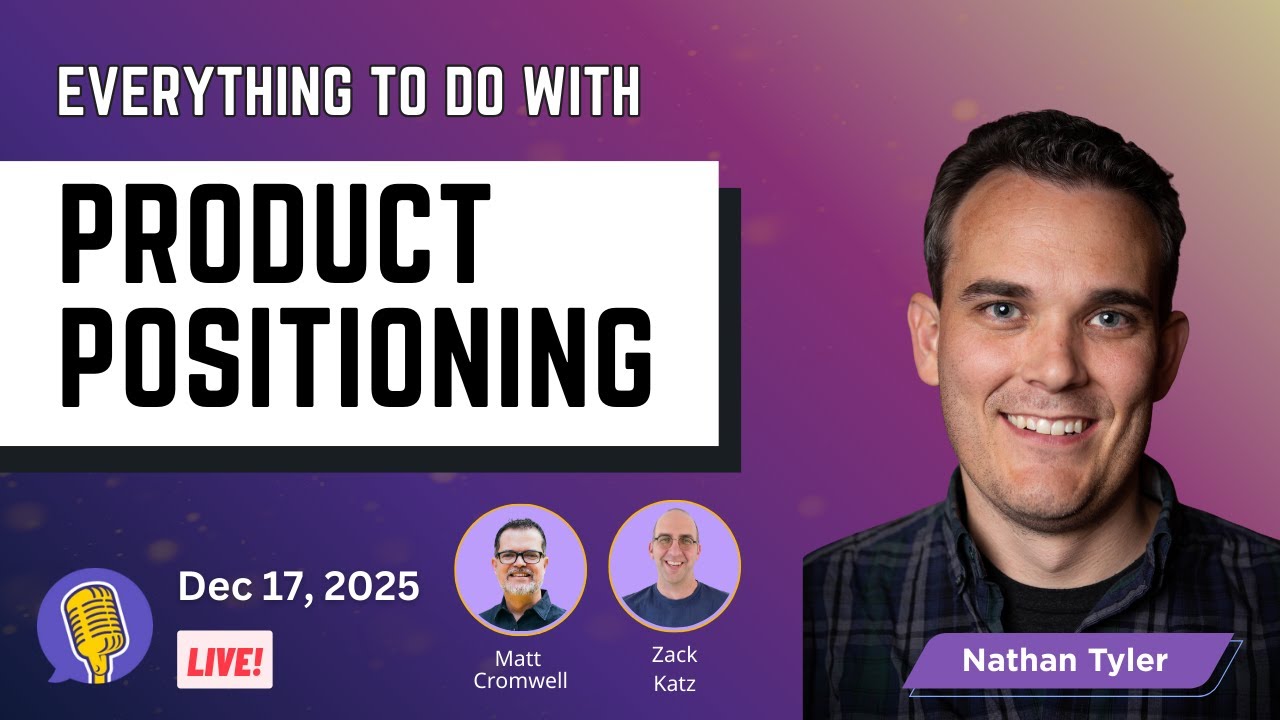
Hey everybody. If you were Woo Commerce for example, uh you could just simply say something like sell things online and everybody will immediately get it. It's clear. It solves the problem. They understand the value right away. But think back to when Slack first came on the market. Early on, people had no idea what they were all about. Um it was like, is that chat? Is that messaging? Um is this a social thing? Is this just another tool? I don't know. But I think
what made it spread wasn't necessarily the features so much. But Slack showed up with a very clear enemy and a really bold stance. Um they said email is broken. Inboxes are killing productivity and work communication needs a replacement. Journalists at that time called Slack the email killer. Teams felt that pain immediately and suddenly Slack made sense to everybody without much of a demo at all. That is the power
of positioning. That's what we're going to talk about on the show with you today. This is WP product talk. The place where every week we bring you insights into product marketing, business management and growth, customer experience, product development, and more. It's your go-to podcast for WordPress product owners by WordPress product owners. And now, enjoy
the show. Hey everybody, I am Matt Cromwell, uh, product creator and founder of WP Product Talk. >> And I am Zach Katz, founder of Gravity Kit. >> And before we get started, uh, I want to say that we are on a road to hit 10,000 YouTube subscribers. And the easiest way for you to help us is to hit subscribe right now. It takes just a second and it
makes a really big difference. Thanks a bunch. >> Yeah. And a huge thanks to Fremia for being our exclusive growth partner on the road to 10,000 subscribers. Uh if you don't know about Fremius, Fremia helps software makers grow, monetize, and succeed. Fremius is a merchant of record platform where they handle everything around selling software like checkout, payments, subscriptions, licensing, updates, global tax compliance, so you can focus on building amazing products. >> Cool. Cool. Announcements out of the way. Today we want to talk about
positioning and we want to do that with our special guest, Nathan Tyler. Nathan, hey, welcome to the show. >> Hey guys, thanks for having me. >> Yeah, Nathan, welcome. Thanks so much for being here. Uh, please tell everybody a little bit about yourself. >> Sure. So, I've been uh in the WordPress game for a long time. I ran a web agency building lots of WordPress sites. uh built a few WordPress plugins, the main one being Simply Schedule Appointments, built a couple SAS products, the most recent one being BlinkMetrics, and we'll
get into a little bit later, may have accidentally fallen back into agency life somewhat by accident. >> It happens. >> Thanks so much for coming on, Nathan. If folks, if you are here watching this live on YouTube right now, use that comment comment section uh ask your questions. If you have um questions or problems with positioning yourself, put them in there. We will highlight them and uh answer them live on the show or
we'll just make Nathan answer all of them because uh because he's the expert this time around. Um so let's get into it. So, Nathan, this whole subject came up when you and I were chatting and we were talking about bling metrics and the subject of uh well, I mean, you were talking about the problem you're trying to solve and then it both of us I think almost at the same time was like it's all about positioning like it that's that's a difficult subject. Tell me a little bit about that problem. Tell me about that context at link metrics and
uh and what you're doing about it. >> Sure. So um I think some problems are very easy to frame like simply schedule appointments is basically calendarly but all in WordPress you can say it in a few words and everybody kind of gets it and maybe they want it or they don't. Uh blink metrics came from a different place which is uh maybe not something that everybody leaps out of bed thinking about reporting and KPIs and scorecards and reporting dashboards and often what
you are reporting on is different you know depending on each business. It's critical to businesses growing and scaling their operations, but exactly the pain that a person might feel to jump over the ledge and say, "Okay, yes, I want to do this um is different." And so nailing down that positioning has been quite a journey for for me to figure out exactly where those places are um and how to simplify the message so people get it and can do that same thing that we did with the other positioning which is like okay I kind of
get what this thing is and I either don't care or I am curious and I want to learn more which is I think the main goal of the positioning. >> Yeah. And I feel like uh for me starting positioning often starts from our own pain pain points as developers uh without even considering necessarily uh how we're going to market it. But it's like okay I need this done I need this done now and maybe um leading up to this point in time it's been okay because Google search kind of aligns with the
queries that people were asking like how do I do this? Well, you do that using this like but I feel like the shift to AI and the shift to um AI answers means that we have to position things a lot better uh so that it's answering a broader question than the exact search term match and so that when people get to the website based on the AI uh auto you know AI suggestions or the Google search results that they know that that fit is for them and there are a lot of
different uh problems with uh with WordPress specifically because we have so many different types of people who are building the websites >> and so you have to make sure that you have the messaging and the positioning for the people like the builders or the end users depending on who is going to be buying and suggesting your product. >> I love it. Um I honestly another subject we should maybe have Nathan on at some point for is uh your your your product brand name because you have this thing
Nathan where you are calling the thing exactly what it is so often. Uh one product you didn't mention is uh draw attention that that was one of the early products I remember you for. Um draw attention folks is is basically like a like a uh I don't want to say a heat map. It's not really heat map. it focus points like you create these focus points on an image um and when you click on them popups can come up and things like that it's highly complex but like the name draw attention I thought was so
clever and then you have seriously you have simply schedule appointments as well um and uh and then blink metrics in my mind that's like you know metrics in a blink like is that was that the can you talk a little bit about how you thought about blink metrics is what I'm saying Yeah. So, I've worked in my agency life. I did a lot of custom data pipelines and custom reporting dashboards. You'd be five or six figure projects that would last, you know, six months to two years. And what I've seen
is that every small business doesn't have any of these fancy dashboards. You don't hire a data scientist until employee 100. So most companies just have spreadsheets or they have 12 Chrome tabs that they go check all the reports and all their different tools. And so if a small business is going to engage data and use it meaningfully, it has to be quick. They have a million things to do. And the whole idea is that, you know, in the blink of an eye at a glance, you know, you can have your cup
of morning coffee and you can see the numbers you need to see, you know, each morning. You can see everything at a glance as you close out the month or as you close out a quarter. um it has to be quick and exactly the view that those people need. They don't have time to kind of bounce around and just do analysis for a whole day. So, a lot of it's about speed. >> Yeah, I love it. I feel like you're thinking about positioning even as you're naming your products, which I think is really great. >> Um I want to come back to to Nathan in a little bit, but Zach, I feel like we you
we chatted about this before. I was glad that you were a co-host today because I feel like positioning for gravity kit for data kit for um trusted login which you don't talk about a lot um uh like each of these need a lot of context um how have you thought about positioning for your products? Yeah, you know, part of part of the way to do positioning right is to think about uh each one of the customer profiles and their pain
points and come up with, you know, what their worldview is and uh maybe uh creating a villain that they like what what what they don't like the most and saying how you solve that painoint and then identifying the pricing and like positioning is not just the customer profile. It's also about like the the market that you're in and the like uh what what other products they're looking at and how your pricing in relationship to that. And then it's also um
the different uh the different decision- making points like uh the different roles that they are in. So like who they have to convince and it's so many different things all in one. And we do not do that well. We uh I do not do that well. I'll speak for myself. Um, so when doing trusted login the the positioning was some you have to say why we chose to say why the other login without password options were not good and they're not
good because it's if you have a link that is a login it's a it's sharing your password essentially. So that's it's not secure. Uh and then you have to address the customer support side of things where if uh making it easier to provide customer support and like talking about how trusted login integrates with your support desk and and is integrates with your plug-in so it's one click to grant access to a website. So it's not only more secure, it's also easier for customer support. None of that matters
to the decision makers. The decision makers ask, how is this going to save my team time and money? it's a pain in the it's a pain in the neck to uh to grant access to websites and like solve that problem for me. So the positioning of trusted login is downplaying the security aspect of it even though it is secure. Uh Chris Lema gave me that feedback and said >> nobody cares about security. They just want things to like to to be easier and
better. Uh, so he really didn't think the security thing was important to mention at all, even though it's one of the things that trusted login solves really well. >> Nathan, what what do you think about that? >> Yeah, I I think definitely as developers, we focus on the technical aspects that are very important, but other people may just assume or take for granted, right? Like they they're going to assume that it's secure. Um, but >> right, they should not assume that, but they do. Yeah.
>> Yes. There's lots of shoulds and I I ran into some of those as well. I think as you were talking about competition and like how the decision gets made and how they're perceiving it. Um I ran into that with Blinkmetrics because there were a number of people I was selling it as a SAS subscription and there are for many people $1,000 a month is a huge um investment. It's a very expensive software, but at the same time, they may
be paying somebody a h 100red grand a year to do the same job. Salaries get thought of differently. And also bringing on like a project like a consultant to execute something is also thought differently. They may think nothing of budgeting $10,000 to build, you know, a reporting dashboard custom, but and they may hire somebody for $100,000 a year and one of their main responsibilities will be building this thing, but they won't pay $1,000 a month for software. So, I think some of the positioning too actually gets into the
packaging and like how you're going to deliver the thing is also part of how you >> what you have to think through with positioning. >> Yeah. Yeah, I'll say from um my experience um with GiveWP, I'll say one of the things that we went back and forth on when it came to uh positioning was essentially something that a lot of WordPress folks
think through is should we be uh messaging at the agency u or at the end client. Um, and I that's I mean everyone thinks through that because everybody recognizes most everybody most all plug-in shops recognize how significant the agency is in the plug-in decision-making process for any given website. Particularly in the nonprofit space, uh there's very very very many nonprofits who are not building out
their own websites at all. They're outsourcing that to an agency and they're like, "And we need to do donations. We don't care what you choose. just pick something that works for us. Um, so if we made the GiveWP website all about like serve your clients best with our donation plugin, like we'd probably get a bunch of agency clients, >> um, but maybe at the expense of the millions of charities that are out there. So, we tried to think about how
could we have our cake and eat it too. And at the end of the day, we decided that and I think it was a winning strategy at in reflection. Um we decided that if we make all of our positioning and messaging all about the um the the success of a nonprofit fundraising effort, then we get that client and we win the agency. Because what we wanted was that when that agency lands on our
website, they don't see a tech tool. Um, they see their client on our website. They see they see, oh, this is exactly what my client wants. Um, and that way we felt like we were going to get basically two birds with one stone essentially. And over the years, I feel like that's gone actually really, really well. And that positioning ended up uh impacting our the way that we wrote our blog articles, uh the way that we built out our features, everything ended up
being um uh starting with that that main focus of what does it does success look like for um nonprofits who are doing online fundraising? Um and what how do they describe these things in their own words? um and how can we optimize that um for them? Um and I and we have plenty of agency clients uh at GiveWP over the years um and um they often say, "Yeah,
my client loves it and they're so thankful for it." So, >> and I think that there's a large aspect there of making sure that people see themselves in your product, on your website, in your screenshots, in your testimonials. uh your marketing materials really show who you expect your best clients to be. And I think when it comes to positioning uh you know uh having a premium model is a large statement about who you're how
you're positioning yourself. Y >> you're positioning yourself as an entrylevel possibly like uh as appealing to an entry-level market as opposed to having paid only and that sets another bar. But if you're paid only and you start at $20 a year, that's different than starting at $300 a year. So, I think that when you're positioning yourself, you you got to look around and say like, who do I want as customers and really narrow into that uh like and knowing that if you are targeting
hundreds of dollars a year customers, you are leaving a lot of customers on the table, but they are uh lower annual revenue customers. Uh >> yeah. >> Yeah, >> that's really important. I want to back up just a little bit and there is a distinction that I want to make clear to everybody between messaging and positioning and I and Zach you that was a great example of positioning not just simply messaging u you're saying that this is this is the lane that we run in
um this is this is the the type of of um segment that we are targeting and similarly um at give in particular um we you know our tagline line was always democratizing generosity and that was a call out to WordPress's motto. So we were like really positioning ourselves as a WordPress solution, not a SAS solution specifically, but we also really leaned in in the early days. We really leaned in on on owning your own
donor data. that was really important to us um because the um the competition that we had uh at the time was mostly uh SAS platforms and um and really expensive SAS platforms. Uh so positioning ourselves as like don't share your donor data with random third parties who might be selling that off to advertising agencies or other things like that because that did happen back in the day. It doesn't really happen with the big SAS anymore. Um but we were
positioning ourselves as as a a GPL um distributed u product as in opposition to the SAS's. Um this this kind of thing I could talk about for forever. One one more quick example. Um as things evolved and changed over time, SAS's also got a lot cheaper. So our our advantage of being more affordable as a whole really started to get eroded. And so they had these really large all-in-one solutions
that also were a lot more affordable than they used to be. Um, so we had to start then start really leaning in on uh build any fundraising campaign that you want. Uh, because even though they were big all-in-one solutions, they still when it came to the way that you build out your fundraising pages were pretty cookie cutter overall. Uh whereas with WordPress, you can customize it to do whatever you want and make it look however you want it to look. Um so all
these things are just highlighting different ways that you're like as opposed to this, you can do this with us. Um trying to distinguish and differentiate um uh which kind of customers you're looking for. Long-winded. Sorry, Zach, you were gonna say something. >> Oh. Uh well, I I wanted to ask Nathan because uh on the BlinkMetrics website, which is blinkmetrics.com, you all should check it out. Uh you position the enemy uh as spreadsheets. So you say
take your business reporting out of spreadsheets for good. Um one of the one of the things that I've seen people do is say in, you know, compare with, you know, like think of a generic uh medicine on the shelves. It says like compare with Tylenol. So like it's kind of like Tylenol but it's cheaper. >> Um what who is your enemy at Blink Metrics and how did you decide that like spreadsheets are the issue that you
really wanted to to get away from? >> Yeah. Uh well be I think because you know small businesses don't have you know data scientists on staff. They don't typically have nice automated reporting dashboards. Spreadsheets is the way right? If anybody's trying to bring sanity to their business, somebody in that business copy paste once a week into a spreadsheet from these different places and then it gets fancier and somebody sets up Zapier and the Zapier Zap is pushing rows into a table and you've got VLOOKUPs and there's usually
only one person in the organization who even knows all the pieces. And if that zap year zap breaks eight months from now, like maybe even the person who built it doesn't remember and it's it's always this kind of internal Frankenstein project. And I think most people can relate to that. They can also usually point me to the person who has the spreadsheet. And that spreadsheet is the perfect blueprint for what should be nice automated reporting because even if all that works, there's a lot of manual effort and a lot of things to go wrong and break. And if that person's sick, it
doesn't happen. you still are still limited. Like you can't make that spreadsheet 10 times more complex without making it 10 times more work. You can't segment it by customer or by employee or by product line. You can't look at it weekly and monthly and quarterly. You know, you can't look at year-over-year changes quarterly. You know, it's all this work, but it's still severely limited in a lot of ways. And it I did actually
have some conflict with the siding about spreadsheets because I think some people kind of love their spreadsheets. They're very proud of >> people who love spreadsheets love spreadsheets >> and they're very proud of it. And there is kind of this sense of like oh like I've built this view that shows me things. But I think at some point that crosses a line for somebody where it becomes this burden they have to maintain or the first or second or third time it breaks. Uh then they're like I kind of love and hate this thing. I want this information. I don't want to spend my life filling this thing out. I want
to actually be analyzing it or, you know, and and making a better decision or getting proactively alerted, you know, when these things happen as opposed to kind of having to always go in a monkey with this spreadsheet. So, >> and who who are you positioning against? Like uh what how do you how do you choose uh your pricing and how do you choose like who you're com like I I assume if people are looking into reporting they're looking at a bunch of different things like Microsoft BI and
other stuff. >> Yeah. So, um I think that's been one of the challenges in our positioning is I think we're filling a gap that's a good opportunity, but there's not a lot of straight up competition because basically you're going to um hire a super expensive agency and build out where you're going to hire internally. And that's often like we find in we bump into people there's somebody technical in the company. Maybe they have this spreadsheet and they're drowning and they're ready. Or maybe there's somebody who's like, "Okay, we got to try to
build this in Looker Studio is often one of the first attempts >> or a PowerBI or uh metabase." You know, any of these things that are kind of approachable to a technical person. Um, and then they kind of find out like actually there's this whole other jungle of necessities like Looker Studio is can make a pretty graph, but how do I get my help scout data or my WordPress purchase data into Looker Studio? Well, actually that's quite complicated. You have to use the API and pull it in somewhere and
rate limits and you got to clean up the data and you gota all of this and then Looker Studio is just the visualization piece. It's like one of three or four pillars that you need. Um, so positioning has been challenging because what I described doesn't fit into three or four words. Um, but you know custom reporting dashboards is kind of the thing that we are delivering at the end of the day and that's often people do know that that's what they're looking for. Um, so we we try to catch people at
various stages of that journey. Um, but it is is tricky to nail down. >> Yeah. Tell us a little bit. We were talking before the show about some pivoting that you're doing um based on um these positioning experiments and then listening to customer feedback. You're in the middle of a big shift. Um um is this shift done? Are you able are are you okay talking about this? >> Yes. Yeah. Yeah, it's it it's done. I I've been kind of soft uh doing in
conversations one-on-one for the last couple months and then we just went ahead and made the official shift. Um, so one of the things around positioning is >> it it's all about assumptions, right? You're saying three or four different words and like people are kind of like deciding what is this thing? Is it for me? Do I care? All very quickly. And one of those assumptions is like the delivery model. Um, SAS software is thought of very different than hiring a consultant, you know, or an agency to do a thing. And there's a lot of
assumptions rolled up in that. And we actually operate much closer to an agency model. We basically do we build exactly a custom thing that somebody wants uh to show them everything in their business that's difficult or impossible to answer. We build a a reporting dashboard in 30 days. We meet with them once a week. You know, we staff a data analyst or data engineer to build it um during those 30 days. But when we were positioning as a SAS product, like people, it's a huge uphill battle to convince
them of that because there's some built-in assumptions. SAS is, you know, support's going to be terrible. Onboarding is going to be a joke. Like, um, we can say all these things. You know, we give great support. We're going to hold your hand and and help help you in onboarding. But even in my second or third conversation with people, they there would be a moment where they'd say, "Oh, you're going to build this for me? I I thought I was going to have to learn this platform and it was going to be this big project and you know it says it five different places on our site and
we build it for you and 100% done for you in 30 days and like it's everywhere but people just think of software very differently. Um, so we've actually kind of finally stopped fighting that and embraced an agency model, which is we people have assumptions about agencies, which is they're going to build it for me and they're going to deliver a thing, you know, a deliverable and then maybe there's ongoing support options or maybe there's there's not. But, um, we're
making that shift to that model and it's going a lot smoother. Um, people understand that model much more easily. >> Well, it feels like exactly the hope and the goal of correct positioning um is uh is that it would just resonate a ton more with the audience and they would it would remove a lot of the friction of adoption uh or of um of signing up in the first place. Um I mean it's early
early days, but is that what you're sensing and feeling is happening already? Yeah, because with the SAS model, I would have a conversation that was going pretty well and we get to the pricing and literally like this verbatim was like, "Oh, uh, I thought this was a thing you were going to build for me and then we were going to be done or something." And and so that kind of confusion was really problematic. And and I think the mental accounting of like I'm going to have the weight of this $500 or,000 subscription,
you know, forever is feels heavy and it feels like a big decision that we get put off. Um, but people would much rather spend instead of saying, "Hey, $500 a month. It's just $5,000. We build it. You own it. We can show you how to set it up. We can probably host it 10 times more effectively and we have all this other stuff, but a much lower ongoing cost. It's much closer to a website model, which is we're going to build you a WordPress website and then
you can go host it elsewhere or we can host it and manage it and do updates and everything for you for a very reasonable cost. Um, >> they can actually take your blink metrics setup and host it somewhere else. >> Some of it so we we've pivoted some of our custom reporting dashboards like the main core component actually can be self-hosted. It doesn't really make much sense. There's nobody who could host it cheaper than us, but like just the fact that it's a choice is I mean 90% of the
people have chosen for us to host it anyway. Um but I think the fact that it is a choice just fits more in line with the thinking because they're a bit of an education process. The same thing with websites. If you sell a website, people think it's free afterwards and well, it has to be on a server somewhere and maybe a fast server if you have lots of traffic and if you have an e-commerce store and lots of dynamic things, you need a bigger server, you know, and you kind of have that conversation and education process with the client, you know, along the way. Um, and we can do
the same thing on our side. >> Yeah. >> Yeah. And Matt, how much do you think um addressing objections is part of positioning >> addressing objections? >> Yeah, like Nathan was saying, you know, people would say, I don't want the ongoing costs or I don't I want to be able to help it, like host it myself. I I want to be able to customize after it's built. Uh I don't want to have to build it myself. Like, is that positioning? No, I think it's uh it's
feedback um that maybe the positioning was off in the first place. Um that's that's how I would think. Uh and I think that a little bit of what Nathan is saying is that they did get some feedback that was more like, well, this isn't exactly the way I want it. And they found that feedback to be valid and important. Uh and so they adjusted and they're early enough. they're early enough in the product and the company that they can do that kind of
significant pivoting now. Um, and ideally that means that they've reggrounded correctly. Um, and they'll see they won't have that kind of uh feedback going forward. Now there might be future negative feedback that comes in. Everybody has has feedback that's like, oh, it doesn't do this thing that I want or oh, it doesn't do that thing I want. In those cases, it's easy to to frame that feedback in like, well, that is a valid feature request that we should do and we can speak to that
better in the future or or it's a validation of like, well, they're just not our customer. Um, right. So, you know, ideally if if you're getting that kind of like the whole thing is not the way I want it to be, well then either they're just absolutely not your customer at all or there's something wrong with your website that you didn't you didn't message your positioning very well um and you're attracting the wrong people. Um or yeah or there is something
foundational that you have to pivot on which um which I I love this example that that Nathan's brought up. >> Yeah. I had a call recently with a founder uh when I was demoing their their SAS and I was really interested and it's like build your own documentation by by using turning a video into step-by-step how-to guides and like automatically building your library. And it was exactly the kind of thing that I'm really focused on right now at Gravity Kit. Um, and I said, "Well, do you have an API or are you
able to uh to export these as like markdown files or HTML or can I connect with Zapier so I can actually like host it on my own website?" And he was like, "Yeah, you're not the right customer for us." >> Yeah. >> I felt really upset because like so rarely do people say that >> and he said it very directly. He said, "You're not our target customer." Yeah. We are looking for people who don't want to do it themselves, who have who want it all to be hosted by us and to be done automatically. And I'm like, "Well, I still want to find a way to hack your
product because it's really cool." >> They're like, "Nope." I Yeah, that's a good one. We have a >> one of the things that uh Oh, go ahead, Matt. >> No, you go. One of the things that we're dealing with at Gravity Kit and this has been over the course of the past couple of years now is for Gravity View is our flagship product where you take Gravity Forms entries and you could display it on your the front of your website and turn it into a directory that people can edit themselves and uh export and chart
and things like that. Um the problem is is that that is becoming incre inc increasingly easy to do with other tools including hello AI like AI makes that really easily easy where you can say you know code me a a thing that turns gravity form centuries into a table there is no moat there is no uh reason why you would pay for us to do it other than having you know excellent support and also ongoing updates. So, one of the things that we realized was that our target customer was going to be
more and more advanced and more uh sophisticated in the requests that they have, which means that we need to do a better job of enabling them to build powerful apps that connect to the different parts of our uh our product suite. and that we need to get ready for our support team to be uh to to be ready to support more complex implementations of our products where they are connecting more pieces and there are more deep like in-depth bugs. So we've been over the course of the past few
years dealing with fewer simple questions because we've added a bunch of documentation over that time to address these questions. But more and more we are building apps and powerful things that replace um you know a bunch of other SAS products >> uh built with gravity kit with your own data uh but that transition into build powerful apps with gravity forms data >> um has it's been tough to to communicate the value there um where it's like gravity forms app builder is gravity kit
>> but it's not just saying it it's also shifting our pricing model has gotten more expensive because we are now enabling more powerful things and we need to do more support to support that. >> Um and it's also our new website looks more professional. It looks like a little dark mody. Um we added you know we have recently relaunched our website to look more professional. Um so it's not just a matter of saying we're doing things differently now. It's also
implementing structural changes to to back up that pivot to be more resilient to AI incursion and also to to address a power user customer that we found were our higher value customers in the first place. >> That's cool. That's another really great example. I mean it sounds like you are coming back to your positioning, your original positioning because of a new existential threat essentially. >> Yeah. um like you're like, "Hey, people can vibe code this functionality and
we're not going to survive if we are just this utility." Um >> they're going to think they can vibe code it. >> Yeah. Yeah. >> Even if you have the if your customers have the thought, "Oh, I can do this myself." And I'm Nathan and I had a call about Blink Metrics a year ago or like a few months ago and I was like, "This is amazing. This is exactly what we need." And in the back of my mind, I'm like, $500 a month? Maybe we could do it ourselves. We have a metabase installation. like I don't know if it's the right choice. At 5,000 one time, I'm thinking, well, maybe Nathan and I
should have another conversation. >> Literally, that happened before the call. He was like, "No, it's 5,000 bucks a pop." And and and Zach was really like, "Oh, I'm interested. >> I saw this happen immediately." >> Yeah. >> Yeah. It would have been done in 30 days. >> It would have been done and it would have been great and I would have been very happy already. Yeah. >> 11 months ago, Zach, you spent the whole 11 months thinking you could vibe. blaming nothing for his positioning. >> We have a cool uh comment here uh from
uh Nick. Um he says maybe it would help to hear if or how thoughts about positioning impact product development or is positioning really strictly on marketing or go to market concerns? I I mean I feel like we touched on this a little bit both in terms of like how we had to both Nathan and Zach have had to go back to their positioning um and how that is uh impacted their product directly. One of my favorite examples ever was uh was Pippen Williamson with
Easy Digital Downloads forever ago. He had this great way always of like really synthesizing um keen marketing insight down to like simple examples. um he was just really good at that. And one thing he he he said all the time was like easy digital downloads is about downloading digital products. He was like I can't make it more simple than that. Uh we still have people to this day, this was years ago, but he was said we still have customers
to this day asking us to implement a shipping add-on. And he was like I'm never going to do that. That is not how we have positioned our product. And that was how he he talked about it all the time was was if I do that I kind of violate my my positioning of my of what my product is all about. Um and and it's not that it it's not that it impacted what he should build, but it definitely impacted what he should not build. And I think that
that clarity and that kind of like um ability to say no to certain feature sets was really really important and foundational to easy digital download success way back in the day. Personally, that's I don't know does do either of you resonate with that or have a good example. I uh recently we have migrated our issue tracking from GitHub to linear uh in part because we wanted to have more functionality such as uh the concept of initiatives. In linear you
can set an initiative and associate tickets from across different uh repos to address an initiative. You can also have an initiative be like um kind of a product market fit question like for have have an ideal customer profile and say that this initiative is associated with them. So like we we deal with a lot of educational uh users a lot of government users. So we could create in
linear a government profile, education profile and say that this poll request or this product like uh feature request is directly associated with benefiting them so that we can better align our initiatives around making more money, reducing number of bugs, increasing uh decreasing time for onboarding and uh say that this is for this customer specifically. Um, and I think that aligning um aligning positioning and while developing is a is a really good
thing. It just matters for us it was a matter of having the right tools and linear I think we're on the right path there. >> That's cool. >> How about you Nathan? >> Yeah, I think I I was thinking of the example of the founder that you talked to maybe could have been more tactful but you know in in a positive spin is like your app. I'm not gonna build an API. I'm not going to build all these things. and he's like, "This this is, you know, our position is part of who it's for. It's not for the technical people that want to do it themselves. I'm for this other person." Um, and within my
products, like with simply schedule appointments, like we've had that repeated conversation because there's always that pull from customers and your power users. And we've had to decide, you know, simply schedule appointments is for simply scheduling appointments. It's not for uh it's not for tour, you know, VIP ticket selling and oh, I have 17 tickets of this and it has to be three adults and two kids and packages and all of these things. Like there are other tools that are better for that. Like if you have like one of our things
is defining what an appointment is. There's a lot of people who look at like the events calendar and simply schedule appointments and I think we're competitors and like those are completely opposite to solve. Like if the person running the website decides the date and time, it's an event and there's tickets and there's inventory and there's all that. If the person visiting the website is setting the date and time, it's an appointment and that's what we do. Um, so I think there's there's elements like that. And all along the way, like we decided we're not
going to be the enterprise scheduling tool if you have 80 employees and you're putting their shift schedule and their Monday through Friday and their days off and we're not doing all of that. >> Yeah. >> Though, pay attention to those requests. Um because those are opportunities for partnerships. Uh those are opportunities for acquisitions like either you acquiring another product that does what they're requesting or they could be acquiring you. Um th that is valuable feedback. Uh but it's also valuable
feedback that you're not positioning yourself hard enough uh to to say that you don't do what they're requesting. >> Yeah. And we've done that with integrations like integrate with an events tool, not going to build it ourselves into this cra it into this product. And the same thing with form building. We have a very simple form where you can say here's their name, phone number, what you can ask them three questions. But if you want to do more than that, we have a Gravity Forms integration. So if you want three pages and conditional logic and you want the
appointment to be step three only if they have a say, you know, a budget of this level, right? Then we just show up as a field in Gravity Forms. And so that's a great integration, but we're not going to build a a form builder into our plug-in, >> right? >> We have some great questions coming in from Nick again. Um, one of them is they're gonna think they can vibe code it 100%. another part of how the value ad shifts in the next year. The villain might be changing from spreadsheets to vibecoded apps.
>> For sure it will. Yeah. >> And I think that that's something that we as a WordPress industry are all going to be needing to pivot to to talk about how use our product don't use vibe coded apps for this reason. >> 100%. >> Agreed. >> He's got another uh another good comment here. um or question actually from Nick. Uh looking for some examples, how has understanding the positioning of your
existing product helped you know how to build it further? Like what features to say yes to, not just say no to? >> We have some other WP product topic episodes that are about that. And I think that uh positioning this episode uh we should not go into that too much. But there is a fe we have feature requests episode that talks about like when how to address feature requests and how to know whether feature requests are um are going to be a benefit to your product or a hindrance to long-term
sustainability for it. >> There is part of this though like >> Yeah. Yeah. Yeah. I just I I just I thought I was making >> I think going into customer feedback it would be like a deviation from the topic but at the positioning level for example I think a lot of folks are launching their product from day one as like an MVP per perhaps um and they don't have all the features um right out of the gate um and in that case I think their positioning is going to help them to
navigate what should be on the road map in the future Um our biggest example I give when we launched we did not launch with uh recurring uh donations uh because we were heavily borrowing from a lot of the gateway uh payment gateway logic of easy digital downloads who also didn't have recurring at the time. Um and so um the but we but we had to have it on our roadmap and then what happened like you're saying Zach is that
immediately after we launched we got some adoption and people like the product and everything but they're like oh hey but what about recurring donations and we're like yes yes yes we're it's on the road map. We were definitely like saying 100% we're going to say yes to this. Another way that it impacted it down the line was when we launched um crypto donations was not a thing. It was it was not a thing. People did not do that when we launched GiveWP. But within the first four years after launching, crypto donations became a big
thing. But because we knew exactly how we wanted to support our nonprofit organizations, um whether or not to support crypto donations was like an was a no-brainer. It was like, "Yes, of course, we're going to do that as well." Um, as soon as there was a integration partner that would handle it well. >> Lots of people leaving Dogecoin in their wills. >> Yeah. which I have to say like that it's a weird tidbit, but like um the average
uh US dollar amount of a of a crypto donation uh compared to a normal dollar amount of donations, $10,000 typically when it's crypto. If somebody's donating crypto, it's usually not a small amount. That's that's that's one crazy little tidbit, but >> Okay, >> that's a deviation for sure. >> Well, maybe not. I need to add some Bitcoin payment options for Gravity Kit.
>> Nice. Well, let's uh wrap it up. We are getting close to uh top of the hour and uh every single episode we um conclude by giving our best advice. Um and think of it like uh you know elevator conversation real quick, elevator pitch. Um, somebody's like, "Nathan, I got to figure out my positioning. What am I going to do?" You got three sentences to give them your best advice. Nathan, what is it? >> Uh, I guess I would focus on clarity and
not like worry about mentioning competitors or anything. I think the best thing for simply schedule appointments has been to sayly, but in WordPress, like the exact target customer that we're positioned for wants their solution in WordPress. So like mentioning Calendarly isn't a bad thing. Um and even if it was, it's such a shortcut because people it's so ubiquitous that people understand it. I think that's the right move. Just trying to get as much clarity as
you can in as few words as possible. >> Absolutely love it. Zach, what about you? >> Uh I recommend a sto uh this book, Building a Story Brand. It helps guide you through thinking about things in your business through your customer's eyes and understanding what their objections are and how you would target uh addressing those objections. That also is is it's a lot of work coming up with positioning and like who you are, what you build, why you build it, who it's for, what you price it, who are
your competitors. Having a framework is really helpful. So even if even if it's not this book, have buy a book, download some course, I don't care. Have a framework to help you think through this because it is complicated stuff. >> Love it. That's a great recommendation. >> How about that? >> Yeah, for me, um, I got sidetracked. I had it. What was my best advice? Zach pulled me away with that great recommendation. I was like, I need to read Story Brand again. Um, hold on. Hold on. I got it. I got it. I got it. Um,
oh, focus on outcomes. Uh, focus on outcomes. Um, what position yourself around the success you're looking for in your customer. Um, and I think that will pave everything that you need to pave in one way or another. Uh, similar, it's similar to what Nathan was saying. It's not about like this tool, but in this context or this uh, not like this competitor, but like this thing. um focus the the way you position yourself
around the success that you want to see in your ideal customer >> and all you got to do is buy that product and your life is going to get easier. >> Yeah. Yeah. What one thing that we didn't really cover but Matt just brought up for me is that I think there is one kind of positioning that's very vertical which I think give like you know your customer they're trying nonprofit they're trying to raise donations and so you really can position much more on success and outcomes and I
think there's other tools like Zach's gravity kit right that's more utility and more horizontal across industries like it could be any industry in the world and so you have to really position around that activity around the th the job that it does that's at a small level and the same thing for us with blink metrics custom reporting dashboards like we're usually working with like a director of operations but you know it can be a construction company it can be a you know SAS business it can be a
WordPress plug-in owner it could be anybody um and so we really have tried to position on that job like that activity >> um >> yeah I think that that's a good point I mean There's there are different ways that we serve customers in different um in different ways. Um but there is still that job to be done. What I like what you were circling in on there and I think maybe that's a more refined way to say what I was trying to say is like maybe not the the success of that customer but like the outcome of the job
to be done in that circumstance because that applies to both circumstances. >> Yeah, >> for sure. Um >> that's a good one. Refinement. Cool. Cool. Well, this was great. Um, thanks so much, Nathan. Uh, where can folks find you online? >> Blinkmetrics.com or nsquare.io will also have the WordPress plugins and everything else we do. >> Love it. >> Well, everybody, if you're enjoying these shows, do us a favor and hit that
subscribe button in YouTube. We're trying to get to 10,000 subscribers, so please help us reach that goal. Uh, it's the most free and most easy way you can support our work. So, uh, please subscribe. Special thanks again to Freenius and, uh, thank you to Freemas for their support. >> Yeah. And next week we are on Hiatus and hopefully you are too. Happy holidays to everybody. Um, watch our blog for announcements for our next season which
is going to kick off in January. Uh we're going to have a full six week schedule of some awesome speakers uh which are yet to be determined. So if you want to be on product talk um hit us up online and um if you have any great feature requests for us in terms of topics uh we are listening um and we are positioning ourselves around you. So see what I did there? Pun intended. Um thanks so much everybody. We'll see you
next time. >> Thank you. Happy new year., All About Product Positioning, YouTube, 01kcrs6qfnkajj1vzhzstqwwmj.