America's Deep Religious Divide Over Empathy
🔗 **Source:** [America's Deep Religious Divide Over Empathy](https://www.axios.com/2026/10/20/religious-divide-empathy-democrats-republicans)
> [!note]+ Document Notes
> ---
> tags: [religion-and-politics, empathy, public-opinion-survey, prri, christian-nationalism, evangelicals]
> author: Axios
> source: Axios
> reference: https://www.axios.com/2026/10/20/religious-divide-empathy-democrats-republicans
> date created: 2026-10-20 14:20
> ---
> <!-- deep-read: light-touch -->
> > [!info] Generated analysis — not the author's words. Sections below are machine-written
> > from the captured source. Only text inside `> [!quote]` blocks is verbatim from the author.
> > Do not quote or attribute any other line to the named author.
> # 🏷️ Title: America's deep religious divide over empathy
> ## 📝 Summary
> - **What it is.** A short Axios news article dated 2026-10-20 (Reader doc id 01m5d8nvh6ajc7vygfyc76421h) reporting results from the PRRI 2026 American Values Survey. The capture has no byline (the page fetch returned 403), so the author is listed as the site. Paragraphs are numbered here by blank-line splits of the captured text, ¶1 to ¶19. The capture has no headings; the bullets count as paragraphs, and ¶1 is an import notice, not article text.
> - **What the survey measured.** Agreement with two statements about empathy, broken out by religious group, party and PRRI's Christian nationalism classification (¶6 to ¶15). The headline figures: 42% of white evangelical Protestants agreed empathy is a foundational moral value, against at least 66% in every other religious group the article names, with one exception noted below; 54% of white evangelical Protestants agreed empathy can become dangerous when it leads people away from a society guided by God's truth; 84% of Democrats, 70% of independents and 54% of Republicans agreed with the foundational statement; 38% of Christian nationalism adherents and 94% of rejecters agreed with it.
> - **What the article infers.** The framing that the survey lands amid a quiet civil war over who deserves empathy (¶3), the claim that conservatives have cast empathy as a vulnerability, and Musk's remark (¶4 to ¶5) are context the article supplies. The survey figures don't measure them. The quote from PRRI's president and founder (¶16) is the survey publisher's own reading.
> - **Bottom line.** The figures are specific and the article says plainly what the survey does not establish (¶11 to ¶12). They show how respondents answered two statements. They do not show how much empathy anyone feels or shows. The embedded chart is not in the captured text.
> ## 📖 Main content
> - **¶1, import notice.** The capture says some content could not be imported and points to a "View content" link. That link is the embedded chart (see References).
> - **¶2 to ¶5, lead and context.** ¶2 gives the lead finding: white evangelical Protestants are the only major religious group in which a majority says empathy can become dangerous. ¶3 to ¶5 are the article's framing: a "quiet civil war" within American Christianity, conservatives from evangelical pastors to Elon Musk framing empathy as a vulnerability, and a February 2025 Joe Rogan interview in which Musk called empathy the fundamental weakness of Western civilization while acknowledging its potential good.
> - **¶6 to ¶9, religious groups.** PRRI released the annual survey on Tuesday. 42% of white evangelical Protestants agreed empathy is foundational and 54% agreed it can become dangerous (¶7). The article says at least 66% agreed with the foundational statement in every other group (¶8), including 73% of white mainline Protestants and Hispanic Catholics. ¶9 adds 83% of religiously unaffiliated Americans, 80% of other non-Christian religions, 77% of Jewish Americans and 65% of Latter-day Saints.
> - **¶10 to ¶12, party.** The survey found a 30-point partisan gap: 84% of Democrats against 54% of Republicans, with independents at 70% (¶10). The article says PRRI reports religious and partisan results separately (¶11) and that the survey doesn't establish how much white evangelicals contribute to the gap (¶12).
> - **¶13 to ¶15, Christian nationalism.** Among adherents, 38% agreed empathy is foundational, against 94% of rejecters (¶13). ¶14 gives PRRI's classification basis: support for a U.S. government and laws grounded in Christianity, and the view that Christians should exercise dominion over society. Six in 10 adherents agreed empathy can become dangerous, against 6% of rejecters (¶15).
> - **¶16 to ¶17, PRRI's reading.** The PRRI president and founder, Robert P. Jones, is quoted as saying Christian nationalist leaders attack empathy and an "empathy gap" has opened (¶16). The article adds that Jones said the findings raise questions about the moral foundations that let people from different backgrounds share a democracy (¶17).
> - **¶18 to ¶19, methodology.** Online fieldwork Aug. 20 to Sept. 7, 2026, among 5,200 adults in Ipsos' KnowledgePanel plus 339 adults from opt-in panels recruited to increase sample sizes in smaller states, covering adults 18 and older in all 50 states and D.C. (¶18). Margin of sampling error is ±1.6 percentage points at the 95% confidence level for results based on the entire sample (¶19).
> ## 📚 References
> Nine links are in the capture's link list.
> - **Primary source, linked twice.** The anchors *PRRI, 2026 American Values Survey* and "survey" both point to PRRI's report page, https://prri.org/research/darkening-mood-and-shifting-political-loyalties-ahead-of-midterm-elections-findings-from-the-2026-american-values-survey/. I did not open it (no network use), so this analysis rests on the article's account of it.
> - **Embedded chart.** The "View content" link at ¶1 goes to a graphics.axios.com page whose URL carries the title text for this article and a slug naming Americans by religious group. The chart's contents are not in the captured text, and the image-alt file for this capture is empty. What the chart plots, and whether it shows figures the text omits, is unknown.
> - **Background Axios links.** The anchors "empathy" (2025-11-30, Christians, empathy, Jesus, immigration, politics by URL slug), "civil war" (2025-10-23, Christian leaders, MAGA, immigration crackdowns by URL slug), "American Christianity" (2024-10-07, Christian nationalism, opponents, Trump by URL slug), "immigration", "racial justice" and "LGBTQ+ rights" go to earlier Axios pages. The capture doesn't say what those pages contain beyond what their URLs suggest.
> - **No link in the captured markup** for the Musk and Joe Rogan interview (¶5) or for the Jones statement (¶16).
> ## ✅ Action items
> - **Anyone citing these figures.** Check them against the PRRI report page linked above before repeating them, and note the survey fielded Aug. 20 to Sept. 7, 2026.
> - **Anyone citing the 66% line.** ¶8 says at least 66% in every other group, and ¶9 lists 65% for Latter-day Saints. Verify which is right in the PRRI report.
> - **DevRel, OSPO, Community, The WPOCC.** No direct action from this source.
> ## ❓ Questions
> - Is the Latter-day Saints figure 65% (¶9) or at least 66% (¶8)? The two paragraphs disagree.
> - What were the sample sizes and margins of error for the subgroups, white evangelical Protestants in particular? The article gives ±1.6 points only for the entire sample (¶19).
> - What was the exact wording and response scale for the two statements, and how many respondents agreed with both?
> - What do the other religious groups score on the dangerous-empathy statement? The article gives that figure only for white evangelical Protestants and for the two Christian nationalism groups.
> - What does the embedded chart show?
> ## ✅ Logical validity
> #### Strong reasoning
> - **States its own limits (¶11, ¶12).** The article says PRRI reports religious and partisan results separately and that the survey doesn't establish how much white evangelicals contribute to the party gap. That blocks the easy move from a group gap to a party gap.
> - **Reports method (¶18, ¶19).** Field dates, sample sizes, panel type, geography and the sampling error are given.
> - **Quotes a primary source and links it.** The report page is linked twice (see References).
> #### Fallacies and weak points
> - **Statement agreement is not empathy (¶2 to ¶15).** The survey measured whether respondents agreed with two statements about empathy. It did
Some content could not be imported from the original document. [View content ↗](https://graphics.axios.com/hermesv2/2026-10-20-1834-americans-by-religious/index.html?initialWidth=633&childId=av-hermesv2/2026-10-20-1834-americans-by-religious-VJ8GT&parentTitle=America%27s%20deep%20religious%20divide%20over%20empathy&parentUrl=https%3A%2F%2Fwww.axios.com%2F2026%2F10%2F20%2Freligious-divide-empathy-democrats-republicans)
Data: [PRRI, 2026 American Values Survey](https://prri.org/research/darkening-mood-and-shifting-political-loyalties-ahead-of-midterm-elections-findings-from-the-2026-american-values-survey/); Chart: Russell Contreras/Axios
White evangelical Protestants are the only major religious group in which a majority says [empathy](https://www.axios.com/2025/11/30/christians-empathy-jesus-immigration-politics) can become dangerous when it leads people away from a society guided by God's truth, according to a new [survey](https://prri.org/research/darkening-mood-and-shifting-political-loyalties-ahead-of-midterm-elections-findings-from-the-2026-american-values-survey/).
**Why it matters**: The survey lands amid a quiet [civil war](https://www.axios.com/2025/10/23/christian-leaders-maga-immigration-crackdowns-trump) within [American Christianity](https://www.axios.com/2024/10/07/christian-nationalism-opponents-trump) over who deserves empathy.
* Conservatives ranging from evangelical pastors to Elon Musk have framed empathy as a vulnerability in debates over [immigration](https://www.axios.com/2025/11/24/trump-immigration-temporary-protected-status-myanmar-burma-somalia), [racial justice](https://www.axios.com/local/san-francisco/2025/05/27/george-floyd-murder-bay-area-legacy) and [LGBTQ+ rights](https://www.axios.com/local/detroit/2025/11/20/detroit-city-council-denzel-mccampbell-gabriela-santiago-romero-lgbtq).
* In a February 2025 interview with Joe Rogan, Musk called empathy "the fundamental weakness of Western civilization," while acknowledging its potential good and warning against its weaponization.
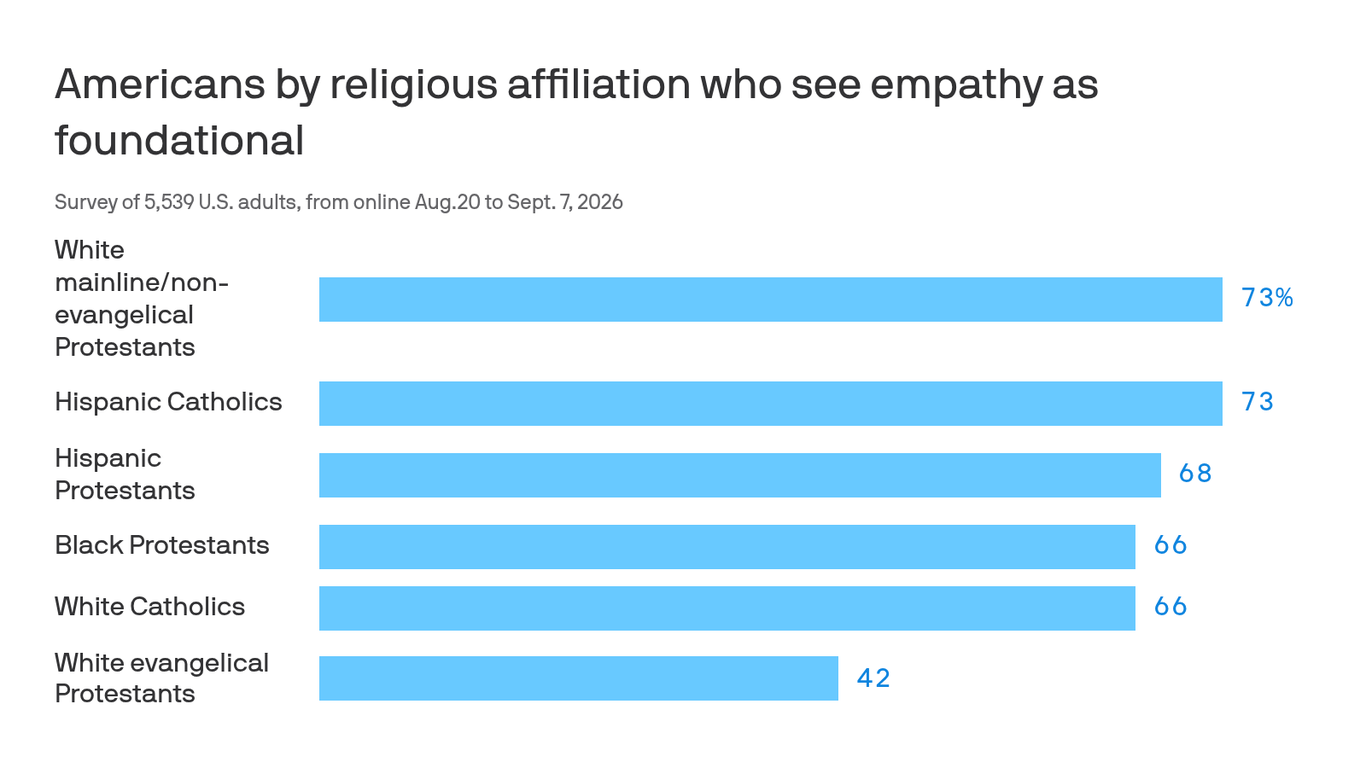
**By the numbers:** The annual American Values Survey from the nonpartisan Public Religion Research Institute (PRRI) released Tuesday found that 42% of white evangelical Protestants agreed that empathy is a foundational moral value that helps build a healthy society.
* Separately, 54% agreed that empathy can become dangerous when it leads people away from a society guided by God's truth.
* In every other religious group, PRRI found that at least 66% agreed with the foundational-value statement, including 73% of white mainline Protestants and Hispanic Catholics.
* Empathy's foundational value was endorsed by 83% of religiously unaffiliated Americans, 80% of respondents grouped under other non-Christian religions, 77% of Jewish Americans and 65% of Latter-day Saints.
**The intrigue:** The survey found a 30-point partisan gap: 84% of Democrats agreed with the foundational-value statement, compared with 54% of Republicans. Independents were at 70%.
* White evangelicals stand out among religious groups, but PRRI reports religious and partisan results separately.
* The survey doesn't establish how much white evangelicals contribute to the Republican-Democratic gap.
**Zoom in:** The divide also tracks with PRRI's Christian nationalism measure. Among people PRRI classifies as Christian nationalism adherents, 38% agreed that empathy is foundational, compared with 94% of rejecters.
* PRRI classifies respondents as Christian nationalist adherents or sympathizers based on support for a U.S. government and laws grounded in Christianity and the view that Christians should exercise dominion over society.
* Six in 10 adherents agreed that empathy can become dangerous, compared with 6% of rejecters.
**What they're saying:** "As Christian nationalist leaders attack the sentiment of empathy, a disturbing 'empathy gap' has opened, separating Republicans and white evangelicals from most other Americans," PRRI President and Founder Robert P. Jones said in a statement.
* Jones said the findings raise questions about the moral foundations that let people from different backgrounds share a democracy.
*Methodology: PRRI conducted the American Values Survey online Aug. 20–Sept. 7, 2026, among 5,200 adults in Ipsos' KnowledgePanel and 339 additional adults recruited through opt-in panels to increase sample sizes in smaller states. The survey covered adults ages 18 and older in all 50 states and the District of Columbia.*
* *The margin of sampling error is ±1.6 percentage points at the 95% confidence level for results based on the entire sample.*, America's Deep Religious Divide Over Empathy, Axios, 01m5d8nvh6ajc7vygfyc76421h.