Are Student Attention Spans Really Shrinking?
🔗 **Source:** [Are Student Attention Spans Really Shrinking?](https://www.edutopia.org/article/are-student-attention-spans-really-shrinking/)
> [!note]+ Document Notes
> ---
> tags: [attention-research, learning-science, instructional-design, education-technology, cognitive-load]
> author: Stephen Merrill and Youki Terada
> source: Edutopia (George Lucas Educational Foundation)
> reference: https://www.edutopia.org/article/are-student-attention-spans-really-shrinking/
> date created: 2026-09-01 09:15
> ---
> > [!info] Generated analysis — not the author's words. Sections below are machine-written
> > from the captured source. Only text inside `> [!quote]` blocks is verbatim from the author.
> > Do not quote or attribute any other line to the named author.
> # 🏷️ Title: Are Student Attention Spans Really Shrinking?
> ## 🧭 Table of Contents
> - [📝 Summary](#-summary)
> - [📖 Main Content](#-main-content)
> - [🗒️ Notes](#️-notes)
> - [📚 References](#-references)
> - [🗣️ Paraphrase](#️-paraphrase)
> - [📰 Newsletter](#-newsletter)
> - [✅ Action Items](#-action-items)
> - [🧪 Hypotheses](#-hypotheses)
> - [📊 Methodology](#-methodology)
> - [❓ Questions](#-questions)
> - [🔮 Future Research](#-future-research)
> - [💡 Implications](#-implications)
> - [🧠 Learning Styles Assessment](#-learning-styles-assessment)
> - [📊 Accessibility Assessment](#-accessibility-assessment)
> - [🌍 DEIB Assessment](#-deib-assessment)
> - [✅ Logical Validity](#-logical-validity)
> - [🛡️ DARVO Analysis](#-darvo-analysis)
> - [🎯 Conclusion](#-conclusion)
> ### 🔗 References
> - Source: https://www.edutopia.org/article/are-student-attention-spans-really-shrinking/ (1,855 words, published 2026-08-28, 26 outbound citations)
> ## 📝 Summary
> **The claim.** Attention spans are not shrinking. What has changed is how students *value* the effort attention costs. Edutopia's Stephen Merrill and Youki Terada take the popular "goldfish" narrative apart, then rebuild the classroom problem as a motivational and cultural shift rather than a biological one.
> **The debunking.** The 2015 report claiming human attention fell from 12 seconds to 8 — below a goldfish's 9 — is dismissed as "remarkable, vague, insulting to both humans and fish—and almost certainly meaningless." The substantive correction is that *sustained* attention, meaning focus on work that is intellectually demanding, repetitive, or compulsory, was never measured in hours. Historical thresholds land at 8, 10, or 25 minutes and almost never exceed 30. On the d2 test, administered for decades, adults perform about as well as they always have.
> **What is actually changing.** Two 2026 studies supply the reframe. One argues that constant notifications, short video, countdown timers and progress bars "heighten temporal salience" — we are not less able to focus, we are more conscious of elapsed time and more impatient. The other argues digital media "may influence cognition mainly by recalibrating how effort is valued and allocated." Daniel Willingham lands it: **"It's not that students can't pay attention, but rather that they more readily choose not to."**
> **Why it matters for anyone who teaches.** If the deficit were capacity, the response would be accommodation — shorter everything, forever. If it is valuation, the response is different and more hopeful: make the effort visibly worth its cost, and train flexible attention rather than longer attention. Willingham's line is the payoff — "The changes we're seeing—as dramatic as they may seem—could be undone."
> **The one internal crack.** Having spent 1,200 words establishing that attention is not waning, the article introduces its recommendations as "ways to manage and strengthen waning student attention." The frame it dismantles reappears in its own transition sentence.
> **Bottom line.** Well-cited, genuinely corrective, and immediately usable — with one contested figure given more platform than the article's own experts support. Take the effort-recalibration reframe; treat the Haidt causal claim as the open question the piece implies it isn't.
> ## 📖 Main Content
> **The myth and the real number.** The article opens on the 2015 report that produced a decade of headlines: attention down by a third since 2000, humans now outperformed by goldfish. It rejects the claim outright. The useful replacement is a distinction the popular story collapses. General attention — movies, chess, poker, comic books — still runs for hours and remains recognizable in today's kids. *Sustained* attention, the effortful kind school requires, has always been a minutes-scale phenomenon. A 2009 study compared a student's in-class concentration curve to "a human operator monitoring automated equipment." Nature reports that lab performance on such tasks "declines in about 10 minutes." None of that is new, and none of it is deterioration.
> **Then something is still happening.** The authors are careful not to overcorrect into denial: "what millions of K–12 teachers are saying is almost certainly not an illusion." The evidence they marshal is behavioral rather than neurological. A 2012 tracking study found habitual "quick uses of 30 seconds or less." A 2013 study of 263 students studying at home found they "averaged less than six minutes on task prior to switching," mostly to technology. A 2017 literature review found error rates rise after interruption, particularly past a 15-second threshold smartphones easily clear, and that a within-phone interruption can delay task completion "by up to 400%." A 2021 JAMA Pediatrics study of 5,400 adolescents recorded non-school phone use doubling from 3.8 to 7.7 hours a day across the pandemic.
> **The mechanism is not in the hardware.** MRI and related methods "reveal no fundamental changes in critical areas related to attention." Cognitive neuroscientist Nilli Lavie allows that such measurements might in principle detect cohort-level change, but "she doesn't have the data to show that, and no such pattern has shown up in controlled lab studies." This is the article's strongest move: it names the absence of evidence for the mechanism everyone assumes.
> **Two better explanations.** *Temporal salience* — a 2026 study proposing that constant exposure to notifications and progress bars makes us more aware of time passing and more impatient to move on. The historical arc is drawn well: newspaper readers waited until morning, television viewers waited for a broadcast, and as technology compressed the gap between event and coverage, expectations adjusted to the pace. *Effort recalibration* — a second 2026 study arguing platforms "engineered for minimal friction and immediate reward can reinforce habit loops that bias cost–benefit computations." Searching a library for hours no longer reads as persistence to a student; it reads as waste.
> **Willingham as the anchor.** Ten years of research, and "children's ability to control their attention has not been compromised, or if it has, it's a small effect and would not account for what educators feel they see in the classroom." A cultural shift, not a biological one — and therefore reversible.
> **Flexible attention, not longer attention.** Stanford's Adi Korisky, who led a 2024 study on a neuroscience curriculum teaching students how attention works, reframes the target. Learning requires shifting nimbly between teacher, notes, and one's own sense-making while filtering noise. That flexibility — "the ability to move between task demands" — was "the best predictor of learning." Attention trains like a muscle, but the muscle is agility, not endurance.
> **Five recommendations.** Teach students how attention works, using experienced limits (the BBC selective-attention video). Work within cognitive limits rather than against them, acknowledging "the theoretical impossibility of perfect sustained attention." Introduce brain breaks. Make effort feel worthwhile — a 2014 study found beyond-the-self purpose helped students resist mind-wandering and persist through tedium. Reduce distractions, supported by a 2025 meta-analysis on phones and recall, a 2022 study on visual noise, and a 2021 study on chatter. Reset expectations gradually, via sustained independent work and the Pomodoro Technique.
> ### 🗒️ Notes
> Not a transcript; segmented by the article's own structure.
> #### ¶ Opening — the goldfish claim
> 2015 report: attention span 12s → 8s over ~13 years from 2000; goldfi
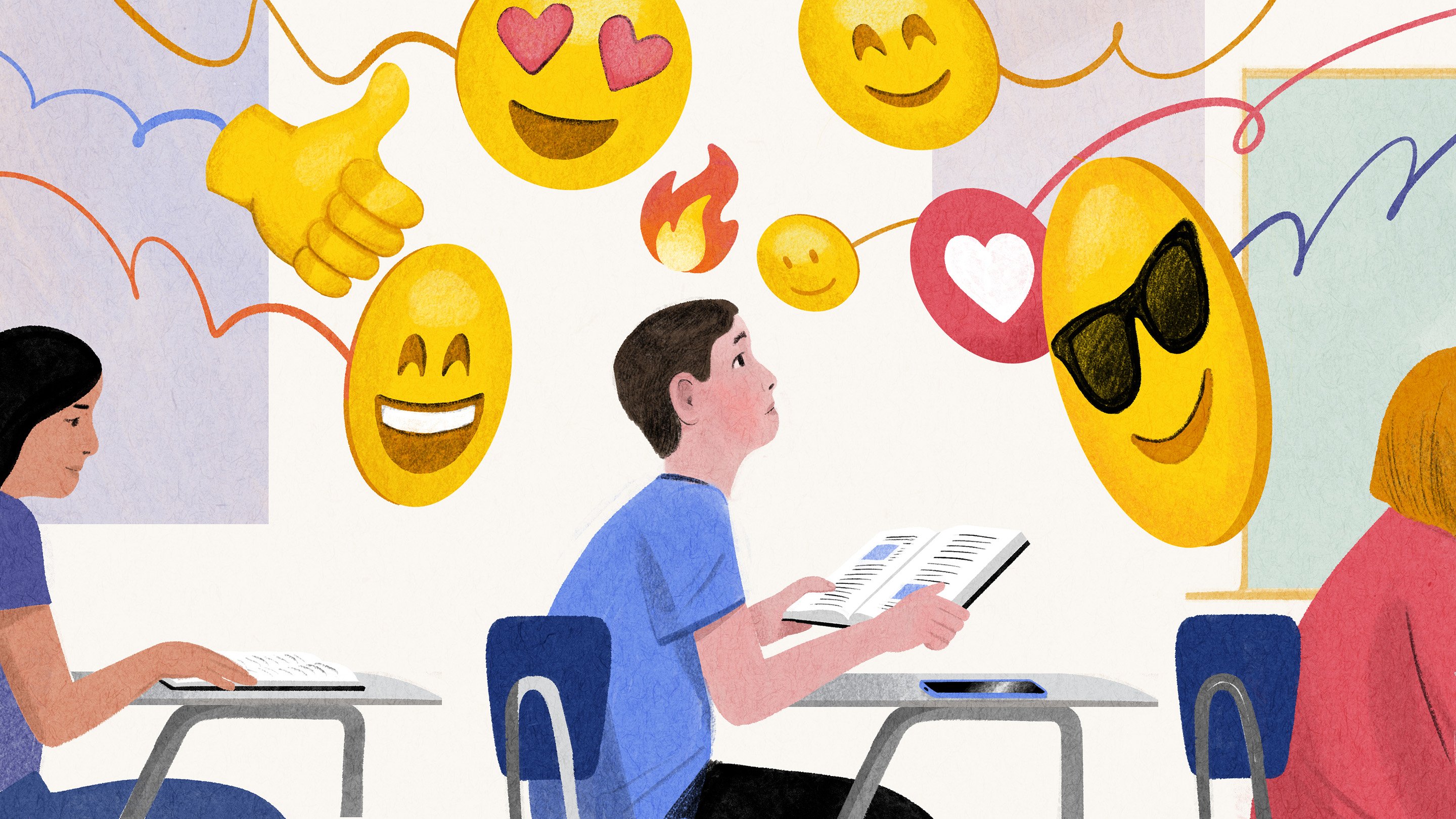
Illustration of a student sitting at a desk in a classroom, looking up from their book as many large emojis spring toward their face.
In a 2015 report that [garnered headlines](https://time.com/3858309/attention-spans-goldfish/) around the world, researchers made an astounding claim. In the roughly 13-year period beginning in 2000, the human attention span dwindled by about a third, from 12 seconds to eight seconds—shorter, they said, than the nine seconds of focus achieved by the common goldfish. Pets had supplanted primates: The “cute little fishies,” wrote the technology publisher CNET wryly, “could be on the path to ruling the world.”
The study’s central claim, in both zoological and neurological terms, is remarkable, vague, insulting to both humans and fish—and almost certainly meaningless.
In many contexts, humans can pay attention for hours at a time, while watching movies, for example, playing games like chess or poker, or reading comic books. This more general class of “attention” remains a recognizable feature of today’s kids and adults, even as cell phones and 90-second videos have begun to chip away at the way we engage with cherished but slower-paced pastimes. Sustained attention, meanwhile, which is generally [defined in research](https://www.sciencedirect.com/topics/psychology/sustained-attention) as the ability to maintain focus during activities that are intellectually challenging, repetitive, or compulsory—the kind of focus required in school or work settings, for example—has always been measured in minutes rather than hours.
An illustration of a brain.
*The Intercom* is jam-packed with practical strategies and genius-level ideas from fellow teachers. Have it delivered to your inbox every Wednesday.
Historical [studies of sustained attention](https://www.frontiersin.org/journals/psychology/articles/10.3389/fpsyg.2025.1589411/full) place the limits at various thresholds, from eight to 10 to 25 minutes, but almost never more than 30 minutes, and almost always much less. A [2009 study](https://journals.sagepub.com/doi/abs/10.1177/1469787408100194) noted that “students’ concentration during a class declines similarly to that of a human operator monitoring automated equipment, with potentially negative consequences for learning and performance.” The journal [*Nature* came to similar conclusions](https://www.nature.com/articles/d41586-026-01407-w) and proposed similar time horizons, in 2025: Adults who take a widely administered test of focused attention, the d2 test—which has been given for decades and requires participants to sift, tediously, through hundreds of variants of the letter “d” looking for telltale markings—perform about as well as they always have.
“Many lab studies,” *Nature* confirms, “have shown how performance on such tasks declines in about 10 minutes.”
There’s no clear evidence that our attentional *capacity* has changed. But something does appear to be shifting in the way people allocate attentional resources, and what millions of K–12 teachers are saying is almost certainly not an illusion: Students may indeed be less focused in classrooms than ever before.
##### THE SOCIAL MEDIA EXPLANATION
The social scientist Jonathan Haidt, author of best-seller *The Anxious Generation*, is one of the leading theorists on the effects of social media and technology on children’s mental health, attention spans, and motivation.
“Being a digital native does not confer an advantage,” Haidt said in a [2026 TED Talk](https://www.youtube.com/watch?v=DH9L7vJ03DE%E2%80%9D). “It teaches [kids] that there’s always a little bit of reward, a little bit of dopamine available, just one swipe away—and that undermines the ability to do difficult or sustained cognitive work like reading a book.”
While many scientists are more tentative in their conclusions, the 24/7 access to digital media is a plausible explanation for a decline in student attention spans. Cell phones, digital notifications, and newer, shorter content formats may well alter our perception of time, speed up the natural rhythms of our social lives, and manipulate our sense of urgency. A survey of the research on the topic reveals a range of changing—but instantly recognizable—behaviors driven by always-on multimedia devices.
A [2012 tracking study](https://researchportal.helsinki.fi/en/publications/habits-make-smartphone-use-more-pervasive/) found frequent “quick uses of 30 seconds or less” among mobile users, indicating a habitual “checking behavior.” The next year, a [study of 263 students](https://www.sciencedirect.com/science/article/abs/pii/S0747563212003305) studying in their homes revealed that the participants, many of them middle and high school students, “averaged less than six minutes on task prior to switching [to new tasks], most often due to technological distractions,” including browsing sites like Facebook and texting with friends.
Errors tend to increase after tasks are interrupted and resumed, write the authors of a [2017 review of the literature](https://doi.org/10.3389/fpsyg.2017.00605), and that’s particularly true when interruptions exceed 15 seconds, an attentional distraction threshold that smartphones easily eclipse. Once a student’s attention has been shifted to the phone, the authors continue, they “often then engage in a chain of subsequent task-unrelated acts on the smartphone,” like watching videos, upvoting posts, or playing digital games. “Studies exploring these ‘within-phone’ interruptions have found that task completion in one app can be delayed by up to 400% by an unintended [interruption from another app](https://dl.acm.org/doi/abs/10.1145/2371574.2371617).”
By the 2020s, the devotion to cell phones among teens had become truly alarming, suggesting that rapid “task-switching” behaviors were now a constant in the lives of young people: [A significant study of 5,400 adolescents](https://jamanetwork.com/journals/jamapediatrics/fullarticle/2785686) published in late 2021 found that non-school cell phone use doubled during the pandemic, from 3.8 hours/day pre-pandemic to an astonishing 7.7 hours/day post-pandemic.
But if our brains are being “rewired” for shorter attention spans, and if social media, video shorts, and other ephemera of the digital age are somehow culpable, the specific mechanisms are unknown.
It does not appear to be an alteration in our brain architecture or a new biological limit to our cognitive capacity. Using MRI and other methods to look into the human brain as neural circuitry is activated reveals no fundamental changes in critical areas related to attention.
“In principle, such measurements might be used to detect changes in attention capacity over time or between cohorts of people,“ says the cognitive neuroscientist Nilli Lavie, as [reported in *Nature*](https://www.nature.com/articles/d41586-026-01407-w). But the article goes on to say that “she doesn’t have the data to show that, and no such pattern has shown up in controlled lab studies.“
##### THE SHIFT IN EXPECTATIONS THEORY
A [2026 study](https://doi.org/10.1002/jcpy.70016) makes a provocative and more reasonable claim: It’s not that attention spans are getting shorter, it’s that we’re more sensitive to delays. Constant exposure to notifications, short videos, countdown timers, and progress bars “heighten temporal salience,” the study argues, making us more conscious of the passage of time—and more impatient to move on to the next thing.
In the newspaper era, for example, it was common to wait until the next morning to catch up on major events. Television viewers saw something closer to real-time coverage of events—if they happened to be watching—although most only tuned in for the morning or evening news broadcast. As technology compresses the time between events and their coverage, barraging us with a stream of instantaneous updates and notifications, our expectations adjust to the pace, researchers explain.
For students, what looks like a diminished capacity for attention may instead reflect a changing willingness to invest effort. “Digital media use may influence cognition mainly by recalibrating how effort is valued and allocated,” researchers explain in another [2026 study](https://doi.org/10.1038/s41562-026-02500-w). Adults may be nostalgic about searching through encyclopedias or visiting the library to research a topic, but when the same information can be retrieved in seconds, spending hours tracking it down doesn’t feel like persistence to students, it feels like wasted effort.
“Platforms engineered for minimal friction and immediate reward can reinforce habit loops that bias cost–benefit computations, making low-effort digital activities feel more valuable than cognitively demanding tasks such as focused work,” the researchers explain.
That’s a point that cognitive scientist Daniel Willingham is careful to emphasize. “There’s been a great deal of research on this question in the last 10 years, and it appears that children’s ability to control their attention has not been compromised, or if it has, it’s a small effect and would not account for what educators feel they see in the classroom,” [Willingham explains](https://www.aft.org/ae/spring2026/willingham).
Instead, technology appears to be playing some role in changing the calculations students make about whether sustained effort is worthwhile. A tough reading assignment or a chemistry problem may feel unreasonably long and tedious when measured against entertainment that can be accessed in seconds and consumed in minutes.
Perhaps, then, it’s a question of motivation and changing values—a cultural shift, not a biological one—Willingham suggests. “It’s not that students can’t pay attention,” he says, “but rather that they more readily choose not to.”
##### RECLAIMING STUDENT ATTENTION
For teachers, that conclusion is cautiously optimistic: “The changes we’re seeing—as dramatic as they may seem—could be undone,” says Willingham.
According to the Stanford neuroscientist Adi Korisky, who led a [2024 study](https://doi.org/10.1111/mbe.12432) on a neuroscience curriculum designed to teach students how attention works, attention can be trained like a muscle, but it’s not as simple as increasing attention spans. Effective learning requires students to shift their focus nimbly from the teacher, to their notes, then to their own thoughts as they make sense of what they’ve heard—all while filtering out background noise, visual distractions, and unrelated thoughts. This more flexible form of attention—“the ability to move between task demands”—was ultimately the “best predictor of learning,” Korisky recently told *Edutopia*.
Taken broadly, the research suggests these ways to manage and strengthen waning student attention:
**Teach students how attention works.** Students often overestimate their ability to pay attention to multiple tasks at once—in fact, the ones who multitask the most tend to be the worst at it, according to a [2013 study](https://doi.org/10.1371/journal.pone.0054402). “One of the most powerful ways to teach attention is to let students experience its limits, so I show my students a [BBC selective-attention video](https://www.youtube.com/watch?v=tMiyzuO1qMs) and ask them to carefully follow the directions,” writes middle school teacher Cathleen Beachboard.
**Work within, not against, cognitive limits.** Attention is limited, but instead of trying to “overcome these constraints,” researchers explain in a [2025 study](https://doi.org/10.3389/fpsyg.2025.1589411), teachers should “acknowledge the theoretical impossibility of perfect sustained attention” and choose strategies that are compatible with “inherent neural, biological, and cognitive limitations.”
That’s why it’s so important to introduce breaks, says [psychology professor Karrie Godwin](https://www.edutopia.org/article/designing-the-ideal-classroom-space/). Look for natural opportunities to interrupt long stretches of concentration with short [brain breaks](https://www.edutopia.org/package/brain-breaks-for-your-classroom) like a few minutes of stretching or movement, a calming exercise, or a quick, informal chat with peers.
**Make effort feel worthwhile.** In a landmark [2014 study](https://doi.org/10.1037/a0037637), researchers found that connecting learning to meaningful, beyond-the-self goals—being a doctor or engineer who helps people, for example—pushed students to reevaluate their goals, resist mind-wandering, and persist through tedious academic work.
**Reduce distractions.** A [2025 meta-analysis](https://doi.org/10.1016/j.chb.2024.108432) found that cell phones during class had “a statistically significant large negative effect” on students’ recall of the material, a [2022 study](https://doi.org/10.1111/mbe.12319) found that students had a harder time paying attention in classrooms with high levels of “visual noise,” and a [2021 study](https://doi.org/10.1177/00315125211005935) concluded that “noise from student chatter has a negative impact on students’ comprehension.”
Attention doesn’t exist in isolation. “Think about a kid that needs to read a book by himself in bed, or needs to read the same book on a football field,” Korisky says. The more distractions there are, the harder it is to pay attention.
**Reset expectations.** Exposure to longer periods of focus can accustom students to new expectations. Consider setting aside sustained periods for independent reading, writing, drawing, reflection, or working through problems without interruption.
Beachboard uses the [Pomodoro Technique](https://www.edutopia.org/article/improving-students-attention-span/)—asking students to work without interruption for a set period, take a break, and then return—and gradually extends the work periods as students become comfortable concentrating for longer stretches., Are Student Attention Spans Really Shrinking?, Stephen Merrill and Youki Terada, 01m1egq4srbe529cy62zy26bc6.