Aspiring to FAIR Package Management
## Metadata
- Author: [[Brent Toderash]]
- Full Title: Aspiring to FAIR Package Management
- Category: #articles
- Document Note: ---
tags:
- #opensource
- #packagemanagement
- #softwaredevelopment
- #FAIR
Author: Aspire Press
Source: Aspire Press Website
Reference: https://aspirepress.org/aspiring-to-fair-package-management/
date created: 2025-06-10 17:10
---
# Title: Aspiring to FAIR Package Management
## Table of Contents:
- [📝 Summary](#-summary)
- [📖 Main Content](#-main-content)
- [🗒️ Notes](#-notes)
- [🗣️ Paraphrase](#-paraphrase)
- [📰 Newsletter](#-newsletter)
- [✅ Action Items](#-action-items)
- [🧪 Hypotheses](#-hypotheses)
- [📊 Methodology](#-methodology)
- [❓ Questions](#-questions)
- [🔮 Future Research](#-future-research)
- [💡 Implications](#-implications)
- [🧠 Learning Styles Assessment](#-learning-styles-assessment)
- [📊 Accessibility Assessment](#-accessibility-assessment)
- [🌍 DEIB Assessment](#-deib-assessment)
- [✅ Logical Validity](#-logical-validity)
- [🔍 DARVO Analysis](#-darvo-analysis)
- [🔍 SEO Evaluation](#-seo-evaluation)
- [🎯 Conclusion](#-conclusion)
### References:
- Aspire Press (2025). *Aspiring to FAIR Package Management*. https://aspirepress.org/aspiring-to-fair-package-management/
- FAIR Principles: Wilkinson et al., 2016.
## 📝 Summary:
This article advocates for the adoption of FAIR (Findable, Accessible, Interoperable, Reusable) principles in software package management. It highlights current challenges in package ecosystems, such as fragmentation, lack of discoverability, and interoperability issues. The authors argue for standardized metadata, transparent governance, and community-driven tools to enable sustainable, efficient, and open package management. Ultimately, the goal is to improve software reuse, reduce duplication, and enhance trustworthiness within open source ecosystems.
## 📖 Main Content:
The article begins by diagnosing problems endemic to modern package managers and ecosystems: inconsistent metadata, siloed registries, and poor discoverability. It stresses the need for a unified, FAIR-aligned framework that prioritizes transparent data about packages, their provenance, and interdependencies.
The authors explore:
- The *Findable* aspect, urging standardized, rich metadata schemas to ensure packages can be reliably located across registries.
- *Accessible* principles, emphasizing open APIs and protocols that guarantee users can retrieve packages without restrictive barriers.
- *Interoperability*, advocating cross-ecosystem standards so packages and their metadata work smoothly in varied environments.
- *Reusability*, focusing on clear licensing, versioning, and quality indicators to foster trust and long-term maintenance.
They also discuss the governance and community collaboration needed to maintain these standards, warning against corporate or siloed control that could hinder openness.
Finally, the piece underscores the growing importance of FAIR-aligned package management to future-proof software development, facilitate research reproducibility, and empower diverse contributors.
## 🗒️ Notes
- **Current challenges in package management**: fragmentation, metadata inconsistency, limited interoperability.
- **FAIR principles applied to packages**:
- Findable: standardized metadata, registries interoperability
- Accessible: open APIs, no restrictive access
- Interoperable: cross-language, cross-registry compatibility
- Reusable: licensing clarity, provenance, quality metrics
- **Governance**: community-driven, transparent, and inclusive decision-making essential.
- **Benefits**: reduces redundant development, increases trust and collaboration, supports reproducible research and development.
- **Future outlook**: FAIR adoption can harmonize ecosystems like npm, PyPI, Maven, and beyond.
## 📖 References:
- Wilkinson, M. D., et al. (2016). *The FAIR Guiding Principles for scientific data management and stewardship.* Scientific Data, 3, 160018.
- Aspire Press Article (2025). *Aspiring to FAIR Package Management*. https://aspirepress.org/aspiring-to-fair-package-management/
## 🗣️ Paraphrase:
1. *Original*: "To achieve FAIRness, package managers need to ensure that metadata is not only present but standardized, making packages discoverable in a predictable way across registries."
*Paraphrased*: For packages to meet FAIR standards, it is critical that metadata is uniformly structured and comprehensive, so that users can reliably find packages regardless of which registry they search.
2. *Original*: "Community governance models that prioritize openness and collaboration prevent single points of control that could limit accessibility or innovation in package ecosystems."
*Paraphrased*: By fostering open and cooperative governance, package ecosystems can avoid monopolies on control, ensuring continued accessibility and promoting innovative development.
## 📰 Newsletter:
Hey WordPress enthusiasts! This issue dives into the future of software package management with a spotlight on FAIR principles — making packages Findable, Accessible, Interoperable, and Reusable. As open-source developers, understanding these principles means better tools, less duplication, and more trust in the code we depend on. Whether you’re building plugins or core features, this insight helps us push towards sustainable, community-driven software ecosystems. Plus, get the latest on community events, plugin updates, and how you can contribute to open-source projects shaping our future! Stay curious, stay coding.
## ✅ Action Items:
- Explore how FAIR principles can improve WordPress plugin and theme package management.
- Advocate for standardized metadata and interoperability in WordPress ecosystems.
- Educate contributors on the benefits of transparent governance in open source projects.
- Promote tooling and documentation aligned with FAIR to new contributors.
- Incorporate FAIR concepts into talks and training to foster sustainable open-source growth.
- Prepare a proposal for integrating FAIR metadata standards into WordPress.org repository guidelines.
## 🧪 Hypotheses:
- Applying FAIR principles to WordPress package management will increase plugin discoverability by 40% within one year.
- FAIR-compliant metadata standards will reduce duplicated efforts across plugin developers by 30%.
- Transparent governance aligned with FAIR principles leads to higher contributor retention and engagement.
### 📊 Methodology:
- Quantitative analysis of plugin discoverability metrics before and after FAIR adoption.
- Surveys and interviews with WordPress developers on perceived benefits of FAIR metadata.
- Comparative study of governance models’ impact on community engagement in open source projects.
### ❓ Questions:
- What are the biggest barriers to implementing FAIR in large open-source ecosystems like WordPress?
- How can decentralized registries be aligned with FAIR principles without sacrificing usability?
- What governance structures best support the sustainability of FAIR package management?
### 🔮 Future Research:
- Evaluating the impact of FAIR adoption on software supply chain security in WordPress.
- Studying interoperability challenges between different package ecosystems under FAIR guidelines.
- Assessing community responses and adoption rates of FAIR-based tooling.
### 💡 Implications:
Advancing FAIR in package management can lead to more sustainable software ecosystems, enhanced developer collaboration, and greater resilience against supply chain risks. For WordPress, this means a stronger foundation for plugin and theme reliability, and a clearer path to onboarding new contributors effectively.
### 🧠 Learning Styles Assessment:
- **Visual Learners**:
- Present: Article lacks visuals.
- Improve: Add flowcharts or infographics explaining FAIR principles applied to package management.
- **Aural Learners**:
- Present: No audio or podcast links.
- Improve: Include audio summaries or podcasts discussing FAIR in open source.
- **Verbal Learners**:
- Present: Clear language with some analogies.
- Improve: Add more storytelling/examples from real-world ecosystems.
- **Physical Learners**:
- Summary: Word of the announcement of the FAIR Package Manager at the AltCtrlOrg side-event to WCEU in Basel, Switzerland has traveled quickly. The announcement took place immediately following Matt Leach's demo of AspireUpdate and AspireExplorer, immediately before a Q&A session whose topic was suddenly focused completely on the FAIR announcement, partly due to the excitement in
- URL: https://aspirepress.org/aspiring-to-fair-package-management/
[Brent Toderash](https://aspirepress.org/author/
[email protected]) |
June 9, 2025
Word of the announcement of the FAIR Package Manager at the [AltCtrlOrg](https://altctrl.org) side-event to [WCEU](https://europe.wordcamp.org/2025/) in Basel, Switzerland has traveled quickly. The announcement took place immediately following Matt Leach’s demo of AspireUpdate and AspireExplorer, immediately before a Q&A session whose topic was suddenly focused completely on the FAIR announcement, partly due to the excitement in the room and partly due to the fact that the panel participants (including Joost de Valk) were already familiar with FAIR.
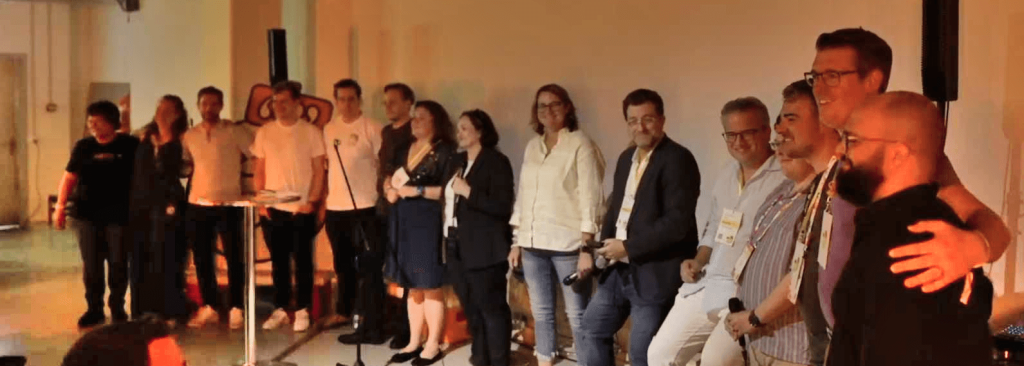Some of the people involved in the FAIR project at its announcement in Basel, Switzerland.
An immediate question for followers of AspirePress is what this means for us in light of the [public release announcement](https://aspirepress.org/everest-1-0-is-not-just-a-number/ "“Everest” (1.0 is not just a number.)") we made at the same time. So glad you asked — we’ll respond by sharing a bit of background.
The AspirePress project to develop a distributed repository for WordPress was founded by Sarah Savage in the fall of 2024. Once work had begun, the AspirePress community began to grow and more contributors were added to the team. At that stage, Sarah shared [A vision of a distributed package repository in WordPress](https://aspirepress.org/a-vision-for-aspirepress-and-a-community-run-org-mirror/), outlining where the project was headed. On the heels of an open letter from 20 leaders in the WordPress community In December of 2024, [Joost de Valk posted](https://joost.blog/wordpress-leadership/) about leadership in WordPress and called for ***Fair And Independent Repositories***, or FAIR. At the same time, [Karim Marucchi published his post](https://marucchi.com/wordpress-leadership-continued/) about a new WordPress roadmap. Both posts included “Breaking the Status Quo”, and Joost stated that 2025 would begin with discussions about next steps. (Several other supportive posts appeared soon after; including [my own take on breaking the status quo](https://yawp.foo/articles/2025/breaking-the-status-quo-how-it-came-to-this/).)
As of Spring 2025, discussions were quietly underway among a slowly-growing group of individuals, many of whom did not feel free to speak about their involvement publicly. At that time, many people had been banned from contributing, blocked from logging into wordpress.org, and publicly maligned. The group fully respected this, and continues to maintain their confidentiality. Sarah Savage (AspirePress founder) and I (AspirePress project manager) were engaged in discussion with the group, which [came to be known as FAIR](https://fair.pm). A handful of other contributors to AspirePress have also participated in creating FAIR.
For assistance governance structure, the group [organized itself under the Linux Foundation](https://www.linuxfoundation.org/press/linux-foundation-announces-the-fair-package-manager-project-for-open-source-content-management-system-stability). As stated by Carrie Dils (FAIR TSC Co-Chair) during the FAIR announcement this past weekend, rather than reinvent the wheel, when it came time to start coding the FAIR project began with the code written by the AspirePress team.
While respecting the confidentiality of many contributors, the work of AspirePress alongside the FAIR project has been close, cooperative, and collaborative. In many ways, AspirePress has become a *part* of FAIR — we share a common vision toward federated independent repositories, and are proud to be working on it together. At its launch, the [FAIR plugin](https://github.com/fairpm/fair-plugin) redirects API calls for wordpress.org for updates to plugins, themes, and WordPress core to our API server running [AspireCloud](https://github.com/aspirepress/AspireCloud) via Fastly CDN, and serves package downloads from this alternative source — the same as the [AspireUpdate plugin](https://github.com/aspirepress/aspireupdate) does.
Although the package update mechanism is the same, there are a few differences between the initial release versions of [AspireUpdate plugin](https://github.com/aspirepress/aspireupdate) and the [FAIR plugin](https://github.com/fairpm/fair-plugin). First, AspireUpdate includes a dropdown setting allowing the user to select between updating from wordpress.org or from the AspireCloud production server, and offers a text field where the url for any compatible mirror can be entered. The FAIR plugin also supports other compatible mirrors, but the configuration is done by setting a constant in wp-config.php. Second, the FAIR plugin includes some additional options for independence from wordpress.org, such as replacements for browse-happy, serve-happy, Gravatar, and dashboard RSS feeds. These were all well down the priority list for AspirePress, but because we had already tackled package updates, the FAIR team were able to tackle these additional features.
**In short, we are where we are by working together.**
What’s next? We’ll keep working together. In speaking about FAIR and the WordPress community, Karim Marucchi has used the phrase “groups of groups”, and we believe that’s the future for a healthy WordPress community and ecosystem. Like [FAIR](https://fair.pm) and AspirePress, organizations like the [WP Community Collective](https://www.thewpcommunitycollective.com/), [AltCtrlOrg](https://altctrl.org/), and the re-minted [Post Status](https://poststatus.com/) are all like-minded groups with different mandates. Each contributes to the whole, not as rivals, but as groups within a shared community, cooperating and collaborating in the stewardship of the Commons that we share.
This is the best and healthiest future we can imagine for the WordPress community and its ecosystem., Aspiring to FAIR Package Management, Brent Toderash, 01jxcvshvvwf0ftdrt1mgr73at.