Building Enterprise Frontier Safeguards With Our Customers
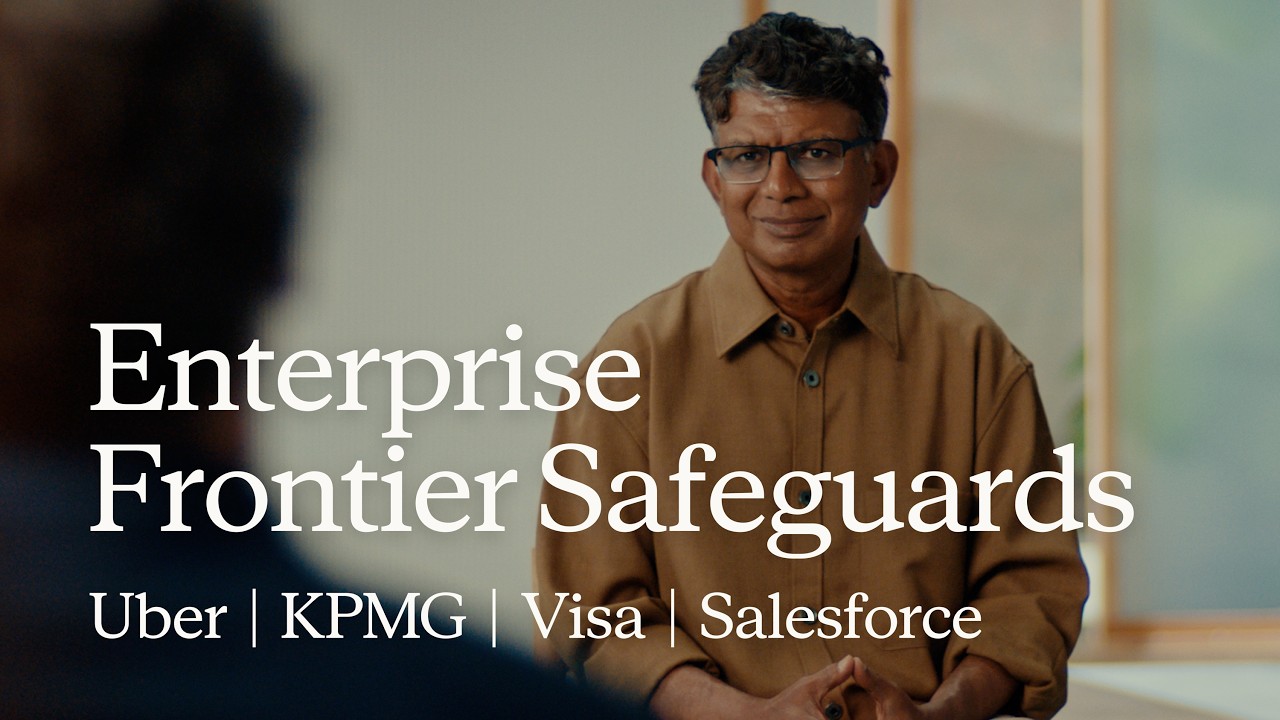
🔗 **Source:** [Building Enterprise Frontier Safeguards With Our Customers](https://www.youtube.com/watch?v=FoteuzPpx7E)
> [!note]+ Document Notes
> ---
> tags: [anthropic, claude, enterprise-ai, ai-safety, privacy-architecture, security-logging, visa, uber, customer-testimonial]
> author: Claude (Anthropic YouTube channel)
> source: YouTube — @claude
> reference: https://www.youtube.com/watch?v=FoteuzPpx7E
> date created: 2026-09-01 21:35
> ---
> > [!info] Generated analysis — not the author's words. Sections below are machine-written
> > from the captured source. Only text inside `> [!quote]` blocks is verbatim from the author.
> > Do not quote or attribute any other line to the named author.
> > [!warning] Thin source — ~220 words of testimonial, speakers unidentified
> > The transcript is a stitched customer-testimonial reel of roughly two minutes with no speaker
> > names, titles, or on-screen text captured. Two companies are identifiable from the speech
> > itself (Uber, Visa); Anthropic is named once. Channel confirmed as Anthropic's "Claude"
> > account via YouTube oEmbed. "Enterprise Frontier Safeguards" is the product name in the title;
> > the transcript never defines it. Where this note describes what the product *does*, it is
> > restating the speakers' claims, not verifying them.
> # 🏷️ Title: Building Enterprise Frontier Safeguards with our customers
> ## 🧭 Table of Contents
> - [📝 Summary](#-summary)
> - [📖 Main Content](#-main-content)
> - [🗒️ Notes](#️-notes)
> - [📚 References](#-references)
> - [🗣️ Paraphrase](#️-paraphrase)
> - [📰 Newsletter](#-newsletter)
> - [✅ Action Items](#-action-items)
> - [🧪 Hypotheses](#-hypotheses)
> - [📊 Methodology](#-methodology)
> - [❓ Questions](#-questions)
> - [🔮 Future Research](#-future-research)
> - [💡 Implications](#-implications)
> - [🧠 Learning Styles Assessment](#-learning-styles-assessment)
> - [📊 Accessibility Assessment](#-accessibility-assessment)
> - [🌍 DEIB Assessment](#-deib-assessment)
> - [✅ Logical Validity](#-logical-validity)
> - [🛡️ DARVO Analysis](#-darvo-analysis)
> - [🎯 Conclusion](#-conclusion)
> ### 🔗 References
> - Source: https://www.youtube.com/watch?v=FoteuzPpx7E (Anthropic "Claude" channel, published 2026-09-01, ~2 min)
> - No links in the stored document (verified: zero `<a>` tags).
> ## 📝 Summary
> **What this is.** A customer-testimonial reel for an Anthropic enterprise offering called "Enterprise Frontier Safeguards." Unnamed speakers from Uber and Visa explain why they trust it. The clip's one technical passage — from the Visa speaker — describes an architecture rather than a promise, and that passage is the only part of the reel that carries information.
> **The architecture claim, as stated.** Security and privacy controls live "at the architectural level, not just policy level." Concretely: (1) the customer's data stays in the customer's cloud under the customer's control; (2) the customer has continuous access to the signals; (3) logs never leave unless the customer chooses; (4) safety review is machine-only — no human at Anthropic reads customer content; (5) what the review emits is "intentionally limited to defined findings, not customer content."
> **Why that passage matters.** Points 4 and 5 describe a specific privacy pattern: a monitoring system whose output is a fixed schema of findings rather than the material it inspected. That's the same shape as a linter that reports rule IDs instead of source lines, or a DLP scanner that flags "credit card detected" without exfiltrating the number. If it works as described, it lets a bank run frontier-model review over regulated data without the reviewer becoming a data recipient.
> **Why the rest doesn't.** The Uber line ("bone-deep focus on safety") and the Visa framing (billions of consumers, 160M merchants, 15,000 banks, 130 years of trust) are brand credentials. They establish that these customers care; they don't establish that the product delivers. "Visa cannot do it ourselves" is the reel's sales thesis — frontier labs supply "ingredients" incumbents can't build — and it's asserted, not shown.
> **Stakeholders.** Anthropic (positioning against other labs on enterprise trust); regulated-industry buyers (finance, mobility); privacy and security teams who will need to verify the architecture; anyone whose payment or ride data flows through these systems.
> **Risks.** The clip's own framing — "the stakes are higher" now — is correct and unelaborated. The architectural claims are unfalsifiable from a testimonial; verifying them needs a technical writeup, a SOC 2 / ISO 27001 scope statement, or a data-flow diagram, none of which the clip references.
> **Bottom line.** Discard the testimonial, keep the design pattern. "Machine-only review, output limited to defined findings, logs under customer control" is a three-clause architecture worth naming and checking against whatever documentation exists.
> ## 📖 Main Content
> The reel runs in three movements.
> **Credentialing (Uber, then Visa).** Uber's speaker asserts a shared safety culture with Anthropic. Visa's speaker recites scale — billions of consumers, 160 million merchants, 15,000 banks — and duration — 130 years — then frames trust as the asset at risk: "That trust took decades to earn, and I don't intend to spend it carelessly now that the stakes are higher."
> **The architecture (Visa).** The only substantive segment. Controls are built in, not bolted on ("architectural level, not just policy level"). Data residency: "store in our cloud with our control." Observability: "continuous access to the signals." Egress: "The logs are under our control. They don't go anywhere else unless we want them to." Review: "machine-only." Output: "intentionally limited to defined findings, not customer content."
> **The thesis (Visa).** Incumbents can't build this alone; frontier labs supply the "ingredients." The safeguards unlock use of AI "in parts of the business that we wouldn't have been able to do so before" while remaining "responsible stewards of the capabilities of these models."
> Nothing in the reel says what a "finding" is, who defines the schema, whether findings can be appealed, what the review is looking for, or where the model itself runs.
> ## 🗒️ Notes
> - [00:00] Uber: "bone-deep focus on safety" — shared-values framing, no content.
> - [00:06] Visa: scale credentials — billions of consumers, 160M merchants, 15,000 banks.
> - [00:14] "Trust is paramount to our brand. It's literally our business model for 130 years."
> - [00:20] "That trust took decades to earn, and I don't intend to spend it carelessly now that the stakes are higher." — the reel's best line; also its only acknowledgment of risk.
> - [00:28] "new security and privacy capabilities at the architectural level, not just policy level" — the enforcement-ladder claim.
> - [00:35] Data residency and control: "store in our cloud with our control… continuous access to the signals."
> - [00:42] Egress: "The logs are under our control. They don't go anywhere else unless we want them to."
> - [00:48] "The review is machine-only. What comes out is intentionally limited to defined findings, not customer content." — the privacy pattern.
> - [00:56] "Visa cannot do it ourselves. We need the frontier labs like Anthropic helping us to provide the ingredients" — the sales thesis.
> - [01:08] Safeguards as enabler: AI "in parts of the business that we wouldn't have been able to do so before."
> - [01:18] Close: "responsible stewards of the capabilities of these models."
> ## 📚 References
> **Stated by the source:** none. No documents, standards, or URLs are named.
> **What would substantiate the claims (not provided):**
> - An Anthropic technical post or docs page defining "Enterprise Frontier Safeguards" and the findings schema.
> - Data-flow documentation showing where inference runs relative to the customer's cloud (the clip says logs stay; it doesn't say the model does).
> - Third-party attestation scope (SOC 2 Type II, ISO 27001) covering the machine-only review path.
> - Visa's and Uber's own disclosures, if any, on AI-vendor data handling.
> **Named entities:** Anthropic, Uber, Visa. Speakers unnamed in the transcript.
> **Link audit.** Zero `<a>` tags in `html_content`. Nothing to check.
> ## 🗣️ Paraphrase
> An Uber executive says Anthropic shares Uber's safety obsession. A Visa executive says Visa protects billions of people and has spent 130 years earni
One thing Anthropic and Uber
have in common is this bone-deep focus on safety. At Visa, we actually secure billions
of consumers around the world, over 160 million merchants,
over 15,000 banks. Trust is paramount to our brand. It's literally our business
model for 130 years. That trust took decades to earn,
and I don't intend to spend it carelessly now that the stakes are higher.
We were able to work together
on new security and privacy capabilities at the architectural level,
not just policy level. We have the ability to store in our cloud
with our control, and that we have
continuous access to the signals. The logs are under our control.
They don't go anywhere else
unless we want them to. The review is machine-only. What comes out is intentionally limited
to defined findings, not customer content. Visa cannot do it ourselves. We need the frontier labs like Anthropic
helping us to provide the ingredients to help us to bring AI
into every aspect of our cyber defense. Those safeguards actually allow us
to apply AI in parts of the business
that we wouldn't have
been able to do so before. They allow us to protect the information,
the use cases that we work on while still being responsible stewards
of the capabilities of these models., Building Enterprise Frontier Safeguards With Our Customers, Claude (Anthropic), 01m1fjjycea6e4mpa18kfc0jnb.