CMS Market Share Analysis

## Metadata
- Author: [[joost.blog]]
- Full Title: CMS Market Share Analysis
- Category: #articles
- Document Note: tags:
- #cms
- #wordpress
- #marketshare
Author: Joost de Valk
Source: joost.blog (Article)
Reference: https://joost.blog/cms-market-share/
date created: 2025-08-22 00:00
# Title: CMS Market Share Analysis (July 2022): Stabilization, Volatility, and the WooCommerce–Shopify Split
## Table of Contents:
- [📚 Overview](#-overview)
- [📈 WordPress Stabilizes](#-wordpress-stabilizes)
- [🛒 E‑commerce: WooCommerce vs Shopify](#-ecommerce-woocommerce-vs-shopify)
- [🧩 Wix, Webflow, Joomla, Drupal](#-wix-webflow-joomla-drupal)
- [🔄 Consolidation Slowing](#-consolidation-slowing)
- [🧾 Data Caution and Conclusions](#-data-caution-and-conclusions)
- [🗒️ Notes](#-notes)
- [📖 References](#-references)
- [🗣️ Paraphrase](#-paraphrase)
- [📰 Newsletter Blurb](#-newsletter-blurb)
- [✅ Action Items (Advocacy + OSPO Alignment)](#-action-items-advocacy--ospo-alignment)
- [🧪 Hypotheses](#-hypotheses)
- [📊 Methodology](#-methodology)
- [❓ Questions](#-questions)
- [🔮 Future Research](#-future-research)
- [💡 Implications](#-implications)
- [🧠 Learning Styles Assessment](#-learning-styles-assessment)
- [📊 Accessibility Assessment](#-accessibility-assessment)
- [🌍 DEIB Assessment](#-deib-assessment)
- [✅ Logical Validity](#-logical-validity)
- [🎯 Conclusion](#-conclusion)
### References:
- W3Techs CMS usage statistics (referenced in-article)
- BuiltWith platform usage data (referenced in-article)
## 📝 Summary:
The July 2022 analysis finds WordPress’s once‑relentless growth has stabilized. Data for Shopify appears to be flattening as well, while WooCommerce continues to grow, widening its lead among e‑commerce CMS options. Wix and Webflow trends are inconclusive because W3Techs and BuiltWith diverge. Drupal and Joomla show consistent declines across datasets. Overall CMS market consolidation is increasing more slowly than previously forecast, and the author refrains from long‑range predictions due to volatility and conflicting data sources.
## 📖 Main Content:
- The top CMS landscape shows WordPress still dominant but no longer accelerating; the trend line suggests a plateau rather than decline.
- Shopify’s growth stalls per both W3Techs (slight dip) and BuiltWith (flat installs), while WooCommerce exhibits continued growth, creating a clearer divergence between the two leading e‑commerce ecosystems.
- Wix and Webflow readings are mixed: W3Techs suggests growth (especially for Wix), but BuiltWith shows relative stability—signaling measurement differences or detection issues.
- Legacy open-source CMSs (Drupal, Joomla) are in persistent decline across both relative share and absolute installs.
- Market consolidation—once brisk—is now slowing, with the combined share of the top 50 CMS rising modestly since late 2021 but missing the earlier projection for 2022.
- Given volatility and dataset conflicts, the analysis avoids strong projections.
### 🗒️ Notes
- WordPress stabilizes
- After years of growth, recent data suggests a plateau rather than decline.
- Interpretation hinges on W3Techs; caution urged due to measurement limitations.
- Shopify vs WooCommerce
- Shopify: flat to slightly down in share and installs (W3Techs + BuiltWith alignment).
- WooCommerce: continued growth; widening gap vs Shopify in the last year.
- Other e‑commerce platforms (Magento, OpenCart) losing ground or harder to track.
- Wix and Webflow
- Wix: W3Techs shows +0.6% YoY; BuiltWith shows stability—no consensus.
- Webflow: growth in W3Techs; nearly flat in BuiltWith—also inconclusive.
- Drupal and Joomla
- Declines confirmed by both relative share (W3Techs) and absolute install counts (BuiltWith).
- Consolidation slowing
- Top 50 CMS combined share rose from 63.8% (Dec 2021) to 64.5% (July 2022), below the previously projected pace.
- Conclusion
- Unusually volatile period; dataset divergence prevents confident long‑term predictions.
## 📖 References:
- W3Techs: CMS usage and market share methodologies and datasets (site-level detection)
- BuiltWith: Technology fingerprinting and install-level tracking
- Article charts summarizing time‑series trends for top CMS, Shopify, Wix, Webflow, and e‑commerce splits
## 🗣️ Paraphrase:
1) Original idea: “WordPress market share is stabilizing.”
Paraphrase: After years of near‑continuous expansion—and a brief hint of shrinkage—WordPress appears to have reached a steady state in overall market share rather than continuing to climb.
2) Original idea: “WooCommerce continues to grow while Shopify doesn’t.”
Paraphrase: The last year shows a clearer separation: WooCommerce’s footprint keeps increasing, whereas Shopify’s presence has leveled off, indicating diverging momentum between the two leaders.
## 📰 Newsletter:
Learning web dev this week? Start with the data. July’s CMS trends show WordPress holding steady at the top while WooCommerce quietly keeps gaining ground in e‑commerce. Meanwhile, Shopify’s curve has flattened, and legacy CMSs like Drupal and Joomla continue to slip. Wix and Webflow? The jury’s out—W3Techs hints at growth but BuiltWith says “steady.” Translation: measure twice before you pick your stack.
What’s new in WordPress:
- Core: Keep an eye on ongoing performance and editor enhancements landing across minor releases.
- Community: Contributor days are ramping up—perfect for onboarding new devs.
- Plugins: WooCommerce extensions focused on checkout optimization and subscription UX are trending.
Resources:
- W3Techs CMS usage overview for longitudinal share insights.
- BuiltWith platform usage for install‑level snapshots.
Tip of the week: If you’re teaching yourself JS for WordPress, pair Gutenberg block development with a real project—nothing beats shipping something your friends can break.
## ✅ Action Items (Advocacy + OSPO Alignment):
- Map article insights to open‑source advocacy
- Use WordPress stabilization to emphasize the value of long‑term OSS sustainability and governance transparency.
- Highlight WooCommerce’s growth as a case study for plugin ecosystems and community‑driven innovation.
- Contributor engagement initiatives
- Design onboarding sessions explaining market trends and where contributor impact is highest (performance, onboarding docs, merchant UX).
- Run data‑literacy workshops on reading W3Techs vs. BuiltWith to inform better product and community decisions.
- Education focus
- Create curricula: PHP/JS for WooCommerce extensions; Git/GitHub workflows for new contributors; accessibility-first development.
- Develop labs comparing Shopify app vs. WooCommerce plugin developer experience; translate findings into community docs.
- OSPO trajectory
- Draft a measurement framework that tracks contribution impact vs. ecosystem trends (e.g., performance fixes correlated with adoption).
- Publish transparent governance reports highlighting inclusivity, funding pathways, and contributor recognition.
- Sustainability
- Advocate for diversified funding (sponsorships, fellowships) targeting areas where declining platforms lost ground (DX, docs, upgrade paths).
## 🧪 Hypotheses:
- H1: WordPress market share will remain within a narrow band until materially new UX or performance breakthroughs occur.
- H2: WooCommerce growth is driven by ecosystem extensibility and lower total cost of ownership vs. hosted alternatives.
- H3: Divergent Wix/Webflow signals arise from detection methodologies rather than true demand shifts.
- H4: Drupal/Joomla decline correlates with developer pipeline attrition and higher migration friction.
### 📊 Methodology:
- Data sources: W3Techs (market share), BuiltWith (install counts), hosting telemetry partners, plugin/theme repo stats, WooCommerce marketplace analytics.
- Design: Mixed‑methods time‑series with cross‑validation; panel surveys of agencies/merchants; developer onboarding funnel analysis.
- Techniques: Interrupted time‑series around major releases; difference‑in‑differences for pricing or policy changes; survival analysis for site churn; triangulation across datasets to de‑bias detection errors.
### ❓ Questions:
- What specific features or policies would restart WordPress growth beyond stabilization?
- Which WooCommerce extensions most correlate with mer
- Document Tags: [[wordpress]]
- Summary: This is the CMS market share analysis for July 2022, my seventh biannual analysis of the CMS market share numbers provided by W3Techs, this time with additional data from BuiltWith.
- URL: https://joost.blog/cms-market-share/
#### The top 10 CMSes July 2022
This is the current top 10 Content Management Systems in the world by market share:
Most of the above is visible (in its relativity) in the chart below. “None” means the CMS wasn’t detected or is “custom”:
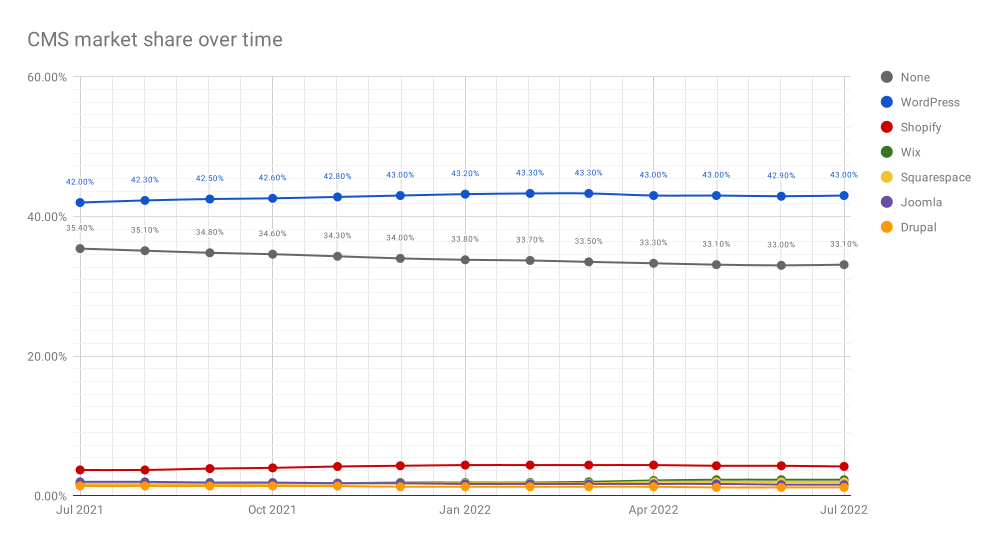CMS market share over time for the top 6 CMSes.
Because the trends for WordPress are so much bigger than everything else, here’s a chart without WordPress:
CMS market share over time for the top 6 CMS excluding WordPress.
#### WordPress stabilizes
For the longest time, it looked like WordPress would just always continue growing. Then, for a brief period, it [looked like its market share was actually in decline](https://joost.blog/wordpress-market-share-shrinking/). I think the best conclusion we can draw based on the W3Techs data, is that WordPress market share is stabilizing.
#### Is Shopify also stabilizing?
Shopify’s market share, according to W3Techs didn’t grow over the last 6 months, in fact, it declined a bit. If I compare that data with the [BuiltWith data on Shopify](https://trends.builtwith.com/shop/Shopify), shown in the chart below, that data seems to corroborate the idea of Shopify stabilizing:

#### Is Wix truly growing that fast?
The W3Techs data shows Wix growing quite rapidly, adding a total of 0.6% market share over the last year. However, that is not corroborated at all by the data BuiltWith shows for Wix, as it has it being relatively stable:

#### Drupal and Joomla decline
While the data is not entirely conclusive on Wix and Shopify’s growth or lack thereof, for Drupal and Joomla every tool I’ve seen agrees. Their decline is real, and doesn’t seem to slow down. They’re not just losing market share, as measured by W3Techs, they’re losing actual installs, as measured by BuiltWith.
#### Webflow numbers: what to believe?
In the W3Techs numbers, Webflow is growing nicely. In the [BuiltWith numbers](https://trends.builtwith.com/cms/Webflow) though, Webflow has barely added any sites at all in more than a year. So this too, is inconclusive.
#### Overall market consolidation slowing
In December I wrote that the entire CMS market is consolidating, and was doing so fairly quickly. In June 2020, the top 50 CMSes combined were responsible for 54.8% of sites followed by W3Techs. In December 2021 this was 63.8% of sites. I forecasted that to be close to 70% by the end of 2022. Although the number has gone up a bit, and is now at 64.5%, this consolidation seems to be slowing a bit.
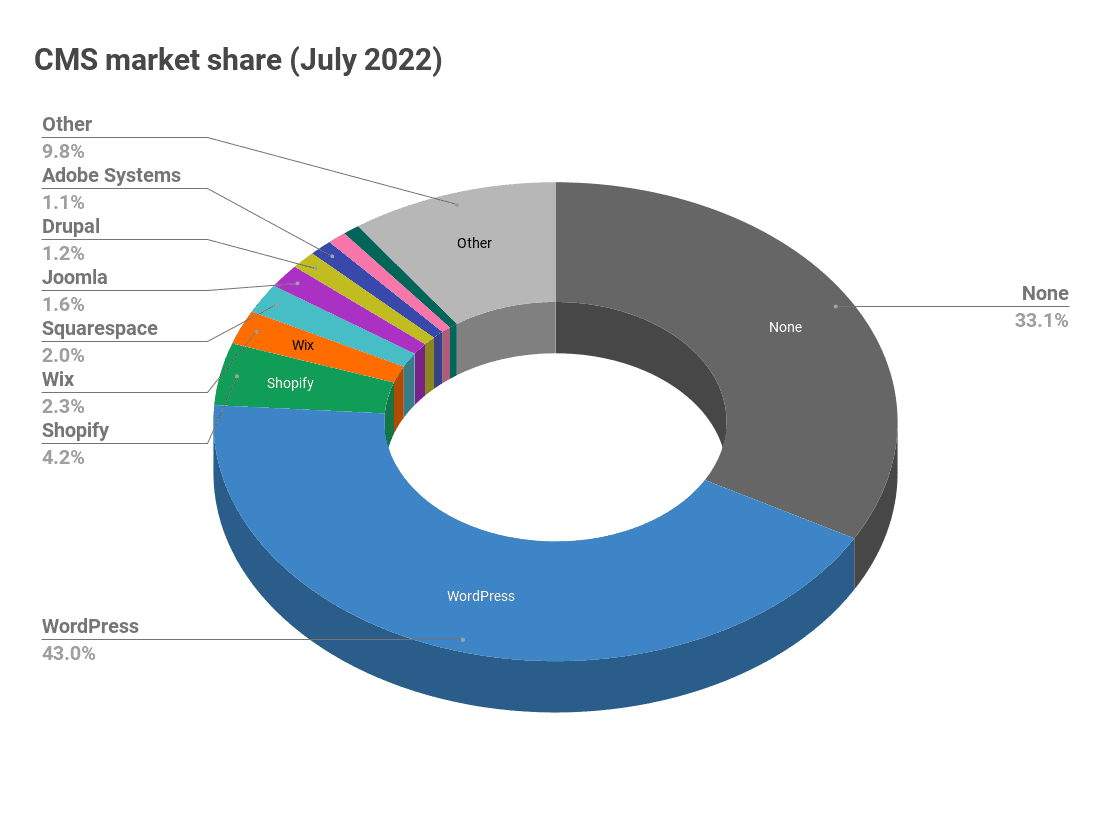
Based on the current numbers, this is the current CMS market share pie chart:
CMS market share as of July 2022
#### The fight for the biggest e-commerce platform
For quite a while, Shopify and WooCommerce had very similar growth trajectories. I think we can now no longer say that that’s the case, as WooCommerce continues to grow and Shopify doesn’t:
WooCommerce vs Shopify growth over the past year.
The other eCommerce players don’t seem to be doing so well. Magento is now harder to track in the W3Techs data but seems to lose, as does OpenCart.
#### Conclusion
The market has not been this volatile since I started looking at it. While growth trajectories for CMSes were stable for quite a while, they’re now going in different directions and the different data sets I look at give me no real conclusive data.
That’s also why I’m not adding big predictions right now. I think the data is simply not stable enough to say “hey I can just project this going like this”., CMS Market Share Analysis, joost.blog, 01gtwcetepnt4xzjxxzvz2vc0r.