Catholic Vs. Orthodox Vs. Protestant: Full Panel
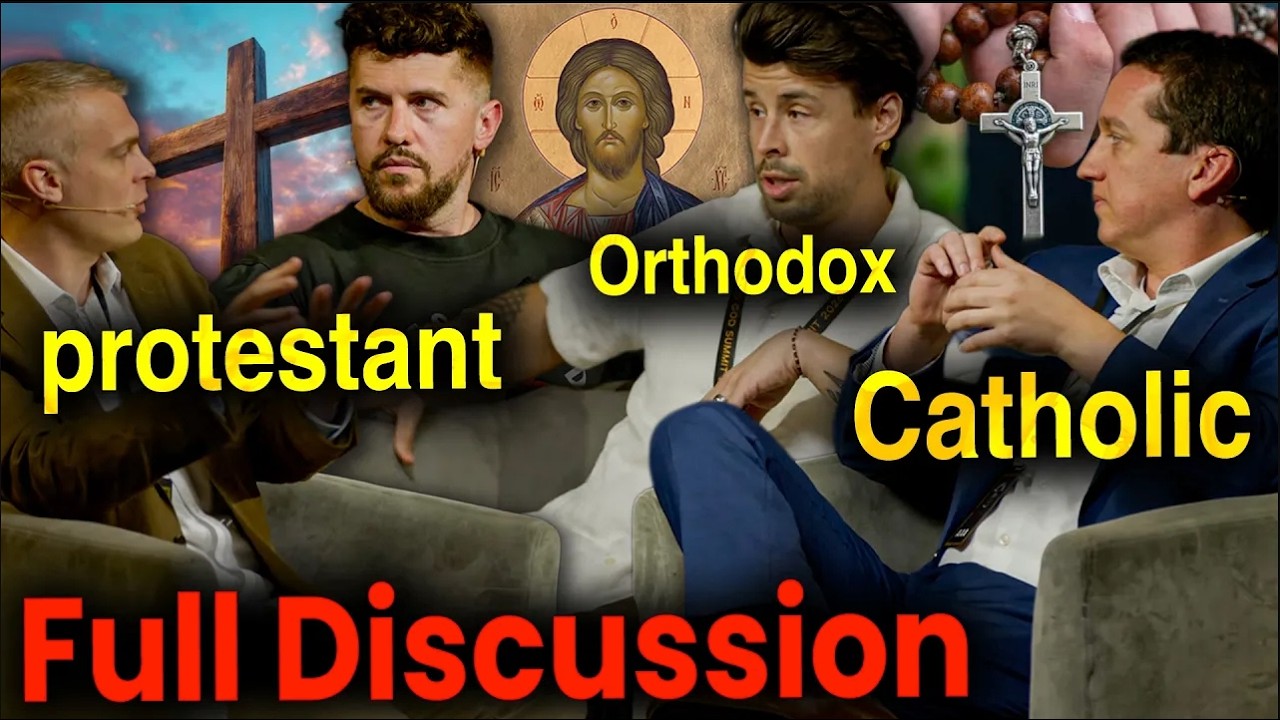
🔗 **Source:** [Catholic Vs. Orthodox Vs. Protestant: Full Panel](https://www.youtube.com/watch?v=_nD3Cy4HZiA)
> [!note]+ Document Notes
> ---
> tags: #christianity #protestantism #catholicism #eastern-orthodox #salvation #justification #faith #sacraments #scripture #theology
> author: Ruslan KD
> source: YouTube
> reference: https://www.youtube.com/watch?v=_nD3Cy4HZiA
> date created: 2024-12-19 15:30
> ---
> # 🏷️ Title: Catholic Vs. Orthodox Vs. Protestant: Full Panel
> ## 🧰 Action Inbox
> - [H1] Explore denominational differences in justification theology — salvation by faith alone vs faith working through love #theology
> - [H2] Study role of sacraments in salvation across traditions — baptism, confession, Eucharist #sacraments
> - [H3] Examine authority structures for biblical interpretation — scripture alone vs tradition #scripture
> ## 🧭 Table of Contents
> - [[#📝 Summary]]
> - [[#📖 Main Content]]
> - [[#🗒️ Notes]]
> - [[#📚 References]]
> - [[#🗣️ Paraphrase]]
> - [[#📰 Newsletter]]
> - [[#✅ Action Items]]
> - [[#🧪 Hypotheses]]
> - [[#📊 Methodology]]
> - [[#❓ Questions]]
> - [[#🔮 Future Research]]
> - [[#💡 Implications]]
> - [[#🧠 Learning Styles Assessment]]
> - [[#📊 Accessibility Assessment]]
> - [[#🌍 DEIB Assessment]]
> - [[#✅ Logical Validity]]
> - [[#🛡️ DARVO Analysis]]
> - [[#🎯 Conclusion]]
> ### 🔗 References
> - [Gavin Ortlund - Truth Unites](https://www.youtube.com/@TruthUnites)
> - [Trent Horn - Catholic Answers](https://www.catholic.com/)
> - [Josh Nadeau - Sword and Pencil](https://swordandpencil.com/)
> ## 📝 Summary
> - A respectful panel discussion between representatives of Protestant, Catholic, and Eastern Orthodox traditions examining differences in salvation theology
> - Key focus on justification: whether salvation is by faith alone (Protestant), faith working through love (Catholic), or theosis/divine participation (Orthodox)
> - Significant disagreements over necessity of priestly confession, role of sacraments, and biblical authority for doctrine
> - All three acknowledge commonalities while being transparent about substantive theological differences
> - Demonstrates how definitions of terms like "faith," "justification," and "works" create different soteriological frameworks
> ## 📖 Main Content
> This panel brings together three Christian traditions to examine their different approaches to salvation. The Protestant position, represented by Gavin Ortlund, emphasizes justification by faith alone through grace alone, with works as a result rather than cause of salvation. The Catholic position, articulated by Trent Horn, teaches salvation through faith working in love, received initially through baptism but requiring perseverance and avoiding mortal sin. The Eastern Orthodox perspective, shared by Josh Nadeau, focuses on theosis - participation in divine life - viewing salvation as healing from sin's consequences rather than primarily legal justification.
> The discussion reveals how anthropological differences about human nature affect soteriology. Protestants tend toward a forensic/legal model where Christ's righteousness is imputed. Catholics emphasize sacramental grace and the possibility of forsaking salvation through grave sin. Orthodox theology centers on healing the passions and gradual transformation into God's likeness.
> A key dispute emerges over post-baptismal sin forgiveness, particularly whether confession to a priest is necessary (Catholic) or whether confession to any fellow Christian suffices (Protestant). This connects to broader questions about biblical interpretation and ecclesiastical authority.
> ## 🗒️ Notes
> #### ⏱️ [00:00](https://youtu.be/_nD3Cy4HZiA?t=0) — [H1] Panel introductions and backgrounds
> - Key idea: Three traditions represented by thoughtful advocates seeking respectful dialogue
> - Evidence: "This is not a debate... we really just want to steel man the differences in the positions"
> #### ⏱️ [05:23](https://youtu.be/_nD3Cy4HZiA?t=323) — [H2] Josh Nadeau's journey from Reformed Baptist to Orthodox
> - Key idea: Seminary study of early church fathers led to questioning Protestant assumptions
> - Evidence: "Reading them for the first time, I thought, whoa, like where's this been my whole life?"
> #### ⏱️ [12:45](https://youtu.be/_nD3Cy4HZiA?t=765) — [H3] Trent Horn's conversion from deism to Catholicism
> - Key idea: Philosophical apologetics led to Christianity, then historical study to Catholicism
> - Evidence: "It really sent me down a journey to just like reading about the early Christians"
> #### ⏱️ [18:30](https://youtu.be/_nD3Cy4HZiA?t=1110) — [H1] Core question: How is one justified before God?
> - Key idea: Central disagreement over role of works in salvation process
> - Evidence: "For it is by grace you have been saved... not by works so that no one can boast"
> #### ⏱️ [25:15](https://youtu.be/_nD3Cy4HZiA?t=1515) — [H2] Protestant position on imputed righteousness
> - Key idea: Christ's perfect righteousness covers believers at moment of faith
> - Evidence: "When you stand before God on judgment day... he is going to see... the perfect spotless righteousness of Christ"
> #### ⏱️ [32:40](https://youtu.be/_nD3Cy4HZiA?t=1960) — [H2] Catholic view of faith working through love
> - Key idea: Initial justification through baptism, with possibility of losing salvation through mortal sin
> - Evidence: "We are saved by faith working through love as Paul says in Galatians 5:6"
> #### ⏱️ [38:20](https://youtu.be/_nD3Cy4HZiA?t=2300) — [H3] Orthodox emphasis on theosis and anthropology
> - Key idea: Salvation as participation in divine life and healing of human nature
> - Evidence: "God is the source of life. So how else do you find life? You need to participate in God's divine life"
> #### ⏱️ [45:10](https://youtu.be/_nD3Cy4HZiA?t=2710) — [H1] Scenario test: Baptized believer dies after committing sin
> - Key idea: Different traditions have different answers about eternal destiny
> - Evidence: Protestant confidence vs. Catholic/Orthodox uncertainty depending on sin's gravity
> #### ⏱️ [52:30](https://youtu.be/_nD3Cy4HZiA?t=3150) — [H2] Debate over necessity of priestly confession
> - Key idea: Catholics require confession to priest for mortal sin forgiveness
> - Evidence: "In John 20:23, Jesus does tell the apostles whose sins you forgive are forgiven"
> #### ⏱️ [58:45](https://youtu.be/_nD3Cy4HZiA?t=3525) — [H3] Protestant response on confession to fellow believers
> - Key idea: James 5 teaches confession "to each other," not specifically to priests
> - Evidence: "James 5 says, 'Confess your sins to each other'"
> #### ⏱️ [65:20](https://youtu.be/_nD3Cy4HZiA?t=3920) — [H2] Question of assurance of salvation
> - Key idea: Protestants emphasize certainty, others acknowledge ongoing uncertainty
> - Evidence: "You can have an infallible assurance of your own salvation"
> #### ⏱️ [72:15](https://youtu.be/_nD3Cy4HZiA?t=4335) — [H3] Underlying differences in biblical authority
> - Key idea: Scripture alone vs. Scripture plus tradition affects all doctrinal disputes
> - Evidence: "The greater difference... is the question of authority in determining which doctrines are binding"
> ## 📚 References
> - [Ephesians 2:8-10 on salvation by grace through faith](https://www.biblegateway.com/passage/?search=Ephesians%202%3A8-10&version=NIV)
> - [Galatians 5:6 on faith working through love](https://www.biblegateway.com/passage/?search=Galatians%205%3A6&version=NIV)
> - [James 5:13-16 on confession and healing](https://www.biblegateway.com/passage/?search=James%205%3A13-16&version=NIV)
> - [John 20:23 on apostolic authority over sin](https://www.biblegateway.com/passage/?search=John%2020%3A23&version=NIV)
> ## 🗣️ Paraphrase
> - Protestant theology emphasizes that salvation occurs entirely through God's grace received by faith, with good works flowing naturally from genuine faith rather than contributing to justification itself
> - Catholic doctrine teaches that while initial salvation comes through grace in baptism, believers must cooperate with grace throughout life and can forfeit salvation through unrepentant mortal sin
> - Eastern Orthodox spirituality focuses on gradual healing and transformation through participation in divine life, viewing salvation more as therapy than legal transaction
> ## 📰 Newsletter
> This fascinating panel demonstrates how Christians with shared core beliefs can have significantly different understandings of salvation itself. Whether you're exploring faith traditions or seeking to understand denominational differences, this discussion models respectful theological dialogue.
> Key takeaways include the Protestant emphasis on forensic justification, the Catholic sacramental system, and the Orthodox therapeutic model. Each tradition wrestles with balancing God's sovereignty and human responsibility differently.
> For those in ministry or apologetics, notice how definitions of key terms like "faith," "works," and "justification" shape entire theological systems. The discussion also highlights how views of biblical authority affect all other doctrinal questions.
> Resources: [Catholic Answers](https://www.catholic.com/), [Ancient Faith Radio](https://www.ancientfaith.com/), [Gospel Coalition](https://www.thegospelcoalition.org/)
> ## ✅ Action Items
> #### DevRel
> - Documentation: Create comparative theology guides showing respectful presentation of different Christian positions
> - Community engagement: Model charitable disagreement in technical and theological discussions
> - Education: Develop workshops on handling denominational differences in diverse teams
> #### Community
> - Maintainers: Establish protocols for respectful theological discussion in Christian tech communities
> - Contributors: Create inclusive environments that welcome different Christian traditions
> - Sponsors: Support interfaith and inter-denominational dialogue initiatives
> #### WordPress
> - Community: Develop WordCamp policies for handling religious content and speakers from different traditions
> - Training: Create lesson plans on managing diverse religious perspectives in community events
> - Documentation: Guidelines for presenting religious content respectfully across denominational lines
> ## 🧪 Hypotheses
> - Different anthropological assumptions about human nature lead to different soteriological conclusions
> - Views on biblical authority (sola scriptura vs tradition) predict positions on specific doctrines
> - Liturgical traditions shape theological emphases (legal vs sacramental vs therapeutic)
> - Historical context of Protestant Reformation continues to influence contemporary theological boundaries
> ### 📊 Methodology
> - Comparative analysis of systematic theologies across traditions
> - Historical survey of early church practices on confession and justification
> - Empirical study of assurance levels across denominational lines
> - Analysis of conversion patterns between traditions
> ### ❓ Questions
> - How do different views of human nature after the Fall affect understanding of grace?
> - Can traditions with such different views of salvation maintain meaningful unity?
> - What role should historical development of doctrine play in contemporary theology?
> ### 🔮 Future Research
> - Detailed study of patristic sources on justification and confession
> - Analysis of psychological effects of different assurance models
> - Investigation of practical spiritual formation differences across traditions
> ### 💡 Implications
> - Practice: Christians should understand their own tradition's distinctives while respecting others
> - Education: Theological education should include respectful comparative theology
> - Community: Religious diversity requires sophisticated approaches to unity and difference
> - Policy: Religious freedom protections must account for intra-Christian theological diversity
> ### 🧠 Learning Styles Assessment
> Reading level estimate: 12th grade (complex theological vocabulary)
> #### 👀 Visual learners
> - Present: Speaker identification graphics, denominational comparison charts
> - Improve: Theological timeline diagrams, salvation process flowcharts
> #### 🔊 Aural learners
> - Present: Clear audio discussion format with distinct voices
> - Improve: Background music transition, audio chapter markers
> #### 🗣️ Verbal learners
> - Present: Extensive definitions and explanations of technical terms
> - Improve: Glossary overlay, denomination-specific terminology guides
> #### 🧩 Kinesthetic learners
> - Present: Panel discussion allows for engagement and participation
> - Improve: Interactive denomination comparison tools, theological position surveys
> #### 🧠 Logical learners
> - Present: Systematic comparison of positions with biblical citations
> - Improve: Decision trees for theological positions, systematic theology charts
> #### 🧑🤝🧑 Social learners
> - Present: Group discussion format modeling charitable disagreement
> - Improve: Small group discussion guides, interfaith dialogue protocols
> #### 🧘♀️ Solitary learners
> - Present: Individual reflection opportunities on personal theological positions
> - Improve: Self-assessment tools for theological preferences, private study guides
> #### 🌿 Naturalistic learners
> - Present: Limited environmental connections to theological concepts
> - Improve: Analogies from nature, organic growth metaphors for spiritual development
> ### 📊 Accessibility Assessment
> #### Screen reader semantics
> - Present: Clear speaker identification and transitions
> - Improve: More detailed audio descriptions of visual elements
> #### Keyboard navigation
> - Present: Standard video player controls
> - Improve: Timestamp navigation, chapter jumping functionality
> #### Contrast and readability
> - Present: Clear speaker graphics and text overlays
> - Improve: Higher contrast options for graphic elements
> #### Text resizing and reflow
> - Present: Standard video format
> - Improve: Adjustable subtitle sizing, responsive player design
> #### Media and captions
> - Present: Auto-generated captions available
> - Improve: Professional transcript with speaker identification, theological term definitions
> #### Forms and interactions
> - Present: Basic video interaction
> - Improve: Interactive theological position survey, discussion prompts
> ### 🌍 DEIB Assessment
> #### Cultural breadth
> - Present: Western Christian traditions represented
> - Improve: Global perspectives on same theological questions, non-Western Christian voices
> #### Inclusive language
> - Present: Respectful terminology across denominations
> - Improve: Gender-inclusive language where appropriate, accessibility to non-theological audiences
> #### Neurodiversity support
> - Present: Clear structure with distinct sections
> - Improve: Visual chapter markers, content warning for complex theological concepts
> #### Representation
> - Present: Three distinct Christian traditions represented by knowledgeable advocates
> - Improve: More diverse voices within each tradition, female theological perspectives
> #### Psychological safety
> - Present: Respectful tone avoiding inflammatory language
> - Improve: Explicit community guidelines for theological discussion, moderation protocols
> ### ✅ Logical Validity
> #### Strong reasoning
> - Deductive strength: Clear syllogistic reasoning from biblical premises to theological conclusions
> - Inductive strength: Historical evidence cited for theological development
> - Causal reasoning: Logical connections between anthropological and soteriological positions
> - Analogical strength: Effective analogies (marriage vows, sinking ship) to explain abstract concepts
> #### Fallacies
> - False dilemma: Occasional oversimplification of complex positions into binary choices, particularly on salvation security
> - Appeal to authority: Some arguments rely heavily on specific theologians or church traditions without independent validation
> #### Tone of voice
> - Overall tone: Respectful, scholarly, and genuinely curious about differences while maintaining conviction about personal positions
> ### 🛡️ DARVO Analysis
> - Deny: No evidence of denial patterns
> - Attack: No personal attacks on individuals, only theological position disagreements
> - Reverse victim/offender: No victim/offender dynamics present
> - Emotional cues: Positive emotional environment of mutual respect and intellectual curiosity
> ## 🎯 Conclusion
> This panel excellently demonstrates how Christians can maintain deep theological convictions while engaging respectfully with those who hold different positions. The discussion reveals that differences over salvation are not merely academic but affect practical questions of assurance, church practice, and spiritual formation.
> The conversation's value lies not in resolving differences but in modeling charitable dialogue and helping viewers understand why these distinctions matter. Each tradition offers insights that others can learn from, even while maintaining disagreement on fundamental questions.
> For Christians navigating denominational questions or those seeking to understand Christianity's internal diversity, this discussion provides a thoughtful framework for approaching theological differences with both conviction and charity.
> ## 🧱 Refactor Appendix
> ### 📚 Literature Split Pad
> Purpose: Stage CEE units that become Literature notes.
> Split level: H3
> ### [H1] Protestant justification emphasizes forensic legal righteousness
> > [!quote] [Catholic Vs. Orthodox Vs. Protestant: Full Panel](https://www.youtube.com/watch?v=_nD3Cy4HZiA) by
> ---
> ## Full Transcript
> [00:00] So we believe along with other<br>[00:01] Protestant denominations that it is<br>[00:03] possible for someone to forsake their<br>[00:05] salvation.<br>[00:07] >> Confession to a singular priest, private<br>[00:10] confession is definitely my goodness. I<br>[00:12] think we're tampering with the gospel at<br>[00:14] that point by requiring something that<br>[00:17] God doesn't require.<br>[00:18] >> Well, I think actually the greater<br>[00:19] difference we have between us. It's<br>[00:22] actually not justification. It is the<br>[00:24] question of<br>[00:25] >> course. So, so if someone confesses<br>[00:26] their sins to [music] their nonpriest,<br>[00:28] their Christian brother, but not to a<br>[00:30] priest,<br>[00:32] then they die, will they go to heaven?<br>[00:36] >> Bruce lawn.<br>[00:38] >> Hey, thank you so much for checking us<br>[00:40] out. Hey, two quick things. Number one,<br>[00:42] this is from our Bless God Summit that<br>[00:45] just happened here in Oceanside,<br>[00:46] California. And if you want to come to<br>[00:48] the next one, sign up for the weight<br>[00:50] list right now. uh you will get access<br>[00:53] to the early bird tickets before they go<br>[00:55] live. This past year's uh Bless God<br>[00:57] Summit sold out. The next year were<br>[00:58] likely sold out. So if you want first<br>[01:00] access to tickets and get them early and<br>[01:02] get them at the cheapest price, sign up<br>[01:04] for the waiting list now. We're going to<br>[01:05] be announcing it in the next couple<br>[01:07] months. Also, another thing is uh we<br>[01:09] want to be send a big shout out to one<br>[01:10] of our sponsors, partner here on the<br>[01:12] channel, Logos Bible Software. If you<br>[01:14] guys aren't familiar with Logos, uh I<br>[01:16] use this every day. There's amazing<br>[01:18] tools in here, like being able to go<br>[01:21] back into the Greek, uh, to be able to<br>[01:23] go and see what the original languages<br>[01:25] said. There's commentary tools. They<br>[01:26] have a new AI tool. And I want to make<br>[01:29] sure that every single one of you guys<br>[01:30] know that you can get a free 60-day<br>[01:32] trial of Logos. Check out their original<br>[01:35] Greek and Hebrew tools. You can check<br>[01:37] out my Bible in 2-year reading plan on<br>[01:40] Logos as well, Monday through Friday.<br>[01:42] And you can check out their new study AI<br>[01:43] assistant where this is like AI but it's<br>[01:46] based on scripture and amazing<br>[01:48] literature in uh the logos software<br>[01:51] built in. Logos used to cost hundreds of<br>[01:53] dollars. Now it's like 12 bucks a month<br>[01:56] is where it starts. And again, all you<br>[01:57] guys get a free 60-day trial. So sign up<br>[01:59] for Logos. Big shout out to them for<br>[02:01] sponsoring the summit, sponsoring this<br>[02:03] video. Now for the moment you've been<br>[02:05] waiting for, let's get into this video.<br>[02:06] Okay, so without any further ado, ladies<br>[02:09] and gentlemen, we have Gavin Ortland.<br>[02:12] [cheering]<br>[02:14] Yeah,<br>[02:17] everybody. [applause]<br>[02:19] All the way from Canada, [applause] we<br>[02:23] have Josh Nato.<br>[02:28] [applause and cheering]<br>[02:30] And last but not least, my Catholic<br>[02:34] brother in Christ, the legendary Trent<br>[02:37] Horn. [cheering]<br>[02:39] [applause]<br>[02:44] >> So, here's what's going to happen. We<br>[02:45] are going to have an armchair<br>[02:48] conversation about the differences<br>[02:50] between the Protestant position, the<br>[02:53] Catholic position, and the Eastern<br>[02:55] Orthodox position. Uh this is not a<br>[02:58] debate.<br>[03:00] Gavin and Trent have debated at least<br>[03:02] once before right on Solar Sweep store.<br>[03:04] So if you guys want to see a debate, it<br>[03:06] is the most polite debate you'll ever<br>[03:07] see in your life. Okay? [laughter]<br>[03:09] There's no chef hats,<br>[03:12] there's no this. It's a real classy real<br>[03:15] classy debate. Uh and here's the<br>[03:17] objective. We we really just want to<br>[03:19] steal man the differences in the<br>[03:22] positions and to say what are the<br>[03:24] differences specifically around stuff<br>[03:26] like justification. How are we saved? uh<br>[03:29] where do works play into this, right?<br>[03:31] Are we saved with works? Are we saved by<br>[03:34] works? Are works a result of being<br>[03:36] saved? Uh and really just try to just<br>[03:39] accurately represent instead of much of<br>[03:40] the blood sport debate that happens on<br>[03:42] the internet. [snorts] Okay. Uh so<br>[03:44] that's the objective for the next I'd<br>[03:46] say we're going to go about 45 minutes<br>[03:47] and then we're going to do something<br>[03:48] fun. Ray Rock, where's my brother<br>[03:50] Rayrock? Ray Rock is going to be taking<br>[03:52] your guys' questions. Okay. So, and he's<br>[03:56] a wizard at this. Okay. Okay. So, he's<br>[03:58] going to cue your question, make sure<br>[04:00] it's good, and then we're going to take<br>[04:01] your guys' questions. You guys in?<br>[04:03] >> All right. All right. So, everyone<br>[04:06] really quickly introduce yourself. Josh,<br>[04:07] uh Josh is responsible for a lot of our<br>[04:09] art that you guys see here.<br>[04:11] >> Okay. Sword and Pencil. So, let's start<br>[04:13] with you, Josh. Introduce yourself, your<br>[04:15] journey, and uh and then we'll we'll go<br>[04:17] over to Trent and Gavin and and hop into<br>[04:19] it.<br>[04:19] >> For sure. Uh thank you guys so much for<br>[04:21] having me. My name is Josh Nadau. I'm a<br>[04:23] writer and illustrator full-time. So, I<br>[04:25] did do this art. Um, my journey into the<br>[04:28] east. I'm an Eastern Orthodox<br>[04:29] catechuman. So, I'm not I don't have a<br>[04:31] big YouTube channel. I'm a very small<br>[04:33] guppy in a big pond right now. Um, I was<br>[04:37] taking my masters at a reformed Baptist<br>[04:38] seminary writing a paper on the deity of<br>[04:41] Christ. So, when I went to one of the<br>[04:42] theological libraries in Toronto, I<br>[04:45] requested a big stack of books. And the<br>[04:46] librarian gave me another stack of<br>[04:48] books. Hey, have you considered these?<br>[04:50] And that was some Catholic writers and<br>[04:52] some Eastern Orthodox writers. and<br>[04:54] reading them for the first time, I<br>[04:56] thought, whoa, like where's this been my<br>[04:58] whole life? And so I essentially stopped<br>[05:01] being Protestant or Baptist at and<br>[05:04] reformed at my reformed Baptist<br>[05:06] seminary. That was 15 years ago. Uh, and<br>[05:08] then it was a very long journey. So I'm<br>[05:10] 37. I don't I didn't change at the pace<br>[05:13] of like the modern YouTube world. And so<br>[05:16] this has been like a 15-year kind of<br>[05:18] process for me, rethinking, tearing<br>[05:20] things down, trying to figure out how to<br>[05:21] build things up.<br>[05:23] Okay.<br>[05:24] >> All right. So, a little bit background<br>[05:25] for myself. Uh, my family, my mom used<br>[05:28] to be Catholic, then she left the<br>[05:30] Catholic church. Um, my dad's Jewish,<br>[05:32] but he hadn't been to Temple in a very<br>[05:33] long time. So, I was raised in a kind of<br>[05:35] non-religious household. Um, we had<br>[05:38] exposure to things like Bible stories<br>[05:40] through the Hannah Barbara Greatest<br>[05:41] Adventures Ever Told, which are awesome.<br>[05:43] And on YouTube, if you have children,<br>[05:45] show that to them. It's, you know, makes<br>[05:47] the Bible uh, it's it's the real deal.<br>[05:49] The '8s cartoons don't spare kids<br>[05:51] feelings. So, um, [laughter]<br>[05:53] so it's good stuff. Uh, when I got to<br>[05:56] junior high, I kind of thought, okay,<br>[05:58] these are just a bunch of stories. Why<br>[05:59] would I believe in this? So, I was I was<br>[06:01] never an atheist, but I was a deist. I<br>[06:03] thought there was a God who started<br>[06:04] everything, but I thought Christianity<br>[06:07] was for simpleans. I I thought science<br>[06:10] is all I need. I don't need God. Don't<br>[06:12] need religion. Uh, you know, I in the<br>[06:14] late 90s, I was, you know, on my<br>[06:17] parents' computer like debating people<br>[06:19] and and I thought Christianity was bunk.<br>[06:21] Uh then in high school I met some<br>[06:24] Catholic friends and that got me<br>[06:26] searching first just for the case of<br>[06:28] Christianity and I was really convinced.<br>[06:29] I just watched uh well downloaded audio<br>[06:33] waiting on the dialup internet to get<br>[06:34] that William Lane Craig debate. You're<br>[06:36] spoiled today by the way the amount of<br>[06:38] debates you can get to. Back in the day<br>[06:40] we had to we had to wait for all the<br>[06:42] little blue bars to come across to get<br>[06:44] that that Bill Craig debate. JP Morland.<br>[06:47] Um so there was a lot of evangelical<br>[06:49] philosophers who were helpful in my<br>[06:50] journey to Christianity. Uh and then I<br>[06:52] had figured out okay what church should<br>[06:54] I belong to? So I went I started going<br>[06:56] to churches. I went to this wonderful<br>[06:57] evangelical church and I remember like<br>[07:00] five people came up to me and said hi,<br>[07:02] introduced themselves. They're super<br>[07:04] happy and nice, but I am horribly<br>[07:06] introverted. So like I never wanted to<br>[07:08] go back. And then I went to a Catholic<br>[07:11] church and I walked in like no one said<br>[07:13] hi and um one person stand [laughter]<br>[07:16] this is my place introverted<br>[07:18] >> these are my people<br>[07:19] >> exactly hands me the the missile and I<br>[07:21] sit in the back by myself and I'm like<br>[07:23] this is [laughter]<br>[07:24] this is where I could be this is where I<br>[07:25] could be but you know so you know<br>[07:27] there's different ways you got to reach<br>[07:28] out to people but it really sent me down<br>[07:29] a journey to just like reading about the<br>[07:32] early Christians uh the differences<br>[07:34] between Catholics and Protestants. So it<br>[07:36] was about a year year and a half after I<br>[07:38] became Christian. I sorted through<br>[07:40] everything. I uh entered the Catholic<br>[07:41] church and was baptized uh 2002 when I<br>[07:44] was 17. Uh and I've been doing<br>[07:45] apologetics or Catholic answers since<br>[07:47] 2012 and I started my YouTube channel<br>[07:49] well posting content regularly probably<br>[07:51] around uh 2020.<br>[07:53] >> So<br>[07:53] >> cool.<br>[07:54] >> All right, Mr. Gavin Ortland.<br>[07:56] >> Yeah, Gavin Ortland run a ministry<br>[07:58] called Truth Unites. Really happy to be<br>[07:59] here. Happy to have this discussion. Uh<br>[08:02] I grew up evangelical Protestant. I've<br>[08:04] always I had really healthy church up<br>[08:07] upbringing which I know sadly is not uh<br>[08:10] feels like more the exception for for<br>[08:11] many people today. Never really was in<br>[08:14] these conversations Catholic, Protestant<br>[08:16] and Orthodox until I started a YouTube<br>[08:18] channel. I got bored during COVID and<br>[08:19] started a YouTube channel and about 3<br>[08:21] months in needed something to do. Uh was<br>[08:23] writing a book on general Christian<br>[08:25] apologetics and so plan to do videos in<br>[08:28] that. I still do that. That's my next<br>[08:29] book as well. But I've just gotten<br>[08:31] pulled into these conversations. uh<br>[08:34] really out of a pastoral burden. I think<br>[08:36] a lot of people have anxiety about their<br>[08:38] place in church history, their place<br>[08:40] amidst different Christian traditions.<br>[08:41] They feel overwhelmed. We get so much<br>[08:43] information bombarding us through the<br>[08:45] internet. People don't know how to find<br>[08:47] their bearings. And so my goal is to<br>[08:50] provide assurance in the gospel. And uh<br>[08:54] that's my my heart's cry in these<br>[08:56] conversations. try to take the approach<br>[08:58] of let's celebrate common ground and<br>[09:00] let's be transparent about differences<br>[09:03] as well.<br>[09:04] >> You know the there's the really<br>[09:05] ecumenical side of things where we don't<br>[09:07] talk about our differences. Then there's<br>[09:09] the really angry feisty side of things.<br>[09:11] I think the healthy place is to have<br>[09:13] love in your heart. I have love for all<br>[09:15] three of these uh brothers. Um but also<br>[09:17] just be really honest and say here's the<br>[09:19] arguments for this position and so forth<br>[09:21] and work through things. So happy to be<br>[09:24] here and dive in. And since we we<br>[09:27] literally have everything represented on<br>[09:28] the stage, it just kind of hit me. So I<br>[09:30] I grew up oriental Orthodox going to the<br>[09:32] Armenian Apostolic Church. Shout out to<br>[09:34] my Armenian brothers and sisters in the<br>[09:36] house. I think there's one of you, my<br>[09:38] man Art, who you guys will hear from<br>[09:40] later. And I uh was was baptized and uh<br>[09:45] was an alter boy and all the things. And<br>[09:49] none of like no one shared the gospel<br>[09:51] with me. Like no one explained how am I<br>[09:53] forgiven of my sins? How do I get to<br>[09:55] heaven? It was a lot of beauty and a lot<br>[09:58] of beautiful tradition, but no practical<br>[10:00] explanation. And then when some personal<br>[10:02] stuff happened in my life, the way it<br>[10:04] was handled or not handled by the church<br>[10:06] really did a number on me. And so<br>[10:08] >> I I ended up probably being the youngest<br>[10:11] atheist walking around. Uh I was 11<br>[10:14] years old saying there there is no God<br>[10:16] and I'm an atheist. Literally using the<br>[10:17] word atheist at 11. And which is a trip<br>[10:19] because my son's 11 now. Um, and I<br>[10:24] ended up having people repeatedly share<br>[10:27] the good news for me. Now, I'm not one<br>[10:28] of those people. I heard it once and it<br>[10:30] clicked. It was four years of kicking<br>[10:32] and screaming uh to finally come to<br>[10:35] Jesus the end of my sophomore year of<br>[10:37] high school. Uh and it was it was an<br>[10:40] encounter outside of myself in an<br>[10:42] evangelical<br>[10:44] context that completely uh transformed<br>[10:47] me, gave me a new heart, new desires.<br>[10:49] The sin I used to I used to love, I now<br>[10:53] hate. And the sin I used to I mean the<br>[10:54] things I used to hate, I now love like<br>[10:57] like Christians and worship music.<br>[11:00] And [laughter] I've had the privilege of<br>[11:03] sitting with I would I would say some of<br>[11:05] the brightest uh thinkers. I had you on<br>[11:07] in 2022. I've sat down with a lot of um<br>[11:11] Eastern Orthodox folks and uh priests of<br>[11:14] of all persuasions and I think there are<br>[11:18] commonalities like you said that we<br>[11:20] could agree on and then there are<br>[11:21] differences and I want to jump into I<br>[11:22] would say the most significant one um<br>[11:25] which is how is one saved<br>[11:29] from their sin to go to heaven. When I<br>[11:32] when I take a plain reading of the text,<br>[11:34] I think of of passages like um Ephesians<br>[11:38] 2, for it is by grace you have been<br>[11:39] saved. Uh verse 8, through faith and<br>[11:42] this is not from yourselves. It is the<br>[11:44] gift of God, not by works so that no one<br>[11:46] can boast. For we are God's handiwork<br>[11:48] created in Christ Jesus to do good works<br>[11:50] which God prepared in advance for us to<br>[11:52] do. uh in Romans 11 um verse<br>[11:57] 6 Paul writes, "And if by grace then it<br>[12:00] cannot be based on works, and if it<br>[12:02] were, grace would no longer and if it<br>[12:04] were, it would no longer be grace." So<br>[12:06] it can't be based on works, and if it<br>[12:08] were, then grace would no longer be<br>[12:09] grace. And so I think if we could just<br>[12:11] jump into the justification<br>[12:13] conversation, how is one justified<br>[12:17] before God? Is it the Protestant<br>[12:19] position where you're saved by grace?<br>[12:21] It's a gift. It's outside of myself. I<br>[12:23] didn't do anything to earn it. And and<br>[12:25] and through faith, I place my confidence<br>[12:26] in Jesus. I don't have all the answers.<br>[12:28] I I I can't make sense of I don't know<br>[12:30] why there's suffering in the world. I I<br>[12:32] don't have all those answers, but I'm<br>[12:33] placing my confidence in Jesus. And and<br>[12:36] then I'm being saved to good works that<br>[12:39] that that we should be producing good<br>[12:41] works. We should be fruitful. We should<br>[12:43] obey God's commands. We should get<br>[12:45] baptized, right? We should do these<br>[12:47] things. or is it grace and works? Or is<br>[12:52] there a more nuance position? And so I<br>[12:54] just want to open it up to you guys.<br>[12:55] Feel free to jump in because I think<br>[12:57] it's this is in my opinion the central<br>[12:59] question is how is one justified and how<br>[13:02] is their sin wiped away so they can go<br>[13:04] and be with Jesus in paradise.<br>[13:09] Yeah. I mean, so what we said earlier is<br>[13:11] a great starting point of just that uh<br>[13:14] relentless carefulness to distinguish<br>[13:17] between where we agree and where we<br>[13:18] disagree. I think this area gets really<br>[13:20] nuanced and a lot of it has to do with<br>[13:22] how we define the terms. So I guess<br>[13:24] maybe a helpful starting point is to<br>[13:26] distinguish between kind of the<br>[13:28] technical theology where we can with<br>[13:29] charity stretch toward one another and<br>[13:31] see overlap<br>[13:32] >> but then also just the street level<br>[13:35] experience of people. And I would say<br>[13:37] one of the reasons I'll talk more about<br>[13:38] this in my talk later today. I'll keep<br>[13:40] my opening comments here kind of on the<br>[13:41] briefer side and hear what they have to<br>[13:42] say. One of the reasons I love<br>[13:45] Protestantism and I value Protestantism<br>[13:47] is I believe it led to a greater clarity<br>[13:51] in the experience of justification. So<br>[13:54] you think of Luther before he comes to<br>[13:56] understand the phrase the righteousness<br>[13:58] of God in Romans 1:17 and he's spilling<br>[14:00] the wine during mass because he's so in<br>[14:02] dread fear of God. By the way, I think a<br>[14:05] lot of people today, the anxiety that is<br>[14:08] epidemic in our culture, that's related<br>[14:10] to spirituality. That's not just mental<br>[14:12] health, though it is that. It's it's<br>[14:14] related to our soul and where we're at<br>[14:15] with God. And a lot of people today are<br>[14:17] aching for the same experience that he<br>[14:19] had. When he goes from that to he says,<br>[14:21] I feel like the the gates of paradise<br>[14:23] have been opened and I can walk through<br>[14:25] as he realizes the righteousness of God<br>[14:27] is not a hammer to smash you. It's<br>[14:29] clothing to cover you. And a Protestant<br>[14:32] position says the righteousness of God<br>[14:33] is the uh imputed alien righteousness of<br>[14:37] Christ when you stand before God on<br>[14:39] judgment day. What he is going to see if<br>[14:42] you've placed your faith in Jesus or<br>[14:43] united to Jesus is the perfect spotless<br>[14:47] righteousness of Christ like you've been<br>[14:50] clothed in white garments. Protestants<br>[14:52] can affirm that experience in other<br>[14:54] traditions too. There's lots of<br>[14:55] justified Christians outside of<br>[14:56] Protestantism. Part of the value for<br>[14:59] Protestants will be the clarity and the<br>[15:01] uh articulation of that leading to that<br>[15:04] experience. Then we can also I want to<br>[15:07] flag so we get on the table faith alone<br>[15:09] faith plus works. That's where it gets<br>[15:11] really nuanced. We can talk about that<br>[15:12] too.<br>[15:13] >> Yeah. I'll I'll offer the other side and<br>[15:15] then orthodoxy will be a mysterious<br>[15:19] >> seriously in the middle. Yes.<br>[15:20] >> You see how it's set up. You see how the<br>[15:22] stage is set up.<br>[15:24] >> [laughter]<br>[15:24] >> That's what how the conversation ends up<br>[15:26] ends up going through. Uh the Catholic<br>[15:29] Church would say that we are saved by<br>[15:32] faith working through love as Paul says<br>[15:33] in Galatians 5:6. Uh in paragraph 2010<br>[15:37] of the catechism of the Catholic Church,<br>[15:39] it says that no one can merit either by<br>[15:42] faith or works the initial grace of<br>[15:44] justification. Uh so what saves us is<br>[15:48] that Christ died on the cross for our<br>[15:49] sins and he died as John says not just<br>[15:52] for our sins but the sins of the whole<br>[15:54] world. Uh so Christ's sacrifice was<br>[15:56] super abundant. And so the question is<br>[15:59] how do we apply the graces that Christ<br>[16:01] merited for everyone on the cross? How<br>[16:03] is that applied to an individual's soul?<br>[16:06] And so what the church teaches is that<br>[16:08] the church has given sacraments, ways of<br>[16:10] communicating God's grace to the<br>[16:13] faithful through faith. So when we think<br>[16:15] about being saved without any works you<br>[16:16] can boast of I think the Catholic<br>[16:19] position on infant baptism which is<br>[16:21] shared also by Lutheran uh and Anglicans<br>[16:25] and this will get into also we have to<br>[16:27] be very clear we really can't say the<br>[16:29] Protestant view of salvation because<br>[16:32] there are many denominations that are<br>[16:33] very similar to the Catholic view which<br>[16:35] is say for example that as we agree with<br>[16:37] Lutherans and Anglicans when a baby is<br>[16:39] baptized they go from being a child of<br>[16:41] of Adam in original sin to being free<br>[16:44] from all stain of sin and nothing would<br>[16:46] hinder their entrance into heaven. And<br>[16:48] to think for that little baby who's<br>[16:49] baptized, they cannot boast of anything.<br>[16:52] Like I mean, even if you were an adult<br>[16:53] and say like, "Oh, I I made an act of<br>[16:55] faith in Christ." You could possibly<br>[16:57] boast of that. But that baby can't boast<br>[16:59] of anything. And yet he's saved through<br>[17:00] the waters of baptism because baptism<br>[17:02] says, as 1 Peter 3:21 says, so the<br>[17:05] Catholic view of salvation would be that<br>[17:07] through baptism, we experience initial<br>[17:09] justification. And that's something you<br>[17:11] do not merit either by faith or by<br>[17:12] works. is something you just you<br>[17:14] receive. Uh and then the only thing you<br>[17:17] have to do after that point is that you<br>[17:20] have to recognize it is possible for you<br>[17:22] to freely reject God's gift of<br>[17:24] salvation. Uh people will say, well, if<br>[17:27] you did nothing to earn it, you couldn't<br>[17:29] possibly lose it. Well, Adam and Eve did<br>[17:31] nothing to earn friendship with God, but<br>[17:33] they were still able to lose it. So the<br>[17:34] Catholic Church would say that um<br>[17:37] salvation there's initial salvation uh<br>[17:40] we receive through baptism and final<br>[17:42] salvation is when we arrive in heaven.<br>[17:43] Romans 13:11 says salvation is nearer to<br>[17:46] us now than when we first believed. So<br>[17:48] the since you can forsake salvation the<br>[17:51] only thing you must do in order to enter<br>[17:53] heaven is to not permanently forsake<br>[17:56] your salvation uh through an act of<br>[17:59] grave sin that is unrepentant. And so<br>[18:02] this will and I think a lot of times<br>[18:04] when we talk about what to do to be<br>[18:05] saved when you look at the life of a<br>[18:07] faithful Protestant, the life of a<br>[18:08] faithful Catholic, I think they will<br>[18:10] look very very very similar. We're just<br>[18:12] going to describe their similar actions<br>[18:15] through different kinds of of rationale.<br>[18:17] But I do think the Catholic view is<br>[18:19] firmly rooted in what the Bible teaches<br>[18:21] about what we are to do with the great<br>[18:22] gift of salvation God gave us. Mhm. Um<br>[18:26] from our position, my understanding<br>[18:28] would be very simply just participating<br>[18:30] in the divine life. So if we rejected<br>[18:33] the divine life, we as humanity rejected<br>[18:35] the divine life in Eden. Uh God is the<br>[18:38] source of life. So how else do you find<br>[18:40] life? You need to participate in God's<br>[18:42] divine life. The Orthodox Church calls<br>[18:45] that theosis. So that's like your<br>[18:46] ultimate salvation. in every aspect of<br>[18:49] your current life is God's open<br>[18:52] invitation to you to continue to<br>[18:54] participate and be reconstituted and<br>[18:56] remade into him. Now, the reason I bring<br>[18:59] up that I think I want to piggyback off<br>[19:01] what Gavin said for definitions because<br>[19:03] I was brought up with the Protestant<br>[19:05] imputitional view and um one of the<br>[19:08] reasons it started struggling I started<br>[19:10] struggling was just<br>[19:12] developing an understanding of<br>[19:13] anthropology. So I think one of the<br>[19:16] reasons why Protestants and Orthodox and<br>[19:19] Catholics differ is our understanding of<br>[19:22] like h what humans are constituted of<br>[19:25] and what the fall actually did. I think<br>[19:28] that's like kind of the source of the<br>[19:29] justification problem. Understanding<br>[19:31] what Christ did on the cross has to<br>[19:33] address the fall. And I think the fall<br>[19:36] has to address humans, humans nature and<br>[19:39] their person. And I think there's a<br>[19:41] fundamental difference between how we<br>[19:42] view people between the three camps or<br>[19:46] however we want to describe it. So I'd<br>[19:48] be interested to see I don't know if you<br>[19:49] guys would agree where like um the<br>[19:53] orthodox views so I am a a person I have<br>[19:57] every human has like an essence and<br>[19:59] nature and a person and so their essence<br>[20:01] and nature is just what makes us human.<br>[20:04] So every human has the same essence<br>[20:07] and like God is the same thing. God has<br>[20:09] one essence expressed in three persons.<br>[20:11] That's the trinity. And so when you<br>[20:13] think about what makes up God's essence,<br>[20:15] it's the fact there's things that we can<br>[20:17] say about him. One, God is love. God is<br>[20:20] uncreated. And so those things the east<br>[20:24] will say and say, okay, what can we talk<br>[20:26] about for human nature prefall? There's<br>[20:29] definitely one thing which would be God<br>[20:32] made us in love and to be free. And so<br>[20:34] freedom expresses itself in love. And<br>[20:36] then a person each individual person is<br>[20:39] just an expression of their nature. So<br>[20:42] for me what happens at the fall I think<br>[20:45] will be different than say my<br>[20:47] understanding of Rome would be the<br>[20:49] nature there's like these powers you<br>[20:51] have that are created and then powers<br>[20:52] you receive only by grace like the<br>[20:54] beatotific vision. Does that make sense?<br>[20:57] >> Well beotic vision is something you<br>[20:58] would you would receive when you enter<br>[20:59] into heaven<br>[21:00] >> right a grace at the end. Yes. But there<br>[21:02] are there are means of grace that you<br>[21:03] receive that you could never acquire of<br>[21:06] your own human nature. There's just what<br>[21:09] I'm trying to say is um you were made<br>[21:12] with particular humans are made with<br>[21:13] particular powers and everything else<br>[21:15] that they receive or acquire for<br>[21:17] salvation would be a means of grace.<br>[21:19] >> Right. Yeah.<br>[21:20] >> And so I think if at the fall those<br>[21:22] things um and I don't want to put words<br>[21:25] in your mouth for nature. I'll stop<br>[21:26] talking in just one second. the fall,<br>[21:28] Trent and I are going to begin to start<br>[21:30] understanding what's happening to humans<br>[21:32] slightly differently. And I think that<br>[21:33] that slightness is going to lead to how<br>[21:35] we have different interpretations of the<br>[21:37] cross.<br>[21:38] >> Yeah. I I don't know if we would<br>[21:40] necessarily differ on the fall, but that<br>[21:42] that also widens the scope of the<br>[21:44] conversation so much that in 23 minutes<br>[21:47] we may not be able to resolve it. I<br>[21:49] think you know on the specific issue of<br>[21:51] justification that that's the area that<br>[21:54] I hear you asking about where I do see<br>[21:55] the we've got the overlap we've got the<br>[21:57] differences just to throw in case it's<br>[21:59] helpful throw out a category I would say<br>[22:00] some of the overlap is initial<br>[22:02] justification and part of this is we use<br>[22:04] different terms so we use the term<br>[22:05] justification specifically for that<br>[22:08] following Paul's usage Romans 3 Romans 4<br>[22:11] it's right there um how does forgiveness<br>[22:14] of sins happen after initial<br>[22:17] justification<br>[22:19] You get baptized whether as an infant or<br>[22:21] an adult because I see baptism as kind<br>[22:23] of a related but a little bit distinct<br>[22:25] issue as well. You get baptized on a<br>[22:27] Tuesday. You commit a sin on a Wednesday<br>[22:30] or Tuesday night. Okay, this is reality.<br>[22:34] We're going to, you know, need to know<br>[22:35] the answer to this. Now, how do you get<br>[22:37] justified? And uh so what what what I<br>[22:40] would say I mean one of the probably one<br>[22:41] of the biggest concerns for me with the<br>[22:44] Catholic view specifically would be you<br>[22:46] commit a mortal sin the necessity of<br>[22:48] confession to a priest specifically for<br>[22:52] forgiveness that'd be so as I look at<br>[22:53] things I see look we've got some big<br>[22:55] picture structural agreements we all<br>[22:57] agree with for example<br>[23:00] um the necessity of grace the necessity<br>[23:02] of Christ's death the necessity of faith<br>[23:04] and repentance we can recognize<br>[23:06] Christian realities common among us the<br>[23:09] ongoing on the ground experience for how<br>[23:11] you actually have assurance of your<br>[23:13] status before God. That's an honest area<br>[23:16] of concern. I again I value the<br>[23:18] Protestant Reformation because I think<br>[23:20] it recovered something that is really um<br>[23:23] clear and bright and shiny and beautiful<br>[23:25] in the Apostle Paul's writings<br>[23:27] especially. So I guess I'm just trying<br>[23:29] to locate where we're where we're honing<br>[23:30] the discussion for that ongoing<br>[23:32] experience.<br>[23:32] >> Let me let me phrase it this way in your<br>[23:34] guys's view. Uh, and I don't want to<br>[23:36] generalize because there's distinctions<br>[23:38] between your views. I think I think and<br>[23:40] I don't mean to speak for you either,<br>[23:41] but I think here's I'm going to paint a<br>[23:43] scenario. Okay, someone comes to faith<br>[23:47] in the Lord on Sunday. They get baptized<br>[23:50] that same Sunday.<br>[23:53] Monday, they have a relapse with<br>[23:57] alcohol, God forbid, they get into a<br>[23:59] drunk driving accident, they die.<br>[24:03] Okay. I think we would feel comfortable<br>[24:04] in our position to say that even though<br>[24:06] they had that moment where they failed<br>[24:09] and they sinned, that the blood of Jesus<br>[24:11] covers that.<br>[24:14] >> I I would assume your position is<br>[24:16] different. Is Is that fair? I think a<br>[24:18] lot of us have been in seasons where<br>[24:19] we're trying to figure out what am I<br>[24:21] actually supposed to be doing with my<br>[24:23] life? Like we want to be faithful. We<br>[24:26] want to build something meaningful, but<br>[24:27] it's hard to get real clarity on our<br>[24:29] purpose, our direction, and what God's<br>[24:32] actually calling us to do. And if you've<br>[24:34] been struggling to figure that out, to<br>[24:36] get clarity, that's exactly why I'm<br>[24:38] doing the Godly Ambition Tour. We're<br>[24:39] kicking this off April 10th in Chicago.<br>[24:41] And these nights are designed to help<br>[24:43] you get clarity and actually move<br>[24:46] forward. This is what my book, Godly<br>[24:48] Ambition, is all about. It's currently a<br>[24:50] USA Today bestseller and I wanted to<br>[24:53] bring these ideas into a live<br>[24:56] experience. I'm doing a full keynote<br>[24:58] breaking this down and going deep. We've<br>[25:00] got new music, a live podcast. I'm<br>[25:02] taking your questions in the room and<br>[25:04] I've got a few things up my sleeve for<br>[25:06] the night, too. So, yeah, I love seeing<br>[25:08] you guys in the comments. I love the<br>[25:10] chat. But this is one of those things<br>[25:11] where being in the room is is just going<br>[25:13] to hit different. So, tickets start at<br>[25:15] $35. And if you want to go even deeper,<br>[25:17] we've got premium tickets that include a<br>[25:19] private Q&A before the show. But don't<br>[25:21] wait. Go to rooslock ad.com or hit the<br>[25:24] pin comment and get your tickets now.<br>[25:26] I'll see you in a<br>[25:28] >> Well, it's it's going to be different<br>[25:29] when it comes to different cases. So,<br>[25:32] uh, the Catholic view similar to many<br>[25:35] other Protestant denominations views who<br>[25:36] would also have to answer this question<br>[25:38] is that is it possible to forsake your<br>[25:41] salvation through grave sin? Uh some<br>[25:44] people might say we can only forsake<br>[25:45] your salvation through lack of belief.<br>[25:47] If you say, "Well, God, I don't love you<br>[25:48] anymore. I don't believe in you."<br>[25:49] >> Apostasize.<br>[25:50] >> Apostasy. But we would say it is<br>[25:52] possible to apostasize through action uh<br>[25:55] and not just through belief. Like if you<br>[25:57] have a husband who says, "I love my<br>[26:00] wife. I love my wife." And then he he<br>[26:01] goes and he cheats on his wife and he<br>[26:02] goes to his wife says, "Well, honey, I<br>[26:04] still love you." Does he though? I would<br>[26:06] say that he he through his actions he<br>[26:09] has forsaken the marital vow that he's<br>[26:11] made and grave sin which is freely<br>[26:14] chosen of a serious matter. Uh because<br>[26:16] we all agree that all Christians sin. Um<br>[26:18] I have an episode actually coming up<br>[26:20] soon dealing with this where I think<br>[26:21] it's very clear there's two kinds of<br>[26:22] sins in the Christian life. Ones that<br>[26:24] you will commit and don't make you doubt<br>[26:26] your Christian faith, but others that<br>[26:28] are in that if they were habitual are<br>[26:30] incompatible with the Christian<br>[26:31] lifestyle. So you're right. Someone is<br>[26:33] baptized, they're saved, and then they<br>[26:35] commit a grave sin and they die.<br>[26:36] >> Would would getting drunk be a grave<br>[26:38] sin?<br>[26:39] >> I'm sorry.<br>[26:40] >> It would depend. Well, let's just pick<br>[26:41] an example of someone who chooses to<br>[26:43] commit adultery.<br>[26:44] >> Okay.<br>[26:44] >> Uh because being drunk, you know,<br>[26:45] alcoholism, you know, someone who has<br>[26:47] >> rage, would rage be a great sin? They<br>[26:49] instead they're not drunk. They just<br>[26:50] they're in a rage incident and they they<br>[26:53] spin out of control.<br>[26:54] >> But we I mean we let's just pick murder.<br>[26:55] We'll just pick a clear example. They're<br>[26:57] just sick of their boss and they're just<br>[26:59] like, "Forget the quiet quitting." Oh<br>[27:02] yeah, it's the boss is quiet now. Yeah,<br>[27:04] it is kind of quiet quitting.<br>[27:07] >> They're just sick of it. So we just pick<br>[27:09] a clear example there. So we So we would<br>[27:12] say that if someone dies, if they<br>[27:13] forsake God through grave sin, then<br>[27:17] that's why Jesus said there those who<br>[27:19] say there will be those say to me, Lord,<br>[27:21] Lord, we'll say well not unless you<br>[27:24] those who persevere to the end, those<br>[27:26] who do the will of my father. So it is<br>[27:28] possible, we believe along with other<br>[27:29] Protestant denominations that it is<br>[27:31] possible for someone to forsake their<br>[27:34] salvation. For Protestants who don't<br>[27:36] believe that's possible, who believe in<br>[27:38] eternal security. If you say, well, they<br>[27:39] were saved, then they commit a grave sin<br>[27:42] and they die. We think the blood of<br>[27:43] Christ still covers them. What if they<br>[27:45] commit that grave sin and they stay in<br>[27:46] that grave sin for a month and then they<br>[27:48] die or a year or five years? Then I<br>[27:52] think you might start to say, "Oh, well,<br>[27:54] he was never really saved in the first<br>[27:56] place." or if you're free grace, you'll<br>[27:58] say, "Yeah, he's definitely going to<br>[27:59] heaven, of course,<br>[28:01] >> no matter what." So, we there's lots of<br>[28:03] things we have to sort out here. And I<br>[28:05] think the view that you can forsake<br>[28:07] salvation while God may have mercy and<br>[28:09] save someone knowing their individual<br>[28:10] circumstance, we don't know<br>[28:12] >> because it is possible, and I don't use<br>[28:14] the word lose, by the way, can you lose<br>[28:16] your salvation? Like, you can't lose<br>[28:17] salvation like you lose your car keys,<br>[28:20] but you can forsake it through gravely<br>[28:22] freely chosen sin. And the question is,<br>[28:25] will you repent of it? So the cath view<br>[28:26] of salvation if I had Rouslon to really<br>[28:28] summarize it you know just like I would<br>[28:31] say it's the three Rs repent receive<br>[28:34] remain repent of sin receive Christ in<br>[28:37] baptism and faith and then remain united<br>[28:40] to him if you're separated from Christ<br>[28:41] be reconciled to him<br>[28:42] >> but if I if I could just say to clarify<br>[28:45] from where I look at where we differ<br>[28:47] it's how the ex uh the forgiveness of<br>[28:49] sins is actually acquired what does that<br>[28:51] repentance look like right<br>[28:52] >> for example after a mortal sin it's<br>[28:54] necessary to confess to a priest<br>[28:57] specifically to receive a judicial act<br>[29:00] of forgiveness from God. And as<br>[29:02] Protestants, we would say you just<br>[29:04] repent. If you have a pastor to repent<br>[29:07] to, great. If you've got your brother,<br>[29:09] your neighbor to repent to, great. James<br>[29:10] 5 says, "Confess your sins to each<br>[29:12] other." But we wouldn't require it to a<br>[29:15] priest specifically. We'd say, "Look at<br>[29:17] David after Ba Sheba. He repents, but<br>[29:19] there's no judicial act from a priest."<br>[29:22] Um, so that is where I did a video on<br>[29:25] penance. That was one of the issues<br>[29:26] where I'm looking at it because I want<br>[29:27] to be as ecumenical as I can be. That<br>[29:30] was one of the issues that really gave<br>[29:32] me pause. And I thought, "Oh my<br>[29:33] goodness, I think we're tampering with<br>[29:35] the gospel at that point by requiring<br>[29:37] something that God doesn't require<br>[29:39] because I would say God requires us to<br>[29:41] repent and remain. Absolutely. But not<br>[29:43] to repent and confess to a priest<br>[29:45] specifically. Uh, I think Jesus is the<br>[29:48] one necessity you have. And the pastoral<br>[29:52] outflow for this would be, look, people<br>[29:54] are going to commit a sin. They're going<br>[29:56] to commit mortal sins. Some of the<br>[29:58] things that are classified as mortal<br>[30:00] sins in the Catholic Church aren't as<br>[30:01] serious as as murder. They're going to<br>[30:03] be things where, you know, misuse of of<br>[30:07] sexual faculties, for example, um<br>[30:10] certain kinds of anger, things like<br>[30:11] this. You're going to sometimes it's a<br>[30:12] gray area. You're going to wonder, am I<br>[30:14] forgiven? If I die right now, am I going<br>[30:17] to hell?<br>[30:18] >> And what I would want to point people to<br>[30:20] is the sufficiency of Christ. So yes,<br>[30:22] repent. Yes, confess. But do it to<br>[30:25] Christ. Do it to your brother as well.<br>[30:27] But Christ is the one<br>[30:29] necessary ingredient to be assured you<br>[30:32] will be saved. That's what I would say<br>[30:33] as a Protestant. Yeah. I wasn't going<br>[30:35] for applause, but thanks.<br>[30:36] >> And I I think my reply to that, I would<br>[30:38] point out that the New Testament never<br>[30:40] instructs us to confess our sins to<br>[30:42] Jesus. There is no verse that says that.<br>[30:45] But in John 20:23, Jesus does tell the<br>[30:47] apostles whose sins you forgive are<br>[30:49] forgiven. Whose sins you retain are<br>[30:52] retained. And I would say also that in<br>[30:54] James 5, talking about confessing sins<br>[30:56] to one another, it's talking about the<br>[30:58] duties of the presidy, the elders in the<br>[31:00] church who also will anoint with oil and<br>[31:03] sins will be forgiven when they go and<br>[31:05] do that. Uh I would say that<br>[31:07] >> wait, let me understand. You're saying<br>[31:08] in James 5, yeah, your understanding is<br>[31:11] it's confess sins to the pres bitter.<br>[31:13] >> I'm saying the context in James 5 is<br>[31:15] referring to the the role and functions<br>[31:17] of the presittery, the elders in the<br>[31:19] church.<br>[31:20] >> Okay. But the confession is to other<br>[31:22] brothers, not necessarily to the to the<br>[31:25] prespits.<br>[31:25] >> Well, no, I'm saying that it it fits<br>[31:27] within the prespits and one can take a<br>[31:29] reading from that that it's referring to<br>[31:30] confession to them.<br>[31:32] >> Oh, okay. You said one can take that<br>[31:34] reading.<br>[31:35] >> Yeah. So, in in James 5 that it is very<br>[31:37] clear. It says the presidary the elders<br>[31:39] in the church if someone is sick they<br>[31:40] can go and anoint them with oil and<br>[31:42] their sins will be forgiven. So I think<br>[31:45] that if you're if you are concerned<br>[31:46] about why would I have to go to a man uh<br>[31:49] to be saved just as it is not listenit<br>[31:52] to practice autobaptism<br>[31:55] like you can't baptize I think hopefully<br>[31:57] everybody agrees on that that you have<br>[32:00] to go to um<br>[32:01] >> there's probably some Protestant out<br>[32:03] there who's done it.<br>[32:03] >> I'm sure [laughter]<br>[32:06] >> with Protestantism uh because while it's<br>[32:09] ever reforming and flexible you get<br>[32:10] everything from soup to nuts you know.<br>[32:12] So uh but I think but I do think it's<br>[32:15] bad to mischaracterize that the nuts are<br>[32:17] few and far between. We should stick to<br>[32:19] the major traditions and creeds and<br>[32:21] confessions. But if you but we would say<br>[32:22] just as it's normal and natural to seek<br>[32:25] to be uh united to Christ the very first<br>[32:28] moment through a minister of the church<br>[32:30] who baptizes you, it makes sense to be<br>[32:33] reconciled to God again would be to<br>[32:35] approach the minister of the church<br>[32:36] because you're also separated from<br>[32:38] Christ's body. You're separated in that<br>[32:39] way from receiving the sacraments if<br>[32:41] you're in grave sin. And I and I think I<br>[32:43] find this very uh early historically in<br>[32:45] the third century. Cyprien talks about<br>[32:47] the salutary medicine of confession to<br>[32:49] priests. This is not some kind of late<br>[32:51] medieval concept. So I I I think it's<br>[32:54] quite understandable.<br>[32:55] >> I I want to get Josh in on this. See<br>[32:57] your your take. I just say just<br>[32:58] summatively I think we got to talk more<br>[33:00] about this. So we'll have more times but<br>[33:02] I don't his are great because the your<br>[33:04] your special father puts a great blanket<br>[33:06] over you.<br>[33:06] >> Totally. He covers me of a multitude of<br>[33:08] sins. I do have a YouTube chat about<br>[33:10] this<br>[33:10] >> sumatively. I don't think James 5 is<br>[33:13] talking about confession to a priest. I<br>[33:14] think it's to to other Christians. And<br>[33:17] John 20 is the apostles.<br>[33:19] >> And I have my own sketch in my video on<br>[33:20] this on the historical development.<br>[33:23] >> Confession to a singular priest. Private<br>[33:26] confession is definitely medieval, not<br>[33:29] petristic. Just my take.<br>[33:30] >> Can I can I read it real quick and then<br>[33:31] you could respond<br>[33:32] >> if you'd like. Sure.<br>[33:33] >> Yeah. So James uh 5:13 it says, "Is<br>[33:36] anyone among you in trouble? Let them<br>[33:38] pray. Is anyone happy? Let them sing<br>[33:41] songs of prayer uh praise, excuse me. Uh<br>[33:44] verse 14, is anyone among you sick? Let<br>[33:46] them call the elders of the church to<br>[33:47] pray over them and anoint them with oil<br>[33:49] in the name of the Lord. And the prayer<br>[33:51] offered in faith which will make the<br>[33:53] sick person well. The Lord will raise<br>[33:55] them up. If they have sinned, they will<br>[33:56] be forgiven. Therefore, confess your<br>[33:59] sins to each other and pray for each<br>[34:02] other so that you may be healed. The<br>[34:05] prayer of a righteous person is powerful<br>[34:07] and effective. Yeah, I'm not arguing for<br>[34:09] that as a proof text for the sacrament<br>[34:11] of confession. I'm just saying that it's<br>[34:14] illuminating and it makes a lot of sense<br>[34:17] of the role that the elders are placed<br>[34:19] in there. I find actually just the the<br>[34:21] role the elders in administering the<br>[34:23] sacrament of anointing of the sick and<br>[34:25] the forgiveness of sins associated with<br>[34:27] that is I think that's very interesting<br>[34:30] especially if you don't consider the<br>[34:31] anointing of the sick to be a a<br>[34:33] sacrament. If you think there's those<br>[34:34] there there's only two. But I I would<br>[34:37] say though, well, I would say no, I<br>[34:38] would say that we do have confession to<br>[34:41] priests in the antiine church. Uh I<br>[34:44] think we we we clearly do have that that<br>[34:46] uh there's elements in understanding the<br>[34:48] theology of it that do develop later,<br>[34:50] >> but I'm trying to figure out<br>[34:52] >> I want to ask a clarifying question, but<br>[34:53] I don't want to hijack. I mean so so the<br>[34:56] the the nerve center of the difference<br>[34:58] here I think is necessity to a priest<br>[35:02] for so so if someone confesses their<br>[35:03] sins to their nonpriest their Christian<br>[35:06] brother but not to a priest<br>[35:09] then they die will they go to heaven<br>[35:13] >> it would when you say necessity we have<br>[35:15] to distinguish between um strict<br>[35:17] necessity and other forms of necessity<br>[35:20] so for example you might say it's<br>[35:22] necessary for someone to have faith in<br>[35:24] order to go to heaven. But someone might<br>[35:26] die when they're at a very young age<br>[35:28] before they're able to attain faith, but<br>[35:30] they're still able to go to heaven. So,<br>[35:31] it's not a strict necessity. It's a<br>[35:33] general necessity. We would say the same<br>[35:35] thing about uh confessing sins to a<br>[35:38] priest who stands in the person of<br>[35:40] Christ and offers through the sacrament<br>[35:42] of reconciliation to be reconciled to<br>[35:43] God in his church. that if you are<br>[35:45] unable to see a priest, if you're unable<br>[35:48] to avail yourself of the sacrament, just<br>[35:50] like for someone who is unable to fi to<br>[35:52] find someone to baptize them, God will<br>[35:55] not hold that against that person. But<br>[35:57] to choose to forsake the ordinary means<br>[36:00] of salvation is not great for one p a<br>[36:02] person's soul, whether it's confession,<br>[36:04] baptism, having faith in Christ, being<br>[36:07] obedient to Christ, things like that.<br>[36:08] >> Well, it's good. We're and I'll let Josh<br>[36:09] jump in too, but we're we're narrowing<br>[36:11] we're we're identifying the disagreement<br>[36:12] then cuz cuz I would say that it's not<br>[36:15] the necessary way to have your sins<br>[36:17] forgiven to confess to a priest<br>[36:19] specifically. It's to one another and<br>[36:22] it's to God. But I so that that's the<br>[36:24] disagreement. Is is that the ordinary?<br>[36:26] >> But that's what's interesting for me is<br>[36:27] the Bible says to confess your sins to<br>[36:29] one another, but the New Testament does<br>[36:30] not say to confess your sins to Christ.<br>[36:33] So that's<br>[36:33] >> Yeah. But that's an argument from<br>[36:34] silence, isn't it, Trent? Well, if we're<br>[36:36] argu Well, if we're arguing that you<br>[36:38] shouldn't confess to a priest because<br>[36:39] it's not in scripture, I'm bringing up<br>[36:41] something else that's not in scripture.<br>[36:42] >> Yeah, but we're we're pointing to a<br>[36:44] prescriptive passage. So, yes, you're<br>[36:45] right that they're both arguments from<br>[36:47] silence, but we're giving you a<br>[36:48] prescriptive passage saying repeatedly<br>[36:51] to each other, to each other, pray for<br>[36:52] each other, to each other.<br>[36:53] >> And that's why I think actually the<br>[36:55] greater difference we have between us,<br>[36:57] it's actually not justification. It is<br>[37:00] the question of authority in determining<br>[37:02] which doctrines are binding and which<br>[37:04] aren't and how we're going and how the<br>[37:06] written word of God dis um resolves the<br>[37:10] doctrinal disputes we have because even<br>[37:12] now that's what we're basically doing<br>[37:13] with the sacrament of confession but<br>[37:15] you're operating from a principle of<br>[37:18] solos scriptorera in trying to solve the<br>[37:20] question and that's a paradigm both of<br>[37:22] us would reject as being unbiblical<br>[37:24] >> because you guys would say scripture and<br>[37:27] the church fathers and the cate just be<br>[37:29] a question of normative authority like<br>[37:31] if you have a text how do you interpret<br>[37:33] the text and how does that text have any<br>[37:34] authority over you? So before we hop<br>[37:37] into that, just like from the Orthodox<br>[37:39] perspective, this is why I brought up<br>[37:40] the anthropological thing<br>[37:42] >> where so it's a Monday I'm baptized, a<br>[37:46] Tuesday, a Monday night I sin. What<br>[37:47] happens to me? From the Orthodox<br>[37:49] perspective, the results of the fall are<br>[37:52] consequential. So death is a<br>[37:54] consequence, not like this punitive<br>[37:56] thing where God is say the penalty for<br>[37:59] your sin is death. It's a consequential<br>[38:01] thing. This is where it would become a<br>[38:02] disease. So when you are united to<br>[38:04] Christ and salvation, so through baptism<br>[38:06] and receiving the Eucharist and the<br>[38:09] other means of grace, the holy<br>[38:10] mysteries,<br>[38:12] um God begins to heal your passions and<br>[38:14] reorient you towards him. So there is a<br>[38:17] more mysterious thing when it comes to<br>[38:19] what is my right standing before God.<br>[38:21] But I I do think that the idea of<br>[38:24] assurance, I know you had a debate with<br>[38:27] James White on assurance, I think on his<br>[38:28] home turf.<br>[38:29] >> Oh, it's fun. And um I think the idea of<br>[38:32] assurance is a little bit more nebulous<br>[38:34] than protest. I mean I was a Protestant<br>[38:36] and I had tons of I was an alcoholic. Um<br>[38:40] I was not assured of my salvation. I was<br>[38:41] a reformed Baptist. I was Calvinistic.<br>[38:43] And I remember being in seminary. I<br>[38:46] remember sitting I lived above a<br>[38:48] restaurant sitting on my bed being like<br>[38:51] if I'm saved then it doesn't matter what<br>[38:53] I do. God will get me in the end. If I'm<br>[38:55] not I'm pooched anyways. So I'm just<br>[38:57] stuck. I just I had no clue what my<br>[38:59] standing with God was. And so the idea<br>[39:03] for us would be healing the passions. It<br>[39:06] be Christ is the cure to the disease of<br>[39:09] sin and death that we have.<br>[39:11] >> Yeah.<br>[39:13] >> Ch.<br>[39:14] >> Um well Trent makes a great point about<br>[39:16] the larger paradigmatic differences we<br>[39:19] have. That's why almost every discussion<br>[39:20] I have in these spaces, I try to just<br>[39:22] focus on the solar scriptor debate<br>[39:24] because that's like the rudder on the<br>[39:26] ship that steers us. But it's also good<br>[39:28] to talk these things through. Um,<br>[39:30] >> and you guys had a great solid debate.<br>[39:32] >> Yeah, people can check out the debate.<br>[39:34] Three years old as of<br>[39:35] >> and it was long. It was extensive. It<br>[39:37] was like 3 hours long.<br>[39:38] >> You know what? Even as long as it was,<br>[39:40] it felt like we just skimmed the<br>[39:41] surface.<br>[39:41] >> There's so much more discussed. I think<br>[39:42] we can have when it comes to assurance<br>[39:45] uh I think there's many people who may<br>[39:48] feel concerned in Catholicism orthodox<br>[39:50] like well where where is that assurance<br>[39:52] what if what if I die where where am I<br>[39:54] going to go I will be frankly honest<br>[39:57] with you I think the only people that<br>[39:58] can give you an easy answer to that<br>[40:01] question are the so-called hyper grace<br>[40:03] or free grace theologians people like<br>[40:05] Bob Wilkins and others who say oh yeah<br>[40:08] as long as you made an act of faith it<br>[40:10] does not matter you could become an<br>[40:11] apostate and you will still go to<br>[40:13] heaven. And there's there's a<br>[40:14] non-negligible number of people who hold<br>[40:16] to that view. But everyone else everyone<br>[40:18] else is going to have to discern, okay,<br>[40:22] >> Catholics and and Orthodox like, am I in<br>[40:24] a a state of grace? Have I committed<br>[40:26] grave sin? But even Protestants, even<br>[40:29] those who believe in assurance, will<br>[40:31] start to say, well, was I was I really<br>[40:33] saved in the first place? Did I was I<br>[40:35] mature enough to make that commitment or<br>[40:38] is my sinful life now a consequence of<br>[40:40] showing I need to get saved all over<br>[40:42] again or saved truly for the first time?<br>[40:44] Everyone has everyone has that issue to<br>[40:46] discuss.<br>[40:46] >> And then I'll go after Josh.<br>[40:47] >> I just I think one of the things that<br>[40:49] might like elucidate it would be where<br>[40:50] Trent and I would say faith working<br>[40:52] itself out in love. So justified by<br>[40:54] faith, how we define justification or<br>[40:56] faith um would be important because<br>[41:00] there seemed to there seems to be a very<br>[41:03] mental or intellectual ascent in the<br>[41:06] Protestant view of faith. I believe I<br>[41:08] have this mental thought of belief and<br>[41:11] so therefore it's divorced from these<br>[41:13] actions you do. So you can say well I<br>[41:15] believed<br>[41:16] but I'm not living in harmony between my<br>[41:19] belief and my life. I'm living a certain<br>[41:20] way, but it doesn't matter because I<br>[41:22] believe. And Trent brought this up<br>[41:23] earlier. So, what if someone's like, "I<br>[41:24] love you, honey, but I still cheated on<br>[41:26] my wife." The Orthodox would say the<br>[41:28] whole person is the uniting of their<br>[41:30] belief. So, their their soul and their<br>[41:32] body through grace. So, the saints and<br>[41:36] who we will become in the new life will<br>[41:38] be body, soul, and this third thing,<br>[41:40] which is God's grace in our lives.<br>[41:42] >> I agree with that. I don't think that's<br>[41:44] a Protestant versus Orthodox difference.<br>[41:45] Protestants agree with James, too. Faith<br>[41:47] without works is dead.<br>[41:49] If you if you are not changing, you do<br>[41:51] not have faith in Christ. And it's true<br>[41:53] that there's human ambiguities for all<br>[41:55] our positions. People on Tuesday can<br>[41:57] feel differently than they do on<br>[41:58] Wednesday. It's true that people can<br>[42:00] forsake their assurance by being a<br>[42:03] genuine Christian, but they're living in<br>[42:04] in sin to a degree that it it drains the<br>[42:08] vitality of their assurance. But what<br>[42:11] the uh reformed theologian Francis<br>[42:13] Turretton said, this is strong. I<br>[42:14] remember sometimes you read a sentence,<br>[42:16] you think, did he really say that? He<br>[42:17] says you can, it is possible to have an<br>[42:20] infallible assurance of your own<br>[42:22] salvation. And what he meant by that is<br>[42:25] you are placing your trust in the<br>[42:27] promises of God. And this is what I<br>[42:29] would want to offer to anybody who I<br>[42:31] mean this is the most important question<br>[42:32] in your whole life is where am I going<br>[42:34] to spend eternity? Nothing more<br>[42:35] important than that.<br>[42:37] My heart burns with a passion for people<br>[42:40] to be able to rest secure in knowing the<br>[42:43] answer to that question provided you<br>[42:45] simply do what the New Testament<br>[42:47] commands. Okay? You you place your faith<br>[42:49] in Jesus. You say, "He's my sufficient<br>[42:51] savior. You repent of your sin and<br>[42:54] follow him. Not perfectly but sincerely.<br>[42:57] You get baptized. You join a church." I<br>[42:59] would want to tell someone if you do<br>[43:01] that you can have assurance of salvation<br>[43:04] because Jesus is not a liar. And when he<br>[43:07] says, "Whoever believes in him who sent<br>[43:10] me shall have eternal life. He shall not<br>[43:11] perish." He meant it.<br>[43:13] >> And I So that's the assurance I want.<br>[43:15] >> Remember, but John 3:36 says, "Whoever<br>[43:17] believes will be saved. Whoever does not<br>[43:19] obey<br>[43:20] >> will not be saved." So that continual<br>[43:22] obedience is an issue that I agree you<br>[43:24] could have assurance in this moment<br>[43:26] right now. I wouldn't call it<br>[43:28] infallible, but you can have moral<br>[43:30] certainty that I am in right<br>[43:32] relationship with God right now. any no<br>[43:34] Catholic should be like, "Oh, I don't I<br>[43:35] don't really know." You can examine your<br>[43:37] conscience just like a Protestant would.<br>[43:39] But the future is not is is not for us<br>[43:43] to know. And there have been many people<br>[43:44] who said that who have left the faith,<br>[43:46] who have left Christianity, and we pray<br>[43:48] for God's grace that we will persevere<br>[43:50] and not be like them.<br>[43:51] >> Kevin, could I ask you a question? So,<br>[43:53] bring up Tur um do you bring up Turin or<br>[43:55] Tutulian?<br>[43:56] >> Turretin.<br>[43:57] >> Turin. I shouldn't have quoted these<br>[43:58] obscure theologians in this context, but<br>[44:01] my mind got to learn. There's other<br>[44:03] people before 1980. We got [laughter]<br>[44:06] >> Yeah. Um<br>[44:08] I think it was Tertullian who was more<br>[44:11] he was a lawyer. I think a trained<br>[44:12] lawyer. So it might not apply but there<br>[44:13] seems to be there is a more judicial<br>[44:15] view as in a more legal view of right<br>[44:18] standing with God and the Protestant<br>[44:19] faith would be my understanding as in<br>[44:22] like it is a more central idea of like<br>[44:25] the legal transaction of Christ paying<br>[44:27] the price the penalty for my sin. I<br>[44:30] >> is that fair to say? It's more like Are<br>[44:32] you saying that? Because I was just<br>[44:33] trying to understand how saturation.<br>[44:43] >> So, so Protestants would say the legal<br>[44:46] aspect of our relation to God is one and<br>[44:49] that's where justification comes in. The<br>[44:51] word justification means made right in<br>[44:53] God's sight. So this is one real aspect<br>[44:55] of our relationship with our creator is<br>[44:57] that he's our judge and we're going to<br>[44:59] give an account of our lives. So that's<br>[45:00] one lane but that's not the full uh<br>[45:04] spectrum of salvation because we also<br>[45:06] need a resurrected body. We need uh you<br>[45:08] know our adoption as God's children is<br>[45:11] so there's so much to salvation but for<br>[45:13] that lane justification is is how we<br>[45:16] experience salvation. And Protestants<br>[45:18] simply believe that at the moment of<br>[45:20] faith, you're fully justified and then<br>[45:23] from that you grow in righteousness.<br>[45:26] >> Can we go down that path just a bit<br>[45:27] more? So say you are just seconds.<br>[45:29] >> Can we go?<br>[45:30] >> And I got to say,<br>[45:31] >> oh damn.<br>[45:32] >> Go go go go go.<br>[45:33] >> If like so if you are justified in your<br>[45:35] view, like your specific view, will you<br>[45:38] get to heaven? Can you lose your<br>[45:39] salvation?<br>[45:41] >> If if you are justified, you're headed<br>[45:42] to heaven. Yeah. That you're you're<br>[45:44] >> But is it a guarantee? So like that<br>[45:45] infallible security say. So in that<br>[45:48] legal declaration, no matter what you<br>[45:50] do, if you are truly justified, you're<br>[45:52] in.<br>[45:52] >> If it's a genuine justification, there's<br>[45:55] lots of people who experience tremendous<br>[45:58] spiritual realities of some kind or<br>[46:00] another, but are not genuinely<br>[46:01] believers, are not genuinely justified<br>[46:03] in the sight of God.<br>[46:04] >> So I think some of this too would just<br>[46:05] be a difference in in definitions.<br>[46:08] >> Yeah. So let me let me read this quote<br>[46:09] over you guys. Faith alone saves, but<br>[46:12] the faith that justifies is never alone.<br>[46:15] That's a very Protestant. Well,<br>[46:19] [laughter]<br>[46:19] >> yeah, that was the point. That was the<br>[46:20] point. So, so faith alone saves. Faith<br>[46:23] alone saves. But the faith that say that<br>[46:26] justifies is never alone.<br>[46:27] >> Pope Benedict, Pope Benedict the 16th<br>[46:29] actually says something very similar in<br>[46:31] one of his homalies that he said the<br>[46:32] formulation Luther uses faith alone is<br>[46:36] true if faith is not divorced from<br>[46:38] charity. As I cited Galatians 5:6<br>[46:40] earlier, faith working through love.<br>[46:42] Though I will be clear though that this<br>[46:44] view of of assurance that justification<br>[46:47] can never be undone. That is one<br>[46:49] Protestant view. Others don't hold that.<br>[46:51] Luther himself held that because<br>[46:53] justification occurs by faith through<br>[46:56] apostasy justification can be undone.<br>[46:59] And so that would be the Lutheran view.<br>[47:01] So I would say the Catholic view if I<br>[47:02] had to make an analogy people to<br>[47:03] understand it. Salvation is there's uh<br>[47:06] there's a past, present and future<br>[47:08] element to our salvation. So, we can<br>[47:10] say, "I was saved in the past by grace<br>[47:12] alone." Uh, it's kind of like if you're<br>[47:14] on a sinking ship and you make the radio<br>[47:16] call, Coast Guard, come help us. You<br>[47:18] were saved in the past that moment you<br>[47:20] made the call. They're going to get you.<br>[47:22] They say, "All you got to do is just<br>[47:23] wait and we will come get you." You're<br>[47:25] there in the water. Just wait. Just<br>[47:27] listen and wait. Some will say, "I'm<br>[47:28] going to swim on my own. I'm going to<br>[47:29] I'm going to make it to shore." They try<br>[47:31] to go on their own. Never heard from<br>[47:32] them again. So, there's a present<br>[47:34] element. As Philippians says, "Work out<br>[47:36] your salvation in fear and trembling."<br>[47:38] And then finally a future element where<br>[47:40] we are saved when we set foot back on<br>[47:43] heaven's shores. Uh and so we would say<br>[47:46] that u that's when salvation is final<br>[47:48] and completed. So I think that and<br>[47:51] Protestants could see it this way too.<br>[47:53] But seeing salvation as a process I<br>[47:55] think makes sense of how we view many of<br>[47:57] these instances and help people make the<br>[47:58] Catholic view make more sense.<br>[48:00] >> We would agree with that.<br>[48:00] >> Yeah, we would agree with that. We we<br>[48:02] would say sanctification is that you're<br>[48:04] being you're saved, you're being saved,<br>[48:05] you will be saved. two two quick things.<br>[48:07] Work out your salvation for fear and<br>[48:09] trembling. The very next verse says,<br>[48:10] "For it is God working in you and giving<br>[48:13] you the power to<br>[48:14] >> we would say the only power you have as<br>[48:16] a human being is to get your help<br>[48:18] yourself to hell." The only way you can<br>[48:20] get to heaven is through God.<br>[48:22] >> That was back to the anthropology thing<br>[48:24] of like by your nature,<br>[48:25] >> but that we have even as Christians, we<br>[48:28] are capable of doing that. As Jesus says<br>[48:30] in John 15, those who do not abide in me<br>[48:32] shall be gathered up and burned. So we<br>[48:34] would say yeah let in doing in being<br>[48:37] obedient to God to go to heaven only you<br>[48:39] cannot do that of your own power it's<br>[48:41] only by cooperating with God's grace. So<br>[48:42] you can't get to heaven on your own you<br>[48:44] can certainly get to hell on your own.<br>[48:45] >> Yeah. And so I think the the the the<br>[48:48] push back we would have is then the<br>[48:51] uh you have to confess in this way to a<br>[48:54] priest.<br>[48:54] >> Sure. You know the details one of them.<br>[48:57] Yeah.<br>[48:57] >> That's one of them. And so, you know, if<br>[48:59] I'm looking at at first John, uh, if we<br>[49:01] confess our sins, he is faithful and<br>[49:04] just and will forgive us our sins and<br>[49:06] purify us from all righteousness. If we<br>[49:08] claim we have not sinned, we may come<br>[49:09] out to be a liar and his word is not in<br>[49:11] us. That word, that verse specifically<br>[49:13] would, I would say, strongly imply that<br>[49:16] we're confessing our sins to Jesus<br>[49:18] there. No, because the the verb confess.<br>[49:19] I have a whole article on this. You can<br>[49:21] look up online trenhorn first John 1:9<br>[49:24] where I talk about the use of amalgo and<br>[49:27] examo the word confess with only one<br>[49:29] exception in the New Testament. It<br>[49:31] refers to making confessions. So read<br>[49:33] verses 8 and 10. It talks about<br>[49:35] confessing or speaking to who?<br>[49:38] >> It doesn't say anything about prestors<br>[49:39] or priests in here.<br>[49:40] >> No, no, but it talks about not to God.<br>[49:42] It's talking about if we confess our<br>[49:44] faith or confess<br>[49:45] >> if we claim to be without sin, we<br>[49:46] deceive ourselves and the truth is not<br>[49:48] in us.<br>[49:48] >> So, it's talking to other people.<br>[49:50] >> If we confess our sins, he is faithful<br>[49:53] and just and will forgive us our sins.<br>[49:55] >> Catholics believe that the priest<br>[49:56] doesn't forgive us. God does. Yeah.<br>[49:58] >> But he works through the priest just<br>[49:59] like he works through the minister of<br>[50:00] baptism.<br>[50:01] >> Okay. If we claim we have not sinned, we<br>[50:04] make him out to be a liar and his word<br>[50:07] is not in us.<br>[50:07] >> Correct? So, I would say that verses 8<br>[50:09] and 10 are referring to making claims or<br>[50:13] confessions to other people and verse 9<br>[50:16] would fit into that format of confessing<br>[50:18] sins to other people.<br>[50:19] >> Okay. Yeah. Well, uh,<br>[50:22] >> and if you guys got questions, this<br>[50:23] would be the time to line up with Ray<br>[50:25] Rock.<br>[50:26] >> Ray Rock. So, this is Hold on real<br>[50:28] quick. [clears throat] Ray Rock is going<br>[50:30] to hear your question first. Do not take<br>[50:33] his microphone.<br>[50:35] You are not here to to to to preach. You<br>[50:38] were here to ask a question [laughter]<br>[50:40] >> and keep it concise.<br>[50:42] >> Yeah. Yeah.<br>[50:42] >> Okay. And so, uh, Ray, take the qu and<br>[50:45] then let let's let Gavin make this this<br>[50:47] final point.<br>[50:48] >> Okay. Okay. So, I I'll make a final<br>[50:50] point and then we'll do some questions.<br>[50:51] I was just going to say, I mean, for<br>[50:53] whether or not<br>[50:55] >> Okay.<br>[51:01] Okay. Uh ju just summitative comments<br>[51:04] here for whether the New Testament says<br>[51:07] confess to Jesus specifically. I don't<br>[51:10] really see that because I would say<br>[51:11] that's valid as a theological inference.<br>[51:13] And I bet you would agree too just like<br>[51:15] we can pray to the Holy Spirit. We don't<br>[51:17] have that explicit. We could say it's a<br>[51:18] theological inference. That's fine. But<br>[51:20] the issue is I think one thing that's<br>[51:22] emerged that we got to talk more about<br>[51:24] right is we have some agreements on some<br>[51:27] of the on a lot of structural<br>[51:28] foundational stuff. the actual<br>[51:30] experience of justification<br>[51:33] after your conversion, your your initial<br>[51:36] justification to use your language.<br>[51:37] That's an area where we have a lot of<br>[51:39] disagreements. The necessity of<br>[51:40] confession to a priest being one<br>[51:42] example. So, I'm just summatively kind<br>[51:44] of sometimes we get in the discussion.<br>[51:46] I'm abstracting some big picture<br>[51:48] thoughts of where we agree, where we<br>[51:49] disagree. But let's go to Q&A.<br>[51:52] >> All right. All right. Ray, you got<br>[51:54] something for us, brother?<br>[51:56] >> Yes, sir. Go ahead. Give us give us your<br>[51:58] question my brother from Apologia.<br>[52:01] >> Well, thank you guys. Appreciate this<br>[52:03] conversation. I do think that the core<br>[52:05] of the issue is the authority of the<br>[52:07] church as was brought up. But I really<br>[52:09] don't think that solves anything<br>[52:10] considering the fact that Josh and Trent<br>[52:13] both disagree on the authority of the<br>[52:15] church and the orientals to be added on<br>[52:17] to that disagree with y'all. So, it<br>[52:19] doesn't really solve any issues in<br>[52:21] regards to who's giving us the<br>[52:23] interpretation to these things.<br>[52:25] Um it depends on what you mean by solve<br>[52:27] the issue in the sense of um so Luther<br>[52:31] has his view of private conviction which<br>[52:34] would be if you have a private<br>[52:36] conviction and the ecclesial body so<br>[52:38] your church disagrees with you you can<br>[52:41] have authority over the ecclesial body<br>[52:43] and the normative authority of Rome in<br>[52:45] the east uh would be like no that<br>[52:47] there's um there's an authority that<br>[52:50] helps that put the scriptures together<br>[52:52] and there's an authority that helps you<br>[52:54] interpret those scriptures. Now, Trent<br>[52:57] and I may disagree on a handful of<br>[52:58] things. Um,<br>[53:01] but we're far closer together on the<br>[53:04] majority of things than we would be say<br>[53:06] from, to use Trent's word, the soup and<br>[53:08] the nuts on some broader topics. So, it<br>[53:11] does solve a lot of problems like in the<br>[53:14] church. Um, Trent brought this up as a<br>[53:16] joke. I I submit to my spiritual father.<br>[53:18] So, I have two kids and my kids do not<br>[53:21] understand my undergrad's in physics. My<br>[53:23] my kids don't understand anything about<br>[53:25] the universe. They don't understand<br>[53:26] anything about anything, but they trust<br>[53:28] their dad. And I feel like that for the<br>[53:31] first time again going to my church, I<br>[53:33] feel like I'm under authority. I feel<br>[53:34] like I'm a kid. I feel like for such of<br>[53:36] these is the kingdom of heaven. I am not<br>[53:38] the beall endall of every single<br>[53:39] theological question that has plagued<br>[53:41] humanity for the past 2,000 years. I can<br>[53:44] trust that to the church and I can do my<br>[53:46] best to live a holy life and participate<br>[53:48] in the divine life.<br>[53:50] But I I think though that we can have<br>[53:52] the question of authority even if there<br>[53:54] are other issues about how is it fully<br>[53:57] constituted. Uh that yes the the<br>[53:59] Orthodox and Catholics are much closer<br>[54:03] that we we recognize the Orthodox have<br>[54:05] valid sacraments. They have valid holy<br>[54:07] orders. Uh if you go to an Eastern<br>[54:09] Catholic church because of different<br>[54:10] forms of of worship Catholic means<br>[54:12] universal. The you go to Byzantine<br>[54:14] Catholic church it probably is going to<br>[54:16] look like your church has a picture of<br>[54:17] the pope in the vestibule and that's it<br>[54:18] basically. So there are some of these<br>[54:21] smaller issues of disagreement, but it<br>[54:24] still does it shouldn't send us into a<br>[54:26] kind of relativism that oh well you<br>[54:29] haven't solved the problem either<br>[54:30] because an atheist could do the same<br>[54:32] thing saying why should I bother being a<br>[54:34] Christian? None of you can agree on what<br>[54:35] the Bible says anyways. Well that that<br>[54:37] shouldn't stop you from looking at the<br>[54:39] core truths and seeing okay well at<br>[54:42] least which belief system has a greater<br>[54:44] preponderance of evidence from antiquity<br>[54:46] and scripture um going for it. But I see<br>[54:49] with orthodox like like I just did an<br>[54:51] episode saying like I don't do a lot<br>[54:52] with orthodoxy because my heart is to<br>[54:55] share Jesus with find the people the<br>[54:58] most number of people who are the<br>[54:59] furthest away from Jesus Christ. That is<br>[55:01] what I intend to do. Uh and so that will<br>[55:05] reach primarily non-believers uh but<br>[55:07] also believers. I want them to receive<br>[55:09] Jesus in the in the Eucharist, his true<br>[55:10] body and his true blood. Uh so I don't<br>[55:13] so when it comes to Orthodox I feel like<br>[55:15] it's like an interf family. We'll figure<br>[55:16] it out. We'll [laughter] get it figured<br>[55:18] out. We're basically bros anyways. But<br>[55:20] >> is that is that true though? Don't you<br>[55:22] guys view them as schismatics? The<br>[55:24] >> original way mean they're way meaner to<br>[55:25] us than we are to them.<br>[55:26] >> Yeah.<br>[55:27] >> Yeah. I was You're being very kind.<br>[55:29] >> He even admits it.<br>[55:30] >> How Orthodox talk about the Catholics.<br>[55:32] >> Was much kinder and and in that sense<br>[55:34] would just be some of the differences.<br>[55:36] The East would say<br>[55:37] >> I think it's older brother, younger<br>[55:38] brother.<br>[55:39] >> Frankly, and we would say we I think we<br>[55:41] call you guys the first Protestants.<br>[55:43] >> Um but I think<br>[55:44] >> you think you're the older brother. I<br>[55:45] just said that. So we um but I think<br>[55:47] that like there are some differences<br>[55:49] that we would have but Trent is right<br>[55:51] like you you're kicking the can back and<br>[55:54] essentially saying just because they're<br>[55:56] struggling with struggling with what is<br>[55:58] the normative authority we can't say<br>[56:01] there is no normative authority. just<br>[56:03] one sentence for me and then I know we<br>[56:04] got more questions but I think it's a<br>[56:05] great question in so far as private<br>[56:07] judgment is often said as this great<br>[56:09] tremendous burden upon Protestants<br>[56:11] because if the rhetorical appeal is well<br>[56:14] you can submit to the church and you<br>[56:16] don't have to worry about that you still<br>[56:18] have to figure out through your private<br>[56:19] judgment which church and I think that's<br>[56:21] the part of the point of the question<br>[56:22] that is making a very val<br>[56:24] >> I agree I would just think there I<br>[56:25] believe there's more evidence for<br>[56:27] orthodoxy than protestantism and more<br>[56:29] for Catholicism than orthodoxy but<br>[56:31] that's how I But but YOU GUYS ARE BOTH<br>[56:33] FIGHTING AMONG you want to head if you<br>[56:34] want to head over here. That's that's a<br>[56:36] okay.<br>[56:36] >> You guys all claim to be a true church.<br>[56:38] >> We think you guys love Jesus.<br>[56:40] >> All right, Trent. So since we just spoke<br>[56:42] about uh you know the Holy Sacrament uh<br>[56:45] we have Amy here. Uh sorry, Jenny from<br>[56:48] Vista and uh she has a question on John<br>[56:52] 6.<br>[56:53] >> Hi. Um so I've seen lots of Roman<br>[56:56] Catholics use John 6 uh to say that the<br>[56:59] Eucharist is true. And my question is<br>[57:02] verses 53-54. Jesus says, uh, truly<br>[57:06] truly I say to you, unless you eat of<br>[57:08] the flesh of the son of man and drink<br>[57:09] his blood, you have no life in you.<br>[57:11] Whoever feeds on my flesh and drinks my<br>[57:13] blood has eternal life and I will raise<br>[57:15] him up on the last day. So I see Roman<br>[57:17] Catholics today say, "Oh, Protestants<br>[57:20] can be saved." But they also want to say<br>[57:22] that John 6 points to the Eucharist,<br>[57:24] which I know you guys believe gives you<br>[57:27] a form of grace, right? So how can both<br>[57:30] be true based on what Jesus says here?<br>[57:33] >> This is going to go back to what I said<br>[57:34] about ordinary and extraordinary means<br>[57:36] of salvation. Uh so I think many<br>[57:39] Protestants, not all. Now I guess<br>[57:41] there's two kinds of Protestants if I<br>[57:42] were to reply to this. So the<br>[57:44] exclusivists and the inclusivists. So<br>[57:46] you might have an exclusivist Protestant<br>[57:48] who says, "Look, you got to have faith<br>[57:50] in Christ. If you are a nine-year-old<br>[57:52] Native American girl in 1000 AD meo<br>[57:55] America and you never heard about Jesus,<br>[57:56] tough cookies. you go to hell because<br>[57:58] you're a sinner and that's that. There<br>[58:01] you go. So, if they have that<br>[58:02] exclusivist attitude, I could just say,<br>[58:04] "Yeah, you you don't receive you don't<br>[58:06] receive Jesus in the Eucharist, you're<br>[58:07] you're you're out of here, bud. You<br>[58:09] know, you're out." Uh, and you can't say<br>[58:10] that I'm being, you know, harsh because<br>[58:12] that's the same attitude you have. Uh,<br>[58:14] but that's but the Catholic Church<br>[58:15] doesn't hold that exclusivist view. we<br>[58:17] would hold more of an inclusivist<br>[58:19] theology. One that also pro many<br>[58:21] Protestants hold to who would say that<br>[58:22] it's possible for someone to be saved if<br>[58:25] they have um ignorance that uh they<br>[58:28] could not overcome what's called<br>[58:29] invincible ignorance. Uh so if they are<br>[58:33] not aware of of the means of salvation<br>[58:35] or was presented poorly to them uh just<br>[58:38] as someone could be even if they didn't<br>[58:39] have faith in Christ through no fault of<br>[58:41] their own based on time, place,<br>[58:43] circumstances, the Catholic Church would<br>[58:45] say that it's possible for those who<br>[58:47] have not fully understood the Catholic<br>[58:49] faith to be saved. uh and that would be<br>[58:51] different from someone who who actively<br>[58:53] rejects it or who chooses to not discern<br>[58:58] the promises of Christ's church for uh<br>[59:00] sinful reasons like saying, "Yeah, I<br>[59:02] know maybe it could be true, but I<br>[59:03] really don't want to change my life up<br>[59:05] for something like that." That could<br>[59:06] really put one's soul in jeopardy. So I<br>[59:08] think one could apply the inclusivist<br>[59:10] explanation for salvation for<br>[59:12] non-Christians to Catholicism in seeing<br>[59:15] an inclusivist understanding of the<br>[59:17] possibility of salvation for<br>[59:19] non-atholics including Protestants. But<br>[59:22] we do that's why just in the same way<br>[59:24] just as you would spread the gospel to<br>[59:26] any one to the furthest corners of the<br>[59:29] earth even if it's possible they could<br>[59:31] be saved you want probability and<br>[59:33] assurance. We would say the same for<br>[59:34] sharing the Catholic faith. You<br>[59:36] >> want me to jump on? So on John 6, as one<br>[59:39] who thinks when we partake of the<br>[59:41] Eucharist, we are feasting on Christ. I<br>[59:44] would say feasting on Christ is a<br>[59:46] broader category.<br>[59:49] Eucharistic feasting on Christ is a sort<br>[59:51] of pinnacle expression of that in the<br>[59:52] life of the church. And one of the<br>[59:54] reasons I'd say that is we have a lot of<br>[59:56] biblical data that feasting on Christ<br>[59:58] happens before the Eucharist is<br>[60:00] instituted. John 6 is before you have<br>[60:03] anything. So would it. So in other<br>[60:06] words, the Eucharist is relevant to<br>[60:07] that. But I would say that 1 Corinthians<br>[60:09] 10 says the Old Testament saints feasted<br>[60:11] on Christ. Christ was the rock. So I<br>[60:13] would say that um the restriction of<br>[60:15] John 6 to that one kind of feasting on<br>[60:18] Christ I think is problematic. And I<br>[60:20] also think and one of the biggest<br>[60:22] differences we have in our Eucharistic<br>[60:23] theology is just where's a valid<br>[60:25] Eucharist? I think both of you would say<br>[60:26] I've never had the Eucharist. And I<br>[60:28] think Protestants would say a true and<br>[60:30] valid Eucharist is wherever is the true<br>[60:32] and valid gospel. If you have faith in<br>[60:34] the real Christ, you can experience him<br>[60:36] through the Eucharist. And so we don't<br>[60:37] define a valid Eucharist institutionally<br>[60:40] or by apostolic succession, but rather<br>[60:42] by just pres the presence of genuine<br>[60:45] faith in the gospel as evidenced by the<br>[60:48] spirit's work. So that's probably the<br>[60:50] deeper issue we have on the Eucharist.<br>[60:52] >> But but there Protestants who are<br>[60:53] closer. So like Lutheran, for example,<br>[60:55] will say the bread and wine at the<br>[60:58] Lutheran service is Jesus's body flesh.<br>[61:01] It is contained in the bread and wine.<br>[61:04] Uh and so it communicates the<br>[61:05] forgiveness of some sins but it does not<br>[61:09] become the body and blood of Christ. So<br>[61:11] they would call that sacramental union.<br>[61:13] Uh some reformed call that<br>[61:14] consubstantiation but they don't like<br>[61:16] that term. So remember remember a lot of<br>[61:17] these differences there are it is it is<br>[61:20] not a Protestant view. It is a pro it's<br>[61:22] Protestant views. But the point I was<br>[61:24] just making, we agree with the Lutheran<br>[61:25] on. Neither the Lutheran nor the<br>[61:27] reformed restrict a valid Eucharist just<br>[61:30] institutionally.<br>[61:31] >> So we just have differences in how we<br>[61:33] understand real presence, not where a<br>[61:35] valid, we would both say a valid<br>[61:37] Eucharist can be present outside of<br>[61:39] Lutheranism, reformed Christianity. You<br>[61:41] could just have an island over there<br>[61:43] where people without any bodily contact<br>[61:46] to prior Christians get a Bible, believe<br>[61:49] in Jesus, and they can have a valid<br>[61:51] Eucharist without apostolic succession.<br>[61:53] We agree on that.<br>[61:53] >> It's got to be, for example, it's got to<br>[61:54] be like bread and wine. But even but<br>[61:57] there's some Protestants say it could be<br>[61:58] grape juice. But there are many<br>[61:59] Protestants who say it has to be valid<br>[62:01] matter. Has to be bread and wine for it<br>[62:02] to be the actual sacrament of the Lord's<br>[62:04] supper.<br>[62:05] >> Correct. There are there are boundaries,<br>[62:07] but not institutional boundaries. That<br>[62:09] is my point.<br>[62:10] >> Also, wouldn't the magisterial reformers<br>[62:12] have held to<br>[62:15] um transubstantiation? Calvin and Luther<br>[62:18] for example. I think<br>[62:19] >> they would have held him more Christ is<br>[62:21] fully present.<br>[62:22] >> That's probably a bigger question. We<br>[62:23] got people in line. No, they would not.<br>[62:24] >> Luther would say it is present in the<br>[62:26] Eucharist whether you believe or not.<br>[62:28] Calvin would say it's only present in<br>[62:29] the Eucharist if you do believe.<br>[62:31] >> Right. He had a spiritual thing.<br>[62:32] >> Yeah, that's one of the differences. And<br>[62:34] then there's differences in just how you<br>[62:35] understand what does real presence mean.<br>[62:38] Uh,<br>[62:39] >> there's a good book, four view. There's<br>[62:40] a good book by Zanderan, like four views<br>[62:42] on the Eucharist. If you want to check<br>[62:43] it out, you might find that helpful.<br>[62:45] >> All right, we got Jared from California.<br>[62:47] Let's go, buddy.<br>[62:48] >> Hey guys, Trent, good to see you again,<br>[62:50] Josh. Love your artwork, Rousan. You're<br>[62:51] awesome. But I want to direct this<br>[62:54] question to Gavin really quickly. Um,<br>[62:58] I'm really in this space right now where<br>[63:00] I'm engaging more intellectually with my<br>[63:01] faith. I've been a very passionate<br>[63:03] person when it comes to faith. Raised in<br>[63:05] an evangelical church, all that stuff.<br>[63:07] All that, we go crazy. You know what I'm<br>[63:08] saying? But I really want to ask you how<br>[63:11] you personally engage intellectually<br>[63:14] with the faith while still maintaining a<br>[63:17] passion and a desire for Jesus because I<br>[63:19] find that they sometimes are at odds for<br>[63:21] me.<br>[63:21] >> Yeah, what a great question. And<br>[63:23] probably all of us could come to<br>[63:25] agreement on on just wanting to pastor<br>[63:27] people on this point. CS Lewis has a<br>[63:30] great quote where he talks about um the<br>[63:33] heart sings unbidden when you're working<br>[63:35] through theology.<br>[63:37] And I think a lot of it has to do with<br>[63:39] how we engage theology, but it the<br>[63:42] problem is never the theology itself.<br>[63:45] Sometimes we can make theology seem like<br>[63:47] it's boring or disconnected from the<br>[63:49] passions of the heart. But honestly, if<br>[63:51] you think about what theology is, we<br>[63:54] believe God is a trinity. That means<br>[63:56] love is eternal. We believe that God<br>[64:00] became a baby.<br>[64:02] Uh we believe that God the the God man<br>[64:07] died and then rose again. He was buried.<br>[64:09] I mean you think about these things. It<br>[64:10] cannot not affect your heart if you're<br>[64:13] actually think about what it is. So I<br>[64:15] would say just we should approach<br>[64:17] theology from the standpoint of I'm<br>[64:18] going to assume theology is not the<br>[64:20] problem. Theology is going to pull my<br>[64:22] heart into gear as long as I'm really<br>[64:24] thinking about what we're talking about.<br>[64:26] And then we just want to try to keep the<br>[64:28] mind and the heart together every step<br>[64:29] along that way. Thanks for the great<br>[64:31] question though.<br>[64:32] >> I I want to just quick add on to that<br>[64:33] like I think sometimes you might see<br>[64:35] because Gavin's channel Truth Unites is<br>[64:37] awesome. Frankly, if I if I was a<br>[64:39] Protestant was doing this stuff, I<br>[64:40] actually think it would look a lot like<br>[64:42] your channel because you're not<br>[64:44] exclusively No, I'm serious. Like<br>[64:45] frankly, when I am when I am referring<br>[64:48] people, when I do videos on a lot of<br>[64:50] theological topics, uh Gavin's probably<br>[64:52] one of the top channels. I actually say<br>[64:54] go watch Gavin's video on this because<br>[64:56] then these the other Catholic apologists<br>[64:57] are on YouTube but they're only talking<br>[64:59] about Protestants. I'm talking about<br>[65:00] monotheism in the Bible and we need<br>[65:02] Yeah, I would love my if you Catholics<br>[65:04] are listening there's got to get out of<br>[65:06] the bubble a little bit and reach the<br>[65:07] the pe the most people are the furthest<br>[65:09] away from Jesus. So please help me with<br>[65:11] that. Uh so just seeing this it's it's<br>[65:14] great. And I can see a lot of people<br>[65:15] like oh I'd love to do the same thing.<br>[65:16] I'd love to have a channel like Truth<br>[65:17] Units or Council Tren and and you know<br>[65:20] help debate atheists and show this is<br>[65:22] wrong. I tell you though, like if God<br>[65:25] like came down and told me you I don't<br>[65:27] want you doing this anymore, I would<br>[65:29] just be relieved if I could not have to<br>[65:30] be on the if I can have to be on the<br>[65:32] internet. If I could have not be on X,<br>[65:34] especially if I not have to like ever go<br>[65:37] on the Whatever podcast again, which I I<br>[65:39] am going back on it.<br>[65:42] >> Most people furthest away.<br>[65:44] >> Most people most people furthest away,<br>[65:47] right? And who's furthest away?<br>[65:50] >> Whatever.<br>[65:50] >> Think of think<br>[65:51] >> the whatever podcast.<br>[65:53] Yes. So my analogy and maybe Gavin you<br>[65:57] can relate to this too. Sometimes like<br>[65:58] it is great when you can take the study<br>[65:59] of theology to enlightened soul. It's<br>[66:02] just beautiful. But sometimes I feel<br>[66:04] like the guard on the tower of the<br>[66:07] castle and I'm just like having the<br>[66:09] shift there and constantly be vigilant<br>[66:12] for the the heretics, the apostates and<br>[66:15] the coming in who want to breach the<br>[66:16] walls and the rest of you are in the<br>[66:18] great hall eating turkey legs. Yeah.<br>[66:21] >> And it's like I want to just eat turkey<br>[66:22] legs and be happy. I want to just do<br>[66:24] praise and worship and just be like this<br>[66:26] is great and not have to worry about you<br>[66:29] know what ex YouTuber you know is is<br>[66:32] saying or debating and stuff but<br>[66:33] >> but it's like what Paul says in<br>[66:35] Philippians like my desire is depart and<br>[66:37] be with Christ but it's better for me to<br>[66:38] be here with you. If you do feel called<br>[66:40] to this, know it. Hope you do it with<br>[66:42] reluctance, but to know if you can share<br>[66:46] your faith joyfully in the world, that's<br>[66:47] probably one of the greatest apologetics<br>[66:49] that we need, frankly.<br>[66:50] >> Yeah.<br>[66:51] >> Jared, I don't know where you went, but<br>[66:52] there's a um uh an Eastern Orthodox<br>[66:56] theologian called Vladimir Loski, and he<br>[66:57] said that all theology exists as means<br>[66:59] to an end, which is participating in the<br>[67:01] divine life. And theology is always<br>[67:04] intended to be worshiped and lived out.<br>[67:07] And so like the intellectual stimulation<br>[67:10] that I had say in seminary did totally<br>[67:12] dry me out because it was just some<br>[67:14] intellectual ascent without living a<br>[67:17] life of worship and love.<br>[67:18] >> Good.<br>[67:19] >> Beautiful. Dan, we have Dan here from<br>[67:21] Bakersfield. Go ahead, buddy.<br>[67:23] >> Hi. Um, thank you gentlemen. I<br>[67:25] appreciate the conversation. Um, I'm<br>[67:27] coming from like a reformed Baptist kind<br>[67:29] of view. So my question is, how does a<br>[67:31] fully sinful naturatured person change<br>[67:34] their nature to love God?<br>[67:38] I would say they receive the<br>[67:40] supernatural gifts of faith, hope and<br>[67:42] charity through the sacraments primarily<br>[67:45] through baptism. And through that uh as<br>[67:48] Paul says in Corinthians, anyone who is<br>[67:50] in Christ is a new creation. And so by<br>[67:53] receiving this we go from being children<br>[67:54] of Adam to being ch adopted children of<br>[67:58] God. and we are capable of loving him<br>[68:01] through and that you know that gets back<br>[68:02] to our justification debate imputation<br>[68:05] infusion which also Protestants even<br>[68:07] differ about how we should split the<br>[68:08] hairs on there but we would say that<br>[68:10] we're only capable of supernaturally<br>[68:11] loving God through the grace we receive<br>[68:13] from God specifically in baptism<br>[68:16] >> beautiful I have a question here<br>[68:18] speaking of justification<br>[68:20] uh go ahead my brother he he wants to<br>[68:22] know about walking away specifically<br>[68:25] from justification<br>[68:27] >> yeah So you guys were talking about<br>[68:29] justification of salvation and uh to<br>[68:33] steelhorn Trent's argument because I'm a<br>[68:35] Protestant so don't exactly agree with<br>[68:38] everything but in the spirit of trying<br>[68:40] to find middle ground and agreements.<br>[68:43] you don't agree with losing that term<br>[68:45] losing your salvation, which I also<br>[68:47] agree with, but I've heard also online<br>[68:50] and um some of my friends I talk with<br>[68:53] about walking away from the gift um<br>[68:57] that's been given to us. Can you guys<br>[68:59] kind of uh expound on that or if it<br>[69:01] makes sense in any sense?<br>[69:04] >> Well, I think I would I would say um and<br>[69:07] both of us will be similar. We just it's<br>[69:09] it's mostly it's category and vocabulary<br>[69:12] to describe it. Um that's why I love<br>[69:14] like transubstantiation is a is a term<br>[69:16] that was developed more in the middle<br>[69:18] ages but you go back to like St. Gregory<br>[69:20] of Nissa says mettoic chaosis what<br>[69:22] happens in the bread and wine is<br>[69:23] transelementation you know so so there's<br>[69:26] still that that eastern reality of it uh<br>[69:28] when it comes to that when it comes to<br>[69:29] mortal sin uh and we go back to um 1<br>[69:34] John 5:17 which says you know there not<br>[69:37] all sin is wrongdoing but there is some<br>[69:39] sin which is not mortal there are I<br>[69:42] believe we can all agree nearly<br>[69:44] everybody can agree there are two kinds<br>[69:46] of sins James 3:2 says that we all we<br>[69:49] all sin uh but not not all sins are<br>[69:53] equal in the effect they have on our<br>[69:54] relationship with God. uh that there are<br>[69:57] grave freely chosen sins that by doing<br>[70:00] that as a Catholic we would say that we<br>[70:02] use the term venial sin to talk about<br>[70:04] sins that damage our relationship with<br>[70:06] God and or strain I guess you say strain<br>[70:10] it and mortal sins which sever that<br>[70:13] relationship uh which are grave freely<br>[70:16] chosen acts of evil uh that would<br>[70:19] require one uh to be reconciled to God.<br>[70:22] Uh, so the the question was walking<br>[70:24] away. I mean, I think you can talk about<br>[70:26] that with those two categories. I'm not<br>[70:28] sure there's anything else that's needed<br>[70:29] to make the explanation.<br>[70:32] >> Um, go ahead, Josh.<br>[70:33] >> Just from our view, the walking away<br>[70:34] would just be if you're leaving the<br>[70:36] source of life, you kind of have to<br>[70:38] start wondering, well, what's going to<br>[70:39] happen to me? I don't have the stuff to<br>[70:41] keep myself alive forever. And so, the<br>[70:43] idea of walking away would be, yeah,<br>[70:45] your own free choice um to reject life.<br>[70:49] And then and you would experience the<br>[70:51] consequences of that rebellion. That's<br>[70:53] what the walking away and losing your<br>[70:55] salvation<br>[70:55] >> if you were unrepentant.<br>[70:56] >> Yes. If you're because then repentance<br>[70:58] would be turning back. So sin as like<br>[71:00] the missing the mark or rejecting the<br>[71:03] good, true, and the beautiful.<br>[71:05] Repentance would just be reorienting<br>[71:06] yourself.<br>[71:07] >> So we would say in Catholic theology,<br>[71:08] sanctifying grace is what floods the<br>[71:10] soul with the life of God. Gives us the<br>[71:12] supernatural virtues of faith, hope, and<br>[71:14] love.<br>[71:15] uh that is destroyed though if you<br>[71:18] choose to commit uh mortal sin and great<br>[71:22] and sin grievously against God. Hebrews<br>[71:24] chapter 10 says uh for if we continue to<br>[71:27] sin there no longer remains a sacrifice<br>[71:28] for sins. Uh so in do in doing that um<br>[71:35] sorry lost my lost my train of thought<br>[71:37] here because my my little kids are up<br>[71:38] all night.<br>[71:40] >> Try flying on a plane with five of them.<br>[71:41] >> Oh sorry sorry. Yeah right it's easier<br>[71:44] for me. He took a he took him with him.<br>[71:45] That's a that's a Lenton P, right?<br>[71:47] That's a lent.<br>[71:48] >> If I see distracted, it's like my<br>[71:49] three-year-old running.<br>[71:50] >> So, we say, sorry, we say sanctifying<br>[71:52] grace uh is what allows us to have God's<br>[71:54] divine life to have eternal life with<br>[71:55] him. But even if we were to forsake<br>[71:58] that, we do not come back to God on our<br>[71:59] own. We still have we can only come back<br>[72:01] to God through what's called actual<br>[72:02] grace. A kind of a spiritual kick in the<br>[72:04] pants where God says, you know, he he<br>[72:06] waits for us like the prodigal the<br>[72:07] prodigal son and the father always<br>[72:09] calling us back to him even when we sin.<br>[72:11] So I guess if there's a judicial image,<br>[72:13] it's often used sort of the Protestant<br>[72:15] view of salvation of a judge declaring<br>[72:17] you not guilty. I think my preferred<br>[72:19] image for the Catholic view of salvation<br>[72:21] is filial. It's that uh God adopts us as<br>[72:25] weward children. And if we were to ever<br>[72:27] leave him like the prodigal son<br>[72:29] foolishly did, God the father always<br>[72:31] waits for us just like the father<br>[72:33] prodigal son every morning went and<br>[72:35] looked. I love in the parable that he<br>[72:37] saw him coming at a distance which<br>[72:39] implies that he was always out there<br>[72:41] waiting looking praying for him to<br>[72:43] return and we believe the father does<br>[72:44] the same for us if we're ever wewarded<br>[72:46] with him<br>[72:46] >> the question was asking about common<br>[72:48] ground so just to highlight I think we<br>[72:50] can all agree on the experience and<br>[72:52] observation that there are people who<br>[72:53] profess faith appear to be vibrant in<br>[72:56] faith and then depart from faith I think<br>[72:59] our differences are how to understand<br>[73:00] that categories and terms um we all want<br>[73:03] to warn people not to do that um and<br>[73:07] then we will just differ on the<br>[73:08] categories like for example two kinds of<br>[73:10] sin that would be a point of difference<br>[73:12] I would say there's a spectrum some more<br>[73:15] severe some less severe so not all sins<br>[73:17] are but we wouldn't chop it right down<br>[73:18] the middle just two kinds um so the<br>[73:20] differences are in the categories and<br>[73:22] interpretations but we all agree there's<br>[73:23] a grave danger of something called<br>[73:26] apostasy if you walk away from your<br>[73:27] Christian faith don't do that you will<br>[73:30] not be saved if you do that so we we<br>[73:32] give we give that warning equally we<br>[73:33] understand it differently<br>[73:34] >> I say though it's true even if you still<br>[73:36] claim to be a Christian you go off to do<br>[73:39] of and you say I'm still a Christian and<br>[73:40] I'm doing this stuff you you have also<br>[73:43] walked away just through that kind of<br>[73:44] behavior<br>[73:45] >> agreed mere mere profession without<br>[73:47] possession of faith is not is not going<br>[73:49] to save you<br>[73:49] >> well possession of faith includes<br>[73:51] obedience to the teachings of Christ<br>[73:53] >> correct if you do not Jesus said if you<br>[73:54] love me you will obey what I command<br>[73:56] let's be clear on this as protestants if<br>[73:58] you do not follow Jesus take up your<br>[74:01] cross follow Jesus being being<br>[74:03] increasingly conformed formed to the<br>[74:05] image of Christ in your life, you have<br>[74:06] not experienced salvation.<br>[74:08] >> So, you need to follow Jesus. I mean,<br>[74:10] that the New Testament's urgency on that<br>[74:12] point is very clear. So, we sometimes<br>[74:15] need to do a better job as Protestants<br>[74:16] of making that clear.<br>[74:18] >> Excellent. Excellent. That's that<br>[74:19] deserves. Yes. Yes. Yes.<br>[74:22] >> We have, speaking of category, we have a<br>[74:24] category uh question here and how sins<br>[74:28] connect to the category of idolatry with<br>[74:30] our friend Aurora here. Go ahead,<br>[74:32] Aurora.<br>[74:33] >> AI. So um my I'm got a question is is<br>[74:37] probably more specifically to Trent here<br>[74:39] because this would be more Catholic<br>[74:40] geared but my question is idolatry in my<br>[74:43] understanding is immortal sin in the<br>[74:44] Catholic church but in the scripture<br>[74:47] idolatry is associated as equivalent to<br>[74:50] a lots of different sins. So Ephesians<br>[74:52] 5:5 equiv um makes equivalent that<br>[74:56] greed, sexual immorality and impurity<br>[74:59] are also included as idolatry. And in<br>[75:03] 1st Samuel 15:23, it talks about how<br>[75:07] arrogance or stubbornness is al uh is<br>[75:10] equivalent to idolatry as rebellion is<br>[75:14] to divination. And so my question is<br>[75:18] some of these things can be done<br>[75:20] unintentionally<br>[75:22] um especially if lust is also adultery<br>[75:25] in in uh scripture as well. So if all<br>[75:27] those things are all linked together as<br>[75:29] idolatry then you're committing how does<br>[75:32] a Catholic church would deal with you're<br>[75:34] committing mortal sin all the time that<br>[75:38] these other sins are happening.<br>[75:39] >> Sure. I would say that we have to look<br>[75:41] at a strict definition of idolatry and<br>[75:45] more of a metaphorical definition of<br>[75:47] idolatry. So the strict definition of<br>[75:50] idolatry is a sin against the first<br>[75:52] commandment where you worship something<br>[75:54] as God that is not God. Uh so that's why<br>[75:58] uh when uh the Greeks went to Paul and<br>[76:02] started to treat him like Zeus coming<br>[76:04] down from the mountain, he's like, "No,<br>[76:05] no, no, don't don't do that. Don't treat<br>[76:06] me like a deity. I'm I'm just a man." or<br>[76:09] you know admonishing people for thinking<br>[76:11] that God exists in stone idols or wooden<br>[76:14] boxes that he's create he's fashioned<br>[76:16] out of human hands with these statues.<br>[76:18] So idol strict sense idolatry is<br>[76:21] treating worshiping something as god<br>[76:24] that is not god giving worship that is<br>[76:26] due to god alone to something else. In<br>[76:28] the 4th century there were heretics in<br>[76:30] the church who were offering sacrificial<br>[76:32] cakes to the blessed virgin Mary. So we<br>[76:35] say as as Catholics that of all of God's<br>[76:37] creatures, she deserves the most respect<br>[76:40] among creatures because she's the mother<br>[76:42] of the creator. You know, the creator<br>[76:44] the creator of the universe and you get<br>[76:45] to heaven and you look at him, he's<br>[76:46] going to look a little bit like this<br>[76:47] lady, you know, because he's her son. So<br>[76:50] she is but she did not receive<br>[76:51] sacrifice. Only God can receive that. So<br>[76:53] the mass we offer the sacrifice of the<br>[76:55] Eucharist only to the father. Uh so<br>[76:57] that's idolatry in a strict sense. But<br>[76:59] there's another definition of sin that I<br>[77:00] like which says that sin is when you<br>[77:03] love the creature more than the creator.<br>[77:07] Sin is when we love the creature more<br>[77:10] than the creator. Think about all the<br>[77:12] times that we've sinned. What what do<br>[77:13] they all have in common? We could have<br>[77:14] loved God, but we loved this other thing<br>[77:16] more and chose it instead of him. So we<br>[77:19] can so we can define many sins or<br>[77:21] possibly all sins as a kind of idolatry<br>[77:24] that the love that ought to have been<br>[77:25] given to God was given to this creature<br>[77:27] in perversion to what God wants for us.<br>[77:30] So we can speak of many of these other<br>[77:31] sins as kind of idolatrous in that sense<br>[77:35] as well. But of course you know we're<br>[77:37] we're always going to love um minor sin.<br>[77:41] You know it's in this life because in<br>[77:43] Catholic theology we talk about<br>[77:44] concupisence. We always have a tendency<br>[77:46] towards sin because of human nature.<br>[77:48] Even after we're saved, it's why even<br>[77:50] after we're saved, we keep we keep<br>[77:51] sinning. We're not going to be able it's<br>[77:53] be very very difficult to have sustained<br>[77:55] perfect love of God in this life. But um<br>[78:00] in seeing this, we can distinguish that<br>[78:03] there are great elements where we love<br>[78:04] the creature in a way that's gravely<br>[78:06] injurious to our relationship with God<br>[78:08] and others where it just strains and<br>[78:10] damages that relationship to make that<br>[78:12] distinction between mortal and venial<br>[78:13] sin. All right, we got about 10 minutes<br>[78:16] before we break for lunch. So, we're<br>[78:18] going to do a couple more questions. We<br>[78:19] probably aren't going to get to all<br>[78:20] y'all questions on the side. Correct.<br>[78:23] >> All right, we got Raone here from uh San<br>[78:25] Jose. Go for it, Ramon.<br>[78:27] >> So, my question is, what is the stance<br>[78:29] of any of you on willful uh abuse of<br>[78:35] salvation, justification or free grace?<br>[78:39] Like when somebody says, "I know all of<br>[78:41] this, but I want to become an apostasy<br>[78:43] until they tell me I have cancer. I'm<br>[78:45] gonna die in five minutes."<br>[78:47] >> What What's the stand?<br>[78:48] >> That's presumption, my friend.<br>[78:49] >> I didn't catch the final scenario there.<br>[78:51] Could you just clarify what?<br>[78:52] >> Yeah. I know. If like somebody willfully<br>[78:55] says, "I'm going to ignore all this that<br>[78:57] I already know, even the salvation I<br>[78:59] already received, and wait till the last<br>[79:02] second." So abuse.<br>[79:03] >> Oh, the death bed like death bed like<br>[79:05] purposeful deathbed.<br>[79:07] >> The old okey do.<br>[79:11] Yeah. Uh there's a great quote from JC<br>[79:14] Riyle about the thief on the cross. Oh<br>[79:17] boy. If I can get this. Come on, brain<br>[79:19] work. Um late repentance is seldom true,<br>[79:25] but true repentance is seldom late. Does<br>[79:28] that make any sense?<br>[79:29] >> Yeah. Say that again.<br>[79:30] >> So what he's trying to say is I I'll<br>[79:32] summarize the spirit of it is it's very<br>[79:34] rare that you're going to put off<br>[79:36] salvation. you're going to put off<br>[79:37] repentance and then genuinely repent.<br>[79:39] But if you do sincerely come to your<br>[79:43] senses like the thief on the cross at at<br>[79:45] the end of your life and if it's<br>[79:47] sincere, then you still can be saved<br>[79:48] from that standpoint. But don't presume<br>[79:51] upon that. I think the question, if I<br>[79:53] understand it, is something probably<br>[79:54] we'd all agree on of just a dire<br>[79:56] warning. You can't willfully abuse the<br>[79:58] gifts of God. In Catholic theology, we<br>[80:00] would call that the sin of presumption<br>[80:02] where, oh, well, I'm I'll just do this<br>[80:05] sin on Friday because I'm going to<br>[80:06] confess it on Saturday. And if you<br>[80:08] aren't truly repentant of it, when you<br>[80:10] do confess it, you're not you're not<br>[80:12] forgiven of it. Uh, you know, trying to<br>[80:15] >> if you're going to try to cheat the<br>[80:16] house, you should probably make sure the<br>[80:17] house isn't omnisient and infinite in<br>[80:20] perfection.<br>[80:21] >> Uh, [laughter]<br>[80:22] so, but like I said, someone could have<br>[80:24] this. We we also believe that there's<br>[80:26] two there's two kinds of people who<br>[80:28] repent of sins. So we would talk about<br>[80:30] attrition and cutition. So we would talk<br>[80:32] about uh imperfect uh sorrow for sin<br>[80:36] which is basically Lord please forgive<br>[80:38] me because I don't want to go to hell.<br>[80:39] It's like I mean that can save you but<br>[80:41] it's not the most perfect form of sorrow<br>[80:43] for sin that we can have. Now hey if<br>[80:44] someone could start there hey that's<br>[80:46] great. That's a good starting place.<br>[80:47] Lord please save me because I don't want<br>[80:48] to go to hell. But the ideal is to get<br>[80:50] them to Lord please save me because I am<br>[80:52] sorry that I have sinned against you<br>[80:53] whom I should love above all things.<br>[80:55] Mhm.<br>[80:55] >> And so the goal is then if someone<br>[80:57] struggles with a sinner presumption<br>[80:59] could be a way to encourage them to get<br>[81:00] to perfect contrition.<br>[81:02] >> So a pastoral cash value here would be<br>[81:04] don't put off repentance. Not only<br>[81:07] because uh that is not it robs your<br>[81:12] assurance of salvation but just because<br>[81:13] it keeps you from Jesus for from one<br>[81:15] more for one more minute.<br>[81:17] >> Yeah.<br>[81:17] >> I mean repent today and experience the<br>[81:19] light of the gospel coming into your<br>[81:21] heart. There's no experience in this<br>[81:23] world like having your sins forgiven by<br>[81:24] God. So just do it right now. Don't put<br>[81:26] it off. But also, if you feel as though<br>[81:31] you're beyond hope, that's also a lie.<br>[81:34] You do not despair. If you're not in<br>[81:36] hell yet, seek God. Don't assume that<br>[81:40] you can't be forgiven just because<br>[81:41] you've committed great sins or you've<br>[81:43] delayed. And there are stories, as we<br>[81:45] know in church history, of people who<br>[81:47] delay their repentance for a long time<br>[81:49] and then eventually become a saint. So<br>[81:51] don't assume, don't despair either.<br>[81:53] >> In Catholic theology, we call that the<br>[81:55] sin of despair. And it's the opposite of<br>[81:57] the sin of presumption. We got a label<br>[81:58] for 2,000 years. We got a label for<br>[82:00] everything.<br>[82:00] >> The scholastics, man, they were busy. I<br>[82:02] would just piggyback on what Gavin said.<br>[82:05] Um it's like letting yourself transition<br>[82:08] from this view of like, oh, I'm being<br>[82:10] saved from something, but being saved<br>[82:11] into life. So like even I know that<br>[82:14] whatever this is just like a<br>[82:16] hypothetical but if hell didn't exist<br>[82:18] which it will it just be like you're<br>[82:20] also saved to participate in the<br>[82:22] fullness of love and joy and peace and<br>[82:25] all of these things. So like salvation<br>[82:27] why would like Gavin said why would you<br>[82:28] want to put off participating in<br>[82:31] everything your heart was created for.<br>[82:33] >> Plus an eternity of anything that is not<br>[82:35] that would be hell.<br>[82:37] >> Yes. Yeah.<br>[82:37] >> Anything that is not that if you had it<br>[82:39] for eternity it would it would be hell.<br>[82:41] De facto.<br>[82:42] Truly. Let's do another question.<br>[82:45] >> All right, we got time only for two more<br>[82:46] questions. We got an online question<br>[82:48] first.<br>[82:49] >> Hey, shout out to the virtual viewers<br>[82:52] >> hanging out with us.<br>[82:54] >> Appreciate you guys. I see you chat.<br>[82:57] >> Okay, so the question is, if all humans<br>[83:00] inherit a sinful nature from Adam, how<br>[83:02] is it just for people to be born into a<br>[83:05] broken condition because of something<br>[83:07] they didn't personally choose?<br>[83:12] uh we don't believe in inherited guilt<br>[83:14] uh and nature the same way<br>[83:16] >> might be a semantic difference<br>[83:17] >> it could be I I think like if if what<br>[83:21] the question is asking is something<br>[83:22] around an inherited guilt from Adam we<br>[83:26] believe in the east that we inherit the<br>[83:27] consequences of that so a propensity<br>[83:30] toward an inclination towards sin and<br>[83:33] that death reigns overall and so each<br>[83:35] person experiences the full consequences<br>[83:39] of sin sin and death by their own free<br>[83:41] choice to reject God. So, we all have<br>[83:43] our Adam and Eve moment in the garden.<br>[83:45] And we all took the bite of the apple<br>[83:46] and we all said, "No, no, no. It's okay.<br>[83:48] I'll be my own God." And so, I would<br>[83:52] say, "You can have children. Uh, you're<br>[83:54] not passing your guilt on to them and<br>[83:55] you can raise them up in the faith and<br>[83:57] you can get them baptized and they can<br>[83:58] participate in the divine life and they<br>[84:01] can enjoy God with you forever and for<br>[84:02] always." I would say in Catholicism<br>[84:05] paragraph 404 of the catechism says that<br>[84:07] original sin it's not a sin of<br>[84:09] commission. Uh it is a sin analogically<br>[84:12] in the sense that it's a deprivation of<br>[84:15] the grace of God. So it's not that we<br>[84:17] are punished for what Adam did but we<br>[84:19] suffer for what he did. The analogy I<br>[84:21] would use is let's say you um let's say<br>[84:23] you had a guy and he wins the lottery<br>[84:25] and now it's like oh my gosh he won the<br>[84:27] lottery you know 10 million bucks his<br>[84:29] his kids his descendants they're set for<br>[84:31] life but then he says you know what I<br>[84:33] would really love to get 20 million so<br>[84:34] he cheats and his cheating is discovered<br>[84:37] he loses all the money so now all his<br>[84:39] descendants are born into poverty uh are<br>[84:42] they punished for it no but if he had<br>[84:44] not have committed that original sin uh<br>[84:47] they would have been blessed with with<br>[84:49] wealth and not to worry about poverty,<br>[84:51] but now they are born into it and have<br>[84:53] to be rescued from it. So, as Catholics,<br>[84:55] you would say that yes, Adam and Eve<br>[84:57] through their sin rejected God's grace<br>[84:59] and friendship. They could not pass that<br>[85:01] on to their children. But through<br>[85:03] baptism, that grace and friendship is<br>[85:05] restored to our souls and gives us the<br>[85:07] supernatural grace capable of having<br>[85:09] saving faith with God.<br>[85:10] >> Just a one or two sentences. Sometimes<br>[85:13] this uh reality of being born into a<br>[85:16] state seems unfair to us because we live<br>[85:18] in the modern west which is very<br>[85:21] individualistic. And one of the ways<br>[85:23] that scripture can correct us and I<br>[85:24] think we probably have some broad<br>[85:25] agreement on these points is it pulls us<br>[85:27] out of that highly individualistic<br>[85:29] mindset where it's just about what I do.<br>[85:33] That's not what it means to be a human<br>[85:34] being. But one thing also we can<br>[85:36] emphasize too is there is in scripture<br>[85:38] that personal emphasis as well. And so I<br>[85:42] personally commit sins and Ezekiel says<br>[85:45] the soul who sins will die. And you also<br>[85:47] have this personal aspect of I as an<br>[85:50] individual will stand before the<br>[85:51] judgment day and give an account of my<br>[85:53] life. So the scripture has that emphasis<br>[85:56] as well.<br>[85:57] >> Excellent. We have our friend here from<br>[86:00] Phoenix, Arizona.<br>[86:02] >> Hello. Um my question is probably geared<br>[86:04] more towards um the Catholic belief<br>[86:06] orthodox belief. Um my church is going<br>[86:08] through a Bible study right now in<br>[86:10] Hebrews. where it talks about Jesus as<br>[86:12] the better prophet um messenger and high<br>[86:15] priest, great high priest, right? So I<br>[86:17] guess my question would be um does the<br>[86:19] Catholic Church hold to that same belief<br>[86:22] and if so um why the need then to<br>[86:25] confess to a human sinful priest?<br>[86:28] >> So wait, are you saying the belief in<br>[86:31] Jesus being the high priest?<br>[86:33] >> Well, the the priest like so he's our<br>[86:35] direct mediator to to God, right? So I<br>[86:38] think my question if to rephrase it a<br>[86:41] little bit would be um why go then to a<br>[86:44] human priest if Jesus is our great high<br>[86:48] priest.<br>[86:48] >> Sure. So what I would say is that the<br>[86:50] Bible teaches that uh Christ is our high<br>[86:52] priest and he's the only mediator of our<br>[86:54] salvation. Uh he is the only one by<br>[86:57] presenting himself as presenting himself<br>[87:00] as a sacrifice of love on the cross is<br>[87:02] capable of meriting salvation for the<br>[87:04] whole world. He is our only mediator in<br>[87:07] that sense. But we are all mediators for<br>[87:09] each other all the time whenever we ask<br>[87:11] one another to pray for one another. Uh<br>[87:13] but we participate in Christ's one<br>[87:16] mediatorship but by still praying for<br>[87:19] one another. Uh so what the Catholic<br>[87:21] Church teaches is that just as in the<br>[87:22] Old Testament there was a three-fold<br>[87:25] priesthood. Exodus says you're a kingdom<br>[87:27] of priests. So every person was a priest<br>[87:30] in the Old Testament in a sense. Then<br>[87:32] there was the one high priest and then<br>[87:34] there was a ministerial priesthood like<br>[87:36] with the Levites. Uh we would say<br>[87:38] looking forward from Hebrews and going<br>[87:39] on that Christ is now our high priest.<br>[87:42] Uh Peter says that we are a royal<br>[87:44] priesthood. So it's a priesthood of the<br>[87:46] ley but there is still a role for a<br>[87:48] ministerial priesthood. Uh Hebrews 13<br>[87:51] even talks about how we have an altar.<br>[87:54] We we as Christians have an altar that<br>[87:56] the priests who serve in the tent, the<br>[87:58] temple, which I think wasn't destroyed<br>[87:59] at that time when Hebrews was written,<br>[88:01] uh are not permitted to eat from. And in<br>[88:03] Corinthians, Paul talks about uh you<br>[88:06] cannot eat at the table of the Lord and<br>[88:07] the table of demons. But the word table<br>[88:10] there would then seem to mean altar<br>[88:12] because you can't go to a pagan altar<br>[88:14] and their evil sacrifices or the altar<br>[88:17] for Christians. But to have an altar<br>[88:19] where we offer a sacrifice of bread and<br>[88:21] wine which is Christ's body and blood.<br>[88:23] The only thing we can offer to the<br>[88:24] father is the son uh is to have priests<br>[88:28] to be able to do that. That's why in the<br>[88:30] early church, Ignatius of Antioch is<br>[88:32] very clear. If you don't have bishops,<br>[88:34] priests and deacons uh you don't have a<br>[88:36] valid church. So<br>[88:38] >> do you want to say something?<br>[88:38] >> Just a just a very simple um I don't<br>[88:41] know where the girl went. Just a very<br>[88:42] simple thought experiment would just be<br>[88:45] >> she's right there.<br>[88:45] >> There you go. We just be like just<br>[88:47] because we have the greatest form of<br>[88:48] something doesn't mean that we also can<br>[88:50] have lesser forms of it in some sense.<br>[88:52] So I have a heavenly father. I also have<br>[88:54] an earthly father and I am a father and<br>[88:57] I will point my kids to their heavenly<br>[88:59] father as the greatest father like the<br>[89:00] father from which all fatherhood deres<br>[89:02] its being. And so just because Christ is<br>[89:05] our great high priest doesn't mean that<br>[89:07] we can't have priests over us<br>[89:09] authoritatively or in some form of<br>[89:11] representation of Christ. and the father<br>[89:13] analog. Yeah. 1 Corinthians 4:15. So<br>[89:16] I'll go when you're done.<br>[89:17] >> He's a Paul says, "You've had many<br>[89:18] guides in Christ, not many fathers. I<br>[89:20] became your father in Christ Jesus." So<br>[89:22] Paul gives an example of that spiritual<br>[89:24] fatherhood.<br>[89:24] >> So I was just going to say as<br>[89:25] Protestants, we can also agree with<br>[89:27] intercessory prayer for each other. So<br>[89:28] we don't want to act like, well, Jesus<br>[89:30] is our our great intercessor as our high<br>[89:32] priest and therefore there's no place<br>[89:35] for Christians to intercede for each<br>[89:36] other. This goes back to what we were<br>[89:38] discussing earlier and why I put the<br>[89:39] emphasis upon the necessity of<br>[89:42] confession to a human priest to receive<br>[89:45] a judicial act of forgiveness for<br>[89:48] certain classes of sin. Necessity.<br>[89:51] Without it, you go to hell. That's where<br>[89:54] we differ. And so we want to I think as<br>[89:56] Protestants put the emphasis not on<br>[89:58] Jesus is the only kind of intercessor of<br>[90:00] any kind of intercession but<br>[90:02] specifically for the act of receiving<br>[90:05] forgiveness of sins. He Jesus alone does<br>[90:08] that. That's where I would locate the<br>[90:09] difference and I gave us 5 seconds.<br>[90:11] >> Yeah. I think like when talking about<br>[90:12] the ministerial priesthood like Lutheran<br>[90:14] and Anglicans would agree that maybe not<br>[90:17] well they also practice confession of<br>[90:18] sin. Some of them do with a different<br>[90:20] theology to it. uh but they would talk<br>[90:22] about how like in celebrating the Lord's<br>[90:24] supper for it to be valid it would have<br>[90:25] to be you know an Anglican priest who is<br>[90:28] offering it. So there there there are<br>[90:30] other Protestants who would recognize<br>[90:32] the role of the ministerial priesthood<br>[90:34] uh and the role of of the pastorship. So<br>[90:37] I think we we we are there's going to be<br>[90:38] a gradient of understanding but Hebrews<br>[90:41] 13 is very clear that there are elders<br>[90:44] there are people we must submit to. The<br>[90:46] debate is over which of these Christians<br>[90:48] are the people we are called to submit<br>[90:49] to. I'll give you the final word.<br>[90:51] >> Okay. I I don't The point I was making<br>[90:52] is how you actually get your sins<br>[90:54] forgiven, not just a valid Eucharist.<br>[90:57] And I think I'm in agreement with the<br>[90:58] Anglicans and Lutheran I know that there<br>[91:01] is a difference here Catholic to<br>[91:02] Protestant in actually then again just I<br>[91:05] don't mean to beat a dead horse, but the<br>[91:07] necessity of confession to a human<br>[91:09] priest for the forgiveness of certain<br>[91:11] kinds of sins. Not to have your sins<br>[91:13] announced to you, but actually the<br>[91:15] judicial act of them being forgiven. I<br>[91:18] do see that as a difference. All right,<br>[91:19] ladies and gentlemen, that is our<br>[91:21] amazing panel. Give it up for them.<br>[91:25] >> [applause]
Unfortunately, Youtube does not provide subtitles for this video, Catholic Vs. Orthodox Vs. Protestant: Full Panel, YouTube, 01krc6xabtwbxw5ch77exhpa9n.