ChatGPT Explained for Instructional Designers [Infographic]

## Metadata
- Author: [[commlabindia.com]]
- Full Title: ChatGPT Explained for Instructional Designers [Infographic]
- Category: #articles
- Document Note: # Title: Leveraging AI in Instructional Design
- - -
tags: #InstructionalDesign #AI #ChatGPT #BestPractices
Author: Courtney Robertson
Source: Blog Article
Reference: [Link to Article]
date created: 2024-01-21T08:30
- - -
## Table of Contents:
1. Introduction
2. What is ChatGPT?
3. ChatGPT Explained for Instructional Designers
4. Best Practices for Using ChatGPT
5. Wrapping It Up!
## Index Creation:
- AI
- ChatGPT
- Instructional Design
- Best Practices
- Content Generation
## 📝 Summary:
This article by Courtney Robertson discusses the use of artificial intelligence, particularly ChatGPT, in instructional design. It highlights the capabilities of ChatGPT and provides best practices for instructional designers to make the most of this technology in creating engaging and effective eLearning courses.
## 📖 Main Content:
In this article, Courtney Robertson emphasizes the potential of AI, specifically ChatGPT, in the field of instructional design. She discusses the following key points:
### 🗒️ Notes:
1. **Introduction:** Courtney acknowledges the challenges faced by instructional designers in crafting impactful training courses. She introduces the idea of using AI, specifically ChatGPT, as a solution to these challenges.
2. **What is ChatGPT?:** The article provides a clear explanation of ChatGPT, describing it as a language model developed by OpenAI. It highlights its natural language understanding and generation abilities.
3. **ChatGPT Explained for Instructional Designers:** Courtney explains how instructional designers can utilize ChatGPT. She emphasizes the importance of being clear and specific in requests and suggests experimenting with prompts to get desired responses.
4. **Best Practices for Using ChatGPT:** The article lists several best practices, including breaking down complex requests, iterative refinement, providing context, checking for output consistency, and reviewing and editing ChatGPT's responses. It also mentions the need to check for bias and inappropriate content.
5. **Wrapping It Up:** The article concludes by highlighting the transformative potential of ChatGPT in instructional design. Courtney suggests that ChatGPT can simplify content creation and overcome traditional barriers in course development.
## 📖 References:
- [Link to Article]
## 🗣️ Paraphrase:
1. "AI has the power to revolutionize instructional design, making it more effective and engaging. Using AI, such as ChatGPT, can simplify the content creation process and overcome traditional challenges."
2. "ChatGPT, developed by OpenAI, is a powerful language model known for its natural language understanding and generation abilities. It can be a valuable tool for instructional designers seeking to enhance their courses."
## 🧪 Hypotheses:
1. Future studies could explore the impact of AI-driven instructional design on learner engagement and retention.
2. Research could investigate the potential ethical implications of using AI in education, including issues related to bias and inappropriate content.
### 📊 Methodology:
1. Conduct surveys and interviews with instructional designers and learners to gather data on the effectiveness of AI-enhanced courses.
2. Analyze the content generated by ChatGPT for potential biases and inappropriate language.
### 💡 Implications:
The use of AI in instructional design has the potential to improve the quality and accessibility of education. It can lead to more personalized learning experiences and efficient course development.
### 🔮 Future Research:
1. Further research could explore the integration of AI-powered chatbots in eLearning platforms to provide real-time assistance to learners.
2. Investigate the role of AI in adapting course content to individual learning styles and preferences.
### ❓ Implications:
The ethical considerations surrounding AI in education should not be underestimated. Future research should delve into the ethical dimensions of AI-driven instructional design and propose guidelines for responsible implementation.
### ✅ Logical validity:
The article presents a well-structured argument for the use of AI in instructional design. It logically outlines the benefits of ChatGPT and provides practical best practices for its use. The tone of the article is informative and encouraging, with no apparent logical fallacies.
## Conclusion:
Courtney Robertson's article highlights the potential of AI, specifically ChatGPT, in transforming instructional design. It provides valuable insights and best practices for instructional designers looking to harness the power of AI to create engaging and effective eLearning courses.
- Summary: This document is an infographic that explains how instructional designers can leverage artificial intelligence (AI) in their work, specifically focusing on ChatGPT, a language model developed by OpenAI. It describes what ChatGPT is, its capabilities, and provides best practices for using it effectively. The best practices include being clear and specific in input, experimenting with prompts, iterative refinement of responses, providing context, checking for bias and inappropriate content, reviewing and editing responses, and utilizing ChatGPT as a creative ally in course creation. The document concludes by offering a free eBook for further learning on making the most of AI in instructional design.
- URL: https://blog.commlabindia.com/elearning-design/chatgpt-explained-instructional-designers-infographic

Attention instructional designers! I have a question for you. Do you ever struggle with crafting training courses that not only inform but also leave a lasting impact on your audience? Well, we've all been there. From juggling learning objectives to trying to select the right instructional design strategy to incorporating feedback, it’s nothing less than a rollercoaster. And all this time, if you’ve been wondering what’s the secret to designing next-level, high-impact, eye-catching, attention-grabbing eLearning courses that keep learners hooked, then you’re in luck. Because I’m here to share the secret with you! It’s leveraging [artificial intelligence (AI)](https://blog.commlabindia.com/elearning-design/ai-role-impact-learning-development) for instructional design.
The power and potential of AI in [instructional design](https://blog.commlabindia.com/elearning-design/instructional-design-chatgpt-best-practices-infographic) is endless! You just need to be creative, open-minded, and daring enough to give new things a try. While AI encompasses a variety of tools and platforms, in this blog, we’ll focus on ChatGPT in particular. Firstly, I’ll give you an idea about what ChatGPT is, then I’ll share an infographic that explains how instructional designers can use ChatGPT, and lastly, I’ll enlist the best practices for making the most of ChatGPT.
#### What is ChatGPT?
ChatGPT is a language model developed by OpenAI. It excels in understanding and generating human-like text based on the input it receives. It is part of the GPT (Generative Pre-trained Transformer) series, specifically based on the GPT-3.5 architecture. GPT-3.5 is a powerful and large-scale language model that has been pre-trained on a diverse range of internet text.
[ChatGPT](https://blog.commlabindia.com/elearning-design/chatgpt-rapid-elearning-accelerators-ld) excels in generating human-like text in a conversational context. It can be used for a variety of natural language processing tasks, including answering questions, engaging in conversation, generating text, and more. ChatGPT's capabilities make it suitable for various conversational applications, such as customer support, content generation, and language translation. With its natural language understanding and generation abilities, ChatGPT represents a significant advancement in AI-powered conversational interfaces.
##### [→ Download Now: Redefining Generative AI for Dynamic L&D Teams](https://resources.commlabindia.com/ebook/generative-ai-learning-development-revolution)
#### ChatGPT Explained for Instructional Designers
[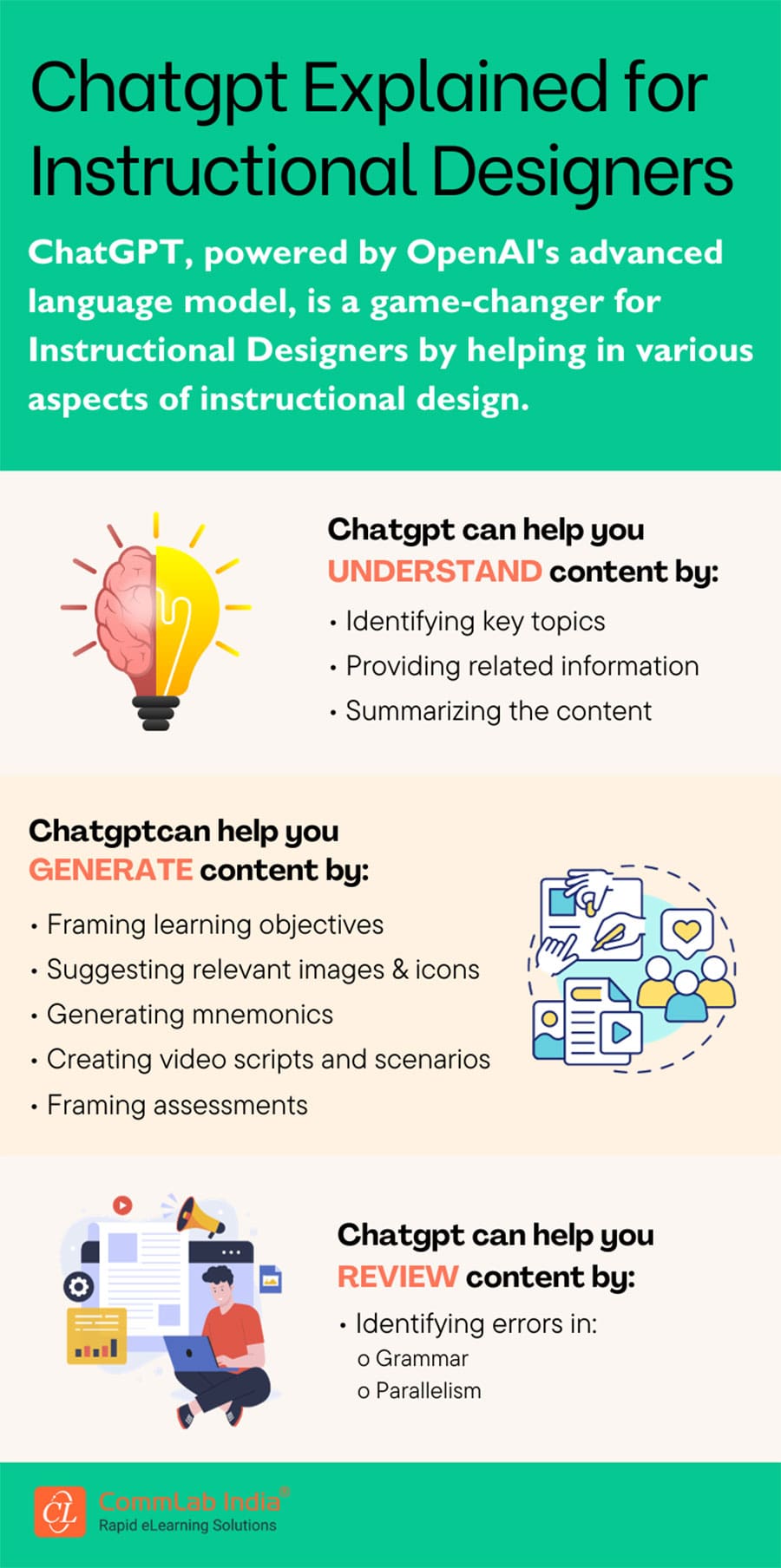](https://www.commlabindia.com/hubfs/blogs/chatgpt-explained-instructional-designers-infographic.jpg)[ChatGPT Explained for Instructional Designers](https://www.commlabindia.com/hubfs/blogs/chatgpt-explained-instructional-designers-infographic.jpg)
#### Best Practices for Using ChatGPT
##### Be Clear and Specific
* Clearly state your input or question.
* If you have a complex request, break it down into smaller, more manageable parts.
##### Experiment with Prompts
* Adjust the length and format of your input and see how it affects the response.
* If you're not getting the desired output, you can also try rephrasing or restructuring your prompt.
##### Iterative Refinement
* If the initial response is not what you want, you can ask ChatGPT to refine its answer or provide more details. Guiding it by highlighting the areas that need improvement can help.
* Experiment with different follow-up questions to guide ChatGPT toward the desired output.
##### Provide Context
* If your question refers to something mentioned earlier in the conversation, make sure to provide context to help the model understand the reference.
##### Check Output Consistency
* If the responses provided by ChatGPT are inconsistent or conflicting, consider asking it to clarify or provide more details to resolve any ambiguity.
##### Check for Bias and Inappropriate Content
* ChatGPT, at times, can generate biased or inappropriate outputs. So whether it is the response for learning objectives, training content, or [assessments](https://elearningindustry.com/perfecting-elearning-assessments-7-factors-keep-eye), make it a point to double-check the results.
##### Review and Edit
* Always review the responses provided by ChatGPT and edit them where necessary. Don’t relying on them blindly, especially if accuracy is crucial.
#### Wrapping It Up!
If you've ever felt the uphill battle of crafting training courses that truly resonate, ChatGPT can be your creative ally. With ChatGPT by your side, you don’t have to the struggle for drafting objectives or eLearning assessments. You just need to add a prompt and voila! Content is ready. AI in instructional design is a game-changer as it helps overcome the barriers of traditional course creation. If you interested in learning more, here’s a free eBook for you. It will guide you on how to make the most of AI revolution. Check it out now!
[](https://blog.commlabindia.com/cs/c/?cta_guid=e0c622c8-923c-4443-8050-364ebf193274&signature=AAH58kF_oPz4hTyItmfPYDHKnfLGJGj6Kg&pageId=153344856335&placement_guid=52b9d8c7-24d7-480b-9d0c-172a0f1a4913&click=18110f0f-41ef-4919-a07a-e162e7b1126f&hsutk=&canon=https%3A%2F%2Fblog.commlabindia.com%2Felearning-design%2Fchatgpt-explained-instructional-designers-infographic&portal_id=59327&redirect_url=APefjpFxippnilnzsNugjtomEN3-ySjboLRYNyEZH3Zth4Xt3fKDpVhqmF1m9Q8VYXDDzwoY3f_nbwAfrZ2pC8EeaCEKrKOaYfnrLyiTFgAd3qPT2MclQeFjJ6X8vrQmpaiaEk9rJLnR1QTv1pCq0VGva5qbZtGQaK2PsPnAo30ebGxh51r7dYzPwmhOo0X4opt9ik8R3kuN)[Redefining Generative AI for Dynamic L&D Teams](https://blog.commlabindia.com/cs/c/?cta_guid=e0c622c8-923c-4443-8050-364ebf193274&signature=AAH58kF_oPz4hTyItmfPYDHKnfLGJGj6Kg&pageId=153344856335&placement_guid=52b9d8c7-24d7-480b-9d0c-172a0f1a4913&click=18110f0f-41ef-4919-a07a-e162e7b1126f&hsutk=&canon=https%3A%2F%2Fblog.commlabindia.com%2Felearning-design%2Fchatgpt-explained-instructional-designers-infographic&portal_id=59327&redirect_url=APefjpFxippnilnzsNugjtomEN3-ySjboLRYNyEZH3Zth4Xt3fKDpVhqmF1m9Q8VYXDDzwoY3f_nbwAfrZ2pC8EeaCEKrKOaYfnrLyiTFgAd3qPT2MclQeFjJ6X8vrQmpaiaEk9rJLnR1QTv1pCq0VGva5qbZtGQaK2PsPnAo30ebGxh51r7dYzPwmhOo0X4opt9ik8R3kuN), ChatGPT Explained for Instructional Designers [Infographic], commlabindia.com, 01hmedn0cybvh6zdf87rmtjfrd.