Curate Your Own Newspaper With RSS

## Metadata
- Author: [[Molly White]]
- Full Title: Curate Your Own Newspaper With RSS
- Category: #articles
- Document Note: ---
tags: [Assign relevant tags or keywords to the notee to facilitate organization and retrieval. Add a # before each tag. Tags cannot have special characters. Do not use the tag #articles]
- #RSS
- #NewsletterStrategies
- #Privacy
Author: Molly White
Source: Citation Needed
Reference: July 31, 2025 – https://www.citationneeded.news/curate-with-rss/
date created: 2025-08-01 12:15
---
# Title: Curate your own newspaper with RSS
## Table of Contents:
- [📝 Summary](#📝-summary)
- [📖 Main Content](#📖-main-content)
- [🗒️ Notes](#🗒️-notes)
- [📖 References](#📖-references)
- [🗣️ Paraphrase](#🗣️-paraphrase)
- [📰 Newsletter](#📰-newsletter)
- [✅ Action Items](#✅-action-items)
- [🧪 Hypotheses](#🧪-hypotheses)
- [📊 Methodology](#📊-methodology)
- [❓ Questions](#❓-questions)
- [🔮 Future Research](#🔮-future-research)
- [💡 Implications](#💡-implications)
- [🧠 Learning Styles Assessment](#🧠-learning-styles-assessment)
- [📊 Accessibility Assessment](#📊-accessibility-assessment)
- [🌍 DEIB Assessment](#🌍-deib-assessment)
- [✅ Logical validity](#✅-logical-validity)
- [🔍 DARVO Analysis Prompt](#🔍-darvo-analysis-prompt)
- [🔍 SEO Evaluation](#🔍-seo-evaluation)
- [🎯 Conclusion](#🎯-conclusion)
### References:
- White, M. (2025, July 31). *Curate your own newspaper with RSS*. Citation Needed. https://www.citationneeded.news/curate-with-rss/
## 📝 Summary:
Molly White argues that RSS lets readers bypass “enshittified” platforms like social media and algorithm-driven feeds by curating their own “newspaper” of desired content. She outlines RSS basics, reader choices, feed management, privacy benefits, and ways to support writers directly, restoring agency over what and when we read.
## 📖 Main Content:
White begins by diagnosing the “traffic apocalypse” afflicting news outlets as platforms decay under profit-driven changes (enshittification) :contentReference[oaicite:0]{index=0}. She contrasts fleeting newsletter overload with the focused experience of a single newspaper. RSS—a 25-year-old “Really Simple Syndication” protocol—serves as a privacy-friendly escape hatch :contentReference[oaicite:1]{index=1}. Readers choose a reader app (e.g., Inoreader, NewsBlur, NetNewsWire), import feeds, and organize them into folders that fit their interests and rhythms. White details workarounds for non-RSS sites (self-hosted readers, email-to-RSS tools) and emphasizes the importance of supporting writers via subscriptions or donations. She concludes that RSS empowers both readers and writers to avoid algorithmic manipulation and reclaim control.
### 🗒️ Notes
- **Platform decay & newsletter overload**
- Social media and AI sniping damage direct traffic :contentReference[oaicite:2]{index=2}
- Newsletters proliferate, cluttering inboxes with mixed content :contentReference[oaicite:3]{index=3}
- **RSS fundamentals**
- Protocol age: ~25 years, survived Google Reader shutdown :contentReference[oaicite:4]{index=4}
- Any site with a feed is followable in any reader :contentReference[oaicite:5]{index=5}
- **Choosing & using a reader**
- Options: Inoreader (paid/free), NewsBlur, NetNewsWire :contentReference[oaicite:6]{index=6}
- Privacy: check reader’s policy; consider FreshRSS self-hosting :contentReference[oaicite:7]{index=7}
- **Adding & organizing feeds**
- Paste site URLs; import OPML files; use search-based feeds for research :contentReference[oaicite:8]{index=8}
- **Sites without RSS**
- Request feed enablement; use email-to-RSS or third-party converters :contentReference[oaicite:9]{index=9}
- **Reading & privacy**
- Foldered “newspapers” for distinct purposes: subscriptions, news, food :contentReference[oaicite:10]{index=10}
- RSS reduces tracking compared to web & email newsletters :contentReference[oaicite:11]{index=11}
- **Supporting writers**
- Subscribe/donate directly; turn off email delivery but maintain financial support :contentReference[oaicite:12]{index=12}
## 📖 References:
- White, M. (2025). *Curate your own newspaper with RSS*. Citation Needed.
- Doctorow, C. (2025). *Enshittification: Why Everything Suddenly Got Worse and What to Do About It*. Macmillan.
## 🗣️ Paraphrase:
> **Original (L3–L6):**
> “Last week… the dwindling supply of visitors from Google Search completely dries up. Traffic to news sites… has atrophied as those services limit links… Some have abandoned Search… for ChatGPT… often without linking….”
**Paraphrase:**
> In recent announcements, Wired warned of a looming “traffic apocalypse” as Google and social platforms strip away referral links, starving news websites of readers. Consequently, many people now bypass traditional search and rely on AI chatbots like ChatGPT, which summarize journalism—sometimes inaccurately—without credit or links.
> **Original (L17–L19):**
> “What if you could… ditch the data collection… curate your own newspaper? It could include independent journalists… Only the stuff you want to see… ready to read at your convenience.”
**Paraphrase:**
> Imagine assembling all your preferred newsletters and media into a personalized digital paper free from tracking. Whether it’s independent blogs, mainstream outlets, or podcasts, RSS lets you gather only the content you care about, delivered on your schedule, without intrusive data-collecting intermediaries.
## 📰 Newsletter:
Here’s your quick feed fix, WordPress fam: Platforms are eating our clicks—and our sanity—so let’s resurrect RSS! This ancient but mighty protocol lets you subscribe to any blog, newsletter, or podcast in one sleek reader—no algorithms, no ads, just pure content. Try Inoreader (web), NetNewsWire (macOS/iOS), or NewsBlur for starters. Organize your feeds into folders—“Plugins,” “WP Security,” “Community Spotlight”—and skim at will. For sites without feeds, spin up FreshRSS or use “Kill the Newsletter” to bridge your email into RSS. Best part? You control the click data and still support creators via subscriptions or donations. Ditch the inbox chaos, reclaim your reading time, and build your perfect WordPress daily paper with RSS today!
## ✅ Action Items:
- Craft an OSPO workshop on “RSS for Developer Relations,” highlighting sustainable open-source communication beyond social feeds.
- Develop a WordPress plugin that auto-generates RSS endpoints for block-editor posts lacking feeds.
- Write a GoDaddy blog post on “Curate Your Dev News with RSS,” aligning with my advocacy for transparent, direct community engagement.
- Propose a session at The WPCC on transitioning newsletters into RSS-driven workflows to reduce dependence on proprietary platforms.
## 🧪 Hypotheses:
1. Users who switch from email newsletters to RSS report 30% less inbox fatigue over 3 months.
2. Independent writers see a 15% increase in direct subscriptions after promoting RSS feeds.
3. Self-hosted RSS readers correlate with higher engagement in open-source community discussions.
### 📊 Methodology:
- **Data sources:** Surveys of reader fatigue, subscription analytics from writers, forum activity logs.
- **Design:** Mixed-methods—pre/post quantitative surveys plus qualitative interviews.
- **Analysis:** T-tests on fatigue scores; thematic coding of interview transcripts; correlation analysis for reader engagement metrics.
### ❓ Questions:
- How does RSS adoption vary across demographics and tech proficiency?
- What barriers prevent mainstream journalists from offering full-text feeds?
- Can RSS metrics be integrated into open-source contribution dashboards as an engagement signal?
### 🔮 Future Research:
- Evaluate long-term retention rates for readers using RSS vs. email newsletters.
- Study the environmental impact of reduced server load from RSS vs. algorithmic feeds.
- Explore RSS integration with decentralized identity to enhance privacy.
### 💡 Implications:
- Validating RSS benefits could shift publishers toward open protocols, strengthening content sovereignty.
- Insights might inform policies advocating for protocol-based communication over proprietary platforms.
### 🧠 Learning Styles Assessment:
1. **Visual**
- **Present:*
- Summary: Escape newsletter inbox chaos and algorithmic surveillance by building your own enshittification-proof newspaper from the writers you already read
- URL: https://www.citationneeded.news/curate-with-rss/

Last week, both **The Verge** and **Wired** announced major newsletter strategies. **Wired** writes of a “traffic apocalypse”, where “platforms on which outlets like **Wired** used to connect with readers, listeners, and viewers are failing in real time”.[1](https://www.citationneeded.news/curate-with-rss/#reference-1) **The Verge** describes “Google Zero”: the moment when the dwindling supply of visitors from Google Search completely dries up.[2](https://www.citationneeded.news/curate-with-rss/#reference-2)
Traffic to news sites from social media platforms like Facebook and Twitter has atrophied as those services limit links to external sites to keep users locked in. Google Search’s excerpts and, more recently, AI overviews have satisfied users’ questions before they click on the article that actually provided the information. Some have abandoned Search altogether for ChatGPT or other chatbot LLMs that summarize journalists’ work with varying degrees of accuracy, often without linking or even mentioning the source.
**Citation Needed** is an independent publication, entirely supported by readers like you. Consider [signing up](https://www.citationneeded.news/signup) for a free or pay-what-you-want subscription — it really helps me to keep doing this work.
These intermediary platforms between news organizations and readers are undergoing a type of predictable decay Cory Doctorow calls “enshittification”.[a](https://www.citationneeded.news/curate-with-rss/#footnote-1) As executives twiddle the knobs to extract ever more profits from their user base, things worsen for people on both ends of the consumer–producer relationship. Readers no longer see news articles from the journalists they **chose** to follow on Twitter as the site downranks any posts that link offsite. When they search on Google, they’re bombarded with error-ridden AI facsimiles before reaching the higher-quality underlying work. Producers who once relied on social media and search engines to drive visits are losing traffic as platforms embrace a [vampiric strategy](https://www.citationneeded.news/free-and-open-access-in-the-age-of-generative-ai/#:~:text=Anyone%20at%20an%20AI%20company%20who%20stops%20to%20think%20for%20half%20a%20second%20should%20be%20able%20to%20recognize%20they%20have%20a%20vampiric%20relationship%20with%20the%20commons.): rip off others’ work while expecting high-quality journalism to magically continue to appear, even as journalists are starved of audience and revenue.
The newsletter strategy aims to bypass these rapidly enshittifying intermediaries and instead establish more direct relationships with subscribers. “I don’t intend to ever rely on someone else’s distribution ever again,” wrote **Verge** editor-in-chief Nilay Patel on Bluesky.[3](https://www.citationneeded.news/curate-with-rss/#reference-3) Although email has undergone some enshittification of its own,[b](https://www.citationneeded.news/curate-with-rss/#footnote-2) its fundamental nature as a [protocol rather than a platform](https://knightcolumbia.org/content/protocols-not-platforms-a-technological-approach-to-free-speech) has provided one essential prophylactic to enshittification: the escape hatch. If your email provider suddenly inserted ads two sentences into every email, you could easily switch providers[c](https://www.citationneeded.news/curate-with-rss/#footnote-3) and still receive emails from everyone you previously emailed. As a result, email has become a go-to refuge for news outlets fleeing their abusive relationships with deeply enshittified platforms they grew reliant upon.
But the surge in newsletters has been overwhelming. Whether it’s writers like me who’ve never worked in a traditional newsroom, journalists who’ve left or been laid off from traditional jobs, or established newsrooms entering the newsletter business, there’s a newsletter around every corner. Instead of subscribing to a single newspaper for columns and articles by a dozen journalists, now you have a dozen separate newsletter subscriptions, with articles appearing haphazardly in your email inbox amid bills, business communications, marketing spam, order confirmations, and two-factor authentication codes.
Even as a newsletter writer myself, I sometimes miss the newspaper. Sure, maybe half of the articles I paid for were deeply uninteresting to me, and sure, the executive overlords and editorial teams of the one-time titans of journalism seem to be in a competition to see who can most eagerly defend fascism, but hey: at least I could choose when to read the news, go to the newspaper and get my fill, and then put it away. No pings in the middle of my workday pulling my focus away from my writing. No notifications during my planned relaxation time, alerting me to some new horror. No threats to my inbox zero, requiring me to choose between staring neurotically at the unread emails notification or marking an email as read only to lose it forever. Maybe there was something to be said for the newspaper.
And increasingly, your reading is spying on you in a way a print newspaper never could, with websites tracking when you click a link or scroll down the page, and even email newsletters tracking when you open an issue or visit a link.[d](https://www.citationneeded.news/curate-with-rss/#footnote-4) Apps like Substack collect data about your reading to show you an algorithmic feed, ostensibly to grow the “Substack network” and drive new subscribers to writers hoping to build a following. In practice, these mechanics in turn drive writers to please the algorithms, writing what gets the most clicks and ranks them higher in the recommendation system. Independent thinking and creativity often get sidelined to click-chasing.
What if you could take all your favorite newsletters, ditch the data collection, and curate your own newspaper? It could include independent journalists, bloggers, mainstream media, worker-owned media collectives, and just about anyone else who publishes online. Even podcast episodes, videos from your favorite YouTube channels, and online forum posts could slot in, too. Only the stuff you want to see, all in one place, ready to read at your convenience. No email notifications interrupting your peace (unless you want them), no pressure to read articles immediately. Wouldn’t that be nice?
Platforms like Substack recognize this appeal, and invite you to follow numerous writers in a tidy feed on their app. But with Substack, you’re limited to following only the writers who publish on that platform. You’re also at the mercy of their rapidly accelerating enshittification, as they work to [lock readers and writers into the product](https://www.aaronrosspowell.com/2024/02/27/substack-doesnt-want-you-to/), while making the experience worse for both.
There’s a more enshittification-proof option.
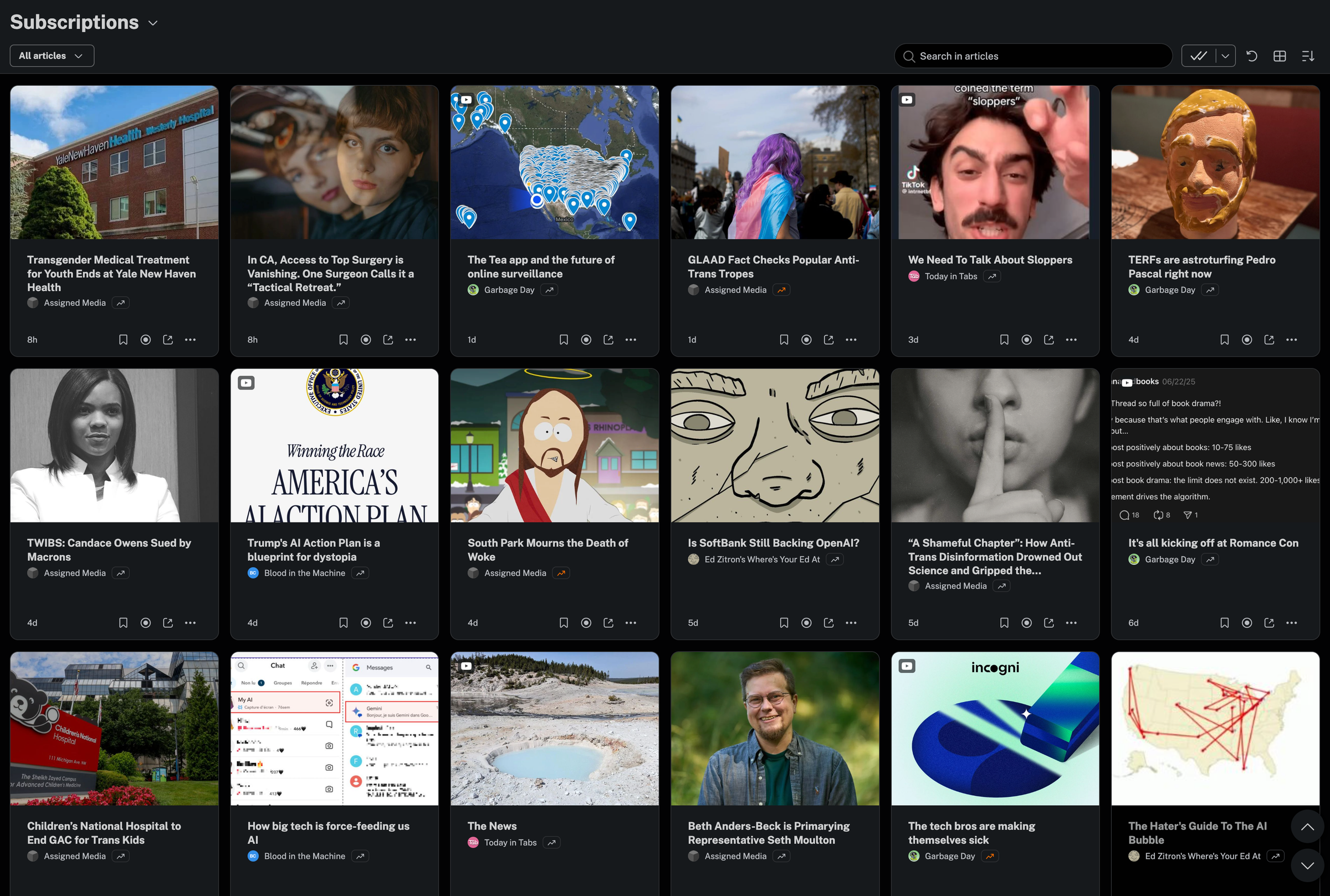One of my “custom newspapers”
Perhaps you’ve heard of RSS. It stands for “Really Simple Syndication” and it allows websites like blogs, newsletters, and news sites to make their content available in “feeds” for outside services called “RSS readers” or “feed readers”. Far from being the new hotness attracting glitzy feature stories in tech media or billions in venture funding, RSS has been around for 25 years.
[Google Reader](https://en.wikipedia.org/wiki/Google_Reader) was once the most popular RSS reader, and many (including me) were heartbroken by its shutdown in 2013. A lot of people moved to centralized microblogging services like Twitter and stopped reading blogs. But despite the loss of Reader, RSS continued on, and many contemporary tools do similar — even better — jobs than the decade-old service. In fact, you’ve almost certainly been using RSS without even knowing it, because the entire podcast industry runs on it.
Many, if not most, websites publish an RSS feed.[e](https://www.citationneeded.news/curate-with-rss/#footnote-5) Whereas you can only follow a Twitter user on Twitter or a Substack writer in the Substack app, you can follow **any website with an RSS feed** in a feed reader. When you open it, all your reading is neatly waiting for you in one place, like a morning newspaper. And RSS is more of a one-way street from a privacy perspective,[f](https://www.citationneeded.news/curate-with-rss/#footnote-6) pushing writing out to you with less of your data flowing back to the publisher.
I’ve been heavily using RSS for over a decade, and it’s a travesty more people aren’t familiar with it. Here’s how to join me in the brave new (old) world of RSS:
Many good free and paid RSS readers exist, as web-based, desktop, or mobile apps. I personally use and like [Inoreader](https://www.inoreader.com/).[g](https://www.citationneeded.news/curate-with-rss/#footnote-7) I pay for a subscription, but it has a generous free tier. I’ve also heard good things about NewsBlur and, for Apple users, NetNewsWire. I [no longer recommend Feedly](https://www.citationneeded.news/feedly-launches-strikebreaking-as/).
Don’t agonize over this decision too much. RSS is a protocol, and switching feed readers later is straightforward.
Do note that various RSS apps may themselves try to collect data about you, so check their privacy policies. As of writing, Inoreader collects some data on your reading activities, but does not sell or share it with marketers.[4](https://www.citationneeded.news/curate-with-rss/#reference-4) Some tech-savvy people opt to self-host RSS feed readers like FreshRSS for maximum privacy and control.
Once you select a feed reader, add the feeds you wish to follow. Most feed readers let you paste a website’s URL to find available RSS feeds. Some websites have multiple RSS feeds, like *Wired*, which allows you to subscribe to a firehose of all articles or trim things down by subscribing separately to specific topic feeds like science or cybersecurity.

Put anything in there: a URL to your favorite newsletter (like this one!), a traditional news publication you enjoy, a blog, a YouTube channel, or even a Mastodon or BlueSky feed.
If you need ideas, I publish several folders of my feeds to [my blogroll](https://www.mollywhite.net/blogroll/). The OPML file can be imported into a feed reader to automatically subscribe to all of the feeds I follow, but beware: these are some of my “firehose” feeds and can be overwhelming. I’d recommend starting small with just a few feeds you enjoy.
Power users can even subscribe to search results from search engines or other websites, making RSS a powerful tool for research. Have you ever wondered how I keep up with cryptocurrency news? Besides the crypto publications in my RSS reader, I have feeds for Google searches like `(cryptocurrency OR NFT) (theft OR hack OR scam)` and [CourtListener](https://en.wikipedia.org/wiki/Free_Law_Project) searches on crypto-related keywords for newly filed cases. CourtListener provides a feed for every docket, so I have a folder in my RSS reader for ongoing court cases I’m tracking.
One hiccup you may encounter is a website you love that doesn’t provide an RSS feed. I encounter these rarely, as many content management systems provide RSS feeds out-of-the-box, sometimes without writers realizing they’re there.
Publishers sometimes need to enable RSS functionality, and some will happily do so if you ask nicely. (I’ve successfully asked at least one newsletter writer I subscribe to to turn on their RSS feed on beehiiv, which doesn’t provide feeds by default but can be made to do so with a click.)
Some paywalled email newsletters lack RSS feeds due to subscription-gated feeds not being universal (though they exist — shoutout to [**404 Media**](https://www.404media.co/404-media-now-has-a-full-text-rss-feed/)). This leaves writers with the choice of exposing all their paywalled writing for free on an RSS feed or not offering a feed at all. Fortunately, many RSS readers can ingest email newsletters, typically by generating a custom email address for newsletters to be sent directly.[h](https://www.citationneeded.news/curate-with-rss/#footnote-8) When that newsletter sends an email, it appears in your RSS reader alongside your normal feeds.
And if your RSS reader doesn’t offer this service, there are third-party tools like [Kill the Newsletter](https://kill-the-newsletter.com/) tha can accomplish the same task.
With your RSS reader configured, you now have your own custom newspaper — or several.
I heavily use the folders functionality in my feed reader to create several “custom newspapers” for different purposes. I have a Subscriptions folder for all the newsletters and media outlets I pay to read, and I usually read almost every entry. A broader Newsletters folder contains a wider array of writers, and I read only the articles that interest me. My News folder usually has thousands of unread articles (often from high-volume publishers like Wired), and I skim through headlines without reading every article. My Food folder holds over 100 food blogs, and I browse it for dinner ideas.
Some publishers provide full-text articles in their RSS feeds, so you can read everything without leaving the reader. Others publish only an excerpt, requiring you to click through to the website to read the page. I often click through regardless, because I like reading articles as their web designers intended.[i](https://www.citationneeded.news/curate-with-rss/#footnote-9) But on sites cluttered with ads and cookie banners, a full-text RSS feed offers relief. For more privacy-minded readers, reading articles in your RSS reader can also reduce ad tracking, click surveillance, and other privacy invasions.
#### Support writers
As always, support writers when possible. The RSS feed can make it easier to miss subscription prompts or donation requests that appear on a website outside the content feed. If you regularly read a writer or publication through RSS, consider subscribing to their newsletter directly, purchasing a paid subscription, or making a one-time donation if accepted. Many newsletters (including this one) allow you to sign up for a paid subscription and turn off email delivery, so you can support the writer financially while reading through your RSS reader and avoiding inbox clutter. This is how I read most of my newsletters.
 Citation Needed’s email preferences dialog
#### Escape enshittification
Using RSS is a way to regain control over the information you read online. Instead of letting platforms like Twitter or TikTok control what you see based on engagement metrics meant to prolong your time on the platform and subject you to endless ads, you can subscribe only to the sources and writers you want to read. Unlike enshittified social networks, your RSS feed will give you exactly what you signed up to read — no promoted posts, no algorithmic deboosting for posts that dare to link to articles, no ragebait from people you don’t follow.
RSS offers readers and writers a path away from unreliable, manipulative, and hostile platforms and intermediaries. In a media landscape dominated by algorithmic feeds that aim to manipulate and extract, sometimes the most radical thing you can do is choose to read what you want, when you want, without anyone watching over your shoulder.
1. Cory’s book [**Enshittification: Why Everything Suddenly Got Worse and What to Do About It**](https://us.macmillan.com/books/9780374619329/enshittification/) comes out in October, and I would highly recommend it. [↩](https://www.citationneeded.news/curate-with-rss/#footnote-anchor-1)
2. Ask any newsletter publisher who’s had to wrestle with Gmail’s spam filter and its intentionally mysterious metrics for whether a newsletter people have **willingly asked to have delivered into their inboxes** is actually spam, and you’ll get an earful on that. Hi, it’s me, the newsletter publisher. [↩](https://www.citationneeded.news/curate-with-rss/#footnote-anchor-2)
3. Although the proliferation of free email services that provide you with an @gmail.com or @outlook.com email address makes this somewhat more challenging, as it’s not an easy thing to tell ten years’ worth of email contacts that you’ve got a new address. This is why I highly recommend obtaining a domain to use for email — I recently switched the underlying service provider I use to send and receive emails with my
[email protected] email address, and no one I communicate with likely even noticed, much less had to make any changes on their end. [↩](https://www.citationneeded.news/curate-with-rss/#footnote-anchor-3)
4. Not this one, though. I don’t collect any email data besides the most basic deliverability information, and I don’t track when you open emails from this site or click on links. See the [privacy policy](https://www.citationneeded.news/privacy/) for more details. [↩](https://www.citationneeded.news/curate-with-rss/#footnote-anchor-4)
5. Fewer websites these days **advertise** their RSS feeds, and I’ve seen some people take this to mean they don’t support RSS anymore. They often still do — you just need to use a feed reader to find the feed, rather than copying-and-pasting an RSS link from your browser. My feed reader has a [handy browser extension](https://www.inoreader.com/blog/2015/04/inoreader-how-to-do-more-with-browser.html) that glows orange if it detects an RSS feed on the website you’re visiting, and lets you quickly add it to your feed reader. [↩](https://www.citationneeded.news/curate-with-rss/#footnote-anchor-5)
6. I will note that **some** tracking is still possible. For example, some platforms will replace links in newsletters with link forwarders that first track the click and then re-route you to the intended destination, and this is something that could feasibly expand to RSS. However, this is somewhat uncommon in my experience — while you will see this kind of linking a lot in email newsletters sent from practically any platform (Substack, Beehiiv, Buttondown, and Ghost all offer the “feature”, and it’s often something a writer has to go out of their way to turn off), at least as of writing, these tracking links are typically not present in RSS feeds from those same platforms unless you are using email ingestion. [↩](https://www.citationneeded.news/curate-with-rss/#footnote-anchor-6)
7. As always, no sponsorship, partnership, or affiliate link deal here. I’m just a fan. [↩](https://www.citationneeded.news/curate-with-rss/#footnote-anchor-7)
8. The one downside to this I’ve noticed is that many newsletters send newsletter issues and subscription notifications to the same email address, meaning that a prompt to renew a paid subscription may end up in your RSS feed (where it may be more prone to being missed). The best option, in my view, is for newsletter authors to enable RSS feeds for their newsletters, allowing subscribers to still receive subscription notifications via email while choosing whether or not they want to receive issues of the newsletter by email or only read them via RSS. [↩](https://www.citationneeded.news/curate-with-rss/#footnote-anchor-8), Curate Your Own Newspaper With RSS, Molly White, 01k1k7gtmr33s5j49y80qgqrhq.