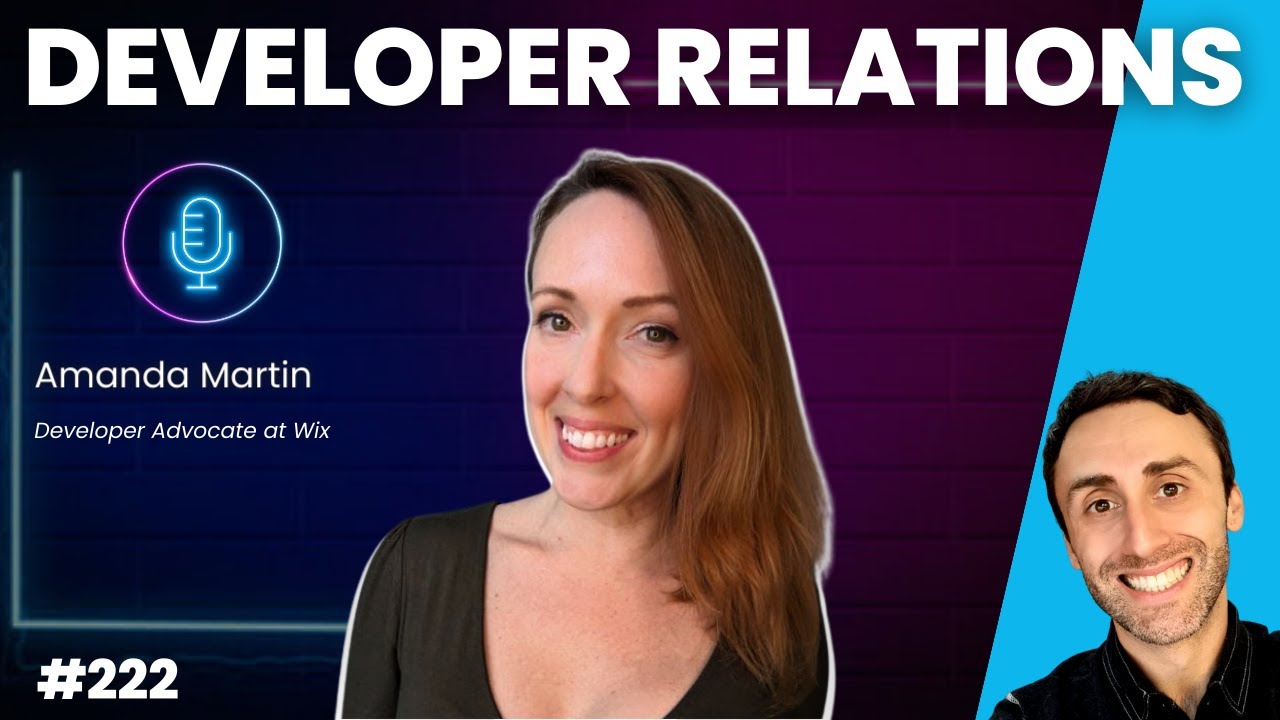
Developer Relations - Amanda Martin @WixStudio
## Metadata
- Author: [[YouTube]]
- Full Title: Developer Relations - Amanda Martin @WixStudio
- Category: #articles
- Document Tags: [[video-notes]] [[youtube]]
- Summary: Developer Relations - Amanda Martin @WixStudio
- URL: https://www.youtube.com/watch?v=g51fuN1gXbg
welcome everyone today we have Amanda developer Advocate at week so usually I interview people and then I meet them in person with her we went on the other side so we met in person and then we started interacting on social media and now she's on my YouTube channel finally because we have so much to talk about H I think she has a great story but I want to hear that like in some calm because usually when we are theel we're always busy we don't know we have many things
to do so now I can relax along to hear your story so Amanda welcome please introduce yourself and then we start hey oh yeah I'm so excited to be here it is it is very interesting to be meeting people in person and then having these wonderful opportunities and I don't um exist as in the content creator space on a personal level so you know you yeah you might hear my story here and there when I'm able to pop into a space and I love to have that time but I kind of function in the background as the as the company Devo that that uh it's a little
more secretive maybe you don't realize what I'm doing dayto day um but yeah so I work for Wix I've been there almost two and a half years now um which is crazy to me when I say that out loud um this is my first role as a developer Advocate um I've been in the tech space for over eight years though I started in uh GIS uh which is kind of a technical but related role you you might write a python script here and there to automate something but you don't you don't build the maps from scratch you're using kind
of an end user software more often and I worked in that role after college I went to to college for this and I worked in that role I'd say for maybe like a year and a half but I sat next to a Dev team and made friends with some of the developers at some point they were giving me some little one-off tasks where maybe a map was needed I had some basic HTML CSS JavaScript never considered being a developer I grew up kind of in that era where it was more of that stereotypical they nobody ever
talked to women about the idea of being in Tech nobody ever congratulated me if I did well on a math test you know there was it was just not the things we were rewarded for or pushed into so I almost didn't even know that world was available to me so I just didn't think about it and at some point one of the devs I had become friends with and I did a few kind of like one-off tasks for him we were just out at lunch like a work lunch and we were just hanging out and he was like hey what do you think about joining the deaf team
and I was like yeah sure that sounds cool like did not I was kind of like didn't it didn't like register to me like this is a huge life decision and I'm just like oh that sounds cool I'd love to work with my friend more you know doing these kind of little coding tasks was fun that sounds cool um I'd still get to do mapping and things which I love I still love geospatial data if you let me put a map on something I will but I was like yeah sure I mean I was uh excited I'm always excited to to learn
something new I'm always one of those like I especially at that time period in my life was a big like yes person I was like yeah let's do it let's try it I um had that kind of and I still have this I'll dive in the deep end of any pool mentality and it's not an ego thing it's not like I know I'm gonna be successful it's more that I'm not afraid of looking stupid and I've kind of always had that I think from being a theater kid back in the day I'm used to looking stupid in public so I'm down for whatever so I was excited about this but didn't really
like this is a huge life decision that people go to school for um and I get on I interview but you know like I've got kind of the backing of the dev team there they want me there so it was like kind of like a half you know not real interview they they already knew about me and I knew the business right is a government contractor and it's it's its own special world and so I get to there and everybody's really nice and great and they're you know onboarding me to the projects and I realized very quickly that this is is a lot it's all their
their main stack is going to be like c.net that's like kind of their bread and butter most of their most of their clients had or their customers their government customers were working withn net um they would have we had a few other things some WordPress sites for more local governments we had some mobile apps this and that it's Government Contracting you don't like get to make a lot of choices you get you win a contract and you find out what tech stack you're going to be working in that week it's like you don't know what it's going to be but they had a lot of
net work so again I've touched HTML CSS in JavaScript I've made little teeny tiny Python scripts but net was like a monster to me I had no idea what I was getting myself into um so terrified but excited and as I start to learn things and get those first wins that we all get as developers I'm I'm like oh I want more like this is cool I'm like I'm having a great time it's a great team and I'm just I'm still panicking because I want to catch up I want to be good I
always I'm a very like I want to be good at whatever I'm trying to do so I'm on the nights and weekends I'm looking up courses videos blogs whatever I'm trying to catch up and anything that anybody mentions that day these terms I don't know object-oriented programming things like stuff I'd never even heard of um so I'm taking down all these terms I don't know and trying to figure them out every day so that's how I got it I like fell into Tech it's it's I was it was a little bit of luck and a little bit of I had the opportunity to to show myself at
work it's like they were probably kind of proving me back in the day like they was like oh let's see if anybody on that team can do these little tasks for us because we need a junior devb and we want to poach one from another team you know like so I almost got to interview on the job by showing that like I was willing to do that work and step up and learn and but I fell into it also so it's really cool it was a bit of luck and a bit of skill and then a bit of like panic and everything and I got there and it was and I I never turned
back I was like this is it these are these are my people this is what I want to do yeah so first of all I love that you say that you you fell into Tech and not get into Tech uh I really don't I disagree with you amand I don't trust in luck I I I I believe in unlucky situations but not much not much in luck yeah well you do make your own luck a little bit like the willingness to say yes was critical in that time period like the first time
somebody came to me and was like Hey can you try this task for me and I said yes like I'm going to try I'm going to figure it out and if you're too scared you might have said no or oh I don't know maybe I can maybe I can't like I was just like sure yeah I'll try that and might I have failed absolutely but I think that willingness to say yes at the time helped create my own luck yeah and I really love this uh more practical approach I think this is what we really need in Tech because otherwise
we can really die by Theory like literally you can literally spend like 10 years learning theory and I also like Theory I like math and something like that but I think at some point you need to be more practical and at the end of the day coding is a skill and can be you can basically learn everything if you have a decent amount of time and I really like this this mindset love that it's hard to learn on the job like that though like you said it's iCal it was it was uh task
driven I learned based on what work we needed to do and so a lot of the foundational things that somebody who did study it purposefully would know I it took me years to then go back and like essentially fill in gaps like oh like I never learned about um like uh performance things and stuff like because I never that wasn't part of the kind of tasks I did and and just these different kinds of maybe fundamental things that you need to understand about how
um applications work on the web or on software or on mobile and it was just instead it was so peace meal How I Learned and so it does give you a little of imposter syndrome as you go along and you get further along and then you realize oh I have huge gaps in my knowledge because I never had a task where I had to learn that skill so it is hard but you have to like put in that work to fill in your own gaps yes absolutely I I know I know these I know I know these Al when I got hired at the European Space Agency I had
to learn learn and learn like the first month they were kind of I would say so you got your first tech role as a Dev right so how did you then transition to Dev rail um so that first role that I told you about that I fell into I was that that company for I'd say a total of I think it was like 4ish years uh it was a terrible commute though this was an in-office job I was commuting 90 minutes each way it was horrible I will never do it again I did love being in office though at that time
it was really helpful to be around these other developers but so I wanted to be closer to home so I left that job for a small agency um in Baltimore where I live and they were like it was like a financial publishing company they had a whole bunch of websites and mobile apps and a few internal kind of tools to maintain and I went and was working there for a while and at both of these jobs the first one and the second one I've always loved working with like doing things outside of just the writing of the code
um in the kind of uh Government Contracting role I was always really good at working with clients with non-technical people and trying to break down you know what exactly they needed and having being able to bridge that gap between the technical and non-technical was always very easy for me um I really enjoyed as I Advanced to more of a mid-level developer I really enjoyed helping onboard Junior devs to our team on my second job we had um someone from our QA team you know transfer into the
dev team which was a pretty common kind of pipeline for how we ended up with devs um and but there's still a lot to learn as a junior and so I never minded being the person that somebody would go to when they get stuck and then trying to help facilitate someone to get unstuck without just giving them the answer because it's much more satisfying rewarding and you learn more when you figure it out on your own and but part of education is being like okay how can I get this person to find the way and so
those two things plus I also have this weird thing where I really enjoy like writing documentation and things like like I always loved like making sure everything was well documented I so there's all these other pieces of tech that I loved um outside of just uh kind of cranking out code and and finishing tickets every day and a lot of people would tell me oh well you know your choices basically be the dev or be like the project manager and I was like I don't know like project management at least the managers I knew I was like it
didn't their world didn't seem to quite speak to me it didn't quite fit so I was at my second agency role about two years and I started feeling like okay I gotta figure out what's my long-term goal am i g to go up in like kind of my IC am I going to get to like a tech lead like what do I want to do here or do I want to explore this other part of me that still wants to be able to connect with um this world in a different way but still touch the code I was really afraid of never touching code again I didn't want that either and I started researching what are what else is out
there in this world of tech and I ran into a Blog that and this I feel like nobody was talking about developer advocacy um it seems like it's like blown up in the fast past few few years in conversation but at the time I had never heard of it but I was looking around and putting in all these different terms about like what I was interested in what can you do if this is what you like and I ran into a Blog of somebody that I believe was a Dev Advocate at maybe Google I'm not sure somewhere and it was just one of those like this is what I do kind of blogs day in the life kind of as a Dev Advocate
blogs and I was reading through and it was a nice long like wellth thought out blog and I read the whole thing and I was like oh my God this sounds like the perfect job for me so now I had a word Dev you know developer Advocate and now I started searching that and so I find more and more information I was like okay I was like okay then I was like are there jobs that's the next question Cool you want to do this are there any jobs so I started looking and there aren't that many so I'm like okay well I'm ready to move on from this company and have a new challenge so I'm going to apply for Dev roles but I'm also going
to apply for these developer Advocate roles because I I really think that's cool but you know who am I to do this how am I going to even prove that I'm somebody that could do this and Wix was hiring for developer Advocates and they were trying at the time to build a very diverse team in experiences as in people that are already out there doing this type of work but also people that clearly have the potential to speak to their developer audience I had a lot of experience working in in uh WordPress
and that was helpful because obviously that's a very direct competitor for Wix um so I understood that kind of mentality uh my Government Contracting work is similar to working in an agency where you might have several clients to work with it's similar so it's like and then you know I went through the interview process with them they accepted me I just like I didn't know anybody there this is was like another one of those things where it was like I don't know how I got interviewed just for my resume you know because I didn't know anybody
and you really do get your best connections from knowing people but I got lucky enough to get interviewed and I had to you know do a presentation I built something presented it and went through all the rounds and was able to articulate kind of what I could bring to the table and just did really well in the interview like I knew I knew I did well in the interview but I still had that back of the head like I've never done this before if anybody with more experience than me there's no way they're going to hire me but they did did and they gave me a chance and I've
been there ever since and I absolutely love it it's such a great world yes I also I think I heard the first time about the V I think it was was during this podcast series with by James quck like the title it was like developer advocacy it was October or November 2020 this is the first time that I heard like for real not just on Twitter I thought and in Italian know Advocate it's like lawyer so I thought that developer Advocate is a lawyer when
a developer get like messes up they need a lawyer to protect them this was Day idea I mean different kind of developer Advocate funny yeah it's it was it's it wasn't a term and maybe outside of kind of the tech Twitter kind of bubble that we're all very much in here maybe it's still not a term anybody knows about but it's yeah it seems more discoverable to me yes I got the Julia's graduation party on Sunday everybody asked me what
they doing for a living and I didn't manage to nail it 100% I tried but it's was a bit hard to to explain I tried my best it will be remarkable what my mom says that I tried to explain this to her and after 10 minutes she said oh basically is someone who's just giving Flyers to developers this was my mom's definition of Dev rail so now since this is a devil podcast we really can't skip
this question am what is devil for you oh my goodness it's I mean I think it's I think that I know I know why it's difficult to Define in a clear way but really you're somebody that's going to function at the intersect of the developer user of whatever your product is the product team building it and the marketing team trying to get the message out right you're you're functioning somewhere in this intersection for me since I I work for Wix and this is the only place I've
existed so far as a Dev Advocate I'm closer to marketing but I still function with the developer community directly and with the product teams directly um and at the end of the day what you're trying to do is make sure that people using your your tools are successful make sure they're happy make sure they're able to build that that everything makes sense to them and get this information back to the product teams building they don't have time to talk to the community every day um they
would love to everybody I've ever met that's building something they would love to be able to spend more time knowing exactly what the users think but then they would never be able to build it um so and to do that to accomplish this goal of making sure that you have successful users people that know about what your tools can even do for them and then a product that knows where they should go next to do that is a mixture of content and community building and then um that kind of external U awareness so you have these kind of three main pillars that you're always
thinking about so that's kind of how I Define it um but then of course as you get into the details it's very different depending on where you work yes I agree and of course also for me I work closer to the marketing team we are we are in the marketing team but of course we are also uh connected with all the product and engineering and so on so yes yes I like I really like this definition you need it how to become a theil I think especially I think for people people who already got a role as
a developer I think there are some people who just became the real but I think that at least let's say statistically most of people they already had at least one or more uh years in experience as developers and then they want to become the real and they get they get um the real opportunity and so on so I get this question very often I would like you to help me to answer to this so so how can I become a deel if I'm currently a
developer and I want to go as you did we can say like go in that direction maybe someone heard about the term theel right now and say this is something that might be interesting for me yeah absolutely so it's a tough question right now right the the situation around hiring is absolute chaos and I think the likelihood of anybody following my path where I wasn't active anywhere you couldn't find me on the internet I was a developer that wasn't paying attention
to anything outside of my work um I wasn't the kind of content I created was internal it was for our customers or for developers I work directly with I don't think that that is a good bet anymore I really don't and if I were getting into it now I would start with first I would start looking at companies that I would love to work with my dream companies and see if they have a developer advocate legy team if they do follow those people follow those Dev
Advocates see what they're like when they host events see what they're doing because that's going to give you an idea of what those companies value now your your dream company might not open a position right but at least you're going to know what you're shooting for um also look at positions that are open what are the companies that are currently hiring looking for so that's a good place to start because even though the definition of devil might sound like straightforward it's the details will change from company to
company about especially where their focus is are they more on content right now are they more on getting out there on the Conference Track the meetups do they want you in person more what do they want so from all of that kind of research and starting to network starting to make connections the networking is huge follow these people you're interested in engage with their content interact with them start to build relationships so that ultimately you can find out what what it would take if and when they were hiring then start doing the work you know not don't run
yourself ragged like don't have a second full-time job outside of your Dove career but start talking about what you do if it's content creation that you're passionate about and that the companies you would love to work for are passionate about start creating content Maybe YouTube maybe it's um blogging maybe whatever it is whatever it is start somewhere you don't have to do everything um find some developer communities to get involved with maybe get to a point where you can be a moderator there you don't have to start your own Community I think a lot of
people think they need to start a successful Community that's there's so many communities you don't have to do that you can if you're passionate but that's a big responsibility to start a community you need to be there for those people and what are you going to do when you get a job are you going to maintain it so think about that starting a community is hard and it's a it's a bigger responsibility but I would say do some research begin expanding your network to following the people that are doing the things that you want to do follow the companies that you're interested in and and then find a place
where you can just get started doing that work just start sharing you can even start smaller than full content creation you could start with Twitter you can start with LinkedIn you can start just making some simple posts and just kind of see see what people respond to you'll you'll find where you'll find your voice you'll find your Niche you'll find what it works um and and I would start there that's where I would start now it's not something that I currently do so I know it's weird for me to say that but if I were in a hiring
position I would notice those people I think about that now we work you know we do a lot of influencer Partnerships and it's not to hire people fully into our team but it's a similar kind of concept we look and we see who's creating interesting content that might speak to our community of developers and we don't know you if you're not creating content if we don't see it and so because those things there's a lot more to it behind like once you're in the company there's a lot
of things that aren't external but those external things can give people those indicators of of that you can communicate that you have empathy for developers um that you can explain technical things in a way that is clear and engaging and just that you're out there and you're interested so that's that's kind of where I would start nice and this is exactly what I did but the fun fact in 2020 I started my sharing content was four years ago it started with blog because I was too shy to make videos yes it's true uh the fun
fact is that I was not actively looking for a the position I I was focused more on what you say like focused on on Twitter then sharing videos and then I ended up like I I fell into the in some in some ways like I quit my job and after two two months I got this the position but I was not let's say actively looking for and craving for a Dev position from my experience people who get the real position usually they get it because they get contacted or
they or they you know they do something and of course maybe from visibility for example I one of the people uh who I interviewed in my first uh episode it was the co of the leev I don't know if you know this it was one of the people who I interviewed and you so you know out of 100 people I did a crazy challenge of doing this podcast 100 interviews in 100 days while I was still doing the full-time job one of those 100 people is is the person who
like 10 months later offered me a de position for example this was the second position but it's uh it's it's exactly what I did I don't know maybe I made it right because there was not the intention say okay let's make this podcast so I get I was not thinking about this but I like what you say like if you engage with the community be careful if you want to start a community if you engage with the community if you connect with as many people as possible
and I think the one of the things that I like the most about the is that you work with other devs with you work with like manded people like we are doing exactly now what do you think what is the best thing of being a deil the best thing stay on Twitter all day long you can stay on Twitter all day long oh you know the best thing for there's two best things for me I I still and this is still part of the original reason I got into it I love seeing people get to those little successes as developers I
love seeing people figure something out and knowing that like I was able to help facilitate that in some way whether give you a little code snippet or give you some docs that are actually exactly the docs you need and and then seeing you go oh my God I figured it out like it's just fun and then and being in the community space is fun and engaging with the developers is fun I love developers I worked as a developer like I like talking I like the way developers think so I just enjoy being being able to be in community with developers in in a way
that I also get paid for like that's cool right um and then the other best thing for me is there's it's something different every day and I like that my brain likes novelty in challenges like I love being Say Hey I Love a marketing person coming to me and be like hey I don't know what to do here like let me show you this thing like I've never worked directly in marketing before but let's let's work on this let me research this uh challenge here let me learn something new I love anything can learn something new and do something a little scary and devil is that like every
day yes yes I think I've been in theel for almost three years now I never heard that the say it's like oh my God Franchesco my this life is so boring never heard of this a single time no not boring but yeah if you if you're a developer that really appreciates having your Sprint tickets and you know what your life looks like that week this is not for you like stay with your Sprint if you if you want your life planned out every week this is not for
you yes I agree I agree but this is why you say that the maybe is not for everyone I don't know for me for example I I worked in Tech many years professionally but before that for example I was in sports I was used to talk to people more in person for me it was the weird thing for me it was to doing this like remotely this was the weird thing this is where I was shy in quotes but of course in person and I never had this these issues so for me it was more like this you know break this
camera thing but I always I always loved and worked with people since I was 15 16 so it's so this is probably something that mayy devel it's it's for me I would say for now then we'll see nice Amanda I need to make a de Devil's Advocate question now what do you think is the worst thing of being ad or some bad parts of being of being real I think um it's so hard to say
because there's it's very stressful right you you do have your there's so many things that you're doing at any one time you can get spread too in very easily I think and a lot of times you're this person in the company that people almost come to when they don't know who else to go to about something sometimes the things that people ask me if I can help with I'm like what why did why am I the person that you ended up at like how did this happen but again and I think a
lot of Dev Advocates are like this we're always up to the challenge I'm like all right let me dive in and and we're also relationship Builders so when people approach me within the company for help with something I'm I'm working on a new relationship here you know internally and externally so you get stretched in two directions where you're building external relationships in your community for your product the external Tech Community like you're still building your own community and your network within where Twitter or wherever you kind of hang out as a dove um and then
you're also building this community and relationship with your product teams and your marketing teams so you're giving you're constantly giving of yourself and it's like you have to figure out where your boundaries are and where your energy is and where your health is especially being a remote worker and I think it's very common for Dev Advocates to be remote um even before uh before Co I think this is a common remote role because you're going to conferences and things you're you're dealing with the community um it's not as important
necessarily for you to be in office all the time and I'll have days where I sign on and to to the and I'm just in it in it doing things and so much time has passed and you have to be very careful to take care of yourself first because you can't keep giving of yourself or you're going to be empty be below empty and then you will crash and then you'll burn out I think this is a very high burnout potential role and that's the the hardest part is knowing yourself really really well and making sure to be
able to learn how to say no to opportunities that a aren't going to have the biggest impact for the community and the product that you serve and also to Pro protect your own energy and protect your own ability to continue to do what you love and to love it you don't ever want to hate it um so I think I think the burnout potential and the potential to get spread too thin and a not make the impact that you think you're making because you're trying to do too many things at once or be kind of you know screwing with your own health and your own outside of work existence
is is the little the the parts we all have to manage very carefully yes and I always say like May that we really can't do like I don't know a podcast like this like I don't know with a grumpy face like this I mean we could do it but I mean if you had a bad day remember me having a bad day you can still code maybe you're a bit upset when you have to do with people you have to do live events you you it's harder I mean in a in a reason because you need
of course you need even if you need to advocate for for the company so it's uh it can be a really stressful work you know always need to stay you know high energy levels always ready to share stuff you know maybe we have personal issues personal stuff and but we still we still have to do that so that's uh that's also what I think it's makes these role harder than what people who are not in the realm I think this is my my take you know sometimes we are we are
bed by like developers like we are not even real developers but yes it is it is oh boy yeah I hate hearing that one but yeah I think I I would agree with you it's okay now I I learned to laugh on this nice um yes so um I would like to ask you let's say that uh you you get hired for a de position it can be a part-time position or full uh time position what do you think is something
that you should do in the first I don't know three months in the first quarter as a the things that you need and I think as a developer Advocate Dev you need to own your own tasks because you need to understand maybe you have some technical limitations maybe I don't know you need to start a podcast you need to start creating content but you need to understand many things so what do you think is the best way to to let's say start and Kickstart de position yeah so
if I you know assuming that the company didn't have a road map for Deborah which they probably don't I feel like a lot of companies don't necessarily know what they want out of you so yeah you are likely going to have to Define your own path um get to know everybody you need to know people on the product team you need to know the marketing team you need to know what everybody understands and what everybody is expecting of you and sometimes that's not clear at first um
find out find out who all the key players are in product the developers the marketing team leaves C if there's a customer care or QA team get to know them because they hear a lot of of things that come back from customers and Dev users as well find out what everybody's kind of role is how that relates to you start to build those relationships you're going to need those people um but you also not only do you need them to know kind of what you might want to do but you also need them to understand what you do and what value
you you provide so that they know to come to you if say they're releasing like in the case of Wix um you know to be able to interact with our system they're releasing new apis and ways to kind of get into our system if you want to like extend it so if there's a new API I won't necessarily know it comes out it's a huge system it's a huge company um but if I have this relationships with these product teams they'll be like hey we're releasing this cool feature we really want the devs to know about it how do you think we should tell them about it what do we need to do
and so you want to make sure that they know who you are what you do and you also want to know what they do and what they care about which also comes to and this is probably through your leadership as far up in the com like if you are reporting to the CEO or how or it's one of those companies where it's cool to like meet with the top top person you can find out what the most important thing is that that is um an indicator of success in your company is it people signing up is it them installing a tool
like you're you won't necessarily directly be affecting that kind of metric but if you can keep in the back of your mind what does this company care about like what are they tracking ultimately it's really important to know that that's kind of like that Keystone this is what everybody's always pushing towards um so that you're able to tell the story of how the work that you're doing it it contributes to that effort so it's very important to know how you're contributing to the most important goal that the company has at that time the next thing or maybe the first thing I would do is if you don't
know how to use the product start building like find use the product play with it learn about it if they have onboarding stuff for it do that you're a new user of their product now and this is the only time you're ever going to be new you're G to find out a lot about the developer journey and and how hard it is or easy it is or what's inspiring about it what approach it like like a new user would this is such and write down everything that you think when you're going because this also helps you then know where can I make an impact quickly in the onboarding process because if
people can't onboard to your tool or your platform then they're done they're dead they'll go find something else to use and now you so you have all this research right away to say okay you can come right away and be like okay I I built this thing with the product I learned how to do it this was hard this was hard this was hard let's improve these docs let's make this content let's do whatever it is that we need to do here um and then of course uh take um go around all of the assets the educational
assets the docs the community if there's already a community set up the Forum dig around in there get to know the users start talking to them find out what they're building find out what they care about start to build relationships with them just in a in a way like that you're getting to know them so those are the different things I would do which one you do first might depend on a lot of different things but all of those things are I think very important in your first 90 days um to get up to speed on what what you're doing what your company needs from you yeah thank you so much Amanda I
think that uh this is uh something that you need to be prepared for because of course as a developer Advocate you need to know the stack you need to know the the part many things let's say maybe as a developer you need to you can just start very small you know from from a Jura issue and then you expand as a developer Advocate you need to start by understanding the the whole product the parts the people even in the team how they behave because for as a developer baby I don't care like I don't know if
someone has some some some issues or something I just need to do my work developer get you need it's more about the relations even like how people might present might even help you maybe understanding the product so so yes nice nice nice Amanda we could end the podcast now but you know I really like I like to be uh as authentic as possible and to to do even some not let's say comfortable questions so I really I want
to address I want to address the the elephant in in the room or in the code base which is that I noticed in the last I don't know six months one year that at least some of my friends they even um quit their Dev role intentionally or they've been laid off and we know that is also a trend in the whole tech let's say but of course now I'm more focused about the so what do you think is maybe the issue
or is this just for the reals is just for Tech in general or maybe you you think that something is is changing or maybe companies they starting to I don't know to handle Marketing in a different way uh which are your your thoughts on this I really want to know your opinion because I know that you have been doing this for some time and uh I really would like to to know your point of view yeah it's I think there's a few things going on I mean we're my team I've been here
for two and a half years we've been through two rounds of layoffs already it's it's real it's happening in Dev and Dev rail teams for sure um and then there's also people leaving I think for different reasons than than fear of layoffs so I'll I'll talk about that first because I think that one's a little more simple and I think it's um something that a lot of developer Advocates can relate to is most of the people that I've seen leave it's to go back to to Dev maybe temporarily maybe
per permanently or maybe to take the dev rail part and make that more personal like have a content creator Journey while they work maybe in a more traditional Dev R and when I see that I think developer advocacy does take you out of the code you're likely not writing code every day there are um developer Advocates that they usually title I'd say oh something I can't remember the name but it's like a develop Advocate engineer or something like that and then you might be building the sdks
and things like that um or doing more coding there's one there's a there's an adjacent role that's a little more coding but the average developer Advocate isn't writing a lot of code every day anymore and you start to feel that if you don't find ways to continue to build and grow and learn and then you start to feel a little bit of distance I think from the Builder part of you and so if you don't find a way to fulfill that while you're developer advocate you might be drawn to going back to building and I think I think a lot of us
struggle with making sure that we're still um not only empathetic to developers that are building but we're not necessarily falling behind in the trends and best practices um by not building every day anymore so I think that that's a big struggle for people and I also think it's I think Devo is not necessarily a forever role for some people I think it's part of that kind of concept of being like a t-shaped developer like you come to developer advocacy to broaden your experiences and your horizons and then you go back and
maybe do your depth of knowledge now in a different way with all of this other experience that you're bringing to the team so I think that's one side of it the layoff side is a little more interesting and I think a lot of companies are just downsizing in general for various reasons this kind of story about needing leaner teams and whatnot and fear about Ai and all of these other weird things going on on so there's that and they're looking for where to cut but
I think for devell a lot of and this is on us I think this is on all of us in devl as professionals is I think it goes to show that sometimes we look easy to cut because the understanding of how we impact the bottom line of your product and your developers is clearly not understood so it's like oh these are just the people we send to conferences we don't have money for that anyway let's cut them for now we'll get more of them later and and obviously that's like
very simplified but if your company doesn't understand your impact and doesn't understand what you do then you might become somebody that's like okay well this is easy money for us to let go of for now at least I don't think Devo would go away forever I really don't I think this this um communication between the people building the product traditional marketers who may not understand or have ever worked in a technical role and then the people who want to use your product or could really
benefit from it I think there's always going to be a gap here that is going to need to be filled um but I think we really need to make sure as developer Advocates that we can look at all the different activities that we can do and say how each one is meeting the goals of the company um and I know that we often because and there's always conversations that come up Shy Away from the idea that we should be thinking about sales that we should be thinking about you know signups and this and that because it it it impacts our ability to behave
authentically but I think that it's it's not an either or conversation and you have to um do the hard thing and figure out how to have part of you that can care about that while still behaving authentically and really empathetically for the community so I think I think there's a Mis a disconnect between the impact we provide and then so it can look easier for us to be people to cut first thank you Amanda this was a great answer it was not an easy an easy
question but I promise that was that was the last last minute question for you Amanda I now I I let you give a final message I really enjoyed this U this conversation with you I hope that we'll meet in person soon but is there anything else that you would like to to add from your experience or for people who are here listening to us yeah oh I mean this is a developer advocacy is is a fantastic profession and if you're interested at all I wouldn't be scared
off by the current scenario but also don't quit your job and just you know hope it works out either I'd say you know like keep your eye on it start just doing it start doing the work you want to do it's an exciting place to be it's fun you'll meet a lot of great people and and I still highly recommend it as a career choice and I don't think it's going anywhere even if it evolves but that's what tech does Tech roles evolve and we're not we're not um I can't I'm losing my words and it's only in the middle of my day but we we
don't get away from that either so our role will evolve too and and that's not a bad thing um but yeah don't shy away from it we're not going anywhere and and I can't wait to see what the next batch of deil and Dev Dev Advocates dev's look like nice thank you so much Randa it was a great great conversation I really enjoyed this uh this um episode we will leave in the description of course the links to follow Amanda everywhere she's amazing public speaker are you doing
still spaces I think yes you're doing spaces space uh I've I've been doing a bit of um video for for Wix uh recently so I've been a little hyperfocused on that and not been able to kind of sit in spaces in the middle of my day while I'm doing other kinds of work but um I hope to get back into a few more I love I love popping into a space nice nice nice and of course the intent of this podcast is to get you more into this collaboration so nice thank you so much Amanda and yes see you in the next
episode bye everyone thank you bye-bye, Developer Relations - Amanda Martin @WixStudio, YouTube, 01k9gezvx5avckthbpwjqq2mcq.