Did Pentecostalism Borrow From Secret Societies?
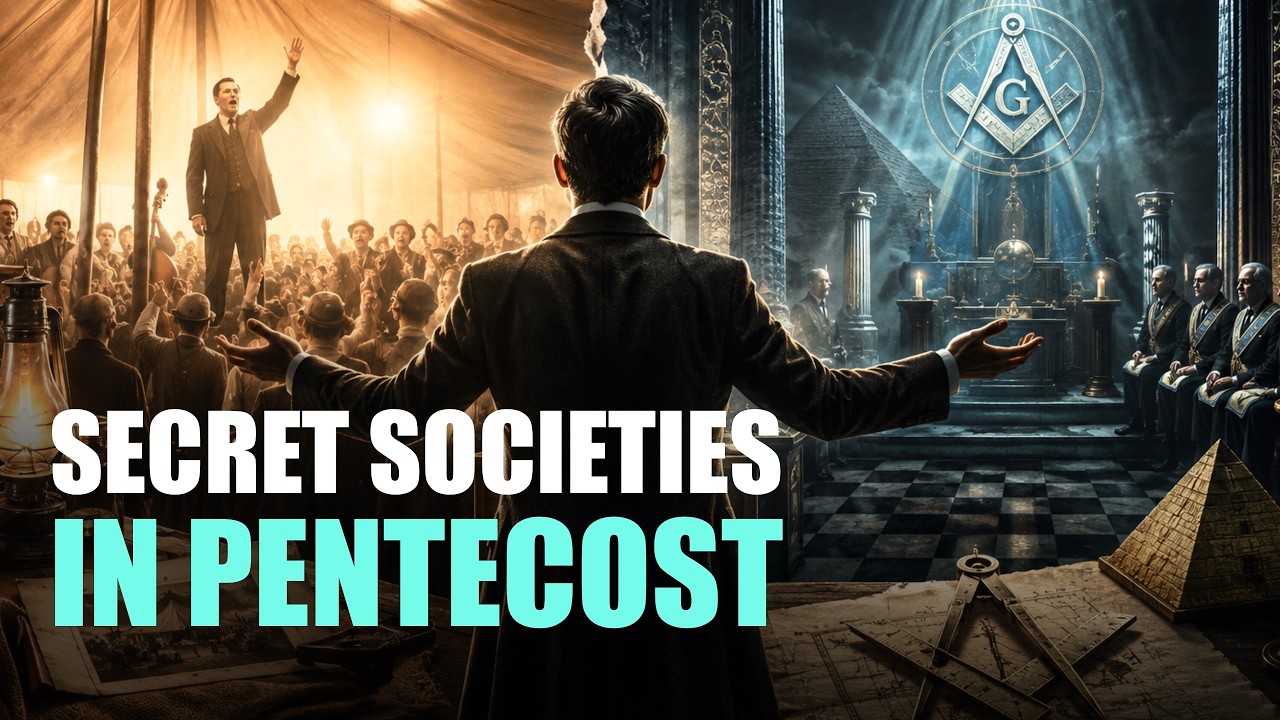
🔗 **Source:** [Did Pentecostalism Borrow From Secret Societies?](https://www.youtube.com/watch?v=0qC0IOgI8VI)
In the history leading to the New Apostolic Reformation, you have both sides. You have people like John Alexander Dowie, >> [clears throat] >> one of the key pillars of Pentecostalism, was very outspoken against Freemasonry. Charles Fox Parham, who is by many accounts the father of modern Pentecostalism, the projector of the apostolic faith he was called. Parham, there is some evidence that suggests that he was at least influenced by Freemasonry. He
mentions, I can't remember which book, you'd have to go look this up, but there is evidence out there that talks about um I think one of his own writings talking about a Masonic order of some sort. So, there's some evidence out there that suggests that Parham was a Freemason. Whether it's true or not, we'll never know because of the transparency. There's no way to go through the books and see was he Freemason or not. For Parham, Freemasonry was irrelevant. He wanted to be apostolic. So, you've got
[clears throat] both sides. One who's against it, one who did not talk against it and apparently was part of it. You [clears throat] have William Joseph Seymour who is basically credited to the Azusa Street Revival, the furthering of Pentecostalism. He, I don't believe was a Freemason. I don't believe [clears throat] many black people were parts of the lodges during the era in which he was
being recognized for the Azusa Street Revival. I think they may have had some black Masonic lodges, but by [clears throat] and large there there weren't as many as the as the white ones. I'll just say it like that. Now, >> [clears throat] >> William Joseph Seymour, he he's kind of in the middle of two sides. And there are others who are either in Freemasonry or have strong similarities. And it's the similarities that I want to talk through. Because of this, go back to Dowie. John Alexander
Dowie became famous in Australia being strongly outspoken against spiritualism and has this big series of debates with a spiritualist trying to expose spiritualism. And what does he [clears throat] do? He sees the power of that debate and he sees the power of interest in the supernatural, the mysterious. And he starts to transform his ministry into that of a Christian spiritualist.
And there are some newspaper [clears throat] articles out there that talk that advertise him as Christian mystic or something like this. You can read my book on Dowie and you can find exactly what it says. But >> [clears throat] >> the point is this, while being outspoken against it, he adopted principles of it with regards to spiritualism. And then it flourished and developed into this religious thing that is kind of in between both. It is it spiritualism? Is it Christianity? I
can't say which because it's a blending of the two. Well, he did the same thing in being outspoken against the Freemasonries. Does he have [clears throat] Freemasonry rituals? No. Does he have rituals that were uncommon to the Christians? Yes, he does. So, he creates his own rituals. He has Does he have secret I don't know handshakes or secret codes to gain these secrets? No, it's not a Freemason It's not a Masonic order.
But [clears throat] he creates loaded language that is very similar. It would be the Christian version of Freemasonry. So, what he has created and he wasn't the only one to do this. What he created had all of the things that Christians abhor with regards to to Freemasonry, he is doing them in a different way that slides through the the cracks. The people just don't recognize what he's doing until they get hooked and
assimilated into his religion. Parham, much the same way, I can't say that he went as far as Dowie, but he was doing many of the same things to the extent that if you study through the Parhamite murders in Zion City, he had people convinced enough of his spiritualism that he was actually he others who were under him were actually killing people in Zion City in the name of faith healing. They were trying to straighten bones, breaking people.
People [clears throat] were dying, etc. And again, Parham is not doing the rituals of Freemasonry, but he's having his own rituals that weren't quite kosher to Christianity. >> [laughter] >> I use the word kosher purposely. So, [clears throat] you start to see developing in early Pentecostalism many of the core concepts and constructs that would be appealing to a person who was a Freemason. And I think that was the purpose and
intent, at least by Dowie. Dowie saw that if I can [clears throat] take some group of people and the things that they're enjoying and demonize it and then do something similar, when they come into my group, they're familiar with it and so it makes them feel at home and yet they won't find it anywhere in the Christian world. We have something we have the secret. We we have we have [clears throat] the rights and codes and if you rise up through the ranks of my religion, you'll gain these
secrets. So, Dowie, I would say is very similar to it. Parham kind of midway, but [clears throat] with regards to Parham and with regards to um Frank Sanford, who was one of the other pillars that developed into Pentecostalism. What they had in common was Christian identity. And Christian identity had a different set of rituals and beliefs and weird things that when you read through it,
you just kind of scratch your head thinking, well, that sounds really Masonic. What are they talking about? When [snorts] you read through Albert Pike or any of the Freemasons talking about the supreme being, they often use phrases like the supreme builder talking about the building of the temples, how the different measurements, etc. That's a >> [clears throat] >> one of the fundamental so-called secrets of Freemasonry, although no longer is a secret. Well, in Christian identity, >> [clears throat] >> probably because of Freemasons,
the idea became widely accepted that the pyramid of Giza, the Great Pyramid of Giza, was constructed as a as a time marker of sorts that could predict futures because of its measurements. In other words, the great architect architected the pyramid and therefore we can decipher it, we who have the secret knowledge. And then they [clears throat] developed their own loaded language regarding the secret knowledge of this.
And I was quite shocked when I found Branham using that loaded language because he is taking part in the secret ritual of knowing the Great Pyramid structure, which sounds Masonic and that's actually what drove me into the pathway of studying the Masons. I thought that was a Masonic thing. It wasn't, it was more of a Christian identity thing., Did Pentecostalism Borrow From Secret Societies?, YouTube, 01ksrmv41yynbrre17dp71agma.