Economic Justice & the Special Mission Offerings
🔗 **Source:** [Economic Justice & the Special Mission Offerings](https://www.youtube.com/watch?v=TMJyD4vOK34)
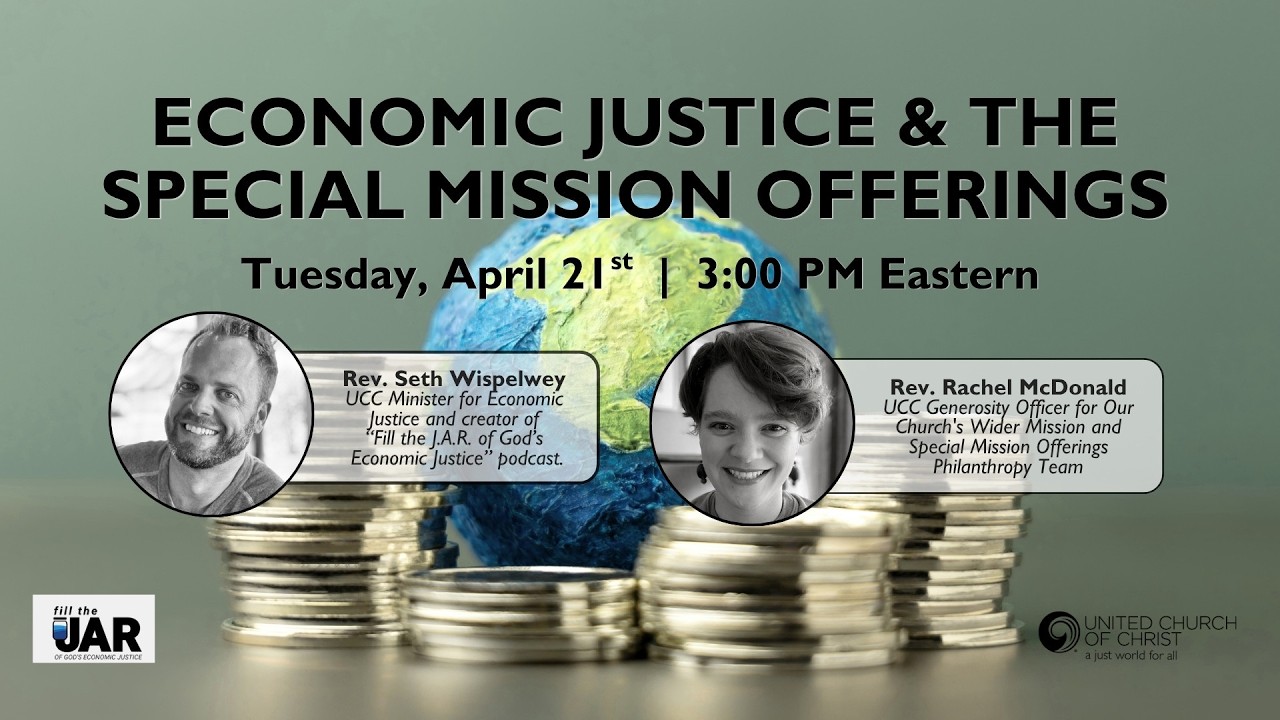
our webinar on economic economic justice and the special mission offerings. I'm so glad you've joined us and you're ready to learn a little bit about the intersection of these two very important things. But first, I would love to introduce myself. My name is Rachel McDonald and I am the generosity officer for our church's wider mission and the special mission offerings of the United Church of Christ. And today I'm here with my colleague Seth. Seth, would you like to introduce yourself to everyone?
>> Greetings and hello to everyone who is here online with us live and watching this in the future. I am Seth Whispullway. I have the privilege of serving as the minister for economic justice with the United Church of Christ national setting. Uh so I stay busy. Thank you for having me, Rachel. And I'm really excited that the two of us are able to be here together today to share on this topic. And we're going to
get started with our slides today. So you all can follow along and learn more about both of these topics and how we can kind of intersect in what we do. So this came together in part because Seth and I work in different teams in the national ministries of the United Church of Christ. Uh and in some ways that makes sense. our work, economic justice and giving and philanthropy are a little bit separate from one another, but Seth and I, every time we talked, we realized actually our work has a tremendous
amount of overlap and not just because it has to do with money, although of course that's a part of it. And so today, I hope that in what we share with you as we share part of um each of what we do in our work, you can see how whether your congregation is interested in economic justice, whether your congregation is a faithful supporter of the special mission offerings or maybe a combination of both of those things, you too will see the relationship between them and you'll find a way to kind of
highlight and support that with your church. And I hope that this webinar is a good training tool for you. Maybe your uh stewardship committee or your justice committee or however you organize at your local church, you'll find some avenue into talking about both of these really important topics. So, first off, I'm going to help teach us about the special mission offerings. What are they? What do they do? And how might they lead us into living a life of
justice? And here is my very first very important thing I want all of us to know and sort of claim. So the special mission offerings of the United Church of Christ teach us how to love our neighbor. I think this is the most important thing about these offerings because I might be coming you today and you might think okay are we going to learn just about fundraising how we can get more money for ministries and
perhaps but I think when we collect these offerings it stretches beyond being a fundraiser beyond something about just sort of gathering money for not exactly a particular purpose but because it shapes us as Christians to learn how to be generous and in that we learn how to love one another and love our neighbor beyond maybe just what our local church does on its own. To understand this though, and you might be already having this question. First,
what are the special mission offerings? I know about these because I work with them all the time, but not everyone knows what they are in the United Church of Christ. So when we talk about special mission offerings all capitalized like that special mission offerings in the UCCC we're talking about a very specific thing this is four offerings that were established from a general senate resolution in 1999 and these are four particular
commitments then in four offerings one great hour of sharing strengthen the church neighbors in need and the Christmas fund You and your local church might have other missions that you support and other special offerings, but in the UCCC when we talk about these, we mean these four specifically. And what's important about this being a general senate resolution is that it was an invitation to the whole church for everyone to participate in these. Um, it
was a really big deal to say we are committed together as the UCCC and we want to support these causes. And I'll talk a little bit more about what each of those four are in just a moment. But I think we have another important thing to learn together that will help us understand more about these offerings and how they overlap with justice. And to do so, I want to give a very particular definition of stewardship.
So perhaps in your local church, you are used to having a stewardship campaign. you get together and you set the budget and the intention and plan the mission for your congregation by fundraising, by sort of getting things together as a church to figure out what are your financials going to be as a church. And that's great. That's definitely one way we use that word stewardship. But I think there's this slightly different definition that comes from the book the
steward a biblical symbol come of age that was written by the theologian Douglas John Hall which I would highly recommend this book to anyone but this is a definition that kind of tells us that when we talk about stewardship when we talk about giving in the church we're actually talking about our responsibility to one another. So I'm going to read this quote and talk about it a little bit. This is a a little bit challenging, but I think it's important for us to know what do we mean when we are sharing our gifts with one another. Is it just sort of passively from far
away or what are we called to in our responsibility to one another? So, Douglas John Hall writes this. He says, "Against the concept of human sovereignty that modern industrial hubris taught us to covet for our species, the symbol of the steward challenges human beings to assume the posture of those who serve. And contrary to the retreat from the world into which we have been seduced by our failure at mastering it, stewardship challenges us to serve responsibly as those committed
to creation." in there. The part I think that's probably the easiest and the thing we want to hold on to is that to practice stewardship is to be in the posture of those who serve, to love our neighbor, to care about one another, and not just to sort of drop gifts from on high to people somewhere else that we don't care about, but actually to act in service of one another with the care and compassion that God calls us to. So when we talk
about stewardship, why I think this is important. When we talk about stewardship and offerings and all this financial language that might sometimes feel a little distant from things like justice, I think things like this call us into remembering that our gifts are about our relationship with one another and how we care for one another. So, if you're making a an announcement for a special mission offering, you're not getting up there and saying, "Hey, just please hand over your money because I don't know why. Maybe this is a good
cause and we hope you will support it." We say, "I want you to participate in this giving because you will be changed. You get to take part in this act of justice and compassion for our neighbor." And it's not just about who we help, but it's about how we as Christians um are also a part of that transformation. That's a lot so far. So, keep thinking about it. And if you have questions, please you can always add them in the chat. I would love to answer.
But I'm going to go through our four special mission offerings now a little more in depth and talk about how they might be examples of this love and stewardship and how that kind of points us toward justice. And this is the kind of thing that I would call up Seth and talk about and say, do you know how our offerings are really about this economic justice that we talk about? And so we have one great hour of sharing. So, one great hour of sharing for many congregations
that is our spring offerings often during Lent, although you can take any of these offerings at any point in the year as your congregation would like to. And one great hour sharing is about development and humanitarian assistance all around the world. Sometimes through things like disaster relief and other times in things like that we think of in terms of like education or infrastructure. And one great hour of sharing is a great encouragement to us to think of our neighbor as not just people who are
close by at home but of course our neighbors are those all around the world. One great hour sharing also has this element I believe of justice in the way that it works closely with partner organizations. So, we tend not to drop in and say, "Here's the help you need." Right? But we have true partners in relationships, whether domestically or internationally, where we get to hear what people need and respond appropriately. We're meeting them as
partners and we're coming to them again as stewards, as people who want to serve and care alongside them. And I think that's part of what has made one great hour sharing so popular for so many years. Our second special mission offering is strengthen the church. And if you're coming to this webinar in the spring, you might be looking towards strengthen the church as many congregations collect this on Pentecost Sunday. Um, which this year is May 24th,
but again, all of these offerings can be shared at any point during the year. And strengthen the church is about blessing new initiatives in the church. So sometimes that takes the form of leadership development or youth and young adult ministries or funding new church plans and it is also shared between your conference and the national ministries of the UCCC. And what I like about strengthen the church is it is an opportunity for
congregations to think about how they not only support their own local church but maybe someone else's church. And again, this comes back to are we only to serve or care about or love the things that are closest to us? But I think it's actually pretty radical when we support one another in our churches, maybe in a location that needs uh a new church community or maybe in a way that stretches beyond what we have already established. And so you can see our kind of new
little strength in the church logo has a little bit of that Pentecost flame really pointing to what might be possible when the Holy Spirit comes and blesses and guides us. The next offering is neighbors in need often collected in the fall maybe the first Sunday of October. And this is an offering that is shared with one-third going to the Council for American Indian Ministries and twothirds to um things under the Justice and Witness Ministries umbrella. So that might mean uh the Washington DC office of the national
ministries or teams like the one Seth is on teams that really outwardly and clearly promote justice in a variety of forms. It also helps fund the neighbors in need grants which allow local congregations to take on their own initiatives of justice. And I think of the special mission offerings, if you ahead of this webinar were like, which special offering really aligned with economic justice, neighbors in need probably is the one that is the clearest and the most on the nose. It is really the one directed toward justice
initiatives. But again, I I'm happy for this webinar to kind of encourage us to see all of these offerings as a point of overlap and not just say, "Oh, this is the justice offering and none of the other ones have anything to do with with that." you know, they all have a purpose in this way. And so, our final offering is the Christmas fund. And this is an offering that is run by the pension boards and it helps support clergy and UCCC employees who are in need. The
Christmas fund is unique among the offerings in the way that it really supports other individuals. So, it becomes more of a peer-to-peer giving. Um, often it's clergy supporting other clergy, churches supporting uh the clergy they know and love when they are in need. And it helps sort of remind us again of how do we care and how do we love for one another. Um, and I think is a really powerful witness of what it means to care for one another in that way. And I actually know um Seth has a
story about the Christmas fund that he was willing to share with us. Seth, you want to tell us a little bit about what you know and love about the Christmas fund? Sure. Thank you, Rachel. I'm really grateful for the opportunity to put a little specificity on the beauty of each of these offerings, having had the opportunity to pastor a local congregation in the United Church of Christ. Um, I got a much more upfront look at how each of these is or is not
engaged often locally. And then very personally, uh, the Christmas fund had always kind of just existed as that must be for those people who need it when it happens. But for me, I was nearing the end of a intentional interim ministry season um that was walking a congregation through the height of the COVID pandemic while also juggling some pretty extreme ongoing activism work uh from a previous
bit of uh time in on the east coast and I landed in the hospital uh for almost two weeks with a life-threatening medical events that came about because I had like a lot of people um but very much like a lot of pastors ignored and/or downplayed um increasing pain and warning signs for almost two
and a half years. And meaning like a lot of pastors and like a lot of folks, I I was too proud to ask for help, going too hard, uh thinking I I needed to prioritize what everyone else needed, uh a lot of stuff I've worked on since then. Um and while I'm very privileged then and now to have health insurance, um uh health insurance is not universal
healthcare. We don't have health care in this country. We have health insurance and with that health insurance. Uh came a pretty big uh deductible. Um I had to meet. Uh but that this medical event definitely made sure I was going to meet. Um I had to spend up to $5,000 uh before um the insurance company would fully uh start to cover the rest of my bills. I do not have I did not have $5,000 lying around. And this is when a
colleague very graciously invited me to consider applying for help to the Christmas fund. And then it became very real as those medical bills started piling up. Um, and through a very simple and direct and loving application process, I was granted money to help pay down uh a good chunk of those bills so that I might continue in ministry um and seek ongoing healing and care and therapy for the traumas I had uh
experienced. So, um I feel like honored, humbled to be able to share that story. definitely not proud uh prideful anymore about seeking help or saying this is what we need because we need each other and that's a big piece of what I'll speak about a little bit later in this webinar about the interconnectedness of these special mission offerings in the life of the church and the life of the world and in how we serve uh and steward our resources towards life. Uh but they
really do um help people. I I used to be able to say like look at the story of how we help people but they've they've really helped me. I I would not be here uh with the relative stability I have without these special mission offerings and I'm grateful for that. That's an incredible testimony that I'm grateful that you are willing to share stuff because I think it's important. Uh part of what I see as the justice throughout all of these is that when we
come to these special mission offerings as folks in the UCCC, we don't do so thinking that these are sort of dispassionate causes that we are not connected with that there's no relational sort of connection or um anything that's sort of required of us beyond maybe writing a check occasionally. All of these really represent genuine commitments, genuine relationships and the sense of togetherness that I believe is at the heart of justice. That doesn't say that there's an other out there, but it's all of us together. And again, they do so in
different ways, but I believe it's a a powerful witness. So again, we have one great hour sharing is our first offering of the year. And then strengthen the church, neighbors in need, and the Christmas fund. So those are our four special mission offerings. I want to make sure that it's extra clear that these offerings are not just to benefit your church. I think this is again one of the greatest formational
ideas of these offerings. And I know this might seem so simple, but I think it's very radical. They're deeply not self-interested. It is this sense of generosity and care for others. And so I believe that these offerings, part of what they do is they grow our sense of responsibility for the world beyond ourselves. They model a stewardship that cares for the whole world. Again, not just the people in your pews. It loosens our ownership of resources to being uh you
know just for us. And it builds relationships with the networks of ministries. So I list this out again because thinking again of your church, your context, uh the offerings might fall under stewardship people or maybe some treasurers or some you know people who are really good at sort of the uh financial accounting of your ministries and your church and this kind of language talking about it might find more of a home with again your justice folks with your folks who really want to make a difference in the world. So knowing this overlap that the offerings
really are about this purpose and sort of service for one another, I did want to make sure to show you a way of understanding these offerings um in this particular uh way we've organized them for this year. So to help tell this story of the offerings, we have been saying that the offerings are part of this year of love and each of them have been themed this year to show this love. So you can see
here what has been really helpful is the short snippet that again describes what the offering does and also the theme that you can also use to help describe it to your congregation. So much of the success of these offering rests on the storytelling abilities of our local churches. To be able to connect what these offerings do with what matters to your church. And so being able to see this and tell that story quickly and clearly I think is a great help hopefully to you to continue
to pursue these allurch commitments. And I want to just start to end my part of sharing about the special mission offerings by talking about how lovely and radical the success of these offerings have been. So if you didn't know, each of these offerings has raised millions of dollars over the 25 years that they've been in existence in sort of aggregate. Um several of the offerings raising over a million dollars each year since their sort of
beginnings. And yet this has not been done in the UCCC because we have had sort of a set of ultra-wealthy donors who are have decided to give to these offerings. I suppose if we have those out there, you know, welcome, come on in, come learn about economic justice. But in fact, our pattern of giving that we have is that uh we raise this amount of money through small grassroots gifts. It is our thousands of congregations each chipping
in a little bit to make a major change in the world to really try to shift um some injustices in the world. It is in fact thousands of UCCC congregations participating each year. It is one of our uh most sort of shared commitments in the UCCC. We have a lot of diversity across our church and a lot of congregations that do things in many different ways. The special offerings are one way we sort of act and come together and move as one. And we can really see the outcome of this. Because
of this, because of these relationships and this movement of churches, I believe they have been relationally transformative for us in the life of the church. I believe that they have helped connect people to causes bigger than themselves. And I think it helps us understand that to take part in shifting systems again is more than just occasional dispassionate gifts, but is part of this ongoing relationship built decades in the making. Um, and done with
this sense that each of these offerings is an invitation for connection and relationship and to stretch beyond what we might be able to do on our own. really practically, I think something about the yearly cycle of these offerings, like it said sort of back here in this year of love has helped kind of set that out for congregations to remember to take part in this and to learn from this year after year. Um, and so I want to kind of leave that as the
invitation as I invite Seth to share more about his ministry with economic justice to say we have so many congregations who already take part in these offerings. Maybe these dates, maybe these offerings are an invitation to your church to talk about these things to say, hey, how can we dig in more and say, what does it mean to do charitable giving, but what does it mean to be in relationship? And what does it mean to think about what our me money means in terms of our faith? And how are we part of something bigger than
ourselves? Each of these dates are an invitation to have those conversations that maybe you're already doing in your congregation. And so if you have any questions about the special mission offerings, again, you can put them in the chat now or we'll take some time at the end to talk a little more. Um, but hopefully that gave you enough of an overview to know who we are and what we do with these and also to start to see how this might overlap with some of the work that Seth does and how you might make those connections in your own congregation.
So, I'm going to hand it off to you, Seth. >> Thank you so much again, Rachel. I am so glad to be here and doing this with you and all of you participating um because these things are so important and so lifegiving and life affirming especially in these exceedingly trying times but also personally Rachel and I have found as colleagues even though we're on different teams that we think and operate very similarly. And I think uh what I love about the presentation
Rachel just gave is that it walked us through a funnel of first wait why do we have these in the first place? Again, having pastored at the local congregational level and you know a church that had had a rupture with a previous pastor and was searching to find their way again and looking at their budget and can we keep passing deficit budgets. Sometimes the first things they'd raise like wait what's one great hour of sharing? What's this? again. And so I love the work of reinforcing no why we do these special mission offerings is because of the
larger story we're a part of and the way it weaves into the fabric of our shared uh church family and humanity. And we move from why into okay, how do these things manifest? Well, through things like the special offerings. And then what can we do? What are the hallelujah mo moments where it always clicks? Um, and those are those four dates throughout the calendar year. These these guideposts that we can hitch uh our story to to be part of the ongoing
uh fabric of God's community, the I'm mixing all my metaphors as usual. uh but these guideposts that we can hitch our our traveling uh journey on um onwards. Um, in between those hallelujah moments where we give, where we steward, where we see the fruit of our shared resources and and riches together are the inhalations and the exhalations of our time on this earth, our time together in
community, our time seeking uh the kingdom, and our time very much seeking God's justice. And I'll be the first to say uh economic justice uh as a portfolio of work to be charged with manifesting in the wider denomination, but economic justice just in general is everything. It touches everything and everything is economic justice. And so, um, if I tried to play whack-a-ole on
any given day with addressing, um, all the injustice in the world and trying to empower folks to address it, I would be spreading myself a mile wide and an inch deep. So, a lot of the ways I think similar to Rachel is what is the why, what is the how, and then what is the what that we can all engage in while recognizing um that each and every person, each and every church, each and every context and region and community is decidedly
unique. And that's also what's so beautiful about how we organize ourselves in the United Church of Christ. So bear with me for one uh not mixed metaphor which is I understand the pursuit of economic justice into which these special mission offerings also uh live as um working in the river's flow. We the river of life and everything that's happening is always flowing in different ways. And where we find ourselves in the river's flow, for the
sake of this analogy, um where we find ourselves in the river's flow as people of faith and conscience, as people of in communities of faith and conscience, uh can always look different. Um and there's no wrong way of engaging with the river's flow. Um, and I've kind of named for myself and how I organize my own work. Uh, but also, uh, where folks are relationally and moving through the world, uh, four different parts of the river's flow. And, uh, the first, and
again, there's no wrong way. We're always in different phases of life, um, both as church communities and as individuals. Um, but the first is, uh, some folks just need to rest on the riverbank. Uh and in the United Church of Christ, a lot of folks um are sometimes coming from more spiritually violent traditions are experienced a lot of hate and rejection and they say, "I want safe space to be affirmed that I am
not alone." and prayerfully uh the United Church of Christ uh with our professions of extravagant welcome derived directly from God's expressions of extravagant welcome and affirmations that you are worthy of so much love uh can be that place and the river's flow is where nutrients are brought down from um the mountain or wherever the river head is and tossed up on the banks and in a lot of ways recipients of um special mission offerings
um are on the river banks being fortified and affirmed in the different ways and specificities. Uh the second way that folks can engage with economic justice or any other thing um is by waiting into the water and often I associate this with uh uh going deeper into why locating naming our our space. Okay, the water's cold. Uh the water is getting this deep. Um this is relaxing everything. We're disciplehip is what
some people might call it. Better understanding uh where we are in relation uh to the current and the world and looking ahead at uh where we might go deeper. And so another way we can engage in the rivers flow is to go tubing. You know it's not too crazy but we are acknowledging we are getting into the flow. Uh if you've ever gone tubing, uh sometimes you can tie the tubes together and that's a way to enjoy and and participate in the activity together. And a lot of times
this can be uh charitable uh work, direct hands-on work um that a lot of our churches uh and you all participating this call have no doubt participated in before. uh it can be the special mission offerings, it could be sewing into them, building up the stories of where the need is um and going down together and recognizing we are collecting this and we are flowing together. Uh the final uh way of
engaging the river is often to go whitewater uh rafting or whitewater kaying um whatever uh you might associate it with. And this is uh oftentimes uh what I associate with direct action. Um and so it's for folks who are um trained up and ready to really get hot and heavy with tapping into the sources and the churn of where injustice uh comes from and navigating folks safely through that uh through any
variety of means. Um, but it can also be some of the more uh extreme uh direct actions like showing up in the face of danger, uh, linking arms, you know, to combat um, ICE. Um, you didn't hear this from me, but it could be burning down a data center uh, that are ravaging our communities um, environmentally, uh, ecologically, economically,
um, that sort of thing. Figuratively, of course. Um, so standing on the river banks, waiting, tubing, whitewater rafting, these are always options we have as individuals and communities to engage with the rivers flow wherever our passions um and the spirit guides us. I love what Rachel said about how we connect these offerings with what matters to your church. we always and ever here at uh the national headquarters of the UCCC want to come alongside where you are at
and that's also very much what informed my own platform uh which I've called filling the jar um of God's economic justice like I said everything is economic justice and vice versa um there are so many ways to access caring about people's needs and only you know specifically what your direct community needs the most. We come alongside many global partners who tell us stories that connect to our larger bit of life
because of course all life on this earth is interconnected and interdependent and everything in between. And so the way I make sense of it and and and keep focused every day, but I hope makes a lot of sense to you is um by saying we are called to fill the jar of God's economic justice. And because I was an English major and I love word play, JAR is an acronym uh for the three big buckets of justice that God cares about. And these buckets uh overlap with each
other. They are concentric, but they also hold any given issue whether that we might be scandalized by in the headlines or care about in our own communities. I believe any issue of economic justice and the needs and resources we have uh to address them can fit into either the jar of jubilee which is the cancellation of debts. I you know I shared my story uh in regards to the Christmas fund. The
United Church of Christ has led a medical debt cancellation campaign in the recent past where churches for pennies on the dollar were raising money to abolish millions in um medical debt nationwide. Um a beautiful example of how we can address direct need and then also systemic need and and then raise questions kind of to go wading in and say, "Wait, why do we have medical debt in the first place? This is Antichrist. God desires our full uh thriving because
when we have our material material needs met, that is when we are most spiritually healthy uh individually, communally and collectively. So filling the jar of God's economic justice means filling the jar of jubilee. This is called for throughout our holy scriptures and and through the prophets um ancient and modern. Uh filling the jar of abundance. Uh this is also done through the special mission offerings. uh the abundance of saying recognizing
that the way uh our economic systems and the powers that be have structured thing is preventing people in spite of having all the resources necessary for every single human being and animal to live a thriving life recognizing that these things are held back uh that they are stolen. And so the jar of abundance is to push into u making sure that people have their material needs met. These things that God cries out for that uh breathe throughout scripture that are
not separate from um uh loving and naming God as the great liberator of humanity but saying this is actually intrinsic to who uh God is. uh whether it's food, water, housing, health care, uh safety, and more. And then finally, the R and J is for reparations. Recognizing that so much wealth and resources have been stolen um by uh people in power for racist and
capitalistic and and violent uh reasons um over centuries. and that we cannot and will not be whole until there is um a reckoning and a return um and a rebalancing of of those resources that this is directly connected to the other two. And again um this is connected to um a partnerships we have and for example our neighbors in need offering and one great hour of sharing. But my hope is that understanding we're in the
river's flow. There's ways for all of us. we're always in some position and then that these are the jars into which we can put our efforts kind of helps clarify where I come from um in this work in connection to the special mission offerings when I'm inviting people to get involved like here are the opportunities I don't try to overload people with uh options but I say wherever you are you do have options and when we claim that this still speaking
God is living and loving us into this life and has a lot of very strong things to say um about how and where and if people's material needs are met. That lays claims on us. And so these are invitations into saying rather than getting overwhelmed, it's very understandable be overwhelmed by just the cascading calamities of injustice like what do I do? I don't know what to do. Where do I turn? There are ways and opportunities. And
I'll be the first person to say no one can be responsible for all the things all the time. Uh so if it helps turn off half the notifications you get on your phone. Um if that helps your mental health and say where is God speaking to me? Where is God speaking to our community? We can care about all the things we see and hear about. But what are the two three deep grooves tops that we as individuals and communities of faith can sew into? Let's set ourselves measurable goals. This gets at the what, right? Um the what of how we respond in
faith. And those things can look like a waiting option, a tubing option, and a whitewater option. And that's how I structure my work. So maybe the waiting option is like we're going to go deep into a book study um to better understand how things are interconnected. I am working on I'll get to this in a later slide currently with uh a colleague um on the concept of mutual aid uh so that churches can go
deeper into understanding our interdependence and solidarity with each other that pushes us beyond charitable uh simply charity mindsets, excuse me. Um maybe tubing looks like uh all right, we're going to set ourselves a goal. Um look at the impact that the neighbors in need offering or one great hour of sharing. what if we as a church pushed um to to raise this by this particular date and lifted a story? And that's something we as national staff can help you do. We'll get that story told not
just in UCCC media, but in your own local media. Because what Rachel and I have both found is that when folks in our wider communities are so hungry for the extravagant welcome that we say and often do provide in the United Church of Christ, they're hungry to hear about it. So something we can do is help tell that story and they'll be like, "Oh my gosh, look at these folks over here practicing what they preach. I want to be a part of that." Because people are hungry for belonging. Everything in our uh system
of racial capitalism is meant to disconnect us from each other, to make us feel isolated, to make us feel like we don't belong or aren't worthy of love. We can be an are antidote to so much of that with a story to tell. And then maybe the whitewater uh option, I should switch there, is to set ourselves advocacy action goals. Um what you're looking at is a slightly outdated in process of being updated um part of my
own website under ucc.org uh ucc.org/fillthejar. Um I'm you can see it says join the 2025 fill the jar campaign. Maybe whitewater rafting means coming alongside setting self's goals for action. I'm I'm currently crafting in uh collaboration with the Coalition of Amachi Workers, for example, uh who the United Church of Christ has supported for decades, a campaign that's going to really materially uh concretize
uh specific goals for congregations to come alongside the CIW as they work to uh get additional corporate partners invested in farmworker rights, greater wages, and all these other things that they've succeeded at fight in fighting for over the past uh two three decades. Um and so that can be the what of how we channel our campaigns. And I I developed these things not in a vacuum vacuum, though I am passionate about them, but
from listening to churches, listening to lay leaders and pastors like yourselves saying, "Hey, we want something to sink our teeth into very specifically like that medical debt campaign I mentioned previously." And to surprise ourselves with what comes out of that. And so maybe waiting in the water means inviting the farm workers into a couple teaching sessions that they have offered um and will soon be live on the website um to sign up for. And then uh the um the tubing option if you're part of that
campaign. See, even within the these analogies, there are more ways to break it down. Um it could look like um okay, our our our uh our church is only going to buy produce that is fair food certified, the guaranteed abuse. Um let's make sure we're doing that. And then the whitewater option uh can be advocating uh to Kroger or Wendy's that they join the fair food program. So I'm running through a lot. You don't need to learn or memorize all this now, but this
is these are just examples of the ways that I believe participating in the story and the hallelujah moments of fundraising, which is not just fundraising as Rachel said, but raising funds to steward our resources, finding out that we are richer than we even believed in sewing that forward is also part of inhaling and exhaling through these other actions and opportunities in the rivers flow that are always and ever complimentary. Um what I find beautiful about that
compliment uh is is a beautiful thing to have. We often talk about it when we like find an affinity with someone whether it's a friend or a romantic partner. We say oh we like the same things we like the the same movies and everything. That's important where these are the ways uh our work and our lives complement uh the faith we profess. Um but deeper than that and that's true we could say wow we profess this faith and we come more alive wow it's complimentary it's
exciting when we like the same things like hey god loves economic justice I like economic justice you're sinking there but underneath that is uh uh I think even our deeper calling which is to be supplementary um complimentary is good supplementary is the deeper calling of locating ourselves in this wider story that goes deeper into um oh yeah, there we go. That goes deeper into
um our connections with one another because we are here to belong to one another in our journeys earth side um and and to find liberating life um not to react to injustice but to respond and to say no we have a story to tell. So we are complimenting when we find ourselves um uh in sync with uh responding and we're supplementing ourselves and enriching our lives when we do it together and and start to build a
unifying story around that. So what's ahead for 2026? I spoke about this a little bit um and I want to just kind of that was the slide I wanted to get to. I spoke about both of these things. I tried to put a little zizzle zazzle on the uh uh slideshow with a picture of myself as opposed to just a book cover. Um but I want to underscore what I'm saying about um supplementing our lives together um
uh by reading the Wikipedia. So, you know, pretty ba neutral base um source the Wikipedia definition of mutual aid. And this isn't just because I'm working on a curriculum uh to launch later this fall around it. And I do highly recommend uh this book because and it's very short. Here it is right here. See, I've dogeared every page which is actually not helpful uh because now I don't know what I'm looking for. Um um but I I'm I'm wanting to talk about
this because I to to close out everything I'm talking about because as cascading calamities come that I'd love to be wrong about but food prices are up 30% just in the past four or five years. Housing is grotesqually out of reach for too many people. Uh, nowhere in the country is there a living wage paying enough to afford um uh with just one job um a two-bedroom apartment at a minimum um for for too many folks. Debts are
skyrocketing. People are increasingly turning to gambling because we our lives are being gambled with um and so there's understanding there. Um all of these things uh right oil prices, gas prices and so on. I strongly believe that a spiritual and literal um understanding and practice of mutual aid can help supplement everything you've heard here today about why and how special mission offerings
are so important to our inhalations and exhalations as people of faith and conscience, but also give us um faith to keep going when things get overwhelming. uh good keep going in campaigns like I'm trying to create and steward uh for the denomination but anything and everywhere where people are doing life affirming work I promise you that if you're not already familiar with the concept of mutual aid this new uh old practice uh really as ancient as uh uh humans have
been on this earth figuring out a way to cooperate and collaborate together that even if you aren't familiar with the term itself it's going on um in your community um in beautiful ways and as you'll see in a moment probably going on in your church you might just not know it yet. So from Wikipedia, mutual aid has traditionally been an organizational model where voluntary collaborative exchanges of resources and services for
common benefit take place amongst community members to overcome social, economic, and political barriers to meeting common needs. Mutual aid can include physical resources like food, clothing, or medicine, as well as services like breakfast programs or education. These groups are often built for the daily needs of their communities. But mutual aid groups are also found throughout relief efforts such as in natural disasters or pandemics like the
CO 19 pandemic. Voluntary collaborative exchanges of resources and services for common benefit. And there are many definitions of mutual aid because it takes on new faces in new places. Um, but I hope what you heard in there, you know what that sounded like to me? It sounds like church or church when we're being at our best. Um, there is so much need out there. But when we get together in relationship to collaborate to meet
needs and responds, we do together wonderful things. our what matches our why and we know how to do it together and we see that in a lot of the ministries of the United Church of Christ and the local church and prayerfully that's what I'm also able to offer complimenting the work and of of Rachel I hope that anyone who participates in any of my campaigns tacks on a goal of uh supporting neighbors in need uh last year's
campaign which is ongoing now was revitalizing Labor Sunday neighbors in need comes a month later. So from the pulpit on Labor Day weekend, you can speak about these ongoing rolling uh moments. So thank you for listening to all these things as I wandered my way down the river's flow of this work um and this opportunity again, Rachel, to share with you all. >> So I'm going to hop back in here and just make sure that we offer this either
for now or in the future. That's why we've included our emails here. Um, if anyone has any questions, both Seth and I are here to respond to those again today or into the future. But I wanted to share a story of how recently I was at a clergy training here in my local association here in Ohio. And part of this was uh a little bit of analysis of ourselves and our personalities and sort of the gifts and the things that we felt confident about. And in this group of
clergy, our sort of weakest area tended to be talking about finances and money, which I think is not uncommon across the life of our church that sometimes talking about money, whether it's giving or your own budgets at the church or whether it's about economic justice, can be a challenging topic. So, one of my uh things I took away from hearing that and sort of remembering that this is a challenge often for our churches is that hopefully what you heard between what I
said or what Seth said was some invitation that felt maybe more comfortable or a path to talk about money and what that means for our faith in your church. Maybe some of uh what Seth sort of brought forth as sort of ways to jump into more sort of action and advocacy. Maybe that's more familiar to your congregation and that's a way that you can invite people along. Or maybe you're a congregation who's faithfully been given to one great hour sharing for decades and decades. And so
that becomes a moment for you to offer that invitation. However you find that in your local church, because of course in the UCCC we are wildly diverse and how we are and and sort of what our gifts are that we bring. Um, I hope that you hear that invitation to participate in these things and I genuinely hope that it is a blessing to your church. Uh, one of my great commitments with the special mission offerings is they are not just an ask to congre congregations, but it's
also a gift, a moment in time where you can feel a part of something bigger than yourselves and know that you are part of loving the world in the way that God loves it. So, I hope that you heard that invitation loud and clear. Seth, do you have any sending sending words or sort of blessings for our UCCC friends? >> Sure. Thank you. Um, you know, assuming there aren't any questions, I was starting to uh type
this into the chat, but I'll just say it. um a crucial aspect um that I alluded to of mutual aid um that I think is already in the DNA of most all churches maybe without knowing it is the recognition that you have resources um beyond what you might think. Um money is definitely one of those resources. Um, but it's also the resources and asset mapping you do when you kind of
shift out of a kind of charitable mindset of like, well, here's where the need is and we're the needers and these are the needers is to say like, wait, everyone has resources and riches, skills, experiences, education, um, wisdom ways, um, and more. skills could be gardening, uh cooking, uh ability to give a ride, um and so on. And when you add those up and put them into conversation with each
other outside of like, well, I have this need and you have this need and everything, but just say like, we're in community. How can we meet each other where we're at? Beautiful things happen. And so many churches and from personal experience do this already. They they offer rides to one another without questioning, right? They offer food to one another when they're in need. Um what I'm interested in moving forward is how we can understand our resources including yes um money in a way that says like let's just say yes uh to the to the
people we're in relationship with around us and those relationships include um our partners uh locally, nationally, globally without worrying about what comes back because we are part of this web. It all comes back because we're part of it when we lean out in faith. So blessings to you all. Um and may you continue to be blessed with uh with holy discomfort at um uh that which is outside of God's vision
for humanity and holy comfort that you are not alone um in addressing these things. uh we're here and um we can also plug you into communities and opportunities uh to steward um ways that they'll help you feel even less alone. >> Thank you and thank you all for being here. Um I'm so glad that you were able to join us. And uh yes, just to sort of
wrap us up, I see this where and how the neighbors need offering is distributed. Let me just add that final clarification because that is a great question and thing to know about. One-third goes to the Council for American Indian Ministries which is a long-term partner and sort of internal member of the United Church of Christ and then twothirds go to national ministries of the UCCC under the justice and witness ministries umbrella. So that includes the team that Seth is on, education for
faithful action ministries and also our Washington DC team and also it helps fund within those teams a neighbors in need grants program. So it is somewhat dispersed but in that it allows a lot of partnerships both sort of locally and nationally and allows us to respond to a whole variety of sort of justice concerns. But if you have questions about these offerings, where they go, if you have questions about how to join in with some of Seth's work, um please, we
would love to talk with you more because again, it's really about you and the work that you do in at your local church. Um that's who we are in the United Church of Christ. So may God continue to bless us in our work and in our growing of abundance and I hope to be in touch with many of you very soon. Thank you so much for joining, Economic Justice & the Special Mission Offerings, YouTube, 01kptx6q7sahnbsanm39vv0qyb.