Emotional & Spiritual Care Resources, Post Disasters
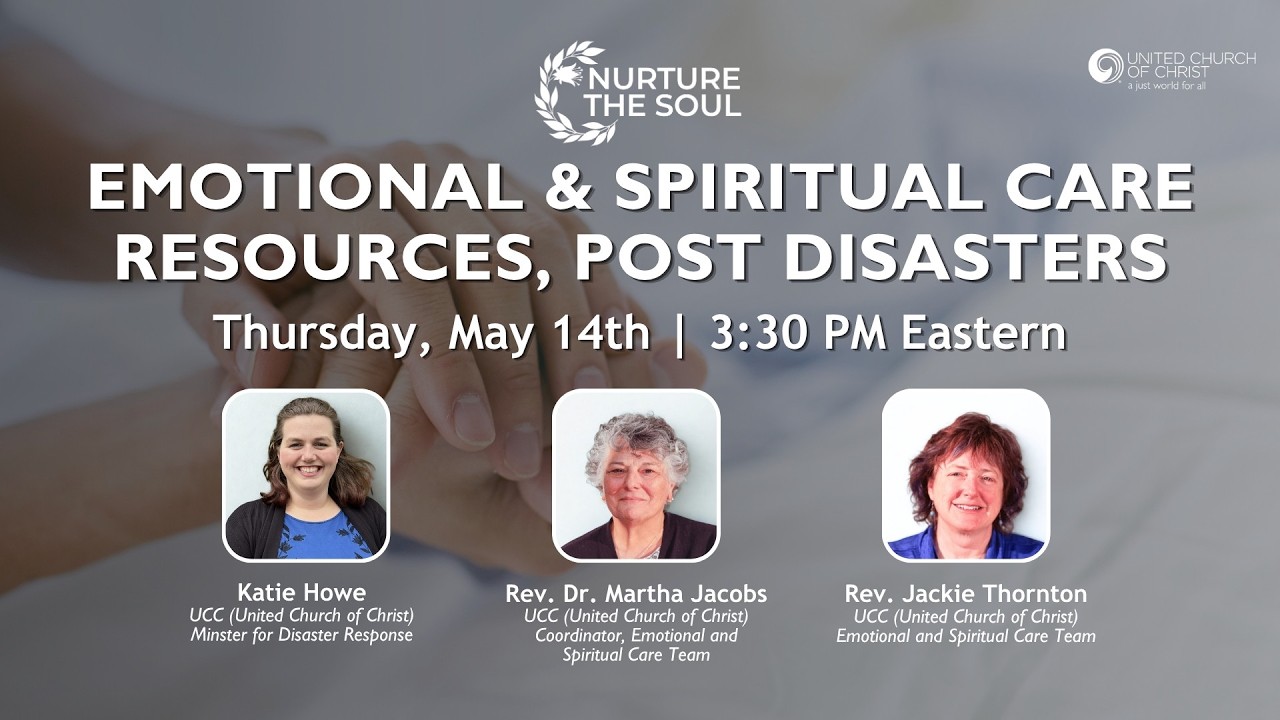
🔗 **Source:** [Emotional & Spiritual Care Resources, Post Disasters](https://www.youtube.com/watch?v=XwV2WUcYkwk)
Everything that I am, I am becoming is sacred and holy. Spirit is with me. The living God is forming. Creator is
making, weaving and painting, singing and waiting. And I will be free. I will be free. I will be free. I will be free.
Everything is holy when we are growing. We honor the journey of life where a soul can find nurture a person belong. No matter who or where they've come from, everybody has a common song. We will be free.
We will be free. We will be free. We will be free. We will be free.
We will be free. We will be free. We will be free. We will be free. We will be free.
Hello and welcome beloveds to Nurture the Soul. I am your host today, Reverend Ellie Hutcherson. Nurture the soul is a weekly webinar series that centers curiosity and care by providing a multitude of resources to engage with the critical topics facing our communities right now. I am your minister for congregational and community engagement. I'm a part of
the Faith Info team and today I have a blonde short pixie haircut with um black rimmed eyeglasses. I am wearing a green linen blouse with a high collar. That was a quick change cuz I just spilled coffee on what I was wearing before. Um, and I am in front of a blue screen that has our UCCC logo in the corner that
says a just world um for all at ucc.org. Beloveds, we hope that this is a virtual space that cultivates a curious and loving community and that you join us every Thursday at 3:30 p.m. Eastern time for Nurture the Soul. And from time to time, you'll find special offerings. You can find a full list of our upcoming digital programs from the national
ministry setting at ucc.org/events or on all of our social media platforms. Before I introduce this week's guest, I'd like to remind you of three features that can be found at the bottom of your Zoom screen. The first one is the chat feature, which is a dialogue bubble. The second is a Q&A feature that is also a dialogue bubble with the question mark in the middle of it. And then finally, I
see so many of you using this already. It's our favorite. It's the react feature, which is in the shape of a heart. When you hear something today, we hope that you use that reaction feature because it lets our speakers and our guests know how much it is that one, you're paying attention and two, what they say, um, how it made you feel. Today, we are joined by members from our disaster ministries team, and I am so
excited to invite them. Katie, uh, Reverend Dr. Martha. Yes. and Jackie, please come on to the screen. So awesome to have you all here today. I am just curious, how is it with your soul and your body? >> Thank you. Um my name is Katie How and I serve as minister for disaster response and recovery with the National Ministries of the United Church of
Christ. Um, today my soul feels grounded after a season of busy work travel and fun travel amidst finishing up my Masters of Divinity degree. Um, I'm feeling grateful to be back in my routine and grateful to be back in kind of settled in my work again. >> And, uh, I'm Martha Jacobs. I am the coordinator, the volunteer coordinator for Disaster Ministries. And my soul is feeling really good. Uh it's always wonderful to be able to do something
like this and share the work that uh our team uh brings on behalf of the United Church of Christ to those who are in need. And um my body is also feeling good. >> Good. >> So >> I'm the Reverend Jacqueline Thornton and I am a member of the spiritual and emotional care team for the United Church of Christ. Um that makes me feel good and so I'm kind of excited to be here today. >> Oh, thank you all. so very very much. Yeah, I'm I am feeling a little
flabbergasted, right? My body is like all out of breath because I had to run and go switch shirts real quick and come back up to the office. So, I'm like got all the cool things. Plus, it's 100° where I'm at. And so, here we are. Um, but I am happy. My soul is full because I get to be alongside each of you. And so, I'm actually going to turn it over to Katie. Katie, I know you have some things to talk about, but leading into that, um, I want to remind everybody you
can use the Q&A feature at any time. We'll have an opportunity, um, to delve into those deeper questions. And if you don't come up with any, then you have to listen to my questions. So, you better fill that space in. Uh, but Katie, I want to first before turning it over to you, ask you, can you tell us a little bit about what Disaster Ministries is for those of um the folks that might be joining us for the first time or a reminder for those who are our regular viewers?
>> Great. Thank you. So the United Church of Christ disaster ministries really seeks to accompany churches, congregations, conferences, chaplain, spiritual caregivers that are all within the UCCC system and their communities and the communities where these folks are located for months, days, months, weeks, years to come after disasters have happened. And so one of our emphasis is emphasis emphasis is really on long-term recovery work. And so we
want to make sure that we many organizations come into the disaster space when disasters first occur. And some of these organizations will leave after they've finished mass feeding or sheltering. Once those needs start to subside, some of these organizations will leave. But we recognize that our churches and our clergy and our other spiritual caregivers are the ones that are providing these supports in their communities even after the other disaster. the other disaster response
volunteers leave. So one of the things that so I work with two distinct groups of volunteers, one being our conference disaster response coordinators who work directly with their conference ministers and their local churches when and their associations when disasters happen in their conference. And then I also work with this team that's here today that is the emotional and spiritual care team. So the emotional and spiritual care team currently has about 10 volunteers located across the country that provide
emotional and spiritual care to clergy, chaplain, and other spiritual caregivers after disasters happen. And so this team is not necessarily geographically based. They provide support all across the US. And we mostly focus my portfolio includes our domestic disaster response program. Um so that's what we'll be talking about here today. So, I'm grateful that Martha and Jackie are here with us today to talk a little bit about some of the important work
that they do. Um, but before we get started, I wanted to kind of start with just a few kind of definitions that I think will help frame our conversation today. Um, so Andrea, if we can put the slides up, that would be helpful. Thank you. So today we're going to be just t talking a little bit about disaster spiritual care. Um and I wanted to start with the UCCC's definition of disaster. So the definition that the United Church
of Christ uses is that a disaster is the occurrence of an event that suddenly and unexpectedly overwhelms a community's ability to recover. When events cause human suffering or create human needs that require spiritual, monetary, material, or physical support, the UCCC may deploy recovery resources. These events can be due to weather or geological events, pandemics, technological disasters, or human causes. Focusing on dis on emotional and
spiritual care, rebuilding, resiliency, and preparedness. UCCC disaster ministries accompanies vulnerable communities for months or years after such events. So when we think a little bit about why we do disaster spiritual care work in particular, disaster spiritual care really helps individuals, families and communities draw on their spiritual perspective as a source of strength, hope and healing. Spirituality helps people find meaning, purpose and hope.
And spiritual caregivers really nurture the human spirit in the midst of crisis. And an important note about disaster spiritual care is that we are providing these services and although we may be UCCC these these are happening in happening in a religiously plural environment. So there's disaster chapency which happens immediately after disasters happen and then there's also the long-term caring for the caregivers which is what this team specializes in.
wanted to talk a little bit about the emotional life cycle of a disaster. So, this was a resource that I borrowed from Episcopal Relief and Development, but I think does a really great job at outlining sort of how one's emotions the framework of emotions that may happen when disasters occur. And I recognize that it's not necessarily linear. These phases can come and go and people can move backwards and forwards on this continuum. But immediately after the impact of an event, there are heroic
efforts that occur. During a period called the honeymoon phase, it's also recognized by community cohesion. Normally following this period, there's an emotional crash characterized by disillusionment and perhaps a feeling of abandonment. From that low place, one starts working through the grief, coupled with the difficulties of applying for benefits, filing insurance claims, and other support that they're working through the community. When there are
anniversaries or trigger events such as a new storm, negative emotions return accompanied by another wave of hopelessness. The length of the cycle can take many, many years. And this is in line with the work that Elizabeth Cubler Ross did related to the five stages of grief. People may return to these stages at any point throughout their recovery process and they may start working through the grief at different points in in their recovery.
And then as we see the community work towards what they would consider a new normal, we have to be mindful of the fact that dis some of these communities experience multiple disasters or maybe in an area where disasters occur um before they've had a chance to understand what that new normal looks like for them. So I'm going to stop there with kind of our more technical definitions and then I'm going to pass it over to Martha. We can stop the screen share for right now. um but to talk a little bit about some
of the work that this team has done in the past. >> Thank you. >> Thank you, Katie. Um I'm going to give you a few examples because I think that's the best way or the team decided it was the best way to kind of explain what it is we do and and they are they vary really. The first one is Pasigril Beach Community Church, uh which is located in St. Pete Beach in Florida. Um, and I'm going to be referring to notes on my screen because otherwise
I'll just go off in 12 different directions. So, Hurricane Hela hit the St. Petersburg area on September 26 of 2024. The church's pastor had just retired and a new called pastor, Angela Wells Bean, had started a few months prior to the one-year commemoration of Hela. So, as the summer of 2025 approached and the start of the hurricane season was approaching, Pastor Angela reached out to Katie asking if we could possibly provide her with
resources to help her with her congregation as they planned a special worship service that would lift up people's concerns as well as their fears and their hopes and their dreams. And that she wanted to include the youth in that service. So, the team happened to be together. We had a Zoom meeting with her and we wanted to hear what she felt she needed. Not what we thought she needed, but what she felt was needed to help nurture the souls of her congregation. So, the team brainstormed
about various rituals that might be helpful to the congregation as their anxiety was growing the closer hurricane season got. So, we offered her several options that included ways to ritualize and name the upcoming time of high anxiety. We also provided ideas to help invite the involve the youth in the worship service that they were preparing. So following we so there were several emails that went back and forth with her and um and and she seemed to
have everything under control and actually following the service here's what she emailed to me. I asked everyone to write down a fear and a prayer as we approach hurricane season. We have two services and I was overwhelmed by the participation. Almost everyone participated. The prayers will stay in a box on the chancel through October so people remember that we prayed, we're still praying and God abides with us always. I also did the Mr. Rogers idea
for the children's time which went very well. For the sermon, I spoke about the different languages of fear, of FEMA, and other things like that that we now speak, but we also speak the languages of resiliency, hope, and care for neighbors. It went very well. Thank you again for consulting with me. I'm grateful for the time your team took out of their lives for the Zoom and for all of their wisdom. So we clearly were able
to help not only pastor Angela to nurture the souls of her congregation but I think we also helped her as well uh as she was establishing herself uh with that congregation. Then um very different in a lot of ways on August 23rd 2025 was the 20th anniversary or commemoration of Hurricane Katrina. Katie was asked if our team could create something that could be used nationally for congregations and individuals on that
Sunday, August 23rd. So, the team came together and wrote a litany which was shared widely for use by the UC by UCCC congregations and also by individuals. And I believe and Katie can confirm that that we got really excellent feedback from people and they were so thankful that we um that we were able to help them. So, so those are two very different but kind of similar examples. So to help nourish the souls of
congregations who are going through a difficult time due to a disaster that suddenly or unexpectedly overwhelms a community's ability to recover. Our team has been working on disaster worship resources to make available online. Our vision, it is it's a huge vision and we're excited about it. Uh is to provide readings, hymns, litinies, and other worship resources making it easier for pastors and other spiritual leaders to
quickly and easily find resources to help them as they are going through the life cycle of a disaster. We're going to be dividing these resources into possibly four categories that will hopefully make it easier for someone to get on that website and locate the situational help that they need depending on where they are in that disaster life cycle. And the categories at the moment are in the midst, working through, hope, and recovery. So, we ask
for your prayers as we continue to build this resource and uh look forward to being able to launch it in the near future. And with that said, uh I'm passing this on to Jackie uh who is going to be talking further. >> Sure. Thank you, Martha. Um so another resource that our team has undertaken is um some training for people who u may find themselves in a disaster situation
without having a lot of training or uh knowledge about um spiritual and emotional care during a disaster. Um, we have a pleasure of having a team member, Rob, and I'm sorry, Kate, what is Rob's last name? >> Rob Edwards. >> Rob who came up with um Anchor. And are we going to bring that slide up?
So, we're going to change gears a little bit and give you and show you an example um that will hopefully will be helpful for you today. I hope to give you some tools and information that will help you enter into meaningful conversation around spiritual wellness and spiritual distress if you were to find yourself um in that position and and maybe start to think about how we engage
um those who have experienced overwhelming events. uh you can see on the slide uh that says responding to spiritual distress. Rob came up with this acronym based on clinical and spiritual um research that he had done. Um a lot of the resources that we had were very clinical and weren't quite um reaching the um the spiritual uh aspects
that we wanted to. So, and we're hoping that in the future we can uh disperse this resource to you or to anybody who needs it, maybe on some little cards or something so that if you want to um get some tips on how to care for somebody who is going through a disaster um and is in spiritual distress um you will have that. Uh so we've adopted this acronym anchor
um and it begins with A which stands for attend. Uh care in a disaster situation is mostly about listening in order to provide comfort and comm companionship to the person um in emotional distress. It's so we can walk with someone that is in an overwhelming world of perhaps a disaster. But in
order to do this, one must first assess and we not only assess the person or people that we plan to speak with u but we need to assess our own abilities to do this work. It's okay to say I should sit this one out even if you've been a great disaster responder in the past. um this particular disaster could trigger something in you. You may be exhausted. You may be um needing care yourself. So
some of the questions we want to ask ourselves when we consider going into this work is am I well physically and emotionally? Have I been affected by this disaster? And can I listen and be a non- anxious presence? If you are a clergy and need someone to be your non- anxious presence, we at the emotional and spiritual care team would like to hear from you. Call Katie. Um and we would like to help you with with
that. Um we can be as uh Katie and Martha both said, our goal is really to support the caregivers, our clergy, um our chaplain in the area. Um, and part of that is to be your um non- anxious listener if if one's not available to you. Um, and since if we find ourselves in this um situation, since we are serving our community and not just our own flock who knows all our lingo and
the way we do things, we ask ourselves, can I listen to someone whose core values do not align with mine? This may be religious. It may be um political um it can be so many things but our goal is to be there to listen for to everyone uh without judgment and if we are ready our job is to listen to the other. Listening and reflecting back is the
simplest way, the most effective way to hear somebody and to have that person in front of you know they have been heard. It sounds simple and it can be so effective for somebody just to know that they have been heard even if you cannot come up with all the answers or even any of the answers. It may be a time when you want to create, it is a time we want to create some breathing space. You can do that um if you're comfortable with
actual breathing exercises if you'd like, like some square breathing. Um or you can do it by just having a space that you're holding for them, listening to them intently and knowing that it's a safe space to breathe and to speak and to be heard. N out of anchor is name the experience. We acknowledge their experience in emotional reality. It's their reality. Whatever you hear,
every community experiences an event differently. Um we hear our mantra over and over that all disasters are local. Um 3 ft of snow here in Maine is not the same as 3 feet of snow in Georgia. It's experienced very differently. Every person brings their own lived experiences to a disaster. When we had a mass shooting here in Lewon, Maine, where there was a large Somali population, it was experienced
differently by those who had experienced violence in their country of origin than it was by the native mayors who probably never expected for anything like that to happen uh in their lifetime. We can help um help the person name their experience and normalize their response. Often their response most of the time their response is a common response to
an uncommon event. Even if their response is different from others, let them know that that is totally normal. Um nobody wants to think that. And many people do think I'm the only person who's ever felt this way. I'm the only person around here who can't handle this. Um or I'm the only person who it brings up these these thoughts about and um that is simply not true most of the time. So we let them know let them know that you that they
have been heard and that these are expected and common responses. We help people clarify gently. Uh we facilitate that understanding and light reframing. So we don't want to go in and tell them, well, this is what's happening. You've got it all wrong. So light reframing maybe some gentle questions about what's really going on here. How, you know, how is this affecting you? So we help them frame. You could ask questions like,
"Has anything like this ever happened to you before?" And when you had a difficult time or difficult things happened in the past, what helped you then? What helped you get through them? Those things just help kind of bring um back bring get people centered on okay, this is where we're at. I maybe have done something like this before, even if it wasn't this bad. Uh because when you have an understanding of the current situation,
we can think about the next steps. And that's what H is help them identify what happens uh what how they move forward. Um so when that person in front of you maybe has formed some clarity on the current situation, it helps to move to that next step. We don't want people mired in their own anxiety with nowhere to go for forever. We want to sit there and listen and be present, but there's usually a next step that can help
somebody. So you can help them identify that. Some things you could ask is what would be most helpful to do next? Would it be to apply for aid? Would it be to seek medical or mental health assistance? Would it be to find your friends and family? Would it be look for housing? That as many questions could be it could be as different as what the particular situation is. But the main question is how will we move forward? Now nobody needs to have all the answers
going into the future. But if we can just have a step or two to go forward, that can be very helpful spiritually and emotionally. And oh, as caregivers, we need to observe our limits. This is highly important and sometimes the most difficult because you want to be everything to everybody. Generally, people are resilient. 90% of people will experience a disaster. they will
respond. They'll go through it even if it's not that fun. And they'll recover to a new, if probably a different normal in their lives. And you can have faith in that. You can have faith in people's resiliency. In our UCCC response, we often, as Katie had said, and I think Martha said too, we often focus on the long-term recovery. We're not the people who show up the day after, but we're the people that show up three months later, six months later, a year later, in the case
of Katrina, 20 years later, um to process the emotional and um spiritual uh parts of their recovery. So, we want to look and when we're in that situation, we want to look for that 10% that still needs the care of someone to walk alongside of them. maybe people who just haven't gotten their footing um since the event uh as they've navigated through this and we may not and we
definitely probably are not everything they need. We're spiritual caregivers. You may be there um in that capacity. Sometimes clergy uh local clergy are called in to kind of hold hold uh space for people. So you may be there strictly for spiritual caregiving or you may be there rebuilding infrastructure um and you find yourself in a position
where hey this person really needs some space. I got to put down the hammer and hold some space for this person right now and you're not going to be everything they need. So you focus on the spiritual care and what you can do and you refer. You refer. You refer. You refer um for any other needs. Um, and it's not your failure. It's actually you're you're um you're doing a great thing if you can hand them off to someone who has the skills they need.
It's really good to have a local and national crisis um hotline numbers available. I actually have a little card from maine.gov that has my local ones um that I can refer to. Uh it's helpful beforehand if possible to identify mental health providers in the area that are available. Um, and if not in the moment, you if you don't have that available right in the moment, you can say, "Can I help you
find somebody?" And you might be able to, you might not. You may be able, "Can I help you find somebody who can find somebody?" Um, but we can only do um so much to um ourselves and we can work towards finding the people that that they need. Um, of course, crisis hotlines are a godsend. As I said before, you can call a hotline when you're sitting with
somebody. If you're doing if you're speaking on the phone with somebody, you can do a three-way calling and do a warm handoff to a crisis worker. Uh, all with permission of the person that you're with. Of course, addiction and recovery is complicated during disasters. Um, so it's helpful if you can know or find your local resources around that. Uh, and there again, there are also hotlines that will help somebody. Homelessness can make
recovery more difficult both physically, uh, emotionally and spiritually. Um, and so it's good to have in mind what resources you might be able to lead somebody to. A lot of recovery response is directed towards restoring infrastructure and homes. But if you were living down by the river that flooded, nobody came to find out what you needed to restore your living situation.
So you can think about what resources you can lead someone to to make that next step as well. And our final letter is R, restore connection. We look to help people restore those connections that were helpful before the disaster happened, things that were spiritually and emotionally uh fulfilling um to them as well as um fulfilling the other uh needs that they have. So we encourage people to return
to their normal function as much as possible. So some of the questions we could ask around that is who do you enjoy spending time with? Is there a faith community that you would like to connect to or reconnect? So these are the basics of caring in the moment. Kind of a real reader's digest version of it, but I hope it's helpful and if we um get this resource out there, I hope it's something that you all will be able to use. But every
moment in spiritual and emotional care will be different. If another person had given this speech um on anchor, you probably would have heard very different tips because we've all been in very different situations. Um that's the one of the strengths of our team is that um we have a broad um broad experience base. Um but these are the basic guidelines that help us function on the
spot. These are the things we have to look at and go, okay, am I staying in my guardrails? Am I staying um am I keeping um and be am I keeping to my mission? And am I being helpful? Um and not on this slide, but I do want to say one word about prayer because um probably a lot of people that are listening to this are clergy. uh probably many of you UCCC or denomination other denominations
and because we are faith leaders um prayer may be important to us and that may be our go-to when we um lead our faith communities but often in disaster response you are ministering to people from all walks of life all walks of life and you're caring for their spirit and their emotions which may be tender and raw are at that time. Some people come into a disaster with some religious um baggage or even
trauma. Um and we don't want to exacerbate that at all. So we pray only if asked and we suggest others pray only if asked to do so or if your conversation has indicated that it's an important spiritual practice for that person when they are in spiritual distress. Um and if that is the case, we generally ask that person to lead the prayer because then we know it will be in their words um and meaningful to
them. Um and above all, you always hold the person's beliefs and practices as the guiding force in that moment. Never use a disaster as an opportunity to evangelize. Thank you. And I think we'll be able to answer any questions that you Well, I hope we will try to answer any questions that you may have, but I'll turn it back to uh Katie. >> Thank you. Thank you, Martha. Thank you, Jackie. And Jackie, I'm so grateful that
you mentioned prayer. And really, that is what this team does. As we care for the caregivers, we recognize that our our spiritual caregivers are caring for their communities. And so we want to be the people that care for them. And so that's really where all of this connects. And so thank you because I think that's a really important point to note. Um so Ellie, I'm going to turn it over to you, I think, because you had some questions. >> I did. Yeah. So I invite the um viewers
to go ahead and put uh use that Q&A feature, which is the dialogue bubble with the question mark, and you should find it at the bottom of your Zoom screen. And if you're somebody like me that takes a while for you to go, what the heck did they just talk about? I'm so overwhelmed. And also, oh wait, I have this question. You're more than welcome to send me an email. I'm the one who sent you the invite to this webinar after you registered. Actually, our tech team made me send you the email. So,
thanks to our tech team for that. But reply back and say, "I remember my question. Um, can you please pass it on to Jackie, Martha, or Katie?" Um, I'm really curious and thank you all for um, one, I know we did have a question, will these PowerPoints be shared in the follow-up email? Because I think that structure and that visual map is very helpful for some of us who are more visual in that way. Um, I'm really curious though for each of you. Um, what
is the thing that has surprised you? um maybe something that you hadn't anticipated when embarking in this work when when engaging and saying yes to this call. Um what is it that surprised you um or caught you a little bit offguard if you don't mind sharing? >> Uh I I'm happy to start that. Um what I was involved after 9/11 uh in New York City and what surprised me the most
were total strangers allowing me into their lives at very very difficult moments for them. whether it was firemen or or police um or volunteers who had come in or workers from KED, whoever it was allowed me to walk with them in in through those moments. Um and uh trusted uh they trust I think you know I I would
say they trusted God. uh they might say they trusted me but it it but for me it was that they trusted in God and I trusted in God that God would provide whatever help through me that I could provide to people. So that was that and that continues actually to be what surprises me the most is that complete strangers will allow us to kind of help them uh in their most difficult moments and difficult and and pressure-filled
times of their lives. Yeah, I feel Month may have um um we may have a similar response. Um I've only been on this team for a year and a lot of what I've done has been um desk work, but I come to disaster ministry through uh I'm a law enforcement chaplain. I have been for um about 20 years. And what surprised me the most um beginning was I thought there would be people that
wouldn't want anything to do with a chaplain um spirit or God. And I found that to absolutely not be the truth that everybody whether they consider a spiritual person or not they have a center of core beliefs. they have something that motivates them that's in their heart that's in the center of them. Um, some may love God and want to tell you all about that. Some may
absolutely hate God and want to tell you all about that. Um, some have other understandings of what um, the divine spirit uh, spirituality may be that doesn't include God. Um, but I have yet to find anybody who just doesn't care. That's what surprised me the most. >> Oh, I love that. How about you, Katie? >> I've really come to love working with this team. And I think one of the things that has surprised me the most has been
the moment I ask any question, we've figured out a way to come up with how to support folks. And we really try to work directly with the communities that have been impacted. And so the ways we've supported people over the I've been in this role two and a half almost three years now. the ways we've supported people in different settings look very different in based on because all response to disaster is local. So following the lead from the local community, I've been really surprised by the willingness of my team to step up to
really meet all of those needs when they need to be met, even if it's a tight timeline. So that's been really life-giving of like how willing folks are to do this work. >> Yeah, I love that, Katie. And I I think I forget which which presenter it was that shared, you know, uh snow in Georgia is going to be different than snow in Maine, right? Um and and like we don't get snow where I live. Well, we do, but not where I live specifically in the southwest. Um and so I always giggle
because I grew up on the east coast. Whenever we get rain, it's like the bread is gone, the milk is gone, all the things, right? Just with rain, right? Um, not that rain isn't as serious as we know because you had focused on um, some of the impacts of the hurricane as well. And you know what too, Jackie, I didn't know we could connect over law enforcement chapency. I also have done law enforcement uh, chapency and I'm in a doctorate program trying to create chapency program for uh, carceral
systems. So, I'm going to be reaching out to you for sure. I love how each of you shared a little bit of um that we don't have to be all the same faith believers. We don't have to believe in all of the same things in order to recognize and know that we are um deserving of love and care and empathy at a time when um we're not we're not driven by those
things. were driven by the immediate need. And so I want to thank each of you for sharing that. Um, for sure. And you know, Katie, I want to build off a little bit what you just talked about too, which was this idea of, you know, that what happens here is different than what happens here and that we have to follow the lead of the local groups. What is some advice that you can give congregations who may have been more internal, right? Their their community is the people who come in the door and
in my role, we're always trying to get people to move beyond those doors to be a part of the larger community. What is one piece of advice that maybe each of you could provide on how is it that you can start building relationships with people locally um beyond a disaster maybe or do we need the disasters to happen in order for those relationships to come together? >> We don't want the disasters to happen for those relationships to come together. We want those relationships to
come together before the disaster. At the previous nurture the soul webinar that we did about a year and a half this point, I had a conversation with Reverend Becca Guell who is from United Church of Morrisville in Morrisville, Vermont. and she talked about her experience in disaster response and how they had created this community coalition prior as a result of COVID but prior to the flooding that happened in Vermont and it
really allowed them to respond more quickly as a whole community. Now to your question about how do we start to make those connections? Well, the people that come to your church, they don't only come to your church. They do other things too, right? So, like they are maybe part of like women's groups or men's groups or the Masons or the Rotary Club or the local nonprofits in the area. And so, like thinking about who are the people
that are in your church that already have some of these connections and where can you start to make those connections? And maybe your church doesn't have a food bank, but maybe you already partner with a food bank or maybe that's a thing you've been thinking about doing. And so, you know, the people that come to your church are such an asset to start with. And so, how do you start asking the right questions to get them to understand where these connections are between what they're doing at church and what they're doing in the the rest of
their lives and how those community connections can be strengthened. I to add to that um I think people sometimes think that because they belong to a particular church they can't necessarily cross boundaries um when I was uh the pastor at the church that I served for a long time um I developed a longtime relationship with the rabbi uh with the uh pastor of another of an
Episcopal church the pastor with of the Methodist church and we never we didn't talk about God uh necessarily. We talked about how we could support our community and if there were any kind of emergency or disaster, what would we do? Uh and and I I think you know to Jackie's point about prayer, I think the same thing stands for building relationships within the community because some people may
have no faith tradition. that doesn't mean they don't want to help. Uh that doesn't mean they don't want to be involved. They just have their own way of looking at life and the world and they shouldn't be left out because of that. Um, so to be able to build those community connections, you know, maybe just to open it up to the community to have a a potluck dinner and invite anyone who's interested in talking about what do we do to kind of bring this community to a place where when
something were something to happen, we can know who the people are. That's that's one of the advantages I think of like the UCCC being part of VOAD which is the volunteer organizations active in disaster is that you know there's a yearly conference and people go and they talk to each other. So you may have someone from the Salvation Army and someone from um someplace else and somebody from someplace else and somebody from FEMA or somebody from
NORAD or somebody from any other governmental or non-governmental organization. And to get to know them before anything happens can only benefit not only you and your community but also the wider community. Um and and so to build those relationships up uh is is really important. >> Yeah, I would just build on that that go out into your community. Um you can well
make it known that you are the pastor or you're a member of a particular church, but go be Jesus without ever mentioning scripture or inviting them. Well, you can invite them to church, but never never a um sometimes we invite people with the expectation that we need them there. You know, we need them there more than they need to be there. Um because if if you can go out into a community and be known somebody that just will listen and listen to anything without judgment, if
you'll listen to anything without um um you know citing scripture um if you will care for them without a quid proquo um then when a disaster strikes you're going to be known as the minister that can be trusted to go into community um without um judgment, without a quid proquo about um when they care and they'll know that they you are somebody
your church they you are somebody you can listen they can listen that will listen to them maybe and um that you're probably a safe space. You can't prove that you're safe space during a disaster. They have to know it before. >> Yeah, I love that. Yeah, thank you. And I love too during the presentation you talked about the these opportunities for faith leaders, faith practitioners to come in and to to serve in this role to accompany people in this way is not
about you know getting them to come to church or whatever. And I remember and this was this was a huge thing when I went through my ecclesiastical council with my member and discernment process here in the UCCC that I remember I I accepted Jesus as my savior. I a bunch of times I was baptized a bunch of times because it would provide an opportunity for my son and I when I was a young teen mom to get fed. And so, um, it's probably why I
moved away from those denominations and into the UCCC. So, when you said that, I I got goosebumps. I was like, "Yes, let's just love the people because we are called to love the people. We are not called to minister to people. We are called to love to people, right?" And I love all of that. Um, you know, you put into chat, uh, Katie, the disaster distress helpline. um as the first national hotline dedicated to providing year-round
disaster crisis counseling. Can you talk a little bit more about this? And then are there volunteers? How is that? Can I be a volunteer to answer that call when people call in? What does that look like? >> So that's actually a SAMA resource um from the Substance Abuse and Mental Health Services Administration. So this is a national hotline. Um it was at the moment that Jackie was talking about. It's important to know where those help lines are to uh to be able to refer
people later. That's where why I put that in. So, I also included a link to the web page if people wanted to learn more. >> Awesome. Yes. Thank you. Thank you. Thank you. >> Clamsa is a wonderful resource. Um they're not specifically uh spiritual, but it they they encompass what you need most of the time. >> Yeah. >> Yeah. That's very helpful. Thank you so much. I might want to add that to our final slide for Nurture the Soul.
Well, Katie, Martha, and Jackie, what an honor to be in this virtual space with you all. I feel I'm I'm a big Mr. Rogers fan, not as a child, but as an adult, and I have picked up on the sense of just care and love and honor through this virtual space, just like when Mr. Rogers talked about, "Oh, I see all the kids on the other side of the camera." I'm grateful for everybody who tuned in
today because they tuned in because they wanted to learn from you. They too have a heart and a desire to accompany people through these really rough times and you all have done it by modeling it and saying yes to it. And so, thank you. I can only imagine the stories that you could tell um of your own interactions with people and so I hope one day I get to read your book um should you ever write something. But I want to thank
each of you for joining us on this webinar today for um if you had crowdsourced the chat putting in those things for the reactions that you shared during this webinar um and for your questions and to our presenters again thank you for being with us. You are a gift in the broader community um and in here in our UCCC hearts. Thank you so much for caring for all of God's people. To our tech and media team, thank you
for helping to make this and all of our webinars possible in live form and in postviewing form. Beloveds, our next webinar is going to be Monday, May 18th at 3:30 p.m. Eastern time. This is a special offering and we're going to be joined by uh First Congregational Church of Benzonia uh which is in Michigan. It's a small town in Michigan and we're going to be learning how they shifted their focus to getting community groups
and other organizations into the building throughout the week. This particular webinar is a part of our future of faith series which is curated to help us learn from thought and religious leaders who are exploring these themes along with our congregations from across this great nation who have heard and are following the invitation to come into a dreaming space where all of God's creation can be cared for. a space where we can know
that the collective dignity, love, kindness, and respect is honored and how our different perspectives of faith can actually build up a better world. And so, Reverend Dr. Martha, I'm going to turn it over to you to take us out in a benediction. Just before I do that, I do think I need to acknowledge the United Church of Christ and its willingness to put resources and to have someone like Katie uh lead uh our disaster ministries team.
I think it it makes a huge difference. It make and not just for um the um the the for UCCC clergy and other spiritual leaders, but for all of those who we always invite to whatever retreats or whatever we're doing in a community. um it's always open to more than just UCCC and clergy and that is to me such a wonderful model uh and motto for the UCCC that all are welcome. So so I now
with that being said I'd like to ask you to join your hearts with mine in our benediction. Holy and gracious God as we move on from this time together may our souls feel nurtured. May our spirits open us to a closer relationship with you. And may you continue, may you continue to help us be free. And may we hear your voice speaking to us loudly and clearly,
lifting us up and moving us to serve all of God's people. May it be so. Siblings in Christ, if you were moved by this conversation, if what's been offered here has helped enhance your ministry or has nurtured your soul for the journey, please consider donating to
the annual fund of the United Church of Christ by texting UCCC to 41444. Your support will help to provide programs like this which are an essential part of our ministries in the United Church of Christ. Thank you for your support. Be blessed on your journey and know that you are not alone. We are holding you in prayer. Amen., Emotional & Spiritual Care Resources, Post Disasters, YouTube, 01krnvn1kj5n3hqc3aetcyne2s.