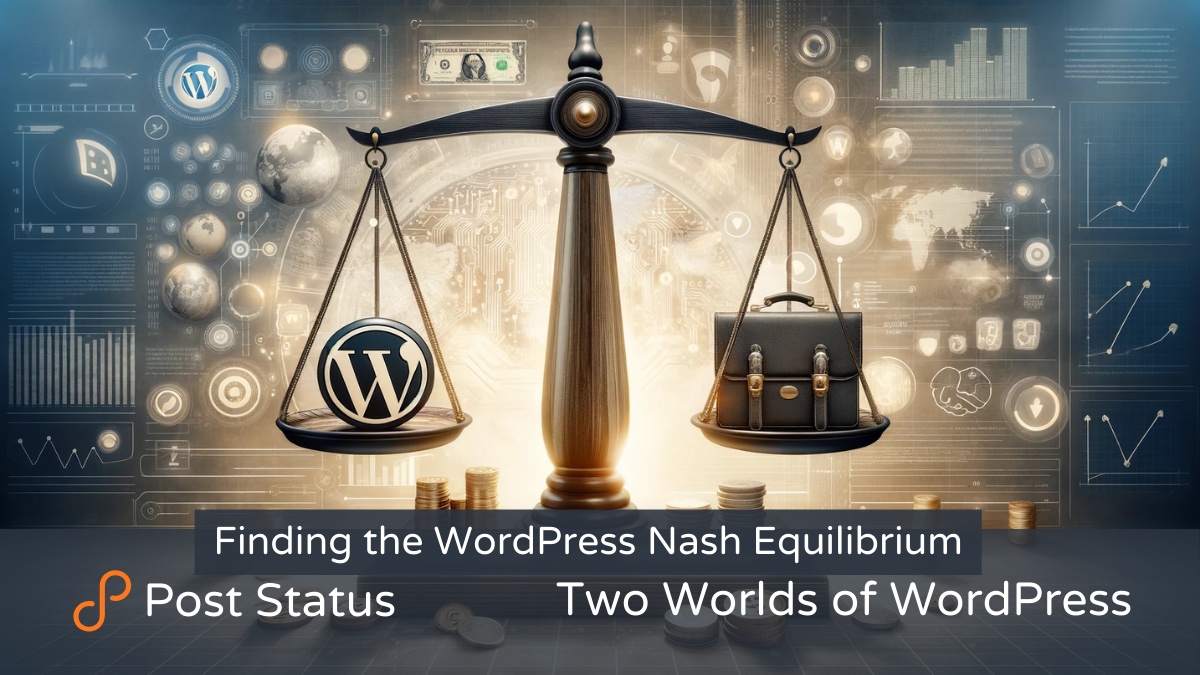
Finding the WordPress Nash Equilibrium
## Metadata
- Author: [[Marieke van de Rakt]]
- Full Title: Finding the WordPress Nash Equilibrium
- Category: #articles
- Document Note: ---
tags: [WordPress, NashEquilibrium, OpenSourceEconomics]
- WordPress
- NashEquilibrium
- OpenSourceEconomics
Author: Marieke van de Rakt
Source: Post Status
Reference: [Finding the WordPress Nash Equilibrium](https://poststatus.com/finding-the-wordpress-nash-equilibrium/)
date created: 2024-09-14 15:00
---
# Title: Finding the WordPress Nash Equilibrium
## Table of Contents:
1. [📝 Summary](#summary)
2. [📖 Main Content](#main-content)
- [🗒️ Notes](#notes)
3. [📖 References](#references)
4. [🗣️ Paraphrase](#paraphrase)
5. [📰 Newsletter](#newsletter)
6. [✅ Action Items](#action-items)
7. [🧪 Hypotheses](#hypotheses)
- [📊 Methodology](#methodology)
- [❓ Questions](#questions)
- [🔮 Future Research](#future-research)
- [💡 Implications](#implications)
8. [🧠 Learning Styles Assessment](#learning-styles-assessment)
9. [📊 Accessibility Assessment](#accessibility-assessment)
10. [🌍 DEIB Assessment](#deib-assessment)
11. [✅ Logical Validity](#logical-validity)
12. [🔍 SEO Evaluation](#seo-evaluation)
13. [🎯 Conclusion](#conclusion)
### References:
- Brian Krogsgard, [Finding the WordPress Nash Equilibrium](https://poststatus.com/finding-the-wordpress-nash-equilibrium/)
---
## 📝 Summary:
This article explores the concept of the Nash Equilibrium as applied to the WordPress ecosystem, specifically focusing on balancing the interests of different stakeholders (core developers, plugin developers, agencies, and users). By framing WordPress as a cooperative open-source project with multiple players, it suggests that a balance between competition and collaboration is essential to maintain sustainability and innovation within the ecosystem.
---
## 📖 Main Content:
In the WordPress community, different groups—such as core developers, plugin authors, agencies, and users—each have distinct goals and interests. Achieving a "Nash Equilibrium" involves ensuring that no one party has an incentive to deviate from the established collaborative path, thus maintaining balance and mutual benefit across the ecosystem. The article delves into the challenges of funding, resource allocation, and contributor burnout in a complex open-source environment.
### 🗒️ Notes:
- **Nash Equilibrium Definition**:
- It refers to a situation where all participants in a system make the best possible decisions, considering the decisions of others.
- **Application to WordPress**:
- Various stakeholders (core developers, plugin/theme authors, agencies) operate in WordPress. For sustainability, a balance needs to be struck where no group feels compelled to act only in self-interest.
- **Challenges in the Ecosystem**:
- Funding and resource allocation are ongoing issues in open source.
- Contributor burnout poses a risk to the stability of the ecosystem.
- **Proposed Solutions**:
- Transparent and equitable funding models for contributors.
- Clear paths for developers and agencies to contribute while maintaining profitability.
- A stronger sense of community ownership to reduce fragmentation.
---
## 📖 References:
- Brian Krogsgard, [Finding the WordPress Nash Equilibrium](https://poststatus.com/finding-the-wordpress-nash-equilibrium/)
---
## 🗣️ Paraphrase:
1. In the context of the WordPress ecosystem, a Nash Equilibrium would mean that contributors, plugin developers, and agencies all find a balance where their actions benefit the community without undercutting the efforts of others. Achieving this balance could improve both sustainability and growth.
2. The WordPress ecosystem is at risk of imbalances, especially concerning funding models and contributor fatigue. A sustainable equilibrium could be reached by offering clearer support systems and incentives for those contributing to the project while ensuring that commercial entities can profit.
---
## 📰 Newsletter:
🎉 **Spotlight on WordPress Economics** 🎉
In a thought-provoking piece, Brian Krogsgard explores the concept of the **Nash Equilibrium** in the WordPress ecosystem. With an intricate balance of developers, plugin authors, agencies, and users all coexisting, maintaining collaboration is key to WordPress's sustainability. How can the community address challenges like contributor burnout and funding gaps while ensuring everyone thrives? Dive into this insightful read on [Post Status](https://poststatus.com/finding-the-wordpress-nash-equilibrium/) to understand the future of collaboration in WordPress. 🧠✨
---
## ✅ Action Items:
- Review the article’s suggestions on balancing the interests of various WordPress stakeholders.
- Consider how to apply Nash Equilibrium principles when collaborating with others in the open-source community.
- Investigate new funding models that support both contributors and commercial entities within the WordPress ecosystem.
---
## 🧪 Hypotheses:
- Introducing transparent and equitable funding models will reduce contributor burnout in WordPress.
- Achieving a Nash Equilibrium in WordPress will lead to long-term sustainability, reducing fragmentation within the community.
### 📊 Methodology:
- **Survey**: Conduct surveys among WordPress contributors and plugin/theme developers to measure burnout and engagement levels.
- **Case Study**: Analyze projects that have adopted equitable funding models and assess their impact on community collaboration and innovation.
### ❓ Questions:
- How can the WordPress community better balance the interests of core contributors and commercial entities?
- What funding models could alleviate the strain on volunteer contributors while ensuring profitability for commercial developers?
### 🔮 Future Research:
- Investigate whether similar ecosystems (e.g., Drupal, Joomla) have implemented sustainable funding models that promote equilibrium among contributors.
- Explore how Nash Equilibrium principles can be applied to other areas of open-source collaboration outside WordPress.
### 💡 Implications:
- Future research on funding models and collaboration within open-source communities can lead to more sustainable practices, ensuring that contributors and commercial entities work harmoniously without overburdening any single group.
---
## 🧠 Learning Styles Assessment:
1. **Visual Learners (Spatial)**:
- **Present**: Limited visual elements.
- **Improve**: Include diagrams or flowcharts illustrating how various stakeholders interact within the WordPress ecosystem.
2. **Aural Learners (Auditory-Musical)**:
- **Present**: No auditory components available.
- **Improve**: Provide an audio version of the article or a podcast discussion on the topic.
3. **Verbal Learners (Linguistic)**:
- **Present**: The article is well-written, with clear examples and analogies.
- **Improve**: Include more real-world case studies or examples of Nash Equilibrium in other ecosystems.
4. **Physical Learners (Kinesthetic)**:
- **Present**: Lacks interactive components.
- **Improve**: Add interactive scenarios or simulations where readers can explore different funding models and their effects on WordPress collaboration.
5. **Logical Learners (Mathematical)**:
- **Present**: The concept of Nash Equilibrium is well explained in logical steps.
- **Improve**: Offer more quantitative data on contributor engagement and funding models.
6. **Social Learners (Interpersonal)**:
- **Present**: Opportunities for discussion exist but are not explicit.
- **Improve**: Encourage participation in community forums to debate the application of Nash Equilibrium in WordPress.
7. **Solitary Learners (Intrapersonal)**:
- **Present**: Provides ample reflection points on open-source collaboration.
- **Improve**: Introduce self-assessment questions for readers to evaluate their role in the ecosystem.
8. **Naturalistic Learners**:
- **Present**: No direct reference to nature or environmental analogies.
- **Improve**: Use nature-based analogies to describe equilibrium (e.g., how ecosystems balance resources).
---
## 📊 Accessibility Assessment:
- **Screen Reader Compatibility**: Ensure all text and links are accessible to screen readers.
- **Keyboard Navigation**: Confirm the article can be navigated via keyboard shortcuts.
-
- Document Tags: [[free rider]] [[sustainability]] [[wordpress]]
- Summary: John Nash's work on game theory and the concept of the Nash Equilibrium can provide valuable insights for the WordPress community. As the community has grown and more businesses are making money from WordPress, it is important to find a balance between individual gain and investing in the overall ecosystem. Nash's theory suggests that the most optimal result for WordPress and the community is achieved when individuals prioritize their own businesses while also contributing to WordPress core and the community. Finding this equilibrium requires collaboration and understanding the potential risks of focusing too much on individual profit or free, open-source development.
- URL: https://poststatus.com/finding-the-wordpress-nash-equilibrium/
I am a huge fan of John Nash. Do you know him? The movie *A Beautiful Mind* was about his life. John Nash won a Nobel prize for his work on economics. His work focuses on game theory and explains why focusing purely on individual gain does not necessarily lead to the best outcome for everyone. And that’s interesting for the WordPress community, which faces problems like free-rider behavior.
In the old days of WordPress – 15 years ago – many people were volunteering and making WordPress bigger. At that time, hardly any people were making money out of it. Nowadays, it is sometimes hard to find enough people working on WordPress Core, but the number of companies making money out of WordPress has grown substantially. We need to find a balance, an equilibrium, between making money for individual businesses and investing in the WordPress ecosystem. And that’s why I love John Nash so much because he came up with such an equilibrium.
Adam Smith, one of the great minds in economics, stated that if everyone does what is best for them, the situation will be optimal for everyone. That’s what a lot of people still believe. That’s also how a lot of people act.
John Nash mathematically proved that Adam Smith was wrong. The most optimal result will come when individuals do what is best for themselves *and* their group. According to John Nash, the most optimal result for WordPress and all of us in the WordPress community would emerge when people do what’s best for their individual businesses *and* for WordPress as a whole. For instance, one should invest in WordPress core and the WordPress community. At the same time, they should benefit from selling plugins (or other products or services) to that community.
John Nash calculated an equilibrium. He called it the Nash Equilibrium. In WordPress, we have to find that Nash equilibrium together. And, of course, an equilibrium is always vulnerable. Putting too much effort into developing free, open-source software could eventually result in a company’s bankruptcy. But what’s also true: putting too much effort into maximizing one’s profits and too little into contributing will damage the WordPress core ecosystem. But we all have beautiful minds, right? We should be able to figure this one out together!, Finding the WordPress Nash Equilibrium, Marieke van de Rakt, 01hnfyc7czt4be78bthwga1rg2.