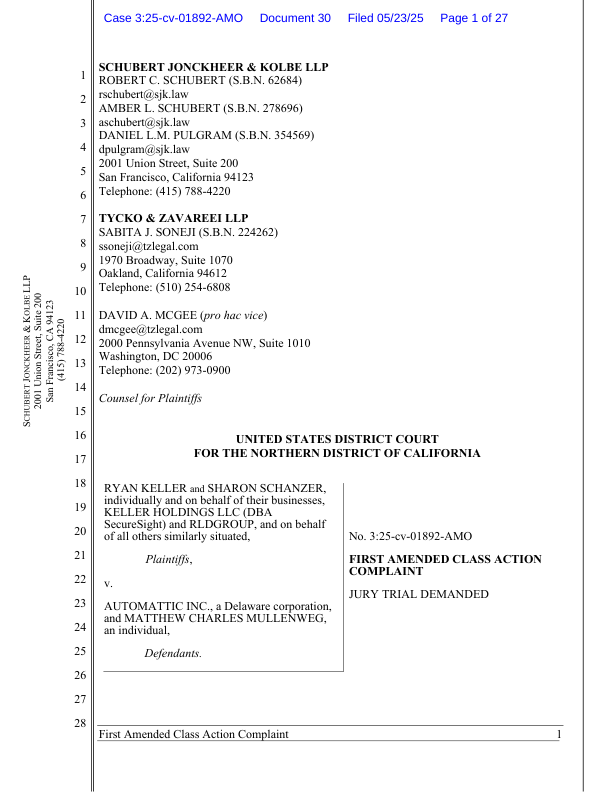
First Amended Class Action Complaint
## Metadata
- Author: [[Ryan Keller, Sharon Schanzer]]
- Full Title: First Amended Class Action Complaint
- Category: #articles
- Document Note: ---
tags:
- #WordPress
- #Automattic
- #WPEngine
- #OpenSource
- #LegalDispute
Author: Schubert Jonckheer & Kolbe LLP, Tycko & Zavareei LLP
Source: United States District Court, Northern District of California
Reference: Case No. 3:25-cv-01892-AMO, First Amended Class Action Complaint, May 23, 2025
date created: 2025-05-27 08:00
---
# Title: First Amended Class Action Complaint Against Automattic and Matthew Mullenweg Regarding WP Engine Dispute
## Table of Contents:
- 📝 Summary
- 📖 Main Content
- 🗒️ Notes
- 📖 References
- 🗣️ Paraphrase
- 📰 Newsletter
- ✅ Action Items
- 🧪 Hypotheses
- 📊 Methodology
- ❓ Questions
- 🔮 Future Research
- 💡 Implications
- 🧠 Learning Styles Assessment
- 📊 Accessibility Assessment
- 🌍 DEIB Assessment
- ✅ Logical Validity
- 🔍 DARVO Analysis
- 🔍 SEO Evaluation
- 🎯 Conclusion
## 📝 Summary:
This legal complaint alleges that Automattic Inc. and its CEO Matthew Mullenweg deliberately interfered with WP Engine’s ability to provide contracted web hosting services by blocking access to the WordPress.org central repository. The plaintiffs, WP Engine customers, assert that this conduct was part of a vindictive campaign to harm a competitor and poach its customers. The case highlights tensions between open-source principles and corporate control, with serious implications for the WordPress ecosystem and businesses relying on WP Engine.
## 📖 Main Content:
The complaint details how Automattic and Mullenweg exercised control over WordPress.org’s plugin repository and updates—critical for WP Engine’s hosting services—and intentionally blocked WP Engine from accessing these resources starting in September 2024. This action disrupted WP Engine’s service quality, violated contracts with WP Engine customers, and enabled Automattic-owned competitors to solicit those customers.
The WordPress ecosystem's open-source nature and promises of free and perpetual software access are central to the case. However, Mullenweg’s recent claim to personal control over WordPress.org and the trademark, coupled with his company’s aggressive tactics, are framed as a betrayal of open-source community values.
Plaintiffs Keller and Schanzer provide testimony on the disruptions’ negative impacts, including financial losses, client trust erosion, and significant time and resources spent mitigating harm or preparing to migrate away from WP Engine.
The complaint argues that these acts constitute intentional interference with contractual and prospective economic relations and unfair competition under California law. The case is filed as a class action for all affected WP Engine customers during the disruption period.
## 🗒️ Notes
- **Parties**:
- Plaintiffs: Ryan Keller and Sharon Schanzer, WP Engine customers and website creators.
- Defendants: Automattic Inc. and CEO Matthew Mullenweg.
- **Background**:
- WordPress powers 40%+ of global websites.
- WordPress.org hosts the core software, 54,000+ plugins, themes, and updates.
- The software is open source, historically managed by the nonprofit WordPress Foundation.
- Mullenweg claims personal control over WordPress.org and trademark rights.
- **Dispute timeline**:
- September 2024: Mullenweg initiates public dispute with WP Engine.
- Sept 24: Automattic blocks WP Engine’s access to WordPress.org repository.
- Sept 27-30: Temporary access allowed; then re-blocked Oct 1.
- Dec 10: Court injunction orders removal of customer list published by defendants.
- **Impact on Plaintiffs and class**:
- Unable to update plugins, security patches, and site content.
- Degraded website performance violating WP Engine’s SLA.
- Forced consideration and expense of migrating hosting.
- Lost revenue and client trust.
- **Defendants’ actions and intent**:
- Public statements describing “nuclear war” on WP Engine.
- Marketing campaigns aimed to poach WP Engine customers.
- Published WP Engine customer lists to pressure defections.
- Seized control of popular WP Engine plugin (ACF).
- **Legal claims**:
- Intentional interference with contracts.
- Interference with prospective economic relations.
- Violation of California’s Unfair Competition Law.
- **Class Allegations**:
- Nationwide class includes all US persons with active WP Engine hosting during disruption.
- Plaintiffs represent class with typical claims and no conflicts.
## 📖 References:
- Case No. 3:25-cv-01892-AMO, Northern District of California, First Amended Class Action Complaint, May 23, 2025
- https://wordpressenginetracker.com
- https://wordpressfoundation.org
- https://www.cio.com/article/3545272/things-get-nasty-in-lawsuit-between-wordpress-org-and-wp-engine.html
- https://www.theverge.com/2024/10/4/24262232/matt-mullenweg-wordpress-org-wp-engine
- https://www.youtube.com/watch?v=f15Xn23Mytg&t=3474s
## 🗣️ Paraphrase:
1. **Original**:
"Defendants intentionally sabotaged WPE’s ability to provide contracted services, disrupting the relationship between WP Engine and its customers, including Plaintiffs."
**Paraphrase**:
The defendants deliberately undermined WP Engine’s capacity to fulfill its service agreements, harming the business relationship between WP Engine and its users, such as the plaintiffs.
2. **Original**:
"Mullenweg has publicly stated he employed a 'nuclear war' approach to force WP Engine to capitulate, aiming to redirect WP Engine customers to Automattic-owned platforms."
**Paraphrase**:
Mullenweg openly admitted to using an aggressive 'nuclear war' strategy intended to compel WP Engine into submission and steer its clients towards platforms owned by Automattic.
## 📰 Newsletter:
🎉 This week in WordPress news: A major legal battle unfolds as WP Engine customers sue Automattic and CEO Matt Mullenweg over alleged sabotage impacting site updates and security. The conflict raises big questions about open-source control and competition within the WordPress ecosystem. Meanwhile, the WordPress community watches closely as this lawsuit may reshape future governance and hosting dynamics. Stay tuned for updates and expert analysis on how this affects your sites and open-source principles.
## ✅ Action Items:
- Advocate for transparency and nonprofit stewardship of critical open-source infrastructure like WordPress.org to prevent centralized corporate control abuse.
- Support efforts to protect open-source users from anti-competitive behaviors by large platform owners.
- Educate the community on the risks of centralized control of open repositories and promote diversification of access points.
- Encourage sustainable funding models for open-source ecosystems that do not compromise user freedoms or ecosystem health.
- Monitor ongoing litigation and policy discussions to prepare the WordPress community for governance shifts.
## 🧪 Hypotheses:
- Centralized control of open-source repositories by corporate entities increases risk of anti-competitive actions harming ecosystem participants.
- Public disclosure and litigation can drive more transparent governance reforms in open-source ecosystems.
- Managed hosting services face unique vulnerabilities when core open-source dependencies are controlled by competitors.
### 📊 Methodology:
- Conduct surveys of open-source hosting users affected by repository access disruptions.
- Analyze case studies of similar disputes in open-source ecosystems.
- Employ network analysis on ecosystem contributions before and after central control shifts.
- Review court documents and corporate communications for legal strategy patterns.
### ❓ Questions:
- How does corporate control of open-source infrastructure affect ecosystem trust and contribution?
- What mechanisms can enforce nonprofit stewardship of community assets?
- How do managed hosting providers mitigate risks from dependency on centralized repositories?
### 🔮 Future Research:
- Comparative studies of open-source ecosystem governance models and anti-competitive risks.
- Impact assessments of legal disputes on open-source community participation and i
- URL: https://readwise.io/reader/document_raw_content/312847053
Full text of this document omitted because this document is a PDF
[Download original file →](https://readwise.io/reader/document_raw_content/312847053), First Amended Class Action Complaint, Ryan Keller, Sharon Schanzer, 01jwbkesg988zq4x46r4wc1g1c.