From SEO to AI Search Optimisation
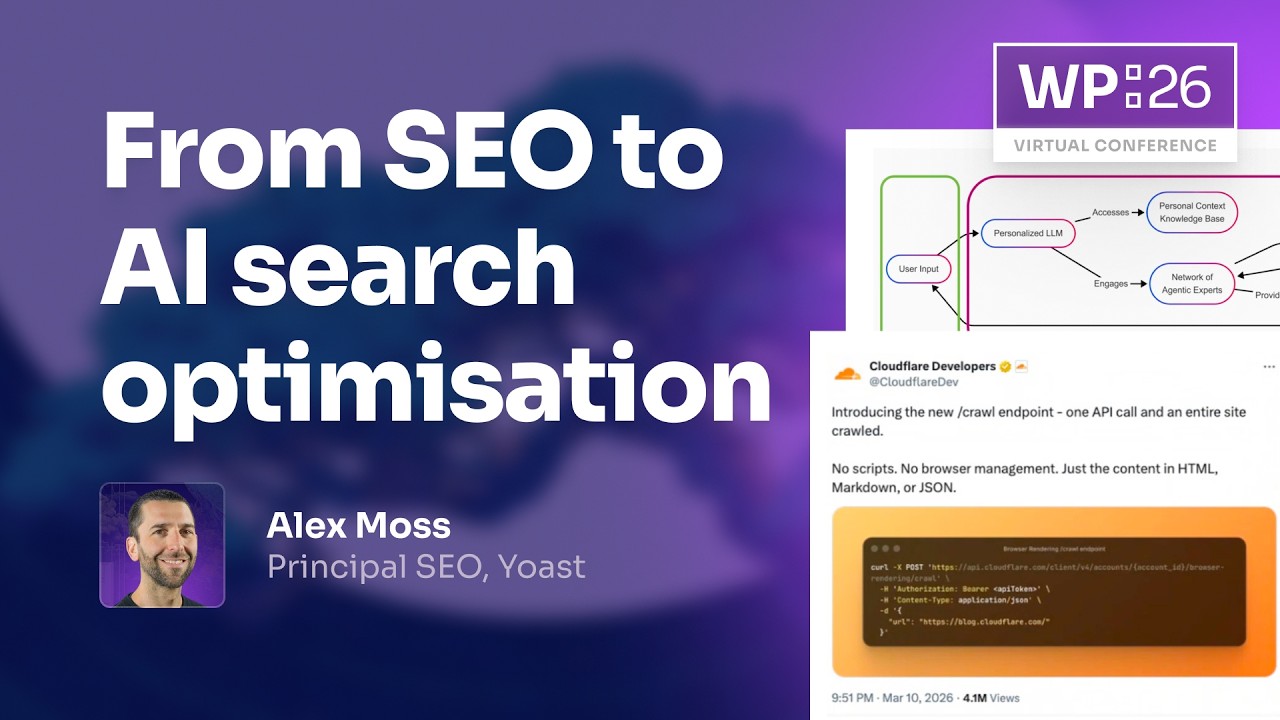
Welcome back everybody. We're live again for the second session of the WP26 uh event and we're going to be talking about SEO and AI search optimization. in this session with uh Alex Moss who is a principal SEO expert at the coast and has like more than 15 years of experience across agency in in-house and
freelancer roles uh specialized in technical uh SEO and has worked with WordPress since uh 2010 has built a lot of plugins a lot of themes and large scale SEO strategies for worldwide organizations. Uh Alex will give us an overview of how how AI is transforming the way we work with content and he's going to share ways we can respond and explore how it
might shape the future of the web uh and content discovery uh in the next years to come. So, welcome Alec. Let me pull you uh up. There you go. Hello. >> Hi. How you doing? >> I'm doing really well. really excited to have you here. We've we like ran a little bit late with no so uh without further ado, over to you, Alex. >> Thank you. Thank you very much and hello everyone. Thank you. Um thank you for
coming. So let me do presenter of you. Um just as a word of warning, I'm going to be doing this offline in presenter of view because Microsoft 365 and Crowdcast don't really get along. So we'll have to make do. So I'm very sorry. I see Tacos. Woo, let's go. So, let me listen to Taco because that's always the best way to do So, I'm going to talk to you about how we've gone from SEO to AI search optimization. Um, because a lot's changed recently and it may be worth um just refreshing everyone's mind about
what's happening. Not all the AI stuff that's happening. I know that null was talking a lot about how you can scale and improve your workflows, but I want to talk about things from a search perspective. Um, as a little bit of background, I know Petia did a wonderful introduction of me. Um, I'm principal SEO at Yoast. I'm also a co-founder and director of a small agency called Fire Cask, which is based in Manchester in the UK. Um, we do organic marketing, omni channel stuff, and as well as that, of course, um, development and design in our favorite CMS. Um, but I've actually
been doing SEO since 1999, which kind of shows my age, also shows the passion that I've got in optimizing websites in order for them to be discoverable, even though I didn't know that's what I was doing at the time. And back in 1999 to 2002, life was so much simpler because we just had this list of 10 links. You did your own research. You saw and decided what was best for you, and then you decided to go away with that information or buy that product or take on that service. Now, as the years went
on, um you saw that Google started buying up more assets like introduced Adwords, they bought YouTube, and they brought it all into the search results page. And over the years, you can see here that the green organic part has been getting less and less so and been taking up more real estate, which is a bit uh made it a bit annoying for us SEOs, but made us a bit more valuable over time. But then a lot has kind of happened specifically in the last two years as I'm sure you might have noticed. Um, and one thing from my point
of view is that LLM's disrupted the native search experience. In a way, it's kind of gone full circle. It's kind of looking a lot more simpler than it used to be. And it wasn't just, you know, lots of flashy assets all around that may confuse you as you're doing your own research. Instead, it's no longer a list of links. It's now about retrieval and generation. And it kind of combines that experience to give you a really conversational and contextual synthesized answer. But more importantly, it's personalized and over
time has come with memory and more context about you as a person. So for example, I know that Gemini connects with Gmail. I've had Gmail for I don't know how long it is. It was in beta for about three years, but I was definitely the first one million who got an email there. Um, so it's got about 20 years worth of emails in there. So it knows a lot about me. Um, but what's also more important is that this flow has changed. It's gone from, you know, a keyword, you get the answers, that's not perfect. Rinse and repeat until you get the
research done from what you want. Now, it's all about your user intent, taking that result and adding additional context to hone down exactly what you want as an end result. Now, behind the scenes, this is kind of what a personal LLM user agent looks like. It takes the user inputs. It com it it connects to an LLM. It then access it then assesses and engages personal context network of agenda and all the stuff that you kind of know already. But what's more important here is that the green part is the human input and then everything else
is the agents input into what's going on. So underneath the hood, they're doing way more work than what we were doing in the first place. But what's more important from a search perspective is that we're going from clicks to decisions and selections through agents, right? And that's kind of been given a lot of debate in search about what term that may be. And here we'll enter geo and that is short for generative engine
optimization. And here's a definition. So I'll read it out. optimizes content for generative AI search environments like a LLM powered engines to make it things discoverable, trustworthy, unauthoritative. Right? So search is no longer this list of blue links. It recaps, it summarizes answers and gives you personalized results delivered by assistance. Now GIO is an acronym that has been adopted um by quite a few SEOs,
but it's up for debate because there's so many out there. But one company that's been really honing in on the term go and AO is Microsoft. They actually um presented um a white paper in January um and it goes back to October as well when they were started writing about GA uh GIO as a specifics. But here it gives you lots of information and this is one screenshot um of how at least from Bing's point of view you and an LLM works behind the scenes in order to give
you the best possible answers. But one thing I do notice here is that they've added AEO as well as GEO and AEO is answer engine optimization. And again it's just another acronym. In fact, there's loads of acronyms about there's GIO, AEO, AIO, AI, SEO, LLM O, LLM, SEO, and VO. VO is vector embedding optimization. Um there's just so many. Um but one thing that's common between
all of them is is a nice little diagram that John Müller presented in um Google search central live in Zoric which is grounding which is basically the validation of information from your website corroborated with other sources on the web. It uses that validation to ensure that the answer is the most accurate and has the least amount of hallucinations. um it shapes content so LLMs can pass it with minimal guesswork and that also means that we have to get on board as an
SEO to make sure that things like schema headings modular content in chunks are all optimized to be not just human readable but machine readable and that goes a step further now we have multimodal search and this is a good example that Google gave where you can select a picture you can take a picture of a few books and say if I enjoyed these what are some similar books and you can see it working. Now, when it does that, it takes those books, it understands everything about those
books, it then presents recommendations based on the combination of all those books, and then it gives you information about them presented in a nice little list that you can then do more research on. But what does that mean for search? It means that technically the agent is an additional p. It's an additional audience that audience segment that we kind of have to attract even not more so than the human nowadays. So much so that Gemini only two days ago released um Gemini embedding 2 which is a combination of
using text, images, video and documents such as PDFs can combine them all in the same model and understand all of those multimodal entities and elements and the relationships between them. And that means it's actually really important. Things go way beyond text now. And now your short video on YouTube can now be understood in the same way that reading a book can. And that's also really important because all of these things can combine and these entities can have
relationships with each other. Um developers can search across all of the platforms using one single system um instead of managing all these separate tools. And I think this is um a trend that's going to continue about this consolidation of tools into one unifying very convenient thing. Now as well as that we've got commerce and in commerce specifically we've had in September Agentic commerce protocol which was introduced by open AI um which kind of lets you inside chat GPT do a search you
find a product and then you can purchase it without leaving that chat session and that's really important because that means that no longer does a person have to go to a website um make a decision go through a checkout add all your information and then go through. It's seamless from the customer's point of view. That's really really convenient. Now, UCP was um introduced in January um by Google and that's an open framework that's still yet to be well started
rolling out in a few places like Walmart um and Wayfair and Etsy using it as well where it doesn't just take the transactional element. It takes the whole journey from discovery all the way to logistics. Um, and that's also really important because you soon you won't need to leave AI mode to understand what you want, when you're going to get it, where it's going to be, and customer service as well. It also will connect to that. If anything, the agents completing the entire buyer journey, and that's very important for an SEO, and we'll go
on to that in a sec. Google have also released the web MCP, and it's currently there um for early preview. They've got a Discord um community as well. There's a mailing list where you can go in and see what's this about. But really, that's kind of like the new SEO for agents specifically. They go under the hood. They look at HTML and they look at elements within HTML to understand the intent of those places. So, as an example, you might use a contact form. It can identify where it is, what the
inputs are for, and as well as that, it can populate it and submit that form on your behalf. Those are all done using imperative JavaScript tools, API, and the declarative HTML form attributes all as tools. And this is interesting because it's actually model agnostic as well. So any LLM can use this right now. But what do we learn from all of this? That in fact with GIO and LLMO or whatever the acronym is, good SEO is
good GEO. Now, this is a slide or a pause of a slide from um Danny Sullivan who gave the keynote in Word Camp US last year. And the same still applies today and good SEO is good GEO because they correlate. And I'd like to challenge by saying that I'm not finding um many or if any sites that are doing really well, say in an LLM such as Chat GPT or Perplexity or Claude that's not doing well in the native SERs that are still there and vice versa. So really
what should we be thinking of as an SEO? What should SEOs be focusing on this year? And I've split this into four key points. The first is editorial standards. Next is brand sentiment. Then success metrics which is going to be confusing. And lastly data integrity. So if we go through editorial standards, it's something that needs to be improved. And I actually think this is for the good of the web a really really positive thing. No longer can mediocre content survive. Um, and making content
for content's sake isn't what's going to win. And it hasn't in the past, but it's going to happen even faster today. You just want to make unique human-driven content that wins, but it also has to be machine readable. So doing things like introducing a summary at the beginning, having a concise conclusion at the end, making the most important things in the top and bottom 20% um of your content, making things like good formatting, right? It says use good formatting. It's very interesting because that's always
been there. And I know that you WordPress afficionados out there are going to be like, "This is obvious." But weirdly, from an editorial point of view, people don't do the basics such as entering headings or increasing tables um or making lists and making sure that evidence and citations are very clearly there and done so in a very very nice formatted and structured manner so that a machine as well as a human can interpret that. Well, um, you've got to site your sources. Provide evidence of
whatever you're writing about. Um, and you don't just focus just on keywords anymore. This isn't about keyword stuffing or minimum words, anything like that. What you need to focus on is is this going to be helpful? Is it additive? Does a user find it useful? And is is a machine going to find it useful enough to site it and bring it back to the human. Um, and as well as that, I mean, there's the obvious of using schema. And I know a really really popular plug-in for WordPress that does all of that. So check that out. Now
there's also interestingly um today that was also shared by Krishna Madavan from Microsoft. He's currently at the Friends of Search conference today in Amsterdam. um and he shared more information about the data no snippet tag which allows you to have precision content controls and it's HTML attribute where you can stay in the index and be ranked but it excludes it from snippets such as AI summaries AI overviews and AI mode. Now
it may be questionable and a business case for you as to whether you want to do that or not. But there are a few use cases that he shared such as protecting premium or payable content, managing brand reputation, removing that legal mumbo jumbo like terms and conditions that serve no real purpose to even be looked at and brought back to the user and excluding sponsored or promotional content. There are use cases, but do handle these things with care. The second thing is discoverability is the
additional goal. It's not just about rankings or keywords. It's about discoverability and assistance to an agent to try and synthesize that answer back to you. And whilst our goalposts have changed, we therefore have to shift with that change as well. It's a structural shift and how people find that trusted information. Now again, the kind of the old hat and the new hat, they're very similar. You've got content is now requires more context. keywords isn't just about that. It's about intent
and so on and so forth. But something that's really interesting is EAT, which um if you should read into it a bit more, it's about experience um experience. Oh, I forgot the other E. Experience doesn't matter. Authority and trust. And in that um it kind of provides a a framework for how ethics should be in terms of authority um on your site. make sure that everything is backed up by a professional i.e. you or the brand and that brings everything
back to make sure it's validated by whatever's looking into it. A good version of brand visibility and success metrics and sentiment is something of tools that are coming out. So you've got the big ones like profound and such. Yoast have a very very affordable way of showing how a brand's sentiment is shown and visibility is shown in different LLMs. And at the moment we've got um Open AAI, Perplexity, Claude and Google um all in
the same hood that looks at everything and brings it all together and sees how your brand is actually seen online. It's something quite important and it goes beyond just the old metrics that we used to have. But even there Google are announcing new reporting to search console. They've introduced in the last three months or announced keyword grouping, brand and non brand query filters and AI and AI mode metrics. But at the moment they've only really and in the last 24 hours um brought out the brand and non-brand query filter which
you can now go inside in search console and have a look. But really it's just doing something that you could have filtered out in the first place. Bing have kind of tried to do a little bit similar. Um they've brought something like grounding queries in an AI performance report. But again a the grounding queries are important because they're keywords that the agent is using in order to search. So it's still important that whilst the keyword is something you need to focus on, it has to be in the right context and it shows
what the grounding queries are and the pages that they relate to. And when things are machine readable, it's good to think about what format that might be. And one debate that's been around quite a bit is the markdown debate. Um, agents, as we all know, prefer markdown to mark up. They prefer the concise structure. They don't need all the visuals whilst they can read everything. It's being supported by Cloudflare. Um, Matt Mullenweg wrote a post himself about it. That's also gone into not just
WordPress.com, but WordPress.org now have um a real alternate markdown. And they've also introduced a plugin as well as Yostastalk as well who's also brought out a plugin that shows an alternate version of a page in markdown and you should definitely check that out um because I think it's going to be um a bit more popular as time goes on. Interestingly, the two people who are not supporting this are John Müller from Google and Fris Canal from Bing. The search engines do not want you to have an alternate version. My guess is that
they don't want to read two versions and then have to connect them together and they're just telling us to have one. But I guess they may not always be exactly defining what goes forward in the future. Um, and that brings on to how not just how things are structured, but data and entities and structured data. And I personally believe I've always been a fan of schema um and structured data in the past, but as time's gone on, I'm believing more so that it's even more important. ACP and UCP whilst
they're not around schema.org all provide structured data and that's how less hallucinations happen and less tokens are used and therefore it's more optimal for a machine to read that rather than something that is unstructured. Think of it as a book with no grammar, punctuation or even um spelling or grammar. You know, it's going to be much harder to read that than it is something that's been nicely spoonfed to them. So from a developer mindset, this is like minimizing things like, you know, div tags um as well,
tidying up your code, making sure that everything's contextually interpretive for a machine and not just a human. And even then, uh in Google search central in in December, we saw this slide about product structured data. And whilst schema.org is the glue, there are other things such as GS1 and UNCFAC. And depending on your business model and vertical, you may want to look into all the different types of structured data that are available and adopt those things. Now, one problem that they have
um is that structured data is only on a page level. Um LLMs at the moment don't always extract structured data and if they do, they may ignore it and they won't especially compute more complex entity relationships. Um and this is something that we've been thinking about quite a lot. And then it was uh very cool of us in November to announce that we were partnering with the NL web team at Microsoft. And NL web um essentially
enables AI agents to query a site's content using natural language. So it's like having an LLM just for your site. It was created by RV Guha. He's the creator of schema.org, or RSS feeds, um, RDF, I think maybe a bit of AMP as well and all the other web standards that you and I love and use today. Um, and and it was very very cool when uh, we started working with work with RV Guhar and um, we created a solution together. Um, which is Yoast schema aggregation. Now
Harvey Guhar thought of a schema map and something which I've loved all this time but never really had the true influence to adopt but someone like him could think of it as an XML site map um where it shows all the structured data of a whole site in one endpoint and that's all the structure under the hood. It now provides standardized gduplicated map of all of your entities via one single API call. An agent no longer needs to crawl any individual page to understand
necessarily the meaning, but it can now ingest an entire site and therefore the relationships between everything. And this is just a little um a little serve of what we have on yos.com on the pages of how they are all listed. And it's really really good that LLMs can potentially look at that. Now I think I've got a video that I can show here and as I do that you can see how complex a site is. This is using our schema visualization tool um that's also available um where you can put in the
schema map URL and then it will bring everything in. It will show you a visual of it and the relationship. So you can see how complex it can get. This is beautiful for a developer who wants to do some diagnostics and problem solving. It can also obviously visualize how your site is interpreted. Not just interpreted but it but is declared through structured data. And it's really not hard to in to install at all. All I would say you do is update Yoast. It's
the in the free version and you simply um if I go to the next slide, simply just turn this on the schema aggregation endpoint. And that's all you really need to do. And what I also thought was quite interesting is only again two days ago, Cloudflare have launched a slashcrawl endpoint where this one API call can crawl an entire site without any scripts. You can choose between HTML, markdown like we were talking about before or JSON. So this
data integrity and the relationships between all of those things are going to be so so important for an LLM to ingest and it will create so much much more efficiency in what's being called back from your website. So I'd say my final thoughts are um all the core SEO principles still matter. Um the biggest disruption is the reliability of the data and not necessarily the LLMs themselves. a lot more is going to happen in the next year that creates a bit more efficiency and um and a lot
less hallucinations um and a lot more accuracy. Um I would first say audit your content. Make sure that you've not got any fluff. If you're one of those companies where if I go to the about page and talk for and and read three sentences and I still don't know what you do, that's for the human. That's not for the machine. Make sure that everything's machine readable and make sure that everything's concise, everything is structured well. Um, also optimize some of your code. Your developers might want to use a no snippet tool alongside an SEO. Um, they
may want to optimize the div soup that might be out there that's creating um, a lot unnecessary code. Um, and also ensure that all your schema entities are connected well. Test new technologies. So download and use an LB, test it on your own site, see what it thinks of your site, and then improve from there. Um, and lastly, I would say update your success metrics. Clicks, impressions aren't as valuable as they used to be. Discovery is becoming a lot more valuable. Um, the evolution of search
isn't a risk to SEO. It's so much more of an opportunity. And I believe that SEOs um may become a lot more valuable in the future to go between marketing and product and development and be the key and the bridge between all of those things. Um, and yeah, that's everything. I hope I've not been uh too over the top or too technical or too simple, but if we've got time for Q&A, you can ask in here. And if not, you can connect with me on X or LinkedIn. Thank you very
much. Don't know if Pach is here, but if not, feel free feel free to ask any questions. I see three actually. Um, how does schema markup play into the future of SEO? Can I actually add this? I can't add it to it. So, how does schema markup play into the future of SEO? It seems semi insignificant before. Um, one of the top ways to talk to AI languages,
the way they understand. Well, at the moment, um, some LLMs are doing, well, all LLMs are working in a different way. Some are taking schema, some aren't. I know that Mark Williams Cook has done some um experiments around it um that say that it's giving out incorrect information and not trusting it and not doing enough grounding maybe. But I do believe with things like endpoints like the Yoast aggregation feature um and using um the schema API as well um that it will be able to interpret things a lot easier with a lot more token
efficiency. Um I hope that answers your question Jeff. Um the next one, um the O redirection module can also create 301 redirects for renamed or deleted pages. Um can this be made more intelligent? There are things being worked on. I'll have to check with my development team on that, but do connect with me on LinkedIn and make sure Matthew that you ask me that so I don't forget. Um so yeah, I can't don't have an exact answer
for that right now. Um and taco what is the main difference between yos schema visualization and classy schema which has been around for years. The answer is is it reads the schema map. So the entire schema map and the aggregation tool that we've made um it crawls all of that whereas classic schema at the moment just crawls at a page level or at a code level and doesn't do an entire site in one go and visualize an entire site like that. I hope I've answered you
there, Taco. I think that's all the questions. How did I how did I do Peter? Was I in time? >> Uh, you were so uh good and in time. Uh, I think there are actually two more questions. Uh, would you like to give those a stop? All right. So, uh, Priscilla is asking, "What metrics or ways are there to test discoverability?" Um, I would say firstly use search console and use web master tools. They
both have MCPs which can connect to Claude um or whatever whatever other LLM you're using. And as well as that, I mean I don't want to sell our own thing but I'm going to sell our own thing. We've got we've got AI business insights which you can also sign up to which isn't anywhere near as um you know as expensive as some of the pro tools that may give you a bit too much information. Um, I think it's kind of like when they took away um ranking reports from page two onwards, the question was, did we even need to know what was ranking on
page 4? Was that just useless information? Um, just just go through everything, ask ask questions, download and export an Excel or a CSV, put it into an LLM and ask questions about it, and then it will give you informed results. >> Okay, cool. And then we've got one more from Matthew. This was actually the first question asked. >> Oh, I answered this. I answered this one. And the answer was the answer was I can't confirm it yet, but I've asked Matthew to connect with me on LinkedIn
so I don't forget. And I will get you an answer, Matthew. >> All right, Matthew. I'm going to mark that as done answering even if even if that hasn't uh yet been answered. Uh thank you, Alex. How is that for you? >> Thank you. Oh, I'm just glad it's over like any speaker. I mean, and I don't look at times, so I don't know. Maybe I that's what I think. Am I going to be short? Am I going to be too long? Who knows? But I don't know if Taco says I' I'm not disappointed. He's,
uh, he's very honest with me. So, um, I'm happy. If Taco's happy, I'm happy. >> Uh, well, if Taco is saying you did well, then you definitely did. Because, as we know, Taco is very critical towards speakers at any event. >> Oh, he is. We worked together for a bit. I I know. I It's just straight talking. I call it straight talking. >> They It's It's just the country. It is the culture. >> We know. Thank you so much, Alex, for joining us today and thanks everybody
for staying Alex's session. We're going to say uh goodbye for a little bit of uh time and then we're moving on to the next session where we're going to chat about accessibility and why it is essential in 2026. Thank you, Alex. Uh, see you soon everybody. >> Bye guys., From SEO to AI Search Optimisation, YouTube, 01kkmf2yccdj3tdfqyd2b4zg5q.