Future of Faith: Faith in Chaotic Times
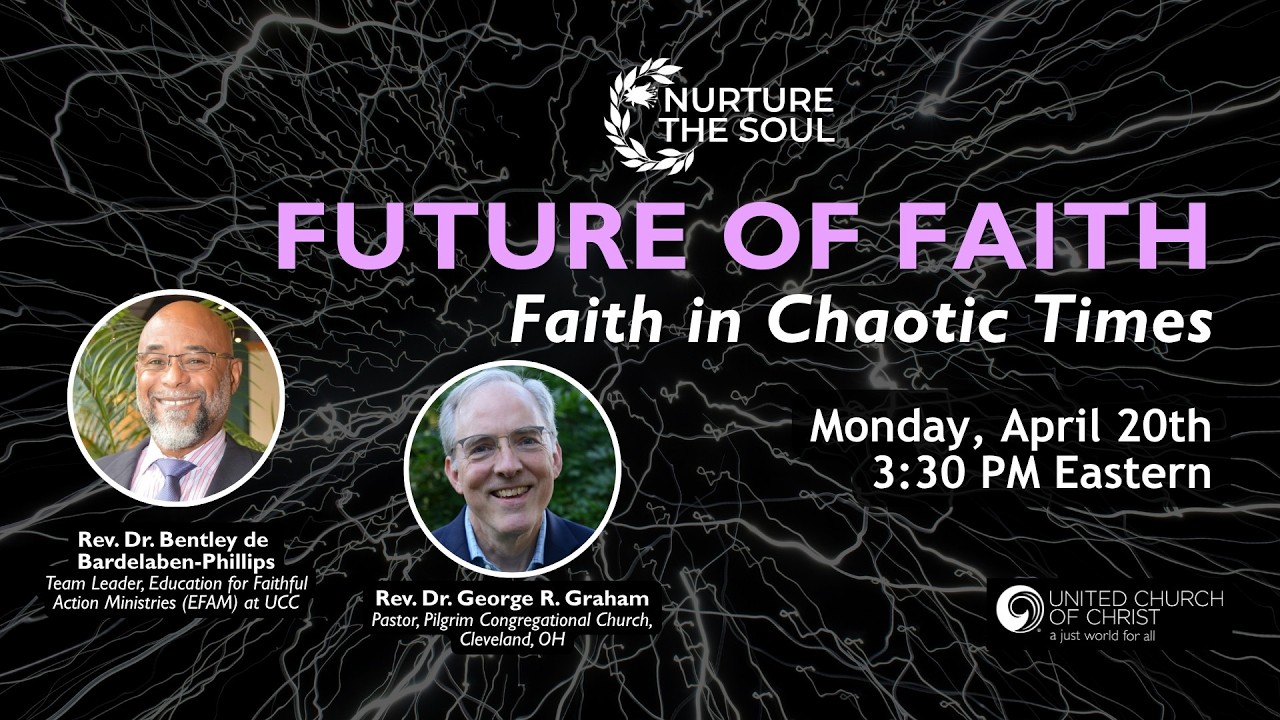
🔗 **Source:** [Future of Faith: Faith in Chaotic Times](https://www.youtube.com/watch?v=Vva9u5EhfoM)
Everything that I am, I am becoming is
sacred and holy. Spirit is with me. The living God is forming. Creator is making, weaving and painting, singing and waiting. And I will be free. I will be free.
I will be free. I will be free. Everything is holy when we are growing. We honor the journey of life where a soul can find nurture. A person belong. No matter who or where they've
come from, everybody has a common song. We will be free. We will be free. We will be free. We will be free.
We will be free. We will be free. We will be free. We will be free. We will be free. We will be free. We will be free.
Welcome, welcome, welcome beloveds to Nurture the Soul. I am your host today, Reverend Ellie Hutcherson. I'm the minister for congregational and community engagement with the faith info team and we are a part of the love of church at the national ministry setting of the United Church of Christ. I use they them pronouns and today am wearing
black rimmed reading glasses, a cream tank sweater and a silver short pixie haircut. Nurture the Soul is a weekly webinar series that centers curiosity and care by providing a multitude of practical, educational, innovative, and formational resources to engage with the critical topics facing our communities today. We feature an array of thought leaders
to delve deeply into these topics for us to explore what a gospel for such a time as this is like. We hope that this virtual space is a space for connection that cultivates curious and loving community and that you join us every Thursday at 3:30 p.m. Eastern time or like today we have some special offerings. You can find all of our digital programming on our website at
ucc.org/events or on all of our social media platforms. And I'd like to get to this before I get to our guests. And you are already using one of the major features in our uh webinar and that is the chat feature. We hope that you continue to use the chat to crowdsource, to comment back and forth to each other, um to share where you're zooming in from and your faith community. And I see somebody just put
up one of our reaction features, which is also one of my favorites. Your reaction feature is a heart-shaped button at the bottom of your screen. You can use that all the time, anytime, especially if something that one of our presenters, one of our conversation partners shares that lands with you. Um, going back to that chat feature, it looks like a dialogue bubble at the bottom of your screen. You can use that at any time. And we also have time at
the end of this webinar for Q&A. And you can use that feature as well. You can put a question in at any time. It is at the bottom of your screen. Looks like a dialogue bubble but has a question mark in it. Beloveds, today we are joined by pastors and thought leaders Reverends George and Bentley for our special offering of future of faith. This series is curated to help us learn from these thought and religious leaders who are exploring these themes along with their
congregations from across this great nation who have heard and are following the invitation to come into that dreaming space where all of God's creation can be cared for. This is a space where we can know that collective dignity, love, kindness, and respect is honored and how our different perspectives of faith can actually create that better world that we're all hoping for. And so, I invite George and
Bentley onto the screen. Thank you so much for joining us today. And I see my co-curator and co-host, Reverend Elder, is here as well. So, if they would like to come on to screen, it would be great to have you. Hello, homie. Good to see you. Well, beloveds, it is so great to be in this virtual space. I tell you what, this on again, off again with Nurture the Soul because of all of this cool stuff we have going on. Really bums me out cuz I don't get to virtually be with
you, but we're here and we're going to enjoy this moment at this time in this virtual sacred space. So, George Bentley, how is it with your body and your soul today? >> George, you want to take that? I can come back around. >> Sure. So, I'd say I'm my body and soul feel uh well today. I feel well today. Um Monday is my regular Sabbath day, and it's cool here in Cleveland. Cold uh
just above freezing, but the sky is clear. And uh from where I'm sitting, I can see the blue sky. So I'm I'm feeling pretty good today. >> Love that. Colds. I don't even know what that means, but go ahead. >> Yeah. Don't make us envious because you're, you know, in the southwest. >> I too I'm in Cleveland, uh Ohio, and uh my soul feels like it's just radiating like the sun. My body is struggling a
little bit. I have a bit of a migraine and I'm trying to manage that. But I I taken all the things that I needed. So I'm very present to be with you all today. I'm honored to do so. >> Yeah. Well, thank you for your authenticity and your vol or your vulnerability and sharing where our souls and minds and bodies are today. Right. Because it's okay that they're not the same every day. And we have a society that's saying you, you know, just work your way through it. Just do all of these things. And in fact, when
we care for ourselves, we get to care for others in such that open and loving way, you know. But before we get into a little bit more about uh what our future of faith is, I am super curious at what brought you all into the work of religion? What was your calling and how long did it take you to actually listen? >> Okay, since I went last, I'll go first on this. And so um I will make this as
brief as possible and you can go hey stop you know we got other things to do in case it goes long-winded. Um so what brought me into the body or work of religion is um actually through Star Wars right so I wasn't raised in a religious home. Yeah. Right. And so by the second Star Wars movie um re Empire Strikes Back um there was this character in introduced called Yoda. And so it was something about that character that
really spoke to me. I was in college at that time. Uh and so was just trying to navigate how do I find myself in a place where I learn more about spirituality maybe more than religion. And then um maybe a within a year or two of that uh uh was born again and found religion. And there were lots of people around me kept saying, "There's something about you, something about you
that God has a call upon you." And I really didn't understand that either. And that at a certain point, I found myself wrestling with seminary. And you know, while I I was saying no, speaking more like Moses about, well, I stumble or stutter and blah blah. Um, you know, dare I say, I'm Reverend Doctor now. So, looks like God won in those battles or spirit or whatever won my address that by. But yeah, that's my long and short
story. >> Yeah. H I love it. I love that you listened because I get to meet you on this end. But yeah, and Star Wars, huh? >> Yes, I love Star Wars. Yes. >> Okay. Are you a Treky as well or is that something >> I am because that is where I began as a a guy born on the cusp of boomers and Gen Xers. So, I tell folks that Star Trek shaped my understanding of how we ought to be able to get along with
anyone, >> no matter, you know, race, color, uh, uh, race, uh, ethnicity, sexual orientation, gender identity, all that stuff. Um, but Star Wars really dropped down for my spirituality. So, I do love them both for very different reasons. >> Oh, awesome. Thank you. That's so cool. >> Yeah. >> How about you? >> Um, so, uh, my call to ministry happened, um, relatively early and I,
uh, as a result of, uh, being in the church and being raised in the church and having a family that was really involved. My father was a lay speaker and my mother was, uh, really involved in Christian ed and they were both involved in leadership. Um, and I didn't I didn't um consider ministry until I was in youth group and doing um service projects with uh work camps with uh the
youth group and started to feel a call to ministry by the end of high school and thought that my call was to local church ministry and I went to seminary, went to Vanderbilt and came out as a gay man in the middle of that journey. and um was United Methodist at that point. So, it was not an option to be ordained. So, my my road to ministry took a uh it was a long and winding one.
Um I worked uh in communications for the United Methodist Church and then for the UCCC and then moved into financial development. Um and I was able to be ordained. um uh that was uh a a position that constituted a call and uh so I'm thankful that I found my way to the UCCC and was able to be ordained. Um but I did not find my way to pastoral ministry full-time
uh until uh being called to pilgrim two and a half years ago in Cleveland. And I'm really grateful for that um that call and I feel like things have come full circle for me even though it's been a a journey of um more than 30 years. >> Yeah. And it almost always does, doesn't it? I mean if we and once we reach a certain uh age uh or way of living in the world we realize that perhaps those those things that that appeared or
bubbled up when we were teens or in our 20s you're like oh I'm that was back then and then when you are in your 50s you're like oh actually I am a lot like my teenage self. I hadn't realized that yeah that they circle back around and they come back around. Well, what a gift it is to have both of you all. Go ahead, Bentley. What were you saying? >> Yeah, I wanted to add a little bit um about that too is how I got to the UCCC. And so, as I said, I wasn't raised in a
religious home. And so, I came out at the age of 19. And so, when religion entered into my life in my mid to late 20s, I had to wrestle through that and try to figure out, well, does God love me or not love me? and all of these kinds of things. So anyway, dare I say that by after a few years in um the as um the Reverend Dr. Bishop um uh Iet
Plunder says uh as a baptostalish person. So you know uh Pentecostal and missionary Baptist kind of stuff. Um, I kind of came out of that and said, "That's just wild to me." And was still in seminary trying to figure it out. and uh moved a few times and landed in uh Memphis, Tennessee, where I was doing um CPE, clinical pastoral education and um
was told by my uh mentor then or chaplain, leader, whatever his role was, Alan Bell was his name. I can remember that much, which is a miracle unto itself. But uh that um that a part of me, the liberal part of me um was fighting against the conservative theology that was placed
inside of me in those seminary institutions and invited me to check out um one of the two uh UCCC churches in Memphis where I was living at the time and uh found uh First Congregational Church in Memphis and uh at that point started learning about the UCCC and really the rest of that is um as they say just kind of water under the bridge. I found that I could be fully myself in
a space where I could question and push back and all of that. And so in that space in the United Church of Christ religion and I have a unique dance and so I really appreciate it there or here should I say. >> Yeah. Yeah. Yeah. Absolutely. And I too, George, grew up Methodist. And and um was a single a single mom in my teens. And so I went to any religious service.
It didn't have to be a Christian service that would one help that would level on my child so I could get a break. Um not a break loving my child, but you know, um that would feed my son because, you know, he always ate. He always was hungry. You know, and so like we became multifaith just by pure survival and not knowing how much what we were actually taking in was going to be able to inform
what he would say he is not religious so he wouldn't say his theology but his ideology and for me my theology how is it I want to be in relationship with people so grew up Methodist for sure but I visited Baptist I visited cogit I visited visited amme, I visited Lutheran, I like look and it was finally when I came to the UCC that I was like, "Oh, I actually feel like I'm being told
a a story of love, a story of that God is still speaking." So, the invitation to be curious was unlike anything else that I had experienced. Um, and not that it was right or wrong or better or worse than anything else. It was just at that moment in my life, I I I felt held in my curiosity and invited to journey alongside others and that and that's also kind of what has informed me even
thinking about what is the future of our faith. You know, you both touched very briefly on seminary and early theological education. I'm I'm curious. Did your seminary education teach you to think about the future of what our faith would look like? >> Um, >> this is a question we did not prepare for. So, sorry about that, y'all. Well, I think that my I I feel really
fortunate about the seminary education that I had and and that um it really did teach me to think and respond. Um the world at hand I could have happened. Um I went to seminary. Um we didn't even have the worldwide web yet. So things have really changed a lot and yet I feel like it did
it did prepare me to respond to the the times that we're living in. >> Yeah. Yeah. >> I would say by the time I got to my third seminary which was Eden Seminary in St. Louis or Webster Groves, Missouri. Um, yes, that I felt that I I was being trained um and equipped to both serve either in
a local church and or in a um uh current u institutional setting um judicatory setting as we say in the UCCC. And so um the answer to that is yes. And then I so I got my MD at Eden and could be fully out there and um got my um doctoral degree in uh or at CTS and so where um
and that was in the early 2000s and queer studies was still very new and fresh and they were one of the few seminaries offering that. So, I was able to kind of expand and understand how to queer things in a way. I already understood uh uh liberation uh through a racial lens. And so it just really did feel like I was being brought in in places and spaces to uh think for
myself, draw upon the wisdom of the elders, whether that might have been uh uh in a spiritual way or draw upon them uh theological uh you know, whoever they might be, whether that was a James Con or or a Walter Bighgamman or something to that effect. So yeah, I think that it did equip me uh in my later years. >> Yeah. Yeah, definitely. Thank you. So w with your with the ability to have this
theological background with your own. So what we've gotten what we've got to hear is a little bit about your stories about how you came into ministry, then a little bit about your seminary education. I'm thinking about how has that informed you with the communities that you find yourselves in now? Like what is the what do you recognize perhaps is the greatest need or maybe even just the greatest question
um for your spiritual communities that you find yourselves in now. What is that? I guess I um I feel like I uh should have mentioned that I just recently completed a doctor of ministry from Eden Theological Seminary and I was able to go back for their uh spring convocation uh two weeks ago. So that was wonderful. I see myself as a lifelong learner and
um I um u it it has helped pull the thread of my ministry forward to be involved um with um with seminary education. >> Yeah. You had Dr. Leum and Dr. Seiku uh give some great talks that day. Yes. >> Really wonderful talks. >> Yeah. Um, so I think that that um I would say that
Vanderbilt had a very liberationist approach and I worked closely with Sally McFag on ecological theology and see that bearing fruit right now in my ministry at at Pilgrim and our concerns about the environment. But then um um thinking about racial justice, racial equity, and the scholars I've been able to um study with and also the books that I've been able to to read in the courses
um have been just really important to me. um from cone to uh oh any number of of folks. >> Yeah. Yeah. That's yeah that's awesome. So yeah what is that need? What are you seeing? Is it the ecological things uh George or is it >> um well I I guess I really feel at its
core um is actually the need for community um >> and um the need um to work for justice within community. whole bunch of different facets of justice, but I see them all connected and intersecting. >> Yeah. Yeah. Thank you for that. >> Yeah. I would echo that it is community
as well because I believe in the digital age that we are in that we are very isolated and obviously we still don't know the impact of what co has done to us psychologically and the ways in which we have fractured ourselves and not re recognizing that I need to be in relationship with you George and you Ellie and so and and so many others even if I'm in relationship in a family right with my spouse or my children or whomever is that uh this device isn't
the thing I have a relationship with, right? And that I really do need to sit down and and listen to you. Not just hear you, but listen to you and open up my heart and be in connection with you. So I do believe that community is key, but that love is at the center of that, right? And so and not me, myself and I, right? So it's not all about me. It really is in about how do I balance the needs of myself in addition to the needs
of the community. So here's a Spock quote for you that the needs of the many outweigh the needs of the one. Right? So how about that for Spock, right? So I told you they both mean a lot to me. I can give you a Yoda quote later, but we won't give it to you right now. But anyway, uh >> um so yeah, but also that I have relationship with the planet, right? And that mother earth needs me too. that I need to be fighting for clean air and clean water and all of those things. So,
it's not just about consuming people or other resources as in planet. So, yeah, I do think community is key. And so, and there are ways in which that I must lead this. I can't just speak it, but I must also example that when I say lead it so that folk recognize, oh, he's serious, right? Or he's committed to that and not in a religious way, but in
a relational way. >> Yeah. Yeah. Yeah. I love how you bring it back to that relational way because I think my follow-up question would be, you know, what does forming and committing to and sustaining community look like? Um, I know there are lots of folks who go to church who, at least where the church where I get to serve, who aren't necessarily believers in uh in Christ. um they have some questions or they have some questions about God.
They believe in Jesus, but like they're like good, but they come every Sunday because they love to be with people where they feel safe, where they feel seen and heard and loved. So, what is it that like what is it that you're finding is good to hold and nurture community in both of your spaces? Is it the coffee hour? Is it the service projects? Is it the del delving into
scripture? >> Here, I'll speak first. Um, so uh I I am not a pastor. Uh I was I uh my first um gig or my first call after seminary was uh at a church in St. Louis, Missouri. And so, um, that was, um, uh, helpful in the things that, uh, it taught me. Some things were painful and some things were loving. And so, but
that's life, right? So, we have to take the bitter with the speed. Um, and so, so, but I've been in a national setting um, a few months shy of 20 years now. And so, that's where my ministry is of a sort, right? in that um I've been uh managing or supervising or guiding uh staff for a very long time like I said nearly two decades and so so that's where I find um community for myself. I
am a member of Pilgrim uh UCCC where as I said before George is pastor but I honestly don't show up there a lot at least not in person. I may show up virtually, but because I have community in so many other places that often do take Sundays for me. And so I I I just don't go there. But but I do again uh believe that my ministry and the ways in which I show up for people um do are reflected both at work as well as I have
a small practice with my husband. My husband is a um uh somatic therapist and we do couples counseling together and so it's even there and just trying to help them. He comes at it from a uh psychological and sematic way and I come at it from a spiritual and psychological way so that we are trying to cover all those bases of mind, body, spirit because I think we must be holistic in our approach because any place that
there is a deficit will then begin to eat or erode at the other. >> Yeah. Yeah. Thank you for that. >> Yeah. And I um think that it's um important to have a space where people can be who they are, feel accepted, um grieve what they might feel like are
the hurts and losses that they're experiencing, but also have a sense of of hope in the future and ways to work toward that future. Um, I've been really heartened at at Pilgrim. Um, after Christmas and after Easter in attendance, a little lull, but I feel like people continue to show up. And I
think that um we all need a sense of community right now and a sense of of hope and a way to um address um uh the reality in our country right now and try to work um toward a a future that we want. So that's the kind of space that I'm trying to provide in worship, but then also in fellowship hour and beyond that um
people really know each other um and can be themselves and feel what they're feeling but then also share some sense of of >> for the future. >> Yeah. And and Go ahead. Go ahead. No, you finish. I I'll come after you. Oh, I was just going to say I think you know one of one of the things that I think about when you know Bentley you going back to what you had said we don't
really know the impacts quite yet psychologically on us um from from co and I think a lot about um the masses of people that passed away from whether it be directly the you know from co 19 the corona virus us and how do we how many have passed away because of the adjacent loneliness that came with it especially our community that
are living with the impacts of dementia and Alzheimer's right so we have those COVID direct deaths we have those associated or affiliated deaths that we can't possibly know the impact of such great loss right um and so I think a lot about that what does it mean for us to be coming out of a secluded space where we were fearful of the other person because of what they you know might we might breathe in. We we share the same
breath to how that has been capitalized into the collective individual, right? There is no there is no community if it isn't if it doesn't, you know, it's you first. It's you prot I feel like we would have done better with the masking if we would have said, "Well, mask to protect yourself and not mask to protect other people." because we were already leaning into that just severe individualism where churches have always been a space at least I hope churches
have always been a space where we're invited out of that individualism right and so I think a lot about what is it is the for the role of the church right now in this moment to say we are coming out of of a of a scary space and we're entering even a scarier space like somebody put into the Q&A this wonderful conversation about that they work as a hospital chaplain and working with
people of all different faiths Christians are the ones who seem to have the difficulty with the ambiguity right I feel like we're always in that doubting Thomas stage before we get to the whatever right so like how is it that we are asking our our our communities to be in community in the midst of so much ambiguity >> so before I tackle Glad I want to say what I was thinking before if that's okay. But since you kind of invoked CO again, I do want to say >> that my mother died um in toward the end
of CO um or what was officially CO um uh precoid she was walking and you know shopping and doing all those things at the end of her life as she was being sheltered alone. She lived in a senior community, but everybody had to stay inside. She couldn't walk anymore. She couldn't she was her dementia kind of ex expanded. It was just very sad to watch
her rapidly decline. And I do believe it was the isolation. So that is that. The other thing is that I would say with regard to hope that George invoked was that um I believe that there's so much grief in the world. COVID was a uh kind of um kind of expanded that in a lot of ways because fear um was a you know kind of wrapped up in that too. So again grief in that that a couple of years ago I read this book called the wild edge of
sorrow um and it's biser and it talks about uh having a relationship with grief and sorrow and recognizing that it's a companion with you always. And so I I like to tell people to read that book, right? And there are a small group of us reading that in the national setting because unless we can really identify what we're feeling, we don't really know how to get to a hopeful place because if we're looking for somebody to give it to you
out there, that's the wrong direction. You got to find it inside, right? And so it really helps us using um both psychological um tools as well as ancestral tools. And I think both again are are very important and that's how I kind of live my own life is drawing upon all of that ancient wisdom um that's in our in our bodies in our souls already and then cerebrally looking to the ances uh the theologians and and and as well as those
who might call themselves philosophers or whatever because there's good >> juju good information everywhere. >> Yeah. >> Right. >> Oh yeah. Yeah. So, the other question you asked was what? I'm sorry. >> Well, just I I don't even know. I got lost into that. Like, yeah, I got lost into that. That's great. >> Sorry. Yeah, >> George might have hurt it, too. >> Yeah. George, do you have anything to add?
Um I um I don't know that I I do to that particularly other than to say that um I think that the the impact of COVID is still very much with us. Um, and I saw a couple comments in the in the in the chat about that. And um, I know as friends or family members have gone through another bout, it's like I don't
think any of us understood six years ago when this started that we would still be dealing with it to this degree. It's really um, pretty amazing. and um colleagues who are still dealing with the impact of long co. It's um it's really something. It it changed the way that we live in in ways that >> um I think what Bentley said about grief, we just um we haven't taken the time to process it all.
>> Yeah. And and I think so much of part of you know I would like to say what I think so much of our issues are today is our inability to understand and sit in the grief moments right which brings me to this really you know when I think of grief when I think about how do we deal with the sadness of the world right it isn't just the grief of someone passing it's the grief of our life changing we may have been this but now we're this you know for whatever reason um how do we grieve that change. I'm often brought
back to the idea of ritual, right? For me, you know, I hadn't had anybody, you know, really close to me pass away until my my dog, right? My dog passed away uh two summers ago, and I never felt that much grief in my life. And I was like, I immediately built an altar to him. Um, and I found it fascinating because I was never really into altar building before.
I always honored and respected other people's version of that, but never really got it until I got it right. Until I was in that grief and then needing to build the altar and then and then developing a ritual around it. So, I'm curious, what are some of the ritual practices or spiritual guides that you all are using to help make sense of the world that we're living in? whether it be personally or going back to that community, that collective uh ritual
space. What does that look like? Um so I I I can start and I can say um personally um that uh having time outside to walk or to run uh is really really important to me and it's a time of reflection for me where I can hold up um those losses and and kind of process them. Um our
church lost uh five uh members last year within a series of months and that was just a really difficult time. Real saints of the the congregation. A lot of people who were uh really dear to the congregation and still very active. Um they all fortunately had lived very full lives and yet there's still that sense of loss. Um and it still um
surprises me uh of course All Saints was uh meaningful but then I'm surprised at different points of the year. I remember Monday Thursday and um a woman named Nancy uh who died last year had read uh last year and I just missed her so much on Monday Thursday I think. um uh being honest about that and saying
hey you know I'm I'm feeling this um and remembering people that way that that um that ritual is u very important. >> Yeah. Yeah. Thank you George. >> Yeah. Um so in my early uh life pre ordination all of that um there were a lot of rituals that I really valued in the church. You know I really loved um
so in some ways you know I really loved the Catholicism and its rituals. I guess high church would be um something close to that. Um so you know lighting candles and just sitting in silence. I I have an altar here with family and my dog, a former dog of mine that are on it where I sit there daily and just uh light candles and pray for people I know and try to commune with spirit and and just kind of start my day in a way that I
feel really rooted and grounded. But but that I learned that in church I will burn incense. That's what I learned in the Catholic church. All the incensors and all of that. So all those smells going up to the heavens. So as well as have done sweat lodges and things like that and and native rituals where they're burning sage and cleaning energy. So all of those things um are part of my life today, right? Because I >> I recognize that um I really want to
stay in relationship with my ancestors as well spiritually, right? as well as with God in a way that I have been shaped both uh in an ancestral way and shaped in a theological way that I'm honor and being authentic into um who I am. But I want to go back to me talking about um the wild edge of sorrow. And like I said, there are rituals in there as well. and and and grief isn't just
about, you know, grieving the loss of a pet or my parents and all of that or grandparents, whomever form a relationship. Grief is about losing a job or losing, you know, your health. You know, I was diagnosed with cancer last year and have survived that. I mean there's so many things that we have to process or or the ways in which um you know I may no longer be in relationship with my best friend or I may no longer be in relationship with my with my spouse and all of these things that keep
hitting us and we don't necessarily know how to grieve them. And so the rituals that I take on and and will share with others who ask. I don't I will say I'm curious about something with someone or invite a conversation in some way and say, you know, you might want to consider this and blah blah blah. But I do think that without a ritual to anchor me, um I would be more lost or be lost period. Right. >> Or Yeah. Or be lost period. Right.
Right. George, did you have something you wanted to respond back with? >> Well, um, and I I guess I, um, those rituals are just so important, um, within the church formalized, um, but also ones that we come up with ourselves. Um I preached um yesterday on the road to Emmas and one of the things that just really
reflecting on um that passage made me realize is that Christ was only recognized in the embodied practice of sharing communion, taking bread, blessing it, breaking it, and sharing it. they uh they didn't recognize him in the hours that he taught them. Their hearts might have been burning, but they didn't recognize them until u there was an
embodied practice. So, I think that that is so crucial right now. >> And I'm looking for ways to embody practice within the congregation. Um, one of the things that we've started to do is practice a little bit of mindfulness, um, leading into, um, uh, a time of silent prayer. And, um, that was meaningful for me when people have done it. And I thought, okay, I'm going to take this to the congregation. And I
think I've gotten positive feedback. It's um, that that people are appreciative of having that time. Yeah. Yes. Yes. Thank you, George. Thank you, Bentley. You know, I want to remind folks that this is an opportunity to speak to some wonderful human beings. You can use our Q&A feature, which is at the bottom of your screen in the shape of a dialogue bubble with a question mark in the middle of it. We do have a question that came in before I get to
back to some of mine. Someone said, "How is it that greed is impacting our world through the lens of faith?" How is greed impacting our world through the lens of faith? >> Wow, that's a big question and I don't know that I can fully answer it, but off the top of my head, I would say that greed has impacted everything. So, why would we think it wouldn't get to faith, right? in that we can pedal cell faith
>> um in a way that doesn't require in my belief um the depth that it takes to learn and grow and understand. It's um you know it's like self-help you know I can read a book and teach myself something but am I really going deep and do I really understand and so so what I hear in that question is it how has it been commodified
>> and and so and so that's where I say everything has been and so I mean that's what an influencer is right isn't that me being commodifying myself so that I can get you to buy this thing over here and so all That makes no sense to me and it makes total sense to me. So I I don't think that we since that you know while scripture may have been kind of written uh as in my view a guide because
someone in community felt God was speaking these things. Um it also um it is still a human uh experience meaning that it's going to be uh both uh infected with great things and bad things and so it's just unfortunately the way of being human. So greed would touch that as it has touched everything else.
>> Yeah. And I think um trying to uh find antidotes um to uh to greed um by examples of generosity and and lifting up um uh generosity and opportunities for that. Um and making real connection uh with people. um that those are just
there's no substitute uh for that. >> I agree. >> Yeah. Yeah, definitely. I It's interesting. I had um somebody I I as an associate pastor just preach once or twice a month, you know, and I had somebody come up and said, "This is the first time that I felt like giving more in the offering plate than I have before because of somebody's sermon." Is that why you place is that why churches place the um the invitation to offering after
the sermon? I was like, "Oh god, I hope not because I don't know if I would always deliver a good enough sermon to warrant anybody to give money." And I don't want it to be associated to that. Like I was like, I never even thought about the order of service, right? The order of worship having invitation offering right after the sermon. And I'm like, "Oo, that kind of makes me feel a little bit like you said, Bentley, an influencer." Like, "Oh, I influenced them to believe in Christianity this week." And so, get more money. I never
even thought about it to then. Right. So, yeah, it's it's always interesting to play around even with just the the rituals that we might have in our own orders of worship. Um, a question did come in. It said, "Do you think much about the long-term future of local congregations or live in the now?" I was challenged recently to live in the moment. So, I do wonder what you think local church might be in 20, 50, or even 100 years.
And so I heard uh Mark Ellston speak recently uh at at the Akran roundt here in Ohio and he was talking about the number of congregations that will close within the next 10 to 20 years and it was astounding number like 25% or something like that. Um, I think um I guess now or future um I try not to
just do either or um but uh live in the live in the present maybe with an eye towards the future. Uh and um things are definitely changing very quickly. Uh it feels like uh cycles are cycles of change are happening more and more click quickly. Future is coming and will be
here before we know it I guess. Um >> but I I think I really um focus on this season in the life of the church and it seems to be one of great change um and just attending to what we need to do in the here and now. Um, I think that's what we're called to do. >> Yeah. Yeah. >> Um, I I am a person who tries to live in
the now. So, um, and in 2050, I may or may not be here. So, I don't know that I think a lot about that. Um but I hope that there is still the church and the Christian church at that. Um um I tell folks who are atheists or agnostic or just don't even know what they are. um that while you know Christianity has its
faults at its root um it is a blessing and a gift to humanity but we don't as a society or a culture even understand what those things are and so >> um so if I just look at that um that it's it's gift to us um I do hope it's still there it's just that You know, when I was a young man, I wanted to
point my finger at this preacher or that preacher and go bad, bad, bad. Um, and throw the baby out with the bathwater, as it were. But the re but Christianity is not bad. It's it's just how it has been uh pre uh uh misused perhaps by some and and viewed by those um who don't know any different. And so I hope that it's still here for sure.
>> Oh, I love that. Um, you know, I I happen to surround myself with a lot of folks that aren't believers and so I'm I'm constantly having to defend Christianity like on a daily and it gets harder and harder uh to for me um to defend it. And and then I always come at it, I'm like, well, is it Christianity or is it the people? because it's the people that are messing the things up. Christianity is a series of of stories
that show us how people always mess it up and that God is with us. God is with us and and if we and why we jump so quickly to the to the oh y'all should hide um and be afraid of each other. If you think about it that the if people put as much stock into Moby Dick and the opening lines of that that that writing of, you know, Moby Dick, then why do we skip past the first line of our
scriptures from the very beginning? We were created good. All was good. You can't tell me that Christianity isn't anything other than that. And so I I lose an argument in my head. I win the argument every single time, but my um my heathen friends have not come around to being Christians, so I might be losing the argument all the time. Um with that, thinking about living in the moment. You know, something you said, you know,
uh Bentley was like, "Oh, I you know, we we have to live in the moment. The moment demand, it is the shortest increment of time period. The future and the past will always be there. Our our present will not, right?" And so how is it I wonder that we like how do we give hope? How do we think about the future of faith? Is it just Christianity or is it uh the uh the salad bowl the the stew of multiple
faith expressions in order to whatever it is. So like how do we work in the moment now knowing that the future's there for our grandkids, our great grandkids, you know, so then when we become the ancestors and then my my question on that is what does the future of faith look like today? How much should we be thinking about the future of faith today and what does it look like? What are your hopes for it? >> So um no, I wasn't just speaking about
Christianity. So, you know, as a person who um is a, you know, salad bowl, you know, I both understand a lot of Buddhist um beliefs and teachings and practice those as well as some pegging things. You know, I can speak that I understand those things, ancestral things, and I understand a lot of Christian things and probably as well as some Jewish things. And so um so I would tell folks who are again you might label
as heathen um I don't know that I don't fit that in some days but you know driving down the road right that but anyway uh I I would say that I try to find what the light li what where is the light in that where's the love in those particular religions and can find a through mind through many of them, then that is the essence of God for me. And
so I believe that God is in a lot of things, right? As well as God likely is in no thing. If God if God created all things, it had to be nothing first, at least in my belief. So So it's so I I would hope that it's it's it's a salad bowl kind of thing. Um hope again um for me is just trusting in that. I don't necessarily say I'm trusting in myself, right? Um because I can let
myself down and certainly have let myself and others down and they're probably a long line outside of my house saying yes, yes, yes, yes, girl, or yes, whatever they want to use, right? He can do that. But in my heart of hearts, I don't believe that God has let me down. And God doesn't let anyone down. In fact, I'm gonna give you my Star Wars Yoda quote. Um or at least somebody from Star Wars and say the force is with you always, which is the same thing as me
saying God is with me always. And so, um that's where my hope is. and to believe that in in all of um the darkness there is light somewhere, right? The darkness cannot erase the light. And so you have to lean into that. And again, I there are people who may not know how to find it, but there are people who do. And that's why relationships are important and community is important.
>> Yeah, I love that. You know, Bentley, one of my tattoos says, "The broken world waits in darkness for the light that is you, >> right?" Always thinking that light is going to come through. Yeah. George, what about you? >> Well, I don't know that I can say it any better than uh Bentley said it, but I think um looking for people that we can join hands with and work together. um making those connections. That's um been one of the
best things of the organizing that's going on right now in response to uh issues in the nation and the world is to build relationships with folks that I didn't have um before. And uh the church and faith-based communities are uh very present in those spaces. Um, and I feel like we have a unique role to play, but we're not the only ones there. Um, and
we don't have to be in charge of it all. Uh, we can join together. >> Look, that part that part Are you all open to one more question that has come through? >> Sure. Sure. >> Okay. So, um, will there uh will we be there when Christian nationalism collapses? Yes. But what do we have to offer that they can relate to and accept? Your answer does not have to be the same
as mine when it comes to will we be there when Christian nationalism collapses because we will. >> Yeah. I there's no question in my mind that we'll be there. We will be there. And I think um what we have to offer is what we have now, which um to me is an an open space um a compassionate space where folks are listened to um and um we
can we can find things um to work on together. >> Yeah. Um, I will say I hope to be there because I don't know my future as a guy who kind of tries to stay in the now. Um, and what we have to offer is a is something that George just said and you've likely said Ellie and I've already said and that is light because I believe that a lot of these things are are rooted in fear, right? And and once
you extrapolate that, you can see that that's that's not go of God, right? And so God God created us all differently so that we could learn how to be together because God didn't need a replication of all anyway. So I don't need to go into that. And so, you know, but again, pulling that fear and darkness out and helping them to understand that, you
know, attending to those wounds that might be emotional, physical, psychological, spiritual, could be a lot of different things. Attending to those things which are again also bringing in the light by healing those things. I do believe that we can um turn things around, but there has to be a willingness and um a trust and all that has to be built. >> Yeah. Yes. Absolutely. And I was going
to finish it with like what's one word hope or phrase that you could give us, you know, one word or phrase that you could give us about hope, but I think you both have, right? It's about being present. This is what I heard from y'all. It's about being in the moment as much as you can. It's about picking a lane, staying in that lane, and bringing others with you. So that way when you do take that step back that you and then you can jump back in, right? So bringing others with you, being in the current
present, loving, seeing, being present, and knowing that we each individually are the light in the darkness that happens to surround us. Unfortunately, it's so many times, right? And so, I want to thank you both for joining us today. I want to thank our our crowd, our viewers, our attendees who have been sharing their being very vulnerable in chat today. So, thank you all for that, for sharing your experiences in chat. I want to thank our
tech and media team for helping to make this and all of our webinars, all of our digital offerings possible, whether it be in live form or in post viewing form. I know they have a lot of work right now preparing for our next um possible associate general minister that will be coming in. So, we're excited to support them. We're excited to have you all here today. And beloveds, we get to be back on Thursday for our next webinar at 3:30 p.m. Eastern time. Reports have recently
shown that approximately 1 in four Americans have had a diagnosible mental health condition. And with this prevalence in mind, we hope that discussing mental health experiences in a way that normalizes the conversation and then normalizes the care we get for that. Particularly from the pulpit, we believe in the United Church of Christ that it is vital to have a healthy and
holistic spiritual care approach to our and with our community. And so the UCCC annually recognizes the third Sunday in May as mental health Sunday. This year that is May 17th, but we're getting you ready now. So as congregation attendees, as pastors, as lay leaders, whatever it is, we'll help to uh resource you with mental health Sunday resources, why you should host one if you've never done it before, and then how do you go about
planning that service so that all of your congregation can feel seen or heard. And if you're a congregation member, then you can attend this webinar to see what it is that you can do to invite your clergy, your lay leaders to embark and embrace on this day. And so, we're going to be joined by the amazing Reverend Dr. Sarah Lund, um, who is UCCC national staff as well as a couple of the board of directors for the UCCC mental health network that are going to be delving deeply into this topic. And
so, beloveds, we are so grateful to be here with you all virtually today on Thursday and for the rest of the weeks coming ahead. I hope that you remain to be the light in the darkness. And I'd like to turn it over to our conversation partners today to take us out in a benediction. I'll offer the benediction that I do every Sunday at Pilgrim, which is go listening to the still speaking voice of God, looking for the face of Christ in
the faces of people you meet as you work for peace and justice and feeling the energy and the guidance of the Holy Spirit going with you. Amen. >> Amen. >> Amen. Ashe, thank you beloveds. Thank you, George and Bentley, Reverends, Doctors, the plurals in there. And uh and thank you all for joining us. Go be the light today. >> Thank you. >> Thank you. >> That's a pleasure.
>> Yeah. >> Thank you, George. >> Thank you, Bentley. Siblings in Christ, if you were moved by this conversation, if what's been offered here has helped enhance your ministry or has nurtured your soul for the journey, please consider donating to the annual fund of the United Church of Christ by texting UCCC to 41444. Your support will help to provide programs like this which are an
essential part of our ministries in the United Church of Christ. Thank you for your support. Be blessed on your journey and know that you are not alone. We are holding you in prayer. Amen., Future of Faith: Faith in Chaotic Times, YouTube, 01kptkrxfzr8yfpt851eaqkas5.