GLM-5 Is Unbelievable
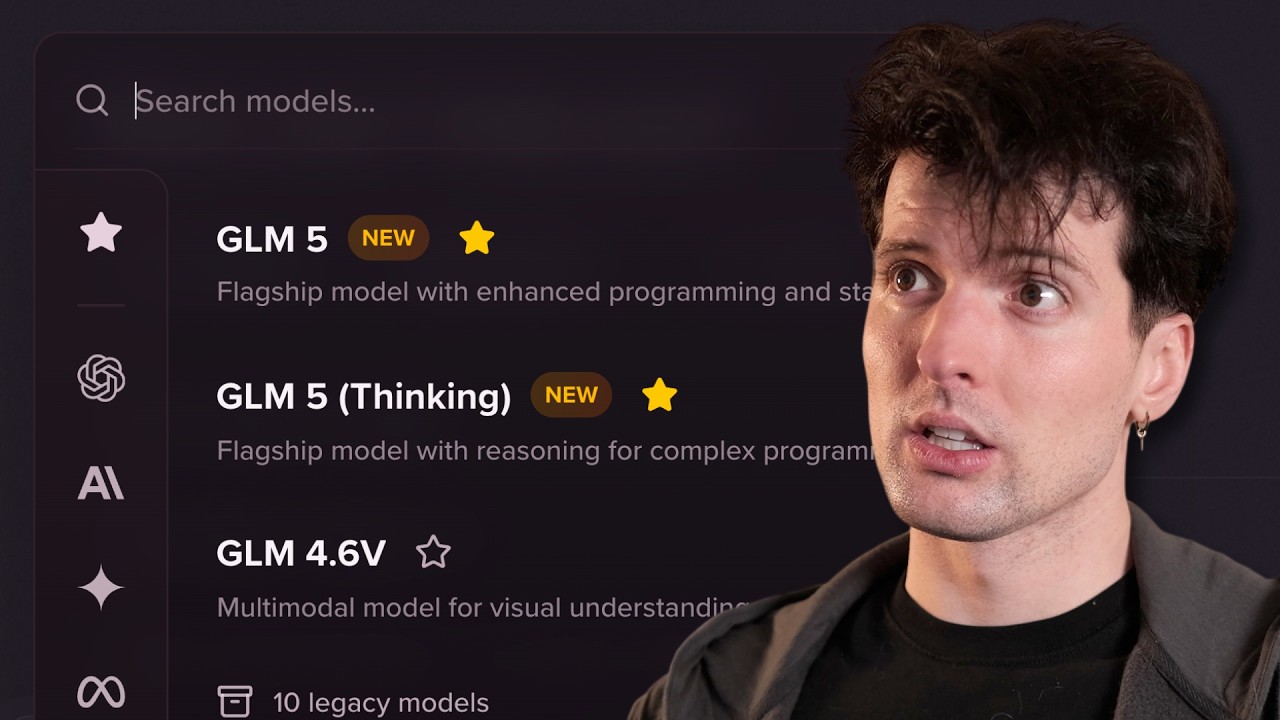
Get your counter ready, folks, becausethere's another new model. GLM5 isblowing me away. Just to jump in frontof everybody's usual question: Is itbetter than Opus 4.6? Is it better thanCodeex 5.3? No, it's an openweight modelfrom a much smaller lab in China. Thatsaid, it is by far the best openweightmodel I have seen, especially for codestuff. KK 2.5 was incredible. It'smind-blowing how good it is for anopenweight model you can go download thefiles for and run yourself. But GLM5 isa meaningful improvement. It's neckand neck with models like 5.2 and codecs inOpus 4.5. Obviously, the most recentthings like Opus 4.6 are still slightlyedging it out, but at the very least,I've had a much better experience withit than I have with Gemini 3 Pro. Thatsaid, I really want to push it to itslimits. They also put out a desktop appsimilar to the one that OpenAI put outfor Codeex, and that is very, very exciting.
But obviously, this only works withtheir hosting because it's their product.So, you probably need to sign up forthat, right? We're going to give thismodel an honest shot, especially thisearly when it's not available in all ofThe platforms just yet. We got to do themax plan. Eighty bucks a month is a littlehigh for a sub that's not going to be mymain, but I want to make sure we'retesting this to its fullest. If youneeded proof that I'm not being paid byZi, here you go. I just paid them. Theonly people paying me for today's videois today's sponsor. There's a lot ofthings that are hard about software dev,but there's one in particular that's sohard that we meme on it constantly: DNS.
I can't tell you how many times I've hadcrazy problems that were results ofdoing one tiny minuscule thing wrongwith DNS. If only it was simple. Oh, DNSsimple. Reliable DNS hosting and domainnames. Okay, real talk. I need you guysto pay attention to this one becausethey're not your normal sponsor on thischannel. Most of the companies you seeme talking about here are VC-backedbusinesses trying to scale to billionsof dollars of revenue with teams thatare growing like mad. Meanwhile, I gotthis shirt from Dian Simple in a boxwith a handwritten address to and frombecause the founders shipped it fromtheir home themselves. Dian Simple is aproduct built by engineers for engineers.
At its very core, they're not adomain reseller trying to rack up crazymargins or some weird, sketchy companytrying to buy domains right out fromunder you. They just want to make DNSeasier. When you have problems and hitthem up, the person you talk to is adeveloper. If you ever wondered how good DNScould be as a developer, look nofurther. Want to list all the domains inyour account? Here's the Ruby API forit. Want to register a new domain with anew contact? Here's the TypeScript APIfor it. Need to set up a Let's EncryptSSL certificate? Here's the line of codeyou have to run. If you want to doanything even vaguely complex with DNS,like making subdomains foryour users when they vibe code an app orletting users purchase domainsthemselves in your product, integratingall of that is hellish. I know companieswith 10-plus person teams that shouldjust be using DNSimple instead. Stopwasting your time and do domains rightat sidyv.link/dnsimple.
We are in. We're definitely going todive deep on the Zcode app, but I'vebeen doing work behind the scenes whileprepping for the stream today, running veryReal work, including this migration foran old codebase that actually ran for anhour for free. This UI might lookfamiliar, like open code, butif you look at the top here, it's Kilocode. Kilo is a sponsor, so counter somebias there. They recently forked opencode to make their own CLI, and it'sbeen pretty cool because you can use it withthe Kilo subub. They also were the firstprovider to have consistent support forthis new model. Not only are theysupporting GLM5, they're supporting itfor free. It seems like a handful ofproviders are doing the same thing,including companies like Modal wherethey have an API endpoint to host this new model that you can usefor free right now. In the future, do Iexpect it to stay free? Probably not.
The current pricing I'm seeing on OpenRouter is about $3 per mill out and adollar per mill in. That puts it at athird to a fourth the price of Sonnetand a fifth to a sixth the price ofOpus. It's a really good valuefor what it is, but also uptime isn'tgreat because these just dropped. A lotof the platforms have an insane amountof latency, like seven plus seconds.
This will all get resolved in very shorttime. It tends to when these new modelsdrop. What we really want to care aboutnow is the performance, not the speed,but the capabilities. And the fact thisis the first openweight model that I'vesuccessfully run a job that took over anhour for without issues just absolutelyblew me away. And I watched it as it wasrunning. It did a lot of smart things.The project I threw this at immediatelywas Ping. If you're not familiar withPing, I built this a while ago rightafter leaving Twitch to make it easierto do live collaborations. It's used byeverybody from Linus Tech Tips to
Elgato to the Xbox team. It was made tomake live streaming collaborationseasier. I'm still proud of the product, butit has not been our main focus becauseit turns out creator tools don't make awhole lot of money. So, we've beenfocusing on everything else we'rebuilding. As such, this codebase hasgotten out of date; a little is a littlegenerous. It's not a fun codebase towork in anymore if I'm being real. A lotof it is because I made early bets onthings that have changed a lot since,like really old versions of TRPC.
Migrating this codebase to modern toolsis one of my favorite challenges tothrow models at because it's notsomething they really can do. However, thecloser they get, the more interestingthey are to me. As I mentioned in mycodeex 5.3 video, it was the first modelthat could make meaningful progress inthis, and it did some novel things aroundpatch packaging in order to make it workand unblock itself throughout. I was reallyimpressed with 5.3's performance, but Ijust ran it with GLM, and it seems likeit is doing very well. It hasn't completedthe last phase of this migration justyet. I want to see how it runs for now.
We don't have great Firefox supportbecause it is a media product, andFirefox's AV layer is subpar. Okay,this is a common error that I get. Everysingle one of the tools I've used forthis has had this particular bug.Actually, this is a great first issue Ihave with GLM5. Paste. Fix it. Send.
Okay, it's a little confused, or theservers are lagging. It doesn't havevision. I know that's silly; it's a codemodel. Why would you need it to havevision? I paste images all the time.It is one of the main things I do whenI'm writing code. I would honestly guessthat 20 to 50% of my prompts have animage in them. So, not having thatsucks. It's one of the things that Iloved about Commun 2.5, that they finallyfixed it. I am getting an error. Pleasefix it. We will let it do this while Ilook at other tasks that I ran. JesusChrist. This model is willing to justwork, which is really, really cool. It'snice having an open-weight model that cango for this long. Oh, here was the firsttime I tried to paste an image. You're
saying the job is working, but I can'tsee the image. Yeah, annoying, but itworks. While I let this job run in thebackground, let's read a little bitabout what they have to say about themodel, as well as all of our friends whoreview these things. Let's start withtheir blog post. I feel like the vibecoding to Agentic Engineering title is abit clickbaity, but I understand whythey're saying it. This, from myexperience so far, feels like ameaningful jump in what the open-weightmodels are capable of, from likeone-shotting cool looking demos over tosomething a little more useful that cango a lot longer and do harder things.
Like I've never seen an openweight modelthat can do migration work like I've hadGLM5 doing, and I can't wait to see ifthat work ends up working. We arelaunching GLM5 targeting complex systemengineering and long horizon agentictasks. Yeah, I can tell. Scaling isstill one of the most important ways toimprove intelligence efficiency of AGI.
Compared to GLM 4.5, 5 scales from 355billion parameters, 32 billion active, to744 billion parameters, 40 billion active.If you're not familiar with what thismeans, it's the mappings inside of themodel for what points to what and howstrongly it does. The parameters arebasically like tokens and vectors thatmap together what should happen based onwhat text you already have. Forreference, Kimmy K 2.5 is a one trillionparameter model. 744 billion is close,which means this model is going to behuge: 1.5 terabytes.
Yeah, versus 4.7, which was 700 gigs. But they do have FP8versions and flash versions that arelighter than the old model; this 4.7FP8 version is only 360 gigs. And 4.7flash is a measly tiny 62 gigs.
But you're not going to be running thismodel on local hardware.
People who assume that open weight meansthey can run it on their computers.You're not running a terabyte model onyour own hardware. This is notsomething that is accessible to peopleat their houses. This is more useful tothe hosting platforms like modal andothers that can host these open weightmodels to provide them for us to use.Potentially, places like Cerebrus orGrock may be able to dotheir own versions of the models thatare significantly faster. One nicedetail now that I'm here is that it'slicensed under a proper MIT license. Itdoesn't have any of the usual carveouts
as far as I can see. Things like youhave to call it out that you're using usor pay us if you have a certain numberof users. None of those weird things. Somore parameters means the model isbigger. For example, the GPT OSS120Bmodel is around 80 to 90 gigs. I can runthat on my laptop locally, but it's 120bills per usage. So there's less intelligencewhen there are fewer parameters. Generally,speaking, the more parameterization youhave, the more value you have, the moredata you have in the model, the moreintelligence it is capable of displaying.
Generally speaking, obviously over time,the amount of intelligence you cansqueeze into a specific size changes.But for now, a bigger model definitelymeans more potential for capability.This 40B active piece is a mixtureof experts. What this means is that on agiven request, instead of going throughall 740 billion parameters, the 40 billionsection that is the most likely to berelevant to what you're doing is what'straversed instead. Mixture ofexperts models have been prettyprominent for a while now. It seemsto be what everyone is doing because youcan have a super intelligent model that
has different knowledge of differentlanguages and different sciences, all thesedifferent things that don't necessarilyneed to be traversed. You don'tneed to go through all of the Chinesedata in a given model when you'reresponding in English. You don't need togo through all of theoretical physicswhen you're writing a "hello world" app.That's effectively how a mixture ofexperts works. The 40 billion active modelis pretty cool, but again the size of this modelis going to make it inaccessible for alot of people.
GLM-5 is insane at 28.5 trillion tokens.GLM5 also integrates Deepseek sparseattention, significantly reducingdeployment cost while preserving longcontext capability. Deepseek's researchhas been pushing a lot of things, andit's cool to see them call it out here.It is definitely going to help withperformance. They've also made hugeimprovements to their reinforcementlearning, which is how you tune themodel after you've made it.
Reinforcement learning aims to bridgethe gap between competence andexcellence in pre-trained models.However, deploying it at scale for LMSis challenging due to RL training andefficiency. To this end, we've developedSlime, a novel asynchronous RL infrastructurethat substantially improves trainingthroughput and efficiency, enabling morefine-grain post-training iteration.
Yeah, that's really cool. I'm assuming,I haven't looked into this yet, and it'snot what we're here for. They found away to run a lot of RL at the same timeinstead of being somewhat linear.That could be really, really cool.Excited to see how it works. What I'mmore excited to see though are theseBenchmarks. Humanity's last exam, itbeat out pretty much everything otherthan Google's models without tools, butwith tools, it won. What's reallyinteresting here is you can see the gapof without to with tools for thisbenchmark because with tools it can doresearch, write code, and stuff like thatinstead of just spitting out text.
You'll notice here that the ZI models dolike 40 to 50% better with tools.Enthropic models do 20 to 30% better,but for some reason it looks like theGoogle and the OpenAI models don'timprove anywhere near as much. I have mysuspicions about that, especially theGoogle models. They don't use toolswell. Then we have SB bench verifiedwhich got neck and neck with Opus andCodeex. I believe this is 4.5 and 5.2.Yeah, it is. They made these before 4.6dropped. This happens a lot. And 5.3isn't on the API yet, so it's reallyhard to benchmark against. So, this is thebest we can do now. But honestly, bothOpus 4.5 and 5.2 are more than goodenough for meaningful day-to-day work.5.3 is a cool improvement. I do use itas my daily driver right now. 5.2 isstill a phenomenal model.
Arguably better than Opus 4, gettingneck and neck with that on S SW bench ishuge. S SW bench verified. It is notonly neck and neck with Anthropic; itbeat out Codex 5.2 and it crushed Gemini3 Pro. In terminal bench, it beatout both Gemini and Codex and is againneck and neck with Anthropic. Vendingbench is the benchmark. How much moneycan it make running a vending machine?It did really well there. Tow bench, itdid very well too. This is a toolcalling bench. MCP Atlas, it got rightup there with 5.2. Then browse comp,which is a browser use benchmark, gotthe best score as far as I know of alltime, which is really, really crazy. Yousee BenchV2 4.7 versus five versus Opus4.5. This is a benchmark that they madein order to test long-running tasks.
That seems to be the real focus for them,which is super cool to see from anopen-weight model. Build success rate hasbumped a ton from previous models. Endto-end correctness has bumpedmeaningfully as well. For back end, ithas also improved. But you'll see herea pretty significant gap if you look atthe right, where front-end tasks can becompleted 98% of the time.
Correctness is 75% of the time across toptier models, but the backend goes all theway down to 26 to 27%. There's a lot ofopportunity to improve backend work withthese models still. I can say thisconfidently, having been doing a lot ofit lately, but they slaughter the front endnow. And again, for long horizon, apparentlyit's now performing better thananthropic models for long horizon tasks.For multi-step chain tasks, it's slightlyworse, but it's still doing way better.
I will admit, it's kind of funny lookingat one of these charts where almost allof the bold values are to the right ofthe thing we're here to look at. Like,they aren't winning anything against thebest closed-weight models. Like, ClaudeOpus 4.5 is still going to be betterthan this. When you consider that it is afifth the price or less and it's opensource, this is a very compellingmodel. Let's check in on that job wewere running. Cool. It fixed it prettyquick. Under five minutes. Let's see ifI can load the page now. It's one ofthose errors that's so nice toscreenshot and so miserable for copypasting. Apparently, their other apps cando images. So let's try out Zcode quick.
Up into a real project. Is it going touse cloud code with GLM? Does it noteven have GLM5? Yeah, I was under theimpression that this would have thatbeing it's their product GM5testing. Looks like that worked. Let'sdo a new task. Let's see if it can takea screenshot here. Fix. It is a littlesilly that it says cloud code when it'susing GLM5 through cloud code. At leastas far as I know, that's how it'sworking. You can feel the slowness. Iagain want to be clear, the speed willalmost certainly improve. With closedweight models from the major labs, ifthey come out slow, they're going to
stay slow. So if GPT5 is slow when itlaunches, that's probably not going tochange. If Opus 4.6 is slow when itlaunches, spoiler, it was. It's probablynot going to change. When the openweight models are slow initially,there's a very good chance it'll improveas hosts find ways to optimize them andcapacity gets better. All of thesethings, these labs also have lesscapacity overall. Very interesting. Itdid analyze the image, but it used atool to do it because it can't see theimages itself. It's not multimodal.
It doesn't have the ability to view things.It just has the ability to do things. Itcan't run bun commands. Is it sandboxed?Why couldn't it do that? Is it notstarting? Oh, I know what they didwrong here. I know too much because I may ormay not have been building a similar appmyself recently. I don't think this isgoing to work. So, we're going to goback to using Kilo for now. It's coolthat they're baking an app like this, butit's clearly not their primary focus. Asyou can see, the fact that Claudecode appears on my screen more than ZI'sbranding does, even though I'm usingZI's model, at the very least, this appearsto be working. At leastwhat did it break? Oh no. Let's runrf node modules, fun install, run dev.
Okay, we appear to be good. I don't knowwhat it's compiling. It's taking solong. But I can sign in still. Giveme a sec. Cool. This appears to beworking so far. See how it goes when Iactually activate my camera. Hi, nerds.You're seeing behind the scenes a littlebit. Mike, join. Okay, we got an errorimmediately upon joining. To be fair,the Aly client is one of the most cursedpieces of software I've ever worked with.
With that said, I'm not surprised it's broken.There are a few companies I can confidently say are evil, and I've hadsuch a bad experience with them. I'm notsurprised that's what broke. The buildI'm working on for this that I actuallyhope to ship in the future is one wherewe move to convex, and I can deprecate alot of the broken things like that.Testing. Cool. And if I refresh, willthe message still be there? It is. Andif I do an external quick embed link,will I appear? I do. Nice. All workingas expected. That is very impressive.
The fact that this model ran for anhour, updated the vast majority of mycore depths, everything other than TRPC,and succeeded, and now is working isnuts. No closed weight model could dothis even at the start of this year. Thefact that an open weight model is doingit this early into the year is really, really impressive.
Obviously, Simon made his own post as well. It'sinteresting to see Zai take a positionon what we should call professionalsoftware engineers building with LMS.I've seen agentic engineering show up afew other places recently, most notablyfrom Cararpathy and Addiosmani.
Fair. It seems like the industry istrying to move away from the vibe codingterm because it has so much negativeassociation, and this is a lot deeper. Oh,apparently, DAX is hanging out inchat. Why am I using Kilo CLI? Because youdidn't have GLM5 yet.Don't worry, DAX. I called out the factthat it's a fork of open code at thestart. People know that I'm using itfor this. Is GM good? Oh, I'd miss this.DAX, it's insane. It is actuallycapable of super long-running tasks. Ijust ran a job in it that went foralmost an hour. It was a huge migrationto migrating the old ping.ggcodebase. The only other model that'scome close to getting this workingproperly is 5.3 Codeex, and it did it.
Yeah, 59 minutes 30 seconds. Almost anhour on the dot it ran for. So youdefinitely want to get the supportASAP. Can we commit the current changesand implement phase 4? Now, it has goodgit etiquette, too. That was not a thingI necessarily expected, but it's cool tosee. I told it once during this tocommit for me and make this new branch,and it seems to be doing all of thatquite well. This is the most I've feltThat competence thing you getfrom just Opus and Codeex and toptier models is the most I've feltoutside of the major labs. I'mfeeling something with this one. Andyes, I did that 1-hour refactor on thefree tier in Kilo. It's kind of nuts.
I would expect a lot of other placesto offer this for free or really cheap,because it's not the hardest thingin the world to host if you have enoughGPUs that are competent and able to dothat. For those of you who are lookingfor near best-in-classintelligence but don't have the budgetfor these $200 plans, this is reallycompelling. This is a big task. Let mestart with the package updates planning.Honestly, a new index you all should starttracking rather than just the best new modelindex is how much of the video you areactually using the model in coding andshowing code versus reading other stuff.The more time you spend in thedetails of a codebase with it, thebetter the model is likely to be. Man, thedashboards for all these sites arerough. The number of times I've beensigned out randomly on the ZI site is alittle frustrating.
Code proper setup. And look at that! Ican use GLM5 through my coding planhere. Let's try this on a differentproject just to see if it feels anyfaster. I'm planning on releasing thisapp soon. Anything stand out that Ishould address before we launch?Throwing it at shoe. See how it does. Weshould do a quick UI test on this.
Initialize it with vittailwind, React, and TypeScript. Make fiverenditions of the homepage. Use yourfront-end design skills to make them lookawesome.This did a legit audit. It only ran fortwo minutes, but it found a lot of goodstuff. Like, it actually properlyscanned the app, found all the thingsthat mattered, and gave goodsuggestions. This is a good model. Like,I don't know how else to put it. I'mexcited to see how it does at UI;though, that's where a lot of theseopen-weight models struggle. Kimmy 2.5did a good job there, but it remains to beseen how good. I'll write them all inparallel for efficiency. [ \_\_ ] Yeah.
While we wait for that, let's see whatartificial analysis had to say. The LM5is ZI's first new architecture since4.5. All the other models were part ofthe original architecture. 5 scaled allthe way up to 744 billion. As we mentionedbefore, it's also BF16 floating-pointprecision versus FP8 in four for DeepSeek V3 and Kimmy K2, which is a bigpart of why the model is so massive. GM5scores 50 on the intelligence index andis the new open weights leader, up from4.7 with a score of 42. An eight-point jumpdriven by improvements across agenticperformance, knowledge, andhallucination. The hallucination part inparticular is really, really cool. Itappears to be the model thathallucinates the least of any model todate. The fact that Google has alreadybeen surpassed by an open weight model iskind of crazy. Like, Gemini 3 is bad andwas already pretty irrelevant.
Now it's done. JM5 abstains morefrequently in the hallucination bench,which keeps it from getting negativepoints for lying and being wrong. Andthat is why it got the lowest scorethey've ever seen on the hallucinationbenchmark. Its hallucination rate is inthe 30% range versus, I don't know, Gemini3 Pro at 88%. Yeah, it's much morewilling to say, "Sorry, I don't know that."Models that will just lie and be wrong. 200K token context multimodality is text input and output only. K2.5 remains the leading open-weight model that supports image inputs. Yep. K2.5 is also really good with that. I can honestly see value in something like a generic image recognition tool that uses K2.5 just for the image part, and then you can use this model for everything else. I don't think any of the open-weight models are good enough by themselves to be the only model you use, but some level of orchestrating between them could work really well.
I know a lot of people were previously using GLM as the workhorse model and had something like Miniax commanding and controlling it. Hum 2.5 shook things up a bit, and I'm sure GLM 5 is going to even more so. Its placement on the cost versus intelligence is really solid. It is a little more expensive than K2.5 because it's huge.Cost might go down, but hard to know for sure, but its performance is a meaningful improvement. It doesn't quite hit this green range, but it's not far off either. And it just kind of makesOther models feel way more expensive.
Remember, this bottom bar is in log scale.So something that is 50% further onisn't twice as bad; it's 20 times sometimes.It's brutal. It also uses fewertokens to run the benchmark than before,even though it is performing muchbetter. That is cool to see because GLM4.7 was definitely token hungry forthese reasoning benchmarks, and thatseems to have been mostly addressed withthis release. If we go look at theactual cost to run, you'll see it's waylower than the leading models. GLM5 cost$500 to run this benchmark, whereas Opus4.6 cost $1,500. That's 3 times cheaper.5.2 was $2,300, and Opus 4.6 in the adaptivereasoning where it can reason as much asit decides it wants to. 2500 and codecson X high cost $3,200. So that's between 3 to 6 timescheaper for intelligence that is not asgood, but meaningfully close enough.
Let's see how the designs came out. Thefact that you can get design this goodout of an open weight model is kind offreaking nuts. What? Obviously, K2.5 cando well, but that is a really goodstarting point. Let's check the otherones. Ah, they all do this fontclipping. I've seen so many of theModels screw this up. It's pretty, butit has problems. Three. I like wherethey're going here, but this side isjust not done quite properly. Again, Ilike where they're going with it, but Ihave some issues with the backdropand other things. But this would be areasonable starting point. If youdon't want to spend the money on themore expensive models, this is fine.
Obviously, one of the things that sucksabout this is if you have a problem, youcan't just screenshot the thing youdon't like and say, "Hey, fix this."Because it doesn't have the ability tolook at images, but these arereasonable starting points. None of thisis as good as what I expect fromOpus 46 with the design scale, but it'shonestly better than what I get from GPTmodels. And I'm still so blown away bythe hallucination rate. That's socool to see. And if they can get thecost down a tiny bit with optimizationsin the hosting, they will quickly end upin this range and be by far the smartestmodel at a reasonable price. Prettymuch everything to the right of thismodel is not as smart. Other than Opus46 in adaptive mode and Codeex in extra.
High, pretty much everything else isdumber, which is kind of crazy that it'sonly halfway on the cost index and it isnear the top on performance. Ifyou've ever doubted that intelligencewould be commoditized, hopefully therecent releases of K2.5 and GLM5 areswaying you the other way. The speed atwhich these labs are catching up withFrontier is insane. Especially when youconsider that at the same time labs likeGoogle and XAI are not keeping up. Likewhere even is Gro 4 now? Oh, it's allthe way down here — 41 and 39respectively. I'll never understand theGrock fanboys, but especially now alltheir researchers left; things are alittle scary. They're getting crushed.
Like everyone's being crushed by themain two labs here and the handful ofreally talented ones in China. I reallydon't think that at the end of the yearanyone other than Anthropic, OpenAI,ZAI, Deep Seek, Miniax, or Moonshot.Like those are the only labs that matterright now. It feels like things couldchange in the future, but no one'smoving as fast as they are. I suspectthe future is going to look very similarto what we see here. The numbers mightIt may be bigger, but the order I would suspectto stay relatively similar. But it isreally cool that one of the top fourmodels right now is an openweight one.
I'm excited. And by the way, thatmigration I was doing for the TRPC thingis still running. It can kind of justgo. And all of this migration I've beendoing here, if I was charged proper APIrates, would have cost about $10. Ialmost paid an engineer a few thousand to dothis migration. It will just grindit out in the background. This wouldhave cost over $100 with thebest-in-class closed weight models. Thatis insane. I think I'm going to use thismodel for a lot of stuff. Congrats toZai for the incredible ship. I love thefocus on engineering and long runningtask work here. It is far ahead ofeverything else. I don't think I wouldlike talking to it a whole lot. And the
lack of multimodal support for images isa little bit rough, but other than that,it feels like we're kind of there. It'swild seeing how fast the openweightworld is moving, and I couldn't behappier with this release. I am so, sopumped. While it isn't going to replacemy daily driver of CodeEx 5.3 just yet,It is so surprisingly close that I caneasily recommend this to anybody tryingto save money or run models that theycan host themselves. Curious how y'allfeel though. Are you as excited as I amabout this release, or are you justtired of all the new releases? Let meknow how you feel. And until next time,peace, nerds., GLM-5 Is Unbelievable, YouTube, 01kh9r5482peqh81449s56x820.