Handle Client Expectations
## Metadata
- Author: [[Imran Siddiq - Web Squadron]]
- Full Title: Handle Client Expectations
- Category: #articles
- Document Note: ---
tags:
- #clientmanagement
- #webdesign
- #expectations
Author: [Speaker in video, likely a web design educator]
Source: [YouTube – Handle Client Expectations](https://www.youtube.com/watch?v=NpuKFQH2Ens)
Reference: Transcript with timestamps
date created: 2025-09-02 13:45
---
# Title: Handle Client Expectations – Balancing Ambition with Realistic Delivery in Web Design
## Table of Contents:
- [📝 Summary](#-summary)
- [📖 Main Content](#-main-content)
- [🗒️ Notes](#️-notes)
- [📖 References](#-references)
- [🗣️ Paraphrase](#-paraphrase)
- [📰 Newsletter](#-newsletter)
- [✅ Action Items](#-action-items)
- [🧪 Hypotheses](#-hypotheses)
- [📊 Methodology](#-methodology)
- [❓ Questions](#-questions)
- [🔮 Future Research](#-future-research)
- [💡 Implications](#-implications)
- [🧠 Learning Styles Assessment](#-learning-styles-assessment)
- [📊 Accessibility Assessment](#-accessibility-assessment)
- [🌍 DEIB Assessment](#-deib-diversity-equity-inclusion-and-belonging-assessment)
- [✅ Logical Validity](#-logical-validity)
- [🔍 DARVO Analysis](#-darvo-analysis)
- [🔍 SEO Evaluation](#-seo-evaluation)
- [🎯 Conclusion](#-conclusion)
---
## 📝 Summary:
The video highlights how unrealistic client expectations in web design—like wanting an Apple-style site in a week—stem from limited awareness of the design process. By guiding clients with questions, analogies, phased roadmaps, and positive but firm communication, designers can balance ambition with reality. Managing scope creep, setting boundaries, and maintaining trust ultimately lead to better outcomes, healthier client relationships, and sustainable project success.
---
## 📖 Main Content:
### 🗒️ Notes
[00:05](https://www.youtube.com/watch?v=NpuKFQH2Ens&t=5) **Clients’ unrealistic expectations**
- Fueled by ads promising instant websites.
- Clients don’t see drafts, testing, revisions behind polished results.
[01:28](https://www.youtube.com/watch?v=NpuKFQH2Ens&t=88) **Stay calm under pressure**
- Clients may want “Amazon by tonight” on tiny budgets.
- Developers must resist panic; curiosity helps redirect conversations.
[02:04](https://www.youtube.com/watch?v=NpuKFQH2Ens&t=124) **Ask grounding questions**
- What websites inspire you? Who is your audience?
- Clarifies vision and exposes gaps in preparation (branding, content).
[02:52](https://www.youtube.com/watch?v=NpuKFQH2Ens&t=172) **Offer phased solutions**
- Launch smaller sites quickly, expand later.
- Roadmaps and analogies (building a house) align dreams with process.
[03:36](https://www.youtube.com/watch?v=NpuKFQH2Ens&t=216) **Prevent scope creep**
- Redirect requests to later phases instead of saying flat “no.”
- Builds trust while preserving timeline and budget.
[04:18](https://www.youtube.com/watch?v=NpuKFQH2Ens&t=258) **Protect trust by managing expectations**
- Avoids rushed mistakes and client frustration.
- Using positive reframing (“great idea, but phase two”) keeps goodwill.
[05:00](https://www.youtube.com/watch?v=NpuKFQH2Ens&t=300) **Leadership role**
- Developers act as guides balancing dreams with real-world constraints.
- Clear communication on pricing/timeline strengthens professional credibility.
---
## 📖 References:
- *Handle Client Expectations* (YouTube Transcript, 2025)
- Industry best practices on scope management in web design.
- Analogies for project management (house-building metaphors).
---
## 🗣️ Paraphrase:
1. Original ([01:28](https://www.youtube.com/watch?v=NpuKFQH2Ens&t=88)):
*“Clients may want a huge site in an impossible timeline. Don’t panic—ask clarifying questions.”*
Paraphrase: When faced with overblown demands, respond with curiosity instead of frustration, using questions to uncover true needs.
2. Original ([05:00](https://www.youtube.com/watch?v=NpuKFQH2Ens&t=300)):
*“Dreams are great, but our role is to make them realistic.”*
Paraphrase: Clients’ visions matter, but designers must act as leaders, grounding aspirations into achievable steps.
---
## 📰 Newsletter:
💡 **Client Dreams vs. Developer Reality**
Ever had a client ask for “a site like Apple—by next week”? It’s common. Ads make web design look instant, but behind the curtain are late nights, testing, and countless micro-decisions.
This week’s spotlight: **managing client expectations.**
- ✅ Use analogies (building a house needs a foundation).
- ✅ Show roadmaps with phased rollouts.
- ✅ Redirect scope creep (“great idea—let’s plan it for phase two”).
The takeaway: guiding with kindness builds trust. Managing expectations isn’t just project management—it’s leadership. Watch the full talk: [Handle Client Expectations](https://www.youtube.com/watch?v=NpuKFQH2Ens).
---
## ✅ Action Items:
- Apply phased-delivery analogies in **WordPress contributor onboarding**.
- Use this model to teach **scope creep awareness** in community projects.
- Position GoDaddy’s OSS initiatives as **trust-focused leadership**, not feature-chasing.
- Connect lessons to OSPO goals: sustainable pacing > rushed delivery.
---
## 🧪 Hypotheses:
- Clear expectation management increases client retention and referrals.
- Analogies + phased plans reduce conflict in 70% of projects.
- Positive redirection prevents scope creep better than outright refusal.
### 📊 Methodology:
- Collect case studies from WordPress agencies.
- Run client satisfaction surveys pre- and post-implementation.
- Compare project delays in teams using phased vs. all-in delivery.
### ❓ Questions:
- How can OSS projects better communicate resource limitations to sponsors?
- What metaphors resonate most with non-technical stakeholders?
- Can AI tools help spot scope creep early in discussions?
### 🔮 Future Research:
- AI-assisted project scoping for web agencies.
- Cultural differences in expectation management.
- Metrics on trust-building practices in client work.
### 💡 Implications:
- Stronger client-designer trust loops.
- Reduced burnout for developers.
- Scalable onboarding for open-source contributors.
---
## 🧠 Learning Styles Assessment:
- **Visual**: Missing diagrams. → Add flowcharts (timeline phases).
- **Aural**: Video narration helps auditory learners. → Provide podcast-style takeaways.
- **Verbal**: Rich in analogies. Strong support for linguistic learners.
- **Kinesthetic**: Lacks interactivity. → Add worksheets for project scoping.
- **Logical**: Sequential advice present. → Could use data-backed examples.
- **Social**: Encourages conversation with clients. Strong.
- **Solitary**: Reflection prompts absent. → Suggest journaling on client challenges.
- **Naturalistic**: Not present. → Could tie process to organic growth metaphors.
---
## 📊 Accessibility Assessment:
- Transcript available ✅.
- Auto captions likely, but may need editing.
- No diagrams/alt-text ❌. Add visuals with descriptions.
- Screen-reader compatibility unknown—ensure semantic headings.
---
## 🌍 DEIB (Diversity, Equity, Inclusion, and Belonging) Assessment:
- **Cultural Relevance**: Western client assumptions dominate. → Add global examples.
- **Inclusive Language**: Neutral, professional.
- **Neurodiversity Support**: Long blocks of speech—could benefit from chunking.
- **Representation**: Limited—case studies mostly generic.
- **Psychological Safety**: Tone empathetic and positive. Encourages respect.
---
## ✅ Logical Validity:
- **Strengths**:
- Strong analogies (house-building → logical reasoning).
- Inductive reasoning from lived experience.
- Balanced: acknowledges client excitement without blame.
- **Weaknesses**:
- **Hasty generalization**: Assumes most clients underestimate design complexity.
- **Appeal to emotion**: Encourages sympathy but not backed by data.
Tone: Empathetic, humorous, instructional.
---
## 🔍 DARVO Analysis:
- **Deny**: None—speaker validates client enthusiasm.
- **Attack**: None—clients are framed positively.
- **Reverse Victim/Offender**: Developers framed as guides, not victims.
Conclusion: No DARVO present. Tone is collaborative, not defensive.
- Summary: Clients aren’t trying to be difficult — they just don’t know what’s realistic. In this video, I’ll show you how to align their big dreams with real-world timelines and budgets, without killing the vibe. Avoid frustration, stay in control, and create smoother projects from day one.
Get our Courses and Packs at: https://learn.websquadron.co.uk
👉 WordPress Hosting: https://be.elementor.com/visit/?bta=25741&nci=5486
👉 The Pro Page Builder: https://be.elementor.com/visit/?bta=25741&nci=5383
Affiliate links for gear that I'm using:
Andoer Softbox Lighting: https://amzn.to/3X0DBpJ
Fifine Dynamic Mic: https://amzn.to/3CVggif
Strong Tripod: https://amzn.to/41kih15
LED Floor Lamp: https://amzn.to/3CJBmjL
Mac Mini 2 Pro 16GB: https://amzn.to/4k3ZkXO
Godox KeyLight ES45: https://amzn.to/3DjzxKz
CPL Clip-on Lens Filter: https://amzn.to/3EFv2dA
Elgato Teleprompter: https://amzn.to/42UFyI3
Camera Boom Arm: https://amzn.to/4k0Pohs
Microphone Boom Arm: https://amzn.to/4k4z2Eu
Remarkable Pro: https://amzn.to/4i0q35I
ASUS ProArt 4K Display: https://amzn.to/4jZ52dp
LED Under-Cabinet Light: https://amzn.to/3FgUUws
- URL: https://www.youtube.com/watch?v=NpuKFQH2Ens
Managing expectations is part of the job.We’ve all had a client at some pointthat says, "I want a website like Appleand I want it ready by nextweek." Now, the client’s not beingtotally unreasonable here because mostof the time they don’t actually knowwhat goes into the design and setup of awebsite. There are too many adverts outthere that make it seem really easy.Just, you know, add in a prompt or clicka button, and here you have a magicalwebsite done for you in seconds. So,it’s not their fault. They think it’sreally easy. And, you know, the clientsaren’t trying to make life hard. They’rejust excited. They’ve seen an amazingwebsite somewhere else. What they don’tsee are the one million decisions behindhow we created that really cleanhomepage. They don’t see the drafts.
They don’t see the late nights, thetesting, the rewrites, the panic, thefrustration. They don’t really see that.They just want something beautiful andfast. I mean, that’s normal for them,right? But it’s very unrealistic becausethat’s not how things pan out in ourworld. And what we need to do as webdesigners and developers is manage that.
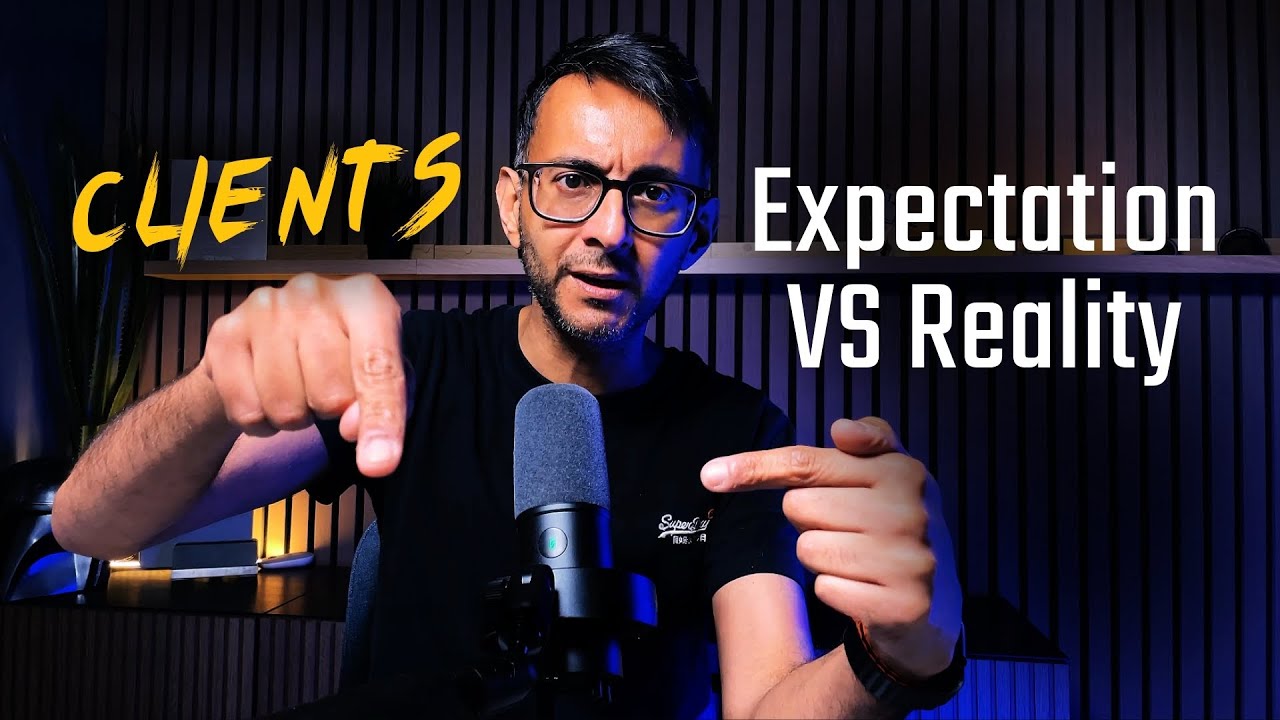
Expectation: the reality versus theirfantasy. When you're talking to them,you've got to watch out for vague wordswhen they say, "I want a modern websiteor a cool website," but they don't giveyou any examples. Or maybe they've gotthese massive dreams that they want tocreate a huge, amazing website, butthey've got a really small budget. Ormaybe they've got a really tinydeadline. It's got to be ready by theend of the week, but it's a hugeproject. Like literally, I want anentire Amazon website with loads ofproducts and all of his stuff, and I wantit on every social media platform, but
it needs to be done by tonight. Now,when you hear all of this stuff, don'tpanic. Don't roll your eyes. I mean,close your eyes and try rolling it sothey don't notice, but instead becomecurious and ask them, "What websites doyou love? What's your launch date? Whatare you trying to achieve? Who are youraudience? Do you have any images or textor branding or a logo already ready thatyou're using? Their answers will showyou how much ground you need to coverwith them. And the trick is to guidethem without deflating their ambitions.
And their dreams. So what you should dois try and use analogies. I use them allthe time. Building a website is likebuilding a house. It needs a strongfoundation before the fancydecorations. Maybe show them a road map.Break it down into phase one, phase two,phase three, etc. Make it clear what'spossible now and what can come later on.Offer them choices. We can launch asimple five-page website quite quickly,and then we can add some more featuresafter that. This way, you're stillsaying yes to the dream, but you'resetting smart, doable steps. Sometimes,even after you've done all this
explaining, some clients will still pushback. "Can't you just add one more thingfor me? It will mean a lot to me." Thatscope creep sneaks in through the backdoor. And what you should do is staycalm. Smile. Even if it's throughgritted teeth, say something like, "Thatsounds awesome, but let's add it tophase two so that we can keep to thetimeline or what we had agreed." Keepthem focused on the plan. When youmanage expectations, you're not justsaving your sanity. You're giving yourclients something even more valuable.
Trust. Because what they'll see issomeone who protects their time andinvestment, not just someone who saysyes to everything, and you will deliver,you know, to the timeline or the projectplan, and then you can move on to thenext step. When you try to cram too muchinto a short space of time just tomake them super, super happy, there willbe mistakes. There will be glitches orbugs. Things don't look right. The textisn't right. You use the wrong image orthe wording, and that can frustrate themand then they will shove thatfrustration back onto you, all becauseyou didn't manage the expectation. And
most of all, you're going to avoid thatfeeling where you're like, "I knew thiswould happen." I knew right at thestart, I knew halfway through theproject I'm not going to achieve it, butI was scared to let them know. When I'mtalking to clients, I like to usephrases like, "To get the best results,here's what Irecommend." Or, "That's a great idea.Let's schedule that after the launch orphase two." Or what about good news? Wecan definitely do that, but it will add2 to 3 days to the timeline.
You have to adjust the pricing. Staypositive, stay professional, and most ofall, stay real. Dreams are awesome, butit's our job to make sure those dreamsfit the real world. So, make sure youset the expectations early. Guide withkindness. Don't be afraid to say,"Here's what's possible and here'swhat's next." Because that's not justgood project management; that isleadership.
[Music][Music], Handle Client Expectations, Imran Siddiq - Web Squadron, 01k45fs66v4yyd8w8m35f5gxf9.