Hannah Ritchie: The Future Is Not Bleak
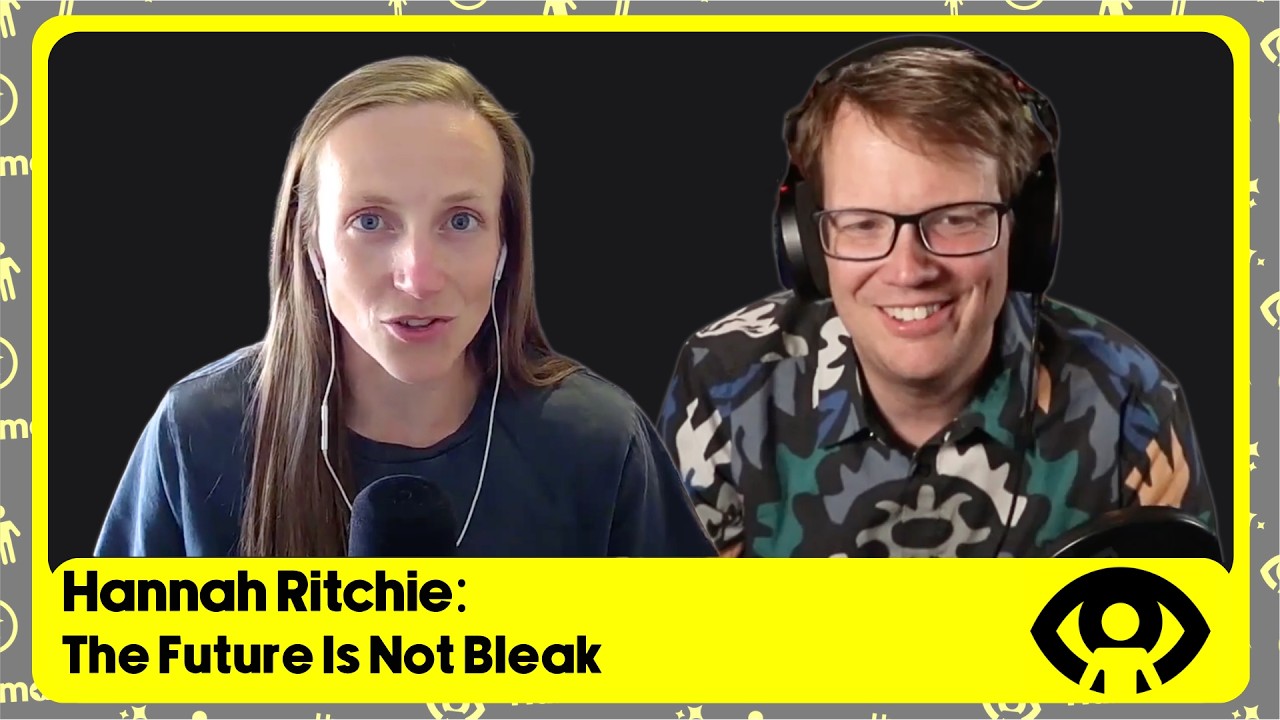
🔗 **Source:** [Hannah Ritchie: The Future Is Not Bleak](https://www.youtube.com/watch?v=VFU6nqbMylM)
> [!note]+ Document Notes
> ---
> tags: [climate-optimism, data-literacy, decarbonization, population-trends, food-systems, renewable-energy]
> author: Hannah Ritchie
> source: Humans (Hank Green), YouTube
> reference: https://www.youtube.com/watch?v=VFU6nqbMylM
> date created: 2026-09-05
> ---
> > [!info] Generated analysis — not the author's words. Sections below are machine-written
> > from the captured source. Only text inside `> [!quote]` blocks is verbatim from the author.
> > Do not quote or attribute any other line to the named author.
> ## Summary
> - Hank Green interviews Hannah Ritchie, deputy editor of Our World in Data (OWID), an Oxford-based nonprofit that aggregates and publishes global research data, on his podcast "Humans."
> - OWID has grown from roughly 5 staff pre-COVID to about 25 today, mixing researchers, data scientists, web developers, and designers.
> - Ritchie describes her personal shift from a teenage/early-university "doom spiral" about environmental collapse to data-driven optimism, crediting Hans Rosling's work on human development data as the turning point.
> - Core argument, developed across her books "Not the End of the World" and the newly released "Clearing the Air": media coverage and public perception systematically overweight dramatic, rare causes of harm (homicide, terrorism) and underweight large, slow-moving problems (heart disease, cancer, child mortality) and the incremental progress made against them.
> - Key data points covered: cause-of-death vs. media-coverage mismatch, childhood leukemia survival flipping from ~10% to ~80-90% over 50 years, population and fertility dynamics, biodiversity loss driven mainly by food and land use rather than climate change, solar's cost collapse via "learning curves," and cement's outsized (7-8%) share of global emissions.
> - Stakeholders: OWID's research and data-provider network, global health funders and governments (95% of global aid budgets vs. 5% from philanthropy), climate and agriculture policymakers, and the general public whose risk perception is shaped by media coverage patterns.
> - Bottom line, in Ritchie's own closing framing: humans have solved large problems before through sustained, deliberate effort rather than accident, and food/agriculture remains the most underappreciated environmental lever left to pull.
> ## Main Content
> Hannah Ritchie's central claim is that misinformation runs in both directions — not just false claims that things are fine, but a "doom narrative" that convinces people progress is impossible, which she says is itself a form of misinformation the world cannot afford if it wants to fix problems. She grounds this in OWID's core function: translating research and data that already exists (often locked behind paywalls or jargon) into a form the public can act on.
> She traces her own change in outlook to Hans Rosling's TED talks on human development data (child mortality, maternal mortality, extreme poverty), which showed her broad global improvement she had not previously been exposed to. Applying the same lens to environmental data, she found solved precedents — the ozone hole and acid rain — that get little contemporary attention precisely because they were successfully addressed.
> The conversation moves through several data-grounded corrections to common assumptions: that population growth is the main lever on future emissions (she argues it isn't, per a paper by economist Dean Spears, because the timeline for decarbonization by 2050 makes even a several-billion-person difference in 2100 population largely irrelevant to emissions); that biodiversity loss is primarily a climate problem (she says food production and land use are the larger driver); and that solar's rapid price collapse is inexplicable (she attributes it to solar being a modular, iterable technology like computing, versus fossil fuels as commodities extracted from the ground and nuclear as large one-off builds that don't accumulate learning). She also flags under-discussed decarbonization targets — cement (7-8% of global emissions, more than double aviation) — and argues a full process redesign is likely to beat bolt-on carbon capture.
> Ritchie closes with two takeaways: a macro one (humans solve large problems through deliberate, sustained effort, not by accident) and a micro one (food and agriculture are the least-discussed and most consequential environmental lever, driving deforestation, biodiversity loss, overfishing, freshwater use, land use change, and water pollution, plus a quarter to a third of climate emissions).
> ## Notes
> #### ⏱️ [00:08](https://www.youtube.com/watch?v=VFU6nqbMylM?t=8) Introduction and premise
> - Hank Green frames the episode around how "knowable" basic global facts feel today and credits the data infrastructure (OWID) that makes this possible.
> - Ritchie is introduced as OWID's deputy editor; the org pulls together data from agencies, governments, and academics into free, shareable charts and articles.
> #### ⏱️ [01:35](https://www.youtube.com/watch?v=VFU6nqbMylM?t=95) What OWID actually does
> - Team grew from roughly 5 people pre-COVID to about 25 today: researchers, data scientists, web developers, and designers together.
> - Ritchie frames OWID's job as translation and bridging: research and data already exist but sit in jargon-filled papers or hard-to-digest spreadsheets.
> #### ⏱️ [06:38](https://www.youtube.com/watch?v=VFU6nqbMylM?t=398) Media coverage vs. actual causes of death
> - OWID compared mentions in the New York Times, Washington Post, and Fox News to actual US causes of death.
> - Heart disease and cancer dominate actual deaths; homicide and terrorism dominate media coverage, creating a stark mismatch.
> - Adjusting for years-of-life-lost narrows but does not close the gap, since younger deaths (homicide, car accidents) get disproportionate coverage.
> #### ⏱️ [09:14](https://www.youtube.com/watch?v=VFU6nqbMylM?t=554) Cancer survival: incremental, not headline, progress
> - Hank Green's own Hodgkin's lymphoma outcome: 5-year survival is 95% in the US and 89% globally — better odds worldwide than he expected.
> - Childhood leukemia: roughly 90% died from it 50 years ago; today survival rates run 80-90%, achieved through accumulated small treatment improvements rather than one breakthrough drug.
> #### ⏱️ [13:38](https://www.youtube.com/watch?v=VFU6nqbMylM?t=818) Data quality problems: infant mortality example
> - Comparing "which country has the lowest infant mortality" is harder than it looks because countries define live birth differently (e.g., a baby born at 24 weeks).
> - Small definitional differences produce large ranking swings, and countries have incentives to define metrics favorably.
> #### ⏱️ [16:09](https://www.youtube.com/watch?v=VFU6nqbMylM?t=969) From pessimism to Hans Rosling
> - Ritchie says 15 years earlier (high school into early university) she held an extremely negative worldview, driven by climate anxiety, and actively sought out confirming bad news ("doom spiral").
> - Hans Rosling's data-driven talks on child mortality, maternal mortality, and extreme poverty were the turning point that showed her broad global progress she hadn't seen before.
> #### ⏱️ [21:43](https://www.youtube.com/watch?v=VFU6nqbMylM?t=1303) Solved environmental precedents: ozone and acid rain
> - Ritchie cites the ozone hole and acid rain as environmental problems the world "largely solved," noting they get little modern attention precisely because they were fixed.
> #### ⏱️ [24:56](https://www.youtube.com/watch?v=VFU6nqbMylM?t=1496) PEPFAR cuts and early data lag
> - Discussion of recent US foreign aid cuts (referenced as "PEPFAR" cuts); Ritchie notes data typically lags a year or more, so full 2024-2025 effects aren't yet visible in macro trends, though smaller studies already show reduced HIV medication access.
> #### ⏱️ [26:50](https://www.youtube.com/watch?v=VFU6nqbMylM?t=1610) Foreign aid: government vs. philanthropy
> - Global aid budgets: roughly 95% from national governments, roughly 5% from philanthropy — contrary to a public perception that billionaires fund most of it.
> - Survey data shows people drastically overestimate the share of national budgets spent on foreign aid; correcting the estimate ten
This is humans. >> Humans. >> Humans. >> Humans. >> Humans. >> Humans. [music] >> I'm Hank Green. How many people are there on Earth? What's the carbon impact of a plastic bottle? What's the infant mortality rate in Sudan? How many people died of CO 19? What country uses the most industrial robots? These are questions that to me, weirdly enough, feel knowable. Like I could Google them and I could get an answer and I would trust that answer. This is not normal.
It's not just weird that I can find that information out. It's weird that that information feels knowable at all. It is a big Earth. There are 8 billion people on it. Who is counting all of these things? And how are they talking to each other? And how do we make sure that they're actually measuring the same or at least comparable things? And also, how am I not feeling grateful for them all of the time? Because we simply cannot make good decisions about the future of humans without understanding the present of humans and also the past
of humans. That understanding is hard fought and complex, but it hides like the pipes beneath our houses. Good data is vital infrastructure. Hannah Richie is the deputy editor of our world and data, a nonprofit research publication based out of Oxford. They take the data that the world's agencies and governments and academics produce and pull it together and publish the result as charts and articles that anyone in the world can look at and share for free. If you have seen a chart on the
internet, you have probably seen some data from our world and data. And somewhat fascinatingly to me, somewhat surprising, as Hannah spent more time with the data, she seems to have become more optimistic, especially about climate change. and she has explained that case in two books. The first, not the end of the world, totally changed my outlook on everything. It takes seven of the big environmental problems that we tend to assume are only getting worse and walks through in the data why most
of them are actually trending in better directions than the headlines suggest. And just released Clearing the Air narrows in on climate specifically. Neither book is arguing that everything is fine. They are arguing that the doom narrative is its own kind of misinformation and that misinformation is a luxury that we really cannot afford if we actually want to fix anything. Hannah Richie, I'm so glad to finally be talking with you. Thank you for coming on humans. >> No, it's great to be here. What an introduction. >> I've heard lots of interviews with you
and I am embarrassed that they never ask about the work that our world and data does. Like of course you were like framing the stuff inside of the frame of your books and you know you got to sell books and people should buy the books but like god what important work. I don't think it's a very big team. >> No it's not. And I should say the work that comes out of the books has basically what I've learned through doing our own data for seven or eight years. So kind of the books are completely built on what we've learned our data and what we publish. I mean
we've grown over time. We did a huge amount on co data. Preco we were maybe five >> and now we're maybe 25. >> But that's a mix of researchers, that's a mix of data scientists, web developers, designers. We are this kind of weird mix. >> It's very rare that you get web developers and academics in the room and they get along. But I think that's actually quite [laughter] unique uh about the publication. >> Yeah. I mean because part of the idea is that you really want to be displaying this information in ways that are useful but also that are like compelling to
some extent. And another thing that y'all do is you write it up. You like write articles about the data that I find to be fun and good to read. And if you follow the we're here newsletter, which we do, we have a little thing where we suck out your your good blog posts and put them inside of our newsletter, uh, which you graciously allow us to do. So, you're also doing that synthesis and being a kind of publication. There's a lot going on for 25 people. >> Yeah, there's a lot. I mean what we're
really trying to do there is and this is a kind of origin of it is that you know the world has lots of big problems and people have questions about those problems they want to know what's the scale are we making progress where are we not making progress what can we learn from the past and the annoying thing is that researchers and often data providers or collectors have actually the answers to those questions they've answered them but in some jargon filled paper behind a pay wall or in some spreadsheet that's very hard for anyone
to digest. And a core part of our work is basically being that bridge and that translator and saying like this is what the research says on this important question or this is what the data says about you know what countries are making progress on child mortality how much progress have they made when was that progress happening so we basically try to be that translation and that bridge but as you say that needs the kind of academic understanding of what's going on but also really essential is presenting it in a really beautiful way or understandable way so that people
engage. Yeah. And having developers so that you can like click a button and watch watch the world go by for the last 50 years and see what has happened. The first time I stumbled across it because of course I make videos and I'm like trying to talk about stuff and it's like oh there's this free resource that just allows me to share something complex about the world easily. And that's that's all of my job is to try and have get complex information across, you know, in a way that does not present a
huge barrier to people. And y'all have just been so helpful in that effort. So I guess mostly I just want to say thanks to you and to all of the people who work at our world in data and of course all of the people who are collecting that data which is you know tens or hundreds of thousands of people. >> Yeah. I mean, we we wouldn't exist if there weren't the researchers and data provisors doing this vital work underneath. >> I feel like we're in the internet era now. We're in the attention age and it's uh everything is competing with everything else whether we pay attention
to something. And so I feel like whether we pay attention to something is often more about how easy it is to pay attention to, how easily it sort of grabs through our human nature, grabs our brains versus the things that are actually the biggest threats. Does that line up for you? >> Yeah. And you see it very much in the data. So this is kind of meta, but we we recently did an analysis where we try to compare in the US what do people die from? M
>> and then what health topics do news organizations cover? Right? So we basically looked at, you know, mentions in the New York Times, the Washington Post, Fox News, and we compared that to what people actually die from. And the difference is very stark, right? So people are dying from heart disease. They're dying from cancer. There are these really big diseases that most people die from, right? And the stuff that's covered in the media are homicides, terrorism, these kind of
almost individual stories. >> Yeah. >> Of like this specific event happened and they dominate the news coverage and they dominate what people see about the world and actually the often the big stuff that actually claims the most lives or is having the most impact on people is kind of lost in the mix because there's no big story there, right? It's just almost a cistic and stuff that happens again and again and again and again. Yeah, there's an element of that that to me is like, well, it's like the abnormal is the thing that's popping out to us,
but also it's the it's the scary, you know, and I think that we can kind of convince ourselves that uh you know, cancer isn't coming for us, though I certainly cannot convince myself of that having having been through it. I don't know, there's just something I would rather die of cancer than be shot, you know? That's just true. And there's also I don't know if you guys adjusted for, you know, life years. There's like research done on this where it's like quality life years. Is that a stat? >> Yeah, there's there's several metrics
like that. There's like healthy life expectancy, there's quality life the years, there's kind of disease burden. >> And when you adjust for that, the gap narrows slightly, right? Because often the stuff that makes into the news is a younger person dying from being murdered, right? Or dying in a car accident. Actually, car accidents aren't covered that much, but tends to be younger deaths are covered more in the news, right? So that gap does narrow but there is still this huge discrepancy and I think as you say is often the unusual stuff that gets reported and the unusual
stuff is nearly always the negative stuff right and the positive stuff that's happening in the world and you really see it if you zoom out over decades or even centuries is this positive incremental change where you know the change from one day to the next or even one year to the next is not huge. Right? [clears throat] >> But add it up over time and you get these really transformative changes. But of course that doesn't make a good headline, right? You cannot put in a headline, you know, child mortality fell
by, you know, 0.3% last year or something, right? Just that doesn't make the news >> for sure. I just recently got interested in whether like what my outcome would have been if I was the average person on Earth. I'm in the US. I'm wealthy. I'm white. So like I got Hodkins lymphoma and the outcome has been good and it was expected to have been good. But what if I was the average person on Earth? And the answer to that question is I probably still would have been okay if I was the average person on Earth. And that surprised me. [snorts] Now, I would have had worse chances, but not anywhere
near as bad as I thought. Like the 5-year survival rate for Hodkins in the US is 95% and in the world it's 89%. And I'm like, "Oh, all right. Good work, Earth, I guess." And the other thing there is you will hear about big achievements. You know, there's this pancreatic cancer news recently where we, you know, there's some medicines that significantly extended the life of pancreatic cancer patients, but you don't hear about a lot of what cancer research is, which is
like making chemo more tolerable, figuring out better anti-nausea protocols, you know, figuring out if you can give people less and have the same outcomes because that's really hard to do. You don't want to give a cancer patient less drugs if that might make their outcome worse. But also giving them more drugs makes other outcomes worse. Like you might be dealing with lifetime, you know, disability from neuropathy or something if you get too much chemotherapy and like you can't feel your feet. So all these things are very little and they're one step at a
time and then nobody's going to make a news story about somebody who is like, "Oh, we figured out how to give a little bit less chemo to to colon cancer patients." >> But I think there's the improvements in the I guess the experience for someone of having to go through treatment. But I think even in terms of survival odds, I think if you were to ask most people, I think they would assume that we're just really not making much progress at all on cancer, right? Like I think the narrative is often, well, we've made good progress on lots of infectious diseases, but these kind of non-communicable diseases like cancer
and heart disease, you know, we're stuck. We're not making any progress and we've put huge amounts of funding into this and it's just not getting anything back. And again, I think that's because the perception is there because there's no big headline saying we cured cancer, right? And that's just not going to happen. Yeah. But there are these huge incremental changes like some of the kind of my favorite statistics here is that, you know, for childhood leukemia. >> Mhm. >> Tragic. You know, go back 50 years and
if a child had leukemia, there's kind of a 90% chance that they would die from that. And today those odds are completely flipped, right? Where you're talking about 80 to 90% survival rates. And again, if you look at the line of those mortality rates over time, there's no big one step change is these incremental. >> Isn't that so weird? >> Yeah. >> Yeah. You would think that we would have come up with a drug. >> Yeah. But it's like we came up with a drug and another drug and a better drug and we rolled it out and then we did this and we added this and we got better
at stem cell transplants and it's just like weird stepbystep progress. I mean there are actually a couple of examples where you get like huge jumps suddenly in certain cancers. >> Yeah. >> You spend a ton of time with this data. You've told me some of the things that you think people are maybe uh misunderstanding. It's great that you did that chart. I've saw I saw that chart flashing around on social media actually. There was another thing that happened on social media. Did you see this? I apologize that I don't have like the example sitting in front of me. There was a chart and it was like deaths
from undernourishment in the world and the US was performing very poorly. But then when people looked at the data more closely it was like oh this is because the US counts under nourishment differently than other countries because you know if you are dying of cancer often times one of the contributions to your death will be under nourishment because you're not able to eat or or digest food properly. Did you see this like hubbub occur on Twitter? >> I did not see this. >> Great for I'm so happy for you. I [laughter] but I can imagine cuz this
stuff happens all the time >> and this is one of the challenges we have with data and a big part of our job is to try to present international data right we're like our world in data right so we want to understand what's going on across the world >> and the challenge is often even for what seem like extremely basic indicators and metrics one either the data is not there or is very very poor quality cuz countries are just not collecting this or there's just very large definitional
differences across countries. Even a simpler example is I recently wrote an article on which country in the world do babies have the lowest chance of dying, right? >> And you would assume that that's a very simple question to answer, right? Every country has these statistics on infant mortality rate. It's just look up the rate and pick up the smallest. But actually, it's more complicated than that because how countries record what is alive birth. You know, if a baby is born at 24 weeks, do you count that as
them being born live or and there's very subtle >> differences in how they count whether a baby is born or is dead upon birth and that makes huge differences to the ranking. So there's even what seems like a very very basic indicator. Even among rich countries, they count them differently. >> Yeah. Yeah, I mean that's especially hard with something like the country that does the best at something because then you're comparing very small differences >> because yeah >> ultimately you know in a lot of developed countries baby mortality is
probably pretty similar I would guess. >> Yes. So very small definitional differences actually make a huge difference to the rankings and then of course countries in some sense are motivated to look good on rankings. So I'm not necessarily saying this is the case for this indicator, but there is also just the the reality that countries want to look good on statistics. So there's ways of changing the definition to look a bit better. >> And then you could really have like 25,000 people at our world in data figuring out trying to to harmonize these things so that they actually agree
with each other and still wouldn't get all the way there. But you're doing a good job. >> Trying your best. >> Yeah, you're trying your best. And also I think that like there's you know getting the macro picture is the important thing whereas picking out you know those ultimately Finland and Norway I bet are pretty similar. >> Yeah. I mean I think a very boring seemingly boring bit of our work is that we spend so much time trying to decide what the subtitle of a chart should be. Like [laughter] a key part of our work is is trying to provide all of the
context someone needs if they see this one snapshot of this chart on Twitter. Like how can someone share this without it being deceiving? Yeah. >> And people can understand this is what this is measuring. So we spend a huge amount of time trying to think about how do we word the subtitle so it's not you know a page long but [laughter] it contains like the vital details that someone would need to understand this metric. >> It actually tells you what's in that chart. >> Yeah. >> Fascinating. So you I have read that
when you were younger you were less sanguin and more pessimistic about the structure of problems. Is this correct? >> Yeah, very correct. If you had spoke to me 15 years ago, I mean I wouldn't have told you any of the positive trends that I've just told you cuz I wasn't aware of them in any way. And I think that very much fed into just a very negative view of the world and humans where the world was an extremely bad place. We hadn't really made progress on problems.
Everything was getting worse and and that was the kind of mindset that I had maybe 15 years ago. >> Mhm. Where were you then? Were you in school or what were you up to? >> Yeah, kind of from high school age into early university, I'd say. And that was when I was kind of deciding what I wanted to do with my life and what I was interested in. And I was really interested in environmental change and I was really really worried about climate change. And actually this was kind of before everyone become or not everyone but most people became
worried about climate change. >> So it wasn't as big on the kind of global radar at that time but I started to come extremely worried about that. And I think that also fed into my crippling anxiety. This is funny because if a little more than 15 years ago, I was in grad school studying environmental studies and I was surrounded by the worst possible news. You know, a lot of like conservation work is protecting things temporarily or
like fighting for something for 20 years and then losing the battle. And sometimes it's not. Sometimes you get a permanent solution in place. But there's a it's rough. It's hard work. And it's Montana, you know, is where I'm studying the stuff. And you know resource extraction still a big part of the economy here. And I responded to this by starting a blog called Ecogeeek which was about the ways in which we will use our brains to solve these problems which I was just like I couldn't handle only bad news and I would like go home and like read about wind turbines and so I
was assigned uh in a class it was like you know like do a project and I did this project where I started a blog and it became my job. Not a very good one but it became my job. And so that for me was like it came out of my soul where I was like I need some good news. Was that a part of it for you or did you just start to like see some good news? >> No, it was at least it was the opposite for me where I definitely ended up in the doom loop. >> Yeah. >> Where to an unhealthy degree I would
almost start to seek out stuff that would confirm how bad things were. I was already in a pretty bad place and just saying lots of bad stuff and stuff going in the wrong direction. But then I started looking almost looking for it and I became obsessed with checking the news and it was all very negative. So initially I definitely had this kind of doom spiral and I think this doom spiral is very common today like I see it in the people that email me especially young people getting kind of stuck in this where it's very very hard to see or
kind of step away from the negative stories. So that was how it started. The question is like how I got out of that and I think it was there were two things. There were one I had a kind of quite profound impact on me was the work of Hans Roslin. [clears throat] >> Now Hans Roslin was the Swedish decision. He would give these really amazing TED talks about in a very auda style like this is how the world is changing. And the key takeaways from
that data and he very much focus on kind of human development data is that like the world has improved in so many different ways whether it's child mortality, maternal mortality, extreme poverty, the world has gotten better in many many ways. And I think for me at that time even though I was focused on environmental problems I extrapolated and assumed that everything was getting worse right so child hunger was getting worse and obviously that meant child
health was getting worse and just just everything was getting worse at the same time so that really flipped a switch where was like oh we've actually made huge progress on these problems and I didn't know that or I wasn't focusing on that >> and no one had surfaced that information to you it hadn't hit you >> I never saw those charts before. >> Yeah. Yeah. >> So that kind of flipped a switch where I was like, "Oh, okay. Humans maybe are capable of solving some problems and actually maybe some of the environmental problems we've created weren't for
nothing, right?" >> Yeah. Yeah. Well, that's isn't that that's so hard? I think that that's like a specifically very hard thing to say where it's like the reason we have climate change is the reason we have air conditioning and refrigeration and like so much else. And it's kind of easy to say like well wouldn't the world be better if we just had like stopped at trains and then we could just have electrified the trains. But there's like there are benefits. We were solving problems and we created a problem.
>> Yeah. Like I mean there was the sense of no we haven't just done this for nothing. We were trying to solve some other really huge problems that we had and there has been this unfortunate tradeoff or negative impact that's come from it. Right? So that flipped my thinking a bit and then I got into the kind of obsession with data and what could you learn from data? what could I learn from environmental data that hand Rosane learned from health data
>> and then I started to see okay there's lots of environmental trends moving in a negative direction >> but there actually have been many successes and again successes that we don't really talk about much when did we last talk about the ozone hole right [laughter] like go back some decades and that was the climate change of its day right that was a kind of impending environmental disaster and the world largely solved it his own whole problem, right? There was acid rain problem. We solved that, too. >> I remember looking at like a Mad
Magazine comic of like the year 2030 and like all the kids would have to be like wearing like they could never let their skin be seen by the sun because everyone was terrified of the ozone hole, which was terrifying. >> Yeah. >> You know, in some ways such a great example of what we can do if we all work together, but also in other ways a much simpler problem than global warming. >> For sure. much simpler than tackling climate change. >> But I started to see in the data, okay, there are actually environmental problems that we've solved and it took a
lot of effort and it took >> many years to get there and it took battles and fights and but we made progress on them and so it kind of flipped my mentality of getting out of this kind of pit of despair. >> Yeah. and just reinforcing this negative view towards you know these are big problems but they are hopefully solvable problems let's just get serious about thinking about how we do this >> I think that they are solvable if taken outside of the context of all of the
intricacies of the way that the system currently exists or all of the the barriers in the way like we know like we know that we'll stay on the the learning curves for solar and batteries and we'll get clean firm power somehow and like I think that these these things are solvable but you know they're solvable with nuclear to some extent but it's hard to build nuclear for a bunch of different reasons. >> I'm totally convinced that they're solvable. My journey there was from this place of you know maybe hopefully we can find a way to solve them and I've become
increasingly optimistic >> that we are solving them and we can do much more. So I'm definitely in the solvable camp. >> It has been nice to see the graphs of solar if nothing else. Do you feel like you're making stuff for former you? Like is there a version of yourself that you're still kind of creating for right now? >> Yeah, I um I said in my first book that I kind of wrote it to my I think it's useful when you're writing a book to
have this reader in mind >> and who it is that you're pitching and trying to speak to. And I had my former self largely in mind when I was writing that. And the feedback has been that for a lot of people, a lot of young people in particular, that's given them this kind of change in mentality or this kind of kick to I mean I just hear a lot from a lot of young people that just feel like >> what's the point? We're not making any progress. The world is going to go to
pieces. maybe I shouldn't go to university or invest in a career because you know I won't be around or the world won't be in a fit state to do this. The feedback has been no since reading the book they've changed their mentality and they're now kind of rolling up their sleeves and trying to think how can I [clears throat] contribute which is kind of what I wanted to achieve. Do you think we've taken any steps back? Like it feels and global health like of course I'm so US- ccentric. It feels like oh god we we canceled us a pepar and shambles. Is that noticeable in the
data yet? >> Some very early data. There's often like a year or more lag, right? So we're kind of waiting on data for 2024 or 2025 and most of these kind of profound impacts would have been in the last year. You can see it at kind of smaller scale studies where they look at a specific country and trying to track have people got the HIV medication that they otherwise would have. And you start to see it in the data there that people that otherwise would have had these
really kind of life-saving resources no longer do. And I think you will start to see that in some of the macro trends over the next year or so. >> How do you think about that as a person who spends a lot of time with the data? Oh, I mean just very kind of devastating and disappointing, right? Like the we've made so much progress on these big problems. We could make so much more progress on them. The fact that we've taken a step back and really didn't need to take a step back.
>> Yeah. >> And I think there's one there's the initial step back, but then there's also just the open question of like how do systems then move forward? Does this kind of backsliding persist? like what's the recovery process from what might seem like a kind of temporary blip. >> I'm very focused [clears throat] on international health and global health >> and I personally donate quite a bit of money to to try to tackle this >> to do that and then just see that just
billions tens of billions are just wiped out the system is just yeah quite heartbreaking. It's hard to understand that the difference in scale between what governments do and what people do in philanthropy, but I have seen it close up and I'm very glad that the governments do the work that they do. Even if it's a very small part of their budget, it turns out that those budgets are big. >> Yeah. People think about foreign aid in terms of government, but I think they probably also overestimate how much comes from philanthropy. >> Mhm. >> Where I think there's probably this
sense that, you know, it's all the billionaires are funding all these philanthropic projects and some are, right? But when you break down the global budget, something like 95% comes from national governments and maybe 5% comes from philanthropy. So it's just yeah, it's a huge part of the pie. >> I just think we did a very bad job of communicating what a wonderful thing we were doing, but at the same time, it's a hard thing to pay attention to. Yeah, that but also when you kind of look at survey data, people
have a poor sense of perspective for how much of a country's budget is going towards foreign aid. Right? So, everyone drastically overestimates >> how much US funding goes towards foreign aid. >> Mhm. >> When you then tell them what the actual amount is, support tends to increase. Right. >> It is. It's very uh I don't know. It's easy to believe to some extent that the end of the world is coming. We always kind of do. Seems that that has been a thing in every era. We've always thought
the world was ending and so far it hasn't. So, it's probably good to assume that if someone's saying the world is ending, they're like all the people who thought it was going to end and didn't. And if there are people who's saying that the world isn't ending, then so far they've been right. So, there's that. >> There is that, but the response is crucial, right? Like often the missing piece there is that like the world and I don't mean necessarily the complete world ended but like often disasters were averted because >> people were aware oh there's this big
problem maybe let's get serious about solving it right like the whole kind of global famine population bomb >> thing that's a great example >> right I mean it's easy to look at some of those earlier predictions and say well that was so stupid like well obviously they were extremely wrong right but they were only proven wrong because people invested in like increasing crop yields and agricultural productivity techniques and so it took human effort to avoid that disaster. Um, and I think that's the same place we're in with lots of problems today.
>> And we have ended up, and I haven't heard you talk about this and I want to talk about it with you, but we've ended up in a world where you would have thought, mouthys would have thought that if you just create like increase crop yields, do the green revolution, you know, all of this stuff happens. And then what you would get is you get 8 billion people who very soon will be 16 billion people. That's what you would assume would happen given the shape of the chart that we were looking at. And
why assume anything else would happen? Because any animal, any organism given sort of infinite resources will have infinite population. That's sort of what evolution selects for. And then that's not what happened. This is very weird. Do you think about I mean, of course, you you work at our world and data. You're the deputy editor. You think about what the heck is going on with population. I mean there are lots of theories of why fertility rates declined, where fertility rates
are going to go, how many kids are people going to have in the future. The big story there is that historically couples or women would have five or six or seven children. >> Mhm. >> For most of human history, child mortality rate was 50%. >> Right. So even though women were having lots of children, probably only three of them or two or three of them were actually surviving. So actually the number of children surviving was
actually not hugely different from what it is today, >> right? Yeah. I mean for most of human history human population was fairly stable to basically. >> Yeah. And then you know agriculture happened and that started to uncouple. >> Yeah. So a big driver of population growth initially was actually falling child mortality, right? Because fertility rates were still very high. More children were surviving. Therefore, you get this population growth. And then what's happened since then is that then fertility rates have started to decline.
So then you have the slowdown in population growth and in many countries and then eventually globally we'll actually get negative growth where populations peak and then start to decline. I mean, I think a big part of that overarching story is that, you know, we're not just optimizing as a species for how can we create the largest number of humans, right? We also care in some sense about quality of life, right? >> Yeah. >> So, it's not just about having as many as we can, but having as many children
as we can provide a good life for. >> Yeah. While also providing a a good life for ourselves, you know, like we also want that. >> Yeah. >> Yeah. And I think there's interesting debate about, you know, how low fertility rates in many countries are today, whether they will rebound. And I think there's lots of different factors there. I think one of the big factors in modern life is actually opportunity costs. >> What else could you have done with your time if your money if you weren't doing
this? So, there's an opportunity cost to you sitting down and speaking to me, which is that you might be able to speak to someone else more interesting. [laughter] But >> it's unlikely. >> I think this is probably quite a big factor today for low fertility rates or lower than in the past where actually the modern world is just more interesting and colorful >> than it was in the past. Right? So even if me and my parents when they were my
age have the same amount of money, you know, they're probably more interesting things I could spend my money on or spend my time on. Like I can invest more time in my career, >> right? When it comes to money, I don't know. I could just go and travel the world for five or 10 years. Like there's just other stuff that we can do almost as a alternative to going through the traditional path where you start a family and you have kids. >> Yeah. I mean, this is a very difficult one, I think, for the average person to
believe because it rests on the world being better now than it used to be and people don't think that that is the case. And so when you're saying like people are having fewer babies because like there's sort of like more fun stuff to do, it's like that's not like lining up with my personal experience that people feel which I think makes sense though I I think to other people it might make sense. >> I think there's fun stuff but also just different pressures right where like especially for women like for women now there is just the opportunity that you can actually make a life of focusing on
your career rather than just >> providing for a family. So I think there's just doesn't necessarily always need to be fun opportunity cost, but there's just a range of different ones than there was in the past. >> Yeah, there's more things to be doing with the resources for sure. It's risky to project, you know, to say like, okay, so this is how things are right now. They're changing, fertility rates are down. Do you think about that in terms of our future environmental impact story >> in terms of population size?
>> Yeah. No, I think population size will have little bearing at all on our ability to solve climate change or other problems. >> Whoa. >> And that is because and there's data to back this up. >> I would be shocked if there wasn't with you. Yeah. There's a paper by Dean Spears and a colleague and basically what they did was they took population projections and they had a couple of scenarios and so they had a scenario
that's kind of where we're headed and then they had a scenario where fertility rates increased quite a lot and you actually ended up with a much much larger population by the end of the century for like I don't know four or five billion more people which seems huge and you would think that would have a huge impact on our emissions. I would >> and the reality is it doesn't [laughter] and that's because we should really have solved this problem by 2100. Right. >> Gotcha. >> So >> the human generation length is too long
for >> so yeah so big demographic changes are basically way too slow >> for the speed by which we need to solve climate change. Right? So if you had a big relatively rise increase in fertility rates today, >> you would only really start to see a noticeable impact on the total number of people towards the second half of the century. And the reality is what we need to do to solve climate change is we basically need to decarbonize our lives by 2050. Right? So at this point where our emissions are still relatively high
per person >> more people is having little there aren't huge numbers on more people if the fertility rates increased >> by the time you get to the point where that population numbers would start to bite right so they would they would have an impact the emissions per person should be so incredibly low that even adding several billion more people >> wouldn't have an impact >> and when you say should you mean that's the likely outcome as well or if it's not then we're screwed anyway. We are
cooked as they say. >> No, I mean I have I am pretty confident that by 2050 emissions per person in the world will be very low cuz I think we've made much more progress on decarbonization. >> One of the frames of your first book that I really enjoy and that helped me a lot was that there are kind of two environmental problems. There is climate change that this is like the earth has more energy in the system and that's a really weird new problem that affects humans and it affects life in general.
And then there's biodiversity loss which is certainly a related problem like climate change can impact biodiversity loss but it's not the big factor in biodiversity loss >> right but I think people think that that's what it is right so I think when people think about species loss and population numbers declining they think about climate change and climate change is one driver and and for some species it's the primary driver but actually the largest driver of biodiversity loss by R
is basically food production and our use of land. Right? So the biggest driver of biodiversity loss is deforestation, the expansion of farmlands, the competition with agricultural inputs, whether that's pesticides or fertilizers or livestock species over fishing. Right? So the biggest driver by far is how we produce food rather than climate change. Do you see us figuring out better ways of
producing food that if our population goes down or up would matter? >> Um >> cuz to me like I can see how you know increasing population would have less effect on climate change. But it seems like it would have it would definitely like there is a chance that a decreasing population would be a advantageous thing for biodiversity loss. It would be a advantageous thing for biodiversity loss and it would be a big benefit to
farm animal welfare [laughter] >> because there would be fewer of them, >> right? >> Yeah. >> Yeah. I mean the reality is that we are raising just land farm animals alone. We're killing 85 billion every year. >> Almost all of which are chickens. >> Yeah. Most of Yeah, mostly chickens. So, and then when you add in fish, you're probably talking about hundreds of billions, if not trillions of animals that [clears throat] we are killing for food every year. So, farm animal wellbe
would would improve with lower population size. So, you ask the question, would we be able to produce food in a a much more biodiversity friendly way? The reality is we can do that already, right? Like [laughter] this is not this is far less of a scientific problem >> than a like what we choose to eat problem. And there are scientific things that can help change people's decisions, right? Like >> if we can produce meat in a lab rather
than raising animals to get there and using lots of land in order to do that, >> then that would help people I guess shift to the more environmentally friendly option. But a huge part of the food story is more about personal choice than it is necessarily about, you know, systemic technological change. When it comes to energy, >> a big part of this is decarbonization, decarbonization of industry. >> For the most part, many people just don't engage with stuff and don't care.
Right. >> Yeah. I don't care where my electrons come from. >> You don't care where your cement comes from or the steel for your house. >> Yeah. for food. People are making individual choices three or four times a day and that's much more challenging >> and it's very cultural. It's very like we have deep relationship with our you know again I live in Montana. You're not going to catch the average Montana feeling good about needing less beef. Eating beef is like that's one of the primary things that makes them into the
person that they are. Which I feel as if I've been mean to them just now. I apologize. But cow in particular is very important which is a shame because in terms of climate impact cow is by far the biggest animal problem. It's such an interesting thing that like it turns out that it is easier to like recreate the entire electricity infrastructure of a country from scratch than it is to be like can you stop eating hamburgers? >> Can you eat more beans and less
hamburgers? >> Yeah. Yeah. Which humans >> So yeah. So I think the food transition that would be needed to greatly improve environmental outcomes is going much slower than the energy transition. >> Feels like it's going backwards. >> Yeah. Globally it's going backwards cuz meat production and consumption is increasing. And a big part of this is because as people get richer and countries get richer, they shift to more diverse diets that have more meat and
dairy in them. So you have still have billions of people that are shifting to more meat inensive diets. So if you just look at projections, yeah, global meat consumption will continue to increase. And for me, again, I I'm sometimes framed as a techno optimist, but for me, the food story, my kind of saving grace is that we come up with some technologies that just produce really, really good alternatives to meat that can undercut the cost of meat. So you have that advantage but are also just
really tasty and people really really want to eat them. >> Montana has made those illegal already just getting ready which I think is adorable and really disappointing which is how I feel about humans in general. So have you seen this graph that I call the hockey stick of hope? >> Don't think so. >> Do you know about the hockey stick graph? This is like the 1990s graph where like climate is relatively stable for like thousands of years and then it shoots up. >> I mean most metrics follow the hockey stick, right? global GDP or
>> Yeah, that's true. Yeah, there's a lot of hockey sticks going on. The hockey stick of hope is this graph that shows I don't know if it's like the International Energy Agency or something is projecting how much solar is going to get deployed every year and then there's the actual deploy of solar every year. It just keeps being exponential and the agencies keep expecting it to be linear. So it has been a source of hope for me to see that the amount of electricity being produced by solar has increased so much in the last 10 years. Like what
happened? >> The deployment of solar has increased so much because it's got so cheap. So there's two things that are advantage for solar. It is now incredibly cheap to build and it's also very fast to build. And actually it has another benefit that you can build utility scale solar. So you can build like a huge solar farm, >> but you can also just I don't know put a solar panel on your roof, right? So they can get this distribution energy network. So you don't need to necessarily plug into this huge infrastructure uh grid system.
>> Can I also say there is a weird thing that nobody like says about renewables that there's a huge advantage. The fuel is free, which is [laughter] like nobody ever says it out loud, so I just want to say it. The fuel is free. >> The fuel is free. So once you've bought the thing, >> yeah, >> it's yours and you're not tied into global energy markets. You're not tied into what war is going on on the other side of the planet and putting up the cost of gas or oil or Yeah, there are many advantages to solar and renewables. >> I [snorts] mean, the story of solar is
that if you go back to the kind of 1970s there, the kind of first use of solar was basically on satellites. >> Yeah. Space, >> right? And then once you get into the kind of 1990s, early 2000s, there were a couple of countries that invested in rolling out solar programs when it was very expensive, >> right? And it just the reality was several decades ago, solar power was expensive, >> right? But then you get on this train
where China gets involved and a couple of other countries get involved and then this technology starts to follow what you call a learning curve where the more of the stuff that's deployed you start again it's this incremental progress. There were no huge step changes in the price here. You start to get these incremental changes where the production process gets a bit more efficient. and they discover if you tweak this material or this chemistry it gets a bit more a bit better we can reduce the cost in this way. So, and then it becomes a more
of a competitive market, right? Then you get producers of solar power competing with each other to see who can get the lowest price. And [snorts] then, you know, 10 years on of these cumulative price reductions and more deployment, you end up with this really, really nice curve where basically every time global capacity of solar has doubled, you've had around a 20% drop in the price. So 10 years ago, solar was way more expensive than fossil fuels.
>> Yeah. >> And now it's undercutting the cost. >> Yeah. When it can produce. So the electrons are cheaper when they're being produced, but then there's the other problem of it not producing all the time. The what puts things on learning curves and why doesn't everything do it? You know, like oil doesn't get on a learning curve. It's getting more expensive though. I mean reasons. I I assume that in the beginning it was on a learning curve. Like there was a time when oil got way cheaper because they figured out how to refine it or whatever like made the technology better. But like the there is something about like
nuclear is a great example of a thing that did not get on a learning curve. It just got more expensive year-over-year even though the fuel is not the big part of the cost. What is it that puts something on a learning curve? this really interesting graph that if you look at energy technologies over a century >> what you basically see is that per unit of energy oil coal and gas basically it's a flat line there's volatility so you get swings in the markets and stuff but it's basically a flat line
>> and then towards the end you get these really steep uh drops for solar and wind basically these technology curves >> and I think there are two key defining factors why these technologies are different from fossil fuels and it's because they're technologies and with technologies you can get these incremental improvements over time >> with oil gas and coal they're commodities right that's stuff that you dig out of the ground
>> so you can make the power plant more efficient but like you have to get the stuff out of the ground >> the limiting factor is that you need to drill into the ground and and take this stuff up maybe initially you learn to do that a bit better and a bit cheaper. But there's just a floor >> to how much that costs to get that stuff out the ground. >> Well, also importantly, it would be cheaper. It would probably still be getting cheaper if it was just as easy to get the oil out of the ground as it used to be. But we've taken out all the easy oil. >> Yeah, we get the easy stuff and then yeah, then it gets increasingly harder
as as resources decline. So, I think that's a key difference. Fossil fuels are commodities that you have to dig out the ground. solar when batteries are basically technologies where you can get these they're kind of like computing like some of the >> lots of predictions of solar power were incredibly wrong as you said the kind of hockey stick of hope >> and this was very very widespread like most people this took most people by surprise >> the people that I spoke to that didn't take it by surprise and they were kind of laughed at at the time were looking
at improvements in computing efficiency and the trends there and they were saying Well, that's just going to do what computing did. >> Solar panels are just silicon. >> Yeah. >> So, they got the predictions right. >> The difference then between solar, wind batteries, and nuclear is there. I think there are several differences, but I think the biggest one is that these are modular technologies. So, you build this stuff again and again, again, again, again, if you do stuff a lot, you
progressively get better at it. The problem with building a big nuclear plant is that you only get a couple of tries at it, right? >> And you can maybe learn a bit, but you don't learn a huge amount and you don't get these incremental recursive improvements like you do with building basically small stuff. And I think that's one of the key differences between nuclear technology and then renewables. So, in your new book, Clearing the Air, you basically go through 50 different
myths, confusions about climate change in the climate and our response to it. Do you have like a favorite? Do you have like a thing that you feel like people are getting wrong the most that when they hear the true answer, it is most useful to them? I actually think one of the key things is more of a overarching principle than a specific question itself. And that is that
none of the solutions that we're going to come up with to solve climate change are perfect. >> Mhm. And if we're waiting and hoping that this perfect solution is going to come along and we shouldn't build any of the other stuff until we found this perfect thing, then we'll be waiting forever and we'll be stuck with the energy system that we have. So, it's this kind of principle that for almost every problem we've solved, we've accidentally created a new one. >> Yeah. Well, almost. I feel like that's
like that's all of them. That's that's all I do all day is I create new problems by solving problems. But the key is that the problem you create is smaller than the one that you had before. So you go through this process and then we work on that problem and then we work on that problem. But hopefully they should get smaller over time. And I think when we are often talking about solutions to climate change, this is really crucial because we are none of these solutions are perfect and we are just creating these side impacts or these trade-offs that we
then need to tackle. Like a very key one here is a big concern is about the amount of minerals we have to mine for solar panels or batteries. That's a problem. Like we do need to do lots of mining in order to build this system. >> But for one thing, the relevant comparison [clears throat] there is not where we do zero mining whatsoever. Right? The relevant comparison is how much mining are we doing for fossil fuels? >> Yeah. >> And is it more or less than that? Right?
And the reality is that if you add up the amount of stuff we need to dig out the ground to build a low carbon energy system over decades, we're probably mining less >> Yeah. >> than we mine fossil fuels in a single year, right? So, [laughter] >> and also what do we do with that? You know, we turn it into carbon dioxide and water >> and then we do it again and then we do it again and then we do it again >> which you cannot recycle back into fuel, you know. With any of these things, I think it's really crucial that we're aware of the problems we're creating and
we work to try and do our best to minimize those impacts and do what we can to whether it's environmental problems or social problems we're creating. But I think the challenge is to put that in perspective of what the status quo is and the reality often is that the solution we're building is better than what we have now. >> Right? And that can be really hard to internalize because what you're saying is like, okay, so we solved a bunch of problems and then the problem we got was we destabilized the climate of the earth. And so that seems like it would
be a bigger problem than the one that we had before. But if you look at what the world was like a 100 years ago, it was bad. And we didn't know what problem we were creating. And of course, we do not know how big of a problem climate change is. But I'm glad I have a flush toilet. And you'd think, well, there's no electricity being used in the flush toilet hank, but yeah, there is. I did want to talk to you about energy generally. What I see here in a interesting way is that we may be going from a world where we had a really sort
of stable cost of energy for a long time to a world where energy gets cheaper. Is that a possible60 situation? Yeah, I think energy in60 will be cheaper, but I think what we're actually doing with the energy system is actually a bit more exciting than I think it's maybe framed. Right? We have an energy system where we burn fossil fuels for energy and it has these negative impacts. What we need to do is replace it with these other things that
don't have those impacts and maybe we'll get the benefit that's a bit cheaper. What we're doing is actually more complex and exciting than that where we're actually fundamentally changing where and when we create energy, where and when we consume energy, what the cost is at different times. I think it's actually more dynamic >> than it's often framed. So, I think yes, I expect that energy will be cheaper in60, but I also just think our relationship to energy will be different. I think it will be more
autonomous. I think there will be more dynamic. I mean, you can choose. I'm going to charge my car then now because the energy now is cheaper. I think there are changes that we're often not necessarily discussing in the simple framing of we'll replace the bad stuff with the good stuff and maybe it'll get a bit cheaper >> but I think also when we see it getting I I think it gets a bit cheaper like you you might think oh that's good that's nice for households to have cheaper energy but I think also you don't know what happens when you make something
more efficient. Every time we make something at at like a substrate level like a uh like the electrons, you know, the just energy generally, you make that cheaper and like you kind of don't know what the world does with that. It delivers a future that you do not expect usually. And maybe it's only like, you know, 20% cheaper in which case that's probably not going to be a big deal. But if it's, [snorts] you know, one of the things about solar is it might produce a whole lot of very cheap electricity for part of the day which in like what do you do with free electricity for part of
the day is a big question. I mean a big thing you do with it is store it but if there's some other systems like we've never thought about that you know >> what like there's there's free electricity for four hours of the day what do we do with that? To me, that's quite exciting. And I think in answer to your question, >> for most people in the world that live in hot climates, they do not have air conditioning. >> And it's actually very bad that they do not have air conditioning. And we'll get even worse that they do not have air
conditioning. >> Yeah. >> So, I think there's a slightly different question from, you know, what would someone in a high-income country do with slightly cheaper energy and a bit more electricity that they could use in the middle of the day. But for some people in the world that transition is absolutely huge. The fact that they could stick a solar panel on the roof and get really really cheap power when actually at the moment they don't really have any power at all is actually just has a could have a huge impact on their quality of life and standard of living.
>> Mhm. And that's happening now. There's like like crazy amounts of people sort of like jumping the grid, you know, like we do we should we build a grid? Do we need that? or should we just all be producing our own electricity? It's very it's a it's a different world. It's so it's so weird to be 45 and realizing that I'm not at the end of history, you know? I just It always feels like you're at the end because you're at the end of what we know, but man, we're in the middle. [snorts] Is there any super excited about that I or people
probably don't know about? You know, we got solar and wind and we think a lot about that. Is there anything else in the sort of world of making the world better that we're missing? >> I mean, there's there's just quite a lot of exciting stuff in the climate space and I think this kind of speaks to the fact that we need more solutions and I think people think about, right? So, I think when people think about what we need to tackle climate change, energy gets the focus and especially electricity gets the focus. solar panels
and wind turbines and they maybe think about an electric car, right? But they're actually just [clears throat] huge amounts of the kind of emissions pie that are not any of those things like cement and steel and food, right? Food is a quarter of the world's greenhouse gas emissions and they [snorts] are a lot of the kind of technologies or solutions we need there are a bit further behind the curve. They're not at the point where we're building huge amounts of this stuff and
they're decarbonizing already, but there are like early prototypes and early signs that we are making progress there. Like a very obvious example is cement, right? So cement is actually seven or eight% of the world's good gas missions. >> I asked you what the most exciting thing that you know about is [laughter] a very Hannah Richie answer. Can't wait to tell you about cement. >> But people don't think about this stuff, right? Yeah. like it's more than double the emissions from aviation, right? And when people think about climate change,
they think about aviation and they don't think about cement. [snorts] >> And the key solution there was that we're going to do carbon capture and storage, right? So, we're going to stick a big plant on the end of a cement plant that would capture the carbon and stick it underground. And the downside to that, it's expensive, right? So you're necessarily making cement more expensive. And now there's probably an alternative to that. Completely rethinking the whole process of how we make cement. And this
kind of started from a few individuals thinking, oh, like how are we going to solve the cement problem? Maybe we just go back to the start and think about the process as a whole rather than just thinking about how we do this thing on the end of it. Right? I think that that solution will probably win in the end. This new complete [clears throat] innovation of how we we make cement. And I think there's lots of stories like that. But again, you just never hear about it because it doesn't seem that newsworthy.
>> It doesn't seem that news. And and also like we don't think about cement at all even though it is >> Yeah. [snorts] you know what is it like the most used material on earth or something and like you don't even know where it comes from even though there's a cement plant probably in your town and you probably drive past it all the time and you don't even notice like every every place is making cement because turns out you can kind of make it in most places which is interesting >> but on a more exciting answer than cement like I think another big focus is health and I think there again I think
there are lots of innovations in health that >> um >> could really make a huge difference over the next 10 years or so. And I think one of the takeaways for that is from some of these innovations is like why on earth did it take us so long to get to this point. So like one very clear example is that we have a malaria vaccine, right? >> And more than half a million people in the world still die from malaria every year. Most of them are children. And we've made progress on malaria. We've
made quite a lot of progress. But we could have made so much more if we'd had this malaria vaccine earlier. And the reality is we did kind of have it earlier. It's just taken a really long time to get to the stage where we've done trials and it's ready for roll out. >> But over the next 10 years that can make a huge difference to this infectious disease and there are lots of examples like that when it comes to tuberculosis or HIV or many of these other diseases. >> Mhm. Hannah, I'm going to ask you our
last question. If there's just something that you've learned doing this work that you wish everyone in the world knew, give me something. >> I'm going to cheat and do two. And I think one is macro and one is more micro. >> Okay. >> I think on a macro level, what just really sticks out from this work, if you just look at long-term data on huge problems is that humans are just really capable of solving problems when we put our mind to it. Mhm. >> We have made huge progress on just a
huge number of extremely large problems. We're not where we would want to be, but we have made huge progress and we should use that as motivation to go even further. But really crucial there is that none of that progress just happened accidentally or on its own, right? It happened from people recognizing there's a problem here. Let's be determined and try to find a solution and a breakthrough. And it's this kind of incremental persistence over time that has led to these really dramatic and really really positive changes. And I think if we
instilled a bit more of this mentality, I think we could go even further and make much more progress. So that's the macro. I think on the micro, I think just a a huge thing is coming back to this environmental impact of food and agriculture. I think it's really >> kind of underd discussed in these discussions and kind of underappreciated. If you look at almost any environmental problem >> except climate change, the food we eat in agriculture is probably the largest
driver. Deforestation, biodiversity loss, over fishing, freshwater use, land use, water pollution, the largest driver is food and agriculture. And even when it comes to climate change, it's a quarter to a third of our our emissions. So I think if we're to solve these wide [clears throat] range of environmental problems, tackling that is really key. >> Why do you think that that one is so hard for us to latch on to? Like we think so much more about the packaging around the food than the food itself.
You probably wouldn't guess that a Diet Coke has less of a carbon impact on the world than a Coke because sugar is hard to make. You know, artificial sweeteners are just made in little labs. I mean, big labs. >> I think it's the difference between synthetic and natural. >> So, what we associate often associate with environmentally bad is stuff we have made, whether that's a plastic wrapper or a can or something made in a factory. And what we think
is something that looks like a very pristine landscape, >> something alive. >> Yeah. >> And I think that's a really really core difference where often if someone was to drive through a landscape that has lots of farmland, >> they just think of that as natural land. >> They do not think of that as an altered landscape that was different from what it was previously. I see all the time people being like, "I don't know. We're
giving up all this land to solar panels." And I'm like, "You guys don't know how much land we're giving up to ethanol that you burn in your gas tank." >> I need to give the stats on this. So, [laughter] >> globally, we use land to produce bofuels, liquid boules that we put in cars. It provides [clears throat] less than 5% of the world's transport fuel for cars. So, we use loads of land for this and don't get a huge amount in return. If we were to just put solar panels on that land, we would produce
the same amount of electricity as we produce globally today. So, we'd be able to build a globalssized grid on the land used for bofuels. >> This does not surprise me. If [laughter] we were to put solar panels on that land and electrify all of our transport, we could electrify and power all of our transport with probably like a third of that land. So we could do a third of it for solar panels, power all of our transport and then there would still be
2/3 of that bofuel land left that we could grow food or rebuild a forest or >> rew wild. Yeah. >> Yeah. We see agriculture as, you know, we've been doing it for so long. We see it as a a natural part of the world, but you know, you fly over the US and man, that's a lot of nature that used to be nature that is now very much industrialized. Like that's not how it looks to our eyes, but that is the case. And I hope that there is a chance that
we get to rewild a lot of the earth eventually when we make things more efficiently or there are fewer of us or something like that. And another thing about agriculture is that we all basically, you know, unless you're a vegan or a vegetarian, we also like nobody's like flying the the private jet of food, you know, like every individual person is basically having the same impact with agriculture on the world because we are all eating roughly the amount that a human eats. Definitely
different country to country, but I kind of want something where I want I can blame somebody besides me. And food really isn't one. >> No. No. I think the difference in probably environmental impact [snorts] between people was maybe at most two or 3x. >> Yeah. >> Like so two or three times, which seems quite big, but when you're looking at kind of inequality of other factors, it's actually really small. Right. >> Yeah. It just comes down to how many hamburgers you have a week. >> Pretty much. Yeah. which is for me less than one because of you. So, thank you
for your work convincing me that I I can indeed make that sacrifice which has not been in any way even like a noticeable sacrifice for me but I know that's not the case for everybody. Hannah Richie, thank you so much for the work that you do and for coming on this podcast. I cannot recommend your work enough. Both our world in data and your two books um which I think can are just extremely helpful in actually understanding the problems that we have to solve. >> Thanks so much Hank. I'm a big fan.
>> Thanks to all the humans who helped make this episode. Morgan Levy is the show's supervising producer and [music] Greg Ripen is our engineer. Peyton Mitchell manages our social media. Andrew Hang composed the music and James Barnard designed the [music] artwork. You can and should follow us wherever you listen to podcasts. Let's do it one more time. Human. Humans., Hannah Ritchie: The Future Is Not Bleak, Hannah Ritchie, 01m1sdh2cw25j1yegn0shawmpd.