How Are Those New Habits Going?

## Metadata
- Author: [[Ross Wintle]]
- Full Title: How Are Those New Habits Going?
- Category: #articles
- Document Note: ---
tags: [HabitTracking, Productivity, SelfImprovement]
- HabitTracking
- Productivity
- SelfImprovement
Author: Ross Wintle
Source: Ross Wintle Blog
Reference: [How Are Those New Habits Going?](https://rosswintle.uk/2024/02/how-are-those-new-habits-going/)
date created: 2024-09-14 21:15
---
# Title: How Are Those New Habits Going?
## Table of Contents:
1. [📝 Summary](#summary)
2. [📖 Main Content](#main-content)
- [🗒️ Notes](#notes)
3. [📖 References](#references)
4. [🗣️ Paraphrase](#paraphrase)
5. [📰 Newsletter](#newsletter)
6. [✅ Action Items](#action-items)
7. [🧪 Hypotheses](#hypotheses)
- [📊 Methodology](#methodology)
- [❓ Questions](#questions)
- [🔮 Future Research](#future-research)
- [💡 Implications](#implications)
8. [🧠 Learning Styles Assessment](#learning-styles-assessment)
9. [📊 Accessibility Assessment](#accessibility-assessment)
10. [🌍 DEIB Assessment](#deib-assessment)
11. [✅ Logical Validity](#logical-validity)
12. [🔍 SEO Evaluation](#seo-evaluation)
13. [🎯 Conclusion](#conclusion)
### References:
- Ross Wintle, [How Are Those New Habits Going?](https://rosswintle.uk/2024/02/how-are-those-new-habits-going/)
---
## 📝 Summary:
Ross Wintle’s blog post reflects on the common struggle of maintaining new habits over time. He addresses how motivation can wane after the initial excitement of creating new routines and offers insights into how habit-tracking and mindset adjustments can help maintain long-term commitment.
---
## 📖 Main Content:
In the article, Ross Wintle discusses the familiar challenges many people face after forming new habits, especially when the initial excitement fades. He emphasizes the importance of recognizing why habits fail, the mental blocks that arise, and how habit-tracking tools can keep motivation alive. The article touches on topics like self-compassion, iterative progress, and the value of long-term perspective when building sustainable habits.
### 🗒️ Notes:
- **Habit Challenges**:
- Initial excitement often leads to burnout after a few weeks.
- Common mental blocks, such as unrealistic expectations and guilt over failure.
- **Tools for Success**:
- Habit-tracking apps provide visual feedback and encouragement.
- Small, consistent actions build momentum better than ambitious goals.
- **Mindset Shifts**:
- Focus on progress, not perfection.
- Be kind to yourself when setbacks happen—consistency is the goal, not rigidity.
---
## 📖 References:
- [Ross Wintle Blog](https://rosswintle.uk/2024/02/how-are-those-new-habits-going/)
---
## 🗣️ Paraphrase:
1. Ross points out that forming habits is often easier than maintaining them, especially once the initial motivation fades. People tend to set overly ambitious goals, which can lead to frustration when progress isn’t immediate.
2. Habit-tracking tools offer a simple but powerful way to keep people accountable. Seeing progress visually can be motivating and help maintain consistency, even when motivation dips.
---
## 📰 Newsletter:
🎯 **Maintaining Habits: It’s All About Consistency!**
Struggling to keep up with those New Year’s resolutions? In his latest blog post, Ross Wintle shares practical tips on maintaining habits long after the initial excitement fades. Whether you’re using a habit tracker or adjusting your mindset to focus on small wins, this read is full of relatable advice. Learn how to stay on track and be kinder to yourself in the process. Check it out [here](https://rosswintle.uk/2024/02/how-are-those-new-habits-going/)! 🚀
---
## ✅ Action Items:
- **Habit-Forming Tools**: Try a habit-tracking app to maintain motivation and track your progress visually.
- **Mindset Shift**: Adopt a progress-over-perfection mindset. Focus on the journey and small wins.
- **Self-Compassion**: Don’t be too hard on yourself when setbacks occur. Habits are about consistency, not perfection.
---
## 🧪 Hypotheses:
- Regular use of habit-tracking tools increases the likelihood of maintaining new habits over six months.
- Self-compassion in habit formation leads to more sustainable long-term behavior change.
### 📊 Methodology:
- **Data Collection**: Track the use of habit-tracking apps among individuals forming new habits.
- **Survey**: Measure the effects of self-compassion on habit consistency through self-reported questionnaires.
### ❓ Questions:
- How does the use of habit-tracking tools improve long-term success in habit formation?
- What role does self-compassion play in overcoming habit setbacks?
### 🔮 Future Research:
- Investigate the correlation between habit-tracking and long-term adherence.
- Explore the impact of mindset shifts like self-compassion on maintaining consistent habits.
### 💡 Implications:
- This research could improve the way people approach habit formation, emphasizing the importance of self-compassion and small, measurable progress.
---
## 🧠 Learning Styles Assessment:
1. **Visual Learners (Spatial)**:
- **Present**: References to visual habit-tracking tools.
- **Improve**: Include more visual examples of habit trackers and progress charts.
2. **Aural Learners (Auditory-Musical)**:
- **Present**: Lacks auditory engagement.
- **Improve**: Include links to podcasts discussing habit formation strategies.
3. **Verbal Learners (Linguistic)**:
- **Present**: Clear and relatable language used throughout the article.
- **Improve**: Add more real-life anecdotes or examples to enrich the narrative.
4. **Physical Learners (Kinesthetic)**:
- **Present**: Mentions habit-tracking apps, but lacks hands-on engagement.
- **Improve**: Include actionable habit-building exercises or challenges.
5. **Logical Learners (Mathematical)**:
- **Present**: Breaks down the process of habit formation logically.
- **Improve**: Provide more structured strategies, like habit loops or flowcharts.
6. **Social Learners (Interpersonal)**:
- **Present**: No group interaction opportunities.
- **Improve**: Suggest forming habit accountability groups or buddy systems.
7. **Solitary Learners (Intrapersonal)**:
- **Present**: Encourages self-reflection on personal habits and growth.
- **Improve**: Suggest journaling exercises to document habit challenges and wins.
8. **Naturalistic Learners**:
- **Present**: Lacks connections to the natural world.
- **Improve**: Use nature-based analogies to compare habits to natural cycles or processes.
---
## 📊 Accessibility Assessment:
- **Screen Reader Compatibility**: Ensure alt text for any habit-tracking visuals used in the article.
- **Keyboard Navigation**: Test website navigation using only the keyboard.
- **Contrast and Readability**: Check text contrast for accessibility, ensuring readability for those with visual impairments.
---
## 🌍 DEIB (Diversity, Equity, Inclusion, and Belonging) Assessment:
- **Cultural Relevance**: The article does not address how cultural factors might influence habit formation.
- **Improve**: Introduce examples from different cultural perspectives to make the content more inclusive.
- **Inclusive Language**: The language is friendly and accessible.
- **Improve**: Avoid any jargon that may alienate readers unfamiliar with productivity tools.
- **Neurodiversity Support**: Long paragraphs may present a challenge to neurodiverse readers.
- **Improve**: Break up text with more bullet points, headers, and summaries.
- **Representation**: The article lacks representation from diverse identities or socioeconomic backgrounds.
- **Improve**: Highlight habit-building experiences from people of various identities and backgrounds.
- **Psychological Safety**: The tone is encouraging and supportive.
- **Improve**: Include suggestions on how to handle frustration or anxiety around unmet habit goals.
---
## ✅ Logical Validity:
The article makes clear, logical points about the struggles of maintaining habits, supporting them with relatable insights. However, more data or examples on how habit-tracking tools specifically contribute to long-term success would strengthen the argument.
- **Positive Reasoning**: The article’s focus on self-compassion and small progress is well-supported.
- **Suggestion**: Inc
- Document Tags: [[habits]] [[resolutions]]
- Summary: The author had set new habits for themselves to bring more energy and discipline to the year 2024. These habits included eating well, exercising, flossing, decluttering, cleaning and tidying the house, going to bed early, reading more books, and writing more. The author faced challenges due to illness and events, but overall, they were happy with their progress. They had made good progress on most habits, such as planning their day, quitting snacks, doing mini workouts, flossing, going to bed early, and exercising. However, they struggled with decluttering. Despite the challenges, the author remained positive and looked forward to starting a new month.
- URL: https://rosswintle.uk/2024/02/how-are-those-new-habits-going/
*I was putting some new habits in place to try and bring more energy and discipline to 2024. How’s that all going?*
Previously, [I explained how I wanted to start some new habits](https://rosswintle.uk/2023/12/2024-self-improvement-and-habits/) to make 2024-me better. The top habits – the easy ones with the most impact – were:
* Eat well
* Exercise
* Floss
* Declutter
But there were others that should have been do-able too:
* Clean/tidy/fix up our house properly
* Stop going to bed late
* Read more books
* Write more
And the things I wanted to do, but that really had to give way because they were harder and lower value:
* Work on side projects…
Well, I’m just about recovered from Covid, which hasn’t helped matters. It’s basically written off the last week, and February will be a clean start. But let’s look at how it’s gone.
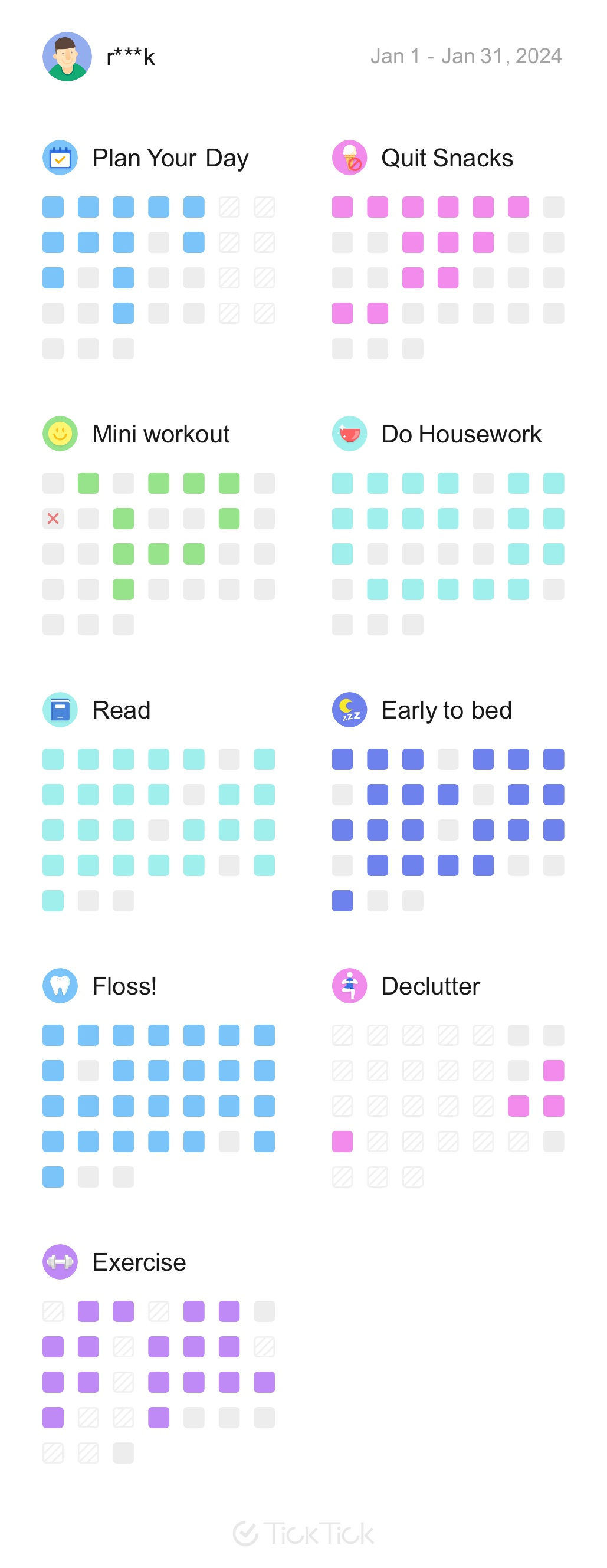
I’m tracking in the excellent TickTick app (which I plan to write about sometime) and it lets me export a nice little graphic of my month.
##### Clarifications on some of the habits
Just to clarify some of these, because their wording in some cases doesn’t really say what they are:
* “Quit snacks” is pretty self-explanatory, but I’m basically calorie tracking with the Lose It app, and this is me hitting my goal there.
* “Do housework” makes is sound like I don’t normally do any. Which is not true. The idea of this is that I will do a significant piece of housework OR a DIY job on the house/garden/car \_before\_ I sit and have “me time” in the evening. It’s about doing things in the right order (rather than playing Zelda for two hours and then rushing to get the dishes done before I go to bed).
* “Early to bed” actually means not starting doing anything new after 10:30pm. I still may not be asleep until quite late. But it’s the cut off for new things that’s important.
How’s it going then?
* Plan your day: Started well, but have dropped off. This ALWAYS happens. Need to nail it because it’s SO useful.
* Quit snacks: Was doing so well and losing some weight and was proud of myself. Then events and illness happened. A fresh start in February. Let’s do better!!
* Mini workouts: Again, started strong, but succumbed to events. Need to find ways to not let events get in the way here. Should be doable.
* Do housework: Not sure what happened in that middle week. But I recovered before Covid struck. This is good!
* Reading: This is was lower importance, but has clearly been easy to do. I’ve even finished [two](https://rosswintle.uk/2024/02/book-doughnut-economics-by-kate-raworth/) [books](https://rosswintle.uk/2024/02/book-indie-microblogging-by-manton-reece/)!
* Early to bed: Excellent. Skipped a few nights. Because sometimes I just want to pause and do something fun or interesting. But generally good here!
* Flossing: Excellent. I am now a “person who flosses”. My dentist will be proud!
* Declutter: Very poor. This is really interesting. BUT… given how well I’m doing with the others I’m not going to beat myself up about it. Call this a stretch goal.
* Exercise: The goal here is actually 5 days a week of either cycling to my office, or doing some other “proper” exercise. So I’m actually doing pretty well. Again – Covid stopped me in my tracks. But I should be able to get this one back on the go.
##### Summary
Overall, I’m REALLY happy. It’s supposed to be hard to work on multiple habits, and I’ve done it pretty well. I’m really pleased.
Covid did really mess things up though. It’s Monday tomorrow. A new week. Let’s see how we get on as we reset and start a new month!
How are your goals or resolutions going?, How Are Those New Habits Going?, Ross Wintle, 01hnwn1ny07n06683tzwvkdx9b.