How I Make My Flashcards
## Metadata
- Author: [[YouTube]]
- Full Title: How I Make My Flashcards
- Category: #articles
- Document Note: ---
tags: [study_methods, flashcards, academic_preparation]
author: [MISSING]
source: YouTube
reference: https://www.youtube.com/watch?v=4ld1gcOtBNY
date created: 2024-12-28 12:00
---
# 🏷️ Title: How I Make My Flashcards
## 🧰 Action Inbox
- [H1] Choose flashcard type and stationary setup — 00:30-01:30 #supplies
- [H2] Select appropriate flashcard structure for content — 02:00-07:00 #structure
- [H3] Organize flashcards with binding method — 11:30-14:00 #organization
## 🧭 Table of Contents
- [📝 Summary](#-summary)
- [📖 Main Content](#-main-content)
- [🗒️ Notes](#️-notes)
- [📚 References](#-references)
- [🗣️ Paraphrase](#️-paraphrase)
- [📰 Newsletter](#-newsletter)
- [✅ Action Items](#-action-items)
- [🧪 Hypotheses](#-hypotheses)
- [📊 Methodology](#-methodology)
- [❓ Questions](#-questions)
- [🔮 Future Research](#-future-research)
- [💡 Implications](#-implications)
- [🧠 Learning Styles Assessment](#-learning-styles-assessment)
- [📊 Accessibility Assessment](#-accessibility-assessment)
- [🌍 DEIB Assessment](#-deib-assessment)
- [✅ Logical Validity](#-logical-validity)
- [🛡️ DARVO Analysis](#-darvo-analysis)
- [🎯 Conclusion](#-conclusion)
### 🔗 References
- [YouTube Video](https://www.youtube.com/watch?v=4ld1gcOtBNY)
## 📝 Summary
- A comprehensive tutorial on creating effective flashcards using various structures and organization methods
- Covers four main flashcard formats: question/answer, term/definition, topic with subtopics, and comprehensive cramming style
- Demonstrates decorative techniques and binding methods for organization
- Targets students looking to improve study efficiency through active recall
- Bottom line: Structured flashcard creation enhances memorization and makes studying more portable and engaging
## 📖 Main Content
This tutorial presents a systematic approach to flashcard creation that goes beyond basic note-taking. The creator demonstrates four distinct structural approaches, each suited for different learning contexts and content types. The question-and-answer format maximizes active recall but can become unwieldy for large amounts of content. The term-definition style offers efficiency but may encourage passive reading. The topic-with-subtopics approach balances comprehensiveness with usability, particularly effective for legal case studies. The comprehensive cramming style consolidates multiple elements but risks information overload.
The tutorial also emphasizes the importance of visual organization through color-coding, highlighting key terms, and maintaining thematic consistency across card sets. Various binding methods are presented to address practical concerns about card management and portability.
## 🗒️ Notes
#### ⏱️ [00:00](https://www.youtube.com/watch?v=4ld1gcOtBNY?t=0) — [H1] Introduction and Flashcard Benefits
- Key idea: Flashcards offer portability and convenience for on-the-go studying
- Evidence: "really fun and convenient as well as easy to carry around with you"
#### ⏱️ [00:30](https://www.youtube.com/watch?v=4ld1gcOtBNY?t=30) — [H2] Flashcard Types and Supply Selection
- Key idea: Different flashcard types serve different purposes (colorful lined, plain lined, decorative)
- Evidence: Shows various flashcard options including turquoise hand-drawn lines
#### ⏱️ [01:00](https://www.youtube.com/watch?v=4ld1gcOtBNY?t=60) — [H2] Essential Stationary Setup
- Key idea: Consistent tool selection improves workflow efficiency
- Evidence: "pilot pen G 207 and then a couple of tombos or outline sticks"
#### ⏱️ [01:30](https://www.youtube.com/watch?v=4ld1gcOtBNY?t=90) — [H2] Using Dual Brush Pens for Emphasis
- Key idea: Felt tip pens help important information stand out from regular content
- Evidence: "I want to make some of the info stand out more and I do that by doing it in a black felt pen"
#### ⏱️ [02:00](https://www.youtube.com/watch?v=4ld1gcOtBNY?t=120) — [H1] Question and Answer Structure
- Key idea: Question-answer format promotes active recall but creates many cards
- Evidence: "actively gets you to recall the information and you're not tempted to see the answer"
#### ⏱️ [03:30](https://www.youtube.com/watch?v=4ld1gcOtBNY?t=210) — [H2] Highlighting Key Words in Definitions
- Key idea: Strategic highlighting using myliners emphasizes essential terms
- Evidence: "highlighting the key words from the definition"
#### ⏱️ [04:00](https://www.youtube.com/watch?v=4ld1gcOtBNY?t=240) — [H1] Term and Definition Structure
- Key idea: Single-sided format saves cards but may encourage passive reading
- Evidence: "doesn't fill up as many cards" but "you'll be tempted to look at the definition"
#### ⏱️ [05:00](https://www.youtube.com/watch?v=4ld1gcOtBNY?t=300) — [H1] Topic with Subtopics Structure
- Key idea: Main topic with numbered subtopics balances comprehensiveness with organization
- Evidence: "key principles or any criterias that are or were established in a certain case"
#### ⏱️ [06:00](https://www.youtube.com/watch?v=4ld1gcOtBNY?t=360) — [H2] Color Theming Across Card Sets
- Key idea: Consistent color schemes throughout sets maintain visual organization
- Evidence: "if my title card is gonna be orange then I kind of like to keep the highlights throughout the entire set orange"
#### ⏱️ [07:00](https://www.youtube.com/watch?v=4ld1gcOtBNY?t=420) — [H1] Comprehensive Cramming Structure
- Key idea: All-in-one format for exam preparation includes title, definition, cases, and principles
- Evidence: "usually before a test or an exam" with "max 2 cases in one flashcard"
#### ⏱️ [08:30](https://www.youtube.com/watch?v=4ld1gcOtBNY?t=510) — [H2] Typed and Printed Content Method
- Key idea: Digital preparation allows for presentation memorization and script highlighting
- Evidence: "print it out in a script style and then highlight my parts"
#### ⏱️ [09:00](https://www.youtube.com/watch?v=4ld1gcOtBNY?t=540) — [H2] Title Card Decoration Techniques
- Key idea: Visual enhancement using brush pens and stickers improves engagement
- Evidence: Uses tombow brush pens and Paper Camacho Koko character stickers
#### ⏱️ [10:30](https://www.youtube.com/watch?v=4ld1gcOtBNY?t=630) — [H2] Watercolor Effect Decoration
- Key idea: Creative watercolor technique using 2-3 colors and spray bottle from distance
- Evidence: "spray it from a distance...20 centimeters maybe"
#### ⏱️ [11:30](https://www.youtube.com/watch?v=4ld1gcOtBNY?t=690) — [H1] Organization Methods: Treasury Tags
- Key idea: Elastic treasury tags provide flexible organization for large card sets
- Evidence: "I had like up to a hundred" cards using treasury tags
#### ⏱️ [13:00](https://www.youtube.com/watch?v=4ld1gcOtBNY?t=780) — [H2] Ring Binders vs Other Methods
- Key idea: Ring binders work well but treasury tags offer more flexibility
- Evidence: "ring binder is a bit more rigid that's why so I do prefer the Treasury tag"
## 📚 References
- [How I Make My Flashcards - YouTube](https://www.youtube.com/watch?v=4ld1gcOtBNY)
## 🗣️ Paraphrase
- Effective flashcard creation requires selecting appropriate structural formats based on content type and study goals
- Visual organization through consistent color theming and highlighting enhances both aesthetics and functionality
- Practical organization methods like treasury tags and ring binders address the challenge of managing large card sets
## 📰 Newsletter
**Transform Your Study Game with Strategic Flashcard Creation**
Whether you're cramming for finals or building long-term knowledge retention, the right flashcard structure can make all the difference. This comprehensive guide breaks down four proven formats—from active-recall question cards to comprehensive topic summaries—plus practical tips for visual organization and card management.
Key takeaway: Match your flashcard structure to your content and goals. Use question-answer for active recall, topic-subtopic for complex subjects, and maintain visual consistency with color theming.
**Quick Wins:**
- Start with quality supplies: reliable pens and consistent flashcard types
- Choose structure based on content volume and recall needs
- Use elastic treasury tags for flexible organization of large sets
Resources: [Study Techniques Research](https://learningcenter.unc.edu/tips-and-tools/studying-101-study-smarter-not-harder/), [Active Recall Methods](https://www.osmosis.org/blog/2022/07/12/active-recall-study-method), [Spaced Repetition Systems](https://ncase.me/remember/)
## ✅ Action Items
#### DevRel
- Developer advocacy: Create flashcard templates for API concepts, SDK methods
- Education: Design interactive flashcard workshops for technical documentation
- Developer experience: Build digital flashcard tools for code snippets, debugging
- Community management: Organize study groups using structured flashcard methods
#### Community
- Contributors: Develop onboarding flashcards for project workflows, coding standards
- Mentors: Create mentorship flashcard sets for common programming concepts
- Event organizers: Design workshop materials using flashcard methodologies
#### WordPress
- Training: Develop WordPress concept flashcards for functions, hooks, best practices
- Documentation: Create quick-reference flashcard summaries for complex topics
- Community: Design meetup activities using collaborative flashcard creation
- Support: Build troubleshooting flashcard sets for common issues
## 🧪 Hypotheses
- Structured flashcard formats improve retention rates compared to unstructured note-taking
- Visual consistency through color theming enhances memory consolidation and retrieval
- Physical organization methods affect long-term study habit sustainability
- Different flashcard structures suit different learning contexts and content complexity levels
### 📊 Methodology
- A/B testing comparing retention rates across the four flashcard structures
- Longitudinal study tracking study habit persistence with different organization methods
- Cognitive load assessment of visual theming impact on learning efficiency
### ❓ Questions
- How do digital flashcard tools compare to physical methods for retention and engagement?
- What is the optimal balance between visual decoration and functional content density?
- How does flashcard structure choice correlate with different learning style preferences?
### 🔮 Future Research
- Integration of spaced repetition algorithms with physical flashcard systems
- Comparative effectiveness studies across different academic disciplines
- Development of adaptive flashcard structure recommendation systems
### 💡 Implications
- Practice: Systematic approach to study material organization improves learning outcomes
- Education: Structured flashcard methodologies can be integrated into curriculum design
- Policy: Study skill training programs should include comprehensive flashcard instruction
- Technology: Digital learning platforms could benefit from these structural principles
### 🧠 Learning Styles Assessment
Reading level estimate: 8th Grade (accessible demonstration-based content)
#### 👀 Visual learners
- Present: Step-by-step visual demonstrations, color-coding examples, decoration techniques
- Improve: Infographic summary of structures, before/after comparison charts
#### 🔊 Aural learners
- Present: Verbal explanation throughout video demonstration
- Improve: Audio summary of key techniques, pronunciation guides for materials
#### 🗣️ Verbal learners
- Present: Clear definitions of techniques, analogies for organization methods
- Improve: Glossary of terms, comparison table of pros/cons for each method
#### 🧩 Kinesthetic learners
- Present: Hands-on demonstration of creation process, multiple binding methods
- Improve: Practice checklist, step-by-step physical workflow guide
#### 🧠 Logical learners
- Present: Systematic progression through structures, clear categorization
- Improve: Decision flowchart for structure selection, efficiency metrics
#### 🧑🤝🧑 Social learners
- Present: Community engagement through Instagram tagging, sharing examples
- Improve: Group study guides, collaborative flashcard creation activities
#### 🧘♀️ Solitary learners
- Present: Individual practice focus, personal organization systems
- Improve: Self-assessment rubrics, reflection prompts for method effectiveness
#### 🌿 Naturalistic learners
- Present: Organic decoration methods, sustainable material choices
- Improve: Environmental impact considerations, natural material alternatives
### 📊 Accessibility Assessment
#### Screen reader semantics
- Present: Video content with spoken explanations
- Improve: Full transcript with time stamps, alt text for visual demonstrations
#### Keyboard navigation
- Present: Standard YouTube player controls
- Improve: Chapter markers for easy section jumping
#### Contrast and readability
- Present: High contrast between text and flashcard backgrounds
- Improve: Captions with sufficient contrast ratios
#### Text resizing and reflow
- Present: Visual demonstrations scalable through video zoom
- Improve: Downloadable PDF guide with resizable text
#### Media and captions
- Present: Comprehensive audio narration
- Improve: Professional captions, downloadable transcript
#### Forms and interactions
- Present: Clear demonstration of physical manipulation
- Improve: Alternative methods for motor accessibility limitations
### 🌍 DEIB Assessment
#### Cultural breadth
- Present: Universal study techniques applicable across educational systems
- Improve: Examples from diverse academic contexts, international supply alternatives
#### Inclusive language
- Present: Neutral instructional tone, accessible vocabulary
- Improve: Multiple language captions, cultural learning style considerations
#### Neurodiversity support
- Present: Multiple structural options accommodating different processing styles
- Improve: ADHD-friendly organization tips, executive function support strategies
#### Representation
- Present: Focus on technique rather than personal characteristics
- Improve: Diverse subject matter examples, various academic disciplines represented
#### Psychological safety
- Present: Non-judgmental presentation of different methods
- Improve: Acknowledgment of learning differences, encouragement for customization
### ✅ Logical Validity
#### Strong reasoning
- Deductive strength: Clear progression from structure choice to implementation outcomes
- Inductive strength: Multiple examples supporting each technique's effectiveness
- Causal reasoning: Links between organization methods and study efficiency
- Analogical strength: Comparison between different binding methods and use cases
#### Fallacies
- False dilemma: Presents limited flashcard types without acknowledging other options, weakness: narrow scope, fix: mention additional alternatives
- Appeal to aesthetics: Emphasizes decoration over function in some sections, weakness: prioritizes appearance, fix: balance visual appeal with learning outcomes
#### Tone of voice
- Overall tone: Enthusiastic and instructional with personal preference sharing, demonstrates techniques through friendly, accessible explanations
### 🛡️ DARVO Analysis
- Deny: No denials present in educational content
- Attack: No attacks on alternative methods or critics
- Reverse victim/offender: Not applicable to instructional content
- Emotional cues and rhetoric: Positive enthusiasm for learning methods, encouraging tone without manipulation
## 🎯 Conclusion
- Effective flashcard creation requires matching structural approach to content type and learning goals
- Visual organization through consistent theming and strategic highlighting enhances both functionality and engagement
- Practical organization systems like treasury tags enable sustainable study habits for large content volumes
- The combination of systematic structure selection and creative visual elements makes studying more effective and enjoyable
## 🧱 Refactor Appendix
### 📚 Literature Split Pad
Purpose: Stage CEE units that become Literature notes.
Split level: H3
### [H1] Flashcard structures enhance active recall effectiveness
> [!quote] How I Make My Flashcards by [MISSING] via YouTube. Published [MISSING]. Accessed 2024-12-28.
> "actively gets you to recall the
- Document Tags: [[supplies]] [[structure]] [[organization]]
- Summary: How I Make My Flashcards
- URL: https://www.youtube.com/watch?v=4ld1gcOtBNY
hello everyone so after tons of requests on Instagram I finally decided to create the video on how I make my flashcards [Music] you
[Music] and another Plus about flashcards is that is really fun and convenient as well as easy to carry around with you and boss on the shoe wherever you need
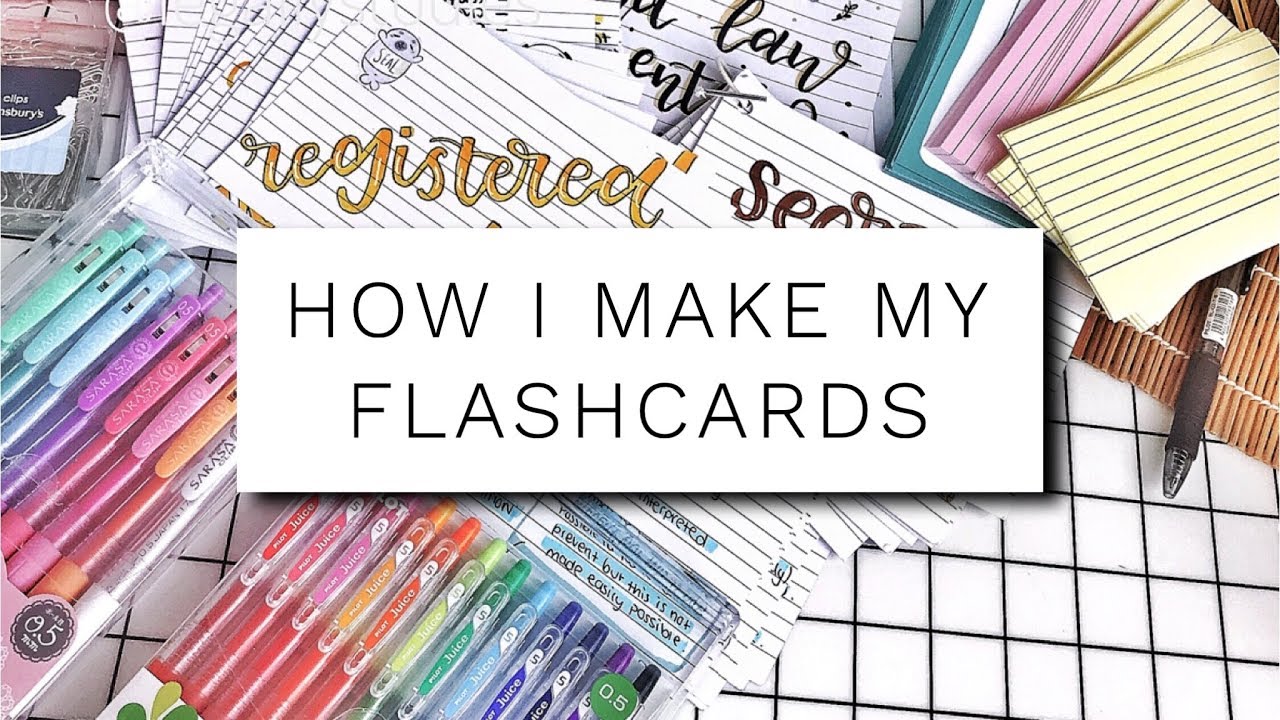
to go with your flashcards so there are different types of flashcards that you can get there's the colorful lined ones and the plain lined ones and then there's one that's turquoise with sort of like hand-drawn lines but I don't use that a lot I just saw it in pound land and I was like oh why not get this and then I ended up not using it but yeah and then after picking up my flashcards I get my go to stationary which is usually the pilot pen G 207 and then a
couple of tombos or outline sticks depending on what subject I'm doing the flash portable [Music] and I also use the dual brush pen by tombow the black one and it's usually the felt tip side they use the most because for some of the flashcards I want to make some of the info stand out more and I do that by doing it in a black felt pen instead of my G to pilot seven of them so the usual kind of
structure that I go for is the one where as a question and answer style and that's where on one side there's the question and then on the other side I had write down the answer and then after writing down the answer I tend to get a highlighter I usually go for the my liner ones but sometimes I got mr. below but here I'm going for my other ones and I'm highlighting the key words from the definition [Music]
the good thing about this style is that it's actively gets you to recall the information and you're not tempted to see the answer because it's not on the same side of the flashcard but and against would be that if you're covering a lot of content then you'll have way too many flashcards with a bunch of question and answers so you can take very long so another structure that you could also use is a bit more straightforward and this is where you've basically got the title and then you write down or what it's about so for
example here I'm just writing the term at the top and then the definition would be at the bottom so this is different to the question and answer style because for this style everything is basically put into one side of the card now the good thing about this style is that it's all in one side so it doesn't fill up as many cards and in case you don't have those many cards then that's not an issue button against would be that unless you know the title of the card you'll be tempted to look at the definition so when you get to the
flashcard as you're revising you're going to see the title right but you might return to to actually look at the definition and the next style is one that I like to call the topic and it's minions so this is basically where at the top is the main topic and then the millions are essentially the subtopics I tend to use this one where I'm trying to write down the key principles or any criterias that are or were established in a certain case
and sometimes I actually get the on line sticks itself or if I'm using the tombow I use that color and use that as a highlighter to highlight the numbers of principals or the numbers of criterias that came out of a certain case and then I also highlight the case there's no particular reason other than just to kind of like keep the theme going so if my title card is gonna be orange then I kind of like to keep the highlights throughout the entire set orange or if
the title card was going to be yellow then I keep the entire set yellow so I like to use the style the most because it feels as though it's not as if you're adding too much or too little it feels like it's the perfect amount and I guess and against would be that depending on the subject that you're doing it for for example if it was English literature you might have to put a lot of information if you were going to do it this style so yeah that's one thing to look out for and another style that I use the most this is usually used when I'm cramming
or something like that so usually before a test or an exam and I kind of put the title at the top and then the definition and then the cases and the principles but yeah I don't put away too many cases or any of these like max2 in one flashcards at least on one side and this is also an example of when I would use the felt tip side of the jaw brush pen by humble so it's one I'm writing down the case and I would usually write the definition
or any principles coming from that case using my pilot pen and then at the end when I finish writing down everything on the flashcards that's when I go in and highlight the key tones or any other key words or cases and the good thing about this style is that everything's on the flash cards so consolidation is easier since it's all in front of you on a small piece of paper but a bad thing could be that obviously some people tend to go a bit overboard so they might
include way too much information and here another style that I use is where I type up the information and print it out and then stick it onto the flashcard I tend to mainly use this style when I've got presentation coming up and I need to memorize my parts of the presentation so I kind of print it out in a script style and then highlight my parts in it now this parts not really necessary it's just sometimes I'm a bit extra and I kind of like to have everything all pretty and neat so here are a couple of
ways or different styles that I use to create the title cards so here I'm just grabbing a brush pen from the tombow collections and I also have a couple of stickers near me so the ones I'm using in this video is by paper Camacho and it's from their new character line titled Koko which is totally adorable you guys should definitely check them out so yeah and then after writing down
the title I put the sticker on there and that's all there is to it another way you can decorate it is by getting a washi tape and here I've gotten a lot of washi tapes I just never really use it a lot so I decided to use it to decorate my flashcards and so you just cut off a piece and then stick it to each corner of the flashcards like so you can either do it on the diagonal
sides or you can do it on all four corners around the card and another way I use is where I get a ruler and then basically create borders around the flashcard this one's probably my least favorite but it's just something for you guys to try out if you want to and you can also color in the square parks in the corners of each side and another way
I decorate my title cards is by using a sort of watercolor effect and I do this firstly by making sure that my desk is protected for me the colors are about to use so make sure you have some sort of protector for you to put the flashcards on that way it doesn't get all messy around you and then I pick two to three colors these countries more if you want to but sometimes if you use a lot and especially if they're quite different
colors then it can look rather messy so yeah and then you also need a spray bottle filled with water here I'm just using my mixing not mixing my makeup spray and just to clarify it's not the actual makeup setting spray that's in there it's actually water so after you've got that near you then you do a squiggly line in the darkest color which is what I usually do and then fill in the blanks parts of the
squiggly line with the other colors that you've got and then you get the spray bottle and you spray it from a distance now here I kind of spread it a bit too close so when I put this onto the flashcards it went a little bit too damp so I'd recommend doing it from a fair good distance away like 20 centimeters maybe but yeah and then after you've got that the flash code might be a little bit damp for a bit but once it's all
dried off and the card actually feels like cardigan and that's when you can go over it and write down the title and here there's another type of a hole puncher that I use but this is a decorative one and you can use this to basically make like a decorative border around the flashcard now you don't really need this it's just something that I've had for a while because I used to be into scrapbooking a lot and once you finished hole punching the top side
and the bottom side or all sides if you want to then sometimes I go over the border that I've created [Music] and one of the ways I keep my cards together is by using an index holder I don't use this as often because it's not big enough to hold my flash cards that I've got because these ones are kind of small and another way to hold the flash cards together is through paper clips now with paper clips although they're
pretty good and you can kind of put the flash cards together either on the top corner or the side of the top corner it doesn't hold that many cards so I think around 10 is the maximum well maybe a little bit more depending on the size of your paper clips or the thickness of the flash card and here we've got a couple of bindings they're not that big because I don't feel like they should be that big if you
were no holds a lot of course because these hold a pretty decent amount but I do have bigger ones but yeah so here it just requires one hole punch on the corner of each flashcard and then you just put in the ring binder like that your ring binder but the ring and close it and then you can flip through your cards really easily now this one's my favorite way of holding all my flashcards together it's just the most convenient for me so these are elastic Treasury tags so they
stretch out they're not like the ones that's just a kind of fixed length so yeah you can stretch them out savers with the binder rings you have two hole punch a corner of each flashcard and then you put in the Treasury tag like so and you can even add quite a lot of other flashcards if you want so I think I had like up to a hundred and one of
these yeah I had a hundred in a pack and then I just used the Treasury tags to put them together I just feel like sometimes that the ring binder is a bit more rigid that's why so I do prefer the Treasury tag over the runes and the last one this is very similar to the ring binder but it's just like a small folder specifically for flashcards and he requires two hole punches at the top so
you guys need to remember though when you're writing out your flashcards not to write all the way at the top otherwise you will be hole punching through your titles of the flashcard [Music] and that's all for this video thank you guys so much for watching if you decide to use any of the sample title cards that I showed you those throughout this video feel free to tag me on instagram
under acts legally studies and if you found this video helpful make sure to give it a like and comment below if you have any other suggestions for other things that you might want to see [Music] [Music]
[Music], How I Make My Flashcards, YouTube, 01ka7wb3m2jxgrwvcw63d929qz.