How To Self-Study Math
## Metadata
- Author: [[YouTube]]
- Full Title: How To Self-Study Math
- Category: #articles
- Document Note: ---
tags: [self-study, mathematics, learning-methods]
author: The Math Sorcerer
source: YouTube
reference: https://www.youtube.com/watch?v=fb_v5Bc8PSk
date created: 2024-12-28 12:00
---
# 🏷️ Title: How To Self-Study Math
## 🧰 Action Inbox
- [H1] Gather quality supplies (pencil, timer, paper) — preparation phase #supplies
- [H2] Find quiet study location for focus — environment setup #environment
- [H3] Practice definitions without looking at book — active recall #studymethod
## 🧭 Table of Contents
- [📝 Summary](#-summary)
- [📖 Main Content](#-main-content)
- [🗒️ Notes](#️-notes)
- [📚 References](#-references)
- [🗣️ Paraphrase](#️-paraphrase)
- [📰 Newsletter](#-newsletter)
- [✅ Action Items](#-action-items)
- [🧪 Hypotheses](#-hypotheses)
- [📊 Methodology](#-methodology)
- [❓ Questions](#-questions)
- [🔮 Future Research](#-future-research)
- [💡 Implications](#-implications)
- [🧠 Learning Styles Assessment](#-learning-styles-assessment)
- [📊 Accessibility Assessment](#-accessibility-assessment)
- [🌍 DEIB Assessment](#-deib-assessment)
- [✅ Logical Validity](#-logical-validity)
- [🛡️ DARVO Analysis](#-darvo-analysis)
- [🎯 Conclusion](#-conclusion)
### 🔗 References
- [How To Self-Study Math](https://www.youtube.com/watch?v=fb_v5Bc8PSk)
## 📝 Summary
- A step-by-step method for effective mathematics self-study
- Emphasizes preparation, environment, active reading, and practice
- Designed for efficient one-hour study sessions
- Acknowledges that confusion is normal and motivates further learning
- Recommends using multiple textbooks for comprehensive understanding
## 📖 Main Content
The video presents a systematic approach to self-studying mathematics that emphasizes both physical preparation and mental engagement. The method begins with gathering quality supplies and creating an optimal study environment, then moves to active reading and problem-solving techniques. The presenter advocates for choosing challenging material that pushes the learner into uncomfortable territory where genuine learning occurs. A key principle is active recall - being able to write definitions and work through examples without referring to the textbook. The approach acknowledges that confusion is a natural part of mathematical learning and should motivate continued study rather than discourage it.
## 🗒️ Notes
#### ⏱️ [00:00](https://www.youtube.com/watch?v=fb_v5Bc8PSk?t=0) — [H1] Introduction to effective math study
- Key idea: Step-by-step process for smart, efficient mathematics learning
- Evidence: "if you follow these steps you'll be able to study smart and make effective use of your time"
#### ⏱️ [00:25](https://www.youtube.com/watch?v=fb_v5Bc8PSk?t=25) — [H2] Gathering study supplies
- Key idea: Quality tools enhance the learning experience and comfort
- Evidence: Recommends Ticonderoga pencils, specific pens, battery-free sharpeners, and timers
#### ⏱️ [02:15](https://www.youtube.com/watch?v=fb_v5Bc8PSk?t=135) — [H2] Paper choice matters
- Key idea: Blank paper without lines may improve mathematical thinking
- Evidence: "the smartest person i ever met used paper with no lines and i thought maybe that's making him better at math"
#### ⏱️ [02:45](https://www.youtube.com/watch?v=fb_v5Bc8PSk?t=165) — [H2] Finding quiet study locations
- Key idea: Minimal distractions are crucial for productive math study
- Evidence: Recommends "very very small and very secluded" spaces or libraries
#### ⏱️ [03:15](https://www.youtube.com/watch?v=fb_v5Bc8PSk?t=195) — [H1] Choosing study material
- Key idea: Decision paralysis is overcome by simply picking a book and starting
- Evidence: "my advice is just pick a book and go with it if you can't make a decision just grab one of your math books"
#### ⏱️ [04:30](https://www.youtube.com/watch?v=fb_v5Bc8PSk?t=270) — [H2] Stewart Calculus as example
- Key idea: Popular, widely-available textbooks provide comprehensive coverage
- Evidence: Shows extensive collection including "calculus advanced calculus vector analysis combinatorics"
#### ⏱️ [05:00](https://www.youtube.com/watch?v=fb_v5Bc8PSk?t=300) — [H2] Selecting challenging sections
- Key idea: Choose material that's interesting but pushes you into discomfort
- Evidence: "you want to pick something that is going to push you a little bit...into that uncomfortable place so that learning actually takes place"
#### ⏱️ [05:30](https://www.youtube.com/watch?v=fb_v5Bc8PSk?t=330) — [H2] One-hour study sessions
- Key idea: Structured time blocks maintain focus and productivity
- Evidence: "i like to set it for one hour i feel like one hour is a good amount of time to study most subjects"
#### ⏱️ [06:00](https://www.youtube.com/watch?v=fb_v5Bc8PSk?t=360) — [H1] Active definition learning
- Key idea: Write definitions from memory without looking at the book
- Evidence: Demonstrates hyperbolic functions: "sinch x is going to be half the difference of e to the x and e to the negative x"
#### ⏱️ [07:15](https://www.youtube.com/watch?v=fb_v5Bc8PSk?t=435) — [H2] Working through examples independently
- Key idea: Attempt proofs and examples before checking the textbook solution
- Evidence: "maybe prove the one they do but do it on your own without looking at their solution"
#### ⏱️ [08:00](https://www.youtube.com/watch?v=fb_v5Bc8PSk?t=480) — [H2] Accepting incomplete understanding
- Key idea: Not everything will make sense initially, and that's normal
- Evidence: "not everything will make sense and that's normal and you want to just work through it"
#### ⏱️ [08:30](https://www.youtube.com/watch?v=fb_v5Bc8PSk?t=510) — [H2] Problem-solving strategy
- Key idea: Some problems require synthesizing information not directly exemplified
- Evidence: "you're going to find problems for which there are no examples in the book...go back to the section and try to find information"
#### ⏱️ [09:45](https://www.youtube.com/watch?v=fb_v5Bc8PSk?t=585) — [H1] Reflection and retention
- Key idea: Post-study reflection reinforces learning and identifies areas for improvement
- Evidence: "reflect on what you did reflect on how meaningful your time was"
#### ⏱️ [11:00](https://www.youtube.com/watch?v=fb_v5Bc8PSk?t=660) — [H2] Multiple textbook approach
- Key idea: Different books provide varied explanations and comprehensive coverage
- Evidence: Shows differential equations books: "this one covers a lot of topics that this one doesn't"
## 📚 References
- [How To Self-Study Math](https://www.youtube.com/watch?v=fb_v5Bc8PSk)
- James Stewart Calculus (5th Edition)
- Various mathematics textbooks mentioned
## 🗣️ Paraphrase
- Effective math self-study requires systematic preparation including quality supplies and distraction-free environments
- Learning occurs best when students challenge themselves with unfamiliar material that creates productive discomfort
- Active recall techniques, such as writing definitions from memory, strengthen understanding more than passive reading
## 📰 Newsletter
**Master Self-Directed Mathematics Learning with Structured Study Sessions**
Whether you're brushing up on calculus or diving into advanced topics, this systematic approach to math self-study can transform your learning efficiency. The key insight: one-hour focused sessions with active recall beat hours of passive reading.
**Quick wins:** Set up a distraction-free space, use quality supplies you enjoy, and always write definitions from memory before checking the book. Remember that confusion signals learning in progress, not failure.
**Try this:** Pick one math topic you've been avoiding, set a timer for one hour, and work through it using active recall techniques. You'll be surprised how much ground you can cover.
Resources: [Khan Academy](https://khanacademy.org), [MIT OpenCourseWare Mathematics](https://ocw.mit.edu/courses/mathematics/), [Paul's Online Math Notes](https://tutorial.math.lamar.edu/)
## ✅ Action Items
#### DevRel
- Create math study methodology documentation for developer communities
- Develop workshop curriculum on technical learning techniques
- Design self-assessment tools for mathematical competency gaps
#### Community
- Establish study groups using structured one-hour sessions
- Create resource sharing system for mathematics textbooks
- Develop mentorship program pairing experienced and novice learners
#### WordPress
- Documentation: Apply active recall principles to technical documentation
- Training: Incorporate reflection phases into coding bootcamps
- Community: Create math prerequisites guides for advanced WordPress development
## 🧪 Hypotheses
- Active recall of mathematical definitions improves long-term retention more than passive reading
- One-hour study sessions optimize attention span and information processing for mathematical concepts
- Productive confusion during mathematics study correlates with deeper learning outcomes
- Multiple textbook exposure increases conceptual understanding through varied explanatory approaches
### 📊 Methodology
- Controlled study comparing active recall vs. passive reading retention rates
- Time-block analysis measuring comprehension across different session lengths
- Longitudinal tracking of student confidence and competency with confusion tolerance training
### ❓ Questions
- How does the optimal study session length vary across different mathematical complexity levels?
- What environmental factors beyond noise reduction most significantly impact mathematical learning efficiency?
- How can digital tools replicate the benefits of handwritten mathematical work?
### 🔮 Future Research
- Neurological basis of mathematical confusion as a learning catalyst
- Comparative effectiveness of different note-taking methods for mathematical concepts
- Impact of supply quality and personal comfort on cognitive performance
### 💡 Implications
- Practice: Structured self-study can replace or supplement formal mathematical education
- Education: Active recall techniques should be emphasized in mathematical pedagogy
- Policy: Self-directed learning methodologies deserve institutional support and recognition
### 🧠 Learning Styles Assessment
Reading level estimate: 8-10 (Flesch-Kincaid Grade Level)
#### 👀 Visual learners
- Present: Demonstrates physical supplies, shows textbook examples
- Improve: Add mathematical concept diagrams, flowcharts of study process
#### 🔊 Aural learners
- Present: Verbal explanation throughout video
- Improve: Include mathematical problem-solving narration, study session audio examples
#### 🗣️ Verbal learners
- Present: Clear definitions, mathematical terminology explanations
- Improve: Add analogies connecting math concepts to everyday experiences
#### 🧩 Kinesthetic learners
- Present: Hands-on writing exercises, physical manipulation of supplies
- Improve: Include movement-based memory techniques, tactile learning aids
#### 🧠 Logical learners
- Present: Step-by-step methodology, structured approach
- Improve: Add decision trees for topic selection, progress tracking systems
#### 🧑🤝🧑 Social learners
- Present: Implicit community through shared textbook recommendations
- Improve: Study group formation guides, peer review protocols
#### 🧘♀️ Solitary learners
- Present: Individual reflection practices, self-directed methodology
- Improve: Self-assessment rubrics, personal progress journaling prompts
#### 🌿 Naturalistic learners
- Present: Limited connections to natural patterns
- Improve: Mathematical examples from nature, environmental study location suggestions
### 📊 Accessibility Assessment
#### Screen reader semantics
- Present: Clear verbal narration throughout video
- Improve: Detailed descriptions of visual mathematical notation, alternative text for equations
#### Keyboard navigation
- Present: Standard YouTube interface navigation
- Improve: Transcription with navigable mathematical expressions
#### Contrast and readability
- Present: Clear handwriting demonstration
- Improve: High-contrast mathematical notation examples
#### Text resizing and reflow
- Present: Video format maintains visibility at different sizes
- Improve: Supplementary text-based materials with scalable fonts
#### Media and captions
- Present: Full transcript available
- Improve: Mathematical notation in captions, audio description track
#### Forms and interactions
- Present: Simple video interface
- Improve: Interactive mathematical exercises, accessible problem-solving tools
### 🌍 DEIB Assessment
#### Cultural breadth
- Present: Universal mathematical concepts, widely-used textbooks
- Improve: International textbook examples, diverse mathematical traditions
#### Inclusive language
- Present: Gender-neutral instructional language
- Improve: Acknowledge different educational backgrounds and starting points
#### Neurodiversity support
- Present: Structured, step-by-step approach accommodates different processing styles
- Improve: Multiple explanation methods, processing time acknowledgments
#### Representation
- Present: Focused on method rather than identity
- Improve: Diverse mathematical role models, varied application contexts
#### Psychological safety
- Present: Normalizes confusion and learning difficulties
- Improve: Explicit encouragement for different learning paces, success redefinition
### ✅ Logical Validity
#### Strong reasoning
- Deductive strength: Logical progression from preparation to practice to reflection
- Inductive strength: Generalizes from specific textbook example to broader study methods
- Causal reasoning: Links active recall to improved understanding
- Analogical strength: Applies successful study habits across mathematical domains
#### Fallacies
- Appeal to authority: References "smartest person" for paper choice without evidence
- Hasty generalization: One-hour sessions may not optimize for all learners or topics
#### Tone of voice
- Overall tone: Encouraging and practical, emphasizes experimentation and personal adaptation
### 🛡️ DARVO Analysis
- Deny: No defensive patterns present
- Attack: No attacks on alternative methods or critics
- Reverse victim/offender: No blame shifting detected
- Emotional cues and rhetoric: Positive reinforcement and normalization of learning challenges
## 🎯 Conclusion
This systematic approach to mathematics self-study emphasizes preparation, active engagement, and structured reflection. The key insight is that effective learning occurs through deliberate practice in focused time blocks, with confusion viewed as a natural part of the learning process rather than a sign of failure. The methodology is accessible to learners at various levels and can be adapted to different mathematical subjects and personal preferences.
## 🧱 Refactor Appendix
### 📚 Literature Split Pad
Purpose: Stage CEE units that become Literature notes.
Split level: H3
### [H1] Active recall improves mathematical retention
> [!quote] How To Self-Study Math by The Math Sorcerer via YouTube. Published 2024. Accessed 2024-12-28.
> "you want to be able to write it down without looking at the book"
Demonstrates principle through hyperbolic function definitions.
[view highlight](https://www.youtube.com/watch?v=fb_v5Bc8PSk#H1) #xref #articleseed ID:rw_math_active_recall
### [H2] Structured time blocks optimize focus
> [!quote] How To Self-Study Math
> "i like to set it for one hour i feel like one hour is a good amount of time"
Balances sustained attention with manageable commitment.
[view highlight](https://www.youtube.com/watch?v=fb_v5Bc8PSk#H2) #xref ID:rw_math_time_blocks
---
### 🔖 Atomic Split Pad (Zettel Candidates)
Purpose: Promote reusable claims into Atomic notes.
Split level: H4
#### [Z1] Confusion signals productive learning
- Applies to mathematical concept acquisition
- Pointer to 08:00 timestamp
- Links: [[Growth-Mindset]] [[Cognitive-Load]]
#### [Z2] Multiple textbooks provide comprehensive understanding
- Different authors offer varied explanations
- Pointer to 11:00 timestamp
- Links: [[Information-Sources]] [[Learning-Resources]]
---
### ✏️ Fleeting Queue
Purpose: Capture quick actions for Fle
- Document Tags: [[h1]] [[xref]] [[supplies]] [[environment]] [[studymethod]]
- Summary: How To Self-Study Math
- URL: https://www.youtube.com/watch?v=fb_v5Bc8PSk
in this video i'm going to show you howto actually study math i'm going to giveyou a step-by-step process that you canfollow so you can sit down and actuallylearn some mathematics and it reallydoesn't take that long if you followthese steps you'll be able to studysmart and make effective use of yourtime step one is to gather your suppliesso for the purposes of this video i'mgoing to show you the things that i'vebeen using whenever i do math this is areally good choice for a pencil theseare ticonderoga pencils and they're
really good quality so currently this isthe pencil i use and it's pretty awesomei'll leave a link in the description bythe way to all the supplies i use incase you want to check them out ifyou're one of those people who likes todo mathematics and pen then this is anincredible one i've known a lot ofpeople who are engineers and physicistsand they tend to use penand they tend to produce a lot of reallycorrect mathematics personally i preferpencils but if you're a pen person thisone's pretty incredible although it is alittle bit pricey of course everyoneneeds a sharpener and i like having one
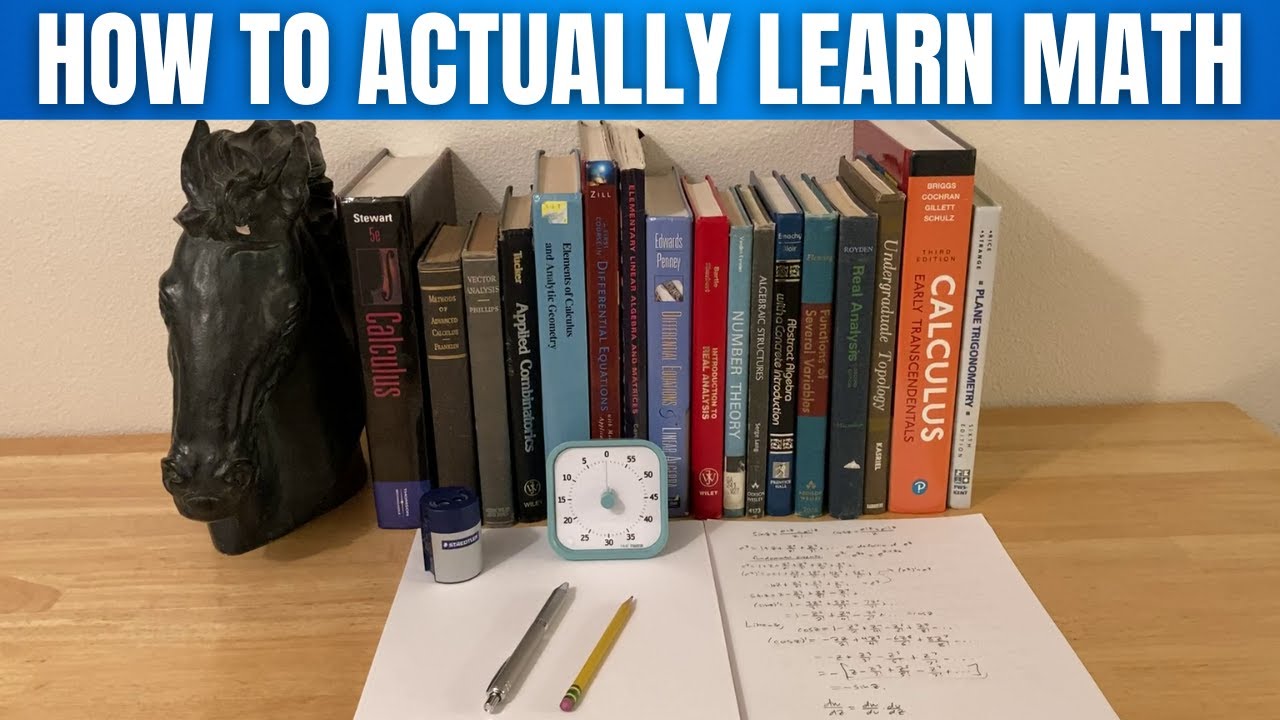
that's pretty good this one doesn't usebatteries so i can take it with me so ifi decide to do math outside i can takeit outside and it doesn't require anyelectricity or anything like that one ofthe most important components is ofcourse a timer so you can use this totime your sessions which i highlyrecommend this is a really simple onethat works great and it uses one doublea battery of course you can't do mathunless you have something to write onand this is paper notice this paperdoesn't have lines the reason i use
paper with no lines is because thesmartest person i ever met used paperwith no lines and i thought maybe that'smaking him better at math so i startedusing paper with no lines and ever sincethen i have been hooked so you'vegathered your supplies you have either apen or a pencil a timera sharpener and some paper that you'recomfortable with and it doesn't have tobe these i would just recommend usingwhat you prefer if you prefer amechanical pencil get that remember youwant to be as comfortable as possiblewhen you're working on math the nextthing you want to do is pick a quiet
location you can see here the room thati'm actually in is very very small andvery secluded and it is extremely quietsotry to find the quietest spot you can soyou can sit down and be productive ifyou can't find a quiet location to studythen try to find a place where you cango that is a little bit more quietconsider college libraries or evenpublic libraries those are usuallypretty good places to go study the nextstep is a really fun step and it'spicking a book and this is a step that
you might get stuck on my advice is justpick a book and go with it if you can'tmake a decision just grab one of yourmath books and start reading it now i'vegot a lot of books here as you can seewe've got some calculus advancedcalculus vector analysis combinatoricsmore calculus differential equationslinear algebra more differentialequations real analysis number theorysome abstract algebra somemulti-variable calculus some realanalysis some topology a little bit more
calculus and some trig so all kinds ofchoices and for the purposes of thisvideo i'm actually going to pick one ofthese books and i'm going to show youhow to study because this is such apopular book and it is so widelyavailable and it is so widely used bycolleges and universities all over theworld i've chosen this one this one iscalculus by james stewart and it is thefifth edition this is a super thick bookthat people use to take calculus one twoand three in colleges in the u.s and incanada once you have the book you have
to decide what section you want to readmy advice is to pick something that youwant to read so something that isinteresting to you but at the same timeyou want to pick something that is goingto push you a little bit you want tostudy something that you really haven'tseen before or something that you feeluncomfortable with you want to pushyourself into that uncomfortable placeso that learning actually takes placeafter all the whole point is to actuallylearn something now it's time to set thetimer i like to set it for one hour ifeel like one hour is a good amount of
time to study most subjects and then youjust get started so you start readingthe book you notice that it gives youthe definition of the hyperbolicfunctions so the first thing you want todo is make sure you know that definitionso how do you do that well the best wayto do that is to actually write down thedefinition and you want to be able towrite it down without looking at thebook for example the hyperbolic sine ofx or sinch xis going to be half the difference of eto the xand e to the negative x so you take e tothe x you subtract e to the negative x
and you divide by twothe hyperbolic cosine is going to be theaverage of e to the x and e to thenegative x so you take e to the x youadd e to the negative x and you divideby two and for the rest of them if younoticed in the formulas they're verysimilar to the trig functions so you cango on from there and fill in the rest ofthe formulas for your hyperbolicfunctions if you find yourself having tolook at the book you want to start overand do everything without looking at thebook until you know the definition'scold as you continue reading the text
you want to work through all of theexamples for example here you noticethey give you the hyperbolic identitiesand they have a proof of one of them somaybe prove the one they do but do it onyour own without looking at theirsolution and maybe do a couple more justfor practice then you continue readingthe text and doing all of the examplesthat you can not everything will makesense and that's normal and you want tojust work through it and try tounderstand as much as you can from theexamples that are given in the book onceyou get to the exercises you should feel
pretty good about yourself because youmade it through the entire section atthis point you should start doing asmany problems as you can in a book likethis you'll have answers to most of theodd numbered problems which really helpsone thing you will notice in most mathbooks is when you get to the problems atthe end of a section you're going tofind problems for which there are noexamples in the book so you wonder howam i supposed to figure those out wellthat's when you have to go back to thesection and try to findinformation that you can use to help yousolve those problems if you still can't
figure them out it's okay books likethis have tons of problems and some ofthem are harder than others and ifyou're wondering why the author didn'tinclude examples of every single type inthe book it's because then the bookwould be insanely huge so they have topick and choose what content theypresent in the book so now you're donestudying you should feel good aboutyourself you got a lot done and this isthe last step it's to reflect reflect onwhat you did reflect on how meaningfulyour time was you just took an hour ofyour life and you learned a lot ofmathematics if you like you can keep
your work you can buy a hole puncher andput it in a binder you can stack it upin a big stack or you can throw it awaywhatever you like as the day proceedsyou're going to find yourself thinkingabout some of the math you did maybethere was some points that you foundconfusing and you might feel a littlebit confused and i really think that'snormal when you study math and when youread a math book you're not going tounderstand everything you're going tohave moments of confusion and thosemoments of confusion should motivate youto study more next time one of the greatthings about self-study is you can studywhatever you want so the next time you
have a study session you can studysomething completely different if youdidn't like the book that you were usingyou can get a different book math booksare so cheap you can get books at reallygood prices and the really good thingwith math books is they contain so muchinformation for examplethis book here has enough material toteach you calculus 1 calculus 2 andcalculus 3. in fact if you went tocollege and you took all three coursescalc 1 calc 2 calc 3 you probablywouldn't even cover all the material in
this book in fact i pretty muchguarantee it there's just so muchcontent in a book like this if you'rewondering which book to get my advicewould be to get as many books aspossible a lot of times you'll pick up abook and read a certain section fromthat bookand it won't be very good and then youpick up another book and it's a littlebit more clear for example here we havetwo differential equations books butthey're very very different this is theone by edwards and penny and this is theone by zil and they do have somesimilarities but this one covers a lotof topics that this one doesn't so by
having a wide selection of books that'sreally going to help your self-studyjourney hopefully this video has givenyou some ideas on how to have betterstudy sessions and learn math on yourown i hope this video has been helpfulgood luck and take care, How To Self-Study Math, YouTube, 01ka89yyg50qwv7dc65wg105z8.