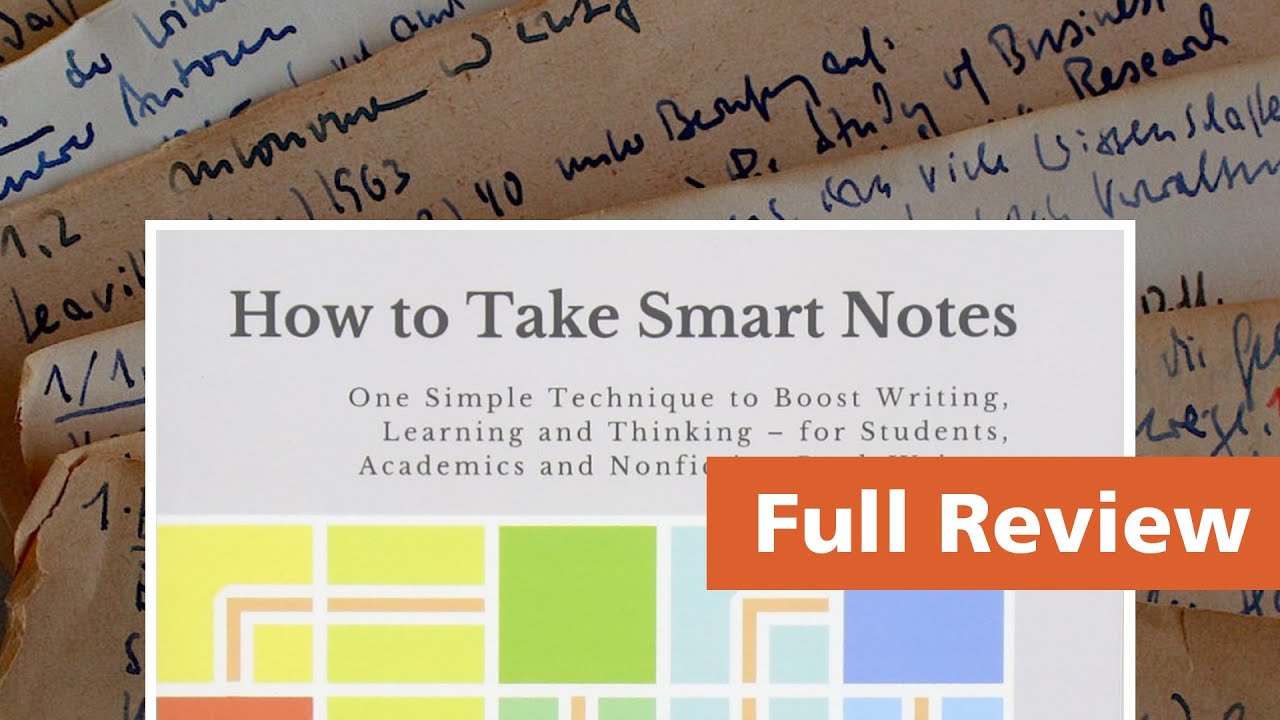
How To Take Smart Notes
## Metadata
- Author: [[YouTube]]
- Full Title: How To Take Smart Notes
- Category: #articles
- Document Note: ---
tags: [note-taking, zettelkasten, knowledge-management]
author: Mike Gaston
source: YouTube
reference: https://www.youtube.com/watch?v=BG1tfC7tSYw
date created: 2024-12-19 15:30
---
# 🏷️ Title: How To Take Smart Notes - Transform Your Thinking and Writing
## 🧰 Action Inbox
- [H1] Implement three-note system: fleeting, literature, permanent notes — 00:08:43 #productivity
- [H2] Set up external zettelkasten system for networked thinking — 00:06:23 #knowledge-management
- [H3] Practice writing as thinking rather than copying quotes — 00:04:12 #writing
## 🧭 Table of Contents
- [📝 Summary](#-summary)
- [📖 Main Content](#-main-content)
- [🗒️ Notes](#️-notes)
- [📚 References](#-references)
- [🗣️ Paraphrase](#️-paraphrase)
- [📰 Newsletter](#-newsletter)
- [✅ Action Items](#-action-items)
- [🧪 Hypotheses](#-hypotheses)
- [📊 Methodology](#-methodology)
- [❓ Questions](#-questions)
- [🔮 Future Research](#-future-research)
- [💡 Implications](#-implications)
- [🧠 Learning Styles Assessment](#-learning-styles-assessment)
- [📊 Accessibility Assessment](#-accessibility-assessment)
- [🌍 DEIB Assessment](#-deib-assessment)
- [✅ Logical Validity](#-logical-validity)
- [🛡️ DARVO Analysis](#-darvo-analysis)
- [🎯 Conclusion](#-conclusion)
### 🔗 References
- [How to Take Smart Notes on Amazon](https://amazon.com/how-to-take-smart-notes)
- [Zettelkasten subreddit](https://reddit.com/r/zettelkasten)
## 📝 Summary
- Mike Gaston reviews "How to Take Smart Notes" by Dr. Sönke Ahrens, which reveals Nicholas Luhmann's note-taking system
- The system helped Luhmann publish 70+ books and 400+ scholarly articles through networked thinking
- Key principles: writing IS thinking, external systems enhance cognition, and emergent approaches beat rigid planning
- Three note types: fleeting (quick captures), literature (reading notes), permanent (refined insights)
- Bottom line: This system transforms how you think, learn, and produce original insights by externalizing and connecting knowledge
## 📖 Main Content
Dr. Sönke Ahrens' book reveals the zettelkasten (slip-box) system used by sociologist Nicholas Luhmann, one of the 20th century's most prolific scholars. The system centers on three revolutionary principles that challenge conventional approaches to learning and writing.
**Writing as Thinking**: Rather than thinking first then writing, the act of writing becomes the mechanism for thinking itself. This means distilling ideas into your own words rather than copying quotes, forcing active engagement with material.
**External Systems**: The zettelkasten serves as an external memory and thinking partner. Notes are numbered, linked, and networked, creating a web of interconnected ideas that reveals patterns and generates insights over time.
**Emergent Approach**: Instead of forcing topics, projects emerge organically from the accumulated and connected notes. This allows for following natural interests while maintaining multiple projects simultaneously.
## 🗒️ Notes
#### ⏱️ [00:00](https://www.youtube.com/watch?v=BG1tfC7tSYw?t=0) — [H1] Book Introduction and Impact Claims
- Key idea: "How to Take Smart Notes" has life-transforming potential through revealing Luhmann's system
- Evidence: "Helped Nicholas Luhmann publish over 70 books and over 400 scholarly articles"
#### ⏱️ [01:43](https://www.youtube.com/watch?v=BG1tfC7tSYw?t=103) — [H2] Book Structure Overview
- Key idea: Simple 150-page book with three clear sections for practical implementation
- Evidence: "Everything you need to know, four underlying principles, and six steps to successful writing"
#### ⏱️ [02:33](https://www.youtube.com/watch?v=BG1tfC7tSYw?t=153) — [H1] Core Takeaway: Writing IS Thinking
- Key idea: Writing should be the process of thinking, not just recording pre-formed thoughts
- Evidence: "The process of writing is actually a way to think, a very powerful way to think"
#### ⏱️ [04:12](https://www.youtube.com/watch?v=BG1tfC7tSYw?t=252) — [H2] Distillation Over Copying
- Key idea: Transform passages into your own words rather than highlighting or copying quotes
- Evidence: "Take that passage and write about that passage and try to distill that passage down into your own words"
#### ⏱️ [05:23](https://www.youtube.com/watch?v=BG1tfC7tSYw?t=323) — [H1] External System Value
- Key idea: Human memory is insufficient; external systems create networked thinking infrastructure
- Evidence: "There's too much typically for the human mind to remember"
#### ⏱️ [06:23](https://www.youtube.com/watch?v=BG1tfC7tSYw?t=383) — [H2] Zettelkasten as Thinking Partner
- Key idea: The slip-box system links and integrates notes to reveal connections and insights
- Evidence: "You could link your notes... they start relating to each other, they begin to become contextualized"
#### ⏱️ [07:45](https://www.youtube.com/watch?v=BG1tfC7tSYw?t=465) — [H2] Three Note Types Introduction
- Key idea: Systematic approach uses fleeting, literature, and permanent notes for different purposes
- Evidence: "Three types of notes that Sönke Ahrens suggests"
#### ⏱️ [08:15](https://www.youtube.com/watch?v=BG1tfC7tSYw?t=495) — [H3] Fleeting Notes Definition
- Key idea: Quick capture of thoughts and questions for later processing
- Evidence: "You have a thought, you just jot it down... on a regular basis either daily weekly you will sit and process"
#### ⏱️ [09:12](https://www.youtube.com/watch?v=BG1tfC7tSYw?t=552) — [H3] Literature Notes Process
- Key idea: Active reading notes that distill and connect ideas in your own words
- Evidence: "I'm distilling down what I've read into my own words, maybe my own thoughts on it"
#### ⏱️ [10:03](https://www.youtube.com/watch?v=BG1tfC7tSYw?t=603) — [H3] Permanent Notes as System Core
- Key idea: Refined notes that become networked knowledge base serving lifetime learning
- Evidence: "Things that you want to capture, the things that you want to own... serve you over a lifetime"
#### ⏱️ [11:23](https://www.youtube.com/watch?v=BG1tfC7tSYw?t=683) — [H1] Emergent Approach Benefits
- Key idea: Projects bubble up from accumulated notes rather than forced topic selection
- Evidence: "Your content, your writing bubbles up, it emerges from this note-taking process"
#### ⏱️ [12:45](https://www.youtube.com/watch?v=BG1tfC7tSYw?t=765) — [H2] Personal Impact Results
- Key idea: System delivers tangible benefits in comprehension, insight generation, and professional success
- Evidence: "Getting way more out of what I'm reading... significantly more insights... high paying consulting projects"
#### ⏱️ [14:33](https://www.youtube.com/watch?v=BG1tfC7tSYw?t=873) — [H2] Book Strengths
- Key idea: Well-written, accessible, practical book with good examples and organization
- Evidence: "Great writer, highly digestible, leads with the facts... easy to read"
#### ⏱️ [15:12](https://www.youtube.com/watch?v=BG1tfC7tSYw?t=912) — [H3] Areas for Improvement
- Key idea: Could use more hands-on implementation details for beginners
- Evidence: "Wanting more data information on how exactly do I do this zettelkasten"
## 📚 References
- [How to Take Smart Notes by Dr. Sönke Ahrens](https://amazon.com/how-to-take-smart-notes)
- [Zettelkasten subreddit](https://reddit.com/r/zettelkasten)
- [Roam Research](https://roamresearch.com/)
## 🗣️ Paraphrase
- The zettelkasten system transforms note-taking from passive copying to active thinking by requiring you to rewrite ideas in your own words and link them to other concepts
- An external note system serves as a thinking partner that reveals patterns and connections your brain alone couldn't maintain across thousands of ideas and sources
- Rather than forcing yourself to write about predetermined topics, let writing projects emerge organically from your growing network of interconnected notes and insights
## 📰 Newsletter
**Transform Your Learning with Smart Note-Taking**
Fellow WordPress builders, here's a game-changing approach to managing the constant influx of documentation, tutorials, and technical insights we encounter daily.
The zettelkasten system revealed in "How to Take Smart Notes" offers a powerful alternative to bookmark chaos and forgotten highlights. Instead of copying code snippets and quotes, try distilling concepts into your own words and linking related ideas together.
Imagine having a searchable, networked knowledge base where that performance optimization technique connects to your accessibility notes, which link to your design system insights. Over time, this external thinking system generates original solutions and reveals patterns you'd never spot otherwise.
**Quick Implementation**: Start with three simple note types - fleeting captures during the day, literature notes while reading docs, and permanent refined insights for your growing knowledge network.
Resources: [Learn WordPress](https://learn.wordpress.org/), [Developer Docs](https://developer.wordpress.org/), [WP-CLI](https://wp-cli.org/)
## ✅ Action Items
#### DevRel
- Education: Develop zettelkasten workshops for developer learning systems, office hours on knowledge management
- Developer experience: Create networked documentation that links concepts across different areas
- Community management: Implement community knowledge gardens where insights connect and evolve
#### OSPO
- License Compliance: Build networked compliance knowledge base linking policies, precedents, and training materials
- Developer Support: Create consultation knowledge system that captures and connects recurring patterns
- Strategic Alignment: Develop emergent OKR system that allows goals to surface from accumulated insights
#### Community
- Contributors: Design onboarding knowledge network that connects skills, projects, and mentorship opportunities
- Sponsors: Create transparent impact knowledge base linking funding to emergent outcomes
- Ecosystem: Build cross-project insight network revealing collaboration opportunities
#### WordPress
- Core: Implement networked decision documentation connecting performance budgets, user needs, and technical constraints
- Documentation: Create HelpHub/DevHub knowledge network linking concepts across different skill levels
- Training: Develop learning path system where educational content emerges from networked foundational concepts
- Community: Build meetup knowledge sharing system connecting local insights with global patterns
#### The WPCC
- Programs: Create fellowship knowledge network connecting mentors, projects, and emerging opportunities
- Funding: Develop grant decision knowledge base linking criteria, outcomes, and community impact patterns
## 🧪 Hypotheses
- Networked note-taking systems increase knowledge retention and insight generation compared to linear approaches
- Writing-as-thinking produces more original ideas than think-then-write methodologies
- External knowledge systems with linking capabilities reveal patterns invisible to individual cognition
- Emergent project selection based on accumulated notes leads to higher engagement and better outcomes
### 📊 Methodology
- A/B test traditional vs zettelkasten note-taking approaches measuring retention and insight generation
- Longitudinal study tracking idea originality and connections across different note-taking systems
- Network analysis comparing insight emergence in linked vs isolated knowledge systems
### ❓ Questions
- How do digital vs analog zettelkasten implementations affect thinking quality and pattern recognition?
- What optimal linking strategies maximize serendipitous insight discovery in large knowledge networks?
- How can team-based zettelkasten systems enhance collective intelligence while preserving individual thinking development?
### 🔮 Future Research
- Integration of AI-assisted pattern recognition with human zettelkasten systems
- Collaborative knowledge networks that maintain individual agency while enabling collective insight
- Adaptive note-taking systems that learn individual thinking patterns and suggest optimal connections
### 💡 Implications
- Practice: Fundamental shift from information consumption to active knowledge construction and synthesis
- Education: Move from lecture-based to network-based learning where insights emerge from connected concepts
- Security: Knowledge systems require backup and version control strategies to protect intellectual investment
- Funding: Long-term knowledge development requires sustained resource allocation rather than project-based thinking
### 🧠 Learning Styles Assessment
Reading level estimate: Flesch-Kincaid Grade Level 9.2
#### 👀 Visual learners
- Present: Examples of note connections, system diagrams implied through description
- Improve: Actual zettelkasten screenshots, network visualization diagrams, note linking examples
#### 🔊 Aural learners
- Present: Video format with clear verbal explanations and personal narrative
- Improve: Podcast version, audio examples of thinking-through-writing process
#### 🗣️ Verbal learners
- Present: Clear definitions, analogies to card catalogs and hyperlinking, concrete examples
- Improve: More metaphors for abstract concepts, comparison tables of note-taking approaches
#### 🧩 Kinesthetic learners
- Present: References to physical card systems, hands-on implementation discussion
- Improve: Step-by-step setup guides, practice exercises, template downloads
#### 🧠 Logical learners
- Present: Clear cause-and-effect relationships, systematic three-note framework, numbered steps
- Improve: Decision trees for note classification, flowcharts for linking strategies
#### 🧑🤝🧑 Social learners
- Present: Community references (Reddit), sharing of personal experience and results
- Improve: Study group guides, peer review processes for note systems, collaborative exercises
#### 🧘♀️ Solitary learners
- Present: Individual system development, personal reflection on learning transformation
- Improve: Self-assessment rubrics, private journaling prompts, solo practice schedules
#### 🌿 Naturalistic learners
- Present: Organic emergence metaphors, natural pattern recognition discussion
- Improve: Ecosystem analogies for knowledge networks, growth pattern examples
### 📊 Accessibility Assessment
#### Screen reader semantics
- Present: Clear heading structure, descriptive timestamps
- Improve: Alt text for any visual examples, ARIA labels for interactive elements
#### Keyboard navigation
- Present: Standard video controls accessible via keyboard
- Improve: Transcript navigation, chapter jumping capabilities
#### Contrast and readability
- Present: Standard video player contrast
- Improve: High contrast video player option, adjustable text size for descriptions
#### Text resizing and reflow
- Present: Responsive video player
- Improve: Reflowable transcript format, adjustable line spacing
#### Media and captions
- Present: Full transcript provided
- Improve: Time-synced captions, downloadable SRT file
#### Forms and interactions
- Present: Standard YouTube interaction elements
- Improve: Accessible note-taking templates, screen reader friendly examples
### 🌍 DEIB Assessment
#### Cultural breadth
- Present: Universal learning principles, accessible academic references
- Improve: Examples from diverse knowledge traditions, multilingual note-taking considerations
#### Inclusive language
- Present: Gender-neutral language, accessible explanations of academic concepts
- Improve: Plain language alternatives for jargon, cultural context for German terms
#### Neurodiversity support
- Present: Clear structure, concrete examples, multiple implementation options
- Improve: ADHD-friendly chunking strategies, autism-friendly systematic approaches
#### Representation
- Present: Focus on methodology over personality, diverse implementation options
- Improve: Examples from varied professional contexts, acknowledgment of different learning needs
#### Psychological safety
- Present: Encouraging tone, acknowledgment of individual preferences
- Improve: Explicit permission for adaptation, validation of different approaches
### ✅ Logical Validity
#### Strong reasoning
- Deductive strength: Clear logical progression from principles to implementation to outcomes
- Inductive strength: Personal experience evidence supports broader claims about system effectiveness
- Causal reasoning: Establishes clear links between note-taking methods and thinking
- Document Tags: [[writing]] [[knowledge]] [[productivity]]
- Summary: How To Take Smart Notes
- URL: https://www.youtube.com/watch?v=BG1tfC7tSYw
Hey, what’s going on? Mike Gaston here, and today we’re going to talk about a book that has the potential to transform your life. And no, that is not puffery, as we say in the advertising industry. This is the gosh-honest truth; this book is phenomenal. The title of the book is "How to Take Smart Notes." It's written by Dr. Zonka Ahrens. It’s easy to read, under 150 pages, and essentially what the book does is it reveals the system that helped Nicholas Luhmann. He was one of the 20th century’s most important social theorists. It helped Luhmann publish over 70 books and over 400 scholarly articles. It helped Luhmann produce an amazing amount of insightful, complex, deep, highly respected content. And what Dr. Ahrens does is he takes a look at Luhmann's system and he breaks it down and shares it with the world. He’s leveraged it himself, and it’s quite powerful. So why should you care?
About this book, it's fascinating. "Take Smart Notes" sounds like a snoozer, let me tell you, and this is where we get into the transformation of your life. If you want to become someone who’s a powerful thinker, who has original ideas, who’s able to synthesize various ideas and come up with original content and original thinking, this book is going to help you do that. There's a process to getting great ideas, and this book reveals it. Now, let’s talk a little bit about the content, the structure.
I said it was a simple book, under 150 pages. It's got three main sections. Essentially, the first section is everything you need to know. It's like, "What do I need to know? How do I do it?" Very easy; it just gives you the information right up front. The second section contains four underlying principles that will help you as you go about your journey as a thinker and as a learner. The last section gives you six steps to successful writing. The last section just gives you these kinds of tools.
Tips or steps? Now, there are three main takeaways for me. First, that writing is thinking; writing is thinking. The second takeaway is the value of an external system, and the third takeaway is the superiority of an emergent approach. Now, let me explain those three things. You're like, "Okay." Sound kind of esoteric there, brother. Mike, what are you talking about?
I don’t know about you, but I’ve been writing content for many years—20 plus years. And one of the mistakes, one of the errors that I’ve lived in is this idea that I have to have my thoughts. I have to think everything through, and then I sit down and write out my thoughts. I share those thoughts with you. That the thinking happens before the writing. I've got to figure things out, and then I write to share what I've thought, what I've come up with, what I've come to understand. Aren't you making the argument that no?
The process of writing is actually a way to think— a very powerful way to think. That writing isn’t something that happens after you've figured things out, after you've had your thoughts. But that writing is the process of thinking. You might be reading a passage of a book, and I think a lot of us do this. You want to underline something, you want to highlight it, you want to copy a quote down and put that quote on a card or in a file somewhere. And Luhmann and Ahrens argue that no, that’s not the way that you do it; that’s not thinking; that’s just copying.
So what you want to do is take that passage and write about that passage and try to distill that passage down into your own words, not just copy the author’s ideas but interact with it. Write about it a little bit and distill it down. What do you think about that passage? If there’s an important passage to you and you want to remember it, you want to own it; you want to integrate it into A way of working, thinking, and doing, you need to write about it and distill it down into your own words. That process of writing is thinking, and the same goes for an essay. The same goes for a script. The same goes for a book.
No matter what you want to write about, you don't think first and then write. The actual process of writing is the thinking, and over time that leads to a finished product.
The second concept here is this power: the value of an external system. Luhmann used this system that he called the Zettelkästen, which is German for essentially like a note box or a slip box. Think of a card catalog, and essentially what he would do is write these notes that he would take as he was reading, similar to like a three by five card, and he would store it in his Zettelkästen. This is a system that he developed and perfected over many years. But the Zettelkästen is the core, the focal point of this whole Approach.
Now, the interesting thing about it is that it's a box. It can be a digital box; there are digital Zettelkasten programs out there. People like to use apps like Roam Research and others like it. I, myself, like to use three by five cards and put them in a box because I like the process of physically writing something out. It's easier to remember that way for me.
But the interesting thing about the Zettelkasten system is that you would write your notes down and then you could link them. I'm not going to get into all the details of how you would do that, but it's essentially like hyperlinking. You would link your notes so if one note related to another through a numbering system, you could link them. The argument here, the takeaway here, is that there's too much for the human mind to remember. There's too much for us to keep in. You read a book and you forget most of that book. You can underline the book, you can dog-ear it, you can highlight it.
You can database it if you're reading on a Kindle, but the other day we don't remember all this stuff, and the argument is that you need some type of external system, almost like a lattice work latticework to hold your thinking and not just hold it as bits of data, as independent thoughts or ideas or quotes, but to link them and integrate them and network them so they start relating to each other. They begin to become contextualized, and by doing this, you start to see your thinking come together. Your thinking synthesizes, your ideas come together, and you see connections. You have insights, and you develop original thoughts—all this from taking smart notes as you're reading a document.
Now, there are three types of notes that Zonka Ahrens suggests that we use as we go about this system. One is the fleeting note. The other is the literature note, and the last one is the permanent note. So for instance, a fleeting note essentially keeps something to write on wherever you go.
I like to use my iPad Pro typically, because I'm using it all the time at work. That's you; you have a thought, you just jot it down. Maybe it's, "I need to look into this, follow up on that. What about this question? You might have an insight or an aha, or something you just want to pursue. It's a fleeting note; you don't give it much time. You just scribble it out, and then on a regular basis, either daily or weekly, you will sit and process those fleeting notes. You go through them and say, "Oh, yeah, I need to follow up on this. I wanted to check or reread this segment of an article, or I want to take this thought that I had and maybe start to prepare a potential article or essay on this idea and start to work on that. But that's a fleeting note.
The next is your literature note. Now, these are notes that you would take as you read something. I like to keep a Moleskine style book with me and a pen, and as I'm reading a book, I might see something in there that A concept stands out to me, a position, a question, a piece of information, and I'm going to scribble a note on that.
Now, typically I'm not writing quotes; I'm not just sitting there saying, "Okay, you know, let me get this quote in the page number," but I'm referencing the page number, and I'm distilling down what I've read into my own words, maybe my own thoughts on it; maybe I'm referencing something I've read elsewhere or another thought that I've had or a situation that it applies to.
These are literature notes, and the final notes are going to be your permanent notes. This is where you go through your literature notes. You go through your fleeting notes as they apply, and you're choosing which ones are going to end up in your Zettelkasten, into your box or into your digital system. These are the things that you want to capture, the things that you want to own, and you’re going to refine these. You’re going to take these and distill them down.
You're going to reference where you had your original idea, from where it comes from. But this is where you start to build your system, your latticework, your database of ideas that are networked and connected. The permanent notes serve you over a lifetime. That's why I said earlier, I wish I knew about this system when I was younger.
Because I've read, I don't even know how many books I've read in my lifetime. I love reading and the tons of dog ears and underlines, but at the end of the day, I don't remember all that stuff. I remember general ideas.
I might remember topics or themes, concepts, but I have not internalized these and made them my own. And I don't have a physical system that I could go back to, where they all relate to one another. I can say, "Hey, here's the synthesized idea that I came up with after reading these authors." Often I might sit down and say, "Hey, I want to write an article on X," and I start to write it and I churn through it.
You lose energy; you're trying You know, bang this thing out; what Lumen would do, and Aaron's advice is, if you're reading multiple things, you're pursuing multiple interests, you're taking notes on different topics.
You're going through your fleeting notes, you're going through your literature notes and your permanent notes. You're kind of growing your understanding, you're growing your thinking, but in multiple directions on multiple topics. With various levels of specificity, this means that you can allow the work to emerge as you're taking your notes, as you're distilling down your thoughts, and as your thoughts are interacting with new thoughts, and you're synthesizing, coming up with new ideas. What happens is your topics, your content, your writing bubbles up; it emerges from this note-taking process. It's something that reveals itself over time, and if you have enough of these projects going at once, you essentially just have to follow where your interests are. You may be interested today.
In going deeper with one of your projects, and because they're emerging over time, you can work on that. Maybe a day or two later, you've lost interest in that, but you've got a couple of other things, and Luhmann would do this. He would go from project to project, and he would just produce book after book, after article, after book, after article, after article. I mean, he was highly productive. And so he embraced and advocated for an emergent approach to his work, and those are the three things: this idea that writing is thinking, that we need to leverage the power of an external system for our thinking, and that lastly, we should take an emergent approach to our work. By doing these things, by embracing these ideas and doing them, we'll see amazing results. Now let me share with you real quick some of the personal impact that I've experienced from embracing and implementing this approach in my own life.
First of all, I'm getting way more out of What I'm reading might take me a little bit longer to process a book. I might engage with it a little differently, but I'm digging in and I'm getting so much more out of what I'm reading. I'm gaining more understanding, I'm retaining more, and I'm having more opportunities to apply what I'm learning to my current day situation, whether it's in my personal life or in my work life. Secondly, I'm developing significantly more insights, and I'm producing a lot more original thinking. I'm finding myself not just parroting what I've learned from an author, not just regurgitating some information I may have consumed somewhere else, but I'm taking the thoughts of one author, maybe the ideas of another author, and I'm synthesizing those and coming up with my own insights, my own original thinking.
I'm still able to give credit where credit is due, but it's allowing me to ladder up in ways that I've never done before.
And that's really satisfying, just on a personal level, but that also is having a direct impact on my consulting. This increased thinking and this increased ability, it's directly resulted in high-paying consulting projects. I've come into situations where I've been able to provide insights into those situations and solve significant problems and be remunerated quite handsomely for that. It's had a very direct impact on my life, and that's why I said at the beginning of this that I think this is going to have the potential to transform your life because it's having such an impact on mine. Now, here's what I liked about the book: Aaron does a great job; he's a great writer. It's highly digestible. He leads with the facts, and it's very accessible. He weaves in a Nicholas Luhmann in a way that's very pleasant. Lots of real-world examples, easy to read, and so on. Also easy to go back to, easy to reference and well-organized.
What I didn't like was that I found myself wanting more data and information on how exactly do I do this. Zettelkästen — how does this system work?
Now, the upside is that there’s a Reddit, there’s a subreddit devoted to it. There are blogs online; there’s a bunch of stuff available, so you can access how other people do it. What I realized afterward is that there really isn't a hard and fast way; there isn't like a right way and a wrong way, but there are some things that I think could be there to help the neophyte, like myself, get started.
There’s a great job he shares things like software resources and so on. But for a pen and paper warrior like myself, I would have liked a little bit more hand-holding. I don't fault him for that; I think the book is what it is. I don’t think it’s weaker because of that.
But if there was anything that I didn’t like, I just wanted a section with a little bit more hands-on detail.
The internet is, I guess, lastly, why should you read it? Well, if it isn't apparent to you already, I think if you are someone that wants to produce original, deep, thoughtful, meaningful thinking—if you want to produce content, if you want to build a career based on your originality and the depth of your thought, then you should read this book. At the least, it will tickle your fancy, but I think at the most it will help you become the best version of yourself possible.
Guys, that's all I have for you today. I hope this was useful to you. I will put a link to the book on Amazon in the description below. Of course, if you hit that link, I might get a couple of nickels from our good friend Jeff Bezos, so please do that. But even if you don’t do that, I hope that you found this useful. Check this book out. Get it at your library, order it on Amazon—however you get your hands on it. Read this book and tell me what you think. If you've done this before, if you've used The system.
Leave a message in the comments if you have questions; do the same. And, if you haven't done so already, well, you know what I'm going to say: smash that subscribe button. Guys, I love you all, and I'll catch you in the next video. [Music] You., How To Take Smart Notes, YouTube, 01ka7vxnkjavj18jav5k6db0n1.