How Your Brain Organizes Information
## Metadata
- Author: [[YouTube]]
- Full Title: How Your Brain Organizes Information
- Category: #articles
- Document Note: ---
tags: [neuroscience, cognitive-mapping, hippocampus]
author: Artem Kirsanov
source: YouTube
reference: https://www.youtube.com/watch?v=9qOaII_PzGY
date created: 2024-12-28 14:30
---
# 🏷️ Title: How Your Brain Organizes Information
## 🧰 Action Inbox
- [H1] Explore grid cell computational models — part 2 of series #neuroscience
- [H2] Research factorized representations in AI systems — 15:45 timestamp #ai-research
- [H3] Study place cell remapping experiments — hippocampal plasticity #experimental-neuroscience
## 🧭 Table of Contents
- [📝 Summary](#-summary)
- [📖 Main Content](#-main-content)
- [🗒️ Notes](#️-notes)
- [📚 References](#-references)
- [🗣️ Paraphrase](#️-paraphrase)
- [📰 Newsletter](#-newsletter)
- [✅ Action Items](#-action-items)
- [🧪 Hypotheses](#-hypotheses)
- [📊 Methodology](#-methodology)
- [❓ Questions](#-questions)
- [🔮 Future Research](#-future-research)
- [💡 Implications](#-implications)
- [🧠 Learning Styles Assessment](#-learning-styles-assessment)
- [📊 Accessibility Assessment](#-accessibility-assessment)
- [🌍 DEIB Assessment](#-deib-assessment)
- [✅ Logical Validity](#-logical-validity)
- [🛡️ DARVO Analysis](#-darvo-analysis)
- [🎯 Conclusion](#-conclusion)
### 🔗 References
- [Original Video](https://www.youtube.com/watch?v=9qOaII_PzGY)
- [Brilliant.org](https://brilliant.org/ArtemKirsanov/)
## 📝 Summary
- The mammalian brain creates cognitive maps to organize knowledge and enable flexible, generalizable behavior across contexts
- Hippocampus and entorhinal cortex contain specialized neurons (place cells, grid cells) that encode spatial and abstract information
- Brain represents information as factorized structural and sensory components, enabling generalization from familiar to novel situations
- Cognitive mapping extends beyond physical space to abstract dimensions like sound frequency and decision sequences
- This foundational video sets up part 2 covering the Tolman-Eichenbaum machine computational model
## 📖 Main Content
The video explores how mammalian brains generate flexible behavior that generalizes across contexts through cognitive mapping. Edward Tolman's 1930s rat experiments demonstrated that animals use internal maps rather than simple associations, choosing novel paths that point toward rewards. The hippocampus and entorhinal cortex contain specialized neurons: place cells encode specific locations, grid cells fire in hexagonal patterns providing coordinate systems, and boundary/landmark cells encode environmental features. Remarkably, these same neural mechanisms operate in abstract spaces—neurons respond to sound frequencies and conceptual bird-shape dimensions with similar spatial coding patterns. This suggests the brain uses graph theory principles, representing knowledge as connected vertices and edges that support path integration and generalization. Cognitive maps incorporate latent spaces (unobservable variables inferred from experience) and factorize information into structural components (position on relational graphs) and sensory components (specific environmental contexts), enabling transfer learning across domains.
## 🗒️ Notes
#### ⏱️ [00:00](https://www.youtube.com/watch?v=9qOaII_PzGY?t=0) — [H1] Flexible generalization across contexts
- Key idea: Mammalian brains enable behavior transfer between familiar and novel environments
- Evidence: "You're able to kind of strip away the particular sensory context of your kitchen and extract the abstract notion of lasagna cooking procedure"
#### ⏱️ [01:23](https://www.youtube.com/watch?v=9qOaII_PzGY?t=83) — [H2] Tolman's maze experiments
- Key idea: Animals use internal maps rather than simple stimulus-response associations
- Evidence: "Animals had some sort of internal map of the spatial layout, they would choose path SIX which pointed in the direction of food but which had never been experienced before"
#### ⏱️ [02:45](https://www.youtube.com/watch?v=9qOaII_PzGY?t=165) — [H2] Hippocampal formation anatomy
- Key idea: Hippocampus and entorhinal cortex work together as cognitive mapping system
- Evidence: "The workhorse of cognitive mapping in the mammalian brain is the Hippocampal formation which includes the hippocampus a seahorse shaped structure and Entorhinal cortex"
#### ⏱️ [03:15](https://www.youtube.com/watch?v=9qOaII_PzGY?t=195) — [H3] Place cells encode location
- Key idea: Hippocampal neurons fire when animals are in specific spatial locations
- Evidence: "Place cells, neurons that become active when an animal is in a specific location or place in an environment"
#### ⏱️ [03:35](https://www.youtube.com/watch?v=9qOaII_PzGY?t=215) — [H3] Grid cells provide coordinate system
- Key idea: Entorhinal cortex neurons fire in hexagonal patterns across space
- Evidence: "Grid cells that are located in the entorhinal cortex and fire in regular periodic patterns arranged on a hexagonal grid as the animal moves in the environment"
#### ⏱️ [04:30](https://www.youtube.com/watch?v=9qOaII_PzGY?t=270) — [H2] Entorhinal vs hippocampal functions
- Key idea: Entorhinal cortex provides general coordinates while hippocampus encodes specific locations
- Evidence: "Entorhinal cortex provides a kind of a general coordinate system allowing the brain to perform vector computations and estimate distances. Hippocampus, on the other hand, forms a more specific code"
#### ⏱️ [05:15](https://www.youtube.com/watch?v=9qOaII_PzGY?t=315) — [H1] Beyond physical space
- Key idea: Spatial coding mechanisms extend to abstract dimensions
- Evidence: "Certain neurons in the hippocampus become selective to a particular frequency range like a conventional place cell but in the one-dimensional space of sound frequencies"
#### ⏱️ [06:00](https://www.youtube.com/watch?v=9qOaII_PzGY?t=360) — [H2] Human conceptual spaces
- Key idea: Human entorhinal cortex shows grid patterns in abstract bird-shape space
- Evidence: "Activity of their entorhinal cortex showed signs of a hexagonal symmetry as people mentally moved in this conceptual space of birds"
#### ⏱️ [07:00](https://www.youtube.com/watch?v=9qOaII_PzGY?t=420) — [H2] Graph theory framework
- Key idea: Physical and abstract spaces can be unified using mathematical graph structures
- Evidence: "Elements in all the tasks we have seen so far have a notion of being connected by a certain relation"
#### ⏱️ [08:30](https://www.youtube.com/watch?v=9qOaII_PzGY?t=510) — [H3] Path integration mechanism
- Key idea: Tracking position requires integrating movement vectors over time
- Evidence: "You know that taking a sequence of steps in the direction of north, then west, then south, then east will take you back to where you started"
#### ⏱️ [10:15](https://www.youtube.com/watch?v=9qOaII_PzGY?t=615) — [H2] Latent spaces concept
- Key idea: Cognitive maps include unobservable variables inferred from experience
- Evidence: "Latent space is something that is not directly observable from external cues"
#### ⏱️ [11:30](https://www.youtube.com/watch?v=9qOaII_PzGY?t=690) — [H3] T-maze alternation task
- Key idea: Animals must track both spatial location and abstract trial history
- Evidence: "There is an additional abstract variable encoding where you are going and where you have been"
#### ⏱️ [13:00](https://www.youtube.com/watch?v=9qOaII_PzGY?t=780) — [H3] Splitter cells
- Key idea: Neurons encode both physical location and abstract task variables
- Evidence: "We find cells whose firing is modulated by both the physical location and the direction of the future turn"
#### ⏱️ [15:45](https://www.youtube.com/watch?v=9qOaII_PzGY?t=945) — [H2] Factorized representations
- Key idea: Brain separates structural and sensory components for generalization
- Evidence: "There is factorization of every experience into its Structural component which is the position on this relational graph, and Sensory component"
#### ⏱️ [17:30](https://www.youtube.com/watch?v=9qOaII_PzGY?t=1050) — [H3] Hippocampal remapping
- Key idea: Place cells change firing patterns across different sensory contexts
- Evidence: "After you change the order by spraying with something minty that very place cell might shift its preferred location or stop firing in that environment altogether"
## 📚 References
- [Artem Kirsanov YouTube Channel](https://www.youtube.com/@ArtemKirsanov)
- [Brilliant.org Courses](https://brilliant.org/)
- Tolman, E.C. (1930s) - Cognitive mapping experiments
- O'Keefe & Nadel - Place cell research
- Moser lab - Grid cell discoveries
## 🗣️ Paraphrase
- The brain creates internal maps that organize knowledge into reusable structures, allowing skills learned in one context to transfer to new situations through abstraction of underlying principles
- Specialized neurons in the hippocampus and surrounding regions encode not just physical locations but also abstract dimensions like sound frequency and decision sequences using similar computational mechanisms
- Knowledge is factorized into structural components (relationships and positions) and sensory components (specific environmental details), enabling efficient storage and flexible generalization across domains
## 📰 Newsletter
**🧠 How Your Brain Makes Mental Maps for Everything**
Ever wonder how you can cook in a friend's kitchen despite never using it before? Your brain creates "cognitive maps" - internal representations that organize knowledge into reusable structures.
**Key Discovery**: The same neurons that track your location in physical space also encode abstract dimensions like sound frequency and decision sequences. Your hippocampus literally maps concepts the same way it maps rooms!
**Why It Matters**: Understanding cognitive mapping could revolutionize AI systems and help us build better learning technologies. This research shows how the brain achieves flexible, generalizable intelligence.
**Next Steps**: Part 2 will cover the Tolman-Eichenbaum machine - a computational model that might lead to the first artificial hippocampus.
Resources: [Brilliant Neuroscience Courses](https://brilliant.org/), [Computational Neuroscience Research](https://www.nature.com/subjects/computational-neuroscience)
## ✅ Action Items
#### DevRel
- Developer advocacy: Create interactive demos of cognitive mapping algorithms for ML conferences
- Education: Develop workshops connecting neuroscience insights to AI system design
- Developer experience: Document cognitive architecture patterns in AI frameworks
#### Community
- Contributors: Support neuroscience-AI collaboration projects and cross-disciplinary research
- Ecosystem: Foster connections between computational neuroscience and machine learning communities
## 🧪 Hypotheses
- Grid cell mechanisms can be implemented computationally to improve AI spatial reasoning and transfer learning
- Factorized representations in neural networks will show better generalization than end-to-end learned representations
- Cognitive mapping principles can enhance reinforcement learning by providing structured state representations
- Latent space learning in artificial systems will benefit from hippocampal-inspired architectures
### 📊 Methodology
- Implement grid cell models in neural networks and test on spatial navigation tasks
- Compare factorized vs. conjunctive representations on transfer learning benchmarks
- Design experiments measuring generalization in cognitive map-inspired AI systems
### ❓ Questions
- How can we implement latent space discovery in artificial cognitive mapping systems?
- What computational principles allow the same neural circuits to handle spatial and abstract representations?
- How does the brain decide which latent dimensions to include in cognitive maps?
### 🔮 Future Research
- Development of artificial hippocampus using Tolman-Eichenbaum machine architecture
- Applications of cognitive mapping to robotics and autonomous navigation
- Integration of neuroscience insights into large language model architectures
### 💡 Implications
- Practice: New approaches to AI system design based on brain architecture principles
- Policy: Ethical considerations for brain-inspired AI systems and cognitive enhancement
- Education: Interdisciplinary training programs connecting neuroscience and AI research
- Funding: Investment priorities for computational neuroscience and neuromorphic computing
### 🧠 Learning Styles Assessment
Reading level estimate: Flesch-Kincaid Grade Level 12-14 (undergraduate level)
#### 👀 Visual learners
- Present: Maze diagrams, neural firing patterns, brain anatomy illustrations
- Improve: Interactive 3D brain models, animated grid cell firing patterns
#### 🔊 Aural learners
- Present: Video narration with clear explanations and analogies
- Improve: Podcast version, audio summaries of key concepts
#### 🗣️ Verbal learners
- Present: Detailed analogies (kitchen example), technical term definitions
- Improve: Glossary of neuroscience terms, concept comparison tables
#### 🧩 Kinesthetic learners
- Present: Suggested follow-up experiments, interactive Brilliant courses
- Improve: Virtual maze navigation demos, hands-on neural network coding
#### 🧠 Logical learners
- Present: Mathematical graph theory framework, systematic classification of cell types
- Improve: Formal algorithmic descriptions, quantitative model comparisons
#### 🧑🤝🧑 Social learners
- Present: References to research community, collaborative aspects
- Improve: Discussion forums, research collaboration opportunities
#### 🧘♀️ Solitary learners
- Present: Self-paced video format, independent learning resources
- Improve: Self-assessment quizzes, reflection prompts on concepts
#### 🌿 Naturalistic learners
- Present: Animal behavior examples, evolutionary perspectives
- Improve: Ecological context of cognitive mapping, comparative neuroscience
### 📊 Accessibility Assessment
#### Screen reader semantics
- Present: Clear narration, logical content progression
- Improve: Detailed alt-text for diagrams, structured video chapters
#### Keyboard navigation
- Present: Standard YouTube controls
- Improve: Transcript with timestamp navigation, keyboard shortcuts
#### Contrast and readability
- Present: Clear visual presentations, readable text overlays
- Improve: High contrast mode options, adjustable text sizing
#### Text resizing and reflow
- Present: Scalable video player interface
- Improve: Responsive transcript layout, zoom-friendly diagrams
#### Media and captions
- Present: Detailed transcript provided
- Improve: Professional captions, audio descriptions for visual elements
#### Forms and interactions
- Present: Simple video controls
- Improve: Interactive elements for concept exploration
### 🌍 DEIB Assessment
#### Cultural breadth
- Present: Universal examples (cooking, navigation), multiple species research
- Improve: Cross-cultural spatial cognition studies, diverse research examples
#### Inclusive language
- Present: Gender-neutral examples, accessible scientific language
- Improve: Plain language summaries, diverse researcher representation
#### Neurodiversity support
- Present: Multiple explanation approaches, clear structure
- Improve: Processing time accommodations, alternative format options
#### Representation
- Present: Focus on scientific content over personalities
- Improve: Highlight diverse researchers, inclusive imagery
#### Psychological safety
- Present: Educational focus, encouraging tone
- Improve: Learning difficulty acknowledgment, mistake normalization
### ✅ Logical Validity
#### Strong reasoning
- Deductive strength: Clear progression from experimental evidence to theoretical frameworks
- Inductive strength: Multiple convergent examples support cognitive mapping hypothesis
- Causal reasoning: Well-established neural mechanisms linked to behavioral outcomes
- Analogical strength: Effective use of cooking and navigation analogies
#### Fallacies
- No significant logical fallacies identified - maintains scientific rigor throughout
- Appropriately acknowledges ongoing debates and research limitations
#### Tone of voice
- Overall tone: Educational, enthusiastic, scientifically rigorous with accessible explanations
### 🛡️ DARVO Analysis
- Deny: No denial patterns present - acknowledges research limitations and ongoing
- Document Tags: [[ai]] [[experimental]] [[neuroscience]]
- Summary: How Your Brain Organizes Information
- URL: https://www.youtube.com/watch?v=9qOaII_PzGY
perhaps one of the most fascinatingabilities of the mammalian brain is thatit can generate flexible behavior thatis generalized across contextsfor example let's imagine you spent afew weeks learning how to cook just theperfect lasagna you learn that skill inyour own Kitchen where you are familiarwith the location of all the utensilsingredients and appliances as well asthe layout of the kitchen itself finallyyou get invited to your friend's houseto cook your famous lasagna
even though you have never used theirkitchen before you are still able tonavigate and cook efficiently but how isit possible because if you think aboutit you have never been in thatparticular situation so this must be atotally new problem rightwell the answer lies in the ability ofyour brain to generalizeyou're able to kind of strip away theparticular sensory context of yourkitchen and extract the abstract notion
of lasagna cooking procedure at the sametime you know the general principles ofhow kitchens work so one quick glance atthe location of the oven and theutensils is enough to relate thatparticular layout to your inner model ofkitchensthis generalization requires informationabout the world to be organized into amulti-purpose coherent framework knownas a cognitive mapthis video is the first in a two-part
Series today we will lay the foundationfor the problem of cognitive mappingintroduce some general ideas and look atthe experimental data from Modernneuroscienceand in the second part we'll go througha particular computational solution tothe problem of Cooperative mapping knownas the Tolman agendao machine whichmight be the stepping stone on the pathtowards the first artificial hippocampusif you're interested stay tuned
let's suppose you put a rat in a mazethat looks like this and train it tofind its way to the end of the maze to atasty reward after a few of thesetraining trials in a familiar maze a youput a rat in a new maze B which hasseveral radial arms like sonormally the red would run to the
familiar top pathbut what would happen if you blocked itnow the animal is faced with a choicewhich alternative path to pursue insteadlet's think about possible scenarios onepossibility is that rats learn byassociations which means that they wouldtake a path that was most similar to theone that originally led to food eitherpath 9 or 10.if however animals had some sort ofinternal map of the spatial layout they
would choose path six which pointed inthe direction of food but which hadnever been experienced before so it'snot directly associated with rewardand indeed this is what's usuallyobserved in the real lifethis is one example of an experimentconducted in 1930s by an Americanpsychologist Edward Tolman which led himto coin the term cognitive map relatingto this idea that animals have something
like a mental map of surrounding spacehowever it wasn't until 40 years laterthat neuroscientists were able to peekinside the brain to see how such a mapis manifested in neural activityalthough cognitive Maps serve as ageneral purpose representations of theworld as we'll see further historicallythey were usually studied in the contextof spatial Behaviorthe predominant view is that the
Workhorse of cognitive mapping in themammalian brain is the hippocampalformation which includes the hippocampusa seahorse shaped structure andanteroinal cortex which serves as a kindof Gateway through which informationFlows In and Out of the hippocampuswhat's fascinating about thesestructures is the existence of spatiallyselective neurons which paved the way tounderstanding how knowledge is organizedinto a map-like structure at the levelof single cells let's briefly review the
major types of such map building neuronsthe Hallmark of hippocampus are Placecells neurons that become active when ananimal is in a specific location orplace in an environment they are thoughtto code for the current location in acontext dependent way since the responseof a single cell is totally different indifferent surroundingsUpstream to the place cells are gridcells that are located in the enterinal
cortex and fire in regular periodicpatterns arranged on a hexagonal grid asthe animal moves in the environmentnotably this regular pattern is quitestable and is mostly invariant to aparticular surroundingenterinal cortex also has what arecalled object Vector cells that activatewhenever the animal is at a certaindistance and certain direction away fromany object in the environment
while hippocampus has neurons that aresimilar to object Vector cells but whichrespond selectively to a specific objectand not others known as Landmark cellsboth regions also have boundary cellscoding for the presence of boundarieshead Direction cells that code for thedirection the animal is facing and a fewother cell types as you can see there isa whole zoo of cellular responses in thehippocampal formation and it might seem
unclear how do we even make sense of allthis messan overall pattern can be distinguishedhoweverfrom all these examples you can see thatthe enterinal cortex provides a kind ofa general coordinate system allowing thebrain to perform vector computations andestimate distances hippocampus on theother hand forms a more specific codeproviding the brain with informationabout particular location and landmarksin this coordinate system although such
neurons historically have beendiscovered during spatial Behaviorwhat's crucial is that this selectivityis not restricted to physical spacefor example if you train a rat to pressa lever adjusting the frequency of thesound[Music]you'll see that certain neurons in thehippocampus become selective to aparticular frequency rangelike a conventional Place cell but in
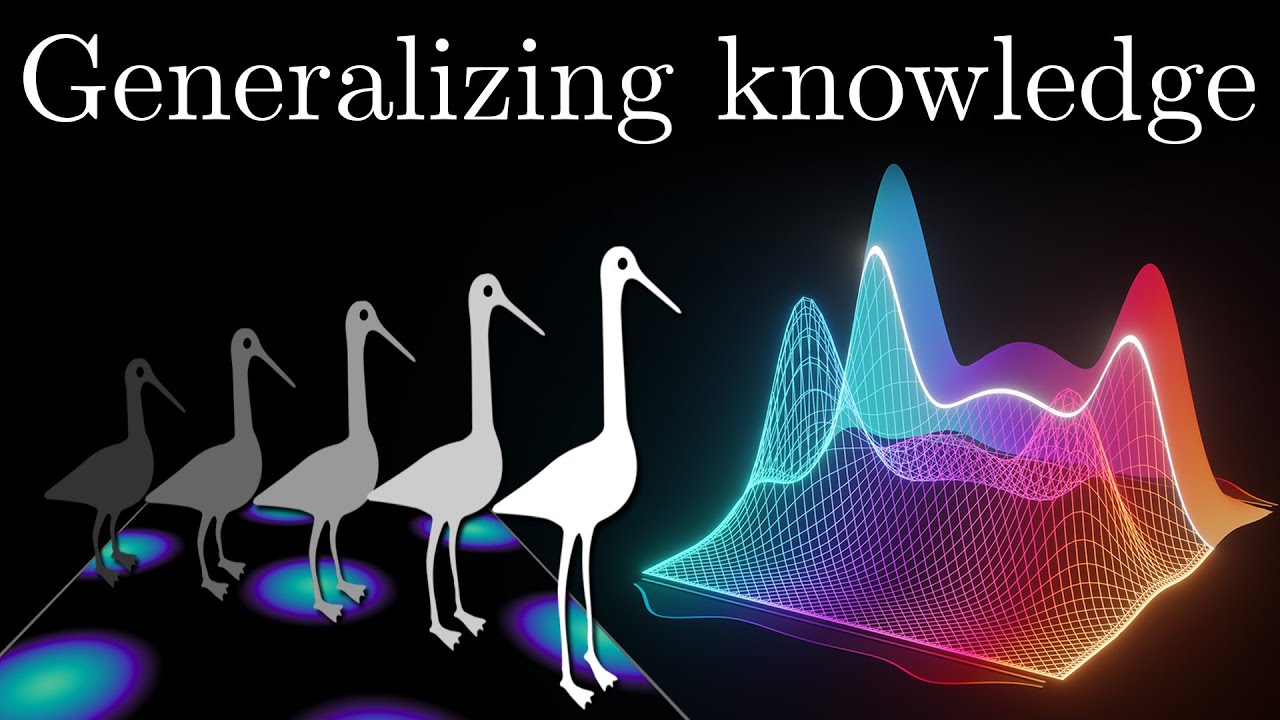
the one-dimensional space of soundfrequenciesneurons in the intrainal cortex alsodevelop a frequency dependent pattern ofactivity but which is periodicresembling grid cells that were squishedto the one dimension of the frequencyspacein another study human subjects weretrained to navigate in a highly abstracttwo-dimensional space of birdSilhouettes characterized by leg and
neck lengths participants couldindependently vary the length of legsand neck with a controller and theirtask was to morph a bird into aparticular configuration while activityof their brains was monitored throughfmriremarkably activity of their enterinalcortex showed signs of a hexagonalsymmetry as people mentally moved inthis conceptual space of birds which isincredibly consistent with the grid cell
codeall of this suggests that thehippocampus and enterinal cortex intandem might indeed construct amulti-dimensional and multi-modelrepresentation of the world but how canit be that the same Machinery is used tosolve computational tasks in bothspatial and non-spatial domains usingwhat seems like similar algorithms theremust be a way we can conceptually unifythem into a single type of problem
luckily there is a simple and elegantmathematical formalism that connectsphysical and Abstract spaces known asgraph Theorynotice that elements in all the tasks wehave seen so far have a notion of beingconnected by a certain relation forinstance neighboring locations in yourroom are physically connected to eachother and you can move along them inhorizontal and vertical directions
similarly members of a family fall ontoa tree like structure with correspondingrelations such as parent sibling Etcthis type of problems are naturallydescribed by a graphessentially a graph is a mathematicalstructure that consists of a set ofpoints called vertices or nodesand a set of lines called edges thatconnect pairs of vertices now thevertices can represent any kind of
object or entity and the edges cancorrespond to any kind of connection orrelation between the verticesfor instance we can construct a graph ofa two-dimensional Space by connectingeach location node to its Four Neighborsin a square grid-like mannerto effectively perform tasks however itis essential that you know where you arelocated on this graph at every point intime otherwise there is no point in
having organized knowledge in the firstplace to keep track of where you are youcan use what's called path integrationin the physical space it refers to usingself-motion cues such as movement speedand direction to accumulate movementvectors and update your positionfor example you knew that taking asequence of steps in the direction ofnorth then West then South then Eastwill take you back to where you started
many animal species such as insectsbirds rodents and humans all can pathintegrate in fact as we'll see in moredetail in the next video networks ofgrid cells can perform path integrationwhich can be modeled in a neural networkwith what's called attractor Dynamicsfor arbitrary graphs however you'll needa more abstract but similar notion ofpath integration that is a finite set ofrules of how to add different types of
relationshipsfor example that taking the root siblingparent is equivalent to parent and soforth and the very same graph can beused for generalization notice that thetask of navigating in a two-dimensionalspace of birds is essentially the sameas walking around the roomthe underlying structure of connectionsis fundamentally the same what'sdifferent is the type of incomingsensory cuessimilarly if you have an internal model
of a family tree not only you can use itfor different families but you can alsouse it to apply to things like taxonomysince it also has a tree-like structurejust relabel the relationships andyou're good to goso in conclusion if the hippocampal andterrinal system can construct theserelational graphs and Carry Out pathintegration and root finding on themthen it makes perfect sense how thissystem could be reused by the brain
across different modalities but how dowe know which graphs to build in thefirst placehow can the brain come up with such astructured representation well tounderstand this we need to First addressanother super important concept and thatis the idea of a latent spaceas it follows from the name latent spaceis something that is not directlyobservable from external keys
for example let's view the World ThroughThe Eyes of a mouse which is performingan alternation task this simply meansthat it is running in a t-shaped mazeand each time it reaches this split achoice whether to turn left or rightneeds to be madenow the task is such that the reward isalways alternating between the sides sothe animal has to learn that if onprevious trial it turned left andreceived a tasty treat that means that
now it should go to the right and viceversalet's try to think about the type ofElemental Model A cognitive map thatmust be built in the brain of this mousein other words what are the relevantbehavioral variables and their structurerequired to perform this particular taskwell first of all there is the spatialcomponent since you need to know whereyou are in this teammates physically andupdate your position so we can
reasonably expect to see conventionalPlace cells when looking inside thehippocampus but notice that informationabout physical location alone is notenough to solve the problem of obtainingthe maximum amount of reward since theanimals supposedly knows that it needsto alternate turns at every trial it hasto remember the direction of theprevious turn in other words there is anadditional abstract variable encodingwhere you are going and where you have
been to completely capture all therelevant information about this task youneed a configuration of a cognitive mapwhich keeps track of both the locationin the physical 2D space of the Maze anda binary location in this abstract spaceof left and right trialshere is another way to think about it atfirst when the animal hasn't learned thenature of this task and is justexploring the maze its cognitive maponly has a spatial component encoding
the 2D location but over the course ofseveral trials the mouse learns that ahaI need to alternate the directionsbecause the reward seems to be alwayslocated on the arm opposite of theprevious trial when this happens thecognitive map is expanded with a newdimension and the mental representationof the teammates kind of splits into twocloned versions of it one for turn lefttrials and another one for right turns
and now all of a sudden you need toupdate your position in this expandedspace which now has an additional axisremarkably we find cells whose firing ismodulated by both the physical locationand the direction of the Future Turnsuch neurons were termed splitter cellsthey uniquely encode the location in thefull expanded version of the cognitivemap which is remarkably consistent with
this idea that the hippocampus keepstrack of all task relevant variables nomatter how abstract they are this splitDimension into left versus right trialsis an example of a latent space since itis not directly observable from thesensory queues there is no light switchthat would signal you where to turninstead you need to infer your locationin the latent space based on previousobservations
another example includes training theanimals to run in a virtual reality andperform what's known as Toweraccumulation task essentially as theyrun on the track they are presented withvisual cues on both sides and at the endof the track they need to choose whetherto turn left or right the direction ofthe reward is indicated by which sidehad the higher number of towersso for example if you encounter in total
nine Towers to your left and only sevento your right it indicates that you needto turn left to get a reward since ithas a higher number of cuesthis number of towers or better yet thedifference between the two sides forms alatent evidence space and it turns outthat the right hippocampal neurons whichForum Place fields in this latent spaceas you can see location in latent spacesand even their pure existence in thecognitive map is extremely important but
the problem is it is not directlyobservable from Individual sensory cuesinstead latent spaces are built fromsequences of sensory observationsfor example remember in your previousChoice can affect the future one but whybother with building such relationalgraphs in the first placein the beginning of this video we saw anexample of how knowledge acquired in one
setting can be successfully generalizedto other contextsthis is because once the structuredrepresentation is built it can beabstracted away from particular sensoryobservationsyou know that North West South East willclose a loop in any environment be ityour room or local park and suchgeneralization effectively requires anexistence of a factorized representationhere is what factorization means
intuitivelylet's imagine you are buying a car andwould like to predict how much you willenjoy driving it for Simplicity thisspace of all possible cars is formed bythe particular model and its color andyour goal is to maximize the value ofyour subjective happiness gamma which isa function of two variables car modeland colorthere is some hidden distribution ofgamma but you don't know it since it
would require driving every possiblecombination of models and colors to findthat distribution however it makes senseto separately learn the distribution ofHappiness along the color axis forexample by driving a Tesla of differentcolors and the distribution of Happinessalong the car axis by driving each modelin red configuration if these twodistributions are independentfor example if you prefer blue overyellow and that is the case
irrespectively of the car model then theunderlying two-dimensional distributionis said to be factorizablemathematically we can describe the jointdistribution to be a product of the twocorresponding one-dimensional alsocalled marginal distributions it isenough for you to know the two factorsseparately to predict the jointdistributionand that means that such factorizationallows you to predict the value of gamma
for combinations you have neverencountered before also notice thatsince you only need to know a pair ofone-dimensional distributions it is muchless information compared to storing thetwo-dimensional distribution of allpossible combinations and for the brainthat problem of information storage iseven more relevant since cognitive mapshave a much larger number of dimensionssimilarly in the brain there isfactorization of every experience into
its structural component which is theposition on this relational graph andsensory component which defines theparticular setting of the outside worldin fact evidence for this factorizationcan be seen in the responses ofindividual neurons in the hippocampalformationrecall that grid cells in the enterRhino cortex and in particular themedial portion of it remain stableacross environments forming this
coordinate systeminformation about this structural basisis then fed into the hippocampusa second stream of informationcontaining purely sensory cues isprovided to the hippocampus by adifferent part of enter rhinocortexlateral enterinal area which doesn'thave such prominent grid patterns ofactivity the hippocampus then forms aconjunctive representationunifying the two streams of information
and embedding the particular sensoryinformation into this structuralbackbone this difference betweenfactorized and conjunctiverepresentations can be demonstrated by afamous phenomenon called hippocampalremapping essentially it refers to thetendency of place cells to change theirfiring patterns in different sensorycontextsfor example one neuron might activatewhen the animal is in the middle of theroom but after you change the order by
spraying with something minty that willreplace cell might shift its preferredlocation or stop firing in thatenvironment altogether notice that thisis completely different from grid cellswhich are largely invariant to suchcontextual perturbations and only careabout spaceall right let's try to tie everythingtogether in this video we saw evidenceboth on the behavioral and cellularlevel that the brain must have an
internal model of the world known as acognitive mapdespite the word map in the name it isnot restricted to representing physicalspacerather cognitive maps are a systematicway to organize knowledge in some kindof structure the main purpose of suchrepresentations is to effectivelyutilize the inherent regularities andrepetitions of the outside world inorder to minimize computational effortand generalize your knowledge
for example transitive rules such asthat if a is bigger than B and B isbigger than C then a must be bigger thanC applied in a variety of differentscenarios from distances and sizes ofpredators to sound frequencies andpaychecks so there is no need to learnthat transitive structure every time youcan just reuse it we also talked abouthow such structural backbones can beviewed as organizing knowledge as a
relational graph which needs to takeinto account latent spaces that are notdirectly observable but rather need tobe inferred from sequences of sensoryobservationsincorporation of latent spaces allowsthe hippocampus to keep track ofabstract variables such as the amount ofsensory evidence in the toweraccumulation task and the position inthe space of left versus right trials inthe alternation task and finally we
discussed why factorizing knowledge intostructural and sensory components isuseful to the brain since it allows itto generalize and make the problems morecomputationally feasible evidence forsuch factorized representations can befound in the intervinyl cortex whosemedial and lateral Parts provide thehippocampus with the two separatestreams of informationwhile the hippocampus then generates a
unified conjoined representationembedding the structure into sensorycontext in order to solve particularbehavioral tasks from running in mazesand pressing sound frequency levers tocooking and lasagna in your friend'skitchen now I know this was a lot totake in and there are a lot of missingpiecesthe thing is what is described in thisvideo is a territory of hard debates andongoing research so we are still lackinga unified interpretation hopefully
things will become more clear in thesecond part of the video series where wewill take the concepts and experimentalobservations we have seen here and tryto build a computational system thatwould be able to generalize and learnlatent spacesin the meantime if you're interested indiving deeper into the topics related tocomputational neuroscienceyou should definitely check out ourtoday's sponsorbrilliant.org brilliant is the perfect
platform to expand your knowledge instem fields and gain new skills unliketraditional textbook based cloningBrilliance courses are designed to behighly engaging and interactive makinglearning an enjoyable and rewardingexperience Hands-On exercises andstunning visualizations allow you todevelop a deep understanding of theunderlying Concepts in the context ofreal world applicationsembedding problem-solving skills intoyour cognitive map brilliant offers a
wide variety of courses for every leveland background from fundamentals of mathand computer science two neural networksand differential equations with newlessons being added every month forexample if you are interested incomputational models of the brain checkout their crash course on reinforcementlearning covering the foundations ofthis framework where an artificial agentis trained by trial and error don'thesitate to dive into brilliant and
begin expanding your knowledge inbite-sized chunks go to brilliant.orgartem carsonov to get a 30-day freetrial of everything brilliant has tooffer at the first 200 people to usethis link will get a 20 discount on thepremium membershipif you enjoyed this video press the likebutton share it with your friends andcolleagues subscribe to the channel ifyou haven't already and considersupporting me on patreon to suggestvideo topics and enjoy the bonus content
stay tuned for more interesting topicscoming up goodbye and thank you for theinterest in the brainforeign[Music], How Your Brain Organizes Information, YouTube, 01ka8dbp14jbts7awf12xvg2af.