Impactful Metrics & Reporting in Community

## Metadata
- Author: [[Shannon Abram]]
- Full Title: Impactful Metrics & Reporting in Community
- Category: #articles
- Document Note: ## Summarize:
The article emphasizes the importance of choosing meaningful engagement metrics to convey the value of community involvement effectively. Differentiating between strategic, operational, and tactical metrics is crucial for tailoring engagement data to various stakeholders. Strategic metrics focus on impact and value, demonstrating how the community aligns with organizational objectives and offers a better investment compared to traditional approaches. Operational metrics monitor changes in behaviors and workflows, helping decision-makers identify opportunities, assess management approaches, and celebrate successes. Tactical metrics measure day-to-day activities, providing insights into the direct impact of community actions and the effectiveness of efforts. The article concludes with three recommendations for more effective community engagement: measuring engagement data to understand its impact, analyzing member behavior to create user stories that resonate, and using insights to improve community programs, functionality, and management approaches.
## Bullet Points:
### Strategic Metrics & Reporting in Community:
- Strategic metrics focus on impact and value.
- Measuring community ROI to demonstrate effective impact.
- Aligning community goals with organizational objectives.
- Showing the value of community beyond revenue benefits.
- Community investments as a long-term benefit for fiscal health, innovation, and customer experience.
### Operational Metrics & Reporting in Community:
- Operational metrics monitor changing behaviors and workflows.
- Understanding how positive behaviors spread and negative ones are discouraged.
- Helping decision-makers assess and adjust plans as needed.
- Recognizing gaps, opportunities, and the effectiveness of management approaches.
- Celebrating good performance and identifying areas of improvement.
### Tactical Metrics & Reporting in Community:
- Tactical metrics measure day-to-day activity and direct impact.
- Assessing engagement levels after specific community actions.
- Analyzing the effectiveness of newsletters and other content.
- Identifying patterns and adjustments in community programs.
- Understanding how management changes influence engagement.
## Paraphrase:
1. Choosing Relevant Engagement Metrics:
Selecting metrics that effectively convey your community's engagement story is essential. The metrics worth measuring depend on your community's strategic, operational, and tactical goals. Different stakeholders may be interested in similar data for distinct reasons; for instance, a product manager may use data to improve the product, while a marketing director may want to identify exciting aspects to share with others. Presenting data in a meaningful way is crucial to effectively communicate your community's narrative and gain support and investment.
2. Strategic Metrics & Community ROI:
Strategic metrics primarily focus on demonstrating impact and value. It is vital to show how the community aligns with the organization's strategic objectives and why it represents a superior investment compared to traditional approaches. Measuring community Return on Investment (ROI) can be a powerful strategic metric, as it illustrates the community's effective impact on organizational change. Beyond revenue benefits, the community's ability to address complex problems contributes to the brand, employees, stakeholders, and long-term fiscal health, innovation, and customer experience.
## Conclusion:
The article highlights the significance of choosing appropriate engagement metrics to convey the value of community involvement effectively. Strategic metrics focus on impact and value, demonstrating the community's alignment with organizational objectives and showcasing its superior investment compared to traditional approaches. Operational metrics monitor changing behaviors and workflows, while tactical metrics measure day-to-day activities to understand the direct impact of community actions. By measuring, analyzing, and acting upon engagement data, community advocates can build successful patterns and foster a thriving and impactful community.
## Questions:
1. How can community advocates identify the most relevant engagement metrics for their unique community goals?
2. What are some effective ways to demonstrate the Return on Investment (ROI) of a community's strategic impact?
3. How do operational metrics help decision-makers understand the effectiveness of management approaches and identify areas for improvement?
4. What are some examples of tactical metrics that can be used to assess the direct impact of community actions?
5. How can community managers effectively analyze member behavior and translate the insights into meaningful user stories?
## Auto-tagging:
Community engagement, strategic metrics, operational metrics, tactical metrics, ROI, impact, value, organizational objectives, investment, decision-making, behavior change, user stories.
## Index Creation:
- Community engagement: Page 1
- Strategic Metrics & Reporting: Page 2
- Impact and value: Page 2
- Community ROI: Page 3
- Alignment with organizational objectives: Page 4
- Operational Metrics & Reporting: Page 5
- Changing behaviors and workflows: Page 5
- Assessing management approaches: Page 6
- Tactical Metrics & Reporting: Page 7
- Day-to-day activity measures: Page 7
- Assessing engagement levels: Page 8
## Table of Contents:
1. Introduction
2. Strategic Metrics & Reporting in Community
- Impact and value
- Community ROI
- Alignment with organizational objectives
3. Operational Metrics & Reporting in Community
- Changing behaviors and workflows
- Assessing management approaches
4. Tactical Metrics & Reporting in Community
- Day-to-day activity measures
- Assessing engagement levels
5. Conclusion
6. Questions
7. Auto-tagging
8. Index Creation
9. References
10. Future Research
11. Hypotheses
12. Methodology
13. Implications
14. Logical Validity
## References:
No sources were cited in the article.
## Future Research:
1. How can engagement metrics be tailored to different audience groups to effectively convey the community's impact and value?
2. What are the long-term effects of community investments on the fiscal health and innovation of organizations?
3. Explore the relationship between community engagement metrics and the overall customer experience and brand perception.
4. Investigate the effectiveness of various management approaches in influencing positive behaviors within the community.
5. Analyze the role of community engagement in addressing organizational change compared to other traditional approaches.
## Hypotheses:
1. Communities that effectively measure and demonstrate their Return on Investment (ROI) will receive increased support and investment from stakeholders.
2. The alignment of community goals with organizational objectives will positively impact the community's perceived value and strategic importance.
3. An analysis of operational metrics can help identify successful management approaches and drive behavior change within the community.
4. Tactical metrics that measure the direct impact of community actions will enable community managers to make data-driven decisions for improving engagement.
5. A strong correlation exists between effective community engagement and improved organizational outcomes, such as customer experience and brand perception.
## Methodology:
To explore the effectiveness of engagement metrics in community management, a mixed-methods approach would be ideal. Data sources can include user activity logs, surveys, and interviews. The research design will involve both quantitative analysis of engagement data and qualitative examination of member feedback. Statistical tools and sentiment analysis can be employed to gain insights into user behaviors and perceptions. A comparative study between communities with varying levels of engagement and strategic alignment can provide valuable findings. Additionally, longitudinal studies can track engagement trends and measure the long-term impact of community investments.
## Implications:
T
- Document Tags: [[community management]] [[metrics]]
- Summary: Choosing the metrics that tell your community’s unique story of engagement is crucial. What engagement activity is worth measuring?
- URL: https://communityroundtable.com/metrics-measurement/impactful-metrics-reporting-in-community/
#### **Great metrics and dashboards reveal the value of engagement.**
Choosing the metrics that tell your community’s unique story of engagement is crucial. What engagement activity is worth measuring? It depends on the strategic, operational, and tactical goals of your community.
Community engagement metrics help to tie engagement to outcomes, and in turn, to business value. Engagement data should be tailored to its audience, ensuring that community metrics are meaningful. For instance, a product manager and a market director may both be interested in the emergent product testimonials in a community, but they are interested in this data for different reasons – and are likely to use it in different ways.
While the product manager may want to understand how the product is used in order to improve the product, the marketing director may be interested in what aspects of the product members are most excited about so they can share it with others. Deciding what data to share, how to present it, and how often, is critical to telling the story of your community in a meaningful way. More importantly, reporting data effectively is what leads to increased support and investment. We break metrics and reporting into three categories: strategic, operational, and tactical.
#### Strategic Metrics & Reporting in Community
Strategic metrics and reporting is focused on impact and value. How does the community further the strategic objectives of the organization? Why is it a better investment than a more traditional approach to addressing those issues? Senior executives are responsible for budgets, which reflect how the priorities of an organization are expressed and changed.
This is why measuring community ROI becomes important – because it demonstrates effective impact. If organizational change is a strategic goal, showing how communities address organizational change more effectively, for the same investment than another approach, is critical. When reporting on the significant value community brings to company culture, executives who look beyond the revenue benefits will find that the complex problems community solves creates value not only for the bottom line but also for the brand, the employees, and the stakeholders. Community investments are an investment in long-term fiscal health, innovation, and a positive customer experience.
[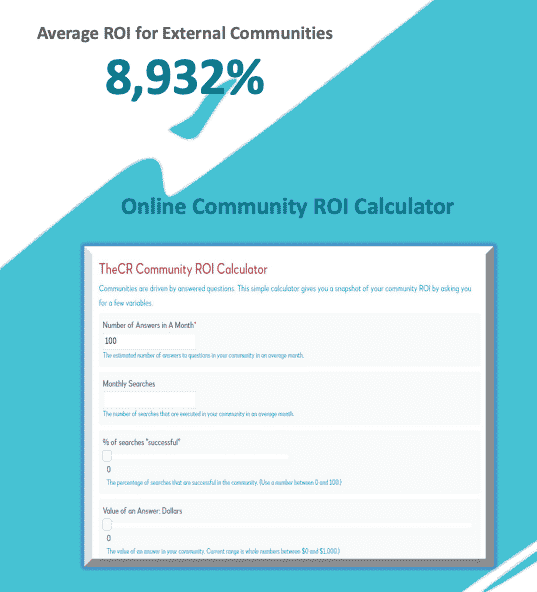](https://communityroundtable.com/what-we-do/models-and-frameworks/roi-calculator/)An example of a strategic metric is Return on Investment (ROI) – Use our ROI Calculator to calculate your community ROI.
#### Operational Metrics & Reporting In Community
Operational metrics are focused on how behaviors and workflows are changing. Behavior change is what collectively generates strategic value. Knowing which behaviors are changing, how fast, and in what areas of the community is critical to understanding how to encourage the spread of positive behaviors and discourage the negative ones.
Operational metrics help decision-makers monitor how well plans are working so they can learn and adjust as needed. If behaviors over a quarter don’t change, then it may prompt a change to how the community is being managed – or when looking at benchmarks over time, it may just signal a traditionally slow period in the life of the community.
Done well, operational metrics help:
* See the gaps and opportunities
* Probe deeper into whether a management approach is working
* Celebrate good performance and reflect on what is working well
#### Tactical Metrics & Reporting in Community
Tactical metrics are the day-to-day activity measures that help community managers understand the direct impact of their actions. How many new comments happen after a question of the week is posted? What percent of the community comes back after newsletters go out? Are those metrics better or worse than prior periods, which can tell the community team if the quality of their efforts is improving?
Done well, tactical metrics help
* Understand what content and programming works
* Identify times and periods that have different engagement levels
* See how changes in management influence engagement
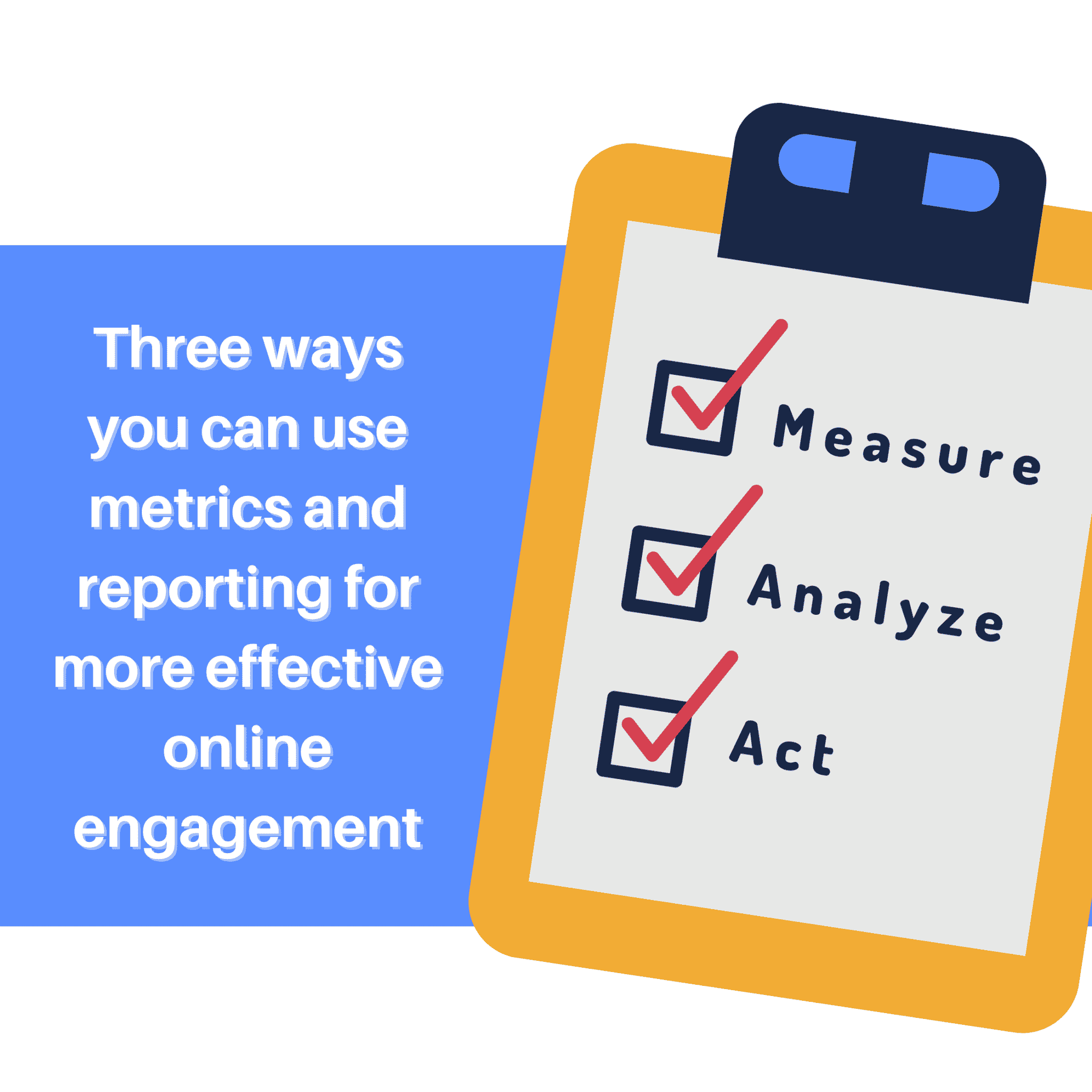
#### Three recommendations for more effective engagement
**Measure:** Engagement data is vital to understanding who, how, and when members engage. Identifying key behaviors when designing metrics will help the organization understand how engagement impacts work. Translating this impact into value makes it meaningful to the business.
**Analyze:** Combine data and member research to understand why members engage – and how it impacts their success. Use this analysis to create user stories that resonate for both users and internal stakeholders so everyone can see the impact
**Act:** Use your understanding of member activity and behaviors to build successful patterns into community programs, functionality, and management approaches. Experiment to see what works.
, Impactful Metrics & Reporting in Community, Shannon Abram, 01gtw6w8tcf0yb09yzfzq0xaj0.