Instructional Design: How ChatGPT Enhances It

## Metadata
- Author: [[commlabindia.com]]
- Full Title: Instructional Design: How ChatGPT Enhances It
- Category: #articles
- Document Note: # Title: ChatGPT’s Transformative Impact on Instructional Design [Infographic]
---
tags: #chatgpt #instructionaldesign #artificialintelligence
Author: Courtney Robertson
Source: OpenAI Blog
Reference: N/A
---
## Table of Contents:
- Introduction
- Innovation in Instructional Design with ChatGPT
- Tips For Instructional Designers to Work with ChatGPT
- Conclusion
### References:
- OpenAI Blog
## Index Creation:
- Instructional design
- Artificial intelligence
- ChatGPT
- Personalized learning paths
- Content creation process
- Adaptive learning systems
- Natural language processing
- Data-driven insights
- Future of instructional design
- ChatGPT's capabilities
- Collaboration with ChatGPT
- Engagement in learning experiences
- Tips for working with ChatGPT
- Context-awareness
## 📝 Summary:
ChatGPT, an artificial intelligence language model developed by OpenAI, has a transformative impact on instructional design. It revolutionizes the field by offering advanced capabilities such as personalized learning paths, simplified content creation, and data-driven insights. ChatGPT serves as a valuable tool for brainstorming ideas, refining language, and fostering collaboration in the creation of engaging and effective learning experiences.
## 📖 Main Content:
Innovation in Instructional Design with ChatGPT:
AI, particularly ChatGPT, has revolutionized instructional design by introducing advanced capabilities that enhance the learning experience. One significant impact is the ability to create personalized learning paths through AI algorithms that understand learner data. This customization ensures that content aligns with learners' specific needs and adapts to their unique learning styles. Moreover, AI automates routine tasks, simplifying the content creation process and allowing instructional designers to focus on strategic aspects of course development. With features like adaptive learning systems, natural language processing, and data-driven insights, AI becomes a transformative force, shaping the future of instructional design to be more advanced, tailored, and responsive to evolving learner needs in the digital age.
Tips For Instructional Designers to Work with ChatGPT:
1. Define Clear Objectives: Clearly outline the learning objectives you want to achieve with ChatGPT's assistance to maximize its effectiveness.
2. Provide Specific Input: Give detailed and specific input to get more relevant and targeted responses from ChatGPT.
3. Iterate and Refine: Use ChatGPT's responses as a starting point and iterate on the generated content to ensure it aligns perfectly with instructional goals.
4. Verify Information: Cross-verify the information provided by ChatGPT, especially in research-heavy topics, to maintain content accuracy.
5. Experiment with Prompts: Try different prompts to see how ChatGPT responds and adjust them based on the assistance needed.
6. Stay Mindful of Context: Understand ChatGPT's strengths and limitations and adapt its use accordingly for more effective collaboration.
## 🗒️ Notes:
- AI, particularly ChatGPT, revolutionizes instructional design with advanced capabilities.
- Personalized learning paths align content with learners' needs and learning styles.
- AI automates routine tasks, simplifying content creation for instructional designers.
- ChatGPT serves as a valuable tool for brainstorming ideas and refining language.
- Tips for working with ChatGPT: define clear objectives, provide specific input, iterate and refine, verify information, experiment with prompts, stay mindful of context.
## 📖 References:
- OpenAI Blog
## 🗣️ Paraphrase:
1. AI, specifically ChatGPT, has a significant impact on instructional design by introducing advanced capabilities that enhance the learning experience. It enables personalized learning paths that cater to learners' specific needs and adapts to their learning styles. Additionally, it streamlines content creation, allowing instructional designers to focus on strategic aspects of course development.
2. ChatGPT, developed by OpenAI, empowers instructional designers by providing a language model that generates human-like text and offers instant responses. It serves as a collaborative tool, assisting in brainstorming ideas, refining language in instructional materials, and fostering innovative approaches in creating effective learning experiences.
## 🧪 Hypotheses:
1. Future studies can examine the effectiveness of personalized learning paths created by AI algorithms in improving learner engagement and knowledge retention.
2. Research could investigate the impact of ChatGPT's language generation capabilities on learner satisfaction and perception of instructional materials.
### 📊 Methodology:
1. Conduct a longitudinal study comparing the learning outcomes of learners who follow personalized learning paths created by AI algorithms and those who follow traditional instructional approaches.
2. Employ surveys and interviews to gather feedback from learners regarding their satisfaction and perception of instructional materials generated by ChatGPT.
### ❓ Questions:
1. How can ChatGPT's adaptive learning systems be further improved to enhance the personalization of learning experiences?
2. What are the potential ethical considerations in using AI, like ChatGPT, for instructional design?
### 🔮 Future Research:
- Investigate the role of AI, specifically ChatGPT, in promoting inclusivity and accessibility in instructional design.
- Explore the potential applications of ChatGPT in different educational contexts, such as K-12 or higher education.
- Examine the use of ChatGPT in collaborative learning environments and its impact on group dynamics and knowledge sharing.
### 💡 Implications:
Future research on the use of ChatGPT in instructional design can advance knowledge by exploring its effectiveness in enhancing learning experiences. It can influence practice by offering innovative approaches in course development and content creation. Moreover, it can inform policy decisions regarding the integration of AI in education and the ethical considerations associated with its use.
### ✅ Logical validity:
The main arguments presented in the article highlight the transformative impact of ChatGPT on instructional design. The evidence supports the claims by explaining how AI enables personalized learning paths, automates routine tasks, and enhances collaboration. No logical fallacies were identified in the article.
## 🎯 Conclusion:
ChatGPT, developed by OpenAI, revolutionizes instructional design by offering advanced capabilities and fostering collaboration. Its ability to generate human-like text and provide instant responses enhances the creativity and efficiency of instructional designers. ChatGPT serves as a transformative tool, shaping the future of instructional design to be more advanced, tailored, and responsive to the evolving needs of learners in the digital age.
- Document Tags: [[ai]] [[instructional design]]
- Summary: AI, specifically ChatGPT, is revolutionizing instructional design by providing advanced capabilities that enhance the learning experience. These capabilities include personalized learning paths based on learner data, simplification of content creation through automation, and the ability to generate human-like text and provide instant responses. ChatGPT serves as a valuable tool for brainstorming, refining language, and offering insights in instructional materials. Instructional designers can maximize the effectiveness of ChatGPT by defining clear objectives, providing specific input, iterating and refining the generated content, verifying information, experimenting with prompts, and staying mindful of context. Leveraging AI in instructional design opens new opportunities for creativity, efficiency, and transformative learning experiences.
- URL: https://blog.commlabindia.com/elearning-design/instructional-design-chatgpt-use-infographic
AI is revolutionizing instructional design by introducing advanced capabilities that enhance the learning experience. One notable impact is the ability to create personalized learning paths through AI algorithms that understand all learner data. This customization ensures that content aligns with learners' specific needs and adapts to their unique learning styles. Additionally, AI simplifies the content creation process, automating routine tasks and allowing instructional designers to focus on strategic aspects of course development. With adaptive learning systems, natural language processing, and data-driven insights, AI is not just a tool but a transformative force, shaping the future of instructional design to be more advanced, tailored, and responsive to the evolving needs of learners in the digital age.
#### Innovation in Instructional Design with ChatGPT
The integration of cutting-edge technologies has brought about significant advancements, and among these, ChatGPT stands out as a powerful ally for instructional designers. Developed by OpenAI, ChatGPT is an [artificial intelligence](https://resources.commlabindia.com/ebook/storytelling-ai-elearning-experience-revolution) language model that opens new avenues for creativity and efficiency in the instructional design process. With its ability to generate human-like text and provide instant responses, ChatGPT serves as a valuable tool for brainstorming ideas, refining language in instructional materials, and offering insights for creative content development. ChatGPT emerges as a futuristic companion, enhancing collaboration and sparking innovative approaches in the creation of engaging and effective learning experiences.
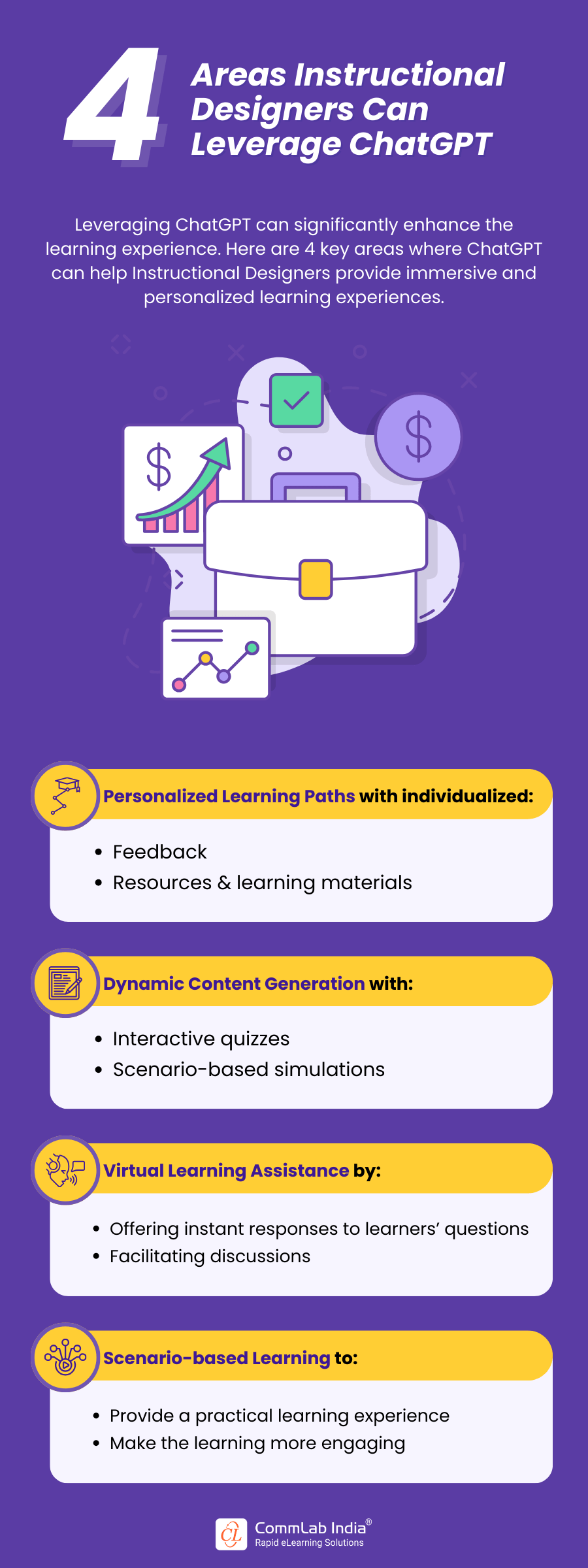
Here's an insightful infographic highlighting the areas where ChatGPT can be leveraged by instructional designers.
[](https://www.commlabindia.com/hubfs/blogs/instructional-design-chatgpt-use-infographic.png)
#### Tips For Instructional Designers to Work with ChatGPT
##### 1. Define Clear Objectives
Clearly outline the learning objectives you want to achieve with ChatGPT's assistance. Whether it's brainstorming ideas, refining language, or generating content outlines, having a clear vision will maximize the tool's effectiveness.
##### 2. Provide Specific Input
Give [ChatGPT](https://openai.com/chatgpt) detailed and specific input to get more relevant and targeted responses. Clearly articulate your requirements to receive insights that align closely with your instructional design needs.
##### 3. Iterate and Refine
Use ChatGPT's responses as a starting point and iterate on the generated content. Refinement is key to ensuring that the output aligns perfectly with your instructional goals and maintains a consistent tone.
##### 4. Verify Information
If ChatGPT provides information, especially in research-heavy topics, cross-verify it for accuracy. While ChatGPT is a powerful tool, human verification is essential to maintain the integrity of instructional content for [corporate training](https://elearningindustry.com/microlearning-videos-and-ai-exploring-combo-for-impactful-corporate-training).
##### 5. Experiment with Prompts
Try out different prompts to see how ChatGPT responds. Adjust your prompts based on the type of assistance you need.
##### 6. Stay Mindful of Context
Be mindful of the context in which you're using ChatGPT. Understand its strengths and limitations and adapt your use accordingly. Context-awareness ensures more effective collaboration with the tool.
#### Wrapping it up!
With ChatGPT’s use in instructional design, the potential for creativity, efficiency, and transformative learning experiences becomes evident. Leveraging the collaborative power of AI in instructional design opens new opportunities for innovation. To delve deeper into the realm of generative AI and its applications in training, consider downloading our comprehensive eBook. Explore the strategies that await in instructional design. Download our eBook now!, Instructional Design: How ChatGPT Enhances It, commlabindia.com, 01hpktfmggresx8dtrt2kvkr2h.