Instructional Design: What’s AI’s Influence on It?
## Metadata
- Author: [[commlabindia.com]]
- Full Title: Instructional Design: What’s AI’s Influence on It?
- Category: #articles
- Document Note: ---
tags: #AI #instructionaldesign
Author: [Author's Name]
Source: [Author/Book/Article/Website]
Reference: [Page numbers/Link]
---
# Innovative AI Transformations in Corporate Training
## Table of Contents:
1. What is the Role of AI in Unlocking the Future of Instructional Design?
2. How Can AI Streamline Instructional Design Tasks?
3. How Is AI Shaping the Future of Corporate Learning?
4. How Can Corporate Training Professionals Adopt AI?
5. Ethical Concerns Surrounding AI in Training
## Index Creation:
- AI
- Instructional Design
- Corporate Learning
- Adaptive Learning
- Virtual Reality
- Bias in AI Algorithms
## 📝 Summary:
AI is redefining instructional design in corporate training by automating tasks, personalizing content, and enhancing learner engagement. Understanding how AI integrates into the learning design process is crucial for professionals to adapt to this rapidly evolving landscape.
## 📖 Main Content:
AI revolutionizes instructional design by automating tasks, making content creation and curation more efficient, personalizing learning experiences for individuals, and enhancing engagement through immersive learning experiences like simulations and gamification. While AI offers numerous benefits, it also raises ethical concerns related to bias, data privacy, and job displacement that must be addressed for responsible AI integration in corporate training.
### 🗒️ Notes:
- AI transforms the instructional design process by automating routine tasks and providing valuable insights for instructional designers.
- AI-powered content creation tools can streamline the development of learning materials through automated storyboarding and quiz generation.
- Adaptive learning with AI tailors content to individual learners, providing personalized experiences and continuous skill development.
- AI-driven immersive learning experiences like simulations and VR enhance engagement and interactivity in eLearning.
- Ethical concerns around AI in training include bias in algorithms, data privacy, and job displacement that require careful consideration by professionals.
## 📖 References:
- Prompt Engineering: Harnessing AI to Create Immersive Learning Experiences
## 🗣️ Paraphrase:
- AI plays a transformative role in instructional design by automating tasks and offering creative suggestions, facilitating the creation of engaging learning materials tailored to individual needs.
- AI enhances the instructional design process, empowering professionals to predict trends, personalize experiences, and provide real-time feedback. Adopting AI is not about replacing human expertise but leveraging technology to enhance creativity and efficiency in designing learning programs.
## 🧪 Hypotheses:
- Future studies could explore the impact of AI on long-term learning outcomes and knowledge retention in corporate training environments.
- Examining the ethical implications of AI integration in training programs and strategies to mitigate bias and privacy concerns would be essential for responsible AI adoption.
### 📊 Methodology:
- Research methodologies like longitudinal studies and mixed-method approaches could assess the effectiveness of AI-driven instructional design strategies on learning outcomes and engagement.
- Utilizing AI-powered sentiment analysis and user behavior tracking could provide insights into learner preferences and the impact of personalized content on engagement.
### ❓ Questions:
- How can AI-powered content curation and trend analysis tools enhance the relevance and engagement of corporate training programs?
- In what ways can AI-driven chatbots and virtual assistants support continuous learning and provide real-time assistance to learners?
### 🔮 Future Research:
- Investigate the implications of AI integration in corporate training on job roles and professional development opportunities for instructional designers.
- Explore the potential of AI in facilitating cross-functional collaboration between training professionals, IT specialists, and data scientists to drive innovative learning solutions.
### 💡 Implications:
- AI offers transformative capabilities for instructional design, enhancing efficiency, personalization, and learner engagement in corporate training.
- Addressing ethical concerns around AI in training is crucial to ensure responsible and inclusive use of technology, promoting equitable learning opportunities and continuous improvement in the field.
## 🎯 Conclusion:
AI's impact on instructional design in corporate training is profound, enabling professionals to streamline tasks, personalize experiences, and drive engagement. Embracing AI-powered solutions while addressing ethical considerations can shape a future where learning is dynamic, accessible, and impactful.
- Document Tags: [[Education]] [[instructional design]]
- Summary: AI is transforming instructional design by automating tasks, personalizing learning experiences, and enhancing engagement. It allows designers to focus on creativity while providing insights based on learner data. The future of eLearning looks promising with AI's potential to improve training and make it more effective.
- URL: https://blog.commlabindia.com/elearning-design/ai-impact-instructional-design


Imagine a scenario where a dedicated instructional designer is struggling to keep up with the rapidly changing needs of a corporate training program. Every time a new product is launched, a policy changes, or a skill gap is identified, the designer must race against time to create relevant and engaging learning materials. The process is painstakingly slow, often requiring hours of brainstorming, content creation, and revision. And despite all the hard work, the final product may still miss the mark, leaving learners disengaged and companies dissatisfied.
Now, imagine a world where this process is streamlined, where instructional designers have a powerful tool at their disposal that can handle mundane tasks, provide creative suggestions, and even predict learning outcomes. This is not a scene from a sci-fi movie—this is the potential future of [instructional design](https://blog.commlabindia.com/instructional-design-powered-ai) with Artificial Intelligence (AI).
But, how exactly is AI impacting instructional design? This is the central theme of our exploration. We’ll delve into the specific ways AI is being integrated into the instructional design process, the benefits it offers, and the challenges it presents. We’ll also look at the future possibilities AI holds for the eLearning industry and how instructional designers can adapt to this rapidly changing landscape.
Table of Contents
Before diving into how AI can revolutionize instructional design, let’s take a moment to define these key terms.
#### What is Instructional Design?
**Instructional Design (ID)** is the systematic process of creating educational experiences that make the acquisition of knowledge and skills more efficient, effective, and engaging. It involves analyzing learners' needs, designing content, developing learning activities, implementing the course, and evaluating its effectiveness.
###### What is Artificial Intelligence?
**Artificial Intelligence (AI)**, on the other hand, refers to the simulation of human intelligence in machines that are programmed to think, learn, and adapt like humans. In the context of eLearning, AI can automate complex processes, personalize learning experiences, and provide insights that were previously unimaginable.
#### What is the Role of AI in Unlocking the Future of Instructional Design?
The landscape of instructional design has never been more demanding. As the need for continuous learning and upskilling accelerates, driven by technological advances and shifting workplace dynamics, instructional designers are under immense pressure. They are expected to create content that not only imparts knowledge but also captivates and retains learners.
Emerging trends like microlearning, gamification, and [mobile learning](https://blog.commlabindia.com/elearning-design/mobile-learning-design-strategies-infographic) are revolutionizing eLearning, yet they add to the complexity that designers face. Traditional instructional design methods, though effective, often fall short in agility and efficiency, leaving many professionals struggling to meet the growing demands of modern learners.
This is where AI steps in as a transformative force. Beyond merely automating routine tasks, AI has the potential to revolutionize the entire instructional design process. By analyzing learner data, AI can suggest content tailored to individual needs, automate the creation of assessments, and free designers to focus on more creative and strategic aspects of course development.
AI also empowers instructional designers, enhancing their ability to produce high-quality content with greater speed and precision. With AI, designers can anticipate trends, predict learner behavior, and provide real-time feedback, making the learning experience not just more efficient but also more dynamic and responsive. The integration of AI into instructional design is more than an evolution—it's a revolution that holds the promise of reshaping the future of eLearning.
#### How Can AI Streamline Instructional Design Tasks?
##### How Can AI Automate Repetitive Tasks in Instructional Design?
Imagine a world where the routine tasks of instructional design (ID) are handled by AI, allowing you to focus on the more strategic and creative aspects of your role. Here’s how AI is making this possible:
**Content Creation**
* **Automated Storyboarding:** AI tools can turn your ideas into structured learning modules quickly by generating templates, suggesting layouts, and recommending multimedia elements.
* **Quiz Generation:** AI can create quizzes tailored to your content, automatically adjusting difficulty levels based on learner performance.
**Administrative Tasks**
* **Scheduling:** AI systems can manage and automate the scheduling of training sessions based on participant availability, reducing administrative overhead.
* **Grading:** Instant grading tools powered by AI can evaluate assessments and provide immediate feedback, speeding up the learning process.
**Content Curation**
* **Sourcing Materials:** AI platforms can analyze data to find and recommend relevant articles, videos, and case studies that align with your learning objectives.
* **Trend Analysis:** AI can identify trending topics and effective resources, ensuring your content stays current and engaging.
##### Prompt Engineering — Harnessing AI to Create Immersive Learning Experiences
Learn the Art of Crafting Effective Prompts and Get Desired Outcomes
* What is Prompt Engineering?
* Why is Prompt Engineering Important?
* How to Craft Effective Prompts?
* And More!
[Download eBook](https://resources.commlabindia.com/ebook/prompt-engineering-and-ai)
##### How Can AI Personalize Learning Experiences?
AI is transforming personalized learning, making it more dynamic and responsive. Here’s how:
**Adaptive Learning**
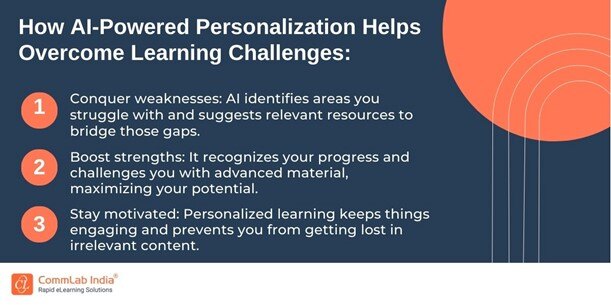
* **Tailored Content:** AI systems monitor learner progress and adjust the learning path to fit individual needs. For example, if a learner struggles with a topic, AI can offer additional resources or practice exercises.
* **Advanced Content:** For learners who excel, AI can introduce more challenging material to keep them engaged.
**Learner Analytics**
* **Tracking Progress:** AI tracks interactions with content, identifying strengths and weaknesses. This data helps in creating detailed learner profiles that inform personalized learning experiences.
* **Gap Identification:** AI-driven insights reveal gaps in knowledge and areas needing improvement.
**Chatbots and Virtual Assistants**
* **Instant Support:** AI chatbots provide real-time assistance, answering questions and offering hints. They help learners even outside regular hours, ensuring continuous support.
**How AI Supercharges Adaptive Learning Systems and Virtual Assistants?**
Some content could not be imported from the original document. [View content ↗](https://www.youtube.com/embed/8oRvI9L0Yo4?feature=oembed)
##### Can AI Automate Instructional Design Entirely?
While AI is a powerful tool, it doesn’t replace human expertise. Here’s why:
**Task Automation**
* **Routine Chores:** AI excels at automating repetitive tasks, such as [eLearning content creation](https://blog.commlabindia.com/elearning-design/custom-elearning-content-creation-tips) and administrative functions.
**Human Expertise**
* **Creative Processes:** Designing innovative learning experiences and developing curricula that meet broader educational goals require human creativity and intuition.
* **Learner Motivation:** Inspiring and engaging learners is a nuanced task that AI alone cannot fully address.
AI acts as an enabler, handling many routine tasks and providing valuable insights, but it works best in partnership with human instructional designers. The blend of AI's capabilities with human creativity will drive the future of instructional design, making learning both effective and inspiring.
#### How Is AI Shaping the Future of Corporate Learning?
##### How Will AI Enhance Engagement and Interactivity in eLearning?
Artificial Intelligence is revolutionizing eLearning by making it more engaging and interactive. Here’s how AI is transforming the landscape:
**Immersive Learning Experiences**
* **Simulations:** AI-driven simulations create [realistic, interactive scenarios](https://www.commlabindia.com/case-studies/gamified-elearning-info-security-success-story) where learners can practice skills in a virtual environment. This hands-on approach enhances understanding and retention. For instance, medical training programs use AI simulations to allow students to perform virtual surgeries.
* **Gamification:** AI integrates game mechanics into learning, making the process more enjoyable. Personalized game-based learning adapts to the learner’s progress, offering tailored challenges and rewards. Platforms like [Kahoot!](https://kahoot.com) use AI to create engaging quizzes and learning games.
**Virtual Reality (VR) and Augmented Reality (AR) Integration**
* **VR Experiences:** AI-powered VR environments offer immersive learning experiences, transporting learners to different settings or historical periods. For example, VR can simulate a space mission for astronauts-in-training.
* **AR Applications:** AI enhances AR by overlaying digital information on the real world. This technology can provide contextual learning, such as interactive lab experiments where learners view data overlays on physical objects.
**AI-Powered Microlearning**
* Ongoing Skill Development: AI curates [microlearning modules](https://www.commlabindia.com/elearning-services/microlearning) that deliver bite-sized content tailored to the learner’s needs. These modules can be pushed as reminders or suggestions, ensuring continuous skill development and knowledge reinforcement. Platforms like [Axonify](https://axonify.com) utilize AI to offer personalized microlearning content.
##### How Can AI Bridge the Accessibility Gap in Learning?
AI is instrumental in making learning accessible to everyone by catering to diverse needs and abilities:
**Personalized Learning Experiences**
* **Adaptive Learning:** AI tailors content based on individual learning styles and abilities, ensuring that each learner receives [training material suited to their needs](https://blog.commlabindia.com/elearning-design/training-need-analysis-at-3-levels). For instance, AI can adjust the difficulty level of a course based on real-time performance.
* **Differentiated Instruction:** AI tools can present content in various formats, such as text, audio, or video, catering to different learning preferences and needs.
****
**Generating Alternative Formats**
* **Text-to-Speech:** AI-powered text-to-speech technology helps learners with visual impairments or reading difficulties by converting written content into spoken words. Tools like **Microsoft’s Immersive Reader** offer such capabilities.
* **Closed Captioning:** AI can automatically generate closed captions for [videos, making learning content accessible](https://www.commlabindia.com/elearning-services/video-based-learning) to those with hearing impairments. Platforms like YouTube use AI to provide real-time captions.
##### Prompt Engineering — Harnessing AI to Create Immersive Learning Experiences
Learn the Art of Crafting Effective Prompts and Get Desired Outcomes
* What is Prompt Engineering?
* Why is Prompt Engineering Important?
* How to Craft Effective Prompts?
* And More!
[Download eBook](https://resources.commlabindia.com/ebook/prompt-engineering-and-ai)
##### What Are the Ethical Concerns Surrounding AI in Training?
While AI offers numerous benefits, it also raises ethical concerns that must be addressed:
**Bias in AI Algorithms**
* **Algorithmic Bias:** AI systems can sometimes continue the biases found in the data they are trained on. To ensure that AI is fair and unbiased, we need to regularly review and improve the algorithms. Trainers and developers should collaborate to spot and reduce these biases.
**Ethical Data Collection and Use**
* **Data Privacy:** AI systems rely on data to function effectively. Protecting learner data and ensuring privacy is paramount. [Learning and development (L&D)](https://blog.commlabindia.com/elearning-design/ld-boosts-employee-retention-guide) pros must adhere to strict data protection standards and transparent data usage policies.
**Job Displacement Concerns**
* **Human-AI Collaboration:** While AI can automate certain tasks, it is not a replacement for human expertise. The focus should be on how AI can enhance and support the work of instructional designers rather than replace them. [Collaboration between AI and human designers](https://blog.commlabindia.com/elearning-design/chatgpt-explained-instructional-designers-infographic) can lead to more innovative and effective learning solutions.
By addressing these concerns, we can harness the power of AI while ensuring it serves educational purposes ethically and inclusively. The future of learning with AI promises to be both dynamic and equitable, offering new opportunities for engagement, accessibility, and continuous improvement in instructional design.
#### How Can Corporate Training Professionals Adopt AI?
##### How Can Corporate Training Professionals Embrace AI in Design Processes?
As AI continues to revolutionize various industries, corporate training professionals need to adapt and integrate AI into their workflows. Here’s how to start:
**Identify Key Areas for AI Integration**
* **Content Creation:** AI streamlines tasks like storyboarding, quiz generation, and video creation, boosting efficiency.
* **Learner Analytics:** Use AI to analyze data, offering insights that help tailor training programs.
* **Personalization:** AI adapts content to individual learners based on performance and preferences.
**Develop Relevant Skills**
* **Technical Proficiency:** Familiarize yourself with AI tools and platforms relevant to corporate training. Understanding how these tools work will help you leverage them effectively.
* **Data Literacy:** Learn to interpret data generated by AI systems. This skill will enable you to make informed decisions and optimize training outcomes.
* **Ethical Awareness:** Stay informed about the ethical implications of AI, including data privacy and algorithmic bias, to ensure responsible use.
**Collaborate and Innovate**
* **Cross-Functional Collaboration:** Work closely with IT, data science, and AI specialists to successfully implement AI in training programs.
* **Continuous Learning:** Stay updated on AI advancements and emerging trends. Regularly participate in webinars, workshops, and digital events like [[LearnFlux]](https://www.commlabindia.com/learnflux) where industry experts share insights on AI in corporate training.
##### Prompt Engineering — Harnessing AI to Create Immersive Learning Experiences
Learn the Art of Crafting Effective Prompts and Get Desired Outcomes
* What is Prompt Engineering?
* Why is Prompt Engineering Important?
* How to Craft Effective Prompts?
* And More!
[Download eBook](https://resources.commlabindia.com/ebook/prompt-engineering-and-ai)
##### What are the Tools and Resources Available for Learning About AI in ID?
For those looking to deepen their understanding of AI in corporate training, here’s a curated list of resources:
**Online Courses and Certifications**
* **Coursera:** Offers courses like ["AI for Everyone" by Andrew Ng](https://www.coursera.org/learn/generative-ai-for-everyone), which provides a foundational understanding of AI.
**Research Papers and Articles**
* **Educause Review:** Articles like "[10 Ways Artificial Intelligence is Transforming Instructional Design](https://er.educause.edu/articles/2023/8/10-ways-artificial-intelligence-is-transforming-instructional-design)" provide valuable insights into AI’s impact on training and development.
* **LinkedIn Pulse:** Posts such as "[The Role of AI in Instructional Design and Learning Experience](https://www.linkedin.com/pulse/role-ai-instructional-design-learning-experience-xekje/)" discuss AI’s role in modern instructional design.
* **Commlab India:** Blogs like “[What Does Generative AI Promise L&D Stakeholders?](https://blog.commlabindia.com/elearning-design/generative-ai-promise-ld)” that discuss how AI impacts L&D.
**Events and Webinars**
* **LearnFlux by CommLab India:** [LearnFlux](https://www.commlabindia.com/learnflux) is a digital event that offers a platform to explore the latest trends in AI and eLearning. Industry experts share their experiences, best practices, and innovative approaches to AI in corporate training.
By leveraging these resources, corporate training professionals can stay ahead of the curve and effectively integrate AI into their design processes, ensuring that they deliver impactful and engaging learning experiences.
#### Wrapping Up
As we've explored, Artificial Intelligence (AI) is set to revolutionize instructional design (ID) by automating routine tasks, enhancing learner engagement, and personalizing the learning experience. From streamlining content creation to offering insightful learner analytics, AI is transforming how we design and deliver corporate training. However, while the potential is vast, it's crucial to implement AI responsibly, ensuring that it augments rather than replaces the creative and strategic roles of instructional designers.
The future of instructional design is undeniably bright, with AI poised to unlock new possibilities in corporate training. By embracing AI, eLearning professionals can create more engaging, effective, and personalized learning experiences that meet the evolving needs of modern learners.
Don't miss out on the opportunity to leverage AI in your instructional design processes. Dive deeper into how you can harness AI for creating immersive learning experiences. Explore our eBook: **Prompt Engineering — Harnessing AI to Create Immersive Learning Experiences** to get started!, Instructional Design: What’s AI’s Influence on It?, commlabindia.com, 01j6yh59xx5nmcrdbrg5arw3fd.