Introducing Code Referencing for GitHub Copilot

## Metadata
- Author: [[Ryan J. Salva]]
- Full Title: Introducing Code Referencing for GitHub Copilot
- Category: #articles
- Document Note: ---
tags:
- #github
- #copilot
- #ai
Author: Ryan J. Salva
Source: GitHub Blog
Reference: https://github.blog/2023-08-03-introducing-code-referencing-for-github-copilot/
date created: 2025-08-22 00:00
---
# Title: Introducing code referencing for GitHub Copilot
## Table of Contents:
- 🔗 [Overview](#-overview)
- 🧭 [Why developers want code referencing](#-why-developers-want-code-referencing)
- ⚙️ [How code referencing works](#%EF%B8%8F-how-code-referencing-works)
- 📈 [Why code referencing matters](#-why-code-referencing-matters)
- 🧪 [Research insights and licensing complexities](#-research-insights-and-licensing-complexities)
- 🧰 [What developers can do with references](#-what-developers-can-do-with-references)
- 🤝 [Developer experience and community](#-developer-experience-and-community)
- 📖 [References](#-references)
- 🗒️ [Notes](#%EF%B8%8F-notes)
- 🗣️ [Paraphrase](#%EF%B8%8F-paraphrase)
- 📰 [Newsletter](#-newsletter)
- ✅ [Action Items](#-action-items)
- 🧪 [Hypotheses](#-hypotheses)
- 📊 [Methodology](#-methodology)
- ❓ [Questions](#-questions)
- 🔮 [Future Research](#-future-research)
- 💡 [Implications](#-implications)
- 🧠 [Learning Styles Assessment](#-learning-styles-assessment)
- 📊 [Accessibility Assessment](#-accessibility-assessment)
- 🌍 [DEIB Assessment](#-deib-assessment)
- ✅ [Logical validity](#-logical-validity)
- 🔍 [DARVO Analysis](#-darvo-analysis)
- 🔍 [SEO Evaluation](#-seo-evaluation)
- 🎯 [Conclusion](#-conclusion)
### References: Include a list of sources consulted and cited in the article.
- The article cites prior research on code similarity and attribution in Java and Python ecosystems and mentions Stack Overflow-related code reuse studies; specific papers are not linked.
## 📝 Summary:
GitHub announces a private beta for Copilot with code referencing: when a suggestion matches public code on GitHub, the editor surfaces the matching snippet, repositories where it appears, and each repo’s license. Developers can choose to block or allow such suggestions. Matches are rare overall (<1% of suggestions), but more common in empty files with little context. Many matches appear across numerous repositories and under multiple, sometimes conflicting licenses, complicating attribution. The feature aims to help developers make informed decisions, learn from community code, and maintain transparent links to upstream projects.
Key pull quote: “In the rare case where a GitHub Copilot suggestion matches public code, this update will show a list of repositories where that code appears and their licenses.”
## 📖 Main Content:
- Overview
- GitHub Copilot now includes a code referencing capability in private beta that detects public code matches and displays the match, repos, and licenses, enabling informed acceptance or blocking of suggestions.
- Scale: Copilot has “more than 1 million developers” and “over 27,000 organizations.”
- Motivation
- Developers want visibility for learning, attribution, governance, or choosing dependencies instead of re-implementing logic.
- How it works
- When enabled, Copilot checks suggestions plus ~150 characters of surrounding context against an index of all public code on GitHub.com within a 10–20ms latency budget.
- If matches exist, the editor shows: matching code, repositories, and licenses; developers can block or allow with context.
- Why it matters
- Matches occur in under 1% of suggestions, but are unevenly distributed:
- Almost never in an existing app with rich context.
- More often in empty or nearly empty files (low-context prompts).
- Many matches appear in dozens or hundreds of repositories—indicating they’re common patterns.
- Licensing can be mixed or conflicting across repos, complicating attribution decisions.
- Outcomes for developers
- Determine appropriate attribution.
- Learn by studying matched examples.
- Prefer dependencies over reinventing business logic.
- Evaluate context before acceptance.
- Discover and contribute to upstream projects.
- Community positioning
- Framed as the beginning of building a better developer experience with transparency to the community.
### 🗒️ Notes
- Private beta scope and purpose
- Surfaces provenance signals for AI-suggested code.
- Intended to support informed decision-making, not just blocking.
- Technical mechanism
- Context window: ~150 characters around suggestion.
- Index scope: all public GitHub code.
- Performance target: 10–20ms per check.
- Distribution of matches
- <1% overall, but skewed by context availability.
- High-context prompts produce tailored, low-match suggestions.
- Low-context prompts in empty files increase match likelihood.
- Pattern detection insight
- Repeated snippets across many repos represent learned “patterns.”
- Licensing complexity
- Multiple and conflicting licenses across matched repos.
- Attribution is non-trivial—tool provides references rather than prescriptive decisions.
- Developer actions enabled
- Attribution options, learning from examples, adopting dependencies, contextual evaluation, upstream discovery and contribution.
- Community & transparency
- Emphasis on connection to open-source community and responsible adoption.
## 📖 References:
- Article: Introducing code referencing for GitHub Copilot (GitHub Blog)
- Video demo referenced: 16-9-Blog-Demo.mp4 (embedded in article)
- Mentioned research areas: Java and Python code similarity with Stack Overflow overlaps; Android code in SO answers.
## 🗣️ Paraphrase:
1) Original idea: Copilot now shows when suggestions match public code and lists repos and licenses; developers can block or allow suggestions accordingly.
Paraphrase: GitHub is adding a beta feature that flags when Copilot’s output resembles code found on GitHub. Inside your editor, you’ll see the snippet, which projects include it, and the license for each. You can then decide to reject those suggestions or accept them with full awareness of their provenance.
2) Original idea: Matches are rare (<1%) and influenced by context; empty files lead to more matches, existing apps with rich context lead to fewer.
Paraphrase: Although overlap with public code is uncommon, the odds depend heavily on how much context you provide. When you’re coding inside a mature codebase, Copilot’s proposals are highly tailored and rarely coincide with public snippets. But in a blank or near-blank file, the absence of context makes Copilot more likely to return code that aligns with widely used patterns found on GitHub.
## 📰 Newsletter:
This week in WordPress and open-source dev: Learning paths, AI guardrails, and community gems
- Learn web development: If you’re ramping up with JavaScript, PHP, HTML/CSS, or Git, pair your studies with modern tooling. GitHub Copilot’s new private beta for code referencing helps you spot when AI suggestions match public code—surfacing the snippet, where it appears, and the repo licenses—so you can attribute properly or choose a dependency instead of reinventing the wheel. Explore the announcement on the GitHub Blog: Introducing code referencing for GitHub Copilot.
- Recent updates: Beyond AI, keep your stack lean—audit dependencies, check licenses, and document attribution. With Copilot’s reference view, provenance becomes part of your workflow rather than a guessing game.
- Community highlights: Contributors continue to ship accessibility fixes and performance wins across popular WordPress plugins and themes. Consider mentoring a first-time contributor this month—pair programming + clear contribution docs = sustainable growth.
- New plugins: Keep an eye out for tools that tighten governance, from license scanners to SBOM generators. Good companions to Copilot’s reference signals.
- Pro tip: In empty files or new projects, Copilot is more likely to surface commonly seen patterns. Start from a minimal scaffold to reduce accidental matches and improve suggestion relevance.
Stay curious, build responsibly, and share what you learn. Got a tutorial or contributor story? Hit reply—we’ll feature it!
## ✅ Action Items:
A tailored prompt you can reuse for future articles, aligned to your role and goals:
“Analyze how this arti
- Summary: GitHub Copilot is introducing code referencing, which allows developers to see when Copilot's suggestions match public code. This feature includes a filter that detects and displays the context of code suggestions that match public code on GitHub. When the filter is enabled, Copilot checks code suggestions against an index of all public code on GitHub.com and displays matches along with information about the repositories where they appear. This feature provides developers with the ability to learn from others' work, take dependencies on existing code, and give or receive credit for similar work.
- URL: https://github.blog/2023-08-03-introducing-code-referencing-for-github-copilot/
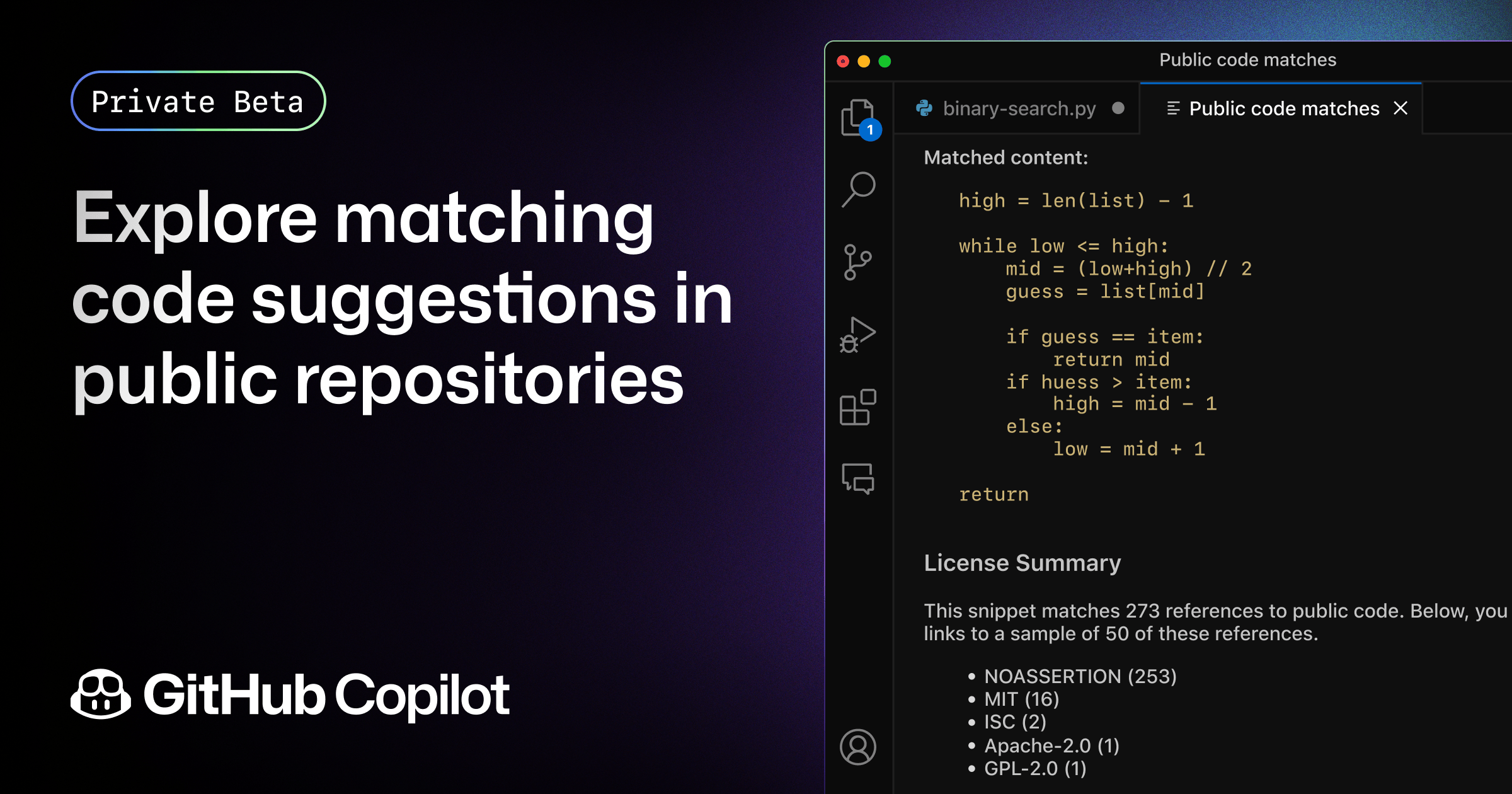
> Make more informed decisions about the code you use. In the rare case where a GitHub Copilot suggestion matches public code, this update will show a list of repositories where that code appears and their licenses. [Sign up for the private beta today](https://github.co/copilot-code-referencing-waitlist).
>
>
Over the course of the last year, GitHub Copilot, [the world’s first at-scale AI pair programmer trained on billions of lines of public code](https://github.blog/2022-06-21-github-copilot-is-generally-available-to-all-developers/), has attracted more than 1 million developers and helped over 27,000 organizations build faster and more productively. During that time, many developers told us they want to see when GitHub Copilot’s suggestions match public code.
Today, we’re announcing a private beta of GitHub Copilot with [code referencing](https://github.blog/2022-11-01-preview-referencing-public-code-in-github-copilot/) that includes an updated filter which detects and shows context of code suggestions matching public code on GitHub. When the filter is enabled, GitHub Copilot checks code suggestions with surrounding code of about 150 characters and compares it against an index of all the public code on GitHub.com. Matches—along with information about every repository in which they appear—are displayed right in the editor. Developers can now choose whether to block suggestions containing matching code, or allow those suggestions with information about matches.
Why? Some want to learn from others’ work, others may want to take a dependency rather than introduce new app logic, and still others want to give or receive credit for similar work. Whatever the reason, it’s nice to know when similar code is out there.
Let’s see how it works.
#### How GitHub Copilot code referencing works
With billions of files to index and a latency budget of only 10-20ms, it’s a miracle of engineering that this is even possible. Still, if there’s a match, a notification appears in the editor showing: (1) the matching code, (2) the repositories where that code appears, and (3) the license governing each repository.
<https://github.blog/wp-content/uploads/2023/08/16-9-Blog-Demo.mp4>
#### Why code referencing matters
In our journey to create a code referencing tool, we discovered a few interesting things:
First, [our previous research](https://github.blog/2021-06-30-github-copilot-research-recitation/) suggests that matches occur in less than one percent of GitHub Copilot suggestions. But that one percent isn’t evenly distributed across all use cases. In the context of an existing application with surrounding code, we almost never see a match. But in an empty or nearly empty file, we see matches far more often.
Suggestions are heavily biased toward the prompt so GitHub Copilot can provide suggestions tailor-made for your current task. That means, in an existing app with lots of context, you’ll get a suggestion customized for your code. But in an empty, or nearly empty file, there’s little to no context. So, you’re more likely to get a suggestion that matches public code.
We’ve also found that when suggestions match public code, those matches frequently appear in dozens, if not hundreds of repositories. In some ways, this isn’t surprising because the models that power GitHub Copilot are akin to giant probability machines. A code fragment that appears in many repositories is more likely to be a “pattern” detected by the model—similar to the patterns we see elsewhere in public code.
For example, [research on Java projects](https://arxiv.org/abs/1802.02938) finds that up to 11% of repositories may contain code that resembles solutions posted to Stack Overflow, and the vast majority of those snippets appear without attribution. [Another study on Python](https://arxiv.org/abs/1705.01198) found that many matches are too generic to trace to an original usage. [A smaller-scale study](https://arxiv.org/abs/1703.03897) found that Stack Overflow answers contain code from Android applications.
Finally, the repositories with matching code are often governed by multiple, sometimes conflicting licenses, which makes attributing a match to its source more challenging. By consulting a list of references, developers can now:
* Determine whether, what, and who to attribute rather than having matches simply blocked from the outset.
* Learn from other developers by studying their approaches to similar problems.
* Take a dependency on an open source library to avoid new business logic.
* Evaluate the context of code before accepting a matching suggestion.
* Discover new projects and contribute upstream.
#### Building a better developer experience and community
This is just the beginning. As GitHub continues to innovate, we will always strive to help developers stay in the flow, build creatively, and maintain a transparent connection to the community. We’re excited for you to try GitHub Copilot with code referencing.
Happy coding., Introducing Code Referencing for GitHub Copilot, Ryan J. Salva, 01h7akm0xn3k1dg50g04hmpgjd.