Is Acts Pseudo-History?
Hey everybody, I'm Dan Mlelen and I'm Dan Beecher and this is Data Over Dogma where we increase public access to the academic study of the Bible and religion and we combat the spread of misinformation about the same. How are things Dan? >> Things are good. It's uh it's a beautiful day outside here in Salt Lake City. Uh in stark contrast to what I just got >> things are going Yeah. back from which was you viewers will uh will remember that a
couple weeks ago there was some very bad weather in the eastern part of North America and I was in the northern I was I was in Canada and uh and I'm I'm lucky to have made it out alive. It was cold. It was bad. >> Some flights got got complicated. So >> yeah, I I I I had to stay an extra day. Uh which, you know, is great when there's when it's
>> when it is so cold. Yeah, there was nothing to do. It was it was a little rough. It was a Monday, so even the museums were closed. It wasn't >> that wasn't very good. >> Oh man. >> But uh but yeah, it's it's beautiful today and I'm excited about today's episode. today's uh segment because we're going to be talking uh for the next two segments, this one and the next one. Uh we're going to be talking about
um a both of them take the same jumping off point, which is Acts chapter 7. Mhm. >> Uh today's we're going to be looking at Acts 7 as a chapter and verse, but specifically we're going to get into how the New Testament authors interacted with and New Testament characters interacted with the Hebrew Bible. And I think that's going to be a really fascinating discussion. So >> yes indeed.
>> Let's dive in with chapter and verse. All right. So chapter uh and verse is Acts chapter 7. >> Yep. >> Uh a lot of verses actually we should call it chapter and verses. >> Um but >> let's where do you want to start with this? Do you want to start with uh Stephen talking about stuff? >> Well, let's just lay our scene uh in in >> in Fair Verona. >> Yes, exactly. Uh two houses alike in
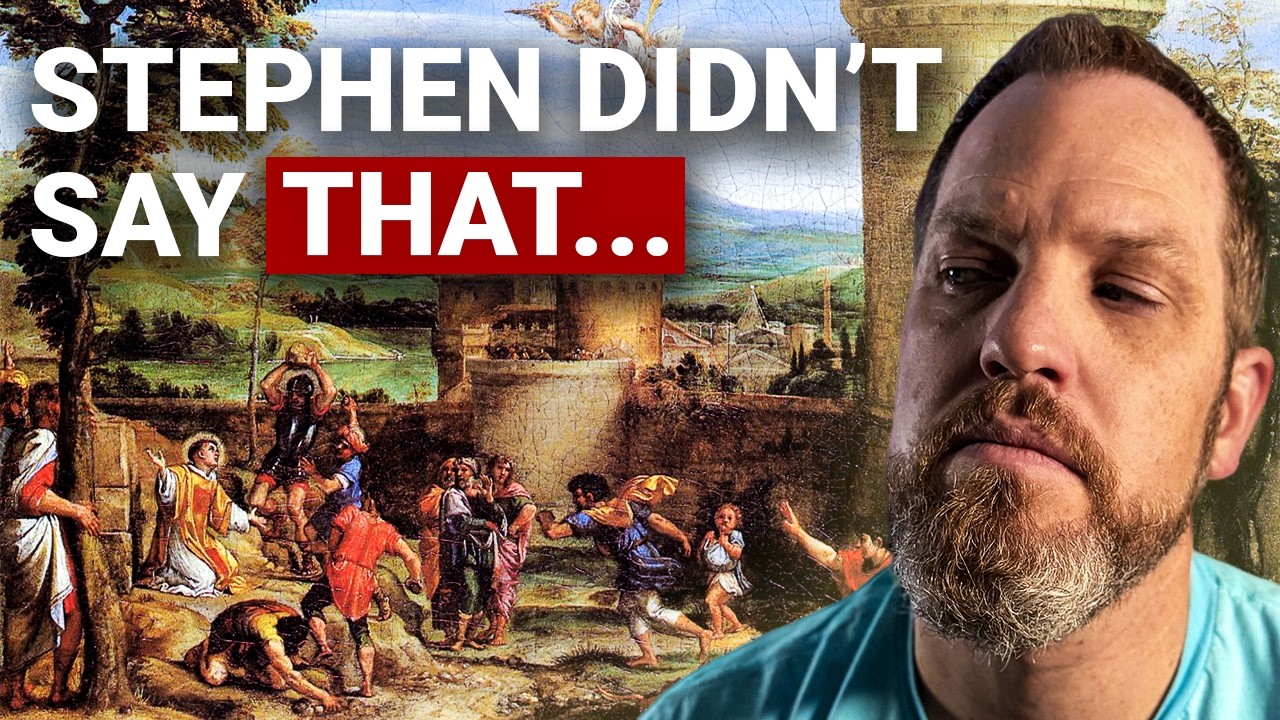
dignity. Uh we have we have some uh the leaders of the synagogue uh are basically call Steven to task. He's doing great signs and wonders among the people and uh they call him to uh to uh they bring him before uh the the council and they uh say, "Hey, you've been doing all this stuff that people said you've been doing." And Stephen basically takes the opportunity to uh just wax
historical for 52 verses. Uh basically outlining the history of the people of Israel starting from Abraham and then going all the way down to uh verse 53 and saying you you know the there was the coming of the righteous one and and you have become his betrayers and murderers and you have not kept the law. And then they become enraged. They grind their teeth at Steven. They go and then
they cast stones at him. >> Yeah. That's that's not great. That's not the outcome you're looking for. >> Yeah. But uh you know, it's it's not a good review of his history of Israel. But um but I think it's it's interesting because what it represents is the author of the book of Acts, negotiation with the history of Israel as told in the Hebrew Bible as they have access to it and as they have negotiated with it. And I just wanted to to jump
around to a handful of verses and talk about some of the ways that they are representing the history that might indicate they're going from the Greek and not the Hebrew. that might indicate they're they're picking and choosing which passages they're basing this on and some places where they even contradict what's going on in the Hebrew Bible and contradict themselves. Uh and so I think I think it's just a fascinating study of how the New Testament one New Testament author anyway is engaging with the traditions
of the Hebrew Bible. And I want to start in uh verse two. Uh this is the very beginning of uh of Steven's uh performance. Brothers and fathers, he says, listen to me. The God of glory appeared to our ancestor Abraham when he was in Mesopotamia before he lived in Haran and said to him, "Leave your country and your relatives and go to the land that I will show you." Then he left the country of the Caldanss and settled in Haron. After his father died, God had
him move from there to this country in which you are now living. And so this is this is basically the end of Genesis 11 and the beginning of Genesis 12. But we the author has Stephen stake a pretty clear claim that Abraham did not leave Haron until after his father Terara died. >> Okay. >> And this is where we're seeing uh the author's interpretation of kind of a squirrely part of of Genesis. Because if
we go to Genesis 11, uh we have uh Haron has some kids. Uh when Tara had lived 70 years, he became the father of Abram, Nahor, and Haron. So that's Genesis 11:26. So Tara is 70 years old, Abraham is born when Tara is 70 years old. Now we have down toward the end of uh chapter 11 that uh Abraham
was 75 years old um when he takes up and leaves picks up and leaves. Excuse me. Um I'm I'm trying to find the exact verse where it says this. Yes. So Abram went this is Genesis 12:4. So Abram went as the Lord had told him and Lot went with him. Abram was 75 years old when he departed from Haron. So Tara was 70, Abraham 75. Put them together, what do
you get? 145 years. Abraham leaves Haron when Tara is 14 45 years old. It says according to Genesis 11:32, however, that Tara was 205 years old when he died in Haron. So if you go by Genesis 11 and 12, Abram departed from Haron, waved bye-bye to his dad when his dad was 175 years old. He he lived for another or excuse me 145
years old. He lived for another 60 years in Haran without Abraham, >> right? >> Abram, except in Acts, the author says that Abram didn't leave Haron until Terara had died. So, we've got a a little bit of a a problematic thing there. And and that's probably just because the author of Acts is not doing the math, is not looking closely at this and being like, "Wait a minute, that doesn't add up, right?" >> Um, and so Tara had to have lived for 60
more years after Abraham left. >> I mean, you're blaming the author of Acts. You could just as easily blame Stephen. >> Stephen could have gotten it wrong. Well, I I I'm gonna There are a number of places where uh I blame the author and not the character precisely because the texts are written are are very clearly written in Greek >> and are very clearly appealing to the Greek translation of the Hebrew Bible, which indicates it's probably not this
Jewish person talking in a Jewish synagogue um when they're being represented as speaking Aramaic or or maybe even Hebrew. >> So what you're saying, if I can just sort of repackage it a little bit, is that Steven himself would have been would have read it in the Hebrew. He would have been a Hebrewspeaking Jewish person. Uh and so if he had encountered the old the the the Hebrew Bible, he would have encountered it in
Hebrew and not made some of the mistakes that we're about to talk about. Is that what >> either? Yeah. either Hebrew or in uh some Aramaic translation, one of the Targum or something like that. But >> oh, okay. >> But what we see is that the author of the book of Acts is relying on the Septuagent. And we see this even more clearly in in Acts 15. And I I think we've talked about this before. This is the Jerusalem Council. And there's a part where they talk, excuse me, they talk about how um the the tabernacle of
David will be restored um and for the the remnant of humanity who seek after the Lord. And this is the Septuagent pretty flagrant mistransation of a a part of Amos that in the Hebrew says something entirely different that has no relevance at all to the context where it's being deployed in the book of Acts. So it has to have been the Greek that was being um being used. And so yeah, there's >> it's it's definitely a literary
composition here. Okay. >> We are we do not have the verbatim recording or transcription of somebody speaking in Aramaic or Hebrew, >> right? >> Um so yeah, it's problematic. Um another another interesting one, we we can um scoot down to verse six. Uh this is where we're talking about uh the Israelites in Egypt and God spoke in these terms that his descendants would be resident aliens in a country belonging to others who would enslave
them and mistreat them during 400 years. And so this is the time that the the Israelites are in Egypt. And if we go to like Genesis 15:13, there's this prophecy about um the Abraham's descendants being uh you know, they'll be oppressed 400 years, >> right? >> But if you go to Exodus 12 40, the time that they were in Egypt was 430 years
being oppressed. So you've got you've got two different ways that the Hebrew Bible is is uh representing the length of uh the sojourn in Egypt. It's either 400 or 430 years. And so here we see that the author of the book of Acts is siding with Genesis over and against Exodus about the story that is actually in Exodus. So picking and choosing here.
This is an example of of uh the author deciding to go with one and not the other. >> Yeah. I mean, you know, you start in Genesis, you might as well hang out there. >> Yeah. Yeah. >> When you know, when you're talking about Abram and whatever. Yeah. Just stick stick with what you with what you know. Why read a whole other book? >> And and here's another uh instance where we can see that the author is pulling from the Septuagent. Then Joseph sent
and this is verse 14. Then Joseph sent and invited his father Jacob and all his relatives to come to him. 75 in all. Great. We can go look at Genesis um 46 27 as well as Exodus 15 and it says there were 70 people who came down to Egypt. Uh but if you go look at the ancient Greek translation, the Septuagent of Genesis 46:27, hey, what do you know? It says 75. So
>> that's interesting. What accounts for that discrepancy? Do you know? Do you have a sense of why they just changed the number? >> Um I I don't you know, this is this would be interesting to look into because 70 is a really important number in the ancient world. you know, you the uh the table of nations in Genesis 10 has 70 nations. If you have 70 uh and you know, Deuteronomy 32:8, we have the
Llon or excuse me, just Elon, the most high divides up the nations according to the number of the sons of God in the early Hebrew, but in the Maseretic text, it's sons of Israel. And that traditional number is 70. So, you would think that they would uh want to stick with 70, but for whatever reason, the Septuagent changed it to um 75. And I'm just going to look >> I'm going to dive in really just really quickly and remind everybody what the Septuagent is because we've been referencing it and we want to we're going to keep referencing it. And uh
it's so it's the Greek translation of the Hebrew Bible. >> Yes. >> That was produced uh when was it produced? somewhere in the >> uh between like the 3rd century BCE and like the 1st century BCE. So the books were translated independently and kind of came together over the centuries. >> Okay. And and so anyone so the what we're talking about is that anyone who was a Greek a reader and probably speaker of Greek around this time who
wanted to read uh the the Hebrew Bible would have read it as the Septuagent in this form. >> Okay. >> And uh technically the Septuagent really refers to the translation of the first five books of Moses. Those would have been the first books translated each one by a different translator. and and they were not coordinating. It was not a systematic process. Uh but you know there's kind of the narrow sense of what the Septuagen is and then the broader sense. We're speaking about the broader
sense and the Septuagent also has 75 in Exodus 1. >> So both both of the passages that in the Maseretic text say 70 are 75 in the Septuagent. So, we have another example of of the author uh relying not on the Greek but uh on the uh or excuse me, not on the Hebrew but on the Greek. >> Right. >> And then the next two verses I think are are really fascinating. I really like uh verse 15 and 16 because says, "So Jacob
went down to Egypt. He himself died there as well as our ancestors. And their bodies were brought back to Sheckchham and laid in the tomb that Abraham had bought for a sum of silver from the sons of Hymor in Sheckchum. So that's pretty clear. Jacob, all the the sons of Jacob who came down to uh to
stay in Egypt, they all died. bodies were brought back. They were all buried in Sheckchum in a tomb that was purchased by Abraham. The problem is that Abraham never bought anything in Sheckchum and not from any sons of of uh Haymore. Abraham bought uh land and a cave which was used as a tomb at Machella which is near Hebron. Okay, >> from Ephron the Hittite. And you can go to Genesis 23 for the story of this
purchase. This is where this there's kind of this haggling back and forth. Um, >> it's a weird it's it's it's uphagling. It goes in the wrong direction >> cuz the Hitittite's like, "Let me just give it to you." And Abraham's like, "Good try. I'm going to pay for it." And and really the point, >> come on. What What's 400 shekels between friends? >> Yeah. And and you get to the end and he's like, "Huckles." Um, and and I think the point there is really what the story is supposed to illustrate is that
this really does legally and fully belong to Abraham and his family and they did pay for it. Cuz you know if they if they were like just take it and he just takes it, it's kind of like ah that was that wasn't a real legitimate transfer of property. That was uh that was a gift or something like that. It it it weakens the claim to the property. But if if Abram can say, "No, I'm paying for it." Um, uh, then then that's really his property. So, so Abraham buys that
plot and that is where Jacob is buried according to Genesis 49 and 50. So, yeah. So, nothing to do with >> Sheckchum. So I just to just to be clear are Sheckchum and Mach Pala are not they're they're not next door no to each other. Where where are we talking about? I don't know. >> Uh Hebrron is is uh a little bit is is closer to Jerusalem. Sheckchham is way
up north in the um the northern kingdom. >> Okay. >> So we're talking close to >> very very different places. >> Yes. Yes. You it's it's a long walk between uh those two places. So, Ste Steven wasn't just uh just getting a little confused here. He was >> No. And and we'll talk about what likely uh Steven was doing, but so so where's the sons of Haymore and Sheckchham coming from? Well, that's coming from Genesis 33 where Jacob, not Abraham,
pays the sons of Hore an amount of silver to purchase some land in Sheckchum. And then it wasn't Jacob who was buried there. Jacob's buried in Makalah. It's Joseph who was buried at Sheckchham according to Joshua 24:32. >> Okay. >> And so what we have is Jacob's burial in Machella, the place that was purchased by Abraham and Joseph's burial in Sheckchum in the place that was purchased by Jacob. And the author seems
to be just just squishing them together and says and and you know there some of the folks who want to argue that this is not actually a contradiction uh will argue well it says Jacob died and then all the ancestors and when it says they were brought to Sheckchum. It just means the ancestors Joseph specifically since he was actually buried in Sheckchum. And so there there are attempts to try to kind of dodge what the text uh is what's actually in the text. Uh but you can't
get around the fact that Abraham did not purchase the plot of land in Sheckchum. That was Jacob who purchased that. So, what seems to be the uh the problem is he just instead of taking the time cuz, you know, they're already picking up rocks and and they're taking getting a good look at at a good round rock and he's like, "Okay, I got to hurry. I'm going to just squish these accounts together and just be like, eh, they were all buried in Sheckchham and and you
know, just save some ink. >> Save a little bit of papyrus. Our current president can't keep Iceland and Greenland straight. It makes sense to me that a guy would like maybe mess up who was buried where, especially when he's >> uh facing down some very angry audience members. >> If if someone as sharp and as insightful as Trump can talk about the airports being taken during the Revolutionary War, uh I think we can forgive Stephen
uh this this little pecadillo. um that uh by messing up exactly what's going on with uh the the graves. But yeah, that's that's another instance of uh of engagement with and negotiation with the tradition coming from uh the Hebrew Bible. >> Yeah. >> Um and there are there are a handful more that I that I think are uh are interesting. One of them is um well
actually I want to go all the way down to the last verse 53 because I I think this is pretty interesting. Um Acts 7:53. You are the one and and we've gotten all the way down to um to Jesus. Uh we're verses 42 and 43 have some interesting stuff in it we're going to talk about in another segment. Uh but in in Acts uh 7:53, Steven's conclusion is you were the ones who received the
law as ordained by angels and yet you have not kept it. And then they say, "How dare you?" They and then they uh they take their their shiny new stones uh and they stone him. But the the law was not given through angels. At least that's that's not really what we find. And we find the the law being given directly by Adonai the God of Israel uh in Exodus 19 and 20 >> and so h where are these angels coming
from the uh this is uh not exactly what we see even in in the Septuagent and here it's not that we're going directly from the text here it is second temple interpretive tradition that is standing in between the text and and what we see Steven saying because you had a bunch of traditions about uh angels mediating what's going on as a way to kind of distance God from from what's going on
here. So uh rather than God themselves being the ones the one to deliver the law, God's presence is represented or born by angels. And and I think this probably has a little bit to do with this concept of the angel of the presence or the the angel of the Lord who is kind of the the identity of the angel is conflated with the identity of God in in a handful of stories. And we've talked about this before on the
show. You have Hagar uh runs into God in the wilderness and it you know in one verse it says it's the angel of God but then Hagar says I'm naming this place uh this way because have I seen God and and lived and you have something similar going on in Exodus 3 in verse two it says an angel of the Lord appeared to Moses in the flame of fire in the midst of the burning bush and then a few verses later that angel says I am the
God of Israel And you have uh Judges 6, Judges 13, Judges 5 probably. Uh you have a handful of places where the identity of God and the angel is is kind of conflated. And in my opinion and the opinion of of uh a number of other scholars, this kind of literary prophylaxis, hey, it says God, but remember it could be the angel probably became very very
um useful in the second temple period to distance God from what was going on. And so at any point in the text where it talks about God doing these things, they could say, "No, that was just the angel." Because remember, the angel can identify as God, >> right? >> And so I I think this is another witness to the proclivity to reinterpret stories about God themselves as stories about angels. And and you even see this in the Septuagen because you at some point we
have we addressed Exodus 4:24, the bridegroom of blood passage. Do you remember that one? >> I don't remember that one. No. That's where, >> but I I could very easily have forgotten. >> Well, yeah, that's um we both could uh that's where God tries to kill Moses. >> God like shows up at the hotel uh and Zapora, his his wife, >> his wife, >> circumcises him and >> has an astonishing uh
>> or or circumcises, >> circumcises their kid and then flips the foreskin at him. >> At his feet. Yeah. And um and says, "You're a bridegroom of blood." Um well, what's what's interesting is in the Septuagent, it's not God, >> it's angels of God. >> So, in the in the translation, they've gone ahead and they've already inserted the angels and and you have similar things going on in in a number of other passages. >> Yeah. I thought we had talked about the the idea that that the Septuagent authors were so uncomfortable with the
idea of it being God that they they just kept making it angels. >> Yeah. God God doesn't personally put out a hit on anybody. God sends angels to >> Yeah. Why? Yeah. >> Carry out his dirty deeds >> done dirt cheap. >> Um did you ever see the movie Dirty Deeds? >> No. >> Oh gosh. >> Who was that? >> Was it called Dirty Deeds? >> Uh that was Norm McDonald. >> I saw Mr. Deeds. >> That was Adam Sandler. >> Adam Sandler. That's right. >> Yeah. No. No. Dirty Deeds was Norm
McDonald. It was um It was funny in parts. >> Kind of like Nor McDonald. It was funny sometimes. >> Was it? Wait, was it Dirty Deeds? I'm seeing another movie come out. >> We are way off track here. I'm >> Yeah, Dirty Work. Excuse me. Dirty Work was Norm McDonald. Okay. Okay. >> Um, it's Nor McDonald. You know what you're getting with Nor McDonald. But, um, so I think that's what's going on there at the very end. And and to kind
of tie all this off in a in a nice little bow, we've got a very creative second temple period literary negotiation with the history of Israel here. That's that's certainly not something that someone speaking Aramaic or Hebrew was going to um you know, just rip off the cuff standing in front of the Sanhedin. Uh this is obviously something that took some care and some time and uh and some thoughtfulness on the part of the author going through and
being like, well, should I say 430? Should I say 400 and uh squishing together the the accounts of Abraham and and Jacob buying the the plots of land and huge tracks of land as as the great poet once said. Um and and so it is it is a creative and an ongoing kind of negotiation with uh the author's own um heritage. It's it's and it con conflicts with that heritage as it has been
preserved down to us in the Hebrew Bible. And in another segment, we're going to talk a little bit more about one of the ways that that it conflicts and and represents uh later ideologies. Uh but but I think taking this text seriously and trying to allow it to operate on its own terms means recognizing that this is a literary creation that this is something that is the product of of thoughtful and again creative engagement with the author's
heritage that is is definitely not uh something that this Steven um who I I'm will I don't know for sure if there was really a martyrdom of a dude named Steven. I'm willing to allow it. That it's that it's certainly plausible. Um but if that person did actually rattle off the history of Israel uh just to to try to buy some time and ended up uh getting stoned for his troubles, uh it wouldn't have matched what we have here
in Acts 7. But it is but it is a fascinating story. >> Well, I love it. uh just a a just a broader more fun way to look at uh at this than just everything is as as it meets the eye or whatever. >> Yeah. >> Um well, if you would like to become a part of keeping this show rocking, uh we sure would love to have you as a uh as a patron of the show. Head on over to patreon.com/data
overdogma and uh you know just chuck a little bit of coin our way. We always appreciate it. You can get early adree versions of the show. You can get the afterparty which is bonus content every week from from the two of us. Uh and you can get the happy feeling of knowing that you are participating in getting the word about the word out there. Uh, thanks to Roger Gaudy for editing the show. Thanks so much to all of you for tuning in and
we'll see you next time. Bye everybody., Is Acts Pseudo-History?, YouTube, 01khm0y46t4njzxnwskk8hprfz.