June 19, 2026
🔗 **Source:** [June 19, 2026](https://heathercoxrichardson.substack.com/p/june-19-2026)
> [!note]+ Document Notes
> ---
> tags: [juneteenth, reconstruction, emancipation, civil-rights, constitutional-amendments, racial-equality]
> author: Heather Cox Richardson
> source: Letters from an American (Substack)
> reference: https://heathercoxrichardson.substack.com/p/june-19-2026
> date created: 2026-06-20 12:00
> ---
> # 🏷️ Title: June 19, 2026
> ## 🧭 Table of Contents
> - [📝 Summary](#-summary)
> - [📖 Main Content](#-main-content)
> - [🗒️ Notes](#️-notes)
> - [📚 References](#-references)
> - [🗣️ Paraphrase](#️-paraphrase)
> - [📰 Newsletter](#-newsletter)
> - [✅ Action Items](#-action-items)
> - [🧪 Hypotheses](#-hypotheses)
> - [📊 Methodology](#-methodology)
> - [❓ Questions](#-questions)
> - [🔮 Future Research](#-future-research)
> - [💡 Implications](#-implications)
> - [🧠 Learning Styles Assessment](#-learning-styles-assessment)
> - [📊 Accessibility Assessment](#-accessibility-assessment)
> - [🌍 DEIB Assessment](#-deib-assessment)
> - [✅ Logical Validity](#-logical-validity)
> - [🛡️ DARVO Analysis](#-darvo-analysis)
> - [🎯 Conclusion](#-conclusion)
> ### 🔗 References
> - [Juneteenth original document — General Order No. 3 (National Archives)](https://www.archives.gov/news/articles/juneteenth-original-document)
> - [13th Amendment (National Archives)](https://www.archives.gov/milestone-documents/13th-amendment)
> - [14th Amendment (National Archives)](https://www.archives.gov/milestone-documents/14th-amendment)
> - [Emancipation Proclamation transcript (National Archives)](https://www.archives.gov/exhibits/featured-documents/emancipation-proclamation/transcript.html)
> - [Juneteenth — Handbook of Texas (TSHA)](https://www.tshaonline.org/handbook/entries/juneteenth)
> - [S.475 — Juneteenth National Independence Day Act (Congress.gov)](https://www.congress.gov/bill/117th-congress/senate-bill/475)
> ## 📝 Summary
> - **What happened.** On the Juneteenth federal holiday, historian Heather Cox Richardson recounts the history of the day: on June 19, 1865, Major General Gordon Granger arrived in Galveston, Texas, and issued General Order No. 3 informing the people of Texas that, under the Emancipation Proclamation, "all slaves are free." She traces why the news came so late (the Trans-Mississippi Department surrendered only on June 2, 1865), and how freedom was *won* by Black Americans who fought, nursed, labored, and resisted — not handed to them.
> - **Why it matters.** Richardson reframes Juneteenth not as a single moment of liberation but as the opening of a constitutional project: the Thirteenth (abolition), Fourteenth (birthright citizenship, equal protection, due process), and Black male suffrage under the 1867 Military Reconstruction Act. Successive Juneteenth celebrations (1865, 1866, 1867) mark each new layer of secured freedom.
> - **Key stakeholders.** Formerly enslaved Texans and Black Americans nationwide; white former Confederates who resisted equality; Congress and the federal government as enforcers; activist Opal Lee and the 2021 lawmakers who made Juneteenth a federal holiday; present-day Americans now contesting equal-rights protections.
> - **Risks and tradeoffs.** The essay warns that the same arguments former Confederates used — that protecting minority rights "discriminates" against the white majority, and that democracy should be skewed toward the wealthy and white men — are "once again, gaining traction," putting the egalitarian nation Juneteenth celebrates "in danger."
> - **Bottom line.** Juneteenth commemorates not a gift of freedom but a hard-won, federally-enforced promise of equality — a promise written into the Constitution and, Richardson argues, now at risk of being lost.
> ## 📖 Main Content
> - **The delayed announcement.** Emancipation reached Galveston on June 19, 1865, only after the Confederacy's last major army surrendered. Lee surrendered the Army of Northern Virginia on April 9, 1865, but General Edmund Kirby Smith did not surrender the Trans-Mississippi Department until June 2 in Galveston (then fleeing to Mexico). Granger arrived seventeen days later to take charge and issued **General Order No. 3**.
> - **What Order No. 3 said.** It informed Texans that "all slaves are free," declaring "an absolute equality of personal rights and rights of property between former masters and slaves," converting the master–slave relation into "that between employer and hired labor." It rested on the **Emancipation Proclamation** (Jan. 1, 1863), which freed people enslaved in states then in rebellion — Texas among them.
> - **Freedom was earned, not gifted.** Richardson is emphatic: "emancipation was not a gift from white Americans." Black Americans fought and died for the Union as soldiers, nurses, and laborers; some fled to northern lines carrying intelligence or matériel; others hid wounded U.S. soldiers and helped them return.
> - **White backlash and the Black Codes.** Defeated Confederates were "demoralized and angered" — cattleman Charles Goodnight recalled "It looked like everything worth living for was gone." States grudgingly ratified the **Thirteenth Amendment** (abolishing slavery "except as punishment for a crime") but enacted **Black Codes** binding freedpeople to yearlong labor contracts, barring them from assembling, owning guns/property, or testifying in court, outlawing interracial marriage, and letting white men buy convicts' jail terms to force debt-labor.
> - **Congress responds.** Refusing to readmit southern states with Black Codes intact, Congress added the Thirteenth Amendment to the Constitution in December 1865. In 1866 it wrote the **Fourteenth Amendment**, establishing birthright citizenship and barring any state from abridging "privileges or immunities," denying "due process," or denying "equal protection of the laws." Richardson calls this "the whole ball game" — the teeth behind the Emancipation Proclamation's principles, with a clause empowering Congress to enforce it.
> - **Black male suffrage and Juneteenth's spread.** When white southerners chose military rule over equality, Congress passed the **Military Reconstruction Act** (March 1867), mandating that Black men could vote for delegates to new constitutional conventions — the first time in U.S. history. The federal government encouraged "Juneteenth" celebrations to publicize these voting rights, spreading the tradition nationally.
> - **The layered meaning of the early celebrations.** 1865 celebrated freedom and the war's end; 1866 celebrated freedom enshrined in the Constitution via the Thirteenth Amendment; 1867 celebrated Black men's freedom to vote — "the very real power of having a say in the government."
> - **Decline and revival.** Juneteenth faded during Jim Crow but traveled with Black Americans migrating from the South during and after World War II. By the 1980s Texas made it a state holiday; in **2021**, partly through activist **Opal Lee's** pressure, Congress made it federal and President Biden signed it into law.
> - **The contemporary warning.** Richardson closes by linking past to present: those who would "preserve a government that discriminates" by race, gender, religion, and ability have always claimed true democracy means "skewing the vote toward the wealthy and white men" and that equal-rights laws "discriminate against the white majority." Those voices "are, once again, gaining traction," and "we are in danger of losing the new nation that [Juneteenth] celebrated."
> ### 🗒️ Notes
> - **Two surrenders, two dates.** Lee's April 9 surrender ended the eastern war; the western Confederacy held until Kirby Smith's June 2 surrender at Galveston — explaining the lag before June 19.
> - **Granger's role.** Gordon Granger arrived June 19, 1865, took command of Texas troops, and issued General Order No. 3 that day.
> - **Order No. 3 text** equates rights of "former masters and slaves" and reframes the relationship as "employer and hired labor" — a labor-relations transformation, not just a status change.
> - **Legal chain of authority.** Order No. 3 → Emancipation Proclamation (Jan. 1, 1863) → applies because Texas was "in rebellion on January 1, 1863."
> - **Agency of the enslaved.** Black Americans served as soldiers, nurses, day laborers; carried information/matériel to Union lines; sheltered wounded U.S. soldiers. "Emancipation was n
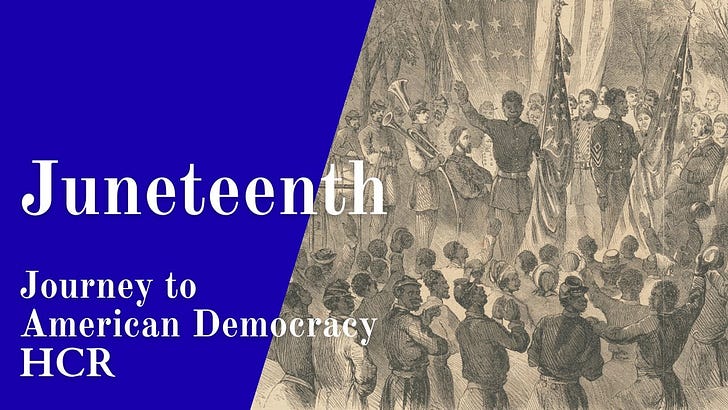
Today is the federal holiday honoring Juneteenth, the celebration of the announcement in Texas on June 19th, 1865, that enslaved Americans were free.
That announcement came as late as it did because while General Robert E. Lee surrendered his Army of Northern Virginia to General Ulysses S. Grant of the U.S. Army on April 9, 1865, it was not until June 2 that General Edmund Kirby Smith surrendered the Trans-Mississippi Department, the last major army of the Confederacy, to the United States, in Galveston, Texas. Smith then fled to Mexico.
Seventeen days later, Major General Gordon Granger of the U.S. Army arrived to take charge of the soldiers stationed in Texas. On that day, June 19, he issued General Order Number 3. It read:
“The people of Texas are informed that, in accordance with a proclamation from the Executive of the United States, all slaves are free. This involves an absolute equality of personal rights and rights of property between former masters and slaves, and the connection heretofore existing between them becomes that between employer and hired labor.”
Granger’s order referred to the Emancipation Proclamation of January 1, 1863, which declared that Americans enslaved in states that were in rebellion against the United States “shall be then, thenceforward, and forever free; and the Executive Government of the United States, including the military and naval authority thereof, will recognize and maintain the freedom of such persons.” Granger was informing the people of Galveston that, Texas having been in rebellion on January 1, 1863, their world had changed. The federal government would see to it that, going forward, white people and Black people would be equal.
Black people in Galveston met the news Order No. 3 brought with celebrations in the streets, but emancipation was not a gift from white Americans. Black Americans had fought and died for the United States*.* They had worked as soldiers, as nurses, and as day laborers in the Union army. Those who could had demonstrated their hatred of enslavement and the Confederacy by leaving their homes for the northern lines, sometimes delivering valuable information or matériel to the Union, while those unable to leave had hidden wounded U.S. soldiers and helped them get back to Union lines.
But white former Confederates in Texas were demoralized and angered by the changes in their circumstances. “It looked like everything worth living for was gone,” Texas cattleman Charles Goodnight later recalled.
In summer 1865, white legislators in the states of the former Confederacy grudgingly ratified the Thirteenth Amendment, which abolished enslavement except as punishment for a crime. But they also passed laws to keep freedpeople subservient to their white neighbors. These laws, known as the Black Codes, varied by state, but they generally bound Black Americans to yearlong contracts working in fields owned by white men; prohibited Black people from meeting in groups, owning guns or property, or testifying in court; outlawed interracial marriage; and permitted white men to buy out the jail terms of Black people convicted of a wide swath of petty crimes and then to force those former prisoners into labor to pay off their debt.
Congress refused to readmit the southern states with the Black Codes in place, and in December 1865, Americans added the Thirteenth Amendment to the Constitution. Six months later, Texas freedpeople gathered on June 19, 1866, to celebrate the anniversary of the coming of their freedom with prayers, speeches, food, and socializing.
By then, congressmen had turned to guaranteeing that states could not pass discriminatory laws against citizens who lived in them, laws like the Black Codes. In 1866 they wrote and passed the Fourteenth Amendment to the Constitution. Its first section established that “All persons born or naturalized in the United States, and subject to the jurisdiction thereof, are citizens of the United States and of the State wherein they reside.” It went on: “No State shall make or enforce any law which shall abridge the privileges or immunities of citizens of the United States; nor shall any State deprive any person of life, liberty, or property, without due process of law; nor deny to any person within its jurisdiction the equal protection of the laws.”
That was the whole ball game, the one that would put teeth behind the principles in the Emancipation Proclamation. The federal government had declared that a state legislature—no matter who elected it or what voters called for—could not discriminate against any of its citizens or arbitrarily take away any of a citizen’s rights. Then, like the Thirteenth Amendment before it, the Fourteenth declared that “Congress shall have the power to enforce, by appropriate legislation, the provisions of this article,” strengthening the federal government.
Rather than accept this new state of affairs, leading white southerners decided they would rather remain under military rule. So in March 1867, Congress passed the Military Reconstruction Act, calling for southern voters to elect delegates to new state constitutional conventions. And, for the first time in U.S. history, they mandated that Black men could vote in those elections.
Three months later the federal government, eager to explain to Black citizens their new voting rights, encouraged “Juneteenth” celebrations, and the tradition of Juneteenth began to spread to Black communities across the nation. The next year, the addition of the Fourteenth Amendment to the Constitution remade the United States of America.
In 1865, Juneteenth was a celebration of freedom and the war’s end. In 1866 it was a celebration of the enshrinement of freedom in the U.S. Constitution after the Thirteenth Amendment had been ratified. In 1867, Juneteenth was a celebration of the freedom of Black men to vote, the very real power of having a say in the government under which they lived.
Celebrations of Juneteenth declined during the Jim Crow years of the late nineteenth and early twentieth centuries, but as Black Americans from the South spread across the country during and after World War II, they brought Juneteenth with them. By the 1980s, Texas had established Juneteenth as a state holiday. Other states followed, and in 2021, thanks in part to pressure from activist Opal Lee, Congress made Juneteenth a federal holiday and President Joe Biden signed the measure into law.
But throughout our history, those determined to preserve a government that discriminates between Americans according to race, gender, religion, ability, and so on, have embraced the idea that true democracy requires skewing the vote toward the wealthy and white men. They have also insisted, as former Confederates did in the late 1860s, that any laws protecting the equal rights of minorities discriminate against the white majority.
Today, those voices are, once again, gaining traction. One hundred and sixty-one years after Juneteenth was established, we are in danger of losing the new nation that it celebrated—one that would honor the equality of all Americans.
—
Notes:
<https://www.archives.gov/news/articles/juneteenth-original-document>
J. Evetts Haley, *Charles Goodnight: Cowman and Plainsman* (1949; rpt. University of Oklahoma Press, 1981).
[https://www.archives.gov/milestone-documents/13th-amendment](https://www.archives.gov/milestone-documents/13th-amendment#:~:text=Passed%20by%20Congress%20on%20January,slavery%20in%20the%20United%20States)
[https://www.archives.gov/milestone-documents/14th-amendment](https://www.archives.gov/milestone-documents/14th-amendment#:~:text=No%20State%20shall%20make%20or,equal%20protection%20of%20the%20laws)
<https://avalon.law.yale.edu/19th_century/csa_scarsec.asp>
<https://www.tshaonline.org/handbook/entries/juneteenth>
<https://www.tsl.texas.gov/ref/abouttx/juneteenth>
<https://www.archives.gov/exhibits/featured-documents/emancipation-proclamation/transcript.html>
<https://www.cnn.com/2025/06/18/us/juneteenth-cancelations-trump-dei-rollbacks>
<https://apnews.com/article/juneteenth-trump-diversity-e441197492e4360f3b7a8cbbc00b5c79>
<https://www.congress.gov/bill/117th-congress/senate-bill/475>
<https://www.archives.gov/exhibits/featured-documents/emancipation-proclamation/transcript.html>
<https://www.npr.org/2021/06/15/1006934154/senate-unanimously-approves-a-bill-to-make-juneteenth-a-public-holiday>, June 19, 2026, heathercoxrichardson.substack.com, 01kvkr2b6pdwk0pctkst76ht67.