Kaspars Dambis’ Post
## Metadata
- Author: [[Kaspars Dambis]]
- Full Title: Kaspars Dambis’ Post
- Category: #articles
- Document Note: ---
tags:
- #wordpress
- #governance
- #distributed
- #proposal
- #open-source
Author: Kaspars Dambis
Source: LinkedIn
Reference: [Link to article](https://www.linkedin.com/posts/kaspars-dambis_here-is-a-proposal-for-distributed-wordpress-activity-7284894867288182785-LJk6/?utm_source=share&utm_medium=member_desktop&__readwiseLocation=)
date created: 2025-01-13 20:00
---
# Title: Here is a Proposal for Distributed WordPress Governance
## Table of Contents:
- [📝 Summary](#summary)
- [📖 Main Content](#main-content)
- [🗒️ Notes](#notes)
- [📖 References](#references)
- [🗣️ Paraphrase](#paraphrase)
- [📰 Newsletter](#newsletter)
- [✅ Action Items](#action-items)
- [🧪 Hypotheses](#hypotheses)
- [📊 Methodology](#methodology)
- [❓ Questions](#questions)
- [🔮 Future Research](#future-research)
- [💡 Implications](#implications)
- [🧠 Learning Styles Assessment](#learning-styles-assessment)
- [📊 Accessibility Assessment](#accessibility-assessment)
- [🌍 DEIB Assessment](#deib-assessment)
- [✅ Logical Validity](#logical-validity)
- [🔍 DARVO Analysis](#darvo-analysis)
- [🔍 SEO Evaluation](#seo-evaluation)
- [🎯 Conclusion](#conclusion)
### References:
- LinkedIn Post: [Link to article](https://www.linkedin.com/posts/kaspars-dambis_here-is-a-proposal-for-distributed-wordpress-activity-7284894867288182785-LJk6/?utm_source=share&utm_medium=member_desktop&__readwiseLocation=)
## 📝 Summary:
Kaspars Dambis, a key member of the WordPress community, has proposed a distributed governance model for WordPress. This proposal aims to decentralize the decision-making process to involve more contributors, ensuring a more transparent and inclusive project. The article discusses the importance of maintaining the open-source nature of WordPress while empowering contributors from all corners of the globe to have a say in its development.
## 📖 Main Content:
Dambis argues that the centralized leadership model currently in place in WordPress is hindering progress and limiting the involvement of a broader range of contributors. His proposed distributed governance system seeks to distribute the authority and decision-making power among a larger, more diverse group, ultimately allowing for greater flexibility and a more inclusive approach. The proposal includes:
- Creating more open spaces for governance discussions and decisions
- Allowing contributors to directly participate in key project decisions, rather than through a few central figures
- Providing a more transparent process, allowing all community members to track and contribute to decisions
This distributed approach is designed to promote fairness and a sense of ownership within the community, helping to ensure that WordPress remains both responsive and inclusive as it continues to evolve.
### 🗒️ Notes:
- **Proposal for Distributed Governance**: Kaspars Dambis introduces a proposal to make WordPress governance more decentralized.
- **Decentralization**: The current centralized model is seen as limiting by some contributors.
- **Inclusivity**: The proposal emphasizes transparency and involvement from a larger, more diverse pool of contributors.
- **Open Discussions**: The governance model encourages open, decentralized discussions on key project decisions.
- **Empowerment of Contributors**: A key goal is to empower more contributors to take part in decision-making processes.
## 📖 References:
- LinkedIn Post: [Link to article](https://www.linkedin.com/posts/kaspars-dambis_here-is-a-proposal-for-distributed-wordpress-activity-7284894867288182785-LJk6/?utm_source=share&utm_medium=member_desktop&__readwiseLocation=)
## 🗣️ Paraphrase:
1. **Original**: "The current centralized leadership model is limiting the growth and inclusivity of the WordPress community."
**Paraphrase**: "The centralized leadership structure in WordPress has been a barrier to community growth and broader participation."
2. **Original**: "This proposal aims to distribute the decision-making power across a more diverse group of contributors to foster inclusivity and transparency."
**Paraphrase**: "The goal of this proposal is to share decision-making responsibilities among a wider array of contributors, ensuring greater openness and inclusiveness."
## 📰 Newsletter:
This week, we explore a forward-thinking proposal aimed at revolutionizing WordPress governance. Kaspars Dambis suggests shifting from a centralized leadership model to a more distributed approach. By doing so, WordPress can become a more inclusive project, allowing more contributors to take part in decision-making processes. With transparency at its core, this new approach could address long-standing issues in the community. [Link to full proposal]
## ✅ Action Items:
1. **Engage with the Community**: Start a conversation around this proposal within your network to gauge support and concerns.
2. **Contribute to the Discussion**: Share your thoughts on the potential benefits and challenges of a decentralized governance model.
3. **Monitor Feedback**: Track how the community responds to this proposal and whether similar ideas are being proposed elsewhere in other open-source communities.
## 🧪 Hypotheses:
1. **Hypothesis 1**: A decentralized governance model will lead to increased participation and engagement from contributors, especially those who feel excluded from the current centralized process.
2. **Hypothesis 2**: The WordPress community will see a more diversified set of contributors and ideas, leading to innovation in project development.
### 📊 Methodology:
- **Data Sources**: Monitor discussions on WordPress-related forums, GitHub issues, and LinkedIn for community feedback.
- **Research Design**: Conduct surveys within the WordPress community to assess the perceived barriers to participation and the openness of the current governance model.
- **Analysis Techniques**: Perform content analysis on community posts and feedback to assess the overall sentiment toward decentralization.
## ❓ Questions:
1. What specific changes in governance would make the WordPress project more inclusive to new contributors?
2. How can decentralized decision-making be effectively implemented in an open-source project as large and diverse as WordPress?
## 🔮 Future Research:
- **Governance Models**: Future studies could explore how decentralization in large open-source projects affects the quality of decision-making.
- **Contributor Engagement**: Research how decentralized governance models influence the types of contributions made and the overall inclusivity of the project.
## 💡 Implications:
- **Increased Inclusivity**: Implementing a distributed governance system could allow for a more diverse range of voices and ideas, ultimately improving the quality of decisions and community morale.
- **Sustainability of Open Source**: If successful, this model could be a blueprint for other large open-source projects seeking to democratize decision-making.
## 🧠 Learning Styles Assessment:
- **Visual Learners**: The content could be improved by using charts or diagrams to illustrate the governance structure and how it would work in a decentralized system.
- **Aural Learners**: Consider offering an audio version of the proposal or related discussions to allow auditory learners to engage with the material.
- **Verbal Learners**: The article uses accessible language but could benefit from more storytelling or examples to better engage verbal learners.
- **Kinesthetic Learners**: Adding interactive components like workshops or webinars to discuss the governance model could increase engagement.
- **Logical Learners**: The proposal should include more step-by-step breakdowns or flowcharts to illustrate how the decentralized governance model would function in practice.
## 📊 Accessibility Assessment:
- **Screen Reader Compatibility**: Ensure that all visuals and diagrams have alt-text, and that the article is fully accessible through screen readers.
- **Keyboard Navigation**: Ensure that the website is fully navigable using a keyboard, especially for those with mobility impairments.
- **Text Resizing**: Ensure that the text can be resized without breaking the layout, catering to users with visual im
- Document Tags: [[distributed]] [[FAIR]] [[WordPress]]
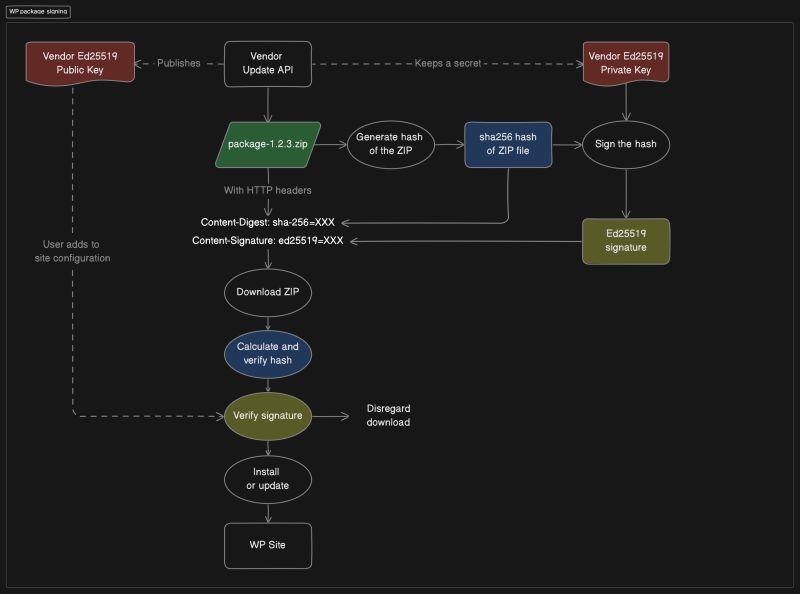
- Summary: Here is a proposal for distributed WordPress package signing:
1. The system relies on users adding the public keys of trusted vendors to their site settings…
- URL: https://www.linkedin.com/posts/kaspars-dambis_here-is-a-proposal-for-distributed-wordpress-activity-7284894867288182785-LJk6/?utm_source=share&utm_medium=member_desktop
[Kaspars Dambis](https://lv.linkedin.com/in/kaspars-dambis?trk=public_post_feed-actor-name)
Full-stack web engineer and team leader with passion for WordPress, teaching and sustainable living.
Here is a proposal for distributed WordPress package signing:
1. The system relies on users adding the public keys of trusted vendors to their site settings. The update API then includes Ed25519 signatures of SHA256 ZIP hashes in the HTTP headers of the updates.
2. This approach could work seamlessly with a Composer for automated CI/CD installs through a custom plugin.
3. For the first install of any plugin or theme, users would need to explicitly specify the trusted key for the vendor. Each download page would prominently display the public key for users to specify.
4. Key rotation could be automated via custom HTTP headers with signed payloads. A single valid public key would ensure that revoked or invalid keys stop working immediately.
5. While this proposal addresses signing and trust, it does not solve directory name isolation for plugins and themes -- that would require a separate solution entirely.
What do you think? Is this simple enough to encourage adoption? What could be improved?
One issue with this approach is that there are no official HTTP headers for specifying the signature (or maybe I'm not able to find it), so Content-Signature is a non-standard thing. Technically, the signature could be also added to the JSON response of the update check but that doesn't work with Composer.
An alternative approach could involve a signed meta file with hashes of all included files in the release. This is not great because it would require unpacking the ZIP and copying/verifying each file.
Here are some other similar initiatives for context:
- Signing of WP core updates [https://lnkd.in/dzjy-Wtf](https://www.linkedin.com/redir/redirect?url=https%3A%2F%2Flnkd%2Ein%2Fdzjy-Wtf&urlhash=hgXr&trk=public_post-text)
- Signing Composer packages [https://lnkd.in/dDYsrEZQ](https://www.linkedin.com/redir/redirect?url=https%3A%2F%2Flnkd%2Ein%2FdDYsrEZQ&urlhash=bzVW&trk=public_post-text)
- The Update Framework (TUF) initiative [https://lnkd.in/dYaTx9Ni](https://www.linkedin.com/redir/redirect?url=https%3A%2F%2Flnkd%2Ein%2FdYaTx9Ni&urlhash=hzoF&trk=public_post-text)
* , Kaspars Dambis’ Post, Kaspars Dambis, 01jhkdzknqa8wm1vq7tq5arnaj.