Launch of the FAIR project
## Metadata
- Author: [[Javier Casares]]
- Full Title: Launch of the FAIR project
- Category: #articles
- Document Note: ---
tags:
- #federatedrepositories
- #independentrepositories
- #opensource
Author: César Domínguez
Source: Casares Blog, "FAIR principles for open source" (https://www.casares.blog/fair/)
Reference: Article published 2023
date created: 2025-06-11 13:15
---
# Title: FAIR Principles and Their Application to Federated and Independent Open Source Repositories
## Table of Contents:
- 🔍 [Summary of FAIR Principles](#summary-of-fair-principles)
- ⚖️ [Federated vs. Independent Repositories](#federated-vs-independent-repositories)
- 🛠️ [Applying FAIR Principles in Federated and Independent Models](#applying-fair-principles-in-federated-and-independent-models)
- 🔗 [Interoperability Challenges and Solutions](#interoperability-challenges-and-solutions)
- 🌐 [Community Impact and Sustainability](#community-impact-and-sustainability)
### References:
- Casares Blog article, FAIR Principles for Open Source: https://www.casares.blog/fair/
- FAIR Principles official website: https://www.go-fair.org/fair-principles/
## 📝 Summary:
This article explores how the FAIR principles—Findability, Accessibility, Interoperability, and Reusability—serve as essential guidelines for managing open source repositories. It emphasizes their critical role in both federated and independent repository architectures, detailing how these principles ensure discoverability, open access, standard integration, and reuse. The article highlights challenges and best practices for applying FAIR in federated models, which consist of multiple, interconnected but independently managed repositories, contrasting them with fully independent repositories.
## 📖 Main Content:
The article asserts that successful open source projects must embody the FAIR principles to foster collaboration and longevity. In federated repository systems—where multiple repositories operate under distributed governance—FAIR principles facilitate cohesion despite decentralization:
- **Findability** is ensured by consistent metadata standards across all federated nodes, enabling seamless discovery regardless of repository location.
- **Accessibility** mandates clear access protocols that allow contributors and users to obtain software without unnecessary restrictions, even when repositories are spread out.
- **Interoperability** focuses on adopting common formats, APIs, and standards so that federated repositories integrate smoothly and tools can operate across them.
- **Reusability** is underpinned by uniform licensing and comprehensive documentation, making code reusable in diverse contexts across the federation or independently.
In contrast, independent repositories operate with full autonomy but may struggle with discoverability and integration unless they voluntarily adopt FAIR practices.
The article discusses practical governance and technical considerations that help federated systems maintain FAIR compliance, such as shared metadata schemas and collaborative licensing strategies. It also notes the potential for federated models to enhance inclusivity and resilience in open source ecosystems.
## 🗒️ Notes
### 🔍 Summary of FAIR Principles
- FAIR guides repositories to be discoverable, accessible, interoperable, and reusable.
- Vital for consistency across decentralized (federated) or autonomous (independent) repositories.
### ⚖️ Federated vs. Independent Repositories
- Federated: Multiple repos linked by governance, standards, and metadata sharing.
- Independent: Separate repos, full autonomy, reliant on individual FAIR adoption.
- Federation improves collective findability and interoperability.
### 🛠️ Applying FAIR Principles in Federated and Independent Models
- Metadata standardization critical for findability across federation.
- Uniform access controls and open policies ensure accessibility.
- Standard APIs and data formats enable interoperability among federated nodes.
- Licensing alignment and documentation promote reusability everywhere.
### 🔗 Interoperability Challenges and Solutions
- Differences in tooling and protocols require agreed-upon standards.
- Federated governance bodies help enforce interoperability rules.
- Independent repos may adopt interoperability voluntarily but lack external enforcement.
### 🌐 Community Impact and Sustainability
- Federated FAIR implementation fosters stronger, more resilient ecosystems.
- Encourages broad participation and mitigates single points of failure.
- Independent repos benefit from adopting FAIR but may face discoverability limits.
## 📖 References:
- Casares Blog: https://www.casares.blog/fair/
- FAIR Principles: https://www.go-fair.org/fair-principles/
## 🗣️ Paraphrase:
1. Original:
"Findability is achieved by consistent metadata across federated nodes, enabling users to locate software easily despite decentralization."
Paraphrase:
By standardizing metadata among distributed repositories, federated systems ensure software remains easily searchable even when spread across multiple locations.
2. Original:
"Interoperability demands shared standards and APIs so that tools and software can function across all repositories in the federation seamlessly."
Paraphrase:
For seamless operation across a federation, it’s crucial that all repositories adopt common interfaces and standards allowing tools to work smoothly everywhere.
## 📰 Newsletter:
This issue digs into how the FAIR principles help federated and independent open source repositories thrive. Federated repos are like a team of independent players sharing playbooks — standardized metadata and APIs keep everything running smoothly and accessible to all. Independent repos operate solo but benefit massively when they adopt FAIR guidelines too. For anyone managing or contributing to open source projects, understanding how FAIR principles apply differently in these models is key. Check out César Domínguez’s insightful breakdown: https://www.casares.blog/fair/
## ✅ Action Items:
- Integrate FAIR-based metadata and licensing standards into federated WordPress repositories.
- Develop documentation and tooling to support interoperability among federated repos.
- Educate contributors and maintainers on FAIR benefits for both federated and independent projects.
- Align OSPO strategies with FAIR adoption to support sustainable open source governance.
## 🧪 Hypotheses:
- Federated repositories that adopt FAIR principles see higher contributor engagement than independent repositories lacking FAIR adherence.
- Standardized interoperability frameworks reduce integration issues and accelerate innovation in federated open source ecosystems.
### 📊 Methodology:
- Comparative study analyzing contribution metrics in federated vs. independent repos.
- Surveys of developer experience regarding FAIR-compliance impact.
- Technical audits assessing interoperability in federated systems.
### ❓ Questions:
- What governance mechanisms best ensure FAIR compliance in federated repositories?
- How can independent repositories be incentivized to adopt FAIR principles?
- What are the main interoperability blockers in existing federated open source communities?
### 🔮 Future Research:
- Tools for automated FAIR compliance auditing in federated environments.
- Case studies on federated governance models successfully applying FAIR.
- Impact of FAIR adoption on ecosystem health and longevity.
### 💡 Implications:
Applying FAIR principles systematically across federated repositories can dramatically improve discoverability, collaboration, and sustainability of large open source projects like WordPress, encouraging more resilient and inclusive community participation.
### 🧠 Learning Styles Assessment:
- Visual learners: Incorporate diagrams showing metadata flow and federation structure.
- Aural learners: Suggest podcasts exploring federation governance and FAIR principles.
- Verbal learners: Use clear explanations with real-world examples.
- Kinesthetic learners: Encourage hands-on exercises mapping repositories and metadata standards.
- Logical learners: Provide flowcharts for governance decision processes.
- Social learners:
- Summary: Esta tarde la Fundación Linux ha presentado el proyecto FAIR, una iniciativa de código abierto como repositorio federado de plugins y temas para proveedores de hosting, plugins comerciales y desarrolladores de herramientas en el ecosistema WordPress. El proyecto FAIR Package Manager, gracias a los voluntarios del proyecto, crea un nuevo sistema de interoperabilidad haciendo la...
- URL: https://www.casares.blog/fair/
[Casares.blog](https://www.casares.blog)

### Launch of the FAIR project
·
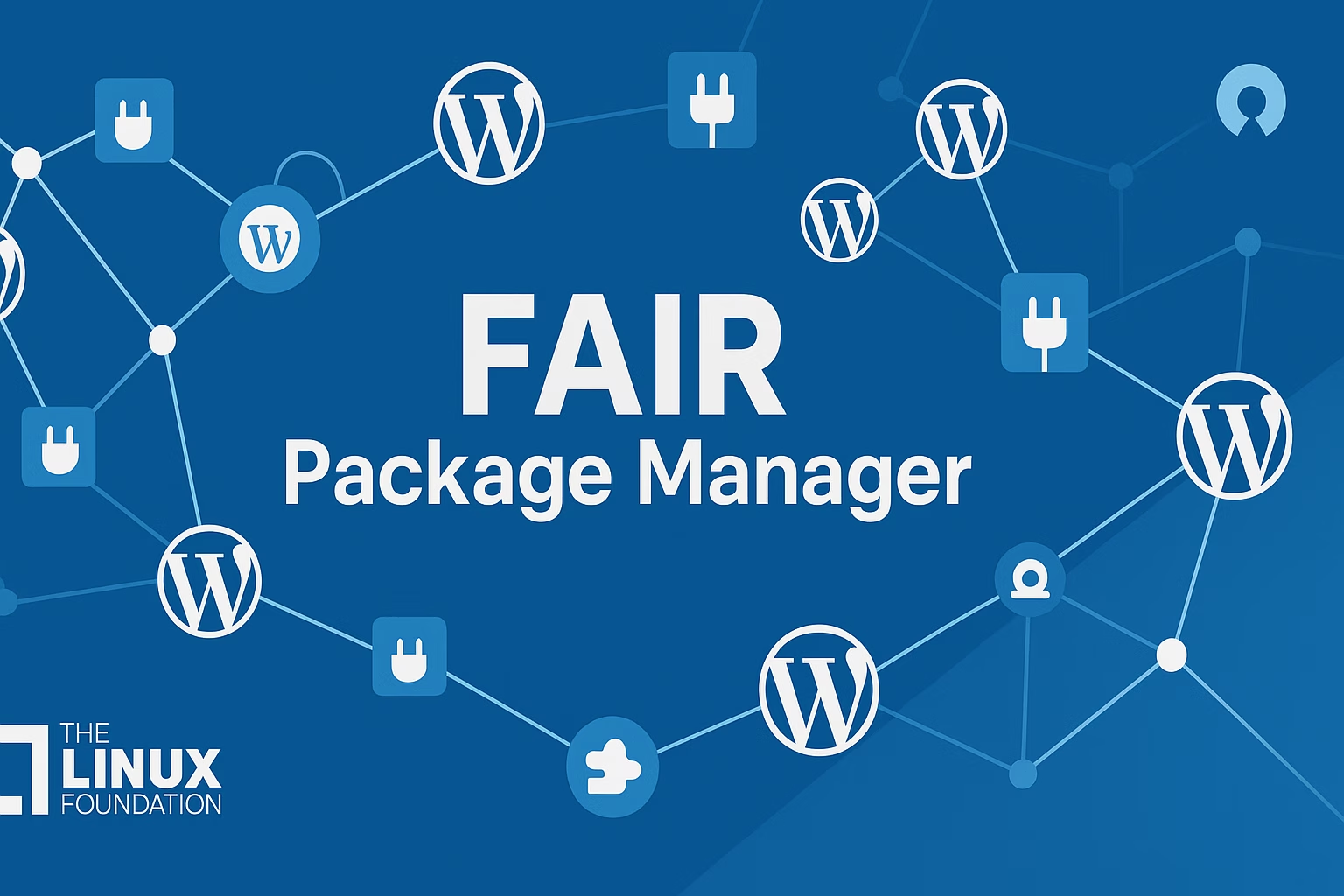
This afternoon, [the Linux Foundation unveiled the FAIR project](https://www.linuxfoundation.org/press/linux-foundation-announces-the-fair-package-manager-project-for-open-source-content-management-system-stability) , an open-source initiative serving as a federated plugin and theme repository for hosting providers, commercial plugin developers, and tool developers in the WordPress ecosystem.
The FAIR Package Manager project, thanks to project volunteers, creates a new interoperability system, making the web more innovative and accessible to everyone.
Vendor-neutral package management for WordPress provides critical, universal infrastructure that addresses the new realities of content, e-commerce, and AI. The FAIR Package Manager project helps make plugins and tools more discoverable and allows developers to choose where to source those plugins based on their supply chain needs. By giving commercial plugin developers, hosting providers, and application developers more options to control the tools they rely on, FAIR Package Manager fosters innovation and protects business continuity.
Some features of the FAIR Package Manager project include:
* Eliminate dependency on any single source for core updates, plugins, themes, and translations, enabling ecosystem-wide federation from trusted sources.
* Progress in aligning WordPress with the GDPR to improve privacy and security by dramatically reducing the automatic transmission of browser data and telemetry sent to commercial entities.
* Unify a fragmented ecosystem by bringing together plugins from any source, not just a central source, while creating a foundation for modern security practices.
* Implementation of supply chain security, including enhanced cryptographic measures, advanced browser compatibility checking, and the ability to rely on security salts from trusted sources.
#### Regarding technology
FAIR Package Manager is a decentralized alternative to the core WordPress.org plugin and theme ecosystem, designed to give control back to WordPress hosts and developers. It functions as a seamlessly integrating WordPress plugin, replacing existing centralized services with a federated, open-source infrastructure.
There are two fundamental pillars in the FAIR system:
* API Replacement: Replaces communication with WordPress.org APIs (such as update checks and event streams) using local or FAIR-governed alternatives. Some functionality—such as browser version checks—is handled entirely within the plugin using built-in logic (e.g., browserslist).
* Decentralized Package Management: FAIR introduces a new package distribution model for themes and plugins. It supports opt-in packages using the FAIR protocol and allows hosts to set up their own mirrors for plugin/theme data using AspirePress or their own domains. While stable plugins currently use WordPress.org mirrors, future releases will fully support native FAIR packages.
#### Project management
The project's Technical Steering Committee is chaired by Carrie Dils, Mika Epstein, and Ryan McCue, all recognized experts in content management. Dils is an educator and leading figure in the WordPress community, known for her advocacy and support of independent developers. Epstein, a longtime WordPress contributor and former plugin repository maintainer, is respected for her thoughtful approach to policy and community engagement. McCue, the developer behind the WordPress REST API and a contributor for over 20 years, has played a key role in expanding the platform's integration capabilities beyond its core ecosystem.
#### Where to follow
The shared package repository is open and ready to receive contributions on [GitHub](https://github.com/fairpm) . Details about the governance and funding of this project will be announced soon. Companies and organizations interested in participating in a funding effort for the [FAIR](https://www.fair.pm/) project can contact [
[email protected]](mailto:
[email protected]) .
You can also follow the project on social media:
In: [WordPress](https://www.casares.blog/tema/wordpress/)
#### Comments
##### Leave a reply
Your email address will not be published. Required fields are marked \*
Comment \*
Web
Casares.blog
[Legal](https://www.robotstxt.es/legal/), Launch of the FAIR project, Javier Casares, 01jxgenxjzp0hf01r352qcdvbp.