Lawrence Ladomery’s Post
🔗 **Source:** [Lawrence Ladomery’s Post](https://www.linkedin.com/posts/lawrenceladomery_wordpress-ai-avada-share-7504718325063806976-9hjm/?utm_source=social_share_send&utm_medium=ios_app&rcm=ACoAAAD0NvEBPtYCnSVTg0yvFSLaHHE9PeEfFY4&utm_campaign=share_via)
> [!note]+ Document Notes
> ---
> tags:
> - wordpress
> - page-builders
> - ai-tooling
> - block-editor
> - no-code
> author: Lawrence Ladomery
> source: https://www.linkedin.com/posts/lawrenceladomery_wordpress-ai-avada-share-7504718325063806976-9hjm/
> reference: https://www.linkedin.com/posts/lawrenceladomery_wordpress-ai-avada-share-7504718325063806976-9hjm/
> date created: 2026-09-13
> ---
> > [!info] Generated analysis — not the author's words. Sections below are machine-written
> > from the captured source. Only text inside `> [!quote]` blocks is verbatim from the author.
> > Do not quote or attribute any other line to the named author.
> <!-- deep-read: light-touch -->
> Light-touch because this is a short LinkedIn post (roughly 390 words) with a single opinion thread and no external evidence.
> ## 🏷️ Title
> Lawrence Ladomery's Post — why "legacy" WordPress page builders (WPBakery, Divi, Avada) may thrive in the AI era
> ## 🧭 Table of Contents
> 1. Summary
> 2. Main Content and Notes
> 3. References
> 4. Paraphrase
> 5. Newsletter
> 6. Action Items
> 7. Hypotheses, Methodology, Questions, Future Research
> 8. Implications and Assessments (Learning Styles, Accessibility, DEIB, Logic, DARVO)
> 9. Conclusion
> 10. Refactor Appendix
> ## 🔗 References (in-page)
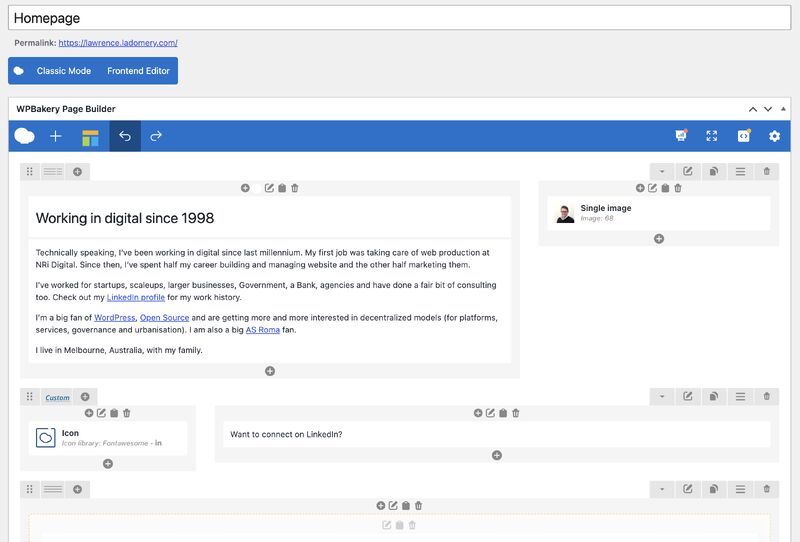
> The captured post links only to LinkedIn profile, company, and hashtag pages: Lawrence Ladomery's profile, WPBakery, Elegant Themes (Divi), WordPress (company page), Bricks Builder, Elementor, and hashtag pages for #WordPress, #AI, and #Avada. One image is attached (a screenshot described as "graphical user interface, text, application, email"). No external articles, data, or documentation are cited.
> ## 📝 Summary
> **What happened.** Lawrence Ladomery, a former WPBakery employee, argues that the consumer-friendly drag-and-drop page builders (WPBakery, Divi, Avada) are well positioned for the AI era because their target users (marketers, content authors, non-technical business owners) prefer visual manipulation over prompting, and because these products hold years of code, knowledge, and usage data that can power AI features. He explicitly excludes the WordPress block editor (too hard for that persona, in his view) and the developer-leaning builders Elementor and Bricks.
> **Why it matters.** It is a contrarian take on a common narrative that AI-driven generation will make shortcode-era builders obsolete. It reframes "legacy" as "accumulated familiarity and data."
> **Stakeholders.** Page-builder vendors; WordPress Core and the Gutenberg team; agencies and freelancers who choose tooling for clients; non-technical site owners; hosting companies bundling builders.
> **Risks.** The post is opinion with a disclosed conflict of interest and no usage data. It leans on an analogy to mobile apps and a sweeping claim that "AI has taken over." Readers could mistake persona intuition for market evidence.
> **Bottom line.** A useful prompt for the block-editor community: the ease-of-use gap for non-technical users is real, and hybrid prompt-plus-drag-and-drop is the direction the author hopes for. Treat the "legacy builders will win" claim as a hypothesis, not a finding.
> ## 📖 Main Content
> The post opens with a question about who in the WordPress ecosystem thrives or struggles under AI, then names the surprising winners: simple drag-and-drop builders. The author discloses 18 months at WPBakery and personal use of WPBakery with Bricks. Three reasons follow: prompting is a skill; visual work beats verbal instruction for layout; users do not worry about consuming tokens mid-task. He flags the second as the important one. He then carves out Elementor and Bricks as too developer-oriented, cites phone apps as proof that the approach generalizes, hopes for prompts combined with drag-and-drop (possibly as a block-editor improvement), and closes on the irony that "legacy" products are now well placed.
> ### 🗒️ Notes
> - The strongest point is the token-anxiety observation: metered AI creates hesitation that a deterministic UI does not.
> - The "ton of data" claim is plausible but unverified; none of the three vendors is cited on what data they hold or how it is used.
> - The author's exclusion of the block editor is asserted, not measured; WordPress has shipped usability work in this area for years and the claim deserves testing.
> - The hybrid model he wishes for is already the design direction of several products (block editor AI experiments, Elementor AI, Divi AI), which slightly undercuts the framing that legacy builders are uniquely placed.
> ## 📚 References
> - Source post: https://www.linkedin.com/posts/lawrenceladomery_wordpress-ai-avada-share-7504718325063806976-9hjm/
> - WPBakery: https://wpbakery.com/
> - Divi by Elegant Themes: https://www.elegantthemes.com/gallery/divi/
> - Avada: https://avada.com/
> - Bricks Builder: https://bricksbuilder.io/
> - Elementor: https://elementor.com/
> - WordPress block editor (Gutenberg) handbook: https://developer.wordpress.org/block-editor/
> Note: only the first link appears in the captured body; the rest are primary vendor sites added for context.
> ## 🗣️ Paraphrase
> 1. The author has been thinking about AI winners and losers in WordPress and offers an unexpected pick: easy drag-and-drop builders for non-technical people.
> 2. He means WPBakery, Divi, and Avada.
> 3. He leaves out the block editor because he believes it is not easy enough for marketers, content authors, and business users.
> 4. Disclosure: he worked at WPBakery for a year and a half and uses it on his own site alongside Bricks.
> 5. Three reasons: prompting is a learned skill; visual manipulation is faster than describing layout moves in words; users are not anxious about token consumption.
> 6. The visual argument is the one that matters most, because it fits the personas WordPress sites are built for.
> 7. Elementor, Bricks, and similar dev-focused tools are excluded because their drag-and-drop is harder for people who do not want to learn flex versus grid.
> 8. The same philosophy has succeeded in phone apps.
> 9. AI could be layered on top of drag-and-drop; he hopes to see more of it and suggests the block editor needs it.
> 10. The incumbents' edge is familiarity plus years of code, knowledge, and data that can power AI features.
> 11. Ironically, products called "legacy" are now in a good position.
> ## 📰 Newsletter
> **Plot twist: the shortcode crowd might outlive the robots.** Lawrence Ladomery (ex-WPBakery, so grain of salt included free of charge) argues that WPBakery, Divi, and Avada are the WordPress tools best placed for the AI era. His reasoning: nobody wants to type "move the second column of the third row to the first column of the fourth row" when they could just drag it, prompting is a skill most business owners have not developed, and nobody enjoys watching a token meter tick while they nudge a hero section. His sharpest jab lands on the block editor, which he says is still too hard for marketers and content folks. Whether or not you buy the "legacy wins" framing, the hybrid he hopes for (prompts plus drag-and-drop) is exactly where Gutenberg's AI experiments are pointed. Read the post: https://www.linkedin.com/posts/lawrenceladomery_wordpress-ai-avada-share-7504718325063806976-9hjm/
> ## ✅ Action Items
> ### DevRel
> - Draft a short response piece or video showing the block editor completing the author's three persona tasks (drag a column, restyle a row, add a section) without prompting, and time it honestly.
> ### OSPO
> - Not applicable to this source; no licensing, governance, or contribution-policy content.
> ### Community
> - Surface the post in a builder-versus-block-editor discussion thread and invite non-technical users, not developers, to react.
> ### Core
> - Log the specific friction points the author implies (column moves, row reordering for non-technical users) and check them against open Gutenberg usability issues.
> ### Core AI
> - Evaluate the "token anxiety" observation as a UX requirement: AI features in the editor should show cost or be unmetered for small edits.
> ### Design
> - Review whether direct-manipulation affordances for rows and columns in the block editor match what Divi and Avada users expect.
> ### Training
> - Consider a Learn WordPress lesson aimed explicitly at marketers and content
[Lawrence Ladomery](https://au.linkedin.com/in/lawrenceladomery?trk=public_post_feed-actor-name)
I'm thinking about who in the [#WordPress](https://www.linkedin.com/signup/cold-join?session_redirect=https%3A%2F%2Fwww.linkedin.com%2Ffeed%2Fhashtag%2Fwordpress&trk=public_post-text) ecosystem will thrive and those who will struggle in the [#AI](https://www.linkedin.com/signup/cold-join?session_redirect=https%3A%2F%2Fwww.linkedin.com%2Ffeed%2Fhashtag%2Fai&trk=public_post-text) era, one idea for the former may surprise you: page builders offering simple and super-easy drag and drop interfaces for non-tech folks.
I'm talking about the likes of [WPBakery](https://www.linkedin.com/company/wpbakery?trk=public_post-text), Divi by [Elegant Themes](https://www.linkedin.com/company/elegantthemes?trk=public_post-text) and [#Avada](https://www.linkedin.com/signup/cold-join?session_redirect=https%3A%2F%2Fwww.linkedin.com%2Ffeed%2Fhashtag%2Favada&trk=public_post-text).
I'm excluding [WordPress](https://www.linkedin.com/company/wordpress?trk=public_post-text)'s own block editor because it's not that easy to use for the ICP I am talking about: marketers, content authors and non-technical business folks.
Please note: I worked for WPBakery for a year and a half so know the product and its users well. I also use it for my own personal site (along with [Bricks Builder](https://gr.linkedin.com/company/bricks-builder?trk=public_post-text) - they seem to work OK together).
Here's why I think they will thrive:
✅ AI is very powerful but prompting isn't as easy - it's a skill that needs to be developed
✅ A lot of non-technical folks like to work 'visually'. Dragging a row or column is always going to be easier and faster than typing "move the second column of the third row to the first column of the fourth row"
✅ Users don't fear using up tokens mid task
The second point is the important one. The simple drag and drop experience works perfectly for the personas I mentioned - the owners and users we build WordPress websites for.
I'm excluding [Elementor](https://il.linkedin.com/company/elementor?trk=public_post-text), [Bricks Builder](https://gr.linkedin.com/company/bricks-builder?trk=public_post-text) and other tools that are more dev-focused as their versions of drag and drop are not that easy to use. For people that don't want to have to learn the difference between CSS flex and grid.
Also, the same approach / philosophy has worked well for other types of applications - just check your phone for any number of examples.
Of course, AI can be set up to allow users to use prompts along with a similar drag and drop experience. I hope to see more of this, and maybe this is what WordPress block editor needs.
The advantage WPBakery, Divi and Avada have is familiarity and having fine tuned a system over many years. Code, knowledge and a ton of data that will make their own AI functions - present and future) very powerful.
Somewhat ironically, products that have been labelled as 'legacy' by many are in a good place to succeed now that AI has taken over.
* , Lawrence Ladomery’s Post, Lawrence Ladomery, 01m2dv6nzjjzswhy26s0tzp417.