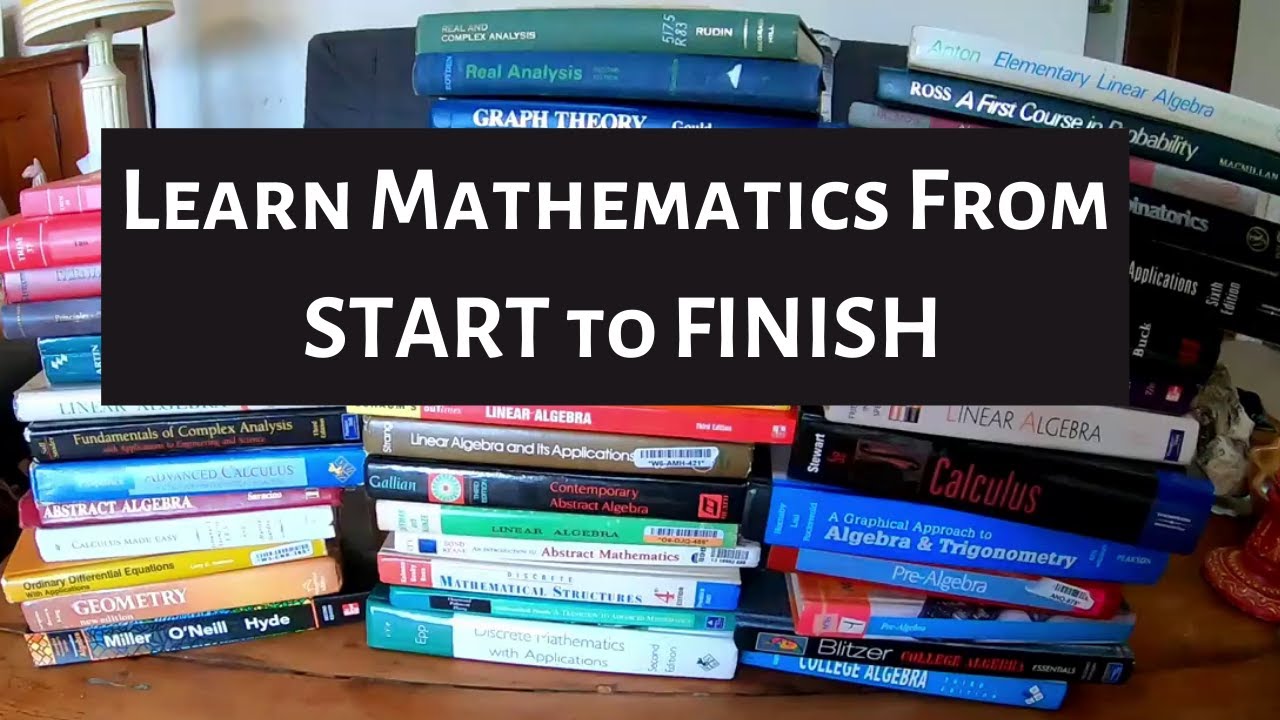
Learn Mathematics from START to FINISH
## Metadata
- Author: [[YouTube]]
- Full Title: Learn Mathematics from START to FINISH
- Category: #articles
- Document Note: ---
tags: [mathematics, self-directed-learning, proof-writing]
author: Math Sorcerer
source: YouTube
reference: https://www.youtube.com/watch?v=pTnEG_WGd2Q
date created: 2024-12-19 21:30
---
# 🏷️ Title: Learn Mathematics from START to FINISH
## 🧰 Action Inbox
- [H1] Start with discrete math and proof writing — foundational skills before algebra #mathematics
- [H2] Progress through calculus sequence after mastering algebra — Stewart or Spivak depending on rigor #calculus
- [H3] Branch into specialized topics after linear algebra — world opens up with proof skills #advanced-math
## 🧭 Table of Contents
- [📝 Summary](#-summary)
- [📖 Main Content](#-main-content)
- [🗒️ Notes](#️-notes)
- [📚 References](#-references)
- [🗣️ Paraphrase](#️-paraphrase)
- [📰 Newsletter](#-newsletter)
- [✅ Action Items](#-action-items)
- [🧪 Hypotheses](#-hypotheses)
- [📊 Methodology](#-methodology)
- [❓ Questions](#-questions)
- [🔮 Future Research](#-future-research)
- [💡 Implications](#-implications)
- [🧠 Learning Styles Assessment](#-learning-styles-assessment)
- [📊 Accessibility Assessment](#-accessibility-assessment)
- [🌍 DEIB Assessment](#-deib-assessment)
- [✅ Logical Validity](#-logical-validity)
- [🛡️ DARVO Analysis](#-darvo-analysis)
- [🎯 Conclusion](#-conclusion)
### 🔗 References
- [Discrete Mathematics with Applications by Susanna Epp](https://www.youtube.com/watch?v=pTnEG_WGd2Q)
- [Mathematical Proofs: A Transition to Advanced Mathematics](https://www.youtube.com/watch?v=pTnEG_WGd2Q)
## 📝 Summary
- Math Sorcerer presents a comprehensive self-study pathway for mathematics from basic logic to graduate-level topics
- Starting point emphasizes discrete math and proof writing before traditional algebra sequence
- Key insight: proof-writing skills unlock advanced mathematics and make difficult texts accessible
- Progression covers foundational skills, algebra sequence, calculus, and branches into specialized fields
- Philosophy emphasizes exploration over mastery - move forward when stuck rather than getting bogged down
## 📖 Main Content
The video presents a structured approach to self-teaching mathematics that diverges from traditional sequences by starting with discrete mathematics and proof writing. The instructor argues this foundation makes advanced topics more accessible later. The pathway progresses through algebra and calculus to advanced undergraduate and graduate topics like real analysis, abstract algebra, and topology. A key philosophy is that learners don't need to master each topic completely before advancing - the goal is exploration and building mathematical maturity over time.
## 🗒️ Notes
#### ⏱️ [00:00:00](https://www.youtube.com/watch?v=pTnEG_WGd2Q?t=0) — [H1] Introduction to self-teaching mathematics
- Key idea: Complete pathway from basic proofs to advanced mathematics
- Evidence: "Starting with just like basic sets and proofs... from there in theory you could teach yourself tons of mathematics"
#### ⏱️ [00:00:30](https://www.youtube.com/watch?v=pTnEG_WGd2Q?t=30) — [H2] Starting with discrete math books
- Key idea: Begin with logic and proof writing, not algebra
- Evidence: "You need zero algebra to learn this... you can start by learning like the core foundations of mathematics"
#### ⏱️ [00:01:15](https://www.youtube.com/watch?v=pTnEG_WGd2Q?t=75) — [H2] Discrete Mathematics with Applications by Epp
- Key idea: Excellent beginner book covering mathematical logic fundamentals
- Evidence: "This will let you get started with the theory of logic... logical implications truth tables all kinds of things"
#### ⏱️ [00:02:00](https://www.youtube.com/watch?v=pTnEG_WGd2Q?t=120) — [H2] Benefits of starting with discrete math
- Key idea: Covers material math majors often don't see, keeps motivation high
- Evidence: "You learn a lot of really cool math that oftentimes math majors don't even see"
#### ⏱️ [00:02:30](https://www.youtube.com/watch?v=pTnEG_WGd2Q?t=150) — [H2] Proof writing books introduction
- Key idea: Mathematical Proofs by Chartrand is more advanced but essential
- Evidence: "This book is awesome... way more advanced than the previous book"
#### ⏱️ [00:03:00](https://www.youtube.com/watch?v=pTnEG_WGd2Q?t=180) — [H3] Key insight about proof writing
- Key idea: These books teach what takes 4 years in college mathematics
- Evidence: "One of the key things you come out with is learning how to write proofs and these two little books basically teach you how to do that"
#### ⏱️ [00:03:30](https://www.youtube.com/watch?v=pTnEG_WGd2Q?t=210) — [H2] Pre-algebra books for review
- Key idea: Refresh basic skills if needed after attempting proof books
- Evidence: "Once you've attempted those books... maybe your math is really bad so maybe you need some pre-algebra"
#### ⏱️ [00:04:15](https://www.youtube.com/watch?v=pTnEG_WGd2Q?t=255) — [H2] College algebra recommendations
- Key idea: Skip intermediate algebra, jump to college algebra
- Evidence: "Most intermediate algebra books just contain like just thousands of problems and it's just too much"
#### ⏱️ [00:05:00](https://www.youtube.com/watch?v=pTnEG_WGd2Q?t=300) — [H2] Precalculus and trigonometry
- Key idea: Graphical Approach by Hornsby provides comprehensive coverage
- Evidence: "This book has everything right it's got conic sections it's got matrices it's got algebra stuff"
#### ⏱️ [00:06:00](https://www.youtube.com/watch?v=pTnEG_WGd2Q?t=360) — [H1] Calculus book recommendations
- Key idea: Stewart for engineering focus, Spivak for theoretical rigor
- Evidence: "This is calculus by james stewart... probably the most popular book in the united states"
#### ⏱️ [00:07:00](https://www.youtube.com/watch?v=pTnEG_WGd2Q?t=420) — [H3] Why Spivak becomes accessible
- Key idea: Prior proof writing experience makes advanced calculus readable
- Evidence: "If you follow this video so far up to this point you already know some logic and you already know some proof writing"
#### ⏱️ [00:08:00](https://www.youtube.com/watch?v=pTnEG_WGd2Q?t=480) — [H2] Differential equations pathway
- Key idea: Integration skills from calculus enable differential equations study
- Evidence: "The main thing for learning differential equations is that you know some integration"
#### ⏱️ [00:09:00](https://www.youtube.com/watch?v=pTnEG_WGd2Q?t=540) — [H1] Linear algebra opens advanced mathematics
- Key idea: Anton for beginners, Friedberg for rigor
- Evidence: "Now it's time for linear algebra... it's like the world is open because you know how to write basic proofs"
#### ⏱️ [00:10:30](https://www.youtube.com/watch?v=pTnEG_WGd2Q?t=630) — [H2] Advanced undergraduate topics become accessible
- Key idea: Statistics, complex analysis, real analysis now within reach
- Evidence: "In theory you can learn almost any math subject that's taught at the undergrad level"
#### ⏱️ [00:12:00](https://www.youtube.com/watch?v=pTnEG_WGd2Q?t=720) — [H2] Graduate level mathematics
- Key idea: Measure theory and advanced analysis possible with foundation
- Evidence: "If you really want to get into the higher level math you could you could do it"
## 📚 References
- [Discrete Mathematics with Applications by Susanna Epp](https://www.youtube.com/watch?v=pTnEG_WGd2Q)
- [Mathematical Proofs by Chartrand, Polimeni, Zhang](https://www.youtube.com/watch?v=pTnEG_WGd2Q)
- [Calculus by James Stewart](https://www.youtube.com/watch?v=pTnEG_WGd2Q)
- [Calculus by Michael Spivak](https://www.youtube.com/watch?v=pTnEG_WGd2Q)
## 🗣️ Paraphrase
- Mathematics self-study should begin with discrete math and proof writing rather than traditional algebra, as these foundational skills unlock advanced topics later
- The progression moves from logic and proofs through algebra and calculus to specialized fields like analysis, abstract algebra, and topology
- Students don't need to completely master each topic before advancing - the goal is building mathematical maturity through exploration rather than perfect understanding
## 📰 Newsletter
**Revolutionary Approach to Learning Mathematics**
Forget everything you thought you knew about learning math! A fascinating new pathway suggests starting with discrete mathematics and proof writing rather than jumping straight into algebra. This counterintuitive approach builds the logical reasoning skills that make advanced topics accessible later.
The key insight? Those proof-writing skills that typically take four years of college mathematics can be learned from just a few focused books. Once you have that foundation, the entire mathematical landscape opens up - from calculus to real analysis to abstract algebra.
**Resources for Your Mathematical Journey:**
- Start with discrete math texts that teach logic and proofs
- Progress through algebra only after building reasoning skills
- Use multiple textbooks and don't expect to master everything
- Focus on exploration and mathematical maturity over perfect understanding
Ready to revolutionize your mathematical education? The path from basic logic to graduate-level mathematics might be shorter than you think!
Resources: [Khan Academy](https://khanacademy.org/), [MIT OpenCourseWare](https://ocw.mit.edu/), [Paul's Online Math Notes](https://tutorial.math.lamar.edu/)
## ✅ Action Items
#### DevRel
- Developer advocacy: Create mathematical programming content showing proof techniques in software verification
- Education: Develop workshops connecting discrete math to computer science fundamentals
- Developer experience: Build tools for mathematical notation and proof checking in documentation
- Developer marketing: Campaign highlighting mathematical foundations for algorithm design
- Community management: Moderate technical discussions requiring mathematical rigor
#### OSPO
- Policy & Governance: Mathematical software licensing and academic collaboration policies
- License Compliance: Review mathematical libraries and proof assistant tools
- Security Management: Mathematical cryptography and formal verification assessments
- Software Inventory: Catalog mathematical computing dependencies and theorem provers
- Developer Support: Training on mathematical software and symbolic computation tools
- Community Engagement: Support mathematical software foundations and research communities
- Strategic Alignment: Align with academic institutions and mathematical software initiatives
#### Community
- Maintainers: Support mathematical software projects and proof assistant development
- Contributors: Mathematical documentation standards and notation consistency
- Sponsors: Fund mathematical education initiatives and open-source mathematical tools
- Ecosystem: Coordinate between mathematical software projects and educational platforms
#### WordPress
- Core: Mathematical content rendering and LaTeX support improvements
- Documentation: Mathematical notation standards for technical documentation
- Training: Mathematical concepts for developers working with algorithms and data structures
- Accessibility: Mathematical content accessibility standards and screen reader support
## 🧪 Hypotheses
- Starting with discrete math and proofs rather than algebra produces better long-term mathematical understanding
- Proof-writing skills acquired early make advanced mathematical texts significantly more accessible
- Self-directed mathematical learning through exploration is more effective than attempting to master each topic sequentially
- The traditional algebra-first approach creates unnecessary barriers to advanced mathematical concepts
### 📊 Methodology
- Comparative study of students following discrete math-first versus algebra-first pathways
- Assessment of proof-writing ability correlation with success in advanced mathematics courses
- Longitudinal tracking of self-directed learners using exploration versus mastery approaches
### ❓ Questions
- How does starting with discrete mathematics affect retention rates in advanced mathematical study?
- What is the optimal balance between breadth and depth when self-teaching mathematics?
- How do proof-writing skills transfer across different mathematical domains?
### 🔮 Future Research
- Effectiveness of proof-first mathematical pedagogy in formal educational settings
- Development of adaptive mathematical learning systems that adjust to individual progress patterns
- Integration of mathematical reasoning skills with computational thinking and programming
### 💡 Implications
- Practice: Restructuring mathematical curricula to prioritize logical reasoning over computational skills
- Policy: Educational standards emphasizing mathematical reasoning and proof techniques
- Education: Teacher training in discrete mathematics and proof writing pedagogy
- Technology: Development of proof assistant tools for educational use
### 🧠 Learning Styles Assessment
Reading level estimate: 10th Grade (Flesch-Kincaid)
#### 👀 Visual learners
- Present: Book covers and visual organization of mathematical progression
- Improve: Mathematical concept maps, proof technique diagrams, topic relationship charts
#### 🔊 Aural learners
- Present: Video format with verbal explanations
- Improve: Audio-only version for commute listening, mathematical concept podcasts
#### 🗣️ Verbal learners
- Present: Clear explanations of mathematical concepts and book comparisons
- Improve: Mathematical vocabulary building exercises, proof-writing language patterns
#### 🧩 Kinesthetic learners
- Present: Book handling and physical progression through topics
- Improve: Interactive proof construction exercises, hands-on mathematical modeling
#### 🧠 Logical learners
- Present: Clear progression from foundations to advanced topics
- Improve: Decision trees for topic selection, prerequisite relationship diagrams
#### 🧑🤝🧑 Social learners
- Present: Implied community of self-learners
- Improve: Study group formation guides, mathematical discussion forums
#### 🧘♀️ Solitary learners
- Present: Self-directed learning approach
- Improve: Progress tracking worksheets, self-assessment mathematical reasoning tests
#### 🌿 Naturalistic learners
- Present: Organic progression through mathematical concepts
- Improve: Mathematical patterns in nature examples, biomathematics applications
### 📊 Accessibility Assessment
#### Screen reader semantics
- Present: Clear verbal descriptions of books and mathematical concepts
- Improve: Mathematical notation descriptions, structured headings for navigation
#### Keyboard navigation
- Present: Standard video player controls
- Improve: Timestamped navigation, chapter markers for mathematical topics
#### Contrast and readability
- Present: Clear visual presentation of books
- Improve: High contrast mathematical notation, adjustable text sizing
#### Text resizing and reflow
- Present: Video format adapts to screen sizes
- Improve: Transcript formatting that maintains mathematical structure
#### Media and captions
- Present: Audio content with mathematical explanations
- Improve: Mathematical notation in captions, formula descriptions
#### Forms and interactions
- Present: Basic video interaction
- Improve: Interactive mathematical exercises, proof construction tools
### 🌍 DEIB Assessment
#### Cultural breadth
- Present: Western mathematical tradition focus
- Improve: Global mathematical traditions, diverse mathematical cultures
#### Inclusive language
- Present: Accessible explanations avoiding excessive jargon
- Improve: Multiple entry points for different mathematical backgrounds
#### Neurodiversity support
- Present: Clear structure and logical progression
- Improve: Multiple learning pathways, various mathematical thinking styles
#### Representation
- Present: Focus on mathematical content over individual representation
- Improve: Diverse mathematical role models, varied problem contexts
#### Psychological safety
- Present: Encouragement that struggling is normal and expected
- Improve: Growth mindset messaging, mathematical anxiety reduction strategies
### ✅ Logical Validity
#### Strong reasoning
- Deductive strength: Clear progression from prerequisites to advanced topics
- Inductive strength: Examples from multiple mathematical domains supporting approach
- Causal reasoning: Proof skills enable advanced mathematics comprehension
- Analogical strength: Comparison between different textbook approaches
#### Fallacies
- Appeal to authority: Heavy reliance on specific textbook recommendations without systematic comparison
- Hasty generalization: Assuming discrete math-first approach works for all learners
#### Tone of voice
- Overall tone: Encouraging and practical, emphasizing exploration
- Document Tags: [[advanced]] [[calculus]] [[mathematics]]
- Summary: Learn Mathematics from START to FINISH
- URL: https://www.youtube.com/watch?v=pTnEG_WGd2Q
hi everyone in this video i'm going toshow you how toteach yourself mathematics from start tofinishstarting with just like basic sets andproofsso we'll start with actually learning towriteproofs and learning some logic and alittle bit of discrete mathematicsand then from there in theory you couldteach yourselftons of mathematics and i'm going toshow you the exact orderthat you should follow or at least ahighly recommended orderlet's get started right away okay so
here i have four books that i think area reallyreally good starting point so the firsttwo are discrete math booksand the bottom two are actually proofwriting books so these are booksthat actually math majors would use solet's go ahead and take a look at thefirst twoso this first book i already did areview on actually just recentlyit's discrete mathematics withapplications by susannah eppthis is an extremely good beginner bookand you can get a used copy for a few
dollarsthis will let you get started with thetheory of logicso you'll learn about like logicalimplicationstruth tables all kinds of thingsregardingyou know basic mathematical logic andthe beautiful thingis you need zero algebra to learn thisnowyou will have to learn algebra at somepoint and i'll show you later in thevideobut you can start with this you canstart by learning like the corefoundations of mathematics it's reallyreally quite beautifulthis other book is just another book on
discrete math that i haveand i have like you know 10 of these butthese two are really good for beginnersand that's what this video is aboutright you want to get startedand you want to learn this is the bookby coleman busby and rozand this is also a very very beginnerfriendly book on discrete mathso in discrete math you learn all kindsof stuff like logic setsand you learn how to write proofs youalso learn other more advanced topicsthat you typically don't see in otherclasses like calculus and stuff like
that soyou learn a lot of really cool math thatoftentimes math majors don't even see soit's a good place to startand a good place to keep you motivatedyou know to start at the beginningbecause you've probably done algebra inthe past maybe you were in school beforemaybe you're in school nowand we just do so much algebra so ithink that this isa really good starting point for peoplediscreet math especially this book theone by eppand the one by coleman busbian ross isalso pretty goodthis one is better though this isprobably a really good choice
so here we have two proof writing booksthis is mathematical proofsa transition to advanced mathematicsthis is thechartrang palomini and zang book thisbook is awesomenow this is way more advanced than theprevious book soyou know you pick up these books youread what you can and you tryto understand as much as you can andthen you move on to the next topicyou're not expected to master everythingin any of these books by the way andthis is another book on proof writingthis is the one by
bonding keen this one is also good uhbut this one is betterand by the way every book i'm showing sofar here you can probably get it forless than ten dollars on the internetif you get a used copy so these booksare good for math majorsbecause they teach you to write proof sothis is this is a big dealyou know you go to college for fouryears to get a math degreeand one of the key things you come outwith is learning how to write proofsand these two little books basicallyteach you how to do that so again
you're not expected to you knowcompletely master everything in thesebooksso just make an effort why are therepre-algebra books in this videowell remember this is from start tofinish so once you've attempted thosebooksand you've learned some logic and maybethat's all you've learnedmaybe your math is really bad so maybeyou need some pre-algebraso these are just two pre-algebra booksthat i have that i likethis is the one it says ags this one'sgood because it has solutionsand this is firon's pre-algebra this one
doesn't have solutionsbut i actually like this one better thanthis one so if you're just trying tolike refreshreally basic math these are two prettygood pre-algebra booksi have about eight pre-algebra books andi think these are maybe the best onesso maybe you decide you don't needpre-algebra or you've already workedthrough it and you feel good enoughabout the materialthen college algebra is a good nextchoice so college algebrais a course where you learn just basicalgebrathere is a course in between thesecalled intermediate algebra
i decided to skip that one because mostintermediate algebra books just containlikejust thousands of problems and it's justtoo much these books i think are betterand they're better written so this isthe one by kaufmanit's a little bit more beginner friendlythan this one this is the one by blitzeri think both are good and both are worthhaving and you will learnall of the basic algebra skills that youneed really to go furtherin mathematics once you get throughcollege algebra or like you feel like
you've mastered enough of the materialfrom college algebrayou can jump into this this book istypically used to teach a course calledprecalculusand also trigonometry uh in the u.sprecalculus is like algebra it's likecollege algebra but it's harder so youdo likemore things you do more things withinequalities you do some stuff withmatricesit's just a little bit more challengingthan algebra so in theory you couldstart with a book like thisthis is the one by hornsby lyle androxwooldand this is good because it's the
instructor's editionso it actually has answers to everysingle problemright next to the exercise which isreally convenientand this book has everything right it'sgot conic sections it's got matricesit's got algebra stuffit's an awesome book so again this isthe book a graphical approach to algebraand trigonometry and it's the one byhornsby lyle and roxworld and againyou could in theory skip all thepre-algebra books skip all the collegealgebra books and start here so if youknow some basic algebrathis is a good place to start and we
have finally arrived at calculus so thebook on the bottom you see hereis calculus by james stewart this is acommon book it's probably the mostpopular bookin the united states that's used toteach calculus and in canadajames stewart was a canadianmathematician he passed away severalyears agoso this is a good book this one calculusfor peoplewho are going like into engineering orif you just want to learnjust basic calculus it's got tons ofproblemsand tons of pretty good explanations
a lot of people don't really like thisbook but it's hard to finda book comparable to this one anothergood one is the book bylarson so again worth owning a copy ofthis bookyou can get a used copy and typicallyin the u.s at least the courses that aretaught with this book are calculus onetwo and three so you could use this bookto teach yourself those thingsso what about this other book this is afamous book this is called calculus bymichael spivak
and this has less material than thestewart book but it's more advancedand the beautiful thing is if you followthis video so far up to this pointyou already know some logic and youalready know some proof writingand that is the number one thing thatgets people hung up with this bookthey'll pick up this book becausethey'll read about it on the internetbut like oh this book is so goodand they're like i don't understandwhat's going on what is michael's didthat talking aboutit's because those people lack the proofwriting skills which we covered at thebeginning of the videoso if you jump into this and you follow
this orderyou'll actually be able to read a booklike michael spivak's calculusand you'll understand the trig that's inhere because you've learned some trig soawesome book worth owning especially ifif you know somesome sets and some proofs once you getthrough calculus it's time to learn somedifferential equations which aresuper awesome the main thing forlearning differential equationsis that you know some integration so ifyou go through a book like the stewartbook and you pick up like all theintegration techniques
that will help you a lot in a courselike this so this is the book that i useto teach differential equations so i'mbiased this is the one by zillit's an okay read this one is a biteasierthis is the one by larry andrews not avery popular bookbut it's pretty good for beginners it'scalled ordinary differential equationsby larry andrews so again differentialequations is a goodnext place to be there's many more booksi just i'm trying to keep this videoshort sohere's two good ones okay so now you
know how to write really basic proofsyou know some basic logic and you know alittle bit of calculus and againyou don't have to be a master to jumpinto this stuff so now it's time forlinear algebraso this is the book by howard antonelementary linear algebrai like this book for beginners becauseit's very consistent with what you wouldlearnin a college level course the exercisesare very similar to like the testquestions you would seein a college level course it's reallyreally good for beginners it goes alongvery well with what's taught so that'll
help you get ana in your class this one is a muchharder book it's a drier bookit's a much more rigorous book but it isstill worth owning it is the one byfriedberg insult and spenceand this one is proof-based but rememberyou have proof writing experience evenjust a little bitbecause that's where you started so bothbooks are worth owningand again you would just try to learn asmuch linear algebra as you can in thisnext stepyou don't have to master it before goingto the next step let's keep goingat this point it's like the world is
open because you know how to write basicproofsyou've made it through some calculus andyou know some basic linear algebra sonow in theoryyou can learn almost any math subjectthat's taught at the undergrad levelso this is a book on mathematicalstatistics so if you're interested instatisticsthis is a really solid choice and thisis an advanced book but you know whatit's okay you're at an advanced stageyou know calculus and this book requirescalculus for some portionsthis one also requires a little bit ofcalculus for some portionsand it's called a first course in
probability but againa lot of this stuff can be done withoutcalculus butthe fact that you know it will let youget through you know giant portions ofthese books a very fun transition mightbeto jump into complex variables orcomplex analysisthat's basically calculus with complexnumbers so in theoryyou could actually skip differentialequations and jump into this althoughi think it's better to learndifferential equations first uh it'sit's funit's worth it but this again if you wantto jump into this once you know some
calculusyou can just jump into this so and youalready know some of you are at thispointso this is the book by safin snyder andthis is the book by brown and churchillboth are pretty muchthe same they're both excellent beginnerbooksand the study of complex variablesreal analysis is often considered thebane of math majorsthis is probably one of the hardest ifnot the hardest class math majors takeyou can actually learn that now ifyou're self studying so again you canjust jump into thisafter linear algebra this is the book by
terence tau this is analysis one andanalysis tworeally good for reading really goodexamples in these booksextremely enlightening much morereadable and much more interesting thanthese other two books howeverthese other two books are a little morestandard and they're still recommendedthis is the one by fitzpatrick it'sreally good for beginnerswho are trying to learn advancedcalculus and this is the classic bookby rudin it's called baby rudin that'sthe nickname it has and it's principles
of mathematical analysis so any of thesebookswould be good choices for beginning tolearnsome real analysis one more sorry iforgot this is elementary analysis thetheory of calculus by rossthis one is very special because hespends a great deal of timegoing into the proof so again anothersolid choice foradvanced calculus aka real analysisanother possibility that you could jumpinto now is abstract algebraso extract algebra is like the study of
groups rings and fields so you look atlikea set with some like basic propertiesandit's really proof based so linearalgebra is a good course to takebefore these because these are very veryproof-based coursesthis is my favorite beginner book on thesubject it's the one by sarah chinoand this is the book by gallian anothergoodbeginner book for abstract algebraokay let's look at a couple moresubjects that you can actually learn nowso topologyi just picked a book i have on topology
this one hasfull solutions to all the problems thisis the one by gamelan and greenit's a great book and it's a dover booksthat means it's cheap it's only a fewdollars on amazonlet's see what's below it this is a bookon combinatorics this is the one by alantuckerthis is an okay book the good news isyou will know some combinatorics becauseyou startedwith those discrete math books so a lotof what's in this book will be reviewso even though this is a little bit moreadvanced bookyou have some background in it becauseyou started with this stuff that makes
it awesomewhat's below it naive set theory so thisis something thatcould have been studied you know evennear linear algebraset theory is not a very difficultsubject this is the classic book by paulhalmos who passed awayseveral years ago this is a very famousbook it's a little bookum it's it's quite enjoyable again it'snaive set theoryby paul helmos this is a book onfunctional analysis and yes in theoryyou could learn this stuff you already
know some advanced calculusaka real analysis you know how to writeproofs this is probably the easiest bookon the subject it's the crisis bookon functional analysis and what's belowthisa book on graph theory this is the bookby ronald gouldand again you might already know somegraph theory because you started withwith that discrete math that's why ithink it's such a good starting pointthat's why i picked this orderuh for this video let's look at somemore stuffif you really want to get into the
higher level math you could you could doitso here we have two famous books this isthe one uh called real analysis byroydenthis is a book on basically measuretheory this is gradual level mathematicsreally hard stuff and this is theclassic booknicknamed papa rudin by rudin it'scalledreal and complex analysis and this isthe book by rootingboth of these can be gotten quiteinexpensively perhaps i know the roydonbook isn't so much money
this one might have appreciated over theyears you knowit's kind of a cult classic but so isroyden and i think royden is a littlebit better so both are good booksfor attempting to teach yourself somegraduate level mathlet's take a look at some more books sothese are just books that i left out ofthe video that i had at the beginning inthe video in in the firstscene so let's just talk about them sothis is one on linear algebra this isthe one by serge langand this could have been another choicefor learning linear algebrai love this book it's an excellent book
and you can get it very inexpensivelyone of my favorite linear algebra byserge lang what's below itah linear algebra by huffman and cunsthis is a classicthis is a book that was used at mit ibelieve in the 60sthis is more like the friedberg bookit's a proof-basedlinear algebra book this next one isalgebra by michael artonso this is a great book on algebrait takes a linear algebra centricapproach toabstract algebra so this is an abstract
algebra book with an emphasis on linearalgebrawhat is this book this is calculus madeeasy bythompson this is a book you read whenyou're laying in bedum i should have mentioned this onebefore but this one's worth picking upthis is an old book uh written i thinkoverit's written a long time ago i thinkfrom the 1900s early 1900sand um yeah this is an awesome bookfor calculus and for understandingcalculus so you don't want to use this
by itself to learn calculus you kind ofwant to use the other book i recommendedand then like lay in bed and read thisonethis will give you some more intuitionhere we have a geometry book that'sright i had nothingin this video about geometry so ithought i should include a bookthis is just a basic book on geometryand this is the one byjurgensen brown and king so just reallyreally basicgeometry you can learn this at any pointindependently of any of the other topicshere we have another book by paul holmos
this is his linear algebra book it'scalled finite dimensional vector spacesand this is something again that you canuse to learn linear algebra when youdecide to jump to that stageand then another book on linear algebrathis is the shamsagain just another resource to haveand then another book on linear algebrathis is the one by gilbert strang that'sthe guy who hasthe mit lectures and i think they're onyoutube alsoreally cool really cool guy so those arethesuggested ways of teaching yourself
mathematicsfrom start to finish and again you don'thave to follow this particular orderand also keep in mind when you're tryingto teach yourself math that math is hardand you're going to get stuckyou might not understand everything andthat's normal and that's okay and that'sexpected solet's say you're learning calculus andthere's just some stuff you don't getit's okayfeel free to move on and explore yourinterest right this videois about teaching yourself math it'sabout learning for the sake of learning
and you know enriching your mathematicalknowledge soi think it's the best way to do it youknow you read what you enjoyread what you want to read you know ifyou're taking a class on linear algebrayou don't want to study linear algebrayou want to study something else it'slike thishuman nature thing we always want tostudy what we don't have to studyand so by teaching yourself you kind ofget to explore what you really enjoy andwhat you really like in mathematics andhopefully this videohas shown you all the different types ofmath that are out there that you can
actually learn on your owngood luck and take care, Learn Mathematics from START to FINISH, YouTube, 01ka8gmarx68pc7ss3ws83k7hq.