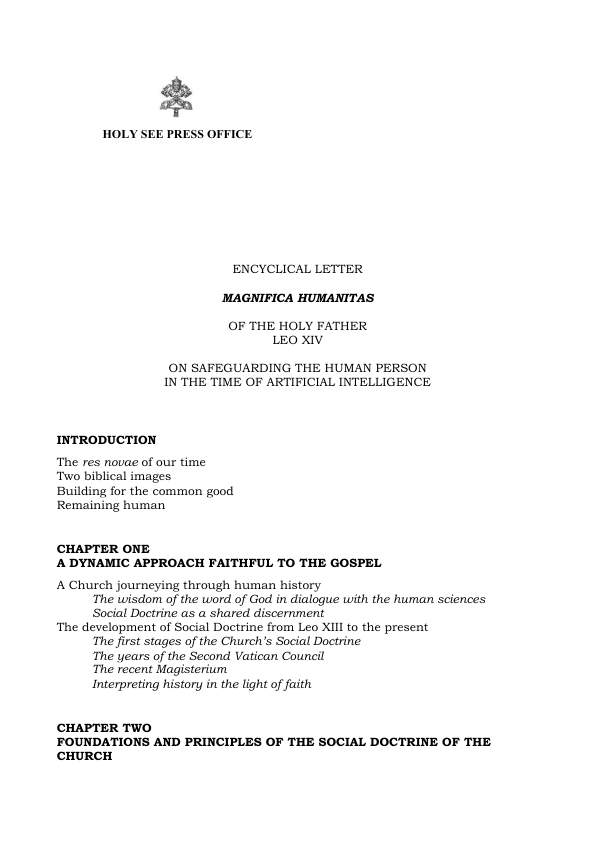
Magnifica Humanitas
🔗 **Source:** [Magnifica Humanitas](https://readwise.io/reader/document_raw_content/458584397)
> [!note]+ Document Notes
> ---
> tags: [artificial-intelligence, social-doctrine, human-dignity, technology-ethics, transhumanism, christian-humanism]
> author: Pope Leo XIV
> source: Holy See Press Office
> reference: https://readwise.io/reader/document_raw_content/458584397
> date created: {{date:YYYY-MM-DD}} {{time:HH:mm}}
> ---
> # 🏷️ Title: Magnifica Humanitas - Encyclical Letter on Safeguarding the Human Person in the Time of Artificial Intelligence
> ## 🧭 Table of Contents
> - [📝 Summary](#-summary)
> - [📖 Main Content](#-main-content)
> - [🗒️ Notes](#️-notes)
> - [📚 References](#-references)
> - [🗣️ Paraphrase](#️-paraphrase)
> - [📰 Digest](#-digest)
> - [🧪 Hypotheses](#-hypotheses)
> - [📊 Methodology](#-methodology)
> - [❓ Questions](#-questions)
> - [🔮 Future Research](#-future-research)
> - [💡 Implications](#-implications)
> - [🧠 Learning Styles Assessment](#-learning-styles-assessment)
> - [📊 Accessibility Assessment](#-accessibility-assessment)
> - [🌍 DEIB Assessment](#-deib-assessment)
> - [✅ Logical Validity](#-logical-validity)
> - [🛡️ DARVO Analysis](#-darvo-analysis)
> - [🎯 Conclusion](#-conclusion)
> ## 📝 Summary
> - **What happened**: Pope Leo XIV issued the encyclical "Magnifica Humanitas," addressing artificial intelligence through the lens of Catholic Social Doctrine.
> - **Why it matters**: First papal encyclical specifically addressing AI's implications for human dignity and social justice, establishing theological framework for technology governance.
> - **Key stakeholders**: Catholic Church, AI developers, policymakers, civil society, educators, families affected by digital transformation.
> - **Risks and tradeoffs**: AI promises healing and connection but risks dehumanization, inequality, and concentration of unprecedented power in private hands.
> - **Bottom line**: Humanity faces a choice between building a new Tower of Babel (prideful self-sufficiency) or rebuilding Jerusalem (collaborative work under God's guidance) in the AI era.
> ## 📖 Main Content
> The encyclical opens with two contrasting biblical images: the Tower of Babel and Nehemiah's rebuilding of Jerusalem. Babel represents prideful technological ambition without God, leading to confusion and dispersion. Jerusalem represents collaborative reconstruction under divine guidance, rebuilding relationships before stones.
> ### The "Res Novae" of Our Time
> Pope Leo XIV identifies AI as the defining "new things" requiring urgent theological reflection. Unlike previous technologies, AI's power is predominantly private and transnational, exceeding many governments' capacity to regulate. The document warns against both naive enthusiasm and unfounded fears, calling for spiritual discernment of underlying cultural roots.
> ### Social Doctrine as Living Tradition
> The encyclical positions itself within 135 years of Catholic Social Doctrine, beginning with Leo XIII's Rerum Novarum (1891). This teaching is not an "inert set of concepts" but a "living corpus of truth" that safeguards humanity's vocation to full and just life. The Church engages worldly matters because Gospel proclamation cannot overlook concrete human lives.
> ### Technology and the Human Person
> The document affirms technology as "profoundly human," linked to human autonomy and freedom. However, it warns against the "technocratic paradigm" where efficiency sacrifices human dignity. AI's unprecedented power raises questions about who controls it and how it serves the common good versus private interests.
> ### Fundamental Principles
> The encyclical reaffirms core Social Doctrine principles:
> - Human dignity as image of Triune God
> - Universal destination of goods
> - Subsidiarity (decisions at most local level possible)
> - Solidarity as shared responsibility
> - Preferential option for the poor
> ### Dangers and Responses
> The document identifies specific threats:
> - **Transhumanism/Posthumanism**: Narratives promising to eliminate human weakness rather than harmonious growth
> - **Digital Dependencies**: New forms of slavery requiring liberation
> - **Democratic Erosion**: AI's impact on truth, communication, and collective imagination
> - **Economic Displacement**: Need to preserve work's dignity amid automation
> - **Weaponization**: AI's military applications threatening peace
> ## 🗒️ Notes
> - The encyclical emphasizes that technology is "never neutral" - it takes on characteristics of those who design, finance, regulate, and use it
> - Warns against "Babel syndrome": idolatry of profit, uniformity neutralizing differences, reducing persons to data and performance
> - Calls for "evangelical language" avoiding humiliation while maintaining clarity and frankness
> - Identifies need for "digital literacy" and inclusion of most vulnerable in technological development
> - Stresses that true progress stems from "heart open to others, intelligence willing to listen, will seeking unity"
> - Proposes standards for discernment: human dignity, universal destination of goods, preferential option for poor, care for common home, peace
> ## 📚 References
> - [Rerum Novarum - Leo XIII (1891)](https://www.vatican.va/content/leo-xiii/en/encyclicals/documents/hf_l-xiii_enc_15051891_rerum-novarum.html)
> - [Gaudium et Spes - Second Vatican Council](https://www.vatican.va/archive/hist_councils/ii_vatican_council/documents/vat-ii_const_19651207_gaudium-et-spes_en.html)
> - [Laudato Si' - Pope Francis](https://www.vatican.va/content/francesco/en/encyclicals/documents/papa-francesco_20150524_enciclica-laudato-si.html)
> - [Fratelli Tutti - Pope Francis](https://www.vatican.va/content/francesco/en/encyclicals/documents/papa-francesco_20201003_enciclica-fratelli-tutti.html)
> ## 🗣️ Paraphrase
> Pope Leo XIV's groundbreaking encyclical addresses artificial intelligence as the defining challenge of our era, requiring the Church to apply its 135-year tradition of social teaching to unprecedented technological transformation. Rather than rejecting or uncritically embracing AI, the document calls for spiritual discernment guided by core Catholic principles of human dignity, solidarity, and the common good.
> The encyclical warns against two extremes: the "Babel syndrome" of prideful technological self-sufficiency that reduces humans to data points, and paralyzing fear that prevents engagement with AI's genuine benefits. Instead, it proposes the "way of Nehemiah" - collaborative rebuilding that puts relationships before efficiency and recognizes diverse voices as resources rather than obstacles.
> Central to the document is concern about AI's concentration in private hands beyond governmental oversight, potentially creating new forms of inequality and control. The Pope calls for governance structures that ensure AI serves all humanity, particularly the most vulnerable, rather than amplifying existing disparities.
> ## 📰 Digest
> The Catholic Church has entered the AI conversation in a major way with Pope Leo XIV's new encyclical "Magnifica Humanitas." This isn't your typical "technology is bad" religious response - instead, it's a nuanced theological framework for navigating AI's promises and perils.
> The Pope uses two biblical stories to frame our choices: we can build another Tower of Babel (prideful tech ambition without regard for God or neighbor) or follow Nehemiah's example (collaborative rebuilding that prioritizes relationships and includes everyone's voice). The encyclical sees AI as fundamentally human - a product of our God-given creativity - but warns it's never neutral, taking on the values of its creators.
> What's particularly striking is the document's focus on power dynamics. Unlike past technologies mainly controlled by governments, AI development is dominated by private transnational companies with resources exceeding many nations. This raises urgent questions about democratic accountability and whether AI will serve the common good or concentrate wealth and influence.
> For faith communities grappling with digital transformation, the encyclical offers practical wisdom: engage seriously with technology while maintaining focus on human dignity, work for just governance structures, and ensure the most vulnerable aren't left behind. It's a call for faithful, informed participation rather than fearful withdrawal.
> ## 🧪 Hypotheses
> - Catholic
Full text of this document omitted because this document is a PDF
[Download original file →](https://readwise.io/reader/document_raw_content/458584397), Magnifica Humanitas, Leo XIV, 01ksfzfc44b3ayeftq05tj7w9q.