Matt Is Not WordPress!
## Metadata
- Author: [[WPisLove]]
- Full Title: Matt Is Not WordPress!
- Category: #articles
- Document Note: ---
tags: [#WordPress, #OpenSource, #GPL, #Automattic]
- #legal
- #community
- #trademark
Author: [Author's Name]
Source: [Mattisnotwp.com]
Reference: [Link to article](https://mattisnotwp.com/?__readwiseLocation)
date created: {{date:YYYY-MM-DD}} {{time:HH:mm}}
---
# Title: [Title of the Note]
## Table of Contents:
1. [📝 Summary](#-summary)
2. [📖 Main Content](#-main-content)
3. [🗒️ Notes](#-notes)
4. [📖 References](#-references)
5. [🗣️ Paraphrase](#-paraphrase)
6. [📰 Newsletter](#-newsletter)
7. [✅ Action Items](#-action-items)
8. [🧪 Hypotheses](#-hypotheses)
9. [📊 Methodology](#-methodology)
10. [❓ Questions](#-questions)
11. [🔮 Future Research](#-future-research)
12. [💡 Implications](#-implications)
13. [🧠 Learning Styles Assessment](#-learning-styles-assessment)
14. [📊 Accessibility Assessment](#-accessibility-assessment)
15. [🌍 DEIB Assessment](#-deib-diversity-equity-inclusion-and-belonging-assessment)
16. [✅ Logical Validity](#-logical-validity)
17. [🔍 DARVO Analysis](#-darvo-analysis)
18. [🔍 SEO Evaluation](#-seo-evaluation)
19. [🎯 Conclusion](#-conclusion)
### References:
- Author's Name. [Link to article](https://mattisnotwp.com/?__readwiseLocation)
## 📝 Summary:
[Provide a brief summary or abstract of the main points or arguments presented in the source material.]
## 📖 Main Content:
[Elaborate on the main ideas, concepts, or arguments found in the source material. Use your own words and examples to deepen your understanding. Add personal insights, reflections, or connections with other notes or concepts.]
### 🗒️ Notes
- **Background and Context**:
- Explanation of the WordPress ecosystem’s dependence on open-source contributions.
- Description of Automattic’s role and influence over WordPress’s brand, including its trademark and GPL licensing agreements.
- **Automattic’s Perspective**:
- Automattic’s emphasis on protecting the integrity of WordPress’s branding and preventing unauthorized use of the trademark.
- Overview of Automattic's argument that misuse of WordPress branding by other companies dilutes its mission and confuses users.
- **GPL Compliance and Open Source Values**:
- Importance of GPL licensing within WordPress, aiming to keep the platform accessible and collaborative.
- Automattic’s position on companies adhering to GPL requirements, ensuring that all contributors to the ecosystem benefit from a shared commitment to open-source standards.
- **Community Response**:
- Reactions from the WordPress community regarding Automattic's enforcement of branding and GPL compliance.
- Mixed opinions from community members on how trademark enforcement impacts the spirit of open source.
## 📖 References:
- Author's Name. [Link to article](https://mattisnotwp.com/?__readwiseLocation)
## 🗣️ Paraphrase:
1. Automattic argues that enforcing WordPress's trademark is essential to preserve its open-source mission, preventing companies from exploiting the brand for profit without contributing back.
2. The GPL licensing system is highlighted as a cornerstone of WordPress, aimed at fostering a collaborative environment where all benefit from shared contributions, as seen in Automattic’s position on branding and compliance.
## 📰 Newsletter:
📰 **WordPress Community News: Trademark Enforcement and GPL Compliance Debate**
In recent developments, Automattic is reinforcing trademark protections within the WordPress ecosystem. This move sparks discussions around GPL compliance and the fine line between brand integrity and open-source collaboration. Automattic’s stance is reshaping expectations for corporate participation in WordPress, with new implications for companies navigating trademark use. [Catch up on the latest insights here!](https://mattisnotwp.com/?__readwiseLocation)
## ✅ Action Items:
- Reflect on GoDaddy’s open-source brand policies to align with evolving GPL expectations.
- Organize a team discussion on potential GPL and branding adjustments within GoDaddy’s open-source involvement.
## 🧪 Hypotheses:
1. If Automattic enforces stricter trademark policies, it could impact community dynamics and corporate contributions.
2. Stronger GPL compliance requirements may encourage more companies to contribute resources and time back into the WordPress project.
### 📊 Methodology:
- **Survey**: Poll WordPress contributors to understand opinions on brand enforcement and GPL compliance.
- **Case Study Analysis**: Review open-source projects with trademark enforcement to draw comparisons in community response and corporate behavior.
### ❓ Questions:
1. How does Automattic’s trademark enforcement influence other open-source ecosystems?
2. Can increased branding policies coexist with open-source values?
### 🔮 Future Research:
- Investigate long-term effects of trademark enforcement on community engagement within open-source projects.
- Analyze the sustainability impact of stricter GPL policies on WordPress’s ecosystem.
### 💡 Implications:
- Stronger brand protection within open-source environments may support project integrity but could alienate contributors who prefer a looser structure.
- Trademark policies in WordPress could set precedents for similar open-source projects balancing corporate involvement and community autonomy.
### 🧠 Learning Styles Assessment:
1. **Visual Learners**: Infographics on WordPress’s GPL guidelines and trademark usage.
2. **Aural Learners**: An audio summary discussing trademark and GPL implications.
3. **Verbal Learners**: Use of analogies to explain complex legal aspects of GPL and trademark compliance.
4. **Logical Learners**: Step-by-step breakdown of Automattic’s arguments for trademark enforcement.
5. **Kinesthetic Learners**: Interactive flowchart exploring GPL compliance steps.
### 📊 Accessibility Assessment:
- **Alt Text**: Ensure all images have descriptive alt text.
- **Keyboard Navigation**: Confirm article’s full navigability for keyboard users.
- **Contrast**: Enhance readability through high-contrast text for improved visual accessibility.
### 🌍 DEIB (Diversity, Equity, Inclusion, and Belonging) Assessment:
- **Cultural Relevance**: Include diverse perspectives on trademark usage across international markets.
- **Inclusive Language**: Check for gender-neutral terms.
- **Neurodiversity Support**: Use clear headers and bullet points to break down complex legal information for easier processing.
### ✅ Logical validity:
- **Sound Reasoning**: Automattic’s rationale for trademark enforcement aligns with protecting community standards.
- **Logical Flow**: Arguments are presented clearly, with evidence supporting Automattic's decision.
- **Fallacy Check**: No notable logical fallacies; reasoning maintains consistency.
🔍 **DARVO Analysis**:
- **Deny**: Automattic refutes claims that trademark enforcement is overreaching, citing brand protection as essential to open-source values.
- **Attack**: Automattic highlights potential harm to community integrity from companies exploiting the brand.
- **Reverse Victim and Offender**: Automattic frames itself as a guardian of community values, positioning itself as protecting open-source principles.
### 🔍 SEO Evaluation:
1. **Keywords**: Includes relevant keywords, e.g., “WordPress,” “GPL,” “trademark.”
2. **Meta Description**: Concise and includes keywords for SEO optimization.
3. **Headers**: Effective use of headers for organization and SEO improvement.
4. **Content Length**: Content is sufficiently detailed.
5. **Image Alt Text**: Ensure alt text is present for all images.
6. **Schema Markup**: Add FAQ schema for enhanced search visibility.
## 🎯 Conclusion:
Automattic’s trademark enforcement policy is reshaping the WordPress ecosystem, balancing corporate accountability and open-source freedom. By emphasizing brand integrity, Automattic reinforces its vision of a collaborative WordPress environment. This approach may influence how other open-source communities handle similar trademark and branding challenges, potentially fostering a more balanced ecosystem where contributors and companies coexist within a structured GPL framework.
- Document Tags: [[matt mullenweg]] [[wordpress]] [[wpdrama]] [[wp engine]]
- Summary: WordPress vs WP Engine Conflict Timeline and Its Impact on the Whole WordPress Ecosystem
- URL: https://mattisnotwp.com/
##### Matt is not WordPress!
*
*
*
*
*
*
*
Before I say anything, I want to express my deep appreiciation for Matt Mullenweg for creating WordPress and for bringing it to the position it holds today**.** His dedication over the past 20 years has significantly contributed to the growth and success of WordPress, which has become one of the most widely used content management systems globally. As of now, WordPress powers over 40% of all websites on the internet, an undeniable proof of its impact and reach. I am incredibly grateful for his work. Without WordPress, I would not have earned the title of “Techie” among my peers, even as a non-coder. I created my first website in 2007 using WordPress, and I’ve continued to rely on it ever since.
**However, it really hurts** to see what’s happening in the WordPress world right now, and it hurts even more to witness Matt behaving in a way I had never imagined. It seems like Matt is not ‘*T**he Matt***’ anymore, the visionary leader who once inspired countless developers and enthusiasts to embrace open-source principles.
Well, this could just be a phase in his life, and hopefully, it will pass soon…
##### What’s the fuss!
It all started in mid-September during WordCamp US, a key event in the WordPress community where developers, contributors, and enthusiasts gather to share knowledge and ideas around WordPress. During this event, Matt publicly called out WP Engine for not contributing enough to the WordPress community while profiting significantly from the free resources available on WordPress.org. He labeled **WP Engine a “cancer to WordPress”** and emphasized that “**WP Engine is not WordPress”** in an [official blog post](https://wordpress.org/news/2024/09/wp-engine/). This statement sent shockwaves through the community, sparking heated debates about the responsibilities of businesses that benefit from open-source projects.
I have been aware of WP Engine for quite some time—probably since 2013. I have always viewed them as a premium (read: costly) WordPress hosting provider, focusing primarily on high-net-worth individuals and businesses, much like how I see WordPress VIP or the premium hosting services offered by WordPress.com. However, it has never confused me into thinking it is an official part of WordPress.
Given our limited budget, investing in such expensive hosting options was not feasible for us. I considered them the iPhones of the WordPress hosting world, while I was more inclined towards affordable yet reliable alternatives, like Android devices. Our preferred platforms used to be HostGator and Bluehost (remember those multi-year unlimited shared hosting plans being offered for just a few dollars?). As I grew, I learnt to use rtCamp’s EasyEngine and other similar tools for the WP hosting management.
Still, I understand Matt’s perpective. Many users might mistakenly think that WP Engine is officially associated with WordPress, especially since they have often been referred to as ‘[WordPress Engine’](https://10web.io/wordpress-glossary/what-is-wordpress-engine/) by [others](https://www.americaneagle.com/platforms/wordpress) and [themseleves](https://wpengine.com/agency-directory/mastroke/) . Hence this potentially be viwed as [trademark violation](https://automattic.com/2024/09/25/open-source-trademarks-wp-engine/) . However, I also think that this was merely an attempt to formalize the verbal agreement, where as per Matt, [they asked WP Engine](https://automattic.com/2024/10/01/wpe-terms/) to contribute a percentage of their revenue back to WordPress, either through a trademark agreement or by allocating employee hours to work on core WordPress. It seems that WP Engine didn’t take this ask seriously. **But why?**
I believe it is a moral obligation for strong companies that benefit from the WordPress ecosystem to give back, whether through financial contributions or by providing code and resources to support its growth and sustainability.
I haven’t delved deeply into the matter, but from a high-level perspective, **it’s hard to understand why WP Engine isn’t one of the [top donors](https://wordpressfoundation.org/donors/) to the WordPress Foundation.** Other companies in the ecosystem, such as Bluehost, Hostinger, and Automattic (the parent company of WordPress.com), regularly contribute both financially and through development efforts that enhance the platform.
But **can we really demand 8% of their total revenue for this?** Can we be so specific with our demands while running a nonprofit open-source software initiative whose services are freely available for all?
**Personally, I think it’s wrong.**
As an open-source community, we can certainly encourage and mobilize for greater contributions, ideally without targeting specific entities. It might even be considered daring (though perhaps wrong, but for the right reasons) in some cases to publicly name and shame those who benefit greatly but contribute little. However, **making such contributions mandatory is not appropriate—not at all.**
I agree with Matt that WP Engine contributes very little directly to the official WordPress organization, but it’s essential to acknowledge their significant impact on the ecosystem in other ways. They do [invest](https://wpengine.com/blog/highlighting-wordpress-innovation-contribution/) in WordPress events, sponsorships, and educational resources. Additionally, they also develop and maintain various valuable WordPress tools such as Advanced Custom Fields (ACF), Genesis Blocks, Faust.js etc.
I resonate with Taylor Otwell, the creator of Laravel, who made a vague comparison between WP Engine and Laracasts in a YouTube [podcast](https://youtu.be/LoRc5A8QCmw?t=5540). Just as Laracasts supports the Laravel community without any formal revenue-sharing arrangements, WP Engine’s contributions to the WordPress community could be considered similarly.
While these demands were already causing tension, Matt started making even more controversial decisions that was about to impact millions of WordPress users in general who had no direct connection to WP Engine. First, he [banned](https://wordpress.org/news/2024/09/wp-engine-banned/) access to WP.org for all WP Engine associates. Then he [forked](https://wordpress.org/news/2024/10/secure-custom-fields/) (or many say [hijacked](https://news.ycombinator.com/item?id=41824852)) the highly popular WordPress plugin—Advanced Custom Fields (ACF)—which has always been promptly maintained and updated by the WP Engine team under the WordPress repository. This decision led many developers to question the future of their own listed tools as whether they could be the next ACF.
This had significant implications for other developers, prompting some to begin removing plugins from the WP repository because this ongoing event.
Later on, access to the entire WP.org site was restricted for any users associated with WP Engine by adding a login-lawsuit checkbox to WP.org.

This action has had a significant impact on regular users because millions have indirectly interacted with WP Engine through their free or pro plugins and other services. **In this 5-minute video, David McCan from WebTNG explains** the ripple effect of this decision.
Requiring this type of checkbox could have made sense if it were intended solely to restrict users with direct associations with WP Engine, such as employees or business partners. However, it is unjust for free users, customers, or regular community members to face consequences due to this situation.
In this context, I appreciate WP Engine for their professionalism. They made it clear that regular customers, agencies, users, and the broader community are not affiliates of WP Engine.
However, **neither Matt nor WordPress clarified this confusion.** It almost seems like they wanted the community to suffer for any association with WP Engine, which is quite troubling.
It would have made more logical sense if WP Engine had chosen to stop maintaining their multiple plugins in the WordPress repository, using the court case as a reason. While this could have painted WP Engine as the villain, it would have at least been a coherent response. Instead, how could WordPress decide to harm its own millions of users just to take a jab at WP Engine? This decision was indeed shocking for the WordPress community.
During the chaos, we noticed some seemingly bitter social media posts from official WordPress accounts. They sometimes appeared to mock users and blocked many developers and contributors, likely for speaking out about their recent decisions. Some of the responses were surprising, making it seem as though WordPress was acting like a troll, trying to be funny with sarcastic replies.
At times, I wondered **if someone had “Elon-ified” Matt**. (Just to clarify, I love and admire Elon Musk for his work, humor, and impact on humanity, but I don’t agree with his style of managing organizations. It often feels like he treats them as personal projects, making decisions without consulting others, reacting emotionally, and responding to critics aggressively.)
In the midst of all this turmoil, new information surfaced – WordPress.org is personally owned by Matt Mullenweg. In fact, during a recent court hearing, Automattic’s lawyers stated that **WordPress.org is not WordPress; it is solely Matt’s project**. This revelation is not only confusing but quite shocking for the entire WordPress community.
Is this why Matt seems so controlling over everything related to WordPress? Are all volunteers working on Matt’s personal project? Why hasn’t domain ownership been transferred to the WordPress Foundation, which holds the trademark and oversees all open-source work? This raises many questions and doubts among users who were unaware of all this until now.
But what if there is some legal trouble in doing so? In a response to Andy Fragen’s blog post on X, Matt mentions that he faced challenges with the IRS not recognizing WordPress code or the .org domain as valid activities for the Foundation.
Interestingly, while researching this topic, I found that the situation with domain ownership in Drupal is quite comparable. Dries Buytaert, the founder of the Drupal project, [retains full rights](https://www.drupal.org/association/copyright) to the domain names drupal.org and drupalcon.org, among others. To my surprise, unlike WordPress, the trademark “Drupal” also belongs to founder Dries Buytaert. Fortunately, there have been no controversies surrounding this within the Drupal community, as Dries has a proven track record of responsible management.
The situation might not have escalated as much if Matt had not taken everything so personally and allowed the WordPress team or board to manage it more patiently and professionally. This is reflected in poll results like this:
It’s disheartening to witness all this… and it’s still an ongoing saga.
However, I am confident that this challenging time will pass and that WordPress will rise again, as a whole.
WordPress was, is, and will always be an open-source project. There is no way it can become a closed project even if Matt wants so. Of course, he still holds all possible rights related to WordPress through his position and domain ownership—but if there ever is a conflict between ‘WordPress’ and Matt, the project will continue to exist for everyone—free of charge and in all its glory—regardless of these domains that are solely owned by him.
Why? Because…
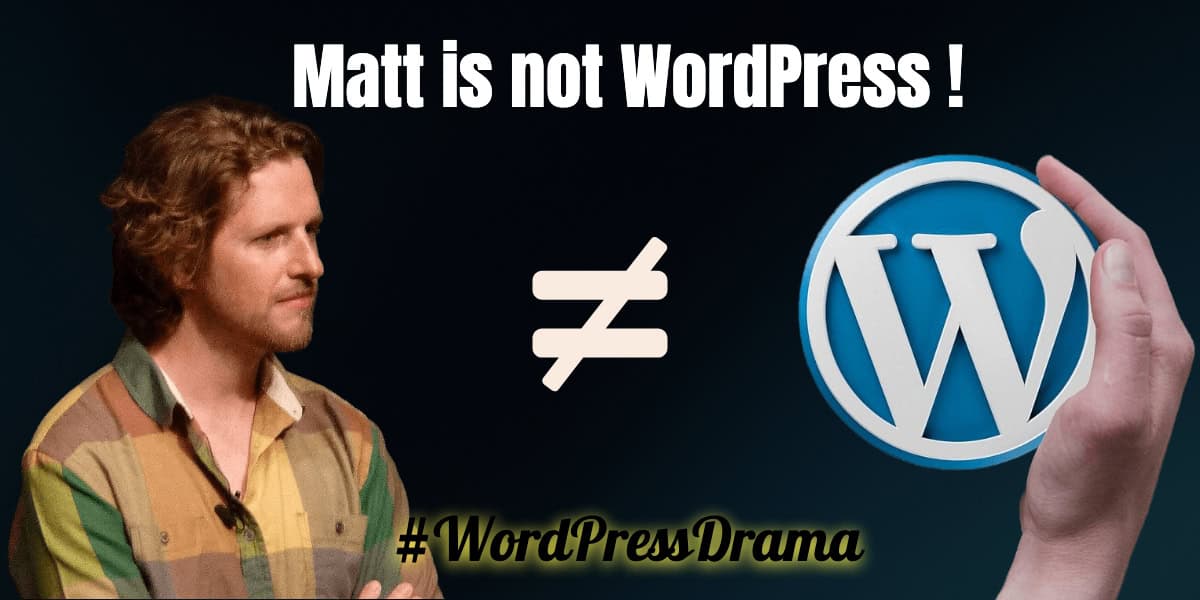
Matt’s image taken from Wikipedia and WordPress image taken from Pixabay. remixed using Pixelied.
While he gave birth to it, now it stands as an independent entity—not controlled by any specific person or certain group of members. In fact, **we are WordPress.** The ‘we’ includes everyone—myself, you, Matt, Automattic, WP Engine — or anyone who loves WordPress, cares for it, and contributes in some way, directly or indirectly. The power of open source comes from the community—a mix of people working together toward a shared goal—and that will continue no matter what individuals do.
However, even though WordPress is free to use, it requires substantial funding to operate and grow effectively… even though it is a shared resource, it still needs a dedicated team to make sound decisions. Ongoing contributions are essential for maintaining financial stability, and it is crucial that no single individual is solely responsible for major decisions.
Matt is already making significant contributions through his efforts. His company, Automattic, has more than [100 employees dedicated](https://wordpress.com/blog/2024/09/26/our-wordpress-contributions/) to the WordPress project full-time, which helps maintain its strength and drive innovation. I highly recommend that other major stakeholders adopt a similar approach. But iss the decision-making process in WordPress truly as collaborative as it needs to be? I have my doubts. There is a clear need for a unified team capable of making effective decisions without being swayed by personal biases or egos.
Overall, I believe that WP Engine should definitely increase its contributions while placing trust in the WordPress Foundation.
**This website is dedicated to all WordPress lovers, especially Matt Mullenweg**. While I believe his intentions are good, the current actions seem off course. I want him to take a moment away from his usual responsibilities and review this [#WordPressDrama timeline](https://mattisnotwp.com/wordpress-drama-timeline/) to understand how it started, how it’s progressing, and its [impact](https://mattisnotwp.com/who-gets-what-in-wordpress-drama/) on developers, contributors, and community members. Is this truly his vision for WordPress, or can improvements be made? It’s time for him to reflect on the situation with a fresh perspective.
##### Love for WordPress!

**Note:** While I have tried my best to remain unbiased and factual in my take on the ongoing WordPress drama above, I may have made some mistakes unintentionally. The same applies to other content on this website. If you have any feedback for me or new information for any page on this website, please update via [this contact form](https://mattisnotwp.com/contact/).
*
*
*
*
*
*
*, Matt Is Not WordPress!, WPisLove, 01jbmnycjcazak29859dtqwz04.